
The most fun way to learn something new everyday.
Joined August 2015
- Tweets 25,918
- Following 68
- Followers 3,531,603
- Likes 5,319
9,267 Photos and videos
Pinned Tweet

There are over 600,000 bridges in the US.
42% are over 50 years old.
7.5% are rated structurally deficient.
Here's what those numbers actually mean, and what engineers check:
STRUCTURAL RATING (0–9 scale)
0 = closed.
4 = poor condition, warrants monitoring.
7 = good.
9 = excellent.
A bridge rated 4 isn't about to collapse, it means repairs are needed and it's being watched.
WHAT GETS INSPECTED
• Deck condition (the surface you drive on)
• Superstructure (beams, trusses, arches carrying the deck)
• Substructure (piers and abutments in the ground and water)
• Channel and channel protection (erosion under the bridge)
HOW BRIDGES ACTUALLY FAIL
1. Scour – water erosion undermines foundations. #1 cause of US bridge failures.
2. Overload – trucks heavier than designed limits. Cumulative damage.
3. Fatigue – metal cracks from repeated stress cycles over decades.
4. Corrosion – reinforced concrete absorbs chloride from road salt. Rebar rusts, expands, concrete spalls.
THE I-35W MINNEAPOLIS COLLAPSE (2007)
Rated structurally deficient for 17 years.
Collapsed due to a design flaw in gusset plates – under-sized from the original 1967 design.
13 people died.
The inspections missed it because they checked the right things in the wrong way.
Inspection systems catch deterioration.
They're weaker at catching original design errors.
That's the gap engineers are still trying to close.
14
23
131
33,927
China alone holds 2,343 GW of renewable energy, nearly half the world total.
18
62
263
60,182
AI will not make engineers more productive.
It will make bad engineering faster.
Here's the pattern I see:
A junior engineer asks an AI to write the simulation code.
The AI writes something plausible.
The engineer doesn't fully understand it.
The simulation runs.
The results look reasonable.
The engineer ships it.
Nobody caught the edge case in the boundary conditions.
Nobody questioned whether the model assumptions were valid.
Nobody held the equations long enough to develop intuition.
Speed without understanding is not productivity.
It's technical debt with better syntax.
The engineers who use AI well are the ones who already know enough to catch its mistakes.
The ones who don't know enough use it as a crutch and call it skill.
AI raises the floor for bad engineers.
It raises the ceiling for great ones.
The gap between them is getting wider, not smaller.
Where are you on that spectrum? Be honest.
93
123
578
49,559
On December 27, 1968, Apollo 8 needed to fire its engine to leave lunar orbit and return to Earth.
If the burn was wrong, the crew would never come home.
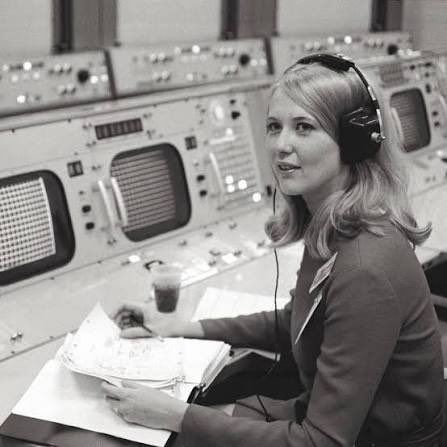
In Mission Control, a 25-year-old mathematician named Frances Northcutt, known as Poppy, had prepared the return-to-Earth calculations.
She was the first woman to work in Mission Control in a technical role.
When the burn data came back, something was off.
The numbers didn't match the expected trajectory.
She had 4 minutes to determine whether the deviation was within tolerance or whether Apollo 8 was in danger.
She ran the calculations by hand.
They were within tolerance.
She gave the go.
The crew came home.
She later went to law school and became a prominent civil rights attorney.
When asked about her time at NASA she said:
"We were just doing our jobs. Nobody thought it was unusual except the reporters."
The people who kept the astronauts alive were largely anonymous.
Most of them were young women with slide rules.
108
504
2,947
133,323
The Great Wall of China was built using "sticky rice mortar," a mix of sticky rice soup and slaked lime. This mortar has a high adhesive strength, sturdiness, and waterproofing capability and prevents weeds from growing. It is also strong enough to resist earthquakes and modern bulldozers.
10
19
177
31,482
The human nose can detect over one trillion different smells!
This incredible sense of smell is due to the complex network of olfactory receptors in our noses, which can distinguish between a vast range of odors and scents. In fact, our sense of smell is so sensitive that we can detect certain odors at a concentration of just a few molecules per billion!
This fact not only highlights the remarkable capabilities of the human body, but also the importance of our sense of smell in our daily lives, from detecting the scent of food to identifying potential dangers and hazards.
16
7
150
30,545
Sand is the world's second most consumed natural resource after water.
We use 50 billion tonnes of it per year.
For concrete. Glass. Semiconductors. Land reclamation.
And we are running out.
Not all sand is usable. Desert sand grains are too smooth and round, wind erosion makes them useless for concrete.
Construction requires angular sand from rivers, lakes, and coastlines.
Those sources are being depleted faster than they naturally replenish.
The consequences are already visible:
• Singapore has run out of local sand and imports it from Cambodia and Vietnam
• Several Pacific islands have lost beaches to sand mining
• Illegal sand mining syndicates operate in India, China, and West Africa
• The price of construction sand has tripled in some markets since 2015
The semiconductor industry uses ultra-pure silicon dioxide, the rarest, most processed form of sand.
One 300mm wafer requires sand that took years to purify.
The thing that builds our cities, powers our phones, and protects our coasts is a finite resource we treat as infinite.
No engineering solution is in wide deployment yet.
This is an unsolved problem.
69
186
977
82,315
Longest-lasting car brands
% chance of lasting 250,000 miles:
1. Toyota – 17.8% (3.7x average)
2. Lexus – 12.8% (2.7x)
3. Honda – 10.8% (2.3x)
4. Acura – 7.2% (1.5x)
— Overall Average: 4.8% —
5. GMC – 4.6% (1.0x)
6. Tesla – 4.6% (1.0x)
7. Chevrolet – 4.5% (0.9x)
8. Cadillac – 4.5% (0.9x)
9. Mazda – 3.6% (0.7x)
10. Ram – 3.5% (0.7x)
11. Lincoln – 3.4% (0.7x)
12. Ford – 3.1% (0.7x)
13. Dodge – 2.5% (0.5x)
14. Nissan – 2.4% (0.5x)
15. Subaru – 2.3% (0.5x)
16. Volvo – 2.2% (0.5x)
17. Infiniti – 2.1% (0.4x)
18. Mercedes-Benz – 1.7% (0.4x)
19. Jeep – 1.3% (0.3x)
20. Mitsubishi – 1.1% (0.2x)
21. Kia – 0.6% (0.1x)
22. Hyundai – 0.6% (0.1x)
23. Buick – 0.6% (0.1x)
24. Porsche – 0.5% (0.1x)
25. Chrysler – 0.5% (0.1x)
26. BMW – 0.4% (0.1x)
27. Volkswagen – 0.4% (0.1x)
28. Audi – 0.3% (0.1x)
29. Land Rover – 0.1% (0x)
30. Jaguar – 0.0% (0x)
31. MINI – 0.0% (0x)
32. Maserati – 0.0% (0x)
📌 Source: iSeeCars
45
57
481
83,722
9 engineering terms that get misused constantly, even by engineers:
1. TOLERANCE
Not how much something can vary. The specified acceptable range of variation. ±0.01mm means the part must be within 0.01mm of nominal, not that 0.01mm of error is fine.
2. SAFETY FACTOR
Not a margin for error. A multiplier applied to the design load. A safety factor of 3 means the structure is designed to hold 3x the maximum expected load.
3. REDUNDANCY
Not backup. Multiple independent systems that each perform the same function. True redundancy means the failure of one doesn't compromise the others.
4. EFFICIENCY
Not quality or speed. The ratio of useful output to total input. A 95% efficient motor converts 95% of electrical energy to mechanical work. The 5% becomes heat.
5. FAILURE
Not breaking. Any condition where a component no longer performs its intended function. A bridge that sags 2 inches more than designed has "failed" even if it's still standing.
6. LOAD
Not just weight. Any force applied to a structure, including wind, temperature change, vibration, and dynamic impact. "Dead load" is static weight. "Live load" is variable.
7. YIELD STRENGTH
Not the breaking point. The stress at which a material begins to deform permanently. Beyond yield, the part is damaged even if it hasn't fractured.
8. LATENCY
Not slowness. The time between a cause and its effect. A fast system can have high latency. A slow system can have low latency. They are not the same axis.
9. PROTOTYPE
Not a demo. A working version built to test specific unknowns. A prototype that tests everything tests nothing, it's just an expensive first unit.
11
35
221
37,723
Most people know the Titanic had too few lifeboats.
Fewer people know that one engineer tried to stop it. [1/7]
6
17
171
72,548
After the disaster, every passenger ship in the world was required to carry lifeboats for all aboard.
Carlisle's original proposal became international law.
Two years too late. [6/7]
1
37
17,686
The engineering solution existed before the disaster.
The business decision overruled it.
This pattern has a name: it happens before every preventable engineering catastrophe.
The engineer was right.
The decision-maker was wrong.
The passengers paid. [7/7]
4
7
86
18,102
If the other planet’s moons have its own name, what is the name of our moon?
885
17
405
132,087
355/113 (an extremely close approximation of PI) has a name, "Milü".
6
1
65
32,256