
Joined December 2022
- Tweets 390
- Following 35
- Followers 29
- Likes 435
15 Photos and videos






Esther retweeted

Pro Hamas and pro PFLP emblems and colours were seen amongst the Palestinian activists that decided it was a good idea to protest Edgware synagogue, London. Police have made arrests.
79
140
627
176,298
Esther retweeted

Jun 12
Baroness Foster of Oxton exposed how British taxpayers are being forced to fund the jihadists in the Middle East.
£101 million given to the Palestinians, at the expense of British taxpayers.
The British government knows the Palestinian Authority uses the money to pay terrorists and family members of suicide bombers as part of the infamous “Pay for Slay” policy.
They do not condition the aid on stopping terrorism because Keir Starmer cannot afford to be called “Islamophobic” by his Muslim voters or the Palestinian leaders. He appeases the jihadists by promoting terror against Jews.
This is not foreign aid. This is British taxpayers subsidizing the murder of Jews.
The Palestinian Authority has a formal system that rewards terrorists with monthly salaries — the more Jews they kill, the higher the payment. Suicide bombers’ families receive lifetime pensions. This is blood money, and Britain is helping to pay it.
139
2,504
5,541
66,591
Esther retweeted

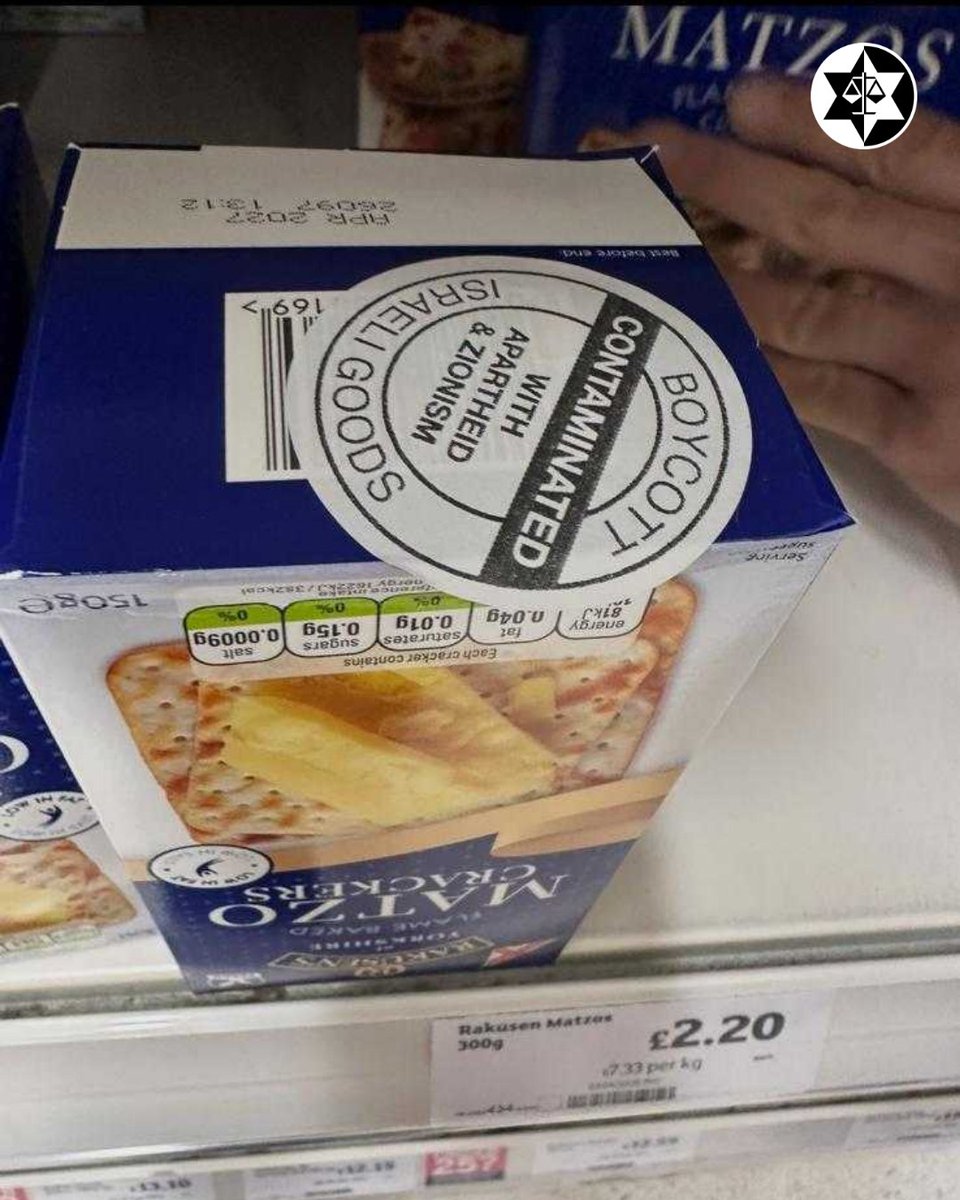
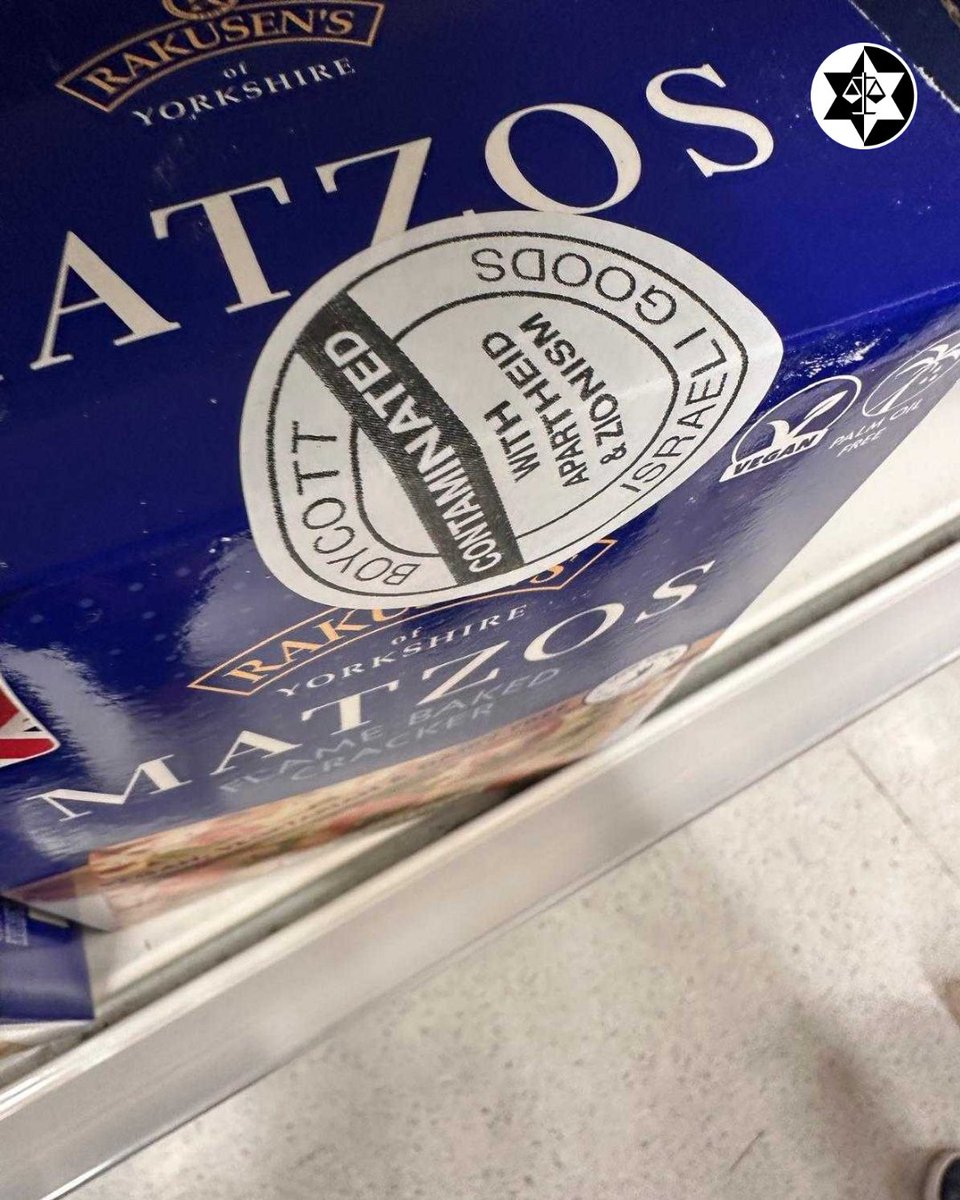
“Contaminated with apartheid and Zionism.”
The anti-Israel mob have officially stopped pretending this isn’t about targeting Jews.
Stickers calling to boycott Israeli goods were placed on a box of matzah in Sainsbury’s in Clifton, Bristol. However, the manufacturer – Rakusen’s – is based in Yorkshire.
This is not a product from Israel. This is a British kosher manufacturer, based in the north of England. Any pretence of this being about Israel has dropped.
They simply saw kosher products in a supermarket and decided that it was fair game to vandalise.
In the 1930s, Nazi propaganda used analogies which compared Jews to parasites, in an effort to dehumanise them and to justify the cleansing of German society from what was perceived to be an unhygienic, contaminating threat. Boycotts of Jewish goods and businesses were also an attempt to rid society of Jews. These stickers echo those disturbing ideas.
We understand that the store manager was alerted and that a police investigation is currently underway.
The targeting of Jewish goods, which bear no connection to Israel, in the name of activism only does one thing: it targets Jews.
68
542
1,948
44,796

Jun 10
Behold @SUTRBristol put out a notice at 6pm to combat the ‘far right’ and showed up masked and in black as instructed. They proceeded to be a nuisance in the park barking and performing circus tricks wasting police time until 10pm despite there being no ‘far right’ present.

1
45
Esther retweeted

Jun 8
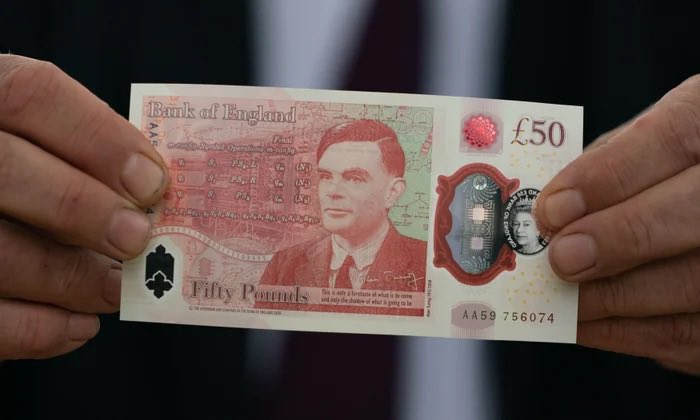
Do you want to know something interesting about the decision to remove Winston Churchill, Alan Turing and Jane Austen from bank notes?
Savanta, a market research company, was chosen to run a focus group.
The result of that focus group is that Churchill was “divisive”, Turing “an imperialist” and Austen “contentious and not representative”.
Yet that focus group had only 119 people in it.
And only one person called Turing “imperialist”. Someone who probably did not even know that he was not only instrumental in the Allies winning WW2 but was a gay man who was chemically castrated to “cure him”.
Turing was left fat, flabby and so unhappy that he carefully injected cyanide into an apple and ate it. He was found with half the apple by his side.
The Bank of England claims that the focus group was only part of its decision and it ran a broader public inquiry that favoured animals and flowers. Who did they ask? Primary school kids?
236
1,625
6,286
175,506
Esther retweeted

Here's my @Telegraph column, 'Zack Polanski wants a Jew register. What could be more sinister than that?'
telegraph.co.uk/news/2026/06…
I’ll say one thing for Zack Polanski: he knows a winning strategy when he sees one. When he became leader of the Greens last September, he spotted straight away that the secret to boosting the party’s poll ratings – and thus electoral success – was straightforward. Dump the green stuff and focus on Gaza.
There was a ready-made group of voters for whom Gaza is the only issue that really matters, waiting to be courted by any party which turned itself into the anti-Israel train. That group fell into the Greens’ arms when Polanski arrived on the scene.
He has been masterly in his care of them, not least in his skilful elision of being anti-Israel with being Jewish himself. It provides a much-used “get out of jail free card” when the Greens’ professed anti-Zionism slips into accusations of barely disguised anti-Semitism.
But even by Polanski’s standards, his demand that any dual British-Israeli citizen who has fought for Israel against Hamas in Gaza has their name listed on a database – a list, in other words, of bad Jews – is breathtakingly blatant.
The Green leader has signed an open letter sent to Home Secretary, Shabana Mahmood, and Foreign Secretary, Yvette Cooper, which calls on the Government to act in the name of “public safety and justice” to “track the movements of Brits who have served in the IDF” and “subject them to secondary screening where necessary at ports of entry”. Britons, that is, who just happen to be Jews.
Israel has national service, and all Israeli citizens (with the exception – which is deeply controversial in Israel – of some religious groups) are conscripted to the IDF at 18. Many have been called up as reservists when they are older.
Polanski is thus calling for a large proportion of British-Israeli dual citizens to be listed on a database. “Nobody wants to live next to a potential war criminal,” the letter organised by campaign group Declassified UK states. Presumably then, Polanski wishes to refuse entry to or deport any British-Israeli who has served in the IDF.
You will notice one obvious element to this demand. There are wars on every continent. There are accusations of war crimes in all those conflicts. But Polanski has said not a word about British dual citizens – or even those of sole UK nationality – who have fought in any of those wars, either ongoing or historic.
I wait, for example, for Polanski to demand a list of dual-nationality Britons who fought in one of the most brutal post-1945 conflicts, the 1971 Bangladesh war of independence. The nine-month conflict led to the death of up to three million Bengalis and the displacement of 10 million refugees into India.
This is not merely historic. War crime investigations are still going on. But no Israelis were involved (let’s be honest: no Jews). So Polanski is silent – not least because many new Green voters are drawn from those communities.
By signing the letter, Polanski doesn’t only demand that Britons who have fought in Gaza be put on a database. He goes far beyond that. The letter calls says “travellers with Israeli travel documents or arriving from an origin of Tel Aviv airport” should be subject to “potential secondary screenings at ports of entry”. For Polanski then, any Israeli should be marked out for special screening.
As for the allegation of genocide against Israel, it is, at the very least, hotly contested. But there is a well-founded allegation of genocide against the Chinese in its treatment of the Uyghurs. Does Polanski demand that any Chinese national arriving in the UK is deemed a suspected war criminal? Of course he doesn’t.
If Jews aren’t involved, neither Polanski nor any of his fellow Greens could give a damn. Polanski may be Jewish, but his party’s strategy could hardly be clearer.
333
446
1,529
72,632
Esther retweeted

So sick to death of this ridiculous ‘ethnic cleansing’ libel.
The only ethnic cleansing that has occurred in the entire Middle Eastern region is the ethnic cleansing of the Jews… by the Muslims.
102
946
2,200
34,339
Esther retweeted

Jun 3
I met Ben once. We were seated at the same dinner table.
At first, we did not recognise each other. Neither of us had any idea we would end up at the same table.
I asked him where I knew him from. He replied, “Ben, from Ben & Jerry’s.”
I smiled and said, “Nice to meet you. I’m Alex, Deputy Consul General of Israel to the Southeastern United States.”
This was at the height of the Ben & Jerry’s Israel controversy. I decided not to raise politics, out of respect for our gracious host. But I was also biding my time, because I suspected he would not be able to resist bringing it up.
About an hour into dinner, he came over to talk.
I saw it as an opportunity to understand where he was coming from, to explain a few things, and to keep the conversation as civil as possible. And to be fair, it was civil. He was pleasant, curious, and polite.
But quite quickly, I also realised he was completely ignorant about Israel.
He had never visited the country or the region. He had basic facts wrong, not only about the narrative, but about the foundations of the conflict itself: the makeup of the countries involved, the history, and the deeply rooted reasons each side sees the conflict the way it does.
For him, it was simple: there are people who appear oppressed, so someone must be the oppressor.
I do not blame Ben personally. He is a businessman who sells ice cream. Why should he be expected to understand Israel, the Middle East, or geopolitics?
The real problem is with those who treat him as an authority.
The media gives him a pedestal to speak about issues he clearly does not understand. And that is the absurdity of it all: taking an ice cream salesman and presenting him as a voice of moral clarity on one of the most complex conflicts in the world.

‘Some people say criticising Israel is anti-Semitic. I think that’s absurd’ - Ben and Jerry’s co-founder Ben Cohen tells @BarbaraGSerra @SkyNews
376
790
4,767
264,402
Esther retweeted

Jun 3
The Travelodge in Manor House is well used by the ultra orthodox community for when their relatives come to stay.
People checking in this week were horrified to find ‘Free Palestine’ on the TVs of their bedrooms.
Every day, there’s a new way to frighten Jewish people.
299
201
1,030
358,414
Esther retweeted

“Educate yourself, it’s not a fetish!”
So I did, and it is! 🤷♀️
144
464
2,887
24,741
Jun 3
Whatever you think of the ban, come on we have to agree this guy’s a chump. I mean he’s just stupid. He has a big stupid face and verbal diarrhoea without a word of sense between barks.
1
69
Esther retweeted

The hijab is not a fun symbol of “diversity” and “inclusion” for brands to commercialize. For millions of women across the globe, it is a symbol of purity culture, r*pe culture, and religiously mandated misogyny.
To glamorize it is to spit in the face of every woman in Iran who risks execution by removing it.
Watch my full discussion on the Unveiled Book Club with @ilvalues
37
499
1,352
14,895
Esther retweeted

May 30
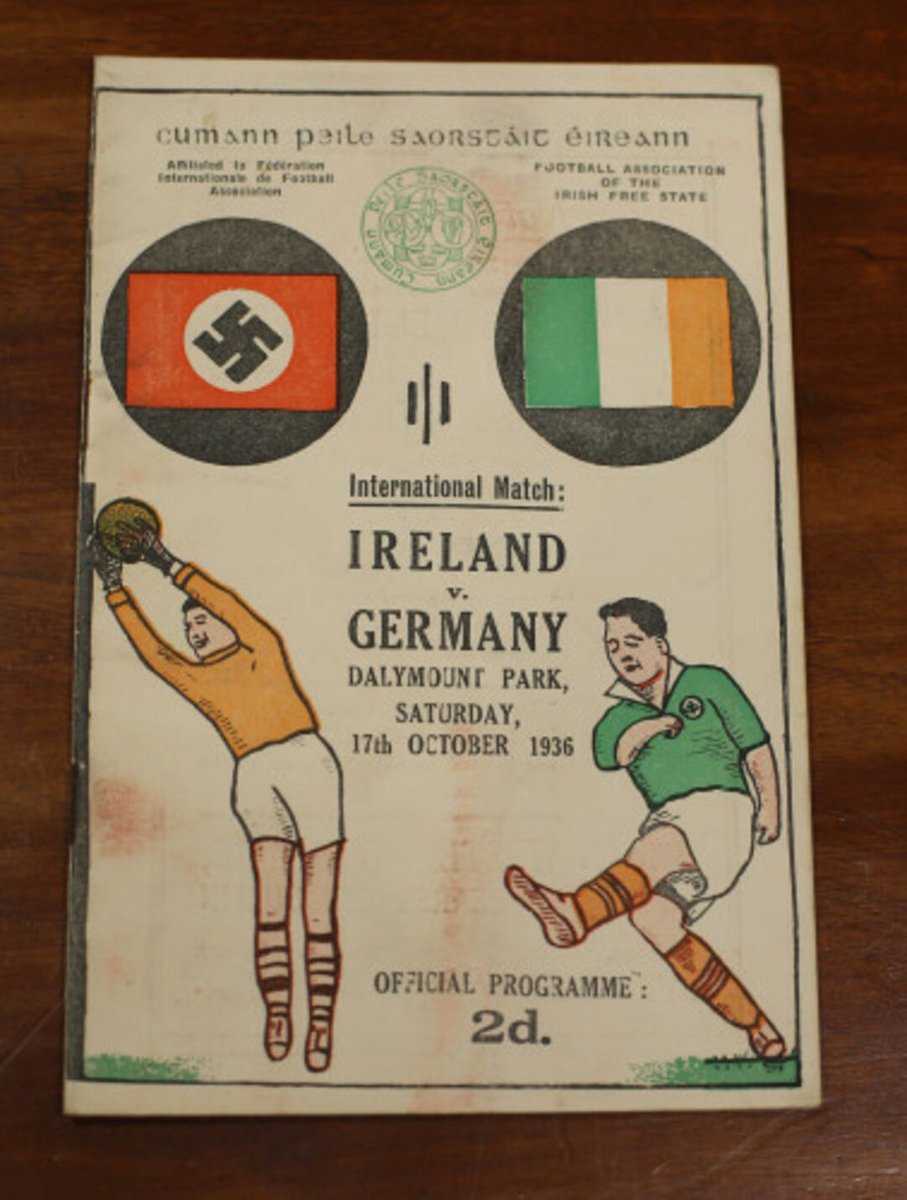
Ireland has played football matches against Nazi Germany, England, China, Qatar and the women’s team have played against North Korea.
That the only time there was pause to discuss a boycott was before a match vs Israel is very telling.
210
982
5,556
164,961
May 31
I am so bored of ‘but the suffragettes’ being used as an example of why violence is good. The suffragettes held back female suffrage and meant the suffragists were not taken seriously. Had they campaigned peacefully we could have had the vote earlier. 1/2
1
1
60
May 31
The gettes played right into men’s fave argument that women are too ‘hysterical’ for sensible choices. Bashing things up instead of debating ideas plays RIGHT into that. So no, they were not a good thing for women. Quite the opposite!
35
Esther retweeted

This is just absolutely brilliant.
170
1,134
6,813
162,847
Esther retweeted

Apr 29
.@zarahsultana I assume this is a different Zarah Sultana MP to the one who was recently filmed clapping along to loudspeaker chants for intifada, on a street in Surrey.
telegraph.co.uk/politics/202…
Apr 29

The stabbing of two Jewish men in Golders Green today is deeply shocking and a stark reminder of the very real danger antisemitism poses on our streets.
My thoughts are with the victims, their loved ones, and the wider Jewish community.
No one should be targeted because of their faith.
1,794
11,416
67,867
2,842,562