
Rethink marketing in an attention economy. A revolutionary book for subversive thinkers from @acroll and @emilyjaneross that is #JustEvilEnough.
Joined May 2018
- Tweets 47
- Following 278
- Followers 363
- Likes 106
11 Photos and videos







20 Feb 2025
Montreal book launch was fantastic. Next stop, San Francisco on Feb 27.
DM us for the invite if you haven’t seen it yet.
20 Feb 2025

Signed copy FTW. Congrats @acroll and @emilyross on the new book.
I’ve always like to think of myself as @justevilenough. can’t wait to dig in and find out if it’s true 😈

3
428
20 Feb 2025
Positioning in 2025:
- Have one clear disagreement
- with a widely understood part of an existing system
- that a lucrative market segment will agree
- is their dominant buying criteria.
Stop the word salad. What is your core disagreement?
150
18 Feb 2025
Nobody cares unless you make them.
Product is easy. Distribution is everything.
#justevilenough
18 Feb 2025

If you build it they will come is true…
Only if your product is an order of magnitude better than the competition and you have time to let distribution find you before your competition copies it.
Otherwise, you need to market and sell too.
190
EvilEnough retweeted

5 Nov 2024
Matthew Dicks (@MatthewDicks) is the author of the most practical and helpful book I’ve ever read on the skill of storytelling—Storyworthy. He’s also a record 61-time Moth StorySLAM champion, 10-time GrandSLAM champion, and lucky for us, he just published a new book, Stories Sell: Storyworthy Strategies to Grow Your Business and Brand, which teaches you how to use the power of storytelling in business.
My favorite part of Matt’s new book is his very actionable advice about how to be funnier. Who doesn’t want to be funnier? So I asked Matt to share his favorite advice here in the newsletter, and he generously agreed to cover seven of his favorite techniques—with tons of examples, simple frameworks, and ideas you can put into practice immediately.
I hope this post makes your work life just a little bit more fun.
lennysnewsletter.com/p/on-be…
7
7
121
23,528
EvilEnough retweeted
3 Nov 2024
Alistair Croll (@acroll) is the co-author of the best-selling book Lean Analytics, and a longtime product manager, entrepreneur, and startup advisor. He also profoundly changed my life over a decade ago by convincing me to start a company, funding it, and helping us exit to Airbnb. More recently, Alistar has been running events such as O’Reilly’s Strata, Cloud Connect, FWD50, and Startupfest, and is about to release a book with co-author Emily Ross that I'm very excited about: Just Evil Enough: The Subversive Marketing Handbook.
In our conversation, we discuss:
🔸 The role of subversive marketing strategies in most startups’ growth
🔸 11 specific subversive tactics
🔸 Examples of companies like Netflix, Airbnb, and Tesla using subversive tactics early on
🔸 A framework for scanning your market for opportunities
🔸 The importance of finding your “zero-day marketing exploit”
🔸 How to apply these tactics ethically without actually being evil
🔸 Much more
Listen now 👇
- YouTube: youtu.be/ywkwUvJlFn0
- Spotify: open.spotify.com/episode/5As…
- Apple: podcasts.apple.com/us/podcas…
Thank you to our wonderful sponsors for supporting the podcast:
🏆 @WorkOS — Modern identity platform for B2B SaaS, free up to 1 million MAUs: workos.com/
🏆 @_hex_tech — Helping teams ask and answer data questions by working together: hex.tech/lenny
🏆 @TrustVanta — Automate compliance. Simplify security: vanta.com/lenny
Some key takeaways:
1. Most startups focus too much on product features and not enough on distribution and go-to-market strategy. To succeed, you need to find an “unfair advantage” in how you capture attention and turn it into profitable demand. This is what Alistair and Emily call “just evil enough.”
2. Stop relying on generic growth hacks. Instead, adopt a mindset focused on “zero-day” marketing exploits—innovative, subversive tactics that are only now possible. Look for unconventional methods to change the game in your favor.
3. Encourage your team to embrace “disagreeable” thinking, where you challenge the status quo rather than following the herd. For example, aim for your ideas to elicit at least 50% disapproval—this can be a great indicator that you’re pushing boundaries and generating true interest. If everyone loves your idea, it might be too safe.
4. Alistair outlines 11 key tactics to grab people’s attention:
a. Turning bugs into features (e.g. Salesforce positioning their limited feature set as simplicity)
b. Buyer upgrade (e.g. selling to insurance companies instead of city councils for bridge inspections)
c. Access (e.g. Bumble’s founder leveraging her sorority connections for initial growth)
d. Bait and switch (e.g. Tupperware using dinner parties to sell products in postwar America)
e. Combination (e.g. Kraft combining powdered cheese with macaroni or 1-800 Mattress including mattress removal with a mattress purchase)
f. Arbitrage (e.g. early social media growth hacks using API data)
g. Aggregation (e.g. Busbud aggregating bus schedules to become the default destination)
h. Reframing (e.g. Tom’s of Maine positioning toothpaste as natural/unfluoridated)
i. Regulation (e.g. organ donor opt-out vs. opt-in policies in Germany vs. Austria)
j. Misappropriation (e.g. Netflix using the postal service as a high-latency network)
k. Sliding the window (e.g. normalizing previously taboo topics or behaviors)
5. To apply these tactics:
a. Spend time understanding your industry’s system and status quo
b. Temporarily think like a “supervillain” to brainstorm novel approaches
c. Use techniques like pre-mortems, counterfactuals, and embracing absurdity
d. Look for ways to change your value chain or industry dynamics
5
14
128
39,955
EvilEnough retweeted

3 Nov 2024
This #podcast episode from @lennysan has the best #marketing insights I’ve seen in years. @acroll really added a shit ton of value.
open.spotify.com/episode/5As…
3
14
5,481
1 Jun 2024
Great example of a Top Shelf strategy (one of the many tactics in the book, which, we’re thrilled to say, will be out later this year.)
justevilenough.com if you’re curious.
1 Jun 2024

Compare Hilfiger (an unknown designer) to the veterans of the veterans:
→ Ralph Lauren
→ Calvin Klein
→ Perry Ellis
1
1,257
12 Apr 2022
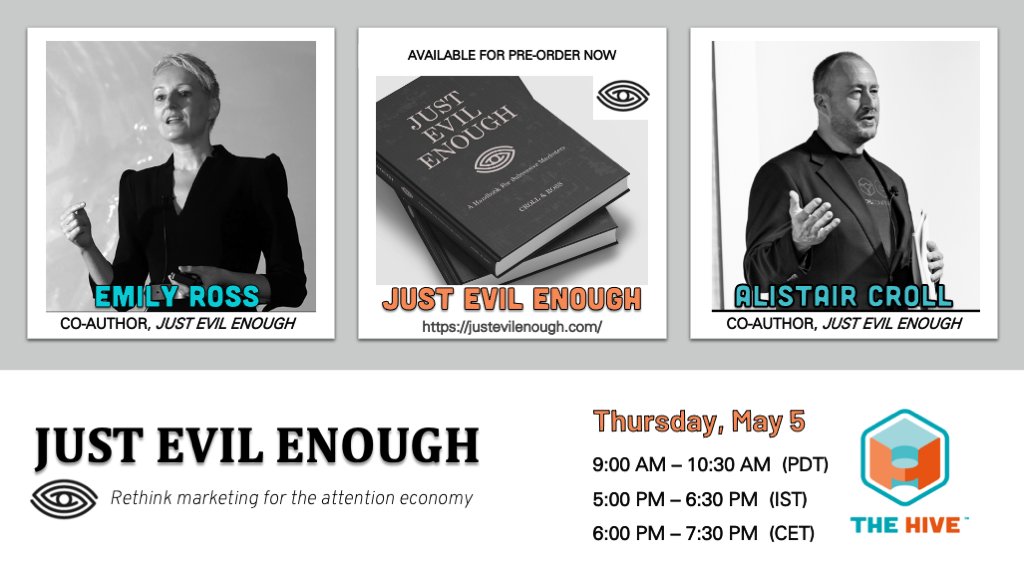
We're revealing some of the subversive tricks from Just Evil Enough with our co-conspirators at @hivedata on May 5. Join the dark side; we have cookies and plots and mischief.

"The biggest risk isn’t #technology, it’s #attention, and you’re going to need to break some rules to capture it." Learn from the folks who literally wrote the book on how to be "Just Evil Enough" on 5/5 with #hivedata co-authors @acroll @emilyross bit.ly/3xjfE0B
1
6
EvilEnough retweeted

22 Nov 2021
Amazing subversive marketing session at @Techstars today from Emily Ross and Alistair Croll. Practical and based on nearly 200 case studies, its taken from their upcoming book which we will definitely be buying, #JustEvilEnough . Oh also theres a website... :D
1
6
6 Oct 2021
Oooh... A treat for Machiavellian minions everywhere!
We just got around to publishing one of our absolute FAVOURITE interviews for the #JustEvilEnough book; @robpas took us on a subversive journey through the world of finance.
Read all about it...
justevilenough.com/subversio…
4
27 Sep 2021
How did the Chinese government turn regular shoppers into tax collectors (and scrape back one billion yuan in lost taxes) with this one simple trick?
Another day, another case study for the #JustEvilEnough handbook for subversive marketers...
justevilenough.com/case-stud…
3
22 Sep 2021
Do you remember Farmville?
We dug into the story for the #JustEvilEnough book.
The social game from Zynga exploited a novel vulnerability in Facebook's API to spread their faster than herpes across millions of users.
Read all about it!
justevilenough.com/case-stud…
2
21 Sep 2021
With over 180 case studies on subversive marketing already under our belts, we've decided to share a few of our favourites in advance.
Here we look @SKODAUK and how they used #reframing and #psychology to reignite their market and transform sales.
justevilenough.com/case-stud…
2
20 Sep 2021
As part of our research for the book, we interviewed New York Times best selling author and infamous behavioural scientist @JonLevyTLB about the art and science of influence.
Want to know what we learned?
#influence #justevilenough
justevilenough.com/case-stud…
2
3
18 Sep 2021
Diamonds are neither rare, nor scarce.
They are however the perfect example of subversive marketing - the focus of our #JustEvilEnough book, coming out later this year.
This post might have a familiar ring to it...
justevilenough.com/case-stud…
17 Sep 2021
How did a marketing genius steal one simple idea from the aviation sector to reduce the friction of Champagne sales?
"Push for Champagne was one of the many case studies (186 so far) that we dived into to research the upcoming #JustEvilEnough book...
justevilenough.com/case-stud…
6
EvilEnough retweeted

5 Sep 2021
Off to talk about subversive marketing and the @evilenough book for a few days in far flung places.
I missed airports.

2
1
18
EvilEnough retweeted

9 Aug 2021
Competitive Advantage hides in the gap between what’s normal and what’s possible
Agree or disagree?
8
1
7