
Joined April 2026
- Tweets 41
- Following 7
- Followers 4,692
- Likes 12
26 Photos and videos







Pinned Tweet

Jun 1
Farside's Public Release is now LIVE!
After a successful beta, we're shipping the full platform:
• Trade on autopilot on both @HyperliquidX and @dYdX
• Email Telegram notifications for performance updates and alerts
• A simplified grid bot experience with asset-specific leverage controls
• The Farside Points System: earn 1 point for every $100 in trading volume
210
615
2,719
717,955
Jun 12
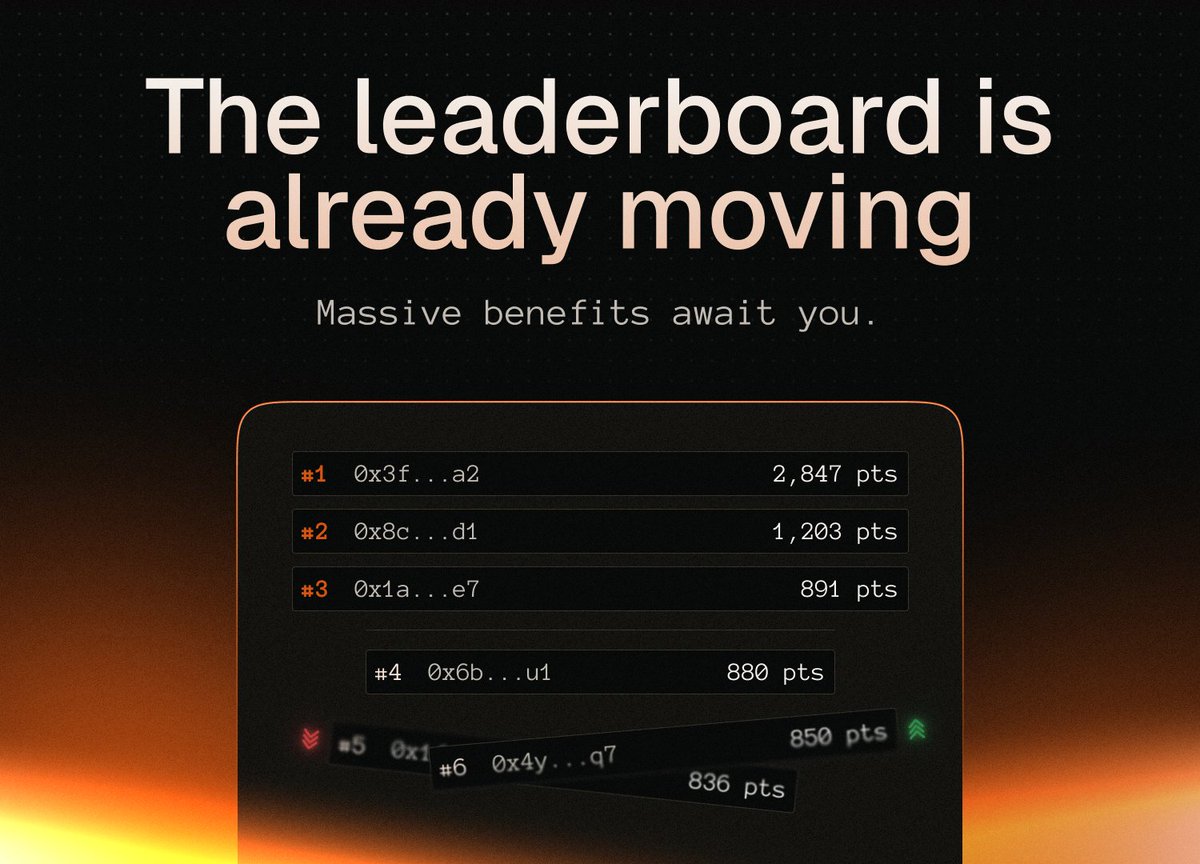
Do you know what separates the top of the leaderboard from everyone else?
It's simple...
The points system has no shortcuts or hidden mechanics.
Every $100 in trading volume earns one point.
Which means the leaderboard is won by whoever keeps their bots running the longest, not whoever trades the hardest in a single week.
Most traders who signed up haven't activated a bot yet.
That's the gap.
And it's growing every day.
If your bot is active, you're already ahead of the majority.
If it isn't, the distance between you and the top is getting larger right now while you're reading this.
Keep your bots running.
farside.app
6
5
33
5,674
Jun 10
Most trading bots make decisions for you.
You hand over capital, pick a risk level, and hope the system knows what it's doing.
Farside works differently.
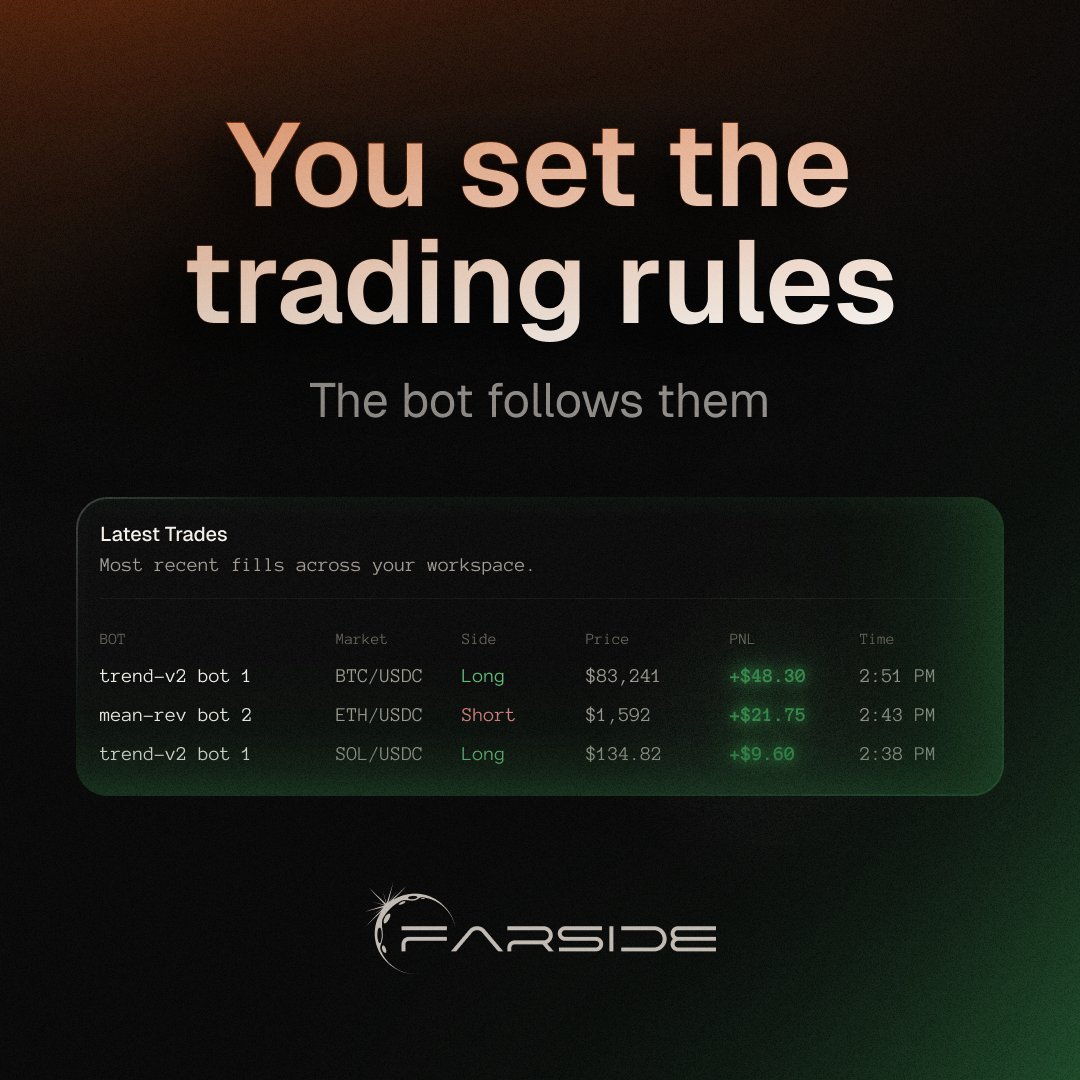
→ You define the strategy.
→ You set the risk constraints.
→ You decide the assets, leverage and conditions.
→ The bot executes within those rules and nothing outside them.
Automation doesn't have to mean surrendering control.
It can mean enforcing the decisions you already made before the market got noisy and you started second-guessing yourself.
Start now: farside.app
7
7
37
3,661
Farside retweeted
Something shifted for me when the first beta round filled faster than I expected.
I had targets in my head for how quickly we would get early users at @farsideapp, how long it would take to validate demand, what the curve would look like.
The reality moved faster.
And instead of feeling like a win, it made me more careful.
I mean, fast early demand can hide things.
It can make you feel more ready than you are.
And I have seen enough products launch too confidently and learn the hard way that users interact with things in ways you cannot fully predict during internal testing.
Two things I would do differently if I was starting over.
First, I would simplify the messaging earlier.
When you build something technical, there is a pull toward explaining how it works.
But what most users actually want to know is much simpler: what does the bot do, what risk controls exist, what happened this week, what do I need to know right now.
I over-explained the technical layer for longer than I should have.
Second, I would internalize earlier that hard launch is not the finish line.
You spend months building toward it and when it arrives there is a version of you that wants to exhale and call it done.
But the hard launch is actually where the real learning starts.
It is the first time users interact with the product in a live environment, under real conditions, with real stakes.
Everything before that is preparation.
What happens after is the actual test.

4
4
24
5,443
Jun 4
Farside's leaderboard is live and points are already accumulating.
Why you should start now:
→ 1 point per $100 traded
→ Ranking based purely on total points
→ Cumulative, so no resets throughout Season 1
This is your head start:
→ Beta testers: 100 bonus points already in your account
→ Waitlist signups: 50 bonus points (submit your wallet via form to claim)
To see your points, connect the same wallet you registered with on the exchange.
No rewards announced yet, but the leaderboard will be used for future campaigns and incentives.
The traders at the top when that happens will be the ones who started earliest.
Start now: farside.app
21
47
237
2,842,710
Jun 1
Farside's Public Release is now LIVE!
After a successful beta, we're shipping the full platform:
• Trade on autopilot on both @HyperliquidX and @dYdX
• Email Telegram notifications for performance updates and alerts
• A simplified grid bot experience with asset-specific leverage controls
• The Farside Points System: earn 1 point for every $100 in trading volume
210
615
2,719
717,955
Jun 1
And we're not stopping here.
Farside will keep expanding exchange connectivity and sharpening trading intelligence, while continuously refining the user experience.
Time to trade perps the better way: farside.app/
2
6
40
3,089
May 31
We didn't open Farside to everyone at once.
We brought users in gradually, watched how they traded, listened to what wasn't working, and improved it in real time.
That process is done.
Are you ready for what's next?
17
25
46
42,706
May 28
Paper trading will teach you a lot of things.
It'll teach you how a strategy behaves across different market conditions.
It'll show you where your entry logic breaks down, which setups have follow-through and which ones don't, how a grid fills in a ranging market versus a trending one.
For understanding mechanics, it's genuinely useful.
What it won't teach you is how you behave when real money is moving.
That's the part most traders find out the hard way.
You can paper trade for three months, run a clean positive expectancy, feel like you finally have a process that works and then go live and fall apart in the first two weeks.
Not because the strategy changed.
Because you changed.
The moment the number on the screen represents something real, everything feels different.
You second-guess entries you paper traded without hesitation.
You exit winners early because you want to lock in the profit before it disappears.
You hold losers longer because closing them makes the loss real in a way it never was on paper.
None of that shows up in paper trading because none of the psychological pressure is there.
You can override a paper trade without consequence.
You can close it, reverse it, pretend it didn't happen.
There's no cost to any of it.
So your behavior in paper trading is a clean version of yourself: disciplined, patient, systematic.
And that version doesn't always survive contact with a live account.
This isn't an argument against paper trading.
It's an argument against treating it as proof that you're ready.
The mechanics you build in paper trading are real and they transfer.
The confidence doesn't always transfer the same way.
Going live with the expectation that you'll perform exactly as you did on paper is where most traders set themselves up to fail.
What actually bridges the gap is starting live with size small enough that the emotional stakes are manageable: real enough to feel, small enough that a losing trade doesn't break your process.
Let the psychology develop the same way the mechanics did.
Gradually.
With room to make mistakes that cost something but don't cost everything.
Paper trading gets you to the starting line.
What happens after that is a different test entirely.
7
13
40
69,146
Farside retweeted

May 27
Building the bots was not the hard part when I started workig on @farsideapp.
The hard part was making people trust them.
Early on I think I assumed that if the system worked, I mean...
If the strategies executed correctly, if the signals fired at the right time...
That would be enough.
Users would see the results and trust would follow naturally.
That assumption was wrong.
What I kept running into during development was that functional and trustworthy are two completely different things.
A bot can execute perfectly and still feel like a black box.
And a black box, no matter how well it performs, creates anxiety.
Especially when real capital is involved.
So we had to rebuild the way we thought about the product.
Not just what it does, but what the user can see, control, and override at every step.
→ Transparency into signal flow.
→ Risk controls that the user sets, not the system.
→ Alerts when something changes.
→ Safe-mode logic that stops execution if conditions shift outside what was defined.
None of that is glamorous to build.
None of it shows up in a feature list the way a new strategy type or a new exchange integration does.
But it is what makes the difference between a tool someone uses once and a system someone actually trusts.
The lesson I took from this is that in trading, trust is the product.
Everything else is infrastructure.
19
21
48
13,846
May 25
Everyone's talking about Hyperliquid right now.
The token. The points. The airdrop.
That's not what's interesting about it if you want to run systems on it.
Here's what actually matters.
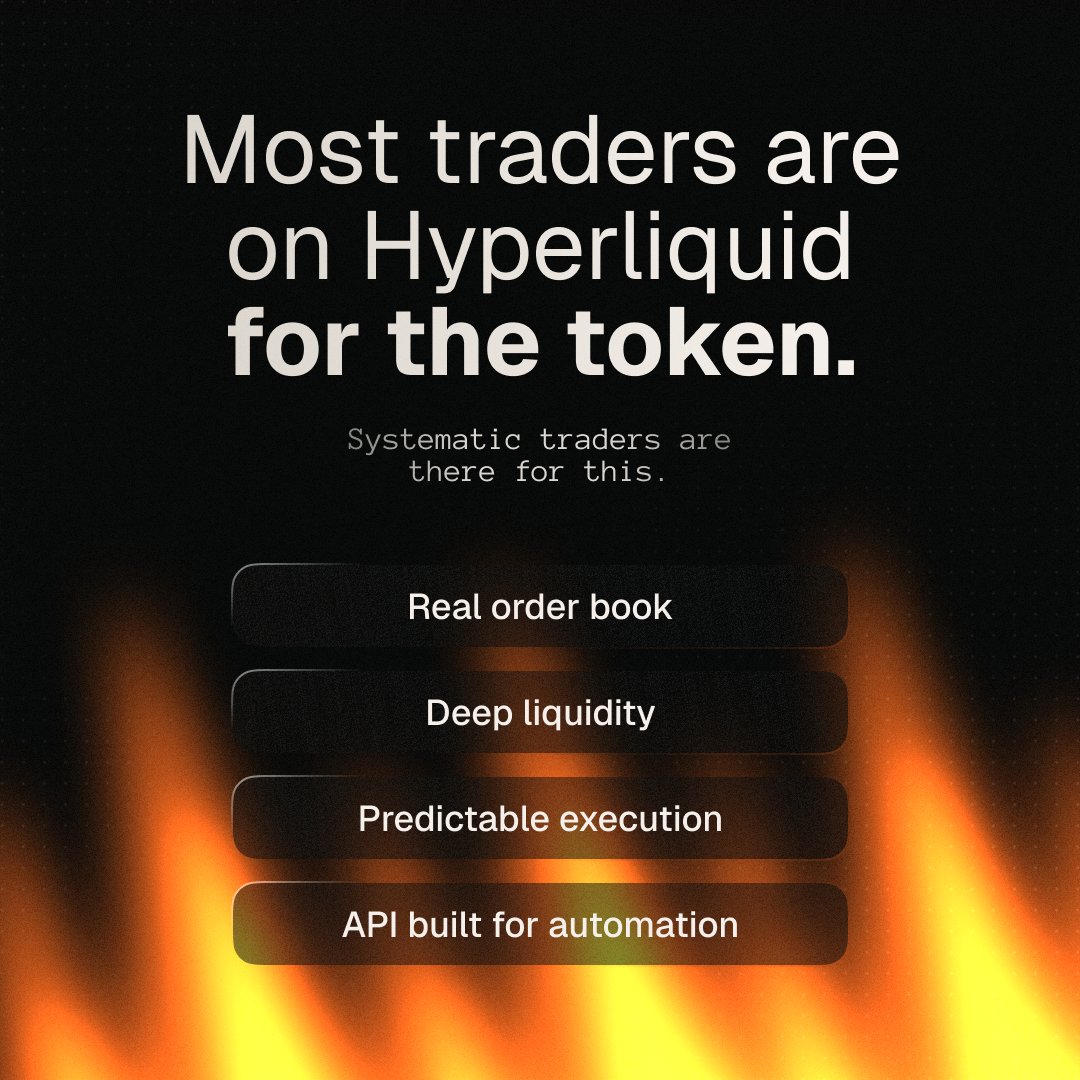
1. The order book is real
Not an AMM. Not a hybrid.
A fully on-chain order book with limit orders, market orders, post-only orders.
If you've ever tried to automate on an AMM-based DEX, you know what happens.
Slippage eats your edge before it has a chance to compound.
An order book changes that entirely.
2. The liquidity is deep enough to use
Most perp DEXs look fine until you actually try to run a strategy on them.
Then slippage becomes a problem.
- Fill quality deteriorates.
- The edge you backtested doesn't survive contact with real execution.
On Hyperliquid's major pairs (BTC, ETH, SOL), a retail-sized systematic strategy can execute without meaningful slippage impact.
That's rarer than it sounds.
3. The execution is predictable
This one is underrated.
Systematic trading needs consistency above everything else.
If fill quality varies session to session, your backtested expectations fall apart in live trading.
Hyperliquid's on-chain matching and deterministic settlement give you an environment that behaves the way you'd expect it to.
For manual traders, that's a nice-to-have.
For systematic traders, it's a requirement.
4. The API was built for automation
You can tell a platform wasn't designed for programmatic access the moment you try to use it that way.
Hyperliquid isn't that.
Clean documentation.
Built to handle continuous interaction.
Not bolted on as an afterthought, it's part of the core infrastructure.
Most traders are on Hyperliquid for the token.
Systematic traders are there for the order book, the liquidity, the execution consistency, and the API.
Those four things together, on a DEX, in one place: that's still not common.
That's why it's where serious builders are going.
23
54
115
310,297
May 22
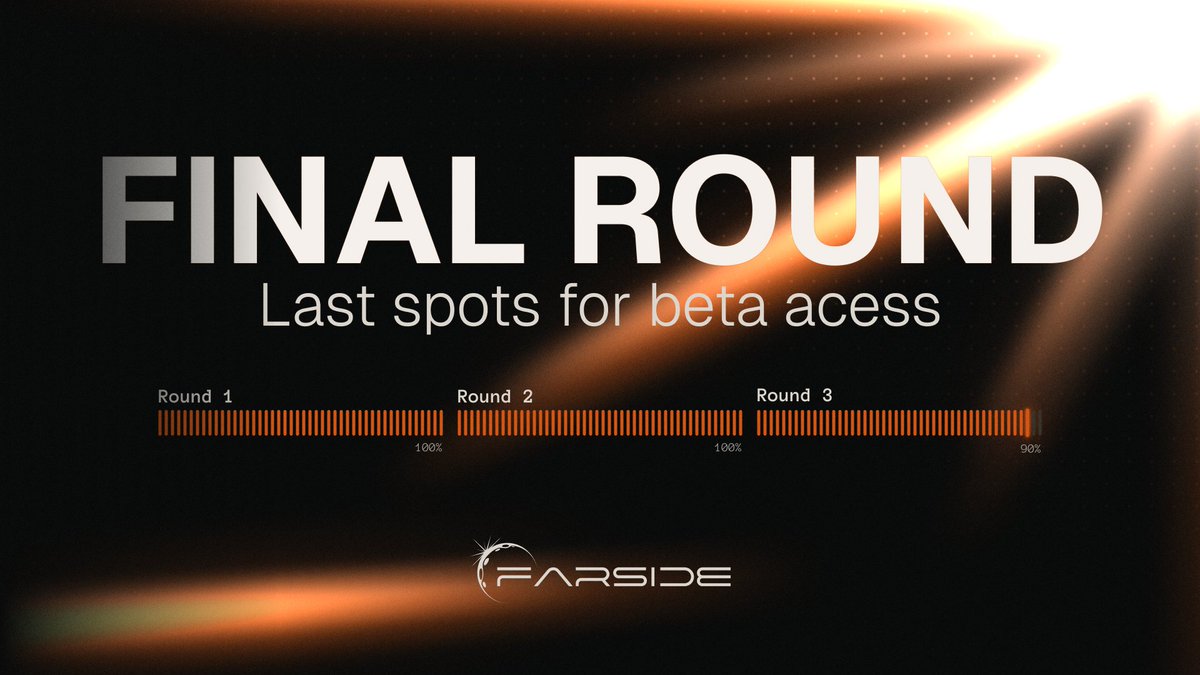
Final Round of beta spots just opened.
Get bonus points, early access and even more points.
This is your last chance:
farside.app
19
86
123
15,630
Farside retweeted
May 22
We almost launched Farside with a subscription model.
For a while, it was the plan.
Monthly tiers, bot limits, a premium layer on top.
It made sense on paper: predictable revenue, clear upgrade paths, the kind of structure any SaaS playbook would tell you to build.
We had the pricing tiers drafted.
We were close to committing to it.
Then I started sitting with the question of who we were actually building for.
Serious traders don't think in monthly plans.
→ They think in trades.
→ They think in execution, in fees, in what a position costs to run.
The moment I framed it that way, the subscription model started feeling like something we'd built for ourselves, not for them.
There was also something uncomfortable about it that took me a while to name.
A subscription gets paid whether you have a good month or a bad one.
That means the platform's incentive is to keep you subscribed, not to help you trade better.
I didn't want to build something with that misalignment baked in from day one.
So we scrapped the tiers and moved to a volume-based fee model instead.
You pay when you trade.
We make money when you're active on the platform.
If the product isn't good enough to keep you trading, we don't get paid.
It was a harder model to build around.
But it was the only one that felt honest about what we're actually trying to do.
The lesson for me wasn't really about pricing.
It was about making sure every structural decision aligns with the user you're building for, not the business model you're most comfortable with.
Follow @farsideapp and stay close.

19
14
36
13,565
May 20
The third round of beta spots is gone.
If you didn't get access this time, keep your eyes open.
The door is closing soon.
7
13
35
89,691
May 19
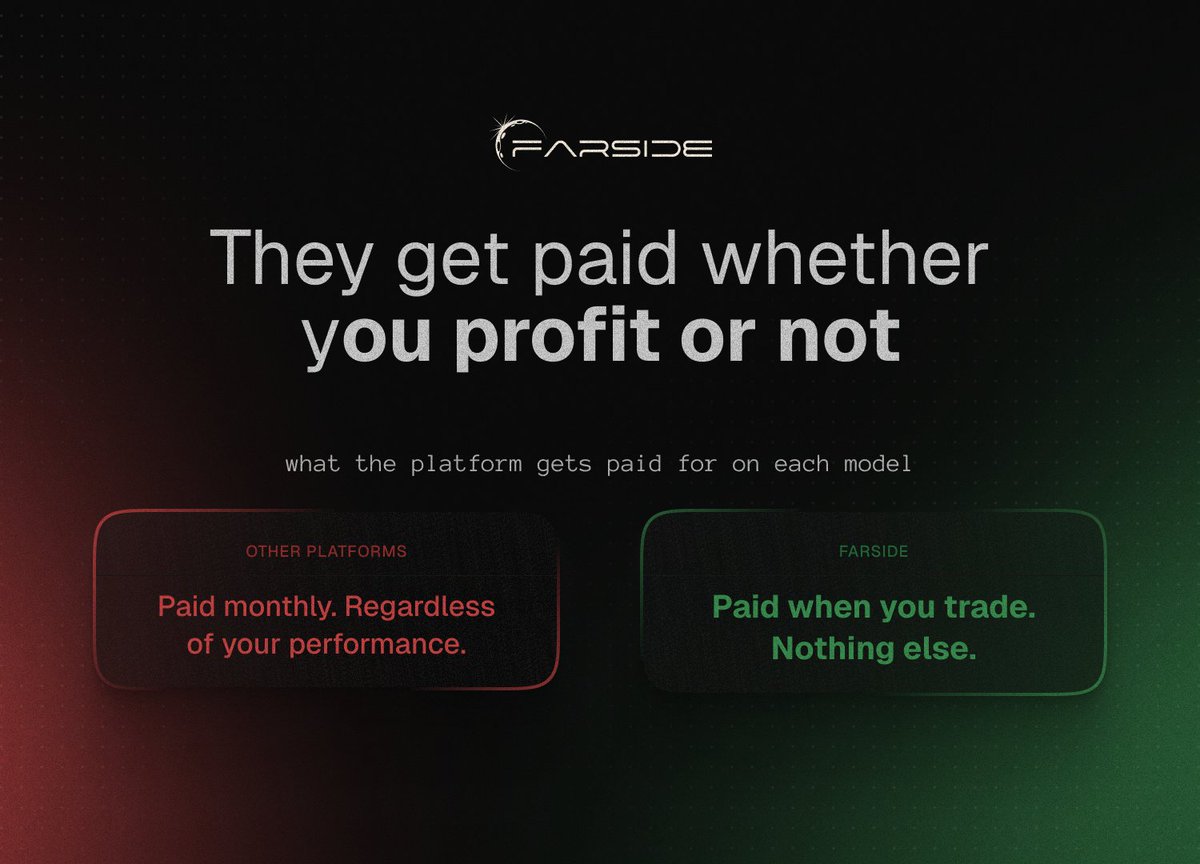
Most trading bots charge you monthly.
Think about what that actually means.
The platform gets paid in January whether you had a good month or a terrible one.
It gets paid in February the same way.
Your performance has no relationship to their revenue.
None.
That's not a minor detail.
That's a fundamental misalignment between what the platform is optimizing for and what you need from it.
When revenue comes from subscriptions, the metric that matters is retention.
- Keeping you subscribed.
- Keeping you engaged with the product.
- Sending you enough notifications, signals, activity to justify the monthly charge.
Whether any of that activity translates into better trading outcomes for you is a secondary concern at best.
The uncomfortable version of this: a subscription-based bot has no financial incentive to make you a more disciplined, less active trader.
Because a more disciplined, less active trader might start questioning whether they need to keep paying every month.
Pay-per-trade changes the structure entirely.
The platform makes money when you trade.
If the product isn't good enough to make you want to use it, it doesn't get paid.
There's no subscription cushioning bad months.
No recurring revenue regardless of whether the product is working for you.
It's a simple idea.
The platform's incentives should point in the same direction as yours.
We built Farside on transaction fees for exactly this reason.
We get paid when you trade, not before.
We still have some beta spots left:
farside.app
18
27
50
73,001
May 18
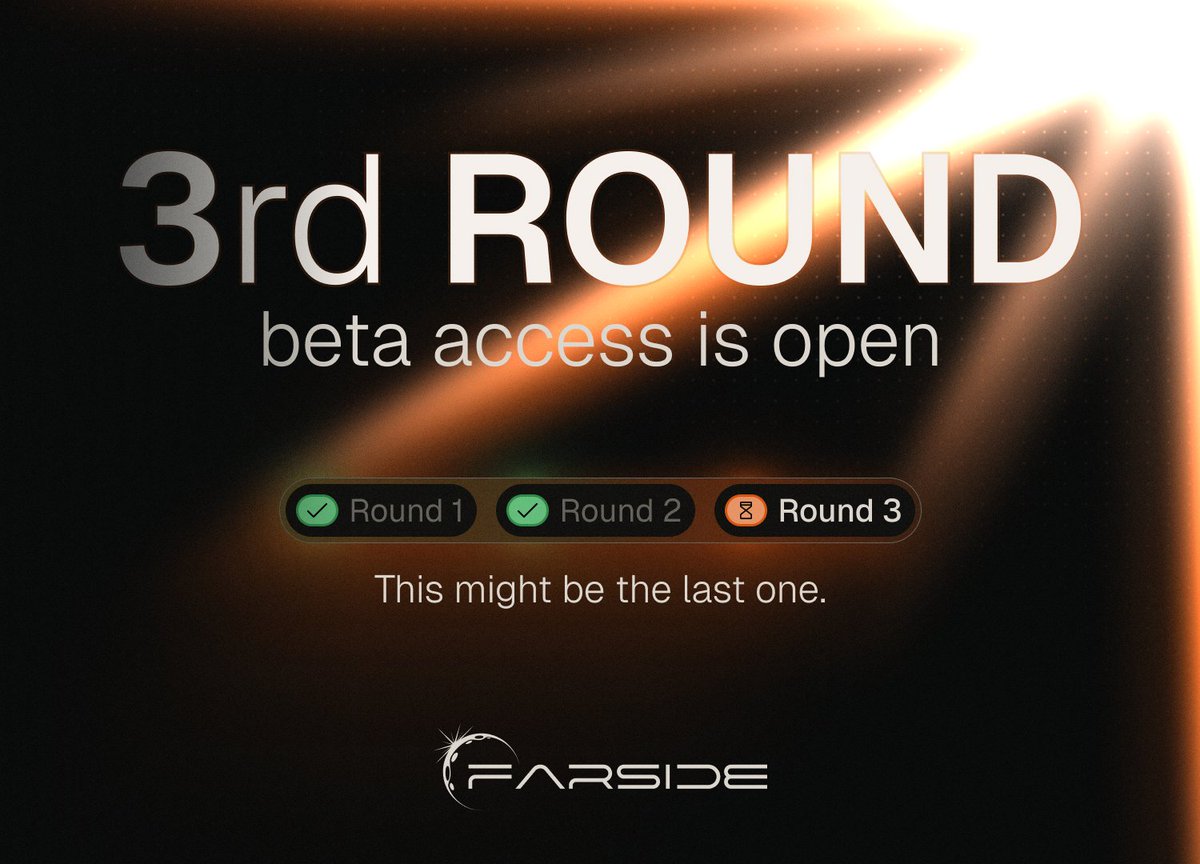
Round 3 of Farside beta spots just opened.
We haven't confirmed this is the last one. But it might be.
If you've been sitting on the fence, here's what beta testers get that nobody else will:
→ Bonus points on top of regular accrual
→ The longer your bot runs, the more points you stack
→ Early access before the platform opens to everyone
Three rounds in. Each one filled faster than the last.
Get your spot now: farside.app
16
28
100
86,231
May 15
The second round of beta spots is gone.
Went faster than the first one did.
Round 3 isn't far.
Follow @farsideapp and you'll know the moment it drops.
14
26
71
84,891
May 15
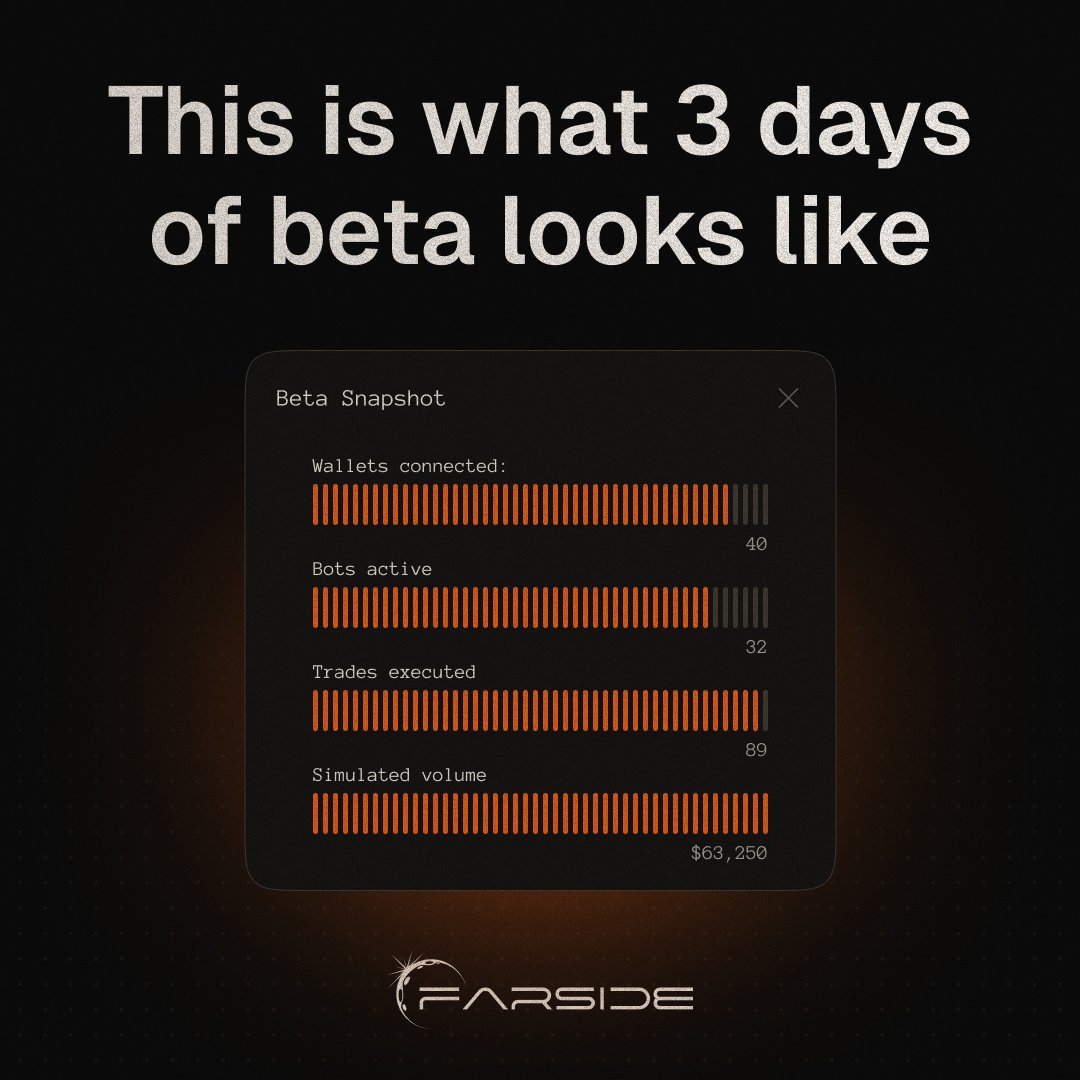
A few days into the beta.
Here's what's actually happening on the platform:
- 40 wallets connected.
- 32 bots running.
- 89 trades executed.
A few things stood out when we looked at the data.
1. BTC is where everyone started
Not surprising. When you're testing a new system for the first time, you go to the asset you know best.
Makes sense.
BTC is liquid, predictable enough to read, and the right place to see if your strategy behaves the way you set it up.
2. The market is slightly more bearish than bullish
54% of trades were short.
46% long.
We're not reading too much into a three day sample, but it's an interesting signal.
The traders who signed up for this beta aren't blindly bullish.
They came in with a view and they're running it.
This is just the beginning.
Keep an eye on @farsideapp for more updates!
17
30
106
73,254
May 13
The trading strategy you're running right now...
Did you choose it because it fits the market, or because it's the one you're most comfortable with?
Most traders never ask that question.
They find something that worked, they stick with it, and then they wonder why it stops working when conditions shift.
Here's how to actually think about the three main ones.
1. Trend following
You're riding momentum.
Price is moving in a direction, you get in after it confirms, and you stay until the move runs out.
This works when there's a real narrative behind the move: macro flows, a sector catching a bid, something with actual force behind it.
The entry always feels uncomfortable because you're buying something that's already gone up.
That's the whole point.
Where traders get hurt with this: using it when the market is just bouncing around.
You see a move, you enter, it reverses.
You see another one, you enter again.
You get chopped apart before any real trend ever develops.
2. Mean reversion
You're fading the move.
Price has pushed too far, too fast, and you're betting it comes back.
Works well when the market is stuck in a range: bouncing between levels, no real directional conviction, just noise.
You sell the top of the range, buy the bottom, collect the middle.
The trap here is running this in a trending market.
Every pullback looks like a reversal.
None of them are.
You keep fading a move that just keeps going and each entry feels more justified than the last because price has moved even further from where you expect it to be.
3. Grid trading
You set a series of orders above and below price at fixed intervals.
The market moves up and down, orders fill on both sides, you capture the oscillation.
This is genuinely useful in a sideways, low-conviction market where price is active but not going anywhere.
The problem is when price breaks out of your range cleanly and doesn't look back.
One side of your grid fills completely, you're holding a position, and the market keeps moving against you.
It feels passive. It isn't.
So look at what the market is doing before you decide what strategy to run.
- Strong directional move with something behind it: trend following makes sense.
- Market bouncing between levels with no clear bias: mean reversion fits better.
- Flat, noisy, contained: grid can work.
The issue isn't that traders don't know these strategies.
It's that most people pick one and keep running it regardless of what the market is actually doing.
Conditions change.
The approach has to change with them.
Follow @farsideapp for more.
12
25
60
81,723