
FI Calc is a powerful and flexible retirement calculator that simulates retirement plans using historical data. Free, privacy focused.
Joined May 2020
- Tweets 107
- Following 154
- Followers 303
- Likes 71
7 Photos and videos

FI Calc retweeted

8 Apr 2025
The thing about these tariffs that people miss isn't so much whether they cause inflation – that part's actually still up for debate.
The real problem is how they put the brakes on economic growth. They essentially shrink the economic pie for everyone.
When imported goods become more expensive (think of everything on Walmart shelves), consumers have less to spend elsewhere, reducing demand across the economy.
So what happens next is a domino effect – when people have to spend more on the basics, they start cutting back on things like vacations, restaurant meals, and all those little extras.
That money that would've been circulating through the service economy just disappears.
And when everyone's tightening their belts like this across the board, the whole economy starts to contract.
Normally, this is when the Fed would swoop in to lower rates, in order to spur spending. But in an inflationary environment, they can't and shouldn't.
The math just doesn't add up favorably here – what consumers lose through tariffs usually far outweighs any job gains in protected industries.
When you look at the total picture, the economy actually shrinks because people simply have less money to spend, and consumer spending is what really drives our economy.
Meanwhile, the Fed's stuck between a rock and a hard place with inflation still running hot, so they can't rush to cut rates.
Add in the government tightening its belt with spending cuts, and we're looking at some pretty rough economic waters ahead – probably until at least 2026.
4
9
30
3,288
A huge update to FI Calc was just released. Read more about it on Reddit: reddit.com/r/leanfire/commen…
2
10
1,101
Did you know that I've made a couple of other mini-calculators? Check them out at calculators.moolah.app/
2
736
In addition to exciting updates to FI Calc, I'm creating a new companion app that should be useful for folks who are planning retirement. It's not a calculator. Excited for you all to see it.
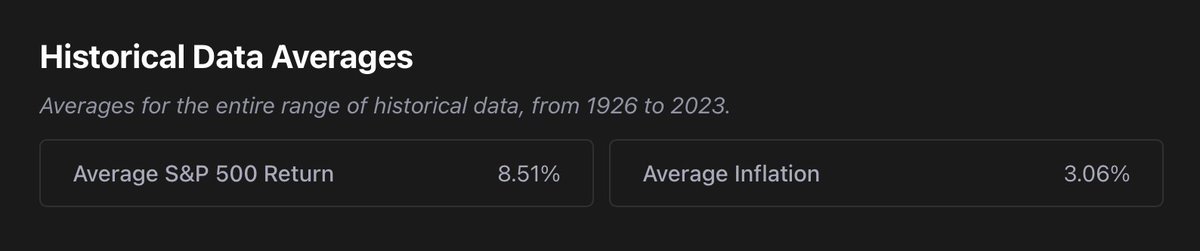
Next FI Calc update: historical data averages. Try it today at staging.ficalc.app
2
5
780
The full data set may have lower average inflation than you'd expect. This is because Shiller's data set dates back considerably further than nearly all sources that average inflation. According to Shiller, inflation was lower between 1871-1910's, which brings down the avg.
1
3
486
If you think that lower inflation is unrealistic for the future, you can limit the data set used in the calculation.
I am also working on a feature that will allow you to tweak these values to try out more optimistic or pessimistic data. i.e.; simulating 1% higher inflation.
3
426
The consensus leans heavily yes. What I plan to do is show a prominent donation link in the place of where an ad would go, and see how that performs over the next month. Then I'll swap that with an ad the following month to see how that performs, and compare the two.
1
275
New data visualizations are in the works. See a preview at staging.ficalc.app
Why switch? The old ones smoothed over some of the details of the distribution, which I never liked. Histograms represent the data much, much more accurately.
Let me know what you think!
2
1
7
903
Thanks to everyone who has messaged me product suggestions. A few notable updates are in the works based on recent feedback!
If you ever have a question, comment, or feature suggestion, feel free to DM me here or email me at hey(at)ficalc.app
4