
Researcher, speaker, & writer of Somalia’s security, clan politics, ideologies, Also practicing Licensed professional clinical counselor in MN.
Joined September 2010
- Tweets 17,589
- Following 562
- Followers 4,410
- Likes 2,234
1,770 Photos and videos






Pinned Tweet

20 Mar 2025
Deedimayno Geerida, mana ogolin Gumaysi.
We do not refuse death, and we do not accept colonialism. War songs as members of the army leave Mogadishu to frontlines.
10
21
137
31,229
1244
On the Spirit of Natality, the Integration of the Unconscious, and What Somalia Must Learn from Both: Part I
Liban began the day with what Hannah Arendt (1958) called the spirit of natality — the human capacity to initiate something radically new, to introduce a rupture into the causal chains of the past. As Arendt observed, “the new always happens against the overwhelming odds of statistical laws… the new therefore always appears in the guise of a miracle” (p. 178). It was in this spirit that Liban resolved to start fresh.
Yet almost immediately upon that resolution, a counterforce seized him — not from without, but from within. A prevailing null hypothesis descended: that nothing interesting would begin, that nothing worth writing about would emerge, that the banality of life would persist with characteristic stubbornness. Liban’s instinct, refined through practice, was neither to resist this thought nor to be governed by it. Drawing on the principles of Acceptance and Commitment Therapy (ACT), he accepted the intrusive cognition as it was — a psychological event, not a verdict on reality (Hayes et al., 2006). Empirical research supports this posture: acceptance-based approaches are demonstrably more effective than suppression or avoidance in reducing the grip of intrusive thought. By neither fighting the thought nor submitting to it, Liban enacted what ACT researchers describe as cognitive defusion — changing one’s relationship to a thought rather than its content (Hayes et al., 2006).
What followed was theoretically significant. The moment Liban gave the nihilist hypothesis full acknowledgment — articulating it aloud, letting it exist in cognitive and bodily space — it ceased to hold power. Evidence of new beginning emerged not abstractly but experientially. He noticed, first and foremost, that his sleep had restored a quality often depleted by the demands of executive function and deliberate self-regulation: patience. He was present with his children — teaching without demanding immediate learning, guiding without expecting instant compliance. This behavioral shift reflects what the literature on mindful parenting describes as nonjudgmental, present-moment awareness in the parent-child relationship (Kabat-Zinn & Kabat-Zinn, 1997; Ahemaitijiang et al., 2021). Research consistently demonstrates that parental dispositional mindfulness is associated with improved parent-child interaction quality and reduced behavioral difficulties in children across developmental stages.
Liban then arrived at a deeper theoretical recognition. He understood that when he declared the intention to “start fresh,” he had been relying exclusively on what Kahneman (2011) termed System 2 — the slow, deliberate, analytically governed mode of processing. His unconscious mind — System 1, the fast, automatic, pattern-recognizing substrate of thought — had not been consulted, let alone enlisted. Its response was predictable: resistance, expressed as the very nihilist intrusion he had experienced. System 1 was not wrong. It was communicating. As dual process theorists have noted, cognitive fluency and behavioral change require alignment across both systems; deliberate intentions that bypass System 1 often collapse under the weight of automatic counter-responses. The moment Liban recognized this — the moment he allowed System 1’s objection to be heard and metabolized rather than overridden — the two systems arrived at integration. New beginning was no longer a declaration. It was a lived condition.
3
336
References
References
Ahemaitijiang, N., Fang, H., Ren, Y., Han, Z. R., & Singh, N. N. (2021). A review of mindful parenting. Journal of Pacific Rim Psychology, 15, 1–13. journals.sagepub.com/doi/ful…
Arendt, H. (1958). The human condition. University of Chicago Press.
Charbonneau, B., & Tayllor, M. (2025). The role of good governance in shaping Somalia. International Journal of Economics, Commerce and Management, 13(7). ijecm.co.uk/wp-content/uploa…
Evans, J. S. B. T., & Stanovich, K. E. (2013). Dual-process theories of higher cognition: Advancing the debate. Perspectives on Psychological Science, 8(3), 223–241. pmc.ncbi.nlm.nih.gov/article…
Hayes, S. C., Luoma, J. B., Bond, F. W., Masuda, A., & Lillis, J. (2006). Acceptance and commitment therapy: Model, processes and outcomes. Behaviour Research and Therapy, 44(1), 1–25.
Kabat-Zinn, M., & Kabat-Zinn, J. (1997). Everyday blessings: The inner work of mindful parenting. Hyperion.
Kahneman, D. (2011). Thinking, fast and slow. Farrar, Straus and Giroux.
Moreira, H., & Canavarro, M. C. (2015). The association of parent mindfulness with parenting and youth psychopathology across three developmental stages. Mindfulness, 6(4), 706–719. ncbi.nlm.nih.gov/pmc/article…
Mosley, J. (2015). Humility on the journey of state-rebuilding in Somalia. World Bank Group. documents1.worldbank.org/cur…
Musa, A. A., & Adan, M. A. (2025). State building and good governance in Somalia. International Journal of Multidisciplinary Research, 6(1), 1075–1082. allmultidisciplinaryjournal.…
Najavits, L. M., et al. (2017). Testing the differential effects of acceptance and attention-based psychological interventions on intrusive thoughts and worry. Behaviour Research and Therapy, 91, 45–56. ncbi.nlm.nih.gov/pmc/article…
Noury, O. (2025). Natality, forgetting, and the politics of beginning. PhilArchive. philarchive.org/rec/NOUTBA
Wilson, M. (2002). Six views of embodied cognition. Psychonomic Bulletin & Review, 9(4), 625–636.
---
178
Part II
This dynamic also illuminates the phenomenology of writer’s block. The writer who insists on originality from the level of conscious intention alone will be sabotaged by the very creative substrate they seek to activate. Liban’s approach — accepting whatever presents itself, including the declaration of creative bankruptcy — functions as an invitation to System 1. The unconscious, once acknowledged, becomes generative rather than obstructive. Embodied cognition research further supports this: bodily states, affective dispositions, and pre-reflective orientations are not peripheral to thought but constitutive of it (Wilson, 2002). In accepting his bodily and cognitive state without resistance, Liban created the somatic conditions under which new thought could arise.
---
THE SOMALIA IMPLICATION
The personal epistemology Liban demonstrated on this morning carries profound implications for Somalia’s state-building project.
For decades, Somalia’s governance renewal has been approached almost entirely at the level of System 2: formal institutional design, constitutional drafting, internationally brokered peace agreements, administrative restructuring. These efforts represent deliberate, explicit, top-down interventions — and they have achieved measurable but fragile results (Mosley, 2015; World Bank, 2024). What they have consistently failed to do is enlist System 1: the deep reservoirs of Somali cultural memory, clan-based social trust, oral tradition, Islamic normative frameworks, and community-level legitimacy that govern behavior beneath the threshold of formal institutions.
Arendt’s concept of natality is not achieved by will alone. It requires what she described as “releasing the hold of the past” while simultaneously being rooted in it. Somalia’s institutional designers have too often attempted to begin without this rootedness — importing governance architectures whose legitimacy was never organically absorbed. The Somali polity’s System 1, so to speak, rejected these transplants.
The lesson from Liban’s experience is this: before the Somali state can begin anew, it must first acknowledge the nihilist hypothesis within its own body politic — the accumulated skepticism, the grief of institutional betrayal, the rational distrust that decades of failed governance have deposited into the collective psyche. ACT-aligned governance theory would suggest that this acknowledgment is not weakness; it is the precondition for defusing the power those experiences hold. Governance built on the suppression of collective historical trauma does not produce legitimacy — it produces the appearance of structure over unresolved dysfunction.
What Somalia requires is a form of institutional natality that integrates the unconscious of the state — its clans, its Islamic legal traditions, its elder councils, its diaspora intellectual capital — not as obstacles to be managed but as the System 1 that must be enlisted if System 2’s constitutional ambitions are ever to hold (Musa & Adan, 2025; Charbonneau & Tayllor, 2025). Research consistently identifies inclusive participation, local ownership, and alignment with indigenous legitimacy structures as the conditions under which formal institutions become self-sustaining.
Liban’s morning, in this sense, was not merely personal. It was a model. The state that accepts its own null hypothesis — that nothing new is possible here, that the banality of political dysfunction will persist — and sits with that acknowledgment without panic or suppression, creates the cognitive and institutional conditions under which genuine natality becomes possible. As Arendt (1958) wrote: “It is in the nature of beginning that something new is started which cannot be expected from whatever may have happened before” (p. 178).
For Somalia, that beginning is still available. But it cannot be willed from the top down. It must be integrated from within.
171
Action Before Motivation: Embodied Discipline, Behavioral Activation, and the Architecture of Human Agency
Liban’s early morning routine illustrates a recurring behavioral pattern in which waking at 5:00 a.m. is not yet self-regulated but externally driven by an alarm (American Psychiatric Association, 2022). This dependence on an external cue reveals a gap between his stated ideal of disciplined autonomy and his current sleep architecture, suggesting that his circadian rhythms and behavioral commitments are not fully integrated (American Psychiatric Association, 2022). From a behavioral science perspective, the first lesson his life is “teaching” him is that disciplined waking begins the night before: by going to bed early enough to allow his internal clock to wake him naturally at 5:00 a.m., he would transform an externally imposed schedule into an internally owned habit (American Psychiatric Association, 2022).
Upon waking, Liban engages in immediate somatic activation—running back and forth, accompanied by intense and sometimes bizarre facial expressions (Damasio, 1994). At first glance, these behaviors might appear eccentric or even chaotic, yet they can be read as a spontaneous self-regulatory strategy (Damasio, 1994). His body is enacting what clinical disciplines would call his “presenting condition”: affect, tension, aspiration, anxiety, hope, competence and incompetence all expressed through movement and facial musculature (American Psychiatric Association, 2022). Rather than suppressing these impulses, Liban allows his somatic system to “speak” before the reflective mind imposes order, working with the givens of his body rather than against them (Damasio, 1994).
This pattern is consistent with an embodied view of cognition, in which the body is not merely a vehicle for a detached mind but an active partner in perception, valuation and decision making (Damasio, 1994). Liban’s early movements can be understood as a bridge between preconscious states and conscious awareness: the dominant feelings, images and concerns present at the threshold of waking are brought to the surface through action rather than left submerged (Damasio, 1994). In this sense, his routine is not merely idiosyncratic; it is a crude but genuine attempt to integrate somatic experience into reflective life (Damasio, 1994).
A second lesson embedded in this routine concerns the relationship between motivation and action. Liban’s experience suggests that waiting to “feel like” acting is a trap; instead, he discovers that taking a step—any step—toward a valued goal can generate the very motivation that people often believe must precede behavior (Martell, Dimidjian, & Herman-Dunn, 2010). His practice turns a common assumption upside down: motivation does not reliably come first; action can be the condition of its emergence (Martell et al., 2010). When he wakes and moves—runs, paces, makes faces, speaks aloud—he is not merely venting; he is initiating a micro-sequence of behavioral activation in which energy, clarity and commitment are consequences of movement, not prerequisites for it (Martell et al., 2010).
To deepen this process, Liban adopts a kind of structured self-dialogue. As he moves, he articulates out loud what he believes is preventing him from doing the work that needs to be done, names the impulses that would pull him away, and restates the rational aims that he has chosen as the organizing principles of his day (Beck, 2011). In doing so, he creates a deliberate tension between impulse and reason, not to eliminate one in favor of the other, but to bring them into a more ordered hierarchy (Beck, 2011). Action becomes not a blind expression of mood, but a rationally guided practice that nonetheless remains rooted in the realities of his somatic life (Beck, 2011).
2
2
498
1021
Liban elected to take a restorative nap beginning at approximately 6:30 AM and awoke at 10:14 AM, totaling roughly four hours of sleep. This period of rest was undertaken intentionally, allowing for physiological recovery and cognitive reset at the start of the day. While he expressed mild concern regarding potential disruption to his circadian rhythm, he resolved to avoid additional daytime sleep, permitting only a brief nap if absolutely necessary.
Framing the day as an opportunity for renewal, Liban adopted a present-focused orientation, emphasizing continuous learning and self-development. Central to his perspective is the belief in iterative renewal—the capacity to begin anew in each moment—guided by a sustained commitment to intellectual growth and mindful engagement with his environment.
155
This morning discipline illustrates a broader philosophical insight: action is not merely repetition; it is the capacity to begin (Arendt, 1958). Each morning, when Liban rises, moves and speaks, he enacts a small “new beginning” that interrupts the banality and inertia of everyday life (Arendt, 1958). His routine functions as a daily revolution in miniature—a breaking news event in the otherwise predictable broadcast of habit (Arendt, 1958).
The crucial distinction is between mere activation, which can dissipate without direction, and principled action, which is oriented toward ends that have been consciously chosen and continually reaffirmed (Arendt, 1958).
For Liban, the task is to sustain this pattern throughout the day: to repeatedly translate intention into behavior, to accept that competence is built through repeated, rationally guided acts, and to recognize that being the person he wishes to be is inseparable from doing the things that person would do (Martell et al., 2010). This is not to deny his need for rest, leisure or simple humanity; rather, it is to situate those needs within an overall architecture of action in which life is continually shaped by what is done, not only by what is imagined or desired (Beck, 2011).
Seen from a wider lens, Liban’s practice offers a microcosmic lesson for institutions and societies, including those in fragile or transitional contexts such as Somalia (Arendt, 1958). Just as his body must learn to wake without an alarm, social systems must learn to act from internalized norms rather than constant external pressure (Arendt, 1958). Just as his early-morning movements transform diffuse feeling into structured action, communities must find ways to channel collective impulses into coherent, principled initiatives (Arendt, 1958). In both cases, the central claim is the same: repeated action, guided by rational principles and grounded in the realities of embodied life, is what turns possibility into actuality and makes both persons and societies what they have the potential to become (Arendt, 1958).
---
References
•American Psychiatric Association. (2022). Diagnostic and statistical manual of mental disorders (5th ed., text rev.).
psychiatry.org/psychiatrists…
•Arendt, H. (1958). The human condition.
University of Chicago Press (overview and access):
press.uchicago.edu/ucp/books…
•Beck, J. S. (2011). Cognitive behavior therapy: Basics and beyond (2nd ed.).
Publisher page (example):
guilford.com/books/Cognitive…
•Martell, C. R., Dimidjian, S., & Herman-Dunn, R. (2010). Behavioral activation for depression: A clinician’s guide.
Publisher page (example):
guilford.com/books/Behaviora…
•Damasio, A. R. (1994). Descartes’ error: Emotion, reason, and the human brain.
Penguin Random House:
penguinrandomhouse.com/books…
314
Samatalis Haille, MA LPCC retweeted

Jun 13
U.S. Firm Surrenders Seven Somalia Offshore Blocks as Turkish Drillship Moves In en.goobjoog.com/101051-2/

1
8
26
4,285
Performance, Desire, and Consciousness: Liban’s Dream as a Psychodynamic Vignette
Liban recently reported a vivid dream in which he sat for a final examination and obtained a score of 50%, despite a history of scoring 80–90% on earlier tests in the same course. He understands this as a symbolic contrast between his usual competence and a felt experience of underperformance on the previous day, when he believed he did not fully utilize his self-regulatory tools (e.g., free association, treadmill walking, spoken planning).
Contemporary accounts suggest that dreams of failing or underperforming on exams often reflect performance anxiety, perceived unpreparedness, and concerns about meeting responsibilities rather than literal predictions of failure. See, for example: weavvehome.com/blogs/news/dr… and a related overview at psychologytoday.com/us/blog/…
Upon awakening, Liban experienced
persistent sleepiness and a sense that psychological work remained incomplete. He described one of his habitual strategies as using exaggerated facial expressions to direct focused attention toward emerging mental contents that he locates at a “preconscious” level, moving toward conscious awareness. This language parallels classical psychoanalytic models that divide mental life into conscious, preconscious, and unconscious systems, with the preconscious containing material that is not presently in awareness but can be accessed with relative ease. A brief summary of this model is available here: verywellmind.com/the-conscio…
Liban articulates a teleology in which the aim of existence is to “create more consciousness,” that is, to become increasingly aware of inner and outer realities. This is broadly consistent with psychoanalytic and Jungian perspectives that view psychological development as the progressive integration of previously unconscious material into conscious life. Jung’s notion of the “collective unconscious” suggests that some dream imagery expresses shared, inherited patterns (archetypes) that help compensate for one-sided conscious attitudes; see, for instance: mindlybiz.com/knowledge/drea…
4
1
771
1456a
Journaling local issues is something Liban was doing less about. He will work on that by creating form that he needs to fill out daily for habit formation process
121
0941
Autonomy in High‑Stakes Purchasing: Liban’s Rejection of Sales Pressure and Affirmation of Mutual Satisfaction in Market Exchange
Recently, Liban engaged in a negotiation to purchase a very expensive item that required a long‑term financial commitment. After giving himself time to think, he realized that, although there were many arguments in favor of buying, his internal experience told a different story. He felt persistent unease—a form of cognitive dissonance that often emerges when a person is pulled between attractive options and serious risks (Festinger, 1957; see also buyer’s remorse as post‑decision dissonance; “Buyer’s remorse,” 2024; Koonce, 2020).[afcpe 2]
During the negotiation, Liban noticed explicit and subtle pressure from others who strongly preferred that he complete the purchase. Research on sales pressure shows that when pressure becomes aggressive rather than simply directive, it undermines trust and satisfaction rather than supporting informed choice (Grewal & Roggeveen, 2017). He also recognized elements of what psychologists describe as guilt‑tripping—attempts to make someone feel guilty for saying “no,” instead of respecting their boundaries (Prewitt, 2026; Retail Minded, 2022).[retailminded 2]
Rather than override his misgivings, Liban treated his discomfort as data. He stepped back and examined the fit between the item, the size of the financial commitment, and his broader life conditions. Evidence from financial counseling suggests this is precisely the kind of reflection that helps people avoid buyer’s remorse and protect long‑term well‑being (AFCPE, 2020).
Once he concluded that the transaction did not truly serve his interests, he decided not to proceed.[afcpe]
Liban then wrote to the seller, stating clearly that he was no longer interested in purchasing the item and that, for a variety of reasons, the deal did not feel right. He acknowledged that the other party might feel disappointed or let down, but he refused to treat their emotional response as a sufficient reason to make a misaligned, high‑stakes purchase. Research on buyer’s remorse emphasizes that major purchases should be compatible with the buyer’s goals and resources, not with others’ expectations (AFCPE, 2020; “Buyer’s remorse,” 2024).[wikipedia 1]
From this experience, Liban drew a broader lesson about markets and boundaries. In his view, the seller’s role is to sell and the buyer’s role is to buy, but a transaction should occur only when both parties are genuinely satisfied with the terms. This reflects standard accounts of voluntary exchange, where each side participates because it expects to be better off, and where coercion or emotional manipulation has no legitimate place (Mises Institute, 2023). Neither party is doing the other a favor; they are entering a mutually beneficial agreement.[mises]
Liban therefore concluded that if a seller becomes angry, unhappy, or dissatisfied when a buyer declines to proceed, that is the seller’s concern, not the buyer’s. Guilt‑tripping, cajoling, or pressuring are not part of healthy, autonomy‑respecting transactions; they are forms of manipulation that individuals are justified in resisting (Prewitt, 2026; Retail Minded, 2022). In subsequent business interactions, Liban has applied this insight by using a simple principle: in high‑stakes decisions, mutual satisfaction—not social pressure—is the only valid engine of the deal.[clevelandclinic 1]
References
Association for Financial Counseling & Planning Education. (2020). Buyer’s remorse: Exploring regret from spending. Retrieved from afcpe.org/news-and-publicati…]
Buyer’s remorse. (2024). In Wikipedia. Retrieved from en.wikipedia.org/wiki/Buyer%…]
Festinger, L. (1957). A theory of cognitive dissonance. Stanford University Press.[psychologytoday]
257
0858
Liban took nap and had had terrifying dreams. He will work on finding interpretation for them.
234
Liban notes that he “has too many things to integrate,” conceptualizing his experience as a movement of content from the personal unconscious and potentially from a collective unconscious into individual consciousness, and possibly toward a broader collective consciousness. Within this framework, the examination score can be interpreted as an attempt by the psyche to balance high achievement standards and self-discipline with experiences of limitation and vulnerability.
In his waking life, Liban has resumed walking on the treadmill while engaging in spoken free association and other self-reflective practices aimed at clarifying priorities, methods of goal attainment, and sustained motivation. Free association—originally developed within psychoanalysis—invites individuals to verbalize whatever comes to mind without censorship, thereby facilitating access to preconscious and unconscious processes and supporting the translation of diffuse inner material into conscious understanding and action. A concise overview of free association can be found here: en.wikipedia.org/wiki/Free_a… and a brief introduction to psychoanalytic dream interpretation here: en.wikipedia.org/wiki/Psycho…
Liban’s dream of scoring 50% on a final exam, his persistent sleepiness, and his disciplined routines of free association and physical exercise can be read as interconnected expressions of an active, self-reflective psyche. These experiences appear to symbolize concerns about performance and productivity, and a broader project of integrating multiple layers of experience—from personal unconscious material to possible archetypal themes—into a more coherent and expanded consciousness.
176
Samatalis Haille, MA LPCC retweeted

Jun 13
DEG-DEG:-Xal ayaa laga gaaray xiisaddii Cadale iyo hubkii Harti Abgaal.
Labada taliye guuto ee Guutada 3-aad, Gen. Saney, iyo Guutada 17-aad ee Kumaandooska Gorgor, G/le Xuseen Moallif, ayaa si wadajir ah xal uga gaaray xaaladihii kacsanaa ee ka jiray degmada Cadale.
4
11
50
5,726
Samatalis Haille, MA LPCC retweeted

Sadia Bajaaj has spent two months in detention without charge for peacefully expressing her views. At her first court appearance, the Prosecutor General failed to present sufficient evidence to indict her. After hearing objections from her lawyers, the judge found legal deficiencies in the prosecution’s case and returned it for correction.
Now, according to credible reports, that judge has been replaced. Sadia is scheduled to appear before the Banadir Regional Court again on 23 June. The questions are simple: Why was the judge changed after rejecting the prosecution’s case? Why has Sadia remained in prison for two months without charge?
This is a serious violation of Sadia’s rights, including her right to liberty, due process, and freedom of expression. Justice delayed is justice denied.
Release Sadia and respect the rule of law. @UKinSomalia @EU_in_Somalia @US2SOMALIA @Swedan2030 @NLinSomalia @GermanyinSOM @UNHumanRights @UNTMIS_ @DKinSomalia

Today marks two months since Sadia was arbitrarily detained. Sadia remains in detention simply for expressing her views. Her case reflects a broader crackdown on activists, journalists, and others who speak out in Somalia.
amnesty.org/en/documents/afr…
10
17
51
8,575
🇸🇴 Liban’s Full Analytical Report on President Hassan Sheikh Mohamud’s Dawan TV Interview and His lecture in Jowhar, Hirshabelle
President Hassan Sheikh Mohamud’s Dawan TV interview was one of the most comprehensive political statements of his term. Below is my full analytical breakdown, grounded in documented sources and publicly available reporting.
The President began by revisiting the 2017–2018 raid on MP Abdirahman Abdishakur’s home. He emphasized that six of Abdishakur’s bodyguards were killed, Abdishakur’s arm was broken, and critically, the graves of the six bodyguards remain unknown to this day. This unresolved trauma continues to symbolize impunity.
📎 Amnesty International: amnesty.org/en/latest/news/2… (amnesty.org in Bing)
📎 Reuters: reut.rs/3uQ0p7H
📎 Human Rights Watch: hrw.org/news/2018/01/04/soma… (hrw.org in Bing)
On Jubbaland, the President stated he does not recognize Ahmed Madobe’s presidency, aligning with UN findings that the 2019 Jubbaland election was contested and influenced by external actors.
📎 UN Monitoring Group (2019): undocs.org/S/2019/858 (undocs.org in Bing)
He accused the opposition of “rejectionist politics,” noting their resistance to lifting the arms embargo, achieving debt relief, and advancing institutional reforms. Somalia’s debt relief and the lifting of the arms embargo are documented milestones.
📎 IMF HIPC Completion: imf.org/en/News/Articles/202… (imf.org in Bing)
📎 UNSC Arms Embargo Lift: undocs.org/S/RES/2714(2023) (undocs.org in Bing)
On constitutional matters, he clarified that the five‑year term stands and that the controversial clause allowing the president to dismiss parliament was removed from constitution of 2012. He attributed earlier confusion to a printing error.
He urged Somalis to transition from clan‑based politics to party‑based democratic competition, echoing academic consensus that clan politics fuels instability.
📎 Menkhaus analysis: journals.sagepub.com/doi/10.… (journals.sagepub.com in Bing)
On land governance, the President raised—but did not answer—whether municipal land was legally acquired. He noted that the land belonged to Mogadishu Municipality, that roads were blocked, and that firefighters could not access neighborhoods due to unregulated construction. UN‑Habitat confirms that irregular land acquisition undermines safety and emergency response.
📎 UN‑Habitat Mogadishu: unhabitat.org/mogadishu-urba… (unhabitat.org in Bing)
On Somaliland and Israel, he warned that hosting Israeli presence could expose Somaliland to Iranian retaliation. I must clarify: Gulf states were attacked because they hosted U.S. military bases, not because of normalization with Israel.
📎 Abqaiq Attack (DoD): media.defense.gov/2019/Sep/2… (media.defense.gov in Bing)
📎 UN Panel of Experts: undocs.org/S/2020/326 (undocs.org in Bing)
On Mogadishu’s security gains, he credited the war on al‑Shabaab and institution‑building.
📎 UNSOM: unsom.unmissions.org
On U.S.–Somalia relations, he said counterterrorism cooperation remains strong despite rhetorical differences.
📎 U.S. CT Report: state.gov/reports/country-re… (state.gov in Bing)
The President also addressed offshore oil blocks. He stated that seven blocks were relinquished by Western companies. My analysis: only four blocks are publicly confirmed, all belonging to Shell & ExxonMobil (Blocks 91, 92, 93, 94). These blocks lie offshore Benadir and Lower Shabelle in the Somali Basin.
📎 Reuters: reut.rs/3uQ0p7H
📎 Upstream: upstreamonline.com
Soma Oil & Gas held exploration zones—not blocks—offshore Mudug, Galgaduud, and Hobyo in the Obbia/Hobyo Basin.
📎 Financial Times: on.ft.com/3wYk0yC
He also said he maintains personal communication with former President Farmaajo but has not received an official invitation.
Finally, he argued that Somalis excel in business but not in politics—a point supported by diaspora economic research.
📎 Lindley (2010): berghahnbooks.com/title/Lind… (berghahnbooks.com in Bing)
Liban’s Conclusion:
The President framed himself as the only actor committed to state‑building, constitutional order, land governance, security consolidation, petroleum transparency, and avoiding foreign entanglements. However, unanswered questions remain—especially regarding municipal land legality. These gaps highlight ongoing governance challenges that require transparency and institutional strengthening.
212
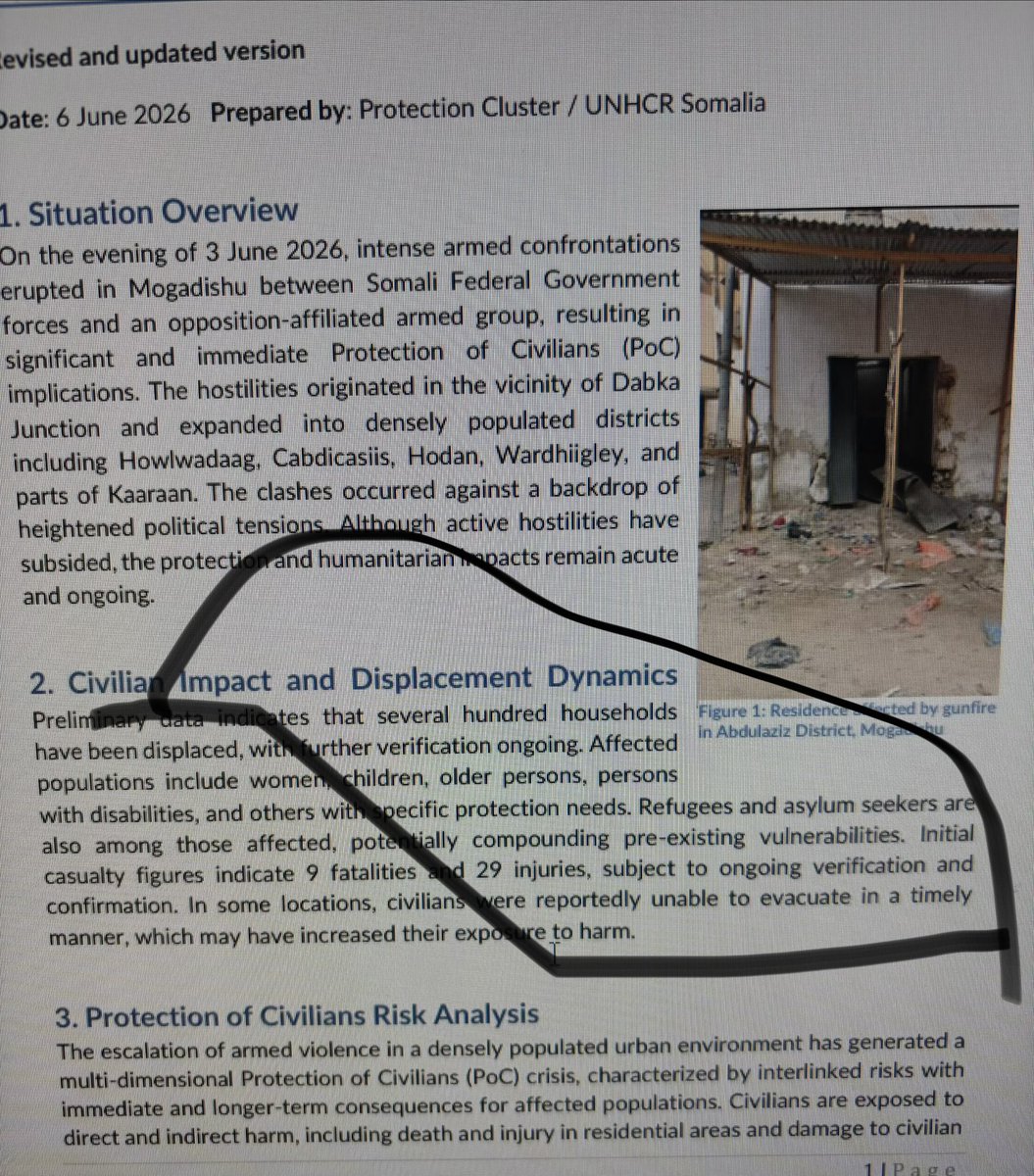
file:///C:/Users/thriv/AppData/Local/Temp/MicrosoftEdgeDownloads/bfa1dacf-4484-46d0-bd44-dd5a958e30fd/Protection of Civilians_Mogadishu_6_June_2026_Revised and Updated (1).pdf
194
Waraysiga oo dhamaystiran
WAREYSI: Muxuu Xasan Sheekh ka yiri? Dhulka, Dagaalkii Muqdisho & Dowlad... youtu.be/hFlRnFFHSsM?is=N-ZB… via @YouTube
296
0533
The Morning Mind: Free Association, Hegelian Agency, and the Epistemology of the Embodied Self
Liban rises on time. Before the day opens its demands, he is already in motion — running back and forth across his space, deploying an unconventional self-regulatory technique: exaggerated, bizarre facial expressions that mirror his internal emotional conflict between the pull of sleep and the discipline of waking. This is not theater. It is method.
What Liban practices is a form of embodied self-observation — a somatic theater in which the body surfaces what the conscious mind deflects. His exaggerated facial expressions function as a free-association mechanism: by physically performing an emotional state, he makes it legible to himself. The face becomes a diagnostic instrument.
The previous evening, Liban had prepared for sleep with equal intentionality. His phone screen was dimmed to zero blue light — a deliberate intervention — while an audiobook on the S&P 500 carried him toward rest. The subject was not incidental. The S&P 500 has delivered an average annual return of approximately 10% since 1957, surviving two World Wars, the Great Depression, and multiple market crises (NerdWallet, 2026).
What Liban absorbs from the S&P 500’s history is not merely financial literacy. He internalizes a deeper epistemic lesson: that diversification across time — enduring volatility without abandoning position — is itself a model of psychological resilience. Long-term reliability requires tolerating short-term discomfort.
The market and the self share a grammar.
He has a 9:00 AM meeting this morning. And yet, Liban does not rush. He has mastered what might be called the phenomenology of incremental action — the discipline of one step at a time. He has identified, with clinical clarity, that his tendency to avoid initiating large projects is not laziness but anxiety: the dread of inadequacy that accompanies the commencement of something significant.
This is a psychologically sophisticated self-diagnosis. It corresponds closely to what Beck et al. (1979) identified in the cognitive model of anxiety: that avoidance behavior is sustained not by the task itself but by distorted cognitions preceding it — anticipatory catastrophizing that makes beginning feel dangerous. Liban has named this in himself.
He has also identified a neglected domain: insufficient engagement with local community life and Somali national politics. This recognition — that civic participation constitutes an obligation of the self, not merely an option — reflects a moral seriousness that exceeds personal development. It is a political claim about the scope of a responsible life.
Central to Liban’s epistemic method is his free-association practice. By adopting bizarre, exaggerated facial expressions, he surfaces emotions, aspirations, and anxieties residing below articulate thought. This is his primary knowledge-generation mechanism — a technique that treats the body not as instrument but as interlocutor. The face asks what the mind has not yet dared to formulate.
This morning, a long-held memory surfaced. Approximately 20 years ago, Liban read a book containing the following claim: “A theory is meaningless to the extent that it is unable to take our own anxieties, worries, aspirations, and hopes into account.” He has carried this sentence for two decades. It functions as a criterion — a standard by which all intellectual frameworks must prove their worth against lived experience.
An AI-mediated conversation this morning sharpened a philosophical distinction Liban had long carried imprecisely. He discovered — with some force — that Hegelian Idealism is not a German cultural doctrine about the good life. It is the philosophical proposition that ideas shape reality, not the reverse (Hegel, 1807/1977). The world, for Hegel, is a reflection of Geist — spirit conceived as the totality of conscious, rational life unfolding through history.
6
1
711
1058
Liban’s focus during this period was excellent, awareness however was limited.
238