Exposé: Behind New Zealand’s $12b Defence Plan lies a quiet strategic realignment
The Government says New Zealand is facing its most challenging and dangerous strategic environment in decades. It is a warning and one that appears repeatedly throughout the Defence Capability Plan 2025, a document outlining the largest military spending increase in modern New Zealand history.
The Government cites a rapidly changing world, growing instability across the Indo-Pacific, intensifying geopolitical competition, and a security environment that can be argued bears little resemblance to the one New Zealand faced only a generation ago. The message portrayed is that the world has become more dangerous and New Zealand must prepare. But that alone raises some questions.
Since the Government unveiled its plan to spend approximately $12 billion on defence over four years, many mainstream media reports focused on the figures, the cost to taxpayers, and the practical challenges of rebuilding a Defence Force that has suffered from years of underinvestment.
What has received far less attention is what the Government actually intends to build.
A closer examination of the Defence Capability Plan document, supporting Cabinet papers, ministerial statements, and associated policy documents reveals a concerning story that extends well beyond replacing ageing aircraft, upgrading military infrastructure, or purchasing new technology. Buried throughout hundreds of pages, broader transformation is taking shape, one that will not simply change what equipment the New Zealand Defence Force operates but may also redefine how it is expected to operate, who it is expected to operate alongside, and what role New Zealand intends to play in an increasingly contested region.
Throughout many publicly available documents released by the Government, each repeatedly describe the need for a Defence Force that is increasingly combat capable, interoperable with international partners, and able to contribute to collective security arrangements across the Indo-Pacific. These references to deterrence, strategic competition, coalition operations, and alliance integration appear throughout the Government's planning assumptions. They sit at the heart of a strategy that would significantly reshape New Zealand's military framework and deepen its integration with partner nations across the Indo-Pacific.
That marks a notable shift from the language that dominated much of New Zealand's defence policy during the decades that followed the Cold War. Governments tended to emphasise peacekeeping, humanitarian assistance, disaster relief, maritime patrols, and regional engagement. Those functions remain important and continue to feature in official planning, but the emphasis has changed.
The Defence Capability Plan describes a world increasingly shaped by strategic rivalry and military competition, particularly across the Indo-Pacific, where warnings were marked about risk of confrontation between major powers. The Indo-Pacific region is identified as the primary theatre for strategic competition where increasing regional tensions sit while raising the prospect of military confrontation and conflict.
On the surface, the Defence Capability Plan appears to be a response to those challenges. A closer reading suggests there is a blueprint set out for a future Defence Force that is more integrated with the United States, more technologically connected, and increasingly designed to operate within a network of international security partnerships. The strategic assumptions could shape New Zealand's defence posture for decades.
The origins of the Defence Capability Plan can be traced back several years before the Government announced its $12 billion spending programme.
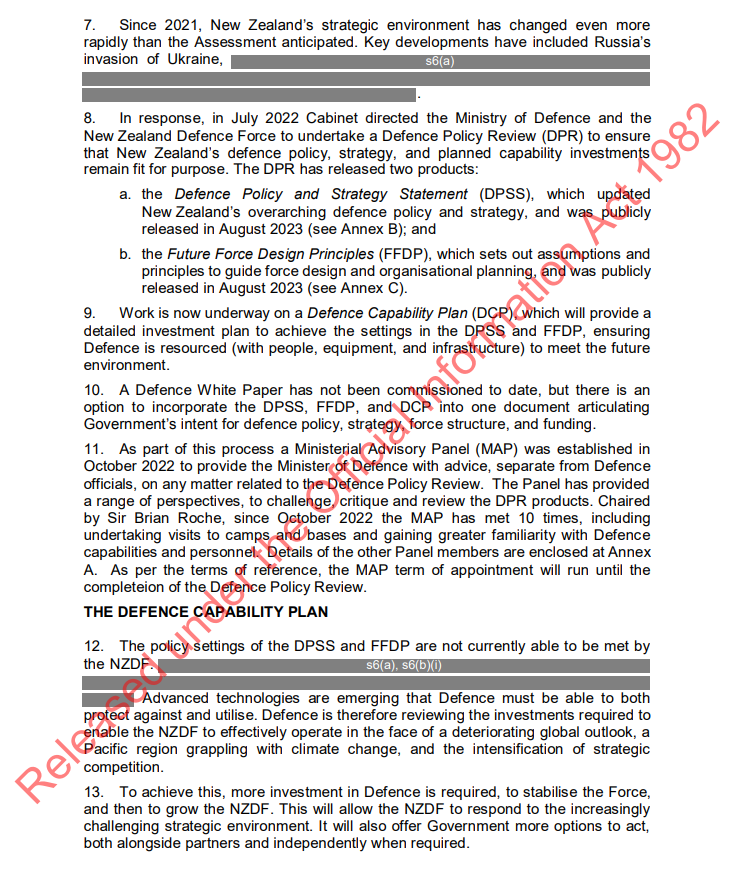
According to ministerial briefing papers, Defence officials at the top concluded that events since 2021 had fundamentally altered the strategic outlook facing New Zealand. Russia's invasion of Ukraine shattered assumptions that large-scale interstate conflict was becoming a relic of the past. Strategic competition between major powers intensified. Military modernisation accelerated across the Indo-Pacific. Emerging technologies began transforming the nature of warfare, while cyber threats and foreign interference became increasingly prominent features of the international landscape.
One briefing prepared for ministers stated that New Zealand's strategic environment had changed more rapidly than earlier assessments anticipated. Existing defence assumptions, capability plans, and long-term investment priorities were increasingly viewed as products of a world that no longer existed. It was a fundamental reassessment of defence policy.
In July 2022, Cabinet directed the Ministry of Defence and the New Zealand Defence Force to undertake a comprehensive Defence Policy Review. The purpose was far-reaching. The departments were tasked with determining whether New Zealand's defence policy, military strategy, and future capability investments remained fit for purpose in what was described as an increasingly uncertain and contested strategic environment. The review produced the Defence Policy and Strategy Statement and the Future Force Design Principles, documents that would ultimately form the foundation of the Defence Capability Plan. Buried within the briefing papers is an admission that helps explain the scale of what followed.
It was assumed that the policy settings outlined in the Defence Policy and Strategy Statement and the Future Force Design Principles could not be achieved by the New Zealand Defence Force in its existing state. In simple terms, the Government's strategic ambitions had outgrown the capabilities available to achieve them. Importantly, the review was about determining how New Zealand would position itself within a rapidly changing regional security environment. The answer that emerged from the review was a Defence Force built around greater interoperability, deeper partnerships, and an increased ability to operate alongside key security partners in the Indo-Pacific.
That conclusion became the justification for one of the most ambitious defence investment programmes in New Zealand's modern history. The Defence Capability Plan was therefore never intended to be a procurement programme and instead it was the practical expression of a much larger strategic reassessment.
The review concluded that the world had changed and the Defence Capability Plan was designed to ensure the Defence Force changed with it. The mechanism for achieving that transformation appears repeatedly throughout: interoperability.
If the Defence Policy Review explains why the Defence Force needed to change, the Defence Capability Plan reveals what was intend to change it into.
For most readers, the term sounds harmless enough. It suggests military forces being able to communicate during exercises, coordinate disaster relief operations, or work together during international deployments. Defence planners frequently describe interoperability as a practical necessity for a country with a relatively small military operating in an increasingly interconnected world. In practice, interoperability extends far beyond radios and common procedures. It increasingly encompasses intelligence sharing, logistics networks, communications infrastructure, digital command systems, surveillance architecture, operational planning, and cyber capability. Modern military interoperability increasingly encompasses the ability for military forces to operate as part of a larger coordinated system.
The deeper that interoperability becomes, the deeper the integration becomes alongside it, raising questions about how New Zealand balances strategic partnerships with its long-standing commitment to an independent foreign policy.
One of the most revealing passages appears in the Government's own description of the future force it intends to build. That the New Zealand Defence Force must become "increasingly combat capable, interoperable with our partners, able to act as a force multiplier with Australia."
The phrase "force multiplier" is notable because it is language more commonly associated with coalition operations and alliance planning than with the traditional image many New Zealanders hold of their Defence Force. New Zealand and Australia have committed to modernising their alliance and strengthening defence integration through the development of a more integrated ANZAC force. Describing a future in which the two countries increasingly combine military capability in defence of shared interests, common values, and territory.
New Zealand and Australia have cooperated closely for generations. Joint operations, intelligence sharing, military exercises, and defence coordination have long formed part of the relationship between the two countries.
What appears to be changing is the depth of that relationship.
The Defence Capability Plan is describing military forces being designed, equipped, and structured with integration increasingly built into their future development, particularly within a regional environment shaped by growing competition between the United States and China.
The Government's wider strategic defence framework says the same thing. The Strategic Defence Policy identifies strengthening New Zealand's alliance with Australia as a core objective. It also places significant emphasis on contributing to the Five Eyes partnership and supporting collective security through a strong network of international partners.
While the documents rarely frame the issue in explicitly American terms, the strategic direction is difficult to ignore. Australia remains New Zealand's closest defence partner, but Australia itself sits at an increasingly integrated security relationship with the United States. Likewise, the Five Eyes intelligence alliance remains aligned by Washington's global security architecture. As a result, many of the capabilities now being prioritised by Defence planners, from interoperability and intelligence sharing to cyber resilience and networked military systems, align closely with the broader strategic priorities being pursued by the United States across the Indo-Pacific.
The trend extends beyond military planning.
In recent years, New Zealand has deepened cooperation with American security and intelligence agencies, including the establishment of a permanent FBI presence in Wellington. While the office operates primarily in support of transnational crime, cyber security, counter-terrorism, and foreign interference investigations, its creation reflects the strengthening of security ties between New Zealand and the United States at a time when increasingly the Indo-Pacific is becoming a region of growing strategic importance.
The establishment of a permanent FBI office can each be explained on their own merits. They reveal a broader pattern of integration occurring across New Zealand's defence, intelligence, and security architecture.
Deeper interoperability reflects strategic reality for a small nation operating in an increasingly contested region. It can be argued that greater integration inevitably raises questions about how much strategic independence can be maintained as systems, planning, and capabilities become more closely connected with larger partners.
That reality becomes even clearer when examining where the money is actually being spent. Because while interoperability provides the framework, the capability investments themselves reveal what kind of military New Zealand is preparing to build.
The same themes extend across the Navy, where future capability investments are closely tied to interoperability and operations alongside regional partners. It becomes clearer that some of the most important investments are not the ones likely to generate headlines.
A generation ago, cyber operations played only a minor role in defence planning. Today they sit near the centre of it. Cyber threats are one of the defining security challenges of the modern era, that hostile actors can increasingly disrupt infrastructure, interfere with communications, steal information, and influence events without ever crossing a physical border. There has been substantial investment in cyber resilience, secure digital infrastructure, classified communications systems, and the networks required to operate in increasingly contested information environments.
Information itself has become a strategic asset. That reality is reflected throughout the Defence Capability Plan. Alongside cyber capability are investments in intelligence functions, surveillance systems, information warfare capabilities, and classified digital services designed to improve decision-making and situational awareness. This represents a significant shift in how military capability is understood.
For much of the twentieth century, military power was often measured by visible assets such as ships, aircraft, vehicles, and personnel. Modern defence planning increasingly focuses on networks, information flows, sensors, and digital infrastructure.
One of the most striking examples is the growing emphasis on autonomous systems. Remotely piloted aircraft, advanced surveillance technologies, and other emerging capabilities feature prominently throughout the investment programme. These systems allow militaries to gather information across vast distances, monitor activities in real time, and extend operational reach without relying solely on traditional platforms.
These technologies being introduced into the Defence Force reflect a growing reliance on information, digital infrastructure, intelligence integration, and networked operations alongside partners.
The future force outlined in the Defence Capability Plan is therefore about more than new equipment. It is about building a military capable of operating in a world where information moves instantly, where alliances matter more than ever, and where security increasingly depends on integration across multiple domains.
The spending programme may be measured in billions of dollars. Its long-term significance lies in the kind of Defence Force those billions are being used to create. Individually, many of the developments outlined throughout the Defence Capability Plan appear practical and largely uncontroversial. A more capable military, stronger cyber defences, improved intelligence systems, deeper cooperation with Australia, and closer interoperability with trusted partners can all be justified on their own merits.
Viewed collectively, however, a broader picture begins to emerge.
The future force described throughout the Government's planning documents is increasingly structured to operate within a wider network of security partnerships spanning Australia, the Five Eyes community, and the broader Indo-Pacific region.
All combined this begins to look more like a strategic repositioning.
New Zealand is not joining a formal alliance, nor do the documents suggest the country is abandoning its independent foreign policy. What they do suggest is that the future Defence Force is being designed to operate more seamlessly within a regional security framework that remains heavily influenced by Washington's strategic priorities and its growing focus on competition in the Indo-Pacific.
The repeated emphasis on interoperability, integration, coalition operations, information sharing, and collective security suggests that the Defence Capability Plan is about more than replacing ageing equipment.
That raises a question that sits quietly beneath much of the public debate surrounding the plan.
Is New Zealand simply rebuilding an ageing Defence Force, or is it also repositioning itself within an increasingly interconnected security architecture at a time of intensifying strategic competition across the Indo-Pacific?
The Government presents the Defence Capability Plan as a response to a deteriorating world. Viewed through that lens, the rationale appears straightforward.
New Zealand faces a more uncertain strategic environment than at any point in recent decades. Strategic competition is intensifying. Military modernisation is accelerating. Cyber threats are growing. The international rules-based order is under increasing pressure. In response, the Government says New Zealand must rebuild and modernise its Defence Force to ensure it can protect the country's interests in an increasingly contested world.
That argument forms the foundation of the entire plan. But the documents reveal something more significant than a simple programme of military modernisation.
The Defence Capability Plan is reshaping how the New Zealand Defence Force is expected to operate, who it is expected to operate alongside, and what role it is expected to play within the wider security architecture emerging across the Indo-Pacific. The Defence Policy Review concluded that New Zealand's existing force structure could no longer deliver the Government's strategic objectives. The response was to design a different kind of military.
That ambition is reflected throughout the Defence Capability Plan and in the words of Former Defence Minister Judith Collins herself.
In her foreword to the plan, Collins writes that New Zealand personnel must be equipped and trained to become more combat capable and able to deter actions adverse to New Zealand's interests. She describes a future force that is combat-capable, interoperable, and ready to be of use wherever it is needed. She also stated that the plan will result in New Zealand becoming more integrated with Australia, making both countries stronger together.
Each decision appears practical and largely uncontroversial. They reveal a strategic direction described a future force that is more connected to its partners than any previous generation of the New Zealand Defence Force. It is a military designed not only to defend New Zealand's interests but also to operate within an increasingly integrated network of regional and international security relationships. Many of those relationships sit within a wider security architecture in which the United States remains the dominant strategic actor.
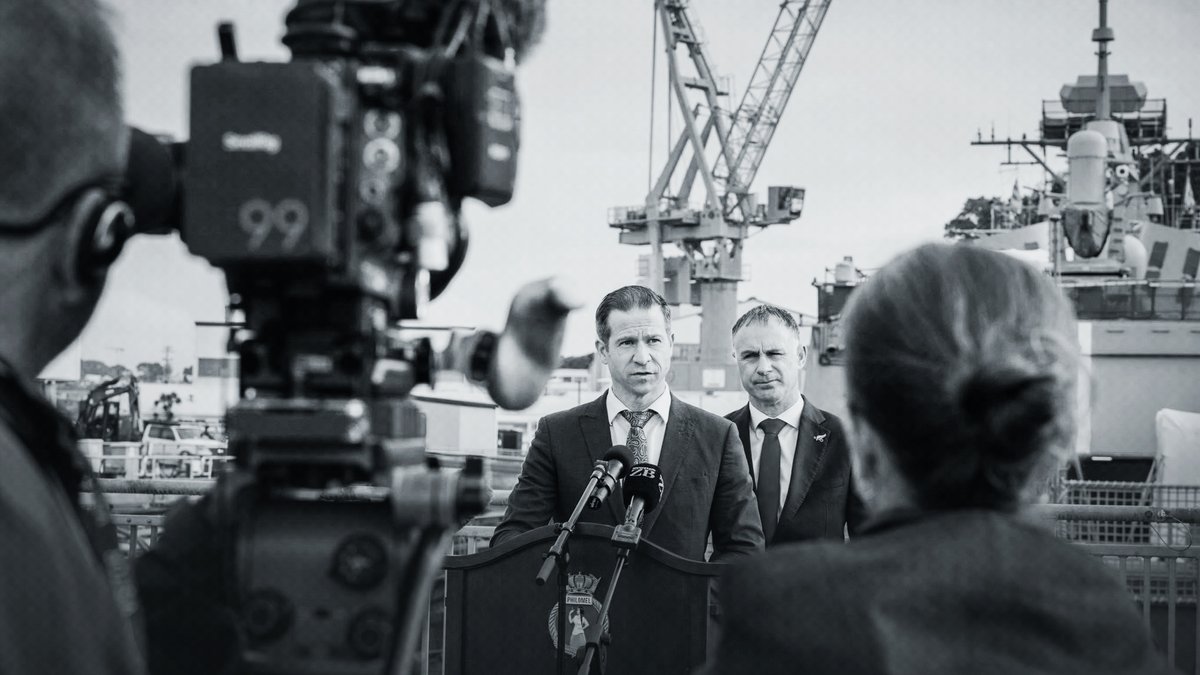
Collins built the framework. Chris Penk is now responsible for turning it into reality.
Since becoming Defence Minister, Penk has inherited not only the Defence portfolio but also responsibility for the GCSB, NZSIS, and New Zealand's growing space portfolio. His tenure has coincided with a further acceleration of defence spending, including Budget 2026 commitments that added another $1.6 billion in new funding for Defence, bringing total new investment announced since the Defence Capability Plan was released to approximately $5.8 billion.
The funding includes maintenance and life-extension work for New Zealand's ANZAC-class frigates, support for HMNZS Canterbury, investment in maritime surveillance drones, military housing upgrades, and programmes designed to improve recruitment and retention across the Defence Force.
Penk has framed those investments as a response to an increasingly uncertain world, arguing that New Zealand can no longer afford to stand still while strategic competition intensifies across the Indo-Pacific. Announcing the Budget package, he said New Zealand needed a Defence Force that was equipped, supported, and ready to protect the country's interests when called upon.
Those comments closely mirror the assumptions underpinning the Defence Capability Plan itself. They also suggest the strategic direction established under Collins remains firmly embedded within the Government's thinking.
Those developments matter because they show the Defence Capability Plan is not a document produced under one minister and left on a shelf. It is now being actively implemented by a minister whose responsibilities span defence, intelligence, national security, and space policy.
The Defence Capability Plan itself is built upon the belief that New Zealand's strategic environment has fundamentally changed. Penk's early public comments suggest that assessment remains firmly embedded within the Government's thinking. The question is how far it ultimately goes and what New Zealand's defence and security architecture will look like once that transformation is complete.
This reflects the realities of a changing world and the practical requirements of a small nation facing increasingly complex security challenges. But questions remain about how far integration should extend and whether the long-term implications have received sufficient public scrutiny.
What is beyond dispute is that the decisions being made today will shape New Zealand's defence posture for decades to come.
The Government says the Defence Capability Plan is a response to a more dangerous world. The documents examined in this investigation support that assessment. What they also reveal is a Defence Force being reshaped around deeper interoperability, closer integration with partners, and a larger role within the security architecture emerging across the Indo-Pacific.
New Zealand is becoming increasingly aligned with a regional security framework in which the United States remains the dominant strategic power. Taken alongside the growing emphasis on interoperability, Australia integration, Five Eyes cooperation, and coalition operations, it points towards what can reasonably be described as a quiet strategic realignment.
*This article is published exclusively to thisquality for the purpose of fair reporting and public interest in matters relating to democracy, transparency, and national security in New Zealand. All information referenced is drawn from publicly available sources, including Official Information Act documents, media reporting, and official public statements. The analysis presented reflects commentary and interpretation for the sake of informed public debate. Any images, screenshots, or excerpts reproduced in this exposé are used under the principles of fair dealing for reporting, criticism, and review under New Zealand copyright law, and are protected by the defence of public interest journalism. All intellectual property remains the copyright of its original owners.
#nzpol