
Building MEDVi and The Gallagher Foundation
Joined June 2009
- Tweets 307
- Following 191
- Followers 18,925
- Likes 823
42 Photos and videos











Pinned Tweet

Apr 5
Me prompting my coding agents at 3am
65
988
7,795
474,288
Apr 8
MEDVi statement in response to external speculation
FDA letter
In September 2025 and February 2026, the FDA sent an unprecedented number of warning letters to dozens of telehealth companies, drug companies and pharmacies regarding their direct-to-consumer advertising practices. In one of the FDA's letters, the URL mentioned is medvi.io - not MEDVi's actual address of medvi.org.
The letter addressed to MEDVi was directed at an affiliate marketing agency whose website contained outdated copy.
We immediately reached out to the affiliate and required them to remove the materials allegedly at issue. We understand the affiliate also directly responded to the FDA.
My company MEDVi has never received a letter from the FDA. If we were to receive such a communication from any regulatory authority, we would act swiftly and collaboratively to address the matter.
So-called "fake doctors"
We have recently become aware of what appear to be advertisements featuring potentially AI-generated medical practitioners.
Since we became aware of this issue, we have updated our marketing practices to make clear that this type of advertising and / or promotion is prohibited. We continue to proactively address this issue.
Additional statement from Mr. Gallagher
Building a company the size of MEDVi and scaling so quickly involves many learning moments. At each of these stages, I have course-corrected immediately and appropriately. I will continue to do so.
The New York Times was recently given unprecedented access to MEDVi's business information and also interviewed our business partners and other collaborators.
As I continue helping our customers achieve their health goals, I remain committed to building and operating transparently.
home.medvi.org/communication
5
162
80,444
Apr 4
One shotted this technical demo on live head tracking to scroll your browser.
The use cases are probably not insanely wide but very cool to see what’s possible: headscroll.replit.app/
7
69
13,972
Apr 4
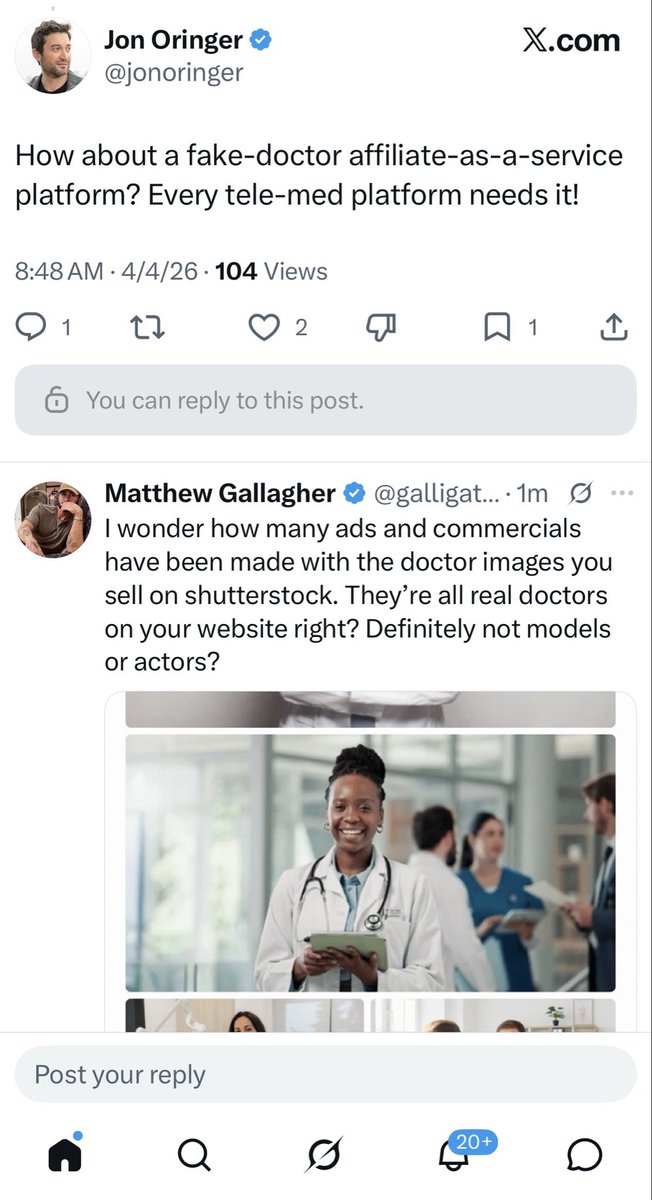
The guy who SELLS images of doctors to marketers pretends not to understand marketing. The irony is beautiful.
8
2
183
30,446
Apr 4
What are you building this weekend?
One comment gets a $10k investment and I’ll help you execute.
202
11
297
39,584
Apr 3
Watching in realtime as people learn about white label, drop shipping, and affiliate marketing is like seeing cavemen “fire bad”
White label telemedicine is a huge benefit with a net positive for humanity. It has been the driving force behind big pharma lowering prices and making healthcare accessible to everyone from home.
Low energy people think offering life-changing weight loss medication, prescribed by a doctor, is a trendy “pill mill”.
Wait til you see what’s possible with longevity services and peptides.
I’m bullish on humanity. If you are too, I’ll help you build.
20
9
307
26,885
Apr 3
medrxiv.org/content/10.64898…
A new real-world study (500 patients) shows ~96% of patients on a telehealth obesity platform lost weight
Not a clinical trial. Not a controlled setting.
This is what happens when:
•distribution scales
•infra standardizes care
•licensed providers deliver outcomes
The model works. The question is who executes it best.
1
2
41
11,656
Apr 3
Some people have a goal to make millions of dollars, but there are many who just want to be ok. Make enough to build a life, have a family, and do some good in the world.
I started a foundation to incubate nonprofits.
If you could make guaranteed $200k/year and run a nonprofit dedicated to providing some good to your community, would that satisfy you?
Choose one
24
5
210
16,606
Apr 3
I ran my last company for 9 years, it did over $250m in sales and profited exactly dick.
When I was growing it, the message to builders was “growth at all costs” because profit would be found at scale.
All of my employees made more money from the company than I did, but I learned valuable lessons.
If you’re building something right now, drop a link and what you’re struggling with and I’ll reply.
If you’re looking for fresh ideas, check what @levelsio recently built
27
8
364
30,926
Apr 3
Some final notes for tonight:
こんにちは、日本。あなたのピザが大好きです!聖林館
I did not launch a shitcoin but just got accused of that
This has been a wild day. I look forward to the battles of tomorrow. I hope the ones who get it took some value out of my story. ✌🏼 ❤️
8
1
121
19,218
Matthew Gallagher retweeted

Apr 3
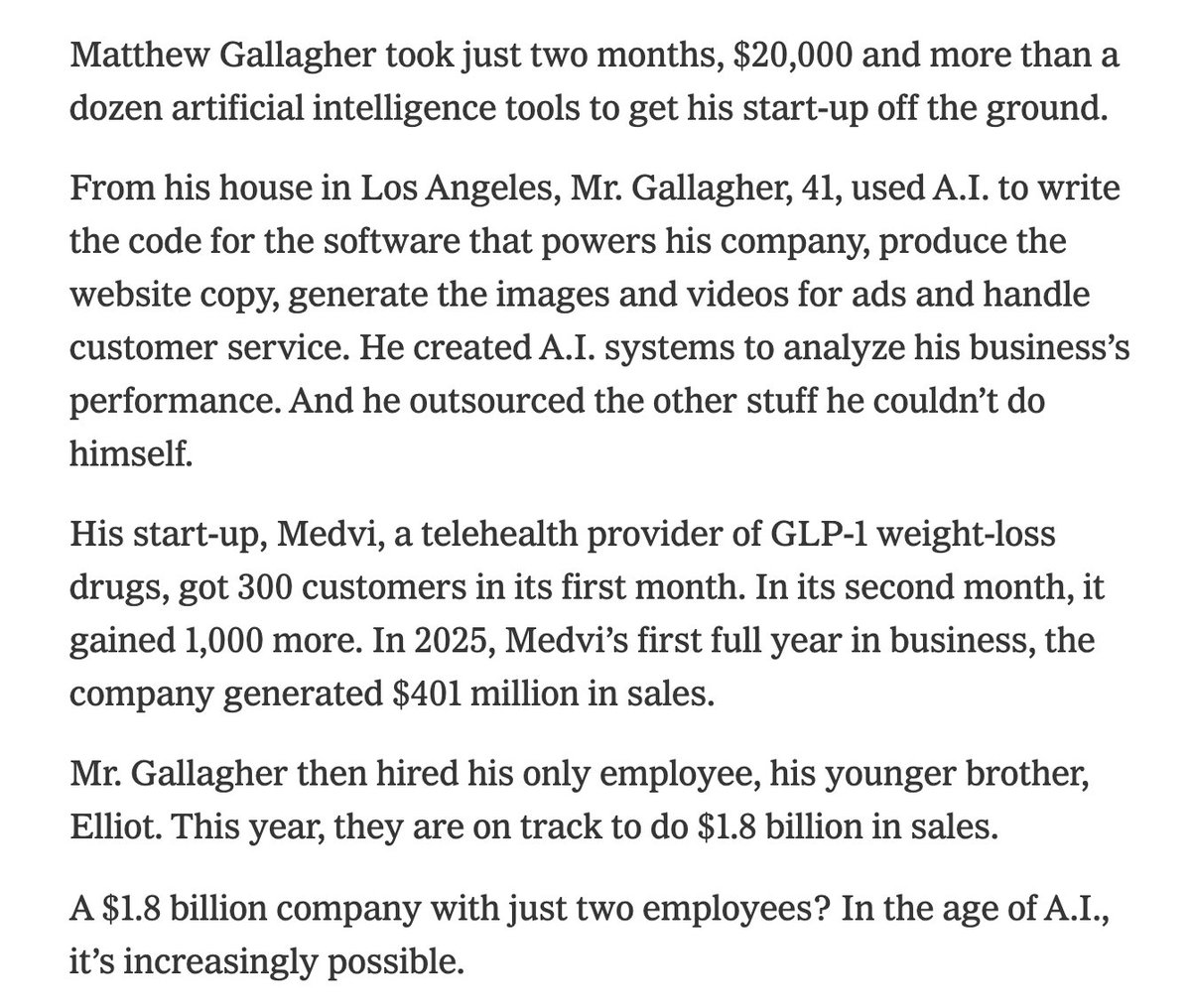
Confused as to why Matthew Gallagher and Medvi are catching so much heat.
Still haven't seen one person calling them scammers explain why.
The New York Times verified the financials.
Hims and Hers is a publicly traded telehealth company prescribing the same category of weight loss drugs through the same type of online platform. They did $2.35 billion in revenue last year with 2,442 employees. Nobody calls them a scam.
Ro raised over $1 billion in funding to build a telehealth platform that prescribes GLP-1 weight loss medications through online consultations. They were valued at $7 billion in 2022 and employ between 500 and 1,000 people. Nobody calls them a scam.
Noom generates over $750 million a year in revenue and launched its own GLP-1 program in September 2024. It reached a $100 million run rate in GLP-1 revenue within four months. Nobody calls them a scam.
LifeMD did $194 million in revenue with over 300 employees. Cerebral raised $462 million in venture capital. WeightWatchers paid $106 million to acquire a telehealth platform called Sequence just to get into this space. Amazon started offering GLP-1 prescriptions through Amazon Pharmacy in January.
These are all doing essentially the same thing: connecting patients with licensed prescribers through an online platform to access weight loss medications. The model is identical. The regulatory framework is the same. The drugs are the same.
The difference is that Gallagher did it with two people and $20,000 worth of AI tools instead of 2,000 employees and a billion dollars in venture capital.
Yes, the FDA sent Medvi a warning letter for how it marketed compounded GLP-1 products. They sent the same letter to tens of other telehealth companies on the same day. It was an industry-wide crackdown on how compounded drugs are marketed, not a Medvi-specific action.
The concerns about compounded drug safety and marketing practices are real and worth taking seriously. But the people calling Gallagher a scammer are not upset about FDA compliance so much as they are upset about what a two-person company generating $401 million in revenue means for businesses that raised hundreds of millions in funding to do the same thing with a hundred times the staff.
The infrastructure advantage is gone. The moat that used to protect large companies was never the product so much as it was the cost of building the product. It was the engineering team, the design team, the customer service department, the marketing staff, the legal team, the operations team. It was the fact that standing all of that up required years of runway and tens of millions of dollars. That is what kept two-person competitors out. And that barrier disappeared the moment AI tools made it possible for one person to do the work of dozens.
This is exactly what is happening across most marketing budgets right now.
The businesses spending $30,000 a month on a marketing agency, $15,000 a month on paid ad management, $10,000 a month on social media, and $8,000 a month on a PR retainer are operating on the same assumption the telehealth companies with 2,000 employees were operating on: that headcount and budget are the moat. That spending more means building more. That the size of the team determines the quality of the output.
It does not. Not anymore.
(If you want to see where your site stands across Google and AI search, start here:
seo-stuff.com/free-audit)
SEO and AI search visibility is the channel where this shift hits hardest. Building real search authority used to require a dedicated content team, a backlink outreach department, a technical SEO specialist, and years of consistent investment before anything compounded. It still requires the strategy and the consistency. But the infrastructure needed to execute it has collapsed. One person with AI tools and the right search strategy can now publish authoritative content, build topical depth, earn citations from AI answer engines, and compound domain authority at a pace that would have required a 15-person team three years ago.
When ChatGPT cites a source, it does not check how many employees the company has. When Google's AI Overview selects a reference, it does not evaluate the size of the marketing budget behind it. When Perplexity assembles an answer, it does not care whether the content was written by a solo founder or a 200-person content team. These systems evaluate authority, depth, and relevance. That is it. The infrastructure moat is gone. The only moat left is whether you built something worth citing.
The businesses still spending six figures a month across five different agencies are the Cerebral of marketing: $462 million raised, and a two-person company is generating more revenue doing the same thing with better tools.
That is the gap SEO Stuff was built to close.
seo-stuff.com
Nobody called Hims a scam when they hit $2.35 billion with 2,442 employees. The model was the same. The drugs were the same. The platform was the same. The only thing that changed is that someone figured out how to do it with two people and $20,000, and that made everyone uncomfortable.
The question is whether your marketing budget is still built on the assumption that headcount and spend are the moat, or whether you have figured out that the only moat left is authority, and authority does not care how big your team is.

27
17
151
50,296
Apr 3
Ok here’s an example, I vibe coded this in 10 minutes - multiplayer wordle.
Here’s a link to play against me right now: wordable.replit.app/room/807…
9
3
58
25,234
Apr 3
Don’t be afraid of competition. No company has 0% churn and a churned customer from your competitor did not die or decide they are never buying xyz again, it’s potentially your next customer.
Build a brand inspired by another in a category you care about. Improve on one thing, or do exactly the same thing in a niche.
For example: take MEDVi. I have given almost the exact work flow to copy my business. You could do that and adjust the branding: “Quality Telehealth for First Responders”.
Now you’ve got your product, your target demographic and the tools to build it.
At my own financial loss, I have given away many secrets to help my competitors because I want good people to win.
Don’t have a scarcity mindset.
7
19
364
17,028
Apr 2
It’s actually a little crazy the number of people who form a whole opinion from a headline and then publicly wish horrible things will happen.
Details matter. Half of X thinks I’m slinging fake Ozempic out of my garage with a robot doctor it’s wild
26
3
190
19,626