
CTO @pumpcade | ex @limitbreak senior solidity engineer | cade.market/
Joined June 2010
- Tweets 3,993
- Following 875
- Followers 2,543
- Likes 7,809
338 Photos and videos










Pinned Tweet

Mar 20
I’ve been obsessed with @pumpcade ever since @PopPunkOnChain told me about the pivot to parimutuel markets for streams
It opens the door to an enormous design space for integrations, participation, and new market experiences
Couldn’t be more excited to bring this from 0 to 1
Mar 20

Excited to share the first people that will be joining the @pumpcade team.
@gnarzilla - CTO
@steoniy - CPO
I’ve been fortunate to work closely with these two guys during my career and am extremely lucky to bring them onboard to build the fastest prediction platform
Pumpcade.
8
8
94
12,501

Jun 12
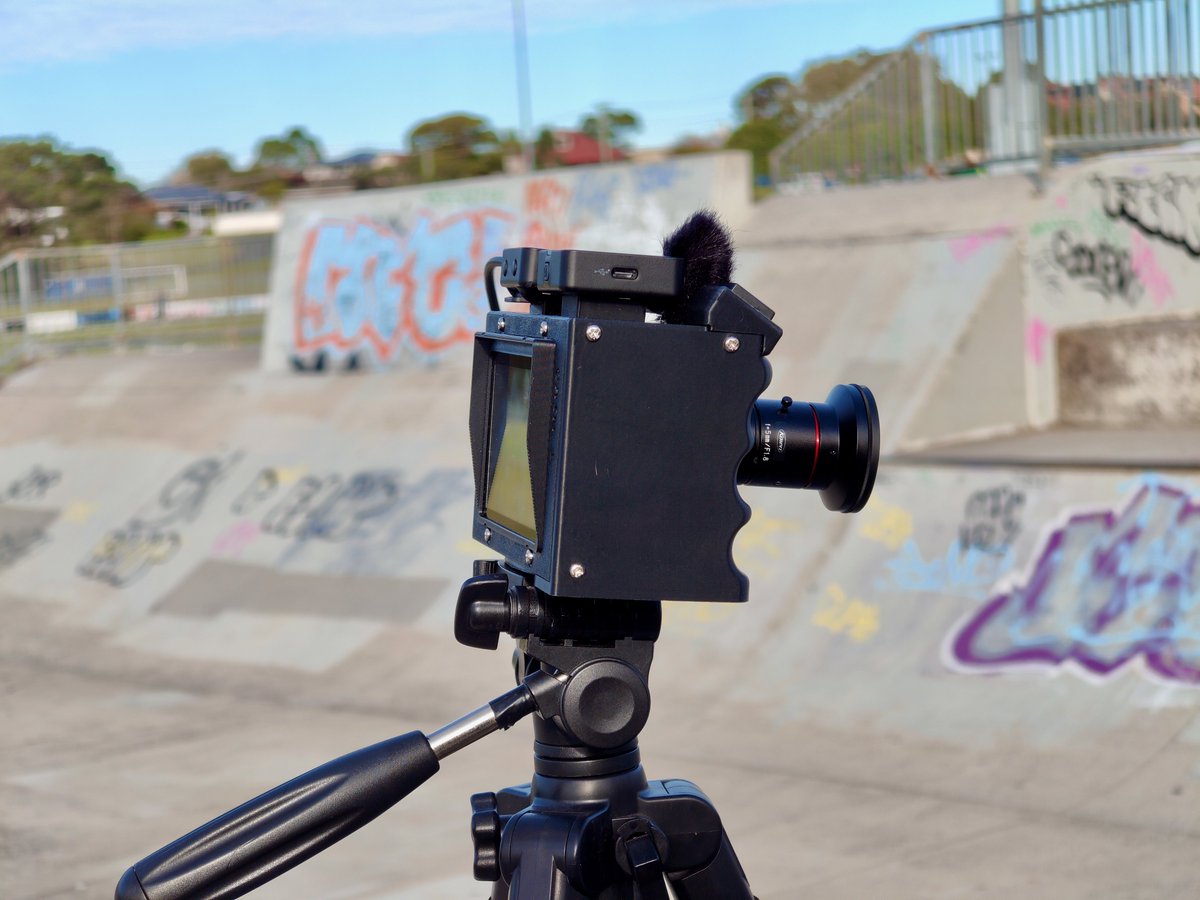
What a brilliant use of ZK proofs! Real world use case in a post AI world from cryptography.

In a world rapidly filling with AI deepfakes and digital manipulation...
How do we actually trust what we see online?
Meet CAIM1... 🧵👇
5
260
gnar retweeted

Jun 4
100% of team efforts are now on @pumpcade sports markets.
We've historically built in public and shared progress screenshots/videos along the way, but not this time.
When it drops, it drops. We haven't seen any approaches to sports markets like this... EVER.
Pumpcade.
15
19
126
5,008
Jun 3
"Don't trust, verify."
That's been crypto's claim for a long time, but it only works if you can actually verify.
Every system has trust assumptions. The chain, the oracle, the data source, the path from the real world into the machine. What crypto actually changes is not whether trust exists, it is whether trust is visible, narrow, and something people can inspect.
Prediction markets are a good test case for this.
Before a market settles, messiness is expected. People are pricing incomplete information, disagreeing on what's likely, and arguing about what's true before it becomes obvious. The crowd is doing real work.
After settlement, the messiness should stop.
The current Polymarket dispute over Strategy's Bitcoin sale is a clean example of what happens when it doesn't. Strategy sold 32 BTC during the May 26-31 window. The market asked whether Strategy would sell any Bitcoin by May 31. The SEC filing confirming the sale came on June 1.
So the dispute is not really about whether the sale happened. Everyone agrees it did. The dispute is about which interpretation controls: did the market ask whether the sale occurred by May 31, or whether it was publicly confirmed by May 31?
That's a real ambiguity. Once it exists, the market stops being about prediction and starts being about resolution politics.
That's where subjective settlement falls apart.
It doesn't matter whether the resolver is a company, a committee, a validator set, a DAO, a multisig, or token-weighted voters. If settlement depends on what a group of people decides after the fact, trust lives with that group. You haven't eliminated the human judgment problem, you've just moved it somewhere harder to reason about.
The version that actually works is narrower. The rule and the resolution source are both defined before the market opens. The input is observable onchain or from a named publication. The resolver is deterministic, and settlement follows mechanically from that.
Show the path from condition to input to output.
Make it verifiable.
Make it dull.
When resolution isn't boring, trust landed somewhere it shouldn't have.
Jun 3
I started @pumpcade with the core idea that outcome resolution should be automatic.
It absolutely should not be left up to a group of people to decide, nor should rules be modified mid market.
Pumpcade ONLY allows markets that can be instantly resolved, with zero human input.
11
8
57
4,579
gnar retweeted
Jun 2
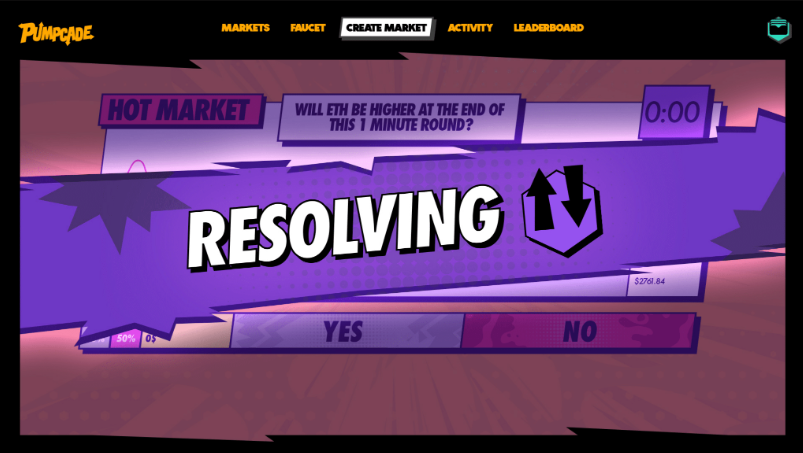
As mentioned prior, we contracted a design studio for the production grade rebrand of @pumpcade
The open beta has served the purpose of monitoring user behavior and getting feedback on the general layout of the application
Here's a sneak peak of where we're at internally
26
22
134
10,618
gnar retweeted
May 30
Developers are already building on top of @pumpcade
We love to see this, and are going to have robust developer APIs and builder codes.
There is a massive opportunity to build telegram bots, trading tools, and new interfaces on top of Pumpcade.
Pumpcade.
May 29

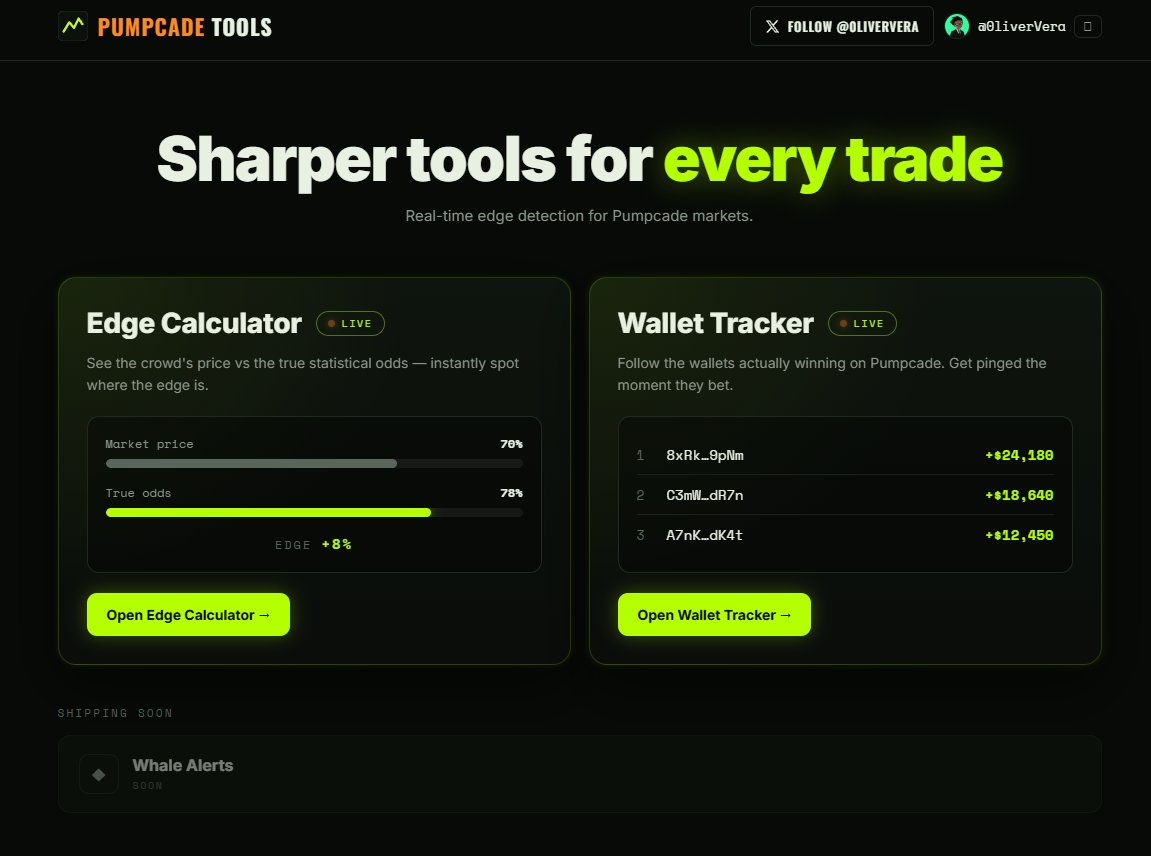
just building a wallet tracker for @pumpcade
pulls the top wallets from the leaderboard. you tap track and it dms your telegram the second they place a bet. follow the smart money without watching a screen all day
tried to build this as user friendly as possible.
i'm not building these tools for money. i'm building them so the people following me actually have an edge over everyone else. that's it
every tool i ship is built around the same idea. give you something the average pumpcade user wont have.
if you want to beta test and give feedback dm me
13
12
108
7,170
May 29
In the world of AI, ideas are not moat and increasingly execution is not moat.
Regulation is.
Big moves by @Kalshi - props to them for showing the world the path for real builders.

Perpetual futures are finally coming to America.
Trade on future asset prices with leverage in a regulated, institutional-grade environment.
Only on Kalshi.
2
1
17
1,215
May 28
You keep giving feedback, we'll keep shipping.
Consistency kills.
May 28
We just did a fairly large release to the @pumpcade open beta.
The team is shipping at unprecedented speeds.
Visual:
1. Entirely overhauled PNL cards.
2. Live charts now better convey movement and activity. There are animations driven by underlying asset volatility as well as alerts for predictions placed.
3. More engaging home screen. Pumpcade markets move fast, so it's important that we can drive your eyes to where the activity is, and where your time is best spent. Market cards now visually display when predictions are placed, and shift accordingly to your field of view based on market volume.
4. Prediction buttons have stronger visual feedback. It should feel good to place a prediction.
Infrastructure:
1. Pumpcade markets begin offchain, and the first prediction moves the market onchain. This happens in a single bundled transaction.
2. We fixed a race condition where the home page would occasionally reload data.
3. We have began migrating all of our services off of Railway and onto AWS. A few have already been migrated. Tomorrow we will have a *brief* period of downtime while we complete the migration for the remainder of the services.
Operational:
1. Half of the team is now heads down working on Sports markets. This includes a fully immersive and "fun to watch" experience for the fast paced sports markets. We have calls starting Monday of next week with data providers for these sports markets. It is incredibly important that we get the fastest data, and we will ensure we explore all options to make sure that we have the perfect data for the speed of our markets.
2. We will be onboarding a new team member soon. More on this later.
Keep sending in your feedback using the Intercom button on the app. We read and respond to nearly everything.
Pumpcade.
3
2
33
962
May 28
Over under 12 hours to Chat GPT 5.6?
May 28

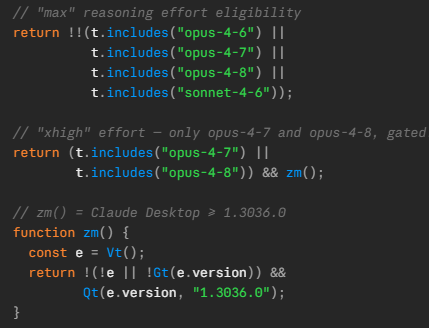
HOLY, here we go: Opus 4.8 in the claude code model selector on the desctop app.
Looks like its release day!!
2
597
May 27
Since we’ve started building @pumpcade, we’ve been saying it’s not like other prediction markets. This sports release will prove we weren’t kidding.
The vast majority of prediction markets for sports feel like a finance product pasted on top of a sports event, but fast resolution changes what’s possible. You can build markets around moments within the game, not just the final outcome.
We’ve never really had a product that let you call the next 5 minutes of a football game. Or the next 2 innings of a baseball game. Or whether the Knicks will be down by 15 after the 3rd quarter. Prediction markets that are settled instantly open up a whole new set of questions.
For example:
“Will Steph Curry hit over 4 threes in the next 5 minutes?”
“Will the Phillies hit a grand slam in the next 3 innings?”
“Will there be a red card in regulation?”
Those are the kinds of things that fast resolution make possible.
But the bigger idea is not to just build a better prediction market, it’s making something people would open even if they weren’t interested in the markets. Good context, good visuals, and keeps you in the action.
Which sport should we tackle first?
22
14
90
7,359
May 26
Quickly iterating to improve the app from standard engineer over design to clean UX that everyone will enjoy.
Expect more coming rapidly.
May 26
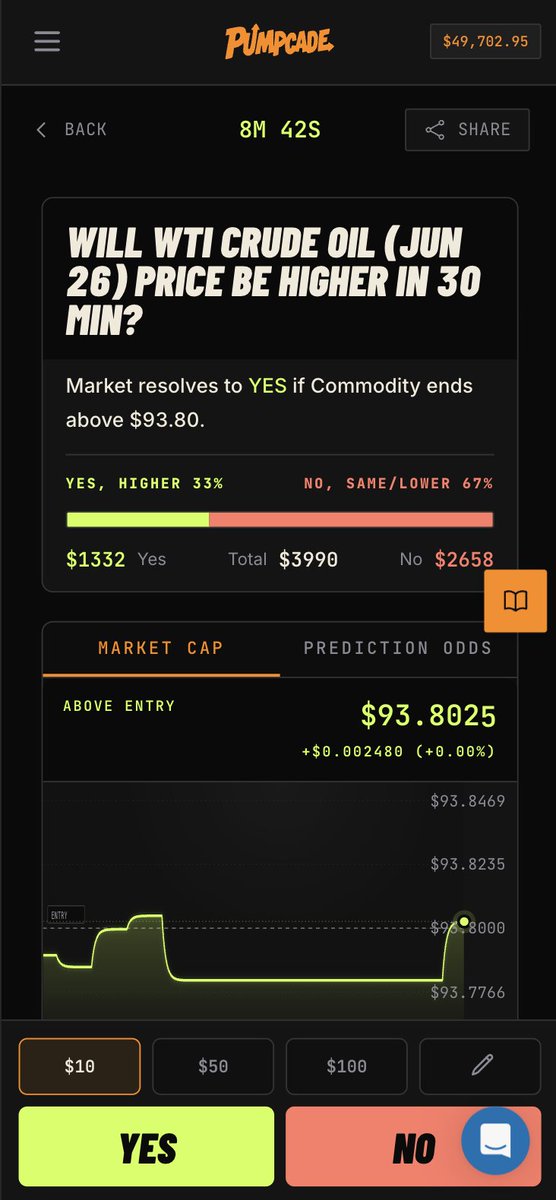
We recently pushed an overhaul of the mobile market view to the @pumpcade beta build.
Easier and simpler to view relevant information and place predictions.
In our next release, you will see a brand new homepage geared towards faster market discovery.
Always be shipping.
1
2
34
844
May 26
Can't wait to use this thing to kill weeds in my garden

He’s basically a tech priest out here crafting 40K plasma weapons from car parts and scrap metal
1
6
940
gnar retweeted
May 26
Over the course of the week we will be pushing large UX changes to the live @pumpcade beta build
Our core focus is on simplification and clarity
These changes will slowly lead us into the roll out of Sports markets on Pumpcade which bring an entirely unique sports experience
20
15
119
5,942

May 23
Pumpcade was born building in public. We will continue to do so, which is why we have this beta open to the public as soon as we were confident in the baseline infrastructure and could give a minimum quality user experience.
We’re looking at every comment, every message in groups, and every message sent via the web app.
Our goal is unchanging. Make this the most fun app possible, with high speed, chaotic and exciting markets to participate in.
Have a great weekend and please keep giving feedback!
Anyways, pumpcade.
May 23
The first 24 hours of @pumpcade beta have been a great test for us.
The beta exists for 2 reasons:
1. Does the core premise of Pumpcade work? Can we accurately resolve these fast markets quickly at scale.
From what we saw yesterday, yes we can. (shoutout to my dev team)
Part of this scale testing includes the few hundred (clearly labeled) bots that you see participating in markets. These bots exist to further test the performance of markets under heavy load.
Pumpcade markets need to resolve accurately and promptly with ANY amount of users in the market and on the platform.
We need to deliver and maintain the same performance whether there's 10 participants in a market or 1,000 participants in a market. The UI should not suffer. The price feeds should remain stable, the pool should accurately reflect current state, the market should resolve quickly.
This was the hardest part to get right and we are doing well here.
2. How do we best deliver this new hyper fast prediction experience to users?
Pumpcade is geared around fast markets, and a different way to see, digest, and act on information.
This isn't something where we as a team should come out of the gate and tell you how to use the platform.
We are gathering user activity (through internal platform events) and direct user feedback on the user experience.
The best Pumpcade experience is user driven, and that's the part we are putting the majority of our time in right now.
What should landing pages look like, where do we want your eyes to go first, how should you discover what's important in the easiest way possible.
You can expect rapid iterations here. We will be constantly measuring user behavior and continuing to take direct feedback from users.
This part really boils down to: What is the best way to use the platform.
Once we get these things in a better state, we will be:
1. Integrating the new v1 protocol
2. Adding some new market types
3. Adding what we call "moments of fun" which comprise of animations, effects, but only where necessary and additive to user experience
4. Running trading competitions 🤫
We want to deliver the optimal experience for Pumpcade. This is WHY we opted to run an open beta for the platform. You will see the platform grow and change as the beta progresses.
Pumpcade.
5
6
51
1,494
gnar retweeted
May 23
The first 24 hours of @pumpcade beta have been a great test for us.
The beta exists for 2 reasons:
1. Does the core premise of Pumpcade work? Can we accurately resolve these fast markets quickly at scale.
From what we saw yesterday, yes we can. (shoutout to my dev team)
Part of this scale testing includes the few hundred (clearly labeled) bots that you see participating in markets. These bots exist to further test the performance of markets under heavy load.
Pumpcade markets need to resolve accurately and promptly with ANY amount of users in the market and on the platform.
We need to deliver and maintain the same performance whether there's 10 participants in a market or 1,000 participants in a market. The UI should not suffer. The price feeds should remain stable, the pool should accurately reflect current state, the market should resolve quickly.
This was the hardest part to get right and we are doing well here.
2. How do we best deliver this new hyper fast prediction experience to users?
Pumpcade is geared around fast markets, and a different way to see, digest, and act on information.
This isn't something where we as a team should come out of the gate and tell you how to use the platform.
We are gathering user activity (through internal platform events) and direct user feedback on the user experience.
The best Pumpcade experience is user driven, and that's the part we are putting the majority of our time in right now.
What should landing pages look like, where do we want your eyes to go first, how should you discover what's important in the easiest way possible.
You can expect rapid iterations here. We will be constantly measuring user behavior and continuing to take direct feedback from users.
This part really boils down to: What is the best way to use the platform.
Once we get these things in a better state, we will be:
1. Integrating the new v1 protocol
2. Adding some new market types
3. Adding what we call "moments of fun" which comprise of animations, effects, but only where necessary and additive to user experience
4. Running trading competitions 🤫
We want to deliver the optimal experience for Pumpcade. This is WHY we opted to run an open beta for the platform. You will see the platform grow and change as the beta progresses.
Pumpcade.
17
25
127
8,700
Pumpcade has officially entered Open Testnet Beta
During beta, we will be:
1. Stress testing our infrastructure
2. Integrating our new world class parimutuel protocol
3. Building a best in class experience
Report bugs/feedback using the chat button
cade.market
49
54
218
37,648
May 21
We'll be working to get all feedback addressed and make the pumpcade app the most fun experience in prediction markets.
Play with fake money and get all set to pump our cades on mainnet.

Open Beta begins tomorrow.
Things to know:
1. It's on testnet
2. It uses v0 of our protocol (v1 soon)
Open beta means we will be iterating quickly. Expect potential downtimes, large rapid changes in UX, and bugs. You can report any feedback directly on the website.
Pumpcade.
2
2
34
992

Excited to share that the @pumpcade public beta will be going live 5/22/2026
When I joined, Pumpcade was an MVP and not built for the masses. We completely rewrote the backend in Go to handle the speed and scale these markets deserve and updated the UI to match it. Looking forward to all the feedback ✊
5
10
85
2,774
May 19
Pumpcade Open Beta is an important step forward towards our mainnet release.
We plan on doing multiple releases during the open beta period to introduce new functionality and update how the V1 protocol is integrated into the site.
The first release is testing our infrastructure - can we handle real world traffic? Are there things our benchmarks have missed? How can we make things meaningfully better for users performance wise?
Next will be the v1 protocol - Does the copy and visuals on the site clearly show what's happening and why? Are congestion fees explained well, do they cause confusion with users and where can that improve?
Finally, we'll be looking at user interactions and feedback - are users following the routes and interactions we expect? Are we capturing all the events we need to make sure we're proactively fixing issues before they become a pain point for users? What has been the high signal complaints or feedback to improve? What were we missing?
We want everyone to be direct in their feedback to us, it will only improve the end product for everyone.
Thank you all for your patience while we got this together, I'm very proud of how it's all turned out so far and can not wait to see how it evolves after this stage!
6
13
83
4,660