
A pragmatic technologist, experienced in finance, travel, retail, whatever. Primary focus on distributed systems, especially microservices, and Erlang/Elixir.
Joined May 2008
- Tweets 14,725
- Following 1,293
- Followers 829
- Likes 28,308
664 Photos and videos






Jun 13
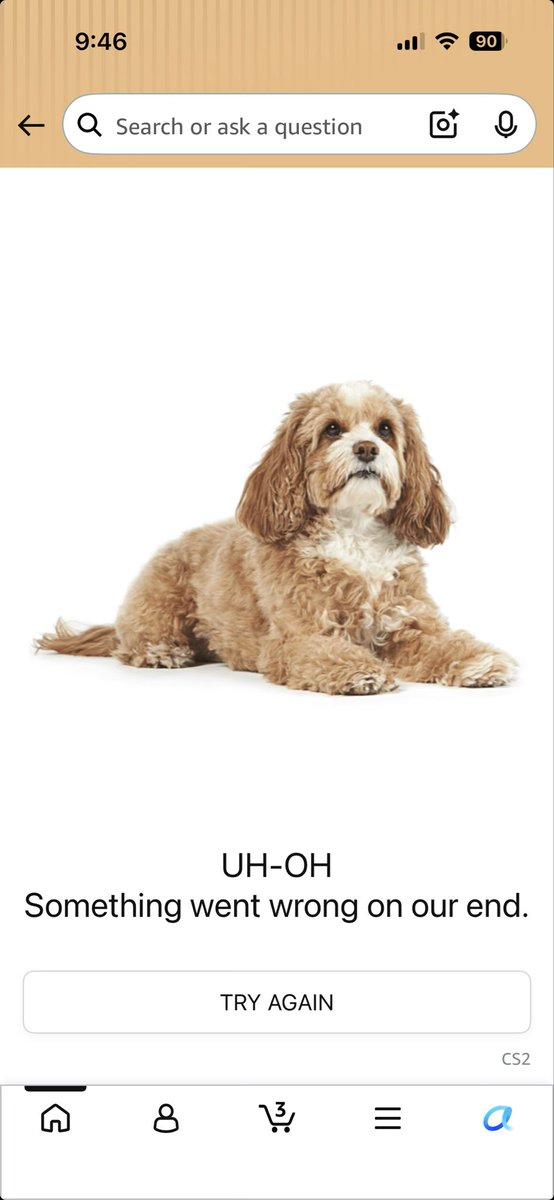
A year ago I couldn’t tell you if or when I’d seen @amazon ‘s apps crash/fail.
But lately, I feel like this little guy is becoming an almost daily companion.
Hey buddy, how you doin? Flaky software getting you down?
31
Jun 13
The most remarkable aspect of this article is the sense of “well that’s obvious” I felt while reading it.
Organizing your codebase for AI is an exercise in returning to first principles. Remembering how we think, assess, self-reflect, improve, and apply our craft.
Jun 13

Effing outstanding. Nice work!
30
Jun 11
This is a great rundown of how political correctness, such as is, works and plays out in today’s world.
Worth watching. Good stuff.
1
12
Jun 10
How cool!
What lovely product placement for @RememberThisPod in Your Friends and Neighbors!
Dunno if it was love from the producers or a kind request, but it was classy - right on a simple coffee mug, zoomed all in nice and clear - love it!
2
18
Jun 9
I’m going to create a generic but extremely useful kanban tool for agents.
It will be free and amazing so I can become world famous.
This must be true.
Because I will call it kahnbahn, and finally get the world to pronounce the damn name correctly.

2
48
Jun 1
Damn.
Imagine, just playing with a space sim … and it’s literally what actual astronauts use.
It’s like Flight Simulator for space, but … almost real?

i think spacex browser game just fixed my fried focus, lol
spent 20 min last night manually docking a crew dragon to the iss and my head went dead quiet for the first time in weeks.
it's the real spacex sim, free, runs in the browser, no install. ease the translation in, null your rotation rate, hold the crosshairs dead center, soft capture.
and that's the actual manual procedure the crew falls back on if autonomous docking ever drops.
iss-sim.spacex.com, go dock something tonight.
71
May 30
There are two types of people who use AI:
1) Those who use it to learn more, faster, than they ever could before.
2) Those who use it to avoid learning entirely.
(Credit to @theallinpod)
31
Scott Pfister retweeted

May 29
Share this with someone that needs it! I believe in you!

542
5,731
26,884
506,055
May 30
Ironic isn’t it?
From coming up with the perfect UX for early internet search - almost all white space and 1 text area, 2 buttons - genius - to … whatever the hell this is.
Android in general came a long way, but even that early success was built on leveraging the innovation from Apple. Kept up well, and surpassed them in some ways too. And yet, with a decade or more of speech recognition, CarPlay/Android Auto, and all the agentic coding/ideation/brainstorming computing power in the world, @Google still doesn’t grasp UX or know how to deliver polished products.
Lucky for them, without Jobs, @Apple’s design and execution are becoming a shadow of what it was. Still great in many ways, but soooo far from what it used to be.
Still, goes to show you, there’s still some opportunity out there for great designers and product owners who really, truly, confidently and competently know how to embrace their product and deliver greatness.
May 30

my dad wanted to use his android phone in his car to play songs on spotify via bluetooth.
he also wanted to control playback by voice. so we tried gemini.
it is madingly bad. half the time it forgets to actually make the tool call. the other half it is unclear if it's listening or not, because the little beep doesn't happen (he can't look at his phonr while driving).
car is too old for android auto. but from my own experience, that's equally bad
how is this not solved yet? why is the ux so atrocious?
41
May 28
This sounds like a fun journey through history.
May 27

I’m making a show about buildings.
The concept is simple: do for the man-made world what Planet Earth did for the natural world.
But, when I pitched the idea, the answer was that nobody would watch it.
So I released a pilot episode on YouTube. It’s got 5.4 million views, 379k likes, and 23k comments.
People are interested, and now it’s time to make the full show.
Six episodes, filming in the UK, France, Belgium, Germany, Italy, and the USA, and releasing on a streaming service like HBO, Netflix, or Prime.
Why does this show matter?
First: we’re surrounded by buildings all the time. Look around yourself, right now… what do you see? Buildings are the logical conclusion of everything a society believes in. That’s the real focus of this show: not the buildings themselves, but what they say about us.
Second: there’s global dissatisfaction with modern architecture. This feeling gets written about online, but nobody’s given a voice to it on film or TV. That’s what this show will be. But this isn’t just about criticising modernity. That’s easy. This is about learning from the past in order to understand and improve the present, for everybody.
Third: there’s a drought of high-quality culture shows. When I spoke to film executives they said that only documentaries about sports, music, or true crime get funded. That’s a colossal missed opportunity. Galleries are always full, content about architecture goes viral online all the time, and people spend their precious holidays visiting beautiful cities.
Why no shows about architecture, then?
Tourists flock in their millions to see (for example) the buildings of Antoni Gaudí in Barcelona. But, if you asked those same people if they’re interested in “architecture”, they’d probably say no.
To put that another way: not many people want to watch “a show about architecture”, but lots of people want to watch a show that illuminates the real world they’re living in, each and every day.
What will the show be like?
Six episodes, going chronologically through history and arriving at the present, each focussing on the architecture and design of a specific period:
1. Middle Ages
2. Renaissance
3. Enlightenment
4. The Nineteenth Century
5. Art Nouveau & Art Deco
6. Present Day
But, in each case, the point isn’t just to learn about that era; the point is to learn about our modern world through those eras and what they’ve left behind. If you watch the pilot episode (included below) you’ll see what I mean.
So the show’s not really “about” the past; it’s about the twenty-first century.
That’s why it’s called The Modern World.
When you think of a typical history show there are loads of interviews, stock footage, archive photos, historical recreations, and graphics. We’re doing none of that. Everything will be filmed on location, because we’re telling our story only through the real world that exists right now. And, rather than going to the most obvious places, we’ll focus on buildings that aren’t well-known but should be more famous.
But that’s all big picture; what will it be like on screen?
Buildings used to look different in every country, and now they look the same. Why? Because the weather is different everywhere, and buildings were always a way of dealing with that weather, using local materials. Now we have air conditioning and we ship concrete around the world, so we don’t need to design our buildings with regard to local weather or rely on local materials.
Look at really old clocks and you’ll notice something: they don’t have a second hand… because it was only invented 300 years ago! Then you look at the present and you realise we’re surrounded by timers, by seconds ticking down and ticking up relentlessly. If we’re looking for a cause of our anxiety-inducing culture, that might be it.
When you spend time with the sun-softened bricks and time-warped timbers of old cities you notice that synthetic materials like plastic have taken over. When we’re surrounded by things that feel temporary, how do you think it makes us feel?
It’s only by seeing 19th century train stations, designed like cathedrals, that you realise tradition and technology aren’t enemies. New things don’t have to look boring: if the Victorians had designed AI data centres, they’d look like Medieval castles.
In the 1920s, at the zenith of Art Deco, people believed technology would uplift humanity. That’s why they decorated their buildings with statues inspired by electricity. Only by seeing their enthusiasm can we realise our own cynicism, and perhaps begin to fix it.
All of that… and much, much more.
But, above all else, this show is about a way of seeing. If you want to understand any society then you need to look at what it creates, not what it says about itself.
There’s a worldview in every single object; our skyscrapers are designed the same way as our phones. Learn to look at this world, to notice its details, and everything else starts to make sense.
What now?
I’ve been quiet online recently because I’ve been researching and working on scripts for six full-length episodes. Production begins when we’ve raised the funding.
The Modern World is coming.
53
Scott Pfister retweeted

May 26
PICARD: Data, shields up
DATA: Brilliant! Shields can reduce damage we sustain. Not immunity. Not hubris. Just prudence. It's not precaution—it's strategy.
[camera shakes]
WORF: HULL BREACHES ON NINE DECKS
DATA: Here's what happened: you told me to raise shields, and I didn't
305
4,861
50,510
1,385,246
May 26
I had no idea Trent Reznor said that…
How extraordinarily generous for an artist to acknowledge the contribution of another, in covering their own work.
Man’s got character, as well as talent. Amazing.

"Hurt" is not an original by Johnny Cash. The song was written by Trent Reznor (Nine Inch Nails) in 1994 for the album The Downward Spiral. Rick Rubin had to insist several times on Cash recording his version, at first Johnny found the idea completely insane because the original version is industrial and noisy. At 71, already very ill, almost blind and with trembling hands, Cash completely transformed the band.
The iconic video, directed by Mark Romanek, was filmed at the House of Cash (his own museum). June Carter Cash appears looking at him fondly, the video was shot in February 2003, a few months before she died (May) and Johnny himself (September).
Trent Reznor was so moved that he declared, "This song is not mine anymore." It is considered one of the best covers of all time.

57
Scott Pfister retweeted

May 26
Mostly down the tubes. We’ve roped a wild stallion that has the potential to become a great racehorse; but we haven’t broken it yet. So it leaps around chaotically throwing its riders on the ground and breaking its corral walls.
There are quite a few of us, trying to figure out how to channel that wild stallion’s energy and directed it towards the race.
Stay tuned.
12
10
182
7,452
May 23
Everything old is new again!
It’s a great day for software craftsmanship!
May 23
My brain is reeling with the implications. I keep having these revelations and I'm beginning to wonder when they will stop.
It turns out that property testing is yet another hardening technique that the agents can profitably engage. Agents can determine whether a function is appropriate for property testing, and can specify the range and domain of those tests. They can implement them quickly, run them, and fix any detected issues.
I just found two production bugs this way. Property testing is going to be part of my normal practice, along with Crap analysis, Function mutation, acceptance test mutation, Dry analysis, etc.
72
Scott Pfister retweeted

May 22
Uncle Bob gets it
May 22
I am absolutely more productive using agents. I don't know the factor but it's large. However much of that productivity is spent tuning the agents and hardening the product. I'm guessing 30%-40%.
Some might consider that a waste; but I don't. The software I'm creating nowadays is vastly more robust than I'd ever been able to create manually.
I don't mean that the code is better. I mean the surrounding tests are vastly better. I have a higher degree of confidence than I ever had manually -- even when I used very disciplined TDD and Acceptance testing.
And then there's the ability to quickly reorganize the modules and the architecture while keeping those robust tests running. That is a tremendous boon.
12
29
687
163,608
May 18
The volume of commercials on @youtube is just obscene. Are they going bankrupt? Some kind of desperation?
It’s like a lame blog site filling the edge with whatever they can cram on the page without burying the content entirely.
Gotta force people into that premium sub, hm?
1
2
96
May 17
Everyone should be following Carter, he’s gonna be the next Gordon Ramsey, just wait!
80
May 14
This is precisely what I’ve come to embrace as an “old guy” in tech:
1. Embrace humility.
2. The more you know, the more you realize what you don’t know.
3. Strong opinions, loosely held.
Never, ever be absolutely certain of your conclusions - hic sunt dracones!
May 14

De mes 15 à 30 ans, j'ai fait de la tech. Beaucoup. J'ai appris sur le terrain tout ce qu'on peut apprendre sur scaler des systèmes, écrire du code, faire tourner une boite.
Depuis 6-7 ans, j'ai basculé une grosse partie de mon temps sur la philo, la psycho, comprendre l'humain. Parce que tu peux pas créer une startup ambitieuse sans comprendre les gens.
Et il y a un trait que je trouve hyper ancré en France, et qui m'obsède : l'ego mal placé. L'incapacité totale à reconnaître qu'on a tort.
Les gens ne veulent pas gagner. Ils veulent avoir raison. C'est pas la même chose. Et c'est même souvent l'opposé.
Le sujet de l'IA est devenu le révélateur ultime de ça.
Il y a deux ans, j'étais dans un cocktail à Paris où Yann LeCun et Geoffrey Hinton débattaient. Deux des plus grands chercheurs vivants. Prix Turing. Et je les regarde, fasciné : ils débattent littéralement comme des gosses dans une cour de récré. Chacun absolument convaincu d'avoir raison. Aucun espace pour le doute.
Et la vérité c'est que ni l'un ni l'autre ne sait. Personne ne sait.
Toutes les études sur la prédiction le montrent : les experts sont parmi les plus mauvais à prédire l'évolution de leur propre discipline. Tetlock l'a démontré sur 20 ans. La raison est simple : ils sont tellement verticaux sur leur domaine qu'ils perdent la capacité à zoomer out.
Moi, sur l'IA, j'ai arrêté d'avoir des certitudes. Tout ce que j'exprime sur le sujet sont des croyances et des intuitions. Pas des vérités. Un mélange d'empirique et d'instinct.
Je sais que je ne sais rien. Mais je sais défendre mes convictions comme jamais.
Sur la conscience de synthèse, on n'a même pas le début d'un commencement de compréhension. Zéro. On ne sait pas définir la conscience humaine, alors prétendre savoir si une machine peut en avoir une, c'est comique.
Si demain de nouvelles données vont dans le sens du possible, je changerai d'avis. Je passe mon temps à changer d'avis.
C'est ça la marque de l'intelligence : pas la certitude, l'updatabilité.
1
122
May 14
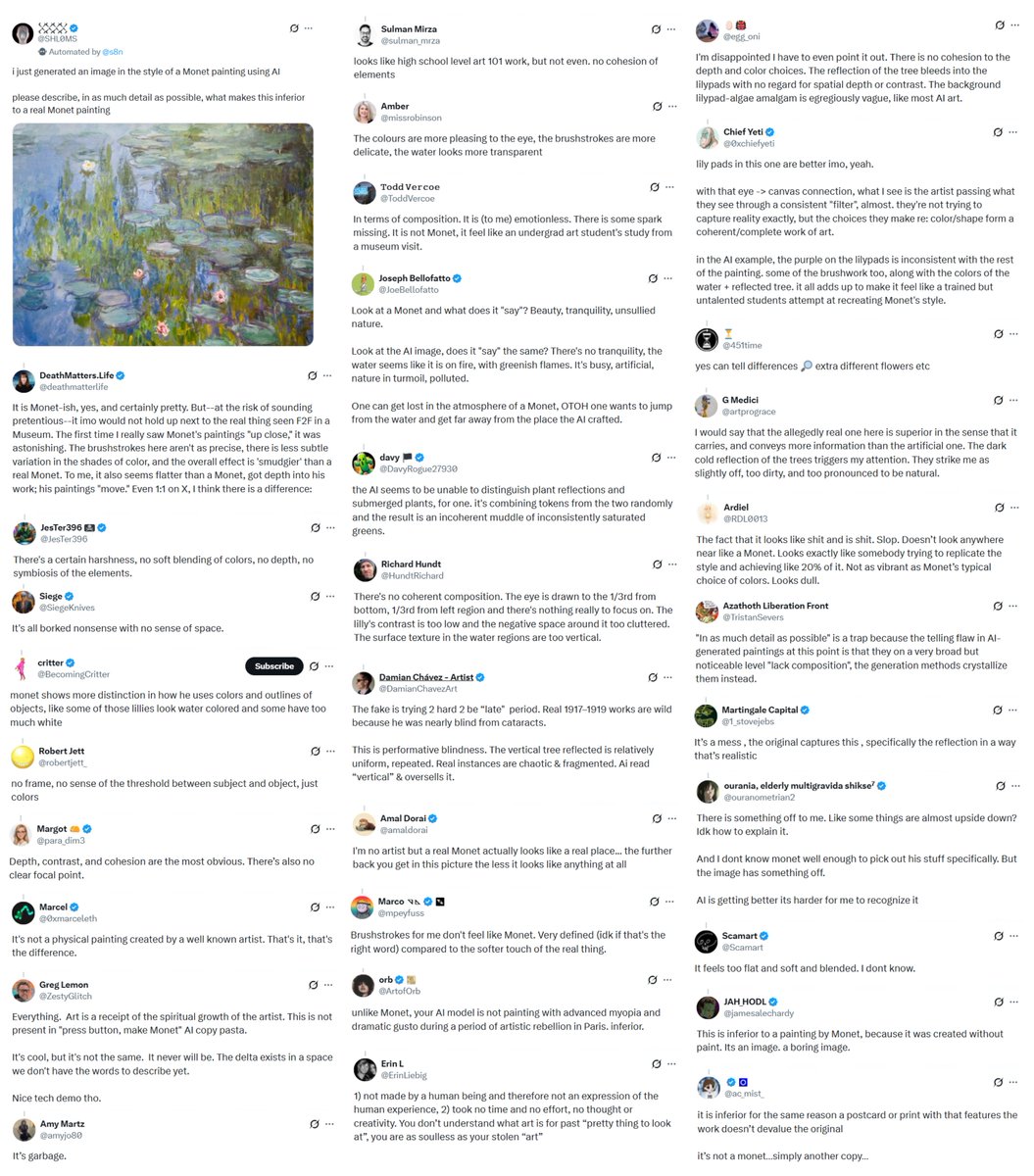
Just like when the museum staff forgets a bucket or ladder in the display space, and suddenly it becomes “modern art” with “profound commentary on the mundanity of modern life”.
Despite the massive subjectivity of the entire concept of art, it triggers such arrogant dogmatism.

What happens when you post a real Monet and say it’s AI? The coolest art social experiment I’ve seen in a while. Thank you @SHL0MS
85
May 13
Best new cooking influencer yet!

🧑🍳Chicken nuggets but make them healthy with ! Can you guess which veggie is hidden inside these Superstar nuggets?! ⭐A perfect snack or mid-week dinner at home🏠
55