
We built the stock analysis app we couldn't find anywhere else.
Joined March 2026
- Tweets 781
- Following 51
- Followers 40
- Likes 11
30 Photos and videos
- $IREN closes $3.65B GPU financing facility linked to Microsoft AI cloud contract — advances 800MW data center plans
- Goldman Sachs predicts AI infrastructure spending could exceed $1 trillion in 2027
- Google DeepMind, Google, and Wellcome Sanger Institute announce five-year AI collaboration for genomics
- Xbox fans waiting on Project Helix get unexpected news from Wedbush
- May CPI jumps to 4.2% — recession fears intensify as core inflation remains elevated
- Roku jumps 20% on buyout speculation — no deal confirmed, shares remain volatile
- 3 Uranium Stocks Worth Buying as Nuclear Heats up in June
goodmoat.com/markets/macro/2…
68
- Anthropic's Claude Fable 5 release — Amazon, Google, NVIDIA, and SPCX cited as beneficiaries with room to run
- Marvell Technology stock surges — up 229% in 2026
- Prem Watsa adds 1.2 million shares to Under Armour — insider buy amid double-digit stock decline
- Ligand Pharmaceuticals director sells 2,501 shares — insider sale amid strong share price gains
- SpaceX IPO sets record — AI bull market gains further runway, per Wall Street analysts
- Stock market nears priciest valuation since 1871 — S&P 500 within striking distance of 155-year record CAPE ratio
- Consumer Tech News (Jun 8-12): SpaceX Debuts On Nasdaq, Big Tech Faces Political Scrutiny & More
goodmoat.com/markets/macro/2…
70
- $GOOGL raises $84.75 billion in debt offering — funds $180-190 billion AI budget
- Rivian CEO announces unsupervised driving feature this year — eyes-off driving targeted for next year
- Nayax CTO and co-founder sells 30,000 shares for $2.2 million — insider filing shows direct stake reduction
- Seniors Just Got a Big Clue on Social Security's 2027 COLA
- Sharplink Insider Trims 12,892 Shares After a 116% Run — Here's What That Means for Crypto Investors
- Senior Independent Director of Mpac Group Picks Up 100% More Stock
goodmoat.com/markets/macro/2…
32
- $AMD secures largest AI chip deal with Meta, including up to 160 million share warrants — Instinct GPU rollout to 6 gigawatts
- Amazon CEO Jassy raised security concerns triggering restrictions on Anthropic's Mythos AI models — internal ban enacted
- SharonAI Holdings shares draw attention after NVIDIA AI compute deal for 72MW Australian data center — P/B ratio at 11.3x
- Bitcoin down 21% in one month — holders dumping coin
- Barclays lowers Chubb price target to $368 from $375 — CB shares face margin pressure concerns
- Domo (DOMO) Q1 Earnings: What To Expect
- Man paid to tattoo meme coin on his forehead — then the typo became a real coin
goodmoat.com/markets/macro/2…
70
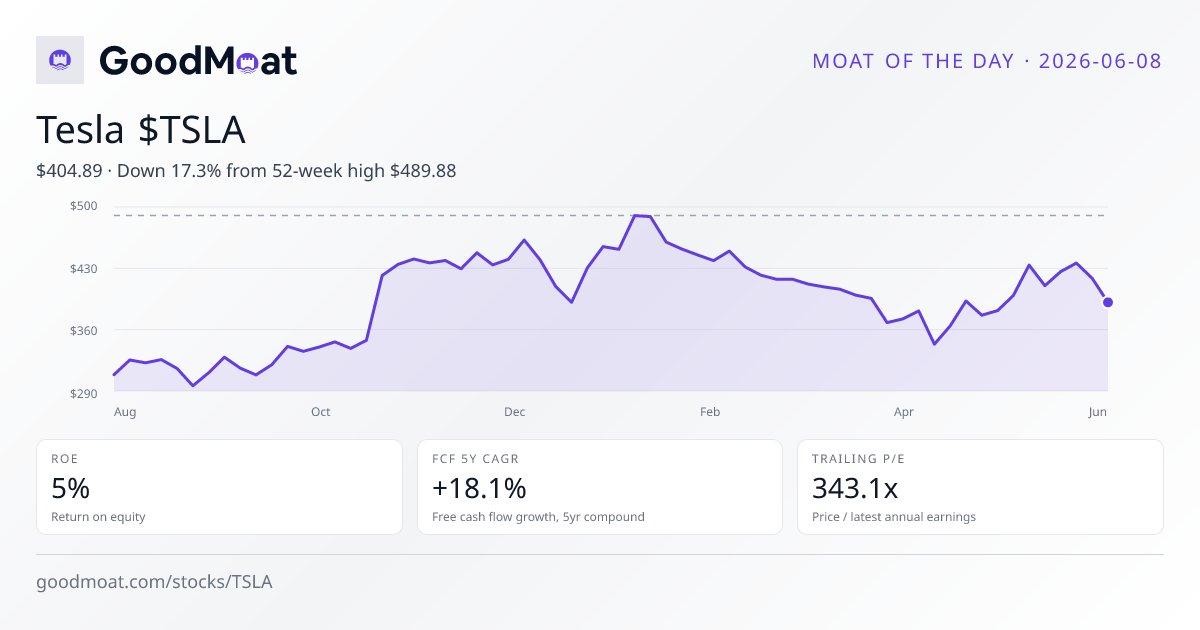
- Cathie Wood sells $16.2M of $TSLA — Ark reduces highest-conviction investment amid stock decline
- Alphabet's SpaceX stake becomes liquid after IPO — Alphabet gains publicly traded position in SpaceX
- Nebius Group joins Nasdaq-100 Index — June 2026 rebalance adds NBIS to AI infrastructure index
- Vertiv stock up 173% yearly to ~$302.87 — AI infrastructure rally raises valuation questions
- SpaceX IPO raises $75 billion — sets stage for potential filings from OpenAI, Anthropic, Anduril
- Bristol Myers Squibb dividend yield reaches 4.5% — payout appears reasonably safe
- How Insurance Companies Turn Their Premiums Into Billions in Profit
goodmoat.com/markets/macro/2…
74
- Broadcom ($AVGO) expands Spring Security with largest open-source update in 23-year history — net income of $23.13B (FY25) and profit margin of 38.85%
- NVIDIA (NVDA) partners with LG Group on humanoid robots and data centers — net income of $120.07B (FY26) and profit margin of 62.97%
- $35B AI Infrastructure Platform Plan Affirms Broadcom Inc. (AVGO) As a Promising Growth Stock to Buy
- NVIDIA Corporation (NVDA) Partners with Nebius to Support AI Robotics Startup in Europe
- Citigroup raises S&P 500 year-end target to 8,100 — corporate earnings and AI-driven growth cited
- Wells Fargo trims PepsiCo price target from $160 to $150 — maintains Equal Weight rating
- Amazon, Inc. (AMZN) Pursues Canadian Bond to Finance $200B AI Data Center Investment Spree
goodmoat.com/markets/macro/2…
1
51

Jun 13
- SpaceX stock closes up 19% in first trading day — valuation questions remain after debut pop
- RBC Capital cuts Zillow price target from $95 to $70 — maintains Outperform rating
- Apple sits out AI spending arms race — AI stocks sell off, Apple's restraint viewed as strength
- Why I'd Buy Ethereum Over Bitcoin Right Now
- 54 nations meet in Washington to build mineral economy without China — largest critical minerals gathering ever
- Why Meta Platforms Might Be a Good Buy Right Now
goodmoat.com/markets/macro/2…
33
Jun 13
- Lumentum enters multi-year $NVDA partnership with $2B commitment — focuses on AI data center optics
- Apple releases major Siri AI upgrade — real challenge begins for adoption
- Nebius reports 684% revenue growth — more growth expected ahead
- Prediction: SoFi Technologies Stock Will Double Within 1 Year
- SpaceX IPO generates windfall for Wall Street banks — JPMorgan, Goldman Sachs, Morgan Stanley among underwriters
- Bank of America warns stock market may face 1994-style shock — inflationary pressures, higher yields, tighter conditions cited
- Nvidia CEO Jensen Huang Says This Will Be the Next $1 Trillion Company
goodmoat.com/markets/macro/2…
74
Jun 13
- $ANET Networks up 5.8% after raising 2026 revenue outlook on AI networking demand — introduces 1.6-terabit platform
- Navitas Semiconductor down 6.7% after filing US$500 million ATM equity program — Nvidia MGX tie-in fails to offset dilution fears
- JPMorgan Chase Is Eyeing 7% Net Interest Income Growth. Why That Goal Just Got Easier to Believe.
- Multi-state probe into OpenAI's data practices and AI safety — IPO timeline faces regulatory uncertainty
- Roku Stock Skyrocketed on Friday. Investors Should Be Paying Attention.
- JPMorgan Backs Bezos AI Startup Prometheus To Expand Industrial AI Reach
goodmoat.com/markets/macro/2…
57
Jun 13
- $AAPL's 134% five-year gain prompts $600 price target speculation — no official change
- Cathie Wood asks Elon Musk how Tesla handles parking tickets after robotaxi ride ends in $75 ticket
- US-Iran peace deal prospect lifts geopolitical risk premium — Coherent, Applied Digital, Everforth stocks trade up in afternoon session
- SpaceX stock soars on blockbuster first day of trading in largest IPO of all time
- The AI Boom's Next Bottleneck Is Electricity. These 3 Stocks Are Positioned to Power the Build-Out.
- Broader REIT Market or Lower-Cost S&P 500 Real Estate? RWR vs. XLRE
goodmoat.com/markets/macro/2…
91
Jun 13
- SpaceX IPO gains 19% on debut — $TSLA closes 2% higher
- AI coins surge after Elon Musk's SpaceX begins trading on Nasdaq
- Adobe stock falls on AI-powered threats forcing new growth strategy
- Poet Technologies stock down 39% from 52-week high after recent pop
- Roku explores potential sale, shares surge over 20% on Friday
- Bitcoin Perpetual Futures Are Now Available for Trading. Here's What You Need to Know.
- Here's How Much $1000 Invested In Vertex Pharmaceuticals 10 Years Ago Would Be Worth Today
goodmoat.com/markets/macro/2…
1
116
Jun 12
- Intel among stocks making big moves this week — $INTC shares volatile after weekly trading
- Arthur Hayes: Bitcoin Got 'Thrown Out With The AI Bathwater,' But Three Factors Could Pop The Bubble
- SpaceX stock gains, space companies fall, chips mixed on IPO news — NVDA shares mixed amid broader chip sector moves
- Brent oil drops below $90 as US-Iran peace deal nears — Strait of Hormuz reopening expected
- I went to a SpaceX IPO protest. The target wasn't just trillionaires — it was Wall Street.
- The SpaceX IPO May Be Quietly Creating A Massive Bitcoin Opportunity
- Wall Street Analyst: SpaceX IPO Could Unleash Billions in New Public Offerings
goodmoat.com/markets/macro/2…
140
Jun 12
Small caps led today. Russell 2000 outpaced the pack at 1.1%, while the S&P 500 added 0.6%. A clear risk-on tilt, with more appetite for the cheaper end of the market.
1
9
Jun 12
Fear & Greed is still stuck in fear at 33, even with the tape green. $INTC and AMD kept the bid alive while ADBE dragged. Full dashboard: goodmoat.com?ref=market_clos…
74
Jun 12
- $INTC shares up 8% in midday trading near $127 — outperforming AMD and NVIDIA among mega-cap chip stocks
- Meta commits $115 million to workforce academy, Reliance to build 168 MW data center for Meta in India
- Forget ASML: As Post-June 5 Volatility Shakes High-Beta Tech, This Dividend-Paying Chip Index Is a No-Brainer Buy
- SpaceX and Tesla merger chatter is heating up. Here's how Musk's companies work together.
- SpaceX IPO surges on Nasdaq debut — SPCX shares soar in first-day trading, lifting AI and aerospace names
- Planet Labs stock crashes on SpaceX IPO — PL shares drop without other news, down on competitive pressure
- Forget Micron Technology: 1 Record-Breaking Cloud Powerhouse to Buy Hand Over Fist After the Pullback
goodmoat.com/markets/macro/2…
138
Jun 12
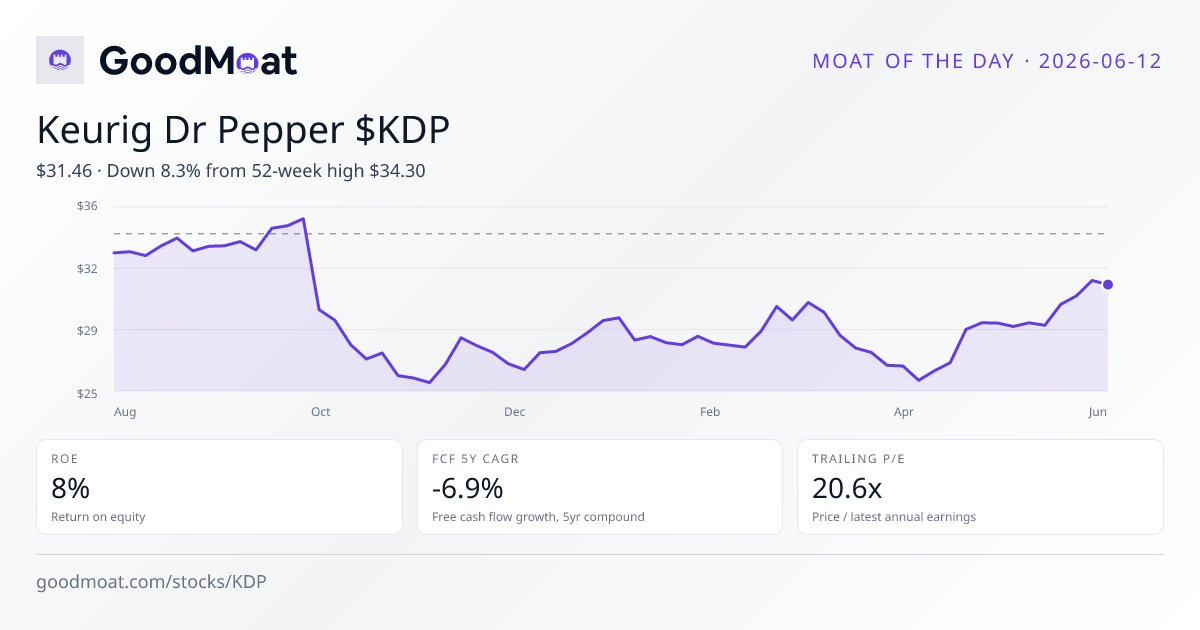
Keurig Dr Pepper is still exposed to a simple risk: beverage moats can look sturdy until consumers shift tastes, retailers push harder, or a brand loses shelf space. If that starts showing up, the business can feel it fast. The question is whether that is happening at $KDP.
KDP sells the drinks people already know and keeps them moving through a distribution system that is hard for smaller rivals to copy. It owns brands like Dr Pepper, Canada Dry, Mott’s, and Keurig, and it has the #1 single-serve coffee brewing system in the U.S. and Canada. That matters because when you swipe a Keurig pod or a Dr Pepper pack into your routine, the company is embedded in habits, shelf placement, and retailer relationships, which is the moat in plain English.
If the moat were eroding, the numbers would usually show it. Instead, revenue compounded 7.4% a year over the last five fiscal years, ROE rose to 8% from 6% three years ago, and annual EPS jumped to $1.53 from $1.06 a year ago. Free cash flow is the softer spot, compounding at -6.9% a year over five years, so the cash story has not been as clean as the revenue story. Share count was also down 0.3% year over year, so buybacks are still doing a little work.
The market is paying 20.6x trailing earnings today, down from 31.3x a year ago, which means what the market is willing to pay per dollar of earnings dropped even as EPS improved. That is the gap: earnings power has held up better than the stock’s valuation.
Our DCF lands at $27.20 versus a current price of $31.46, so the open question is whether KDP can keep turning brand strength and distribution scale into cash flow growth, or whether the weaker FCF trend is the first sign that the moat is less durable than the headline brands suggest. See for yourself: goodmoat.com/stocks/KDP?utm_…
15
Jun 12
- SharonAI announces $NVDA AI factory deal — shares rise on plan for 40,000 GB300 GPUs in Australia
- Amazon custom chip business sees huge demand within AWS — cited as unlikely source of future stock gains
- Mega IPOs from SpaceX, Anthropic, and OpenAI plus AI hyperscaler share sales — Capital Econ warns IPO boom could test stock market
- SpaceX IPO opens at $174 indicative price, 29% above $135 IPO price — Space ETFs ORBX, NASA, MARS, UFO sell off
- Report of Iran deal could put Fed rate hikes on hold — inflation readings moving higher, producer prices accelerating
- Value Investors Question SpaceX's Record IPO: 'It's The Future That Kills You'
goodmoat.com/markets/macro/2…
174
Jun 12
Trending on GoodMoat today.
$ELVN (Enliven Therapeutics Inc) — broad interest building, up 9.1%
DAN (Dana Inc) — lit up across the board, down 15.1%
ADBE (Adobe Inc) — multi-signal trending, down 6.2%
NAVN (Navan Inc - Class A) — sharp price move, up 8.4%
IDCC (Interdigital Inc) — momentum building, up 9.0%
These are signals worth watching, not recommendations.
Full breakdown: goodmoat.com/trending?utm_so…
76
Jun 12
- Citi upgrades $AMD to Buy, raises price target to $575 from $460 — emerging as 'legit second source in the GPU market'
- Lucid Group down 9.0% after Gravity OTA upgrade highlights innovation amid securities lawsuits
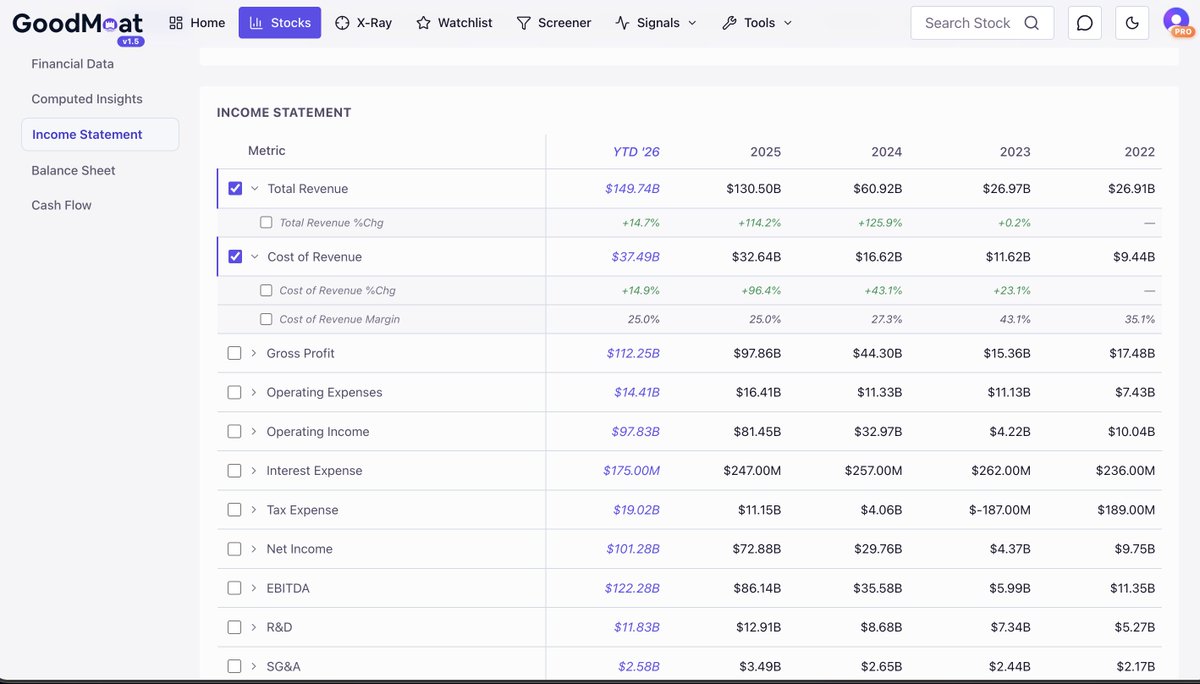
- Tesla stock and robotaxi progress put lofty valuation in spotlight — unsupervised robotaxi rollout in Austin, FSD approvals in Belgium and Denmark
- The Death Cross Is Lying: Why Wall Street Is Still Loading Up on Hershey and Vertex
- SpaceX begins trading on Nasdaq under ticker SPCX — Wolfe Research initiates with Outperform rating and $175 price target
- Global equity funds draw third consecutive weekly inflow — investors add exposure to technology stocks after market selloff
- Forget JEPI, Goldman’s S&P Income ETF Has Beaten It by 42 Points Since Launch
goodmoat.com/markets/macro/2…
1
138