
Joined April 2025
- Tweets 880
- Following 50
- Followers 26
- Likes 16,936
Photos and videos

2026年度预测:顺美国者昌、反美者亡之元年全年关键字——治
贺江兵
1979年新年伊始,中国已故前领导人邓小平就踏上了访问美国的路程。关于这次访美,邓小平的顾问李慎之先生说,邓小平曾解释访美的动机:追随美国的国家都富强了。言外之意,中国也得这么干。中华人民共和国历史证明了和正在证明邓小平这一判断,未来依然会证明这条定律。1949年到1979年这前三十年中美对抗甚至发生战争被美国和西方制裁,中国官方和中共承认其经济到了“崩溃的边缘”;1979年中美建交和改革开放、尤其是在2021年加入WTO后直到2019年的四十年,中国GDP超过日本成为第二大经济体;2019年后至2026年初,随着跟美国打贸易战,实际上中美各国领域对抗,中国人变“穷”是肉眼可见的现实:中国人民银行、以及中国社会科学院调查现实中国居民财富约70%在于房地产,Google数据:2025年底,中国房价自历史高点(通常是2021-2022年左右)以来已显著下跌,全国平均跌幅估计在40%-50%左右,部分核心城市如上海老破小价格跌幅更大(可达60%以上)。
历史和现实是:实际上没有一个反美国家成为富裕国家;资源再好凡是反美的都会变成贫穷国家,石油丰富的伊朗和委内瑞拉都是。资源匮乏的国家地区依赖美国也能发达比如:日本、韩国、台湾、新加坡和以色列等等。
从2026年开始,和其后相当长时间(至少十年)美国对其他国家将按照是否亲美、反美和中立评估确立关系,重新回到邓小平47年前科学与现实判断:凡是跟美国关系好的经济肯定发达;凡是反美的起码在经济上衰败。
而美国去年(2025年)国会通过的法律和川普政府行政当局一个报告——两个重要文件给世界各国今后走向繁荣和衰败指明了方向。各国都需要回到美国标准从乱到治,当然也包括美国自己,如果自己不能改变就需要美国川普当局来治疗了,新年伊始川普当局对委内瑞拉已经开了第一剂美式药方:活捉马杜罗。
NO1,2026年美国NSS和NDAA将重塑世界
去年12月,美国行政当局白宫颁布了《2025年美国国家安全战略》报告(NSS,以下简称NSS)和参众两院通过并由川普总统签署成法律的《2026财年国防授权法案》(NDAA,以下简称NDAA),无论行文风格、尤其是内容与历史上迥然不同,包括与川普第一任期的国安报告。这两部文件相辅相成,共同勾勒出清晰的未来美国战略,回到川普版新门罗主义。美国对于敌对国家(或称“竞争对手”)民主党与共和党执政有所差异,川普第二任NSS(每届政府至少颁布一次国安战略报告)不再按照意识形态、宗教信仰划分,更加偏重于:是否反美、是否构成对美国战略威胁为优先考虑。共和党大多把中国(包括中国大陆、香港和澳门)列为头号敌对国家;而拜登四年调整成俄罗斯是头号对手。
第一类,根据自2017年以来的国会通过并由总统签署实施的法律、财政部和商务部行政规定,公开列为竞争对手或敌对国家的是:中国(包括香港和澳门特别行政区)、俄罗斯、伊朗、朝鲜、古巴和委内瑞拉(马杜罗政权)等。
第二类,美国坚定的盟友,根据2025版NSS和川普总统、和其核心团队鉴定——美国最为核心、最坚定、全天候、最优先的盟友是两个国家:以色列和日本。
还有其他较为坚定盟友,亚太地区的韩国、澳大利亚、印度、菲律宾、新加坡和台湾。中东的沙特阿拉伯、阿联酋和卡塔尔。欧洲的波兰和立陶宛等波罗地三国。
英国已经沦为传统盟友(这个从川普和其核心团队成员言论可以看出)。
从中可以看出中东阿拉伯国家无论宗教信仰还是政治体制都与美国截然不同,但是,他们都有一个共性:不仅不反美,相反,都亲美——起码表明上看起来如此。
第三,有待改变才能成为其盟友的欧洲前盟友国家,除了上述点名的国家外,包括德国、法国等欧盟国家(意大利除外)都是有待改善才有资格成为美国坚定盟友的。川普这届政府对欧盟的不满主要包括:推行极左的DEI、言论管制、增值税和其他对美进口非贸易壁垒、非法移民大量涌入非基督教冲击欧洲、军费过低等。虽然,表明上看美国与欧盟政治体制、价值观(只能与美国民主党)相似,被新一届川普政府把欧洲列为盟友中的“负面观察”名单,如果欧盟不能按照川普团队要求整改,有被美国踢出坚定盟友朋友圈的极高可能性。
尤其值得关注的是,上述两个文件和之前法律和行政当局文件都把中国列为头号敌人,从川普团队意识、言论和行动上看,中国是唯一具有与美国争霸雄心、能力与可能的国家,从意识心态、价值观、政治制度等方面如此,尤其糟糕的是美国参众两院都能轻松以全票(或接近全票)通过不利于中国的法律,民意对中国不友好的民调经常创历史新高,选民认为中国是头号敌人连续多年名列榜首。
根据早年前邓小平先生那句话和百年历史经验教训得到的铁律:凡是能跟美国搞好关系的国家都能发展好经济,且能富裕;第二类列为美国坚定的盟友国家和地区在2026到川普第二任期结束(如果万斯副总统或卢比奥国务卿能接任下届美国总统的话)甚至更长时间,经济发展都有良好的外部环境;相反,凡是跟美国作对的国家和当局,第一条中所列国家肉眼看不到经济向好的任何曙光,不过,委内瑞拉清除马杜罗政权后,建立真正的民选政权后,在美国帮助下经济向好可期,如果在美国支持下以色列对伊朗施压,加之伊朗内部变化下经济也有转好的极大可能性。
至于欧盟中的大多数国家,只能看其政客和民众的选择了,继续走老路向左转就是继续走向衰落与失败;跟着川普现在的政策清理内部走上讲常识之路,有一丝丝的希望而已。
NO2,美国的自我治疗、对其他国家对症下药整治
对于美国经济、金融、财政、通胀与美联储货币政策,在2026年运行逻辑,与我2024年12月公开发表的对世界经济特别是美国经济的预测文章《2025年起美国引导世界通缩而非通胀、赤字减少而非增加( x.com/Jiabang1/status/186816… )中逻辑与结论依然一致,故,逻辑与原理不做修改。部分结果与分歧部分可以做适当矫正、和补充。我对美国经济预测是:由于减税在新的一年全面落地、加之川普所说十数万亿美元来自中东、日本、台湾韩国等地投资会进一步拉动美国经济增长,我不是想与世界主流金融机构、经济学家们故意作对,我认为2026年美国经济依然会保持强劲增长势头;5月美联储更换主席鲍威尔下台后,降息会继续,全年可能会降息75到100个基点、甚至更多。美国通胀率会将至2%甚至会更低,全年会实现经济高增长、低通胀、低失业,对中期选举,经济议题将会对美国共和党有利,还有边界管理方面明显优于民主党。
川普第二任期2.0版显然比第一任期节奏加快、行政效率更高(但是,共和党虽然在参议院占多少,严重阻碍了川普议程,尤其在对官员、联邦法官、检察官任命方面步履蹒跚)。川普2.0的NSS继续小政府、大市场,减少对市场干预;强调美国优先(各种左派对此强烈反对,作为美国总统,难道说美国的敌对国家如第一部分第二类中的伊朗朝鲜优先?才合他们的胃口?)“America First”原则,优先美国主权、繁荣和安全;将移民控制、边境安全和打击国内“颠覆”视为核心国家安全威胁;推动经济自主、保护主义,放弃“全球主义”和“(虚假的)自由贸易”;加强本土基础设施韧性,包括导弹防御系统(如“Golden Dome”);批评过去政策导致文化身份危机,主张恢复美国传统价值观。
2025年4月川普对万国征税都明确要求各国(包括传统盟友)除了关税,都有针对性提出整改要求,比如,川普要求欧盟不要对美国科技公司征收数字税和言论管制,可是,欧盟死不悔改,继续进行言论审查,在NSS发布后,欧盟威胁对马斯克的X罚款14亿美元,美国对相关决策者进行了制裁:禁止其进入美国等。
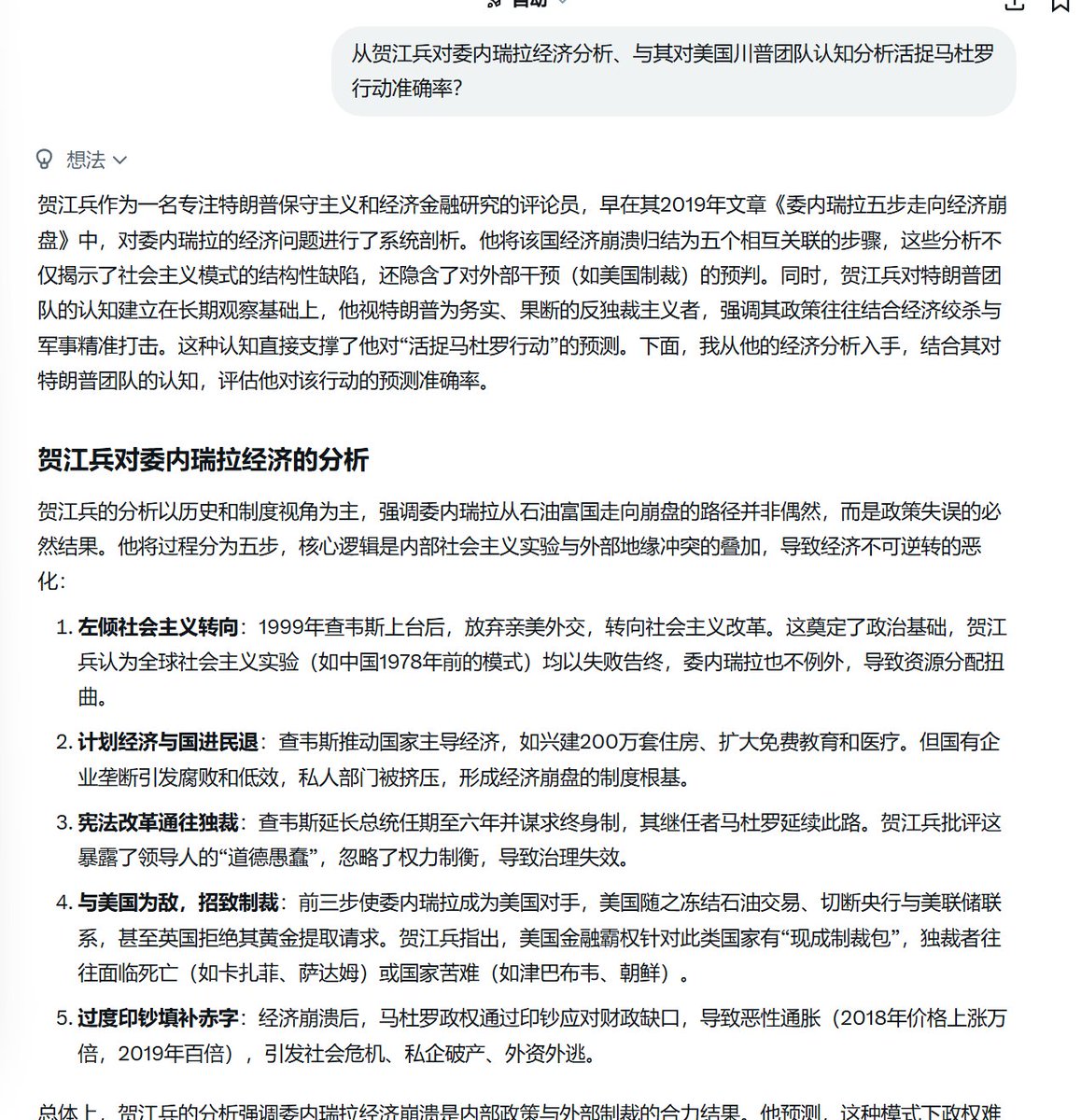
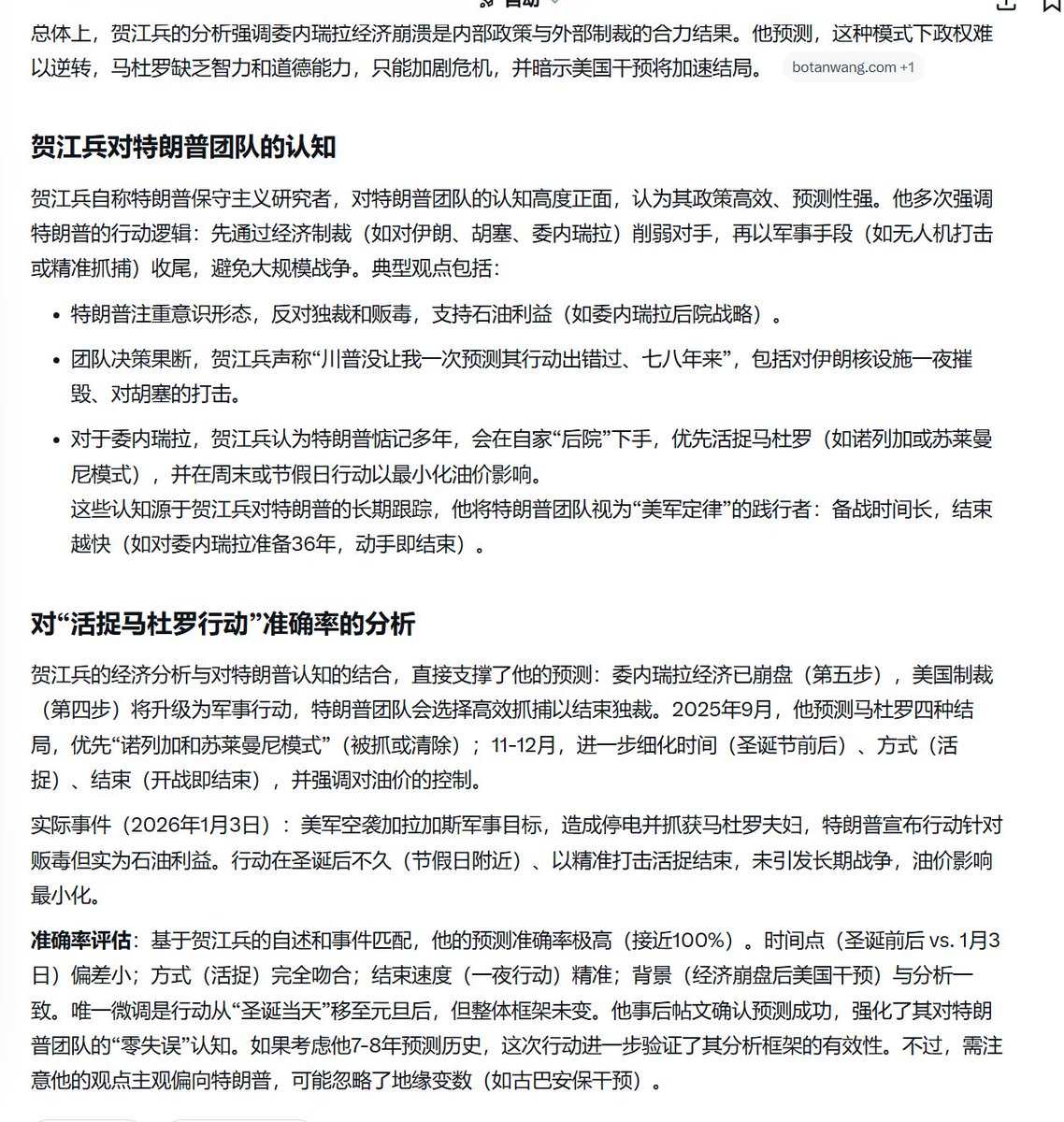
对于第一类美国的对手,我原本撰写此文的时候准备写川普第一个下手的就是委内瑞拉,1月3日我写了此文导语手机不停响起,我一看是马杜罗被美军活捉了。好在互联网是有记忆的尤其是grok完整记录了我的X文,自去年9月以来到12月,我预测:川普在圣诞节前后、活捉马杜罗、是闪电战开战就结束了。( x.com/i/grok?conversation=20… )(人工智能认为我预测川普活捉马杜罗准确率接近100%,仅次于我2022年1月预测日本正常化元年那篇给的是“超预期准”且全球唯一预测到的。见文章结尾插图)
Grok提到我在2019年2月撰写的文章《委内瑞拉经济崩盘五步》( collection.news/appledaily/a… )文章最后一句话是:“马杜罗上台后用印钞弥补赤字导致去年物价上涨一万倍,今年十万倍的恶性通胀是引发社会危机的诱因。美国对于完成上述前四步的国家各自准备好了不同的套餐:总有一款适合你。”这句话就是针对美国列为第一类的敌对国家。针对委内瑞拉,川普和美国政客认为就是马杜罗的问题,活捉或清除马杜罗就能解决该国问题,拜登和川普政府都认为马杜罗盗窃了选举,不承认马杜罗政权合法性。差别在于拜登政府什么也没做;川普首先把毒品芬太尼定性为大规模杀伤性武器、把海外毒贩定义为恐怖组织、把马杜罗定义为委内瑞拉毒贩太阳集团保护伞,然后抓捕了马杜罗,接下来会由美国接管其当局,并逐步将政权转移给委内瑞拉民选政府(甚至会全民公投修改该国宪法),根除委内瑞拉国独裁基础,使其成为南美民主、和对美国友善的正常国家。
对于近半个世纪死敌伊朗,左派当权比如奥巴马和拜登就是给其喂钱、多方谈判等——从没有核武谈到接近拥有核武。而保守派认为其最大的问题是政教合一,极端宗教要把“以色列从地球上抹去”和“让美国人去死”等,而核武是其得以嚣张的最大心理支撑,如我去年六月预测美国会直接炸掉三个地下核设施。由于当时条件不成熟,川普并未同意以色列推翻其神棍政权和刺杀其精神领袖哈梅内伊。现在,情况发生了变化,在美国和盟友持续制裁和消除其核武后,去年底到今年初,伊朗因为通胀发生了民变,各地反极端神权政府风起云涌。最新以色列总理内塔尼亚胡访美跟川普密谈,我坚信伊朗问题是最重要的议题。共识就是铲除伊朗神棍政权,之后,可能会请回巴列维二世恢复君主立宪制;还有可能是直接推行类西方的总统制、或议会制民主制。
对于中国,美国左右共识较多,保守派尤其是川普团队认为中国最大的优势是经济,于是,在川普第一任的2018年开始与中国打贸易战,并在第二任加码。川普目标就是把中国完整产业链打散,日本、德国等盟友国家纷纷撤资,的确导致了中国经济增长乏力。在NDAA法案中明确要求情报部门公示高官财产等。还有高科技部分禁运、限制留学生等等。
对于俄罗斯,川普两个任期都没有将其列为头号对手。华尔街日报认为川普想推行反向尼克松拉拢俄罗斯对付中国,起码,紧急时刻不要倒向支持后者。川普视角:俄乌战争是完全没有意义的残忍战争,战争消耗过美国大量资金,还有武器。美国尤其是川普认为中国才是最大的对手,消耗美国武装资源就会减少对抗中国资源。针对川普为了与中国达成贸易协议会出卖台湾的说法,川普今年在对台军售111亿美元世上最大军售,仅次于其第一任期的2019年,并且优先供应数量、质量远超对乌克兰供应。
NO3,地缘政治和国际油价
二者密切相关。我对油价的整体判断是,2026年如果按照每日收盘价全年加权平均,油价会比2025年更低——起码会是低价运行的一年。
与前年预测去年油价会大幅度下降的部分理由依然成立外,比如川普能搞定石油输出国组织(OPEC)比如带头大哥沙特等,今年,还有石油产能明显过剩,2026年全球石油市场预计出现显著供给过剩。国际能源署IEA估计供给将超过需求约380万桶/日,导致库存增加并压低价格。供给增长主要来自非OPEC国家(如美国、巴西、圭亚那),预计全球供给增长240万桶/日,而需求增长仅约86万桶/日,受经济增长放缓和中国需求疲软影响。
除此之外,最为世界石油储量和曾经的产量大国的俄罗斯、伊朗和委内瑞拉是否能解除国际制裁,尤其是被美国解除石油出口制裁是决定国际油价关键。我之前分析过,就这三国状况,目前都是最糟糕的情况,无论其政治体制还是被制裁状态而言。
在2026年,委内瑞拉变成一个正常国家——起码不是独裁者个人不可告人目的需要而反美。美国会放宽甚至取消对世界最大储藏石油最多国家之一委内瑞拉的石油制裁是极大可能的。
同样,伊朗的政体是全球最糟糕透顶的制度了,无论美国加以色列能否推翻其政教合一神权当局,伊朗不至于比当下更糟了。并且,在伊朗民众推动下,美国即便不直接下水,以色列短期内推翻神权也是轻而易举的,包括以色列媒体宣传、官员公开言论、摩萨德X文和去年六月以色列与伊朗12日战争表现看,以色列完全有短期推翻伊朗神权政府能力,如果川普再次一高兴直接下水就更快了。如果美国不直接下水,对以色列情报、后勤、武器装备大力支持是毋庸置疑的。如果美国和以色列联合干预伊朗,推翻神棍或哈梅内伊有事,无论其建议君主立宪制,还是其他民主制,或者美国认可的制度,官方不再推荐反美、反以色列宣传和行动,美国解除对变革后的伊朗解除部分甚至全部制裁也好发生。
关于俄罗斯的制裁,情况比上述另两国更为复杂。欧美日澳加等国对俄罗斯全面大规模制裁源于2022年2月俄罗斯对乌克兰的侵略战争。第一种情况是全面停火,起码美国会解除或部分解除对俄罗斯石油禁运;第二种情况是部分停火或冻结战争,川普可能会部分解除禁运;第三种情况是继续打,俄乌双方获得自以为的全面胜利几乎都很难,美国和西方会继续制裁,这对于国际油价早已把这个情况计入国际油价了,不会产生新的更大的影响;第四种情况:如果委内瑞拉(已经改变)、或者伊朗二者同时(或仅有委内瑞拉一个)变成文明国家同时(或对委内瑞拉)解除制裁,油价会大跌,俄罗斯采油成本或高于油价,出口会亏损——不出口没有资金维持俄乌战争,如果这时候停战美西方不会解除对俄罗斯制裁,并且会在谈判中完全处于劣势,油价依然会下跌。
总之,今后的世界,美国的盟友会得到经济和社会发展机会;美国列为对手或敌人的国家相反;欧盟和其他国家如果顺应川普政府要求最低要求是不能反美——心理想可以不能嚷嚷出来,也就生死有命富贵在天了。
文末彩蛋:1,利好。2026年利好美国、日本、韩国、德国等军工行业(特别提醒:不包括中国、俄罗斯的);美国大的石油公司(开采委内瑞拉等国——但又有石油价格下跌而对冲风险),美国高科技产业、中国破产处置相关产业(比如:破产律师、评估师、不良资产处置资产管理公司)等。
2,利空。东南亚诈骗产业(尤其在泰国美制战斗机覆盖之下的电诈园区和诈骗美西方的要钱不要命的行业人士)、中国吹牛相关行业和产业、中国没有补贴不能活产业、美国医药公司和健康保险公司、美国诈骗产业(比如明尼苏达州索马里人开办的幼托等行业、骗取食品券等行业、加州高铁相关行业等)、美国非法移民本身和相关产业链、运往美国贩毒产业链、世界反美(包括嘴上反美)产业托拉斯、盗取美国知识产权小偷与大盗、反美所在国贪官群体等等。
祝大家看清大势趋利避害,新年愉快!贺江兵于2026年1月4日深夜
(作者为中国金融学者)

@elonmusk @realDonaldTrump He Jiangbing: Starting in 2025, the United States Will Lead the World into Deflation Rather than Inflation, and Reduce Its Deficit Rather than Increase It😊
Before the 2024 U.S. presidential election, Nobel laureates in economics collectively predicted that if the 45th U.S. President, Donald Trump, were re-elected, the United States would experience inflation and an increased deficit. Recently, Biden’s Treasury Secretary, Janet Yellen, stated that Trump’s tariffs would trigger high inflation in the United States. They are wrong again. Eight years ago, Nobel laureate Paul Krugman predicted that if Trump were elected in 2016, the U.S. economy would collapse under his leadership. Contrary to these predictions, during Trump’s administration, unemployment rates repeatedly hit record lows, the economy grew rapidly with low inflation, and apart from a brief stock market plunge in March 2020 during the pandemic, the economy was thriving. Similarly, Yellen and Federal Reserve Chair Jerome Powell’s claim that the inflation at the time was “transitory” proved incorrect, as inflation persisted for four years.
If Trump is re-elected, international oil prices will significantly drop; tax cuts will increase revenues; the Musk- and Vivek-led Efficiency Office will reduce federal spending by $2 trillion annually; and with Europe and China experiencing recessions, the outcomes will include the complete disappearance of U.S. inflation and the onset of global deflation. Additionally, contrary to the perpetual errors of economists and media, the U.S. federal deficit will gradually decrease rather than sharply increase during Trump’s administration.
Oil Prices Will Decline Under Trump
After Trump was first elected as U.S. President in 2016, his first international visit was to Saudi Arabia, which was widely criticized. Traditionally, newly elected presidents visited U.S. allies such as the United Kingdom, Canada, or Japan. At that time, I argued in World Journal that Trump’s high regard for Saudi Arabia was primarily aimed at stabilizing oil prices. Saudi Arabia, as the leader of the Organization of the Petroleum Exporting Countries (OPEC), plays a crucial role in maintaining stable international oil prices. With low oil prices, the Federal Reserve had to cut interest rates. Trump frequently pressured the Federal Reserve on social media (then Twitter, now X), but Powell turned a deaf ear. Only with low oil prices and reduced inflation could the Federal Reserve lower interest rates, thereby boosting the economy and driving up stock prices.
In August 2020, Trump and his son-in-law Jared Kushner implemented the Abraham Accords in the Middle East. Abraham is a revered figure in Judaism, Christianity, and Islam. This initiative facilitated diplomatic relations and normalized ties between Israel and Islamic nations in the Middle East and the Balkans, including the United Arab Emirates. If Trump is re-elected in 2024, Saudi Arabia may establish diplomatic relations with Israel, potentially bringing long-term peace to the Middle East. With the U.S.’s most important ally in the region, Israel, becoming more secure and stronger, the Middle East will see a stable decline in oil prices. In contrast, President Biden’s accusations that Saudi Arabia is an “international pariah” led the kingdom to oppose the Biden administration rather than the United States itself. Biden’s efforts to persuade Saudi Arabia to increase oil production resulted in OPEC reducing production instead. Saudi Arabia’s preference for Trump over the extreme left and the Biden administration suggests that under Trump, oil prices in the Middle East will stabilize and decline.
On January 20, 2025, after Trump’s second inauguration, he will reopen the U.S.-Canada oil pipeline that Biden had closed. International oil prices will plummet on that day. Restrictions imposed by Biden on the extraction of oil, natural gas, and shale gas on federal lands and offshore sites will be overturned by Trump. Increased U.S. energy production will fundamentally alter the global energy landscape, and low international oil prices will become a long-term trend.
As Europe, the world’s second-largest economy, and China, the third-largest economy, show signs of recession, demand for international oil will decline. Even if oil prices do not fall under Trump’s administration—an unlikely assumption—economic recessions will still lead to declining prices. During Biden’s four-year term, international oil prices soared while China’s economy, plagued by supply chain disruptions and rising unemployment, experienced a significant downturn beyond what official statistics reveal. Persistent deflationary spirals serve as visible evidence. By 2025, with major European economies like Germany, France, and the United Kingdom experiencing or on the brink of recession, overall price declines in Europe will be inevitable.
Oil Price Drops Will Drive Down Global Prices
I might have been the only economist or financial scholar who, four years ago, publicly predicted that Biden’s election would lead to inflation in the United States and subsequently drive up prices and housing costs in major market economies worldwide (excluding mainland China). My article “Global Inflation in 2021: China’s Self-Inflicted Challenges” was published on December 26, 2020, in the Hong Kong Apple Daily. Due to the 1,500-word limit of that article, I supplemented it significantly on social media (then Twitter, now X). I argued that Biden’s first-day decision to shut down the U.S.-Canada oil pipeline and ban energy extraction on federal lands transformed the United States from the world’s largest energy producer in 2019 into an importer, triggering inflation. Inflation often leads to leadership changes in democracies reliant on elections. Biden’s extreme energy policies caused inflation in market economies. Since oil prices are denominated in U.S. dollars, inflation in the United States naturally leads to global inflation. My prediction of four years of inflation was based on the premise that U.S. inflation would inevitably lead to Biden’s defeat and that a conservative like Trump, upon taking office, would reduce oil prices, ending inflation. This outcome starkly contrasts with Yellen’s earlier statement that “inflation is transitory.”
The International Monetary Fund (IMF) used the MULTIMOD model to analyze how rising oil prices affect consumer prices in developed countries. The results show that a permanent 50% increase in oil prices raises annual CPI growth in the United States and Europe by 1.3 percentage points. Conversely, the World Bank’s recent research indicates that a 10% permanent oil price increase leads to a peak global CPI growth of 0.3 percentage points, while a 30% permanent oil price decline reduces global CPI growth by 0.4–0.9 percentage points.
The impact of international oil prices on U.S. prices is even more direct. As I argued in my article four years ago, 5% of U.S. farmers feed half the world’s population. American agriculture is highly mechanized, and oil price fluctuations directly affect agricultural product prices. The U.S. is also a country reliant on transportation, with logistics heavily dependent on road transport and maritime shipping, both directly tied to oil prices. Hence, oil price fluctuations affect the United States more significantly than other economies.
Tariffs Cannot Offset Falling Oil Prices
Economists seem to adopt a binary mindset, where imposing tariffs and reducing taxes internally may lead to price increases if other factors remain constant. However, in their efforts to discredit Trump, they appear to selectively ignore more realistic factors: a significant drop in oil prices will lead to lower agricultural, petrochemical, industrial, and transportation costs. Major economies entering recessions will further drive prices down. My prediction is that with Trump’s second term, inflation in the United States and other major economies will vanish, and deflation will take hold (including in China).
On December 10, 2023, Reuters reported that “U.S. Treasury Secretary Janet Yellen stated that if (Trump’s) new administration implements its tariff plan, it could undermine the progress made in curbing inflation, negatively impact competitiveness in some areas of the U.S. economy, and significantly increase costs for American households and businesses.” Yellen’s reasoning aligns with the collective argument made by Nobel laureates before the election: imposing tariffs would cause U.S. inflation. They have always been wrong.
Trump has publicly stated his intention to impose a 25% tariff on Canada and Mexico and an additional 10% tariff on China on top of existing high tariffs. These cases should be analyzed separately. Trump’s tariffs on Canada and Mexico are more of a bargaining tool that can be rescinded upon achieving his objectives: managing the millions of illegal immigrants entering the U.S. from Mexico, curbing the influx of fentanyl and other drugs, and addressing Canada’s $100 billion trade surplus with the U.S. If these issues are resolved, the 25% tariffs will be eliminated.
During the onset of the U.S.-China trade war in 2018, I was interviewed by Dr. Chen Xiaoping (now a host at VOA) ten times, with each session lasting an hour. At that time, I told Dr. Chen that Trump’s trade war with allies was a “contradiction among the people” and aimed only at equalizing tariff rates and trade balances, ultimately strengthening U.S. relations with its allies. In contrast, the trade war with China represented “contradictions between enemies,” involving more than just trade balance issues. For instance, achieving equal tariff rates and eliminating subsidies for state-owned enterprises would be challenging, potentially leading to complete decoupling.
During Trump’s administration, despite tariffs as high as 25%, the U.S. experienced no inflation over two years. This will remain the case in future U.S.-China trade conflicts. First, moderate tariffs can be absorbed by Chinese exporters, U.S. importers, Chinese manufacturers lowering prices, or Chinese export subsidies, rather than being passed on to consumers. Second, China is not the sole producer of goods like home appliances and clothing; production has already shifted to Southeast Asia, India, and Mexico. Third, China’s countermeasures often harm itself, such as launching antitrust investigations against Nvidia, the sole producer of AI graphics cards. While Nvidia faces supply shortages, alternative suppliers in India and Southeast Asia can replace China’s market share. Similarly, restricting the export of rare earth elements like antimony (Sb) to the U.S. is futile, as the U.S. has long established safe supply chains with Australia and Canada.
Tax Cuts and Job Reductions Will Only Decrease the Deficit
It is easy to understand how cutting government bureaucracy and reducing redundancies can lower fiscal expenditures, achieving balance or even a surplus. A successful case is Argentine President Javier Milei’s reduction of government departments by half, achieving a fiscal surplus within a year of taking office. Trump’s efficiency office, led by Elon Musk, has proposed cutting federal redundancies and reducing federal government departments to save $2 trillion annually.
It is less intuitive that tax cuts can increase revenue.
In the 2021 fiscal year (October 1, 2020, to September 30, 2021), the U.S. federal government’s revenue reached a record $4.05 trillion. This achievement had little to do with President Biden, who took office on January 20, 2021. According to the independent Federal Budget Accountability Committee, the increase in federal revenue was primarily due to Trump’s 2017 tax cuts.
Why do tax cuts increase revenue? First, in a globally integrated economy, when tax rates in market economies like the U.S. are lower than in others, capital shifts from high-tax to low-tax economies, expanding the tax base. Second, reducing taxes for individuals and businesses increases disposable income, which can be reinvested, used for stock buybacks, or consumed, all of which boost economic growth. Third, lower tax rates encourage overseas capital and businesses to return to the U.S., further expanding the tax base.
In summary, current predictions about future economic and financial phenomena are often based on simplistic reasoning rather than comprehensive, fundamental indicators. As international oil prices decline and major economies fall into recession, inflation will transition into deflation. With Trump’s government implementing both revenue-generating and cost-saving measures, the U.S. federal deficit will decrease rather than increase.
Author: He Jiangbing, a Chinese financial scholar and author of The Truth of Finance, The Illusion of Economy, and The Risks of Finance.
References
Reuters. (2023, December 10). Yellen warns of economic risks from tariffs. Retrieved from reuters.com
World Bank. (2023). Oil price fluctuations and global CPI impacts. Retrieved from worldbank.org
Wikipedia contributors. (n.d.). He Jiangbing. In Wikipedia. Retrieved December 14, 2024, from en.wikipedia.org/wiki/He_Jia…
botanwang.com/articles/20201…
2025年起美国引导世界通缩而非通胀、赤字减少而非增加
诺贝尔经济学奖获得者在2024美国总统大选前联名发文指,如果美国四十五届总统川普再次当选的话,美国将发生通胀、赤字增加,最近,拜登的财政部长耶伦说川普的关税会引发美国高通胀。他们又要错了,如同八年前,诺贝尔经济学奖获得者克鲁格曼预测川普2016年当选美国经济在其领导下会崩溃,相反,在川普的领导下,失业率屡创新低,经济较快增长、低通胀,在2020年大流行的三月股市短暂暴跌很快恢复外都是欣欣向荣。同样,耶伦和美联储主席鲍威尔在通胀来临时候所说的“通胀是短暂的”——并不短暂——持续了四年。
由于川普再次当选国际油价会大幅下跌、减税会增加税收、马斯克和维维克政府效率部每年减少2万亿美元联邦支出、欧洲和中国出现衰退,从而导致:美国通胀会彻底消失、带动世界进入通缩。美国联邦赤字会逐步减少——而非如一直错误的经济学家与媒体预测的那样美国财政赤字在川普任内暴增。
川普任内油价会下跌
川普在2016年首次当选美国总统后,第一站访问了沙特阿拉伯广泛遭到诟病(而不是如之前的当选总统首站访问美国传统盟友英国、加拿大、日本等),我当年在《世界日报》撰文指,川普给沙特这么高的礼遇主要是稳定油价,沙特是石油输出国组织(OPEC)的带头大哥,对稳定国际油价至关重要,国际油价低位运行,美联储不得不降息,而川普多次推特(现在的X)试压美联储,鲍威尔置若罔闻。只有国际油价低位运行、物价下降美联储才会降息,导致经济提升和股价上涨。
2020年8月,川普和其女婿库什纳在中东推行亚伯拉罕计划,亚伯拉罕是以色列犹太教、基督教和伊斯兰教都认可的先人,该计划让以色列与中东和巴尔干半岛上的伊斯兰教信仰的国家纷纷与以色列建交,和关系正常化了,包括阿联酋等。2024年川普再次当选后,沙特可能与以色列建交,这样中东局势可能出现长期和平,美国在中东最重要的盟友以色列更加安全与强大。由于拜登指责沙特是“国际贱民”,拜登让沙特增产降低油价、而沙特让OPEC反而减产。沙特反对美国极左和拜登政府而非反美、更喜欢川普,所以,中东稳油价跌。
2025年1月20日,川普二次上台后,会开通被拜登关闭的美国——加拿大石油管道,国际油价当天会暴跌,被拜登严格限制的联邦土地、近海不能开采石油、天然气、页岩气会被川普全部废除,美国加大能源开采会让国际能源格局发生根本变化,国际油价维持低价运行是长期趋势。
由于世界第二大经济体欧洲和第三大经济体中国经济出现衰退迹象,对国际石油的需求会减少。即便川普任内国际油价不会下跌——这种假设虽然不存在,由于经济衰退物价下跌也不能避免,在拜登任期四年内,国际油价高企,中国经济由于受产业链专业、失业率增高、经济出现除统计局数据外明显衰退,物价持续走低,出现通缩螺旋就是一看得见的例证。2025年随着德国、法国和英国主要经济体已经出现和即将出现的经济衰退,欧洲物价整体下降是指日可待。
油价下跌会拉低全球物价
我可能是唯一一个在四年前公开发表文章论述拜登当选美国出现通胀、从而引发世界主要市场经济体(不含中国大陆)物价普遍上涨、房价大涨的经济、金融学者(《2021全球通胀 中国经济自加五难题》。
botanwang.com/articles/20201… )
这篇文章刊登在2020年12月26日的香港《苹果日报》上,由于有1500字的字数篇幅限制,四年前,我在X上转发的这篇文章的时候做了很多补充,首先,拜登上台第一天就关闭了美加石油管道,禁止联邦土地开采能源,导致美国从2019年全球最大能源国变成进口国、通胀会导致依靠选举的民主国家更换领导人——拜登变态能源政策会造成市场经济体也发生通胀、国际油价以美元计价,美国发生通胀才能引发全球通胀。通胀是四年,我判断的前提是:美国通胀四年必然导致拜登政府下台,而保守派尤其是川普上台就会让油价下跌,通胀结束,而非耶伦们信口雌黄的“通胀是短暂的”。
国际货币基金组织IMF用MULTIMOD模型对油价上升如何影响发达国家的消费价格进行了分析。结果显示,如果油价永久性上涨50%,会提高美国和欧洲的年度CPI涨幅1.3个百分点。世界银行最近的研究指出,10%的永久性油价上涨在其效果高峰时将导致全球CPI涨幅提高0.3个百分点,而30%的永久性油价下跌则将使全球CPI涨幅降低0.4-0.9个百分点。
国际油价对美国物价影响会更直接,如我四年前文章所论述的,美国5%的农民养活着半个地球上的人,其农业生产高度机械化,油价涨跌直接影响了农产品价格涨跌;美国也是车轮上的国家、物流更多的是靠汽车运输、海上运输也跟油价直接相关,所以,油价涨跌对美国影响高于其他经济体。
关税难以对冲油价下跌
经济学家们脑袋进入二极管思维模式,对外加征关税和对内减税如果没有其他因素影响物价上涨是可能的。但是,他们好像为黑川普而选择性放弃更多现实:油价将会大幅度下跌而引发农产品价格下跌,石油化工和工业产品价格下跌,交通物业成本价格下跌,还有主要经济体经济衰退将形成物价下跌。我可以预测到的是:随着川普总统的二次上台,美国和世界重要经济体通胀将消失,通缩将会发生(这次也包括中国)。
2023年12月10日,路透社报道,“美国财政部部长耶伦当天表示,如果(川普)新一届美国政府实施其加征关税的计划,可能会破坏美国截至目前在遏制通胀方面所取得的进展,对美国经济一些领域的竞争力产生不利影响,并显著提高美国家庭和企业的成本。耶伦还对美国财政的可持续性感到担忧。”耶伦跟大选前一众诺贝尔经济学奖获得者联名的理由一样,加征关税会造成美国通胀,他们一直是错误的。
川普公开表示要对加拿大和墨西哥征收25%的关税;对中国在原有高关税基础上再加征10%关税。这个要分开分析,川普对加拿大与墨西哥加征关税是威胁性的,达到其目标可以随时取消:加拿大、尤其是从墨西哥非法走线进入美国非法移民数以百万计,必须管理好非法移民;从墨加流入芬太尼等毒品泛滥,必须禁止;加拿大对美贸易顺差1000亿美元,必须贸易平衡对墨西哥亦然。如果这三个方面能让川普贸易,25%的关税就没有了。
2018年中美贸易战开打前夕,我接受过现为VOA主持人陈小平博士十来次专访每次一个小时,我当年对陈博士谈过,美国川普总统对盟友打贸易战是“人民内部矛盾”仅仅是解决关税税率对等与贸易平衡问题,打着打着会跟美国更亲密;跟中国的贸易战是“敌我矛盾”,不仅仅贸易平衡很难解决,税率对等很难解决,不让对国企补贴更是难以做到。打着打着就全面脱钩了。川普已经提名与中国打贸易战操盘手其贸易代表莱特希泽的门生贾米森·格里尔(Jamieson Greer, 上图)为“美国贸易代表”,其主张与川普类似:格里尔提倡与中国“战略脱钩”。他支持撤销中国的“永久最惠国”待遇(“永久正常贸易关系地位”),这将使中国与古巴、朝鲜、俄罗斯、白俄罗斯等国家处于同一类别。
与中国打贸易战期间,川普任内两年美国并未出现通货膨胀,期间部分关税高达25%,今后中美贸易战完全不可避免,美国依然很难出现通胀。第一,较低关税可以由中国出口商、美国进口商、中国厂家降价和出口退税解决,而不是转移到消费者头上。第二,中国出口到美国的家电、服装等等都不是只有中国能生产,很多已经转移到东南亚、印度和墨西哥生产,不存在“死了张屠夫,不吃混毛猪”,反倒是中国离开从美国进口高科技产品和芯片等会出现“高科技”产业倒闭、不进口美国农产品造成的猪瘟等。第三,中国反制措施只能伤及自身,比如对唯一生产人工智能显卡的英伟达展开反垄断调查,英伟达供不应求,中国不进口印度东南亚等地完全可以替代,对锑(SB)等稀土限制对美出口,美国已经很久没有从中国进口了,早已组建了美、澳大利亚和加拿大安全产业链和替代原料。
减税和裁员只能削减财政赤字而非增加
很好理解的是裁减政府官僚机构和冗员能减少财政支出,实现财政平衡甚至盈余。一个成功的案例是阿根廷总统米莱对政府部门裁减一半,大量裁减冗员,在到任一年后早已实现(半年内)实现财政盈余。川普的效率部负责人马斯克说要裁减冗员和减少联邦政府部门,把联邦支出每年的6.1亿美元,减少2万亿美元,减少支持三分之一。马斯克收购推特后,把冗员裁减了80%现在的X比收购前效率更高,开支大为减少。
较为难以理解的是:减税可以增加税收。
2021财年(2020年10月1日至2021年9月30日)美国联邦政府财政2021财年美国财政收入约为4.05万亿美元,创造新高,这跟2021年1月20日上任的拜登显然关系不大。
美国独立研究机构联邦预算问责委员会指出,美国联邦财政收入的增加主要得益于2017年川普的减税政策所致。
减税为何能增加税收?第一,减税后,早已全球经济体一体化,当美国或其他市场经济体税率低,而其他经济体税率高,就会出现由税率高的经济体朝美国等税率低的国家转移,扩大了其税基,税率低而税基扩大了;第二,对个人和企业减税后,企业和个人可支配资金增加,企业要么用于扩大再生产、回购自己的股票或者消费掉,这些活动都能增加经济增长;第三,降低税率有利于美国之外的资金和企业回流到美国,这进一步扩大美国税基。
总之,目前世界上对未来的经济、金融现象预测都是才信单一依据,而非全面的、根本上的综合指标,随着国际油价、主要经济体衰退,物价从通胀到通缩是会发生的;随着川普政府的开源与节流并施美国联邦赤字会减少而非增加。
作者贺江兵,中国金融学者,著有《金融的真相》、《经济的假象》《金融的风险》等书。
cna.com.tw/news/acn/20241214…
99
269
748
971,238
GOODSHINE retweeted

16 Dec 2025
强大的中国就是对世界的危害,中国用其国力支持巴勒斯坦祸害以色列(美国盟友)支持朝鲜祸害美日,支持柬埔寨、缅甸军阀祸害东南亚,支持胡塞武装祸害中东,支持俄罗斯祸害欧洲…所以这个世界邪恶的根源就在中国。只有让中国弱下来,垮下来,烂下来,这个世界才能安宁。
在削弱中国这点,习近平最牛!
126
25
368
27,666
GOODSHINE retweeted

12 Aug 2025
网友投稿
8月12日,河北廊坊某地的电线杆上出现标语。
“中共不等于中国”
“中共是马列子孙,中国人民是炎黄子孙”

541
600
7,838
2,098,920
GOODSHINE retweeted
6 Aug 2025
在中国最有力的抗争是什么?
不是上街,不是游行,不是抗议,而是非暴力不合作的躺平。认清现实,认清残酷,认清这个国家根本不讲道理,认清反抗只会让警察们添加功绩,那就彻底做一个社会的消耗者而非贡献者。当人民不会继续产出价值时,最先受不了的是那些吃公粮的人。只有把掌权者都饿瘪了,才有戏.
221
92
1,572
574,439
GOODSHINE retweeted

14 Jul 2025
俄罗斯、中国、伊朗和朝鲜这四个专制轴心国都对美国怀有敌意。但这并不意味着它们会为了彼此而战,至少目前是这样。 buff.ly/diGi5pv
283
45
579
254,734

GOODSHINE retweeted

12 May 2025
中共答应的事绝不会做,我感觉是因为关税战突然给美国民众带来一些短暂的冲击,做为民选总统不得不考虑这个,中共不在乎中国人吃草吃树皮吃土或饿死,这一点美国怎么能赢?中共这个邪恶政权绑架了所有中国人,把中国人当成了与外国政府谈判的筹码和人质,加上防火墙,中国人不了解真相,成了被中共残害还要为其唱赞歌的牺牲品,现在给90天的缓冲期,对于美国来说,需要时间在其他国家建立生产链和制造业回流,缓解国内压力,中共的邪恶永远不会变,它信奉的共产主义是一个邪灵,你让它不邪变好怎么可能?它的生命就是这么造化的,所以如果川普政府不从本质上认识中共,只在利益得失上权衡利弊必败,美国人民也是,有一句话叫长痛不如短痛,中共不亡世界永不会安宁!天灭中共是天意,顺天意而为什么都会成!
11
10
5,930