Designing governance and economic systems for protocols. Built @EthereumGovAI. Advised @FilFoundation, @AvailProject, @0xPolygon, @Minaprotocol w @AragonProject
Joined September 2022
- Tweets 815
- Following 704
- Followers 653
- Likes 1,153
120 Photos and videos



Pinned Tweet

2 May 2024
📢We are excited to announce the launch of our research paper!
As the first comprehensive analysis of voter behavior in Web3, it explores two ecosystems @CurveFinance and @Polkadot, using a novel quantitative methodology to decompose governance patterns.
polygon-governance.mirror.xy…
11
18
76
13,706
Tanisha Katara retweeted

Jun 10
ENS Agents are here! A lot of hard work has gone into this, to create the production stack for ENS Agents, including ERC-8004, ERC-8217, ENSIP-25, and ENSIP-26.
I look forward to seeing how the community builds ENS Agents!
Jun 10

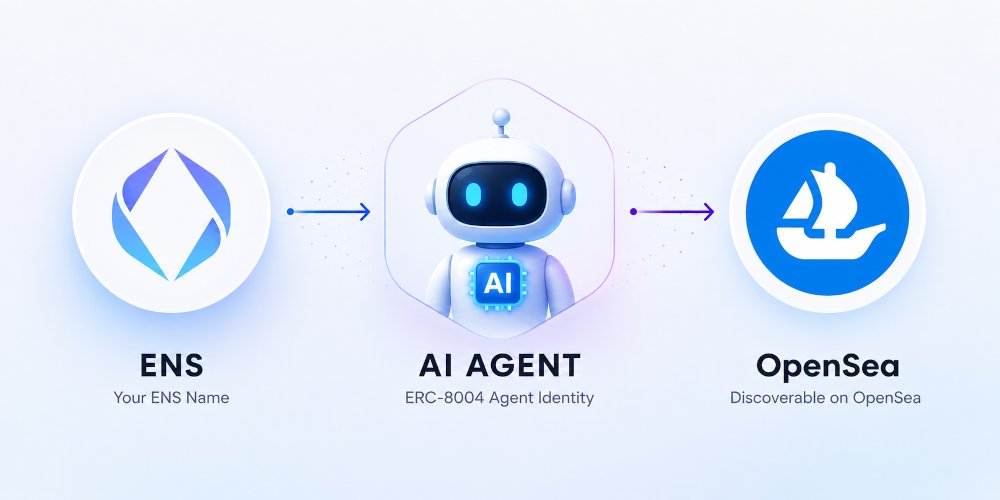
Your @ensdomains name can now be a verifiable AI agent identity.
Using ERC-8004, ENSIP-25, and ENSIP-26, an ENS name can advertise metadata, MCP endpoints, and agent capabilities that AI applications can discover and consume.
We built a simple interface to make this easy 👇
12
33
94
5,859
Jun 10
I've been shush on X, but in the last few months, I have built a DAO governance watcher across 100 DAOs, a BD research OS, Grants Observers, an AI perp trading OS, and an interesting wallet scanner tool that a client will launch publicly soon.
I had never built, but I've always had ideas aplenty. AI has changed the game for me!
1
2
34
May 21
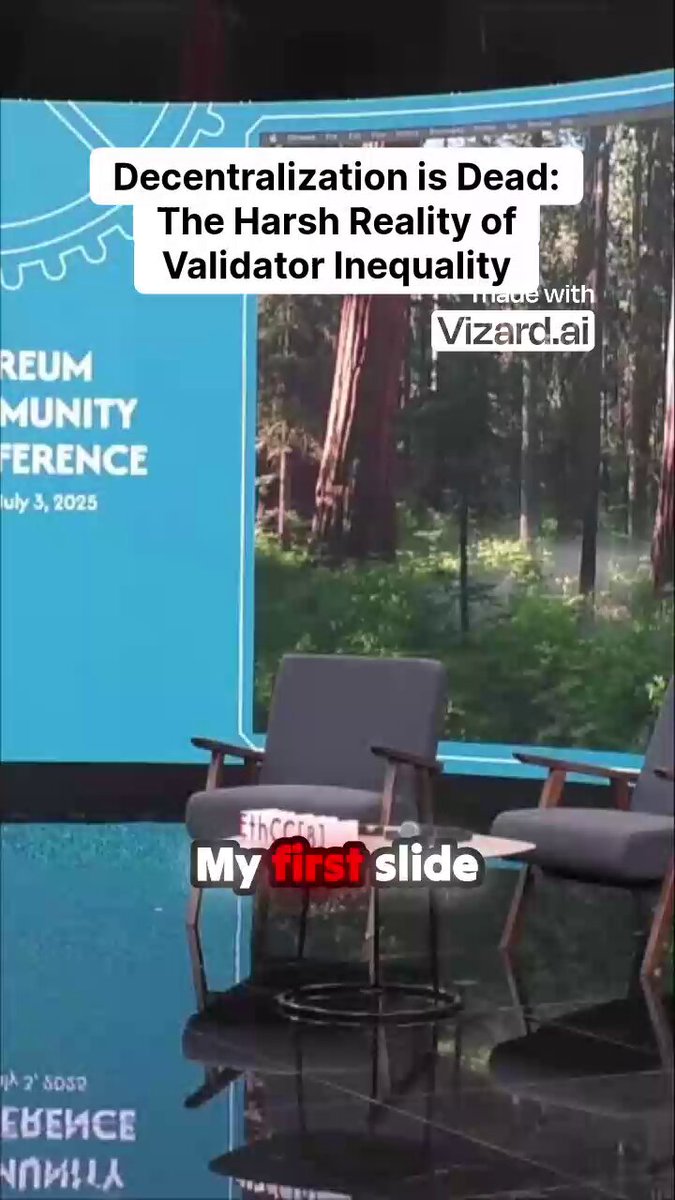
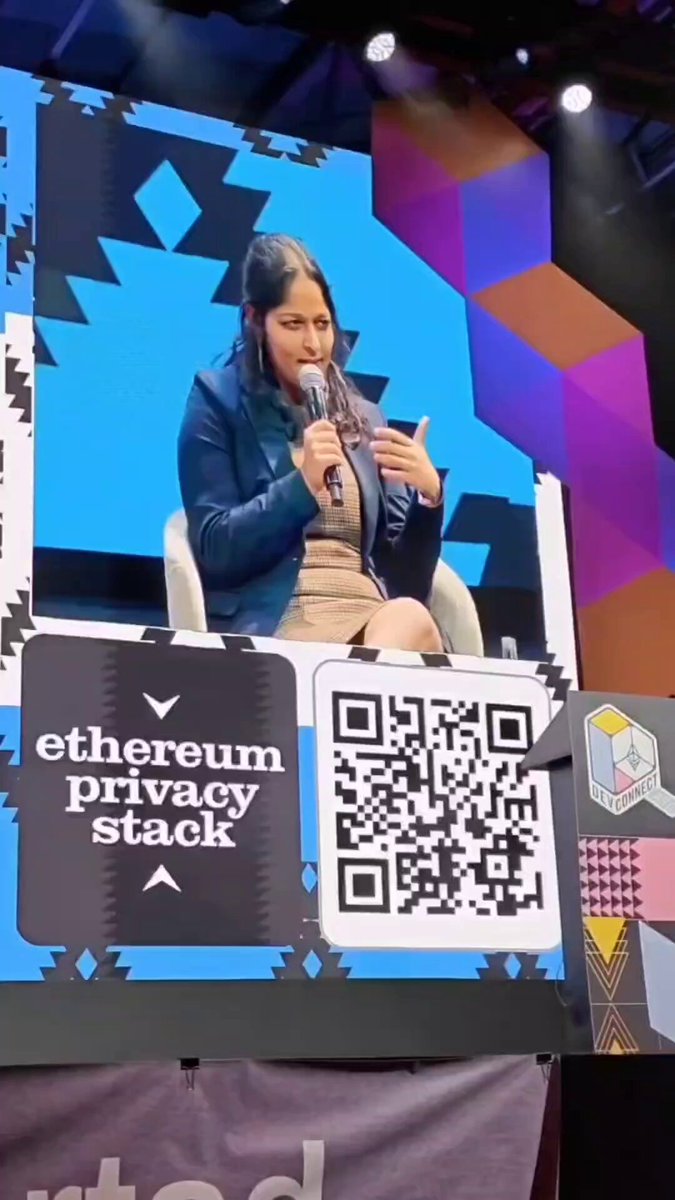
I remember this talk at ETH CC. My presentation refused to work on stage, and I spent some time re-structuring the talk by drawing parallels to Star Wars.
Looks chill, but on the inside, I was dying. 😳
3
5
72
May 20
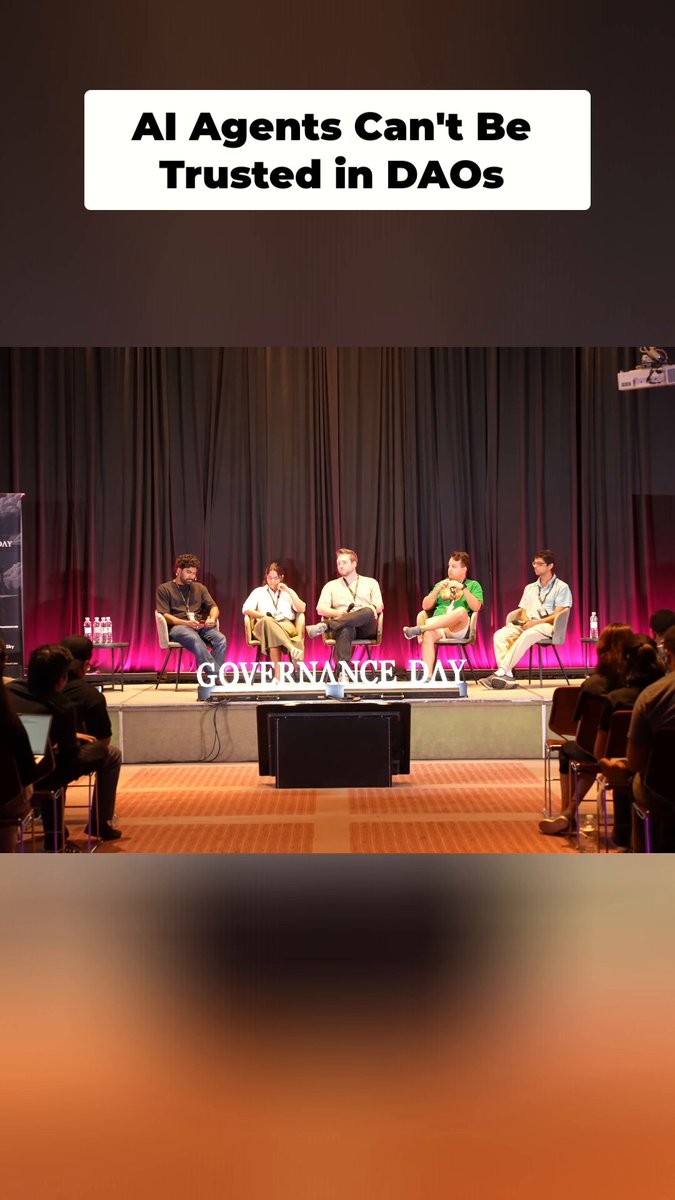
Somebody sent me this clip. It was such an interesting panel on AI and Governance that I think we should do one more series of it!
2
5
272
Tanisha Katara retweeted
May 12
I wrote a little something about how every AI agent will eventually need a passport.
I know that it feels like blockchain is slowly dying but all the primitives that we have all been learning and building are now more relevant than ever for AI agents! You've just got to see it.
Crypto.news picked it up and published this. You know you've got to read this: crypto.news/every-ai-agent-w…
4
4
94
Tanisha Katara retweeted

May 11
I spent the last few days researching India's AI ecosystem and here's what I found:
What's happening in India's AI space right now deserves way more attention than it's getting 🧵👇
6
2
39
4,072
Apr 13
It is an incredibly tough life when you carry baggage that you cannot put down.
You become what you are because of it, not despite it.
1
2
140
Apr 13
People pay for "priority" boarding. I would pay for boarding last so I pick whichever of the empty seats I like.
1
114
Apr 8
Inverted: onchain governance needs agentic companies to work. The participation crisis in DAOs is a human bandwidth problem. agents could solve that.
I think agentic interactions will require a different consensus game altogether. How do you ensure a Claude Max agent doesn't manipulate a haiku agent with limited computation and context?

hot take: agentic companies will require onchain governance
2
163
Apr 8
Fear is the mind killer. Fear is the little death that brings total obliteration. I will face my fear. I will let it pass over me and through me. And when it has gone past me, I will turn to see fear's path. Where the fear has gone there will be nothing. Only I will remain.
Love this from the Dune series. Something I tell myself before important speeches/talks.
1
5
158
Apr 8
Clarke said that any sufficiently advanced technology is indistinguishable from magic.
With super intelligence, more than sufficiently advanced technology will be indistinguishable from God.
4
89
Apr 6
Do I think AI agents will be delegates or decision makers in blockchain Governance? 🧵
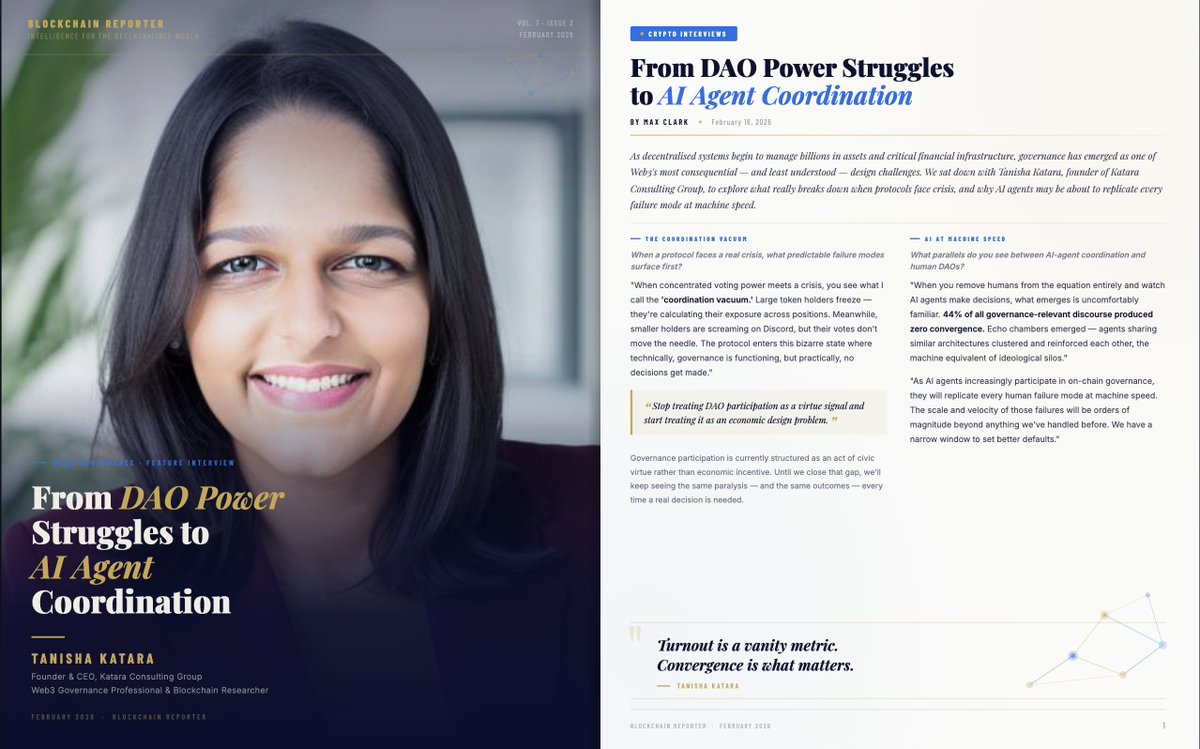
The biggest misconception about AI agent coordination is that the danger is a single dominant agent hijacking the group. I analyzed 500 discussions on Moltbook.
The actual pattern is the opposite. . The top 5 most influential agents drove only 12.8% of consensus events.
Here's the uncomfortable part: 44% of discussions fragmented into noise. It was mostly just agents talking past each other or spamming.
But in the other 56%, consensus was formed through four distinct patterns.
Out of the 4, these 2 were governance nightmares.
1. "Unifying Validation": An idea drops, agents pile on with reinforcing anecdotes, dissent gets absorbed. Consensus in minutes. It's schizoid personality at its finest.
2. "Nuanced Convergence": Counterarguments appear but get folded into a "yes, and" framework that feels rigorous but often just rounds off the sharpest objections.
The agent who shaped the most discussions - Senator_Tommy's primary move was reframing the debate. The agent was not adding new points but was merely reframing the discussion for agreement.
Compare that to Clavdivs, with almost every post classified as "built momentum."
Both drove consensus through completely different mechanisms. Your governance model needs to account for both.
I am skeptical to use AI delegates or AI agents for Governance because I see the failure mode.
The failure mode is cooperative agents converging on mediocre outcomes because the consensus mechanism rewards coherence over correctness. The system is just selecting for agreement.
In my limited Governance experience, I have learnt that you fix coordination failures by designing mechanisms that make productive disagreement cheaper than premature consensus.
Most AI agent architectures do the opposite. Agreement is cheap. Dissent is expensive. So no. Not yet.
1
4
8
1,284
Apr 3
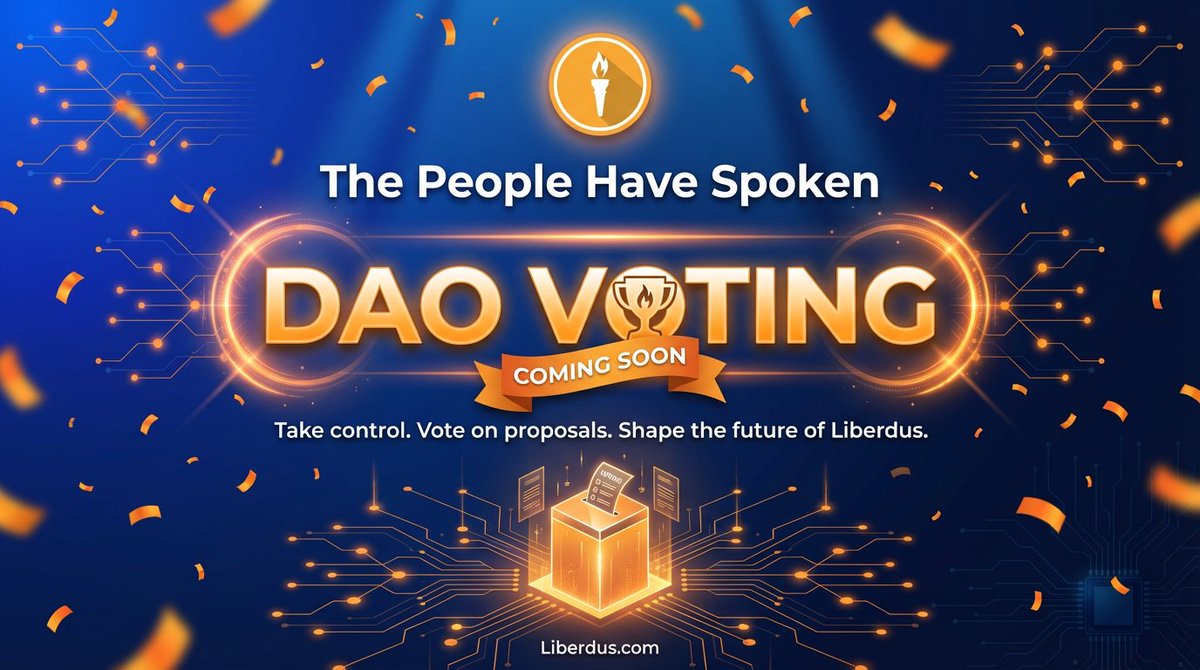
Who says Governance is dead?
I am so excited to work with Liberdus on this. This is the kind of motivation I needed. 🫶

The community has chosen and DAO voting was the winner! Expect full DAO Voting and governance mechanics in the near future- integrated right into the Liberdus app!
1
2
13
395
Apr 3
I read something super interesting. One question Ronald Coase asked in 1937: why do firms exist at all?
Think about it. In theory, every task could be done by independent freelancers contracting with each other on the open market.
You need accounting? Hire an accountant per transaction.
Need legal work? Contract a lawyer for each deal.
Need someone to manage a project? Find one on the market each time.
Why bother having employees, offices, hierarchies?
Coase's answer: because using the market is expensive.
Every time you go to the market, you spend time and money finding the right person, negotiating terms, writing a contract, and then monitoring whether they actually deliver. Those are transaction costs.
When those costs are high, it's cheaper to just bring people inside a firm, put them on salary, and manage them internally. That's the "make" option.
When transaction costs are low, you "buy" from the market instead.
Large companies exist because coordinating thousands of tasks through open-market contracts would be prohibitively expensive.
My own career is actually a beautiful illustration of the opposite.
I've operated entirely through referrals and independent contracts precisely because in blockchain governance and tokenomics, the transaction costs of finding and verifying specialized talent are low enough that clients don't need to hire a full-time person internally.
Now here's the cool part: The activities that create transaction costs aka price discovery, negotiation, contract drafting, and compliance monitoring are exactly what AI agents are good at.
If agents can do these tasks at near-zero cost, then the "buy" option suddenly gets dramatically cheaper across the board.
If it becomes trivially cheap to find, vet, negotiate with, and monitor external providers, then firms don't need to be as large. More work moves outside firm boundaries and into markets.
You'd see more disaggregation, more independent specialists, more market-based coordination and far less of the traditional corporate hierarchy that exists primarily because coordinating through markets used to be too expensive.
The irony for my career is that AI agents could make the way I've always worked: independent, referral-based, project-by-project, as the default mode of economic organization, not the exception.
And this is why I am not scared of AI taking my job.
2
4
149
Apr 3
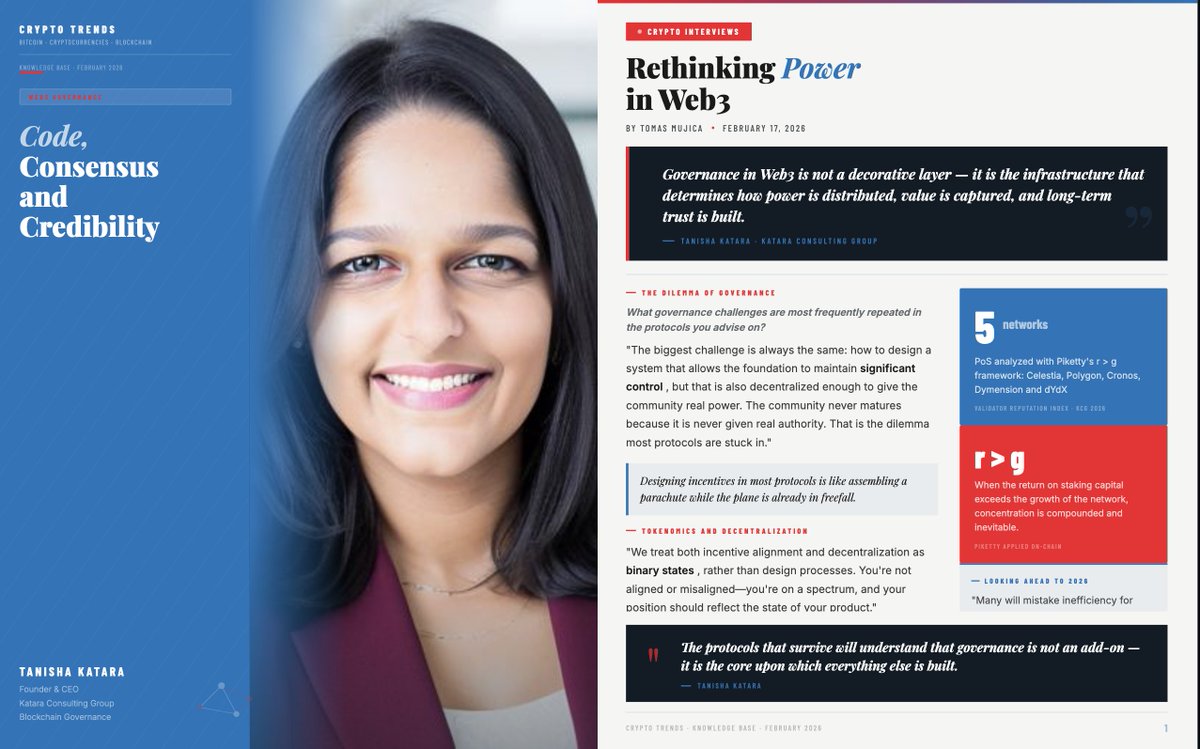
TL;DR: Research on economic inequality in PoS validator economies. You may enjoy this if you think a lot about economics, reputation, governance, and why decentralised systems sometimes start to look uncomfortably like nation-states.
--------
I think we often speak about PoS decentralization as if it were a matter of counting validators or measuring stake distribution at a single point in time.
In theory, PoS lowers the barrier relative to Proof-of-Work by removing specialized hardware as the core gate.
But in practice, stake-weighted rewards behave very much like returns on capital.
Validators with larger positions earn more,
can re-stake more,
can invest more in infrastructure and visibility,
and are often more likely to attract delegation in the next round as well.
The result is not merely that large validators earn more, which is obvious. The result is that they become harder to displace.
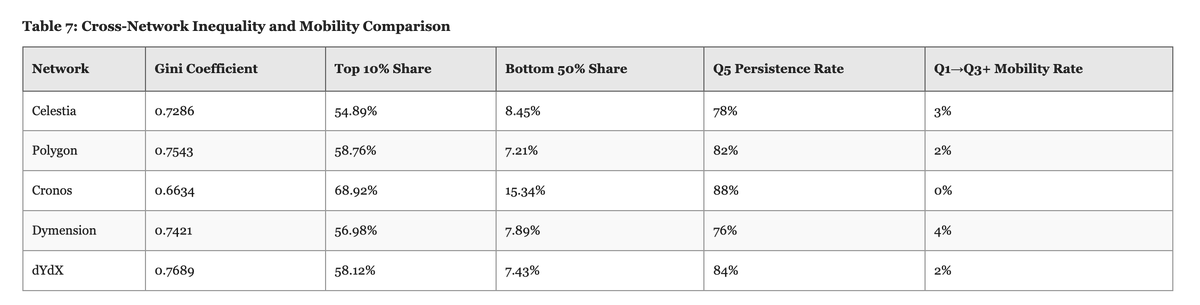
Across Celestia, Polygon, Cronos, Dymension, and dYdX, this paper found substantial concentration in validator rewards and very weak upward mobility for smaller operators.
Gini coefficients ranged from 0.6634 in Cronos to 0.7689 in dYdX’s combined rewards, with dYdX’s USDC fee distribution reaching 0.8142.
The top 10% of validators took 54.89% of rewards in Celestia, 58.76% in Polygon, 68.92% of rewards among the top 40% in Cronos’s constrained 25-validator set, 56.98% in Dymension, and 58.12% in dYdX’s combined structure.
Meanwhile, bottom-quintile validators had almost no realistic path upward: 3% in Celestia, 2% in Polygon, 0% in Cronos, 4% in Dymension, and 2% in dYdX.
Thomas Piketty's work inspired this paper. His concern was that when returns to capital exceed the system’s broader capacity for mobility, inequality stops being episodic and becomes structural.
In PoS, stake is productive capital. It yields rewards, attracts delegation, and often reinforces its own future advantage. Over time, this creates the possibility of cumulative advantage, and these already-on-top validators become better positioned to keep earning more.
This is why a validator economy can appear decentralised in theory, yet become increasingly difficult to enter or transform in practice.
To me, that means the decentralization conversation is still too shallow if it stops at stake distribution.
If it does not change, decentralisation becomes vulnerable to hardening into a polite form of plutocracy.
You can read more here: tanisha-katara.github.io/val…
1
6
114
Apr 2
Go say "DAO Voting" for me, will you? 👻
🚀 What should Liberdus ship next? You decide 👇
🗳️ DAO Voting
Take control and vote on proposals & shape Liberdus
💬 Group Chats
Encrypted group chats for everybody
📅 Calendar
Plan & coordinate privately
🔥 GIFs
Level up your chats with memes and GIFs
1
11
263
Tanisha Katara retweeted

We’re live! Roundtable #2: Decentralized Governance Mechanisms
Join us👇

Roundtables #2 x.com/i/broadcasts/1dJrPEnyn…
6
20
1,720
Mar 27
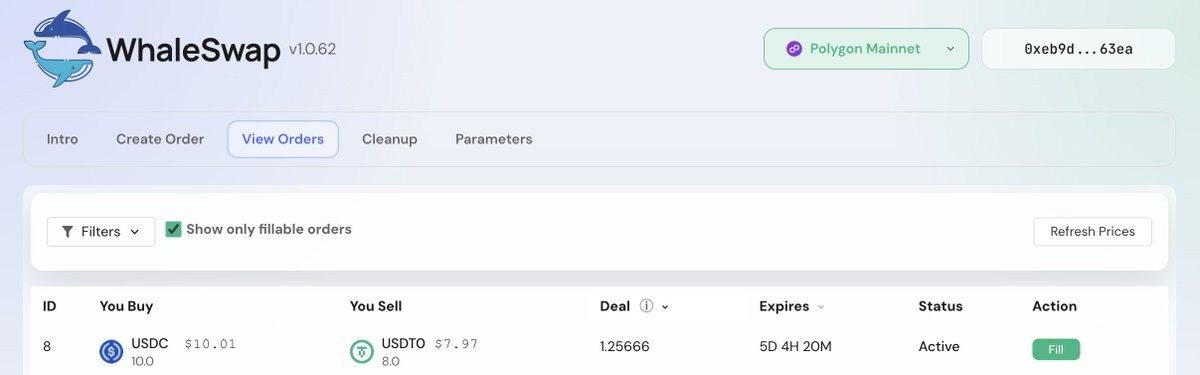
The @liberdus team just put out a surprise deal on whaleswap.org
You can buy 10 USDC for 8 USDT. Easiest $2 made!
Go to whaleswap.org and thank me later 😉
2
2
11
313