
Software Engineer
Joined December 2011
- Tweets 91
- Following 43
- Followers 143
- Likes 5
Photos and videos
Adrien Guillo retweeted

24 Oct 2024
I'm noticing a growing trend of using #S3 instead of traditional databases or block storage in products, which significantly reduces costs.
We've transitioned to using #Quickwit, an analytics and search engine for #OpenTelemetry tracing and logging. It can also be used as a #Jaeger storage backend.
You can easily integrate Jaeger with #Grafana, using Quickwit for S3-based storage. All data is stored in S3, resulting in a time-to-search of just 45 seconds, which is impressive. The time-to-read is nearly 70 ms.
Quickwit is written in Rust and packaged as a single binary, easy to install and deploy. Combined with Grafana, Jaeger and S3, it creates a powerful setup for observability.
Quickwit stores logs and traces in S3, while Grafana provides a flexible dashboard for visualizing and analyzing the data. This combination offers fast search performance and scalable storage without the complexity of traditional ELK stacks—no Java, yay!
#Turbopuffer also caught my attention—a serverless vector database that leverages S3 for storage. It offers a cost advantage of 10x-100x compared to alternative vector database solutions. The biggest user of this technology is Cursor.ai, which is my favorite AI tool for daily use.
1
3
330
Adrien Guillo retweeted

17 Oct 2024
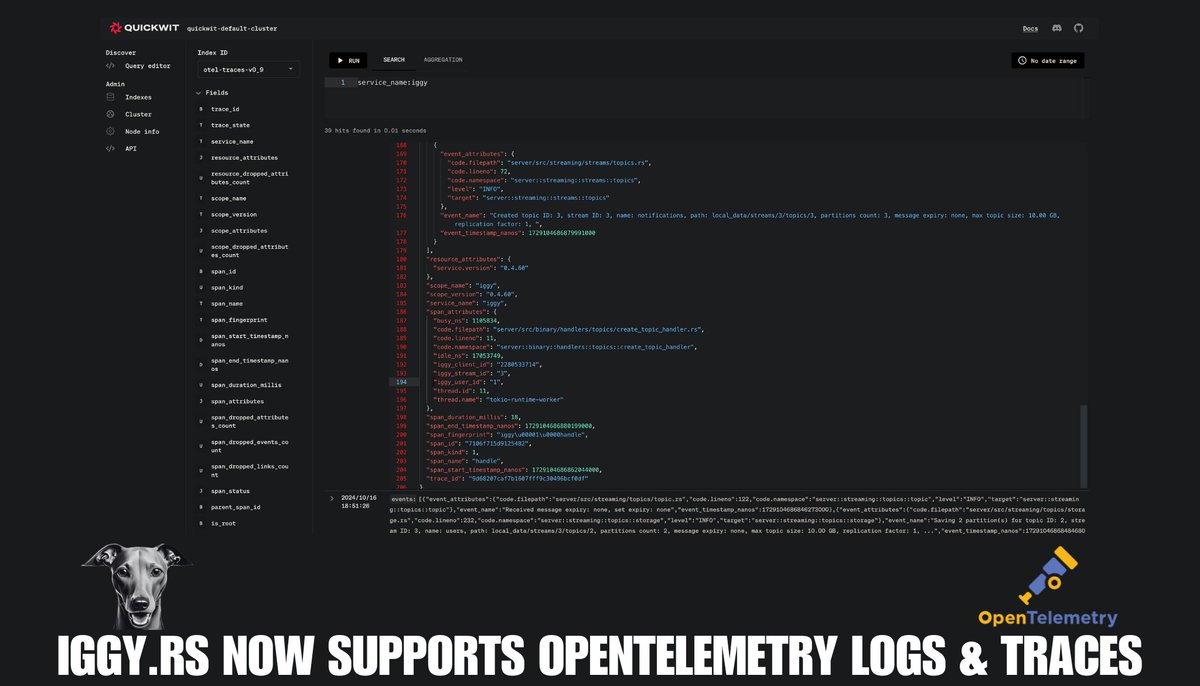
Iggy.rs now supports OpenTelemetry logs & traces! From now on, you can have the full insights into your server, including all the necessary details. If you're looking for a blazingly fast OTel compatible tool, check @Quickwit_Inc :)
#iggyrs #otel #opentelemetry
5
17
964
Adrien Guillo retweeted

11 Apr 2024
The new Quickwit Grafana plugin 0.4 is out!
Quality of Life features ahead:
- Autocomplete hints
- Enhanced log context XP
- Adhoc Filters and more!
quickwit.io/blog/quickwit-gr…
6
26
1,758
Adrien Guillo retweeted
25 Jan 2024
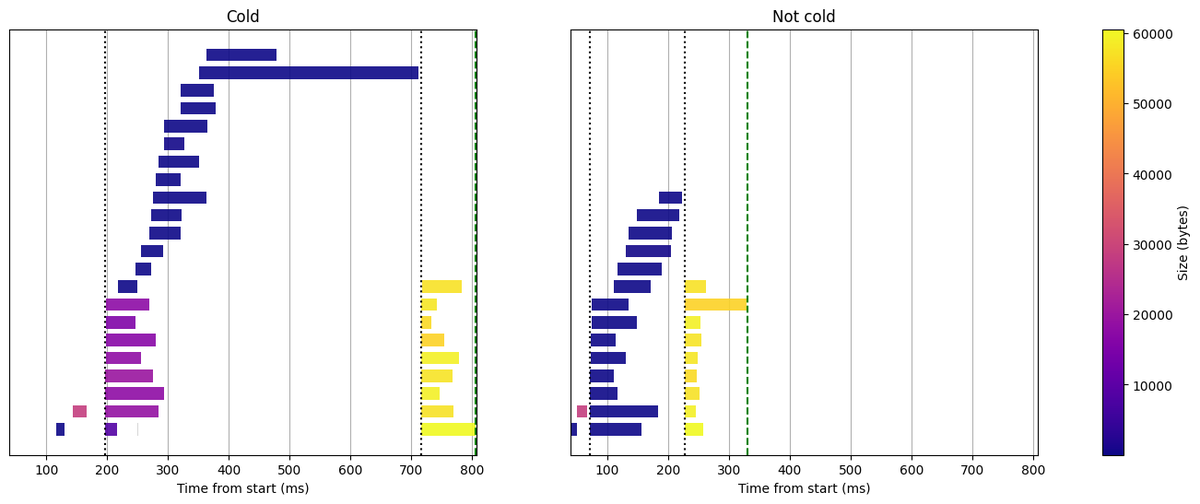
💃🏼New blog post about Quickwit's serverless search performance on AWS Lambda & S3 🏇
On the menu:
- Latency on search/analytics queries
- Impact of Lambda size (1GB to 8GB)
- Impact of caching layers
- Beautiful charts to illustrate our findings 😍
=> quickwit.io/blog/quickwit-la…
1
13
55
5,295
Adrien Guillo retweeted
21 Jan 2024
Just finished a short tutorial to get started with @Quickwit_Inc and @redpandadata.
=> github.com/quickwit-oss/tuto…
The main goal is to demonstrate how easily the indexing is distributed over 3 indexers, each taking a set of partitions of a given topic.

8
30
1,935
Adrien Guillo retweeted

14 Jan 2024
I've heard Bloomberg in NYC might have event space they'd let someone use to host public tech talks.
Do I know anyone who could help me figure out if that's so?
Also, do I know any devs in NYC interested in giving tech talks on any Systems Programming topics?
DMs open. 😀
8
7
71
20,032
Adrien Guillo retweeted
9 Jan 2024
Waking up... and seeing Quickwit on HN frontpage ❤️
news.ycombinator.com/news

3
4
58
3,140
Adrien Guillo retweeted

6 Jul 2023
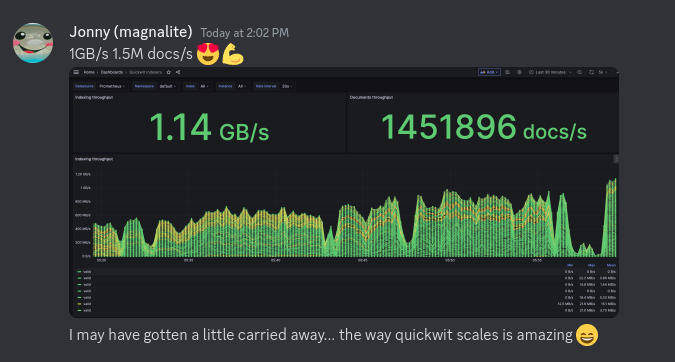
Happy user reporting indexing 1GB/s with Quickwit!
4
12
94
13,855
Adrien Guillo retweeted
6 Jun 2023
💃🏼 Quickwit 0.6 released!🕺🏼 is released!
It packs an 𝗘𝗹𝗮𝘀𝘁𝗶𝗰𝘀𝗲𝗮𝗿𝗰𝗵 𝗰𝗼𝗺𝗽𝗮𝘁𝗶𝗯𝗹𝗲 𝗔𝗣𝗜
and a 𝗚𝗿𝗮𝗳𝗮𝗻𝗮 plugin!
See more here ⬇️
quickwit.io/blog/quickwit-0.…
2
17
48
12,422
Adrien Guillo retweeted
15 May 2023
Playing with Quickwit (github.com/quickwit-oss/quic…) and my favorite dataset: @githubarchive.
𝟭𝟲𝗧𝗕 𝗼𝗳 𝗝𝗦𝗢𝗡. 𝟱.𝟮𝗯𝗶𝗹𝗹𝗶𝗼𝗻𝘀 𝗱𝗼𝗰𝘀
𝗧𝗵𝗲 𝗶𝗻𝗱𝗲𝘅 𝗶𝘀 𝗼𝗻 𝗦𝟯
With a single server 8vCPUs, 16GB of RAM
`actor.login:fulmicoton` returns 21,473 docs in 5.83s
😍
1
8
42
8,079
Adrien Guillo retweeted
1 Jun 2022
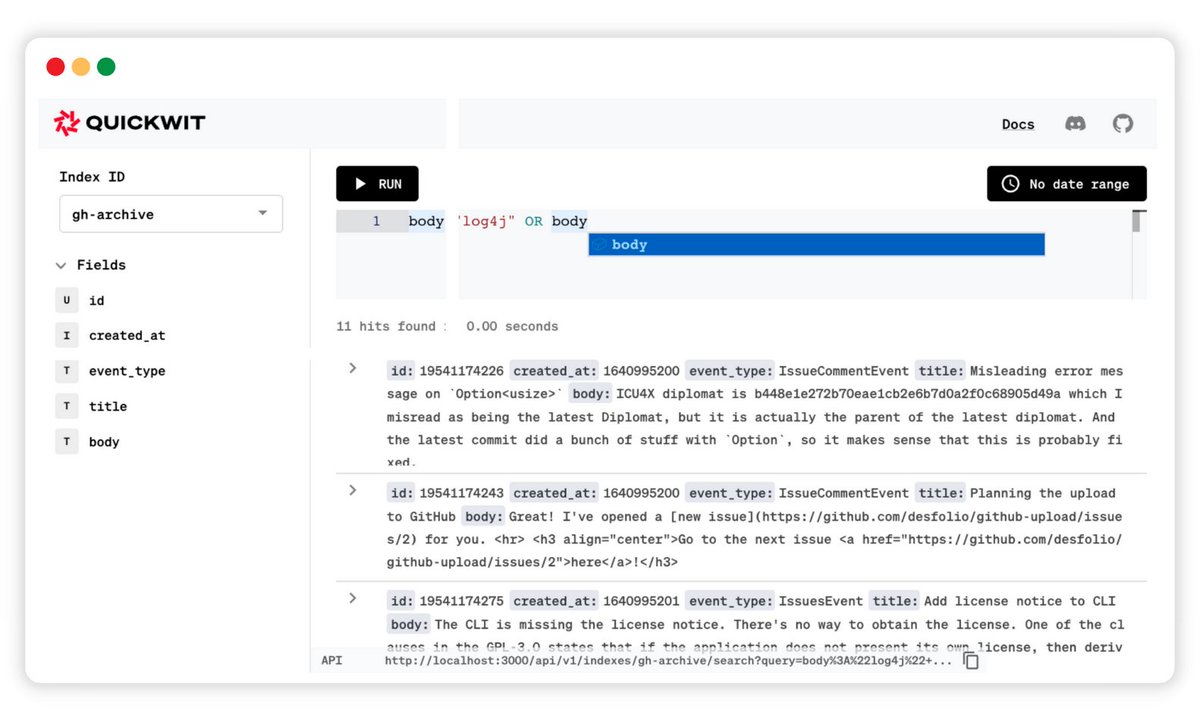
⭐ Quickwit 0.3 is released ⭐.
A lot of new features for our log Search Engine!
- Aggregations
- Schemaless
- UI
- and more!
quickwit.io/blog/quickwit-0.…
#rust #quickwit🦀🔍
7
40
Adrien Guillo retweeted

18 May 2022
📽We will be streaming our next event on 25 May, 12pm ET/18pm CEST!
@guilload, our Co-Founder, will present how to use Quickwit to ingest data from #Kafka & #Kinesis and how our indexing engine works.
👉Register:quickwit.io/events/stream-in…
#search #devops #dev #selfhosted #rustlang
1
9
7
Adrien Guillo retweeted
28 Apr 2022
We just opensourced chitchat: Quickwit's gossip cluster membership. Here is a blog post from @evanxg852000!
quickwit.io/blog/chitchat
github.com/quickwit-oss/chit…
5
10
Adrien Guillo retweeted

14 Apr 2022
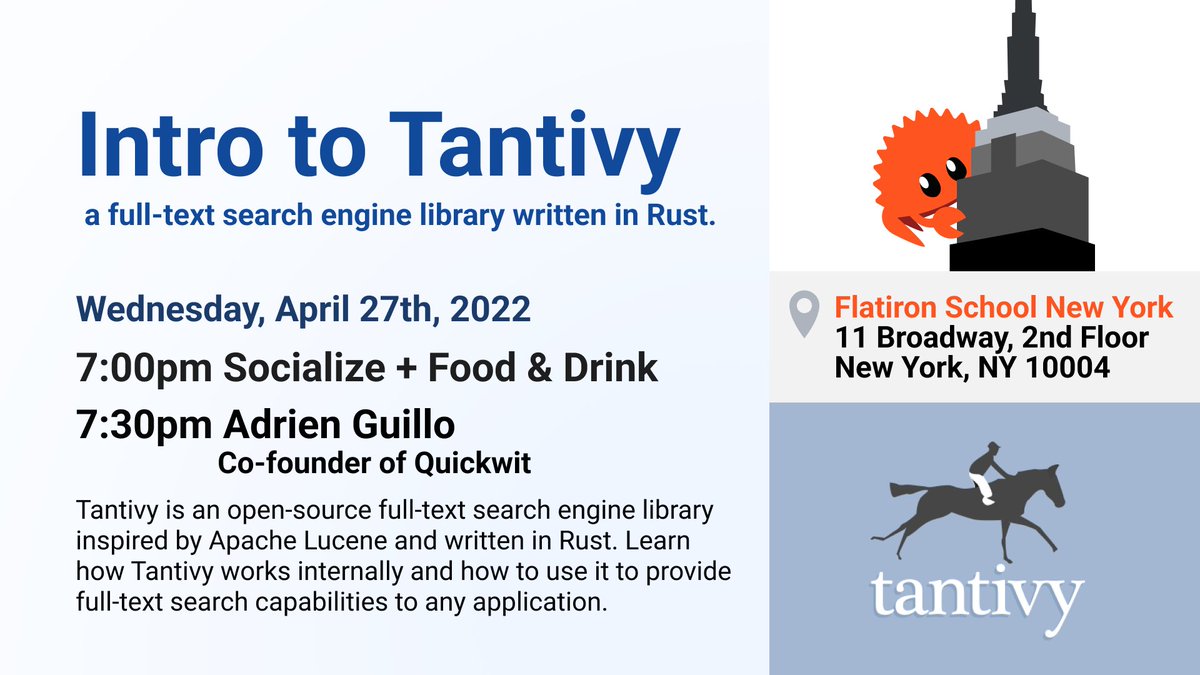
Rustaceans in NYC, please join us for @guilload's talk "Intro to Tantivy: a full-text search engine library written in Rust"
meetup.com/Rust-NYC/events/2…
@Quickwit_Inc #rust #event
1
5
15
Adrien Guillo retweeted
14 Jul 2021
Quickwit 0.1 is released! Rejoice!
Search has never been so cost-efficient...
quickwit.io/blog/quickwit-fi…
quickwit.io/docs/getting-sta…
5
24
Adrien Guillo retweeted

7 May 2021
Search 1B pages on AWS S3 for 1000$ / month, made in Rust and tantivy quickwit.io/blog/commoncrawl…
8
33
Adrien Guillo retweeted

6 May 2021
« French people are... very polite. » Pattern extracted from 1 billion web pages with #Quickwit search engine #Search #S3 common-crawl.quickwit.io/?qu… via @Quickwit_inc
3
3

6 Apr 2018
Some people, when confronted with a problem, think "I know, I'll use a mock." Now they have two problems.
1
2 Nov 2016
.@adriancolyer I discovered the Morning Paper a few days ago. It's brilliant, thank you so much!
1