
Work. Life. Code. Game. Lather. Rinse. Repeat. Husband and father of three. Son of mountain men. International speaker. Geek. Graybeard. Gamemaster. W8GUY.
Joined January 2010
- Tweets 8,532
- Following 1,680
- Followers 3,900
- Likes 5,229
639 Photos and videos
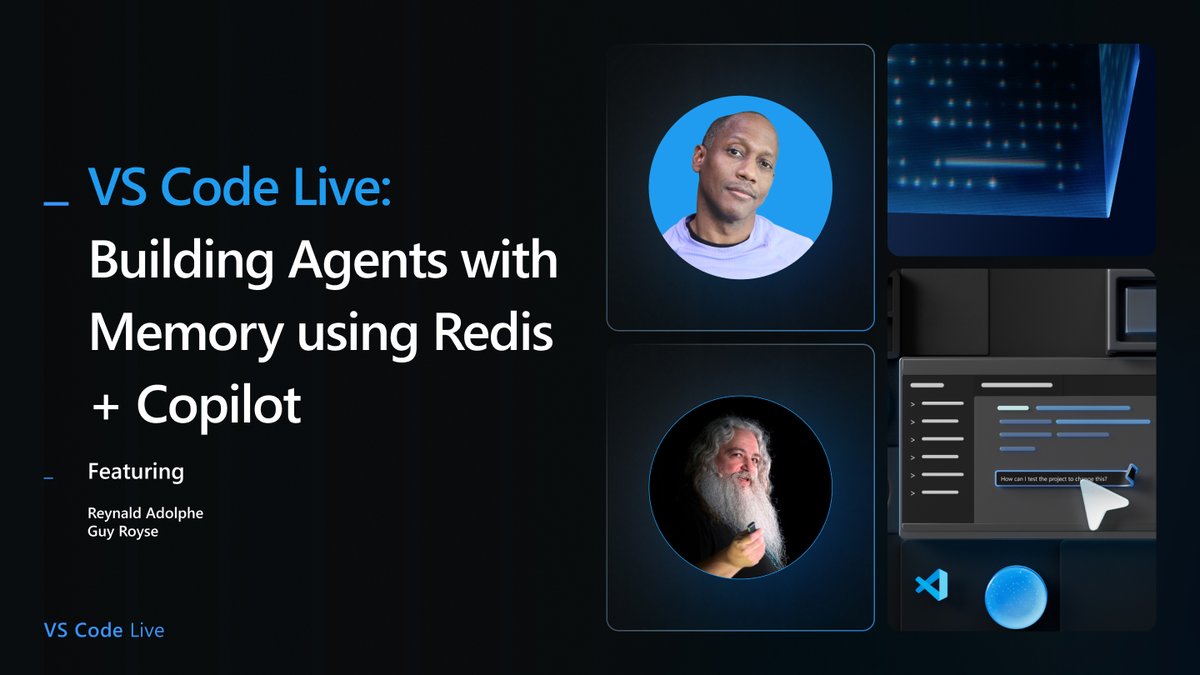
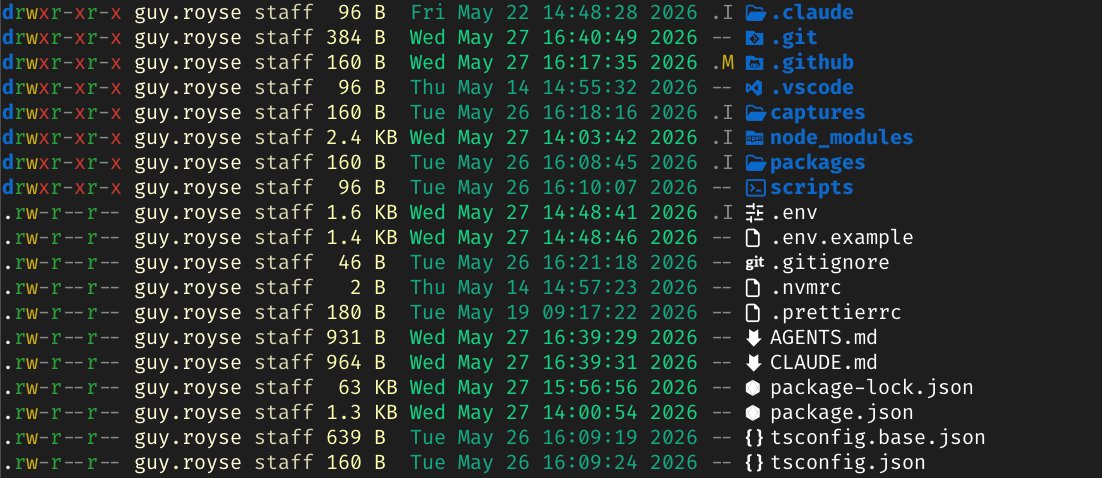









I'm going live with @code on YouTube today at 9am PT. Gonna do some Redis Agent Memory, some VS Code Copilot, and a little bit of ham radio!
Live coding and AI will be involved so it could be brilliant or it could end in fire and tears. Watch to find out!
youtube.com/watch?v=DyAxSCk-…
2
169
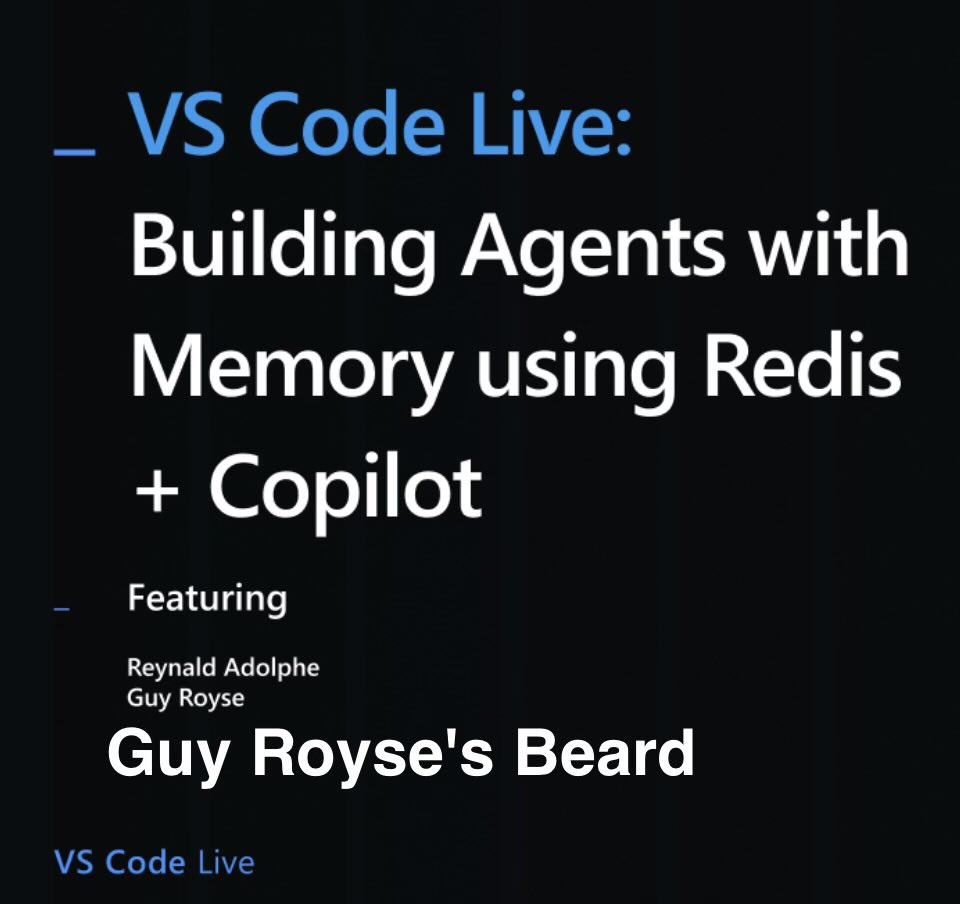
My beard has opinions, apparently.

1
1
176
Guy Royse retweeted

Jun 2
just wanted to make sure all participants were credited
@GuyRoysesBeard
1
324
I built an agentic thing for an upcoming livestream that I'll be on. While building that agentic thing, I learned a lesson. I already knew the lesson. But I didn't know that I knew the lesson. Pretty sure this is called an epiphany. You probably know it too and might benefit from the epiphany. So, I'm gonna share it and then shamelessly plug the livestream.
The thing I built is called Earshot. Earshot consists of three agents: two listeners—one on a microphone, one on my ham radio—that transcribe whatever they hear, decide if it needs any correction, and write it down. And a chatbot that reads what they wrote and lets you, well, chat about it. That's the whole app.
Here's the cool bit. These three agents never talk to each other. The listeners don't know the chatbot exists. The chatbot doesn't know the listeners exist. They just read and write the same shared memory. Ain't nobody wired to anybody.
If that sounds familiar, it should. It's decoupling. The same decoupling we've done with message queues and shared databases and job tables for decades—producers on one side, consumers on the other, some sort of store in the middle. Neither end holding a reference to the other. I reached for it intuitively without realizing I was implementing the same distributed-systems pattern I've used scores of times in the past.
And since this isn't really new, the tradeoffs are the same. No delivery guarantees, no ordering. Things happen when they happen if they happen. Decoupling buys you flexibility at the cost of certainty, same as ever.
But that flexibility is so, so nice. It lets you scale and it lets you extend. Since nothing is wired together, you can add more listeners and more types of listeners, more chatbots and more types of chatbots. Potentially a lot more if your shared state can scale with them.
In Earshot, I used Redis for the shared state, specifically Redis Agent Memory. It was easy to use and gives me scaling, scaling that my toy agents don't really need. But your agents, which do real work for real users, will totally need it. Probably sooner than you think.
I built all of this in VS Code and used GitHub Copilot to assist. In particular, I used Redis' set of agent skills so that Copilot would know how, and more importantly when, to use Redis Agent Memory's APIs.
I plan to demo it all on VS Code Live this Thursday, June 4 at 9am PT. Join @ReynaldAdolphe and me as we take a chatbot that starts with no memory and, one capability at a time, learns to listen to what is in earshot.
Livestream:
youtube.com/watch?v=DyAxSCk-…
GitHub repo with the demo:
github.com/redis-developer/r…
Redis Agent Skills:
github.com/redis/agent-skill…
Redis Agent Memory & Redis Iris:
redis.io/agent-memory/
redis.io/iris/
@Redisinc @code @GitHubCopilot
1
1
4
433
Hey folks. The Central Ohio Radio Enthusiasts is meeting tomorrow night at @CGI_Global in Westerville. The topic is DMR, or digital mobile radio, and Alex Barbur will be showing us how to use it, not only for voice communications, but as an IP transport.
If you're interested, all the details are in the link. And, please RSVP so we know how much pizza to get!
core.radio/#meetings
84
The monthly CORE (Central Ohio Radio Enthusiasts) meeting is Tuesday, June 2. This month we have Alex Barbur presenting An Introduction to DMR as an IP Transport. Don't know what that is? You should come.
Details and RSVP are in the link:
core.radio/#meetings
1
1
1
339
And, special shout out to @CGI_Global for hosting us. Great meeting space. Great location. Great pizza. Great company! Thanks for making CORE possible.
195
I'm gonna be at @BSidesDayton this Saturday running the Radio Village and talking about Reticulum.
Wanna play with some radio? Want to build secure off-grid networks? Buy a ticket already. It's only $25 and they feed ya!
bsidesdayton.com/
1
1
3
104
No joke indeed. @rowantrollope is at the top of the leaderboard at Redis for Codex usage (at least the last time I looked).
It's pretty cool working for a company where the geek runs that deep. And even cooler when we can help companies like OpenAI scale.

Cool to see how OpenAI uses Redis to scale voice AI to 900M users:
openai.com/index/delivering-…
We're huge Codex fans here at Redis - I use Codex 5.5 extensively - amazing work by the team there. GPT 5.5 is the best model for most tasks IMO. It even fixed my wifi tonight (no joke)
5
251
Central Ohio Radio Enthusiasts—CORE—is an informal community for anyone enthusiastic or curious about radio—whether you're new to radio and want to learn or you've been tinkering for years and want to share. Ham radio operators, GMRS users, Meshtastic fans, software-defined radio nerds, makers, and technical and non-technical folks are all welcome. No experience required or expected.
This month we have Radio Signal Analysis Using SDRs and OpenWebRX with Scott McCrory.
Meeting is May 5th in Westerville. Details and RSVP are are core.radio.
1
113
Guy Royse retweeted

Apr 23
The Y2K bug turned out to be a non-event on January 1, 2000 - how did that happen?
Listen to the stories of how we stopped the Y2K from Rik Hepworth, @GuyRoyse, and @ShawnWildermuth on .NET Rocks at dotnetrocks.com/details/1999
1
1
4
766
Guy Royse retweeted
Apr 23
Storing years as two digits made sense before 2000... but then it became a serious problem.
A problem that a lot of software development fixed.
Listen to Y2K stories from @shawnwildermuth, @guyroyse, and Rik Hepworth on DotNetRocks at dotnetrocks.com/details/1999

2
8
756
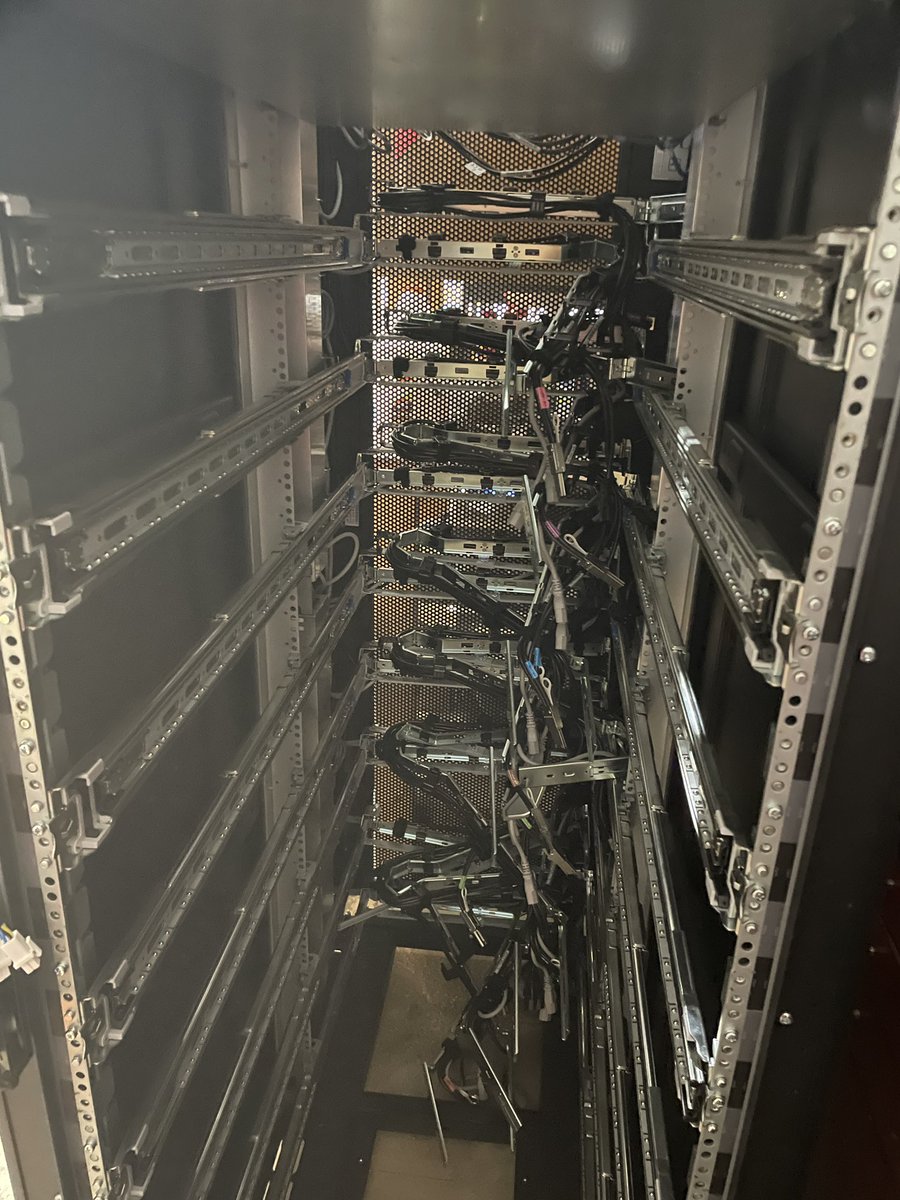
I have a simple request.
Can you tell me where you're hosting the AI skills you write? There's a lot of sites popping up as hubs for this sort of thing. I'm curious what everyone is using, why you're using it, and what you think.
Could I search this? Probably. But a simple search, even with an AI, doesn't get at what people actually use. Ads and SEO influence the results. I want the word on the street.
And since I'm probably not the only person who wants the word on the street, I'll gather all your comments, check out each site, and publish something to help everyone answer this question for themselves.
1
3
282
Context engineering just sort of happens when you use LangGraph.js.
I've been working on a series of posts over on Medium to show folks how to build applications using LangGraph.js. This installment starts with parallel invocation of LLMs by fanning out. And of course, fanning in.
The fanning out part includes a particularly cool feature of LangGraph.js—conditional edges. This isn't a simple turn-left or turn-right sort of conditional edge. This technique selects from a menu of nodes and fans out to them, skipping the other nodes. It behaves as a router.
What does this have to do with context engineering? Well, the example is a game. The player enters some text. The LangGraph.js workflow is invoked, it responds, and the result is returned to the player.
The router sees only the player's action. The game entities that it selects don't know about the router. They just respond to the player's action. The arbiter that reconciles the responses can see the player's action and the responses from the game entities.
Each node has exactly what it needs. No more. No less. This makes the LLMs generate better results and saves tokens. Total win-win.
And it just sort of happened. When I wrote it, I wasn't thinking about context engineering. I was just thinking about what each node needed.
In the next, post we'll save state for our graph outside of the graph. And, yes, we'll be using Redis.
Check out the latest installment and start building some stuff with LangGraph.js.
medium.com/the-guy-wire/lear…
2
2
910
You probably haven't heard of the Reticulum Network. The tl;dr—it's an alternative network stack that's decentralized, encrypted, and runs on everything from Ethernet to LoRa radios to serial cables.
I had the pleasure of hanging out with @emcommsolutions and @defidude yesterday to nerd out about it. It's not exactly an introduction to Reticulum, but we had a good time. The video is up on Jake's channel. Give it a gander.
youtube.com/watch?v=tnpsdDnU…
If you want to learn more or get started with Reticulum yourself, everything you need is over at reticulum.network. Is it a rabbit hole? You betcha! But totally worth it!
3
1,392
Alex Barbur is going to be presenting WiFi HaLow: Introduction and Practical Use at CORE—that the Central Ohio Radio Enthusiasts—next week on April 7th.
WiFi HaLow (802.11ah) is a low-power, long-range variant of WiFi designed for IoT and embedded applications. Operating in the sub-GHz band, it trades raw speed for dramatically better range and penetration—making it a compelling option for sensors, remote monitoring, mesh-style networks, and projects where traditional WiFi falls short.
In this talk, Alex will walk through what HaLow is, how it works, and where it fits alongside other wireless technologies. You'll come away with enough context to get started and some practical applications you can try yourself.
Doors open at 6:00 PM. Talk starts at 6:30. Hangout lasts as long as folks want and the host lets us. Officially ends at 9:00 PM but I'm sure there's a bar nearby.
The address is:
CGI
570 Polaris Pkwy Suite 200
Westerville, Ohio 43082
Please RSVP at core.radio and thanks to CGI for hosting us.
1
3
200