
Jun 12
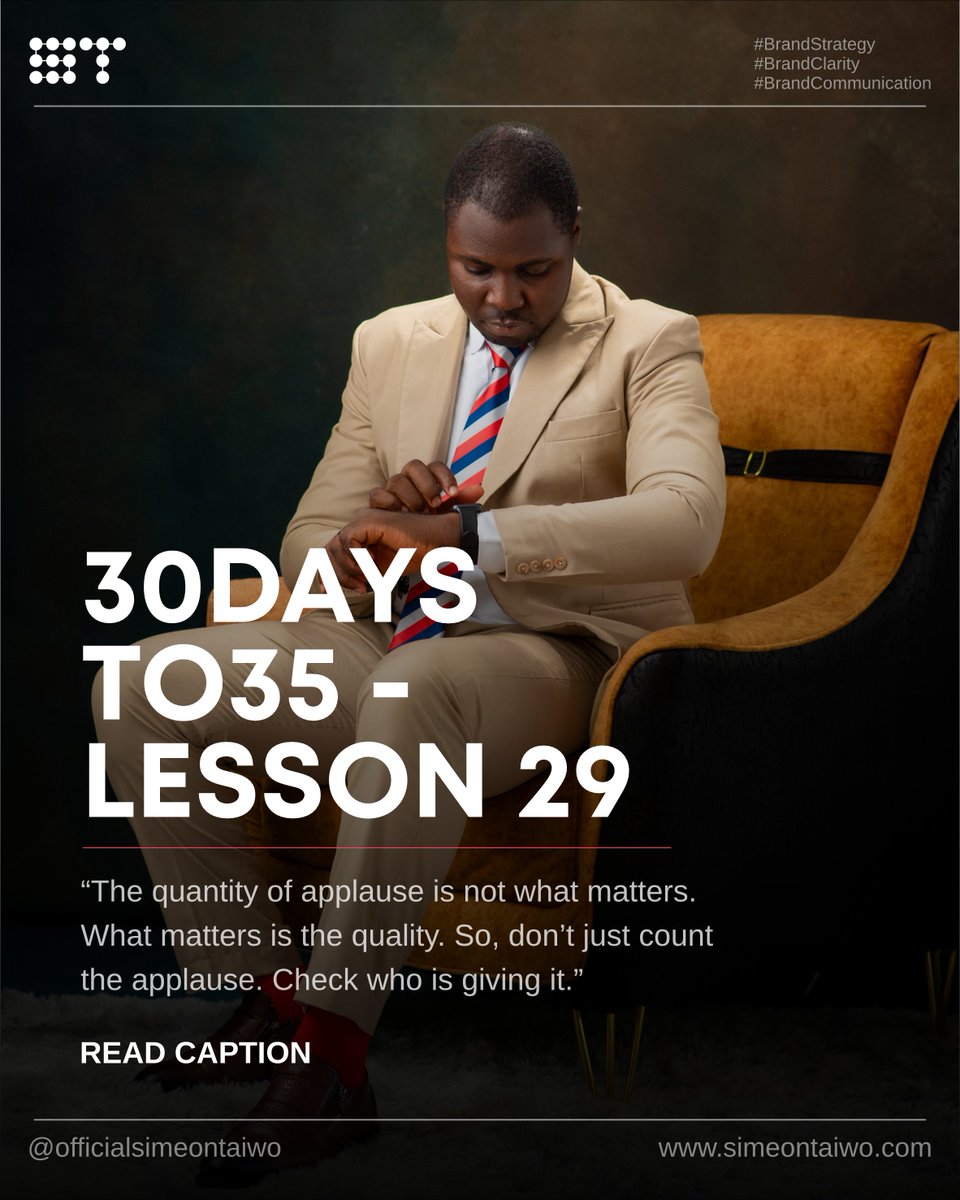
There is a kind of applause that will quietly ruin you. Not because it is fake. But because the people giving it genuinely do not know any better.
.
.
In two days, I turn 35. And this is one of the things these years of building have taught me about validation that I wish someone had told me far earlier.
.
.
Think about it. A one-eyed man is king in the land of the blind. But he is still only working with one eye. The problem is not that his subjects are lying when they crown him. The problem is that they have never seen what two eyes can do. So their applause, genuine as it is, cannot tell him anything useful about his actual limitations.
.
.
That is what uninformed applause does to you. It is honest. It is warm. And it will keep you exactly where you are.
.
.
Hear me out.
.
.
I am not telling you to dismiss the applause or perform some kind of false humility every time people celebrate your work. That is not the lesson. The lesson is this: never let applause be the only yardstick. And always check the quality of the people holding the ruler.
.
.
Because here is what most people will never tell you: the criticism of someone who truly knows what you are doing will do more for your growth than the applause of ten people who do not. One person who has gone further in your field, who can see the gap between where you are and where you could be, whose honest word carries the weight of real experience — that person's feedback is worth more than a standing ovation from a room full of people who simply do not know any better.
.
.
This is why the quality of your audience matters far more than the size of it.
.
.
A large audience that cannot challenge you will celebrate you into stagnation. A small audience that can is worth ten times more to your actual development.
.
.
So yes, receive the applause. Be grateful for it. But do not stop there. Ask yourself who is clapping and what they actually know about the standard you should be reaching for. Are they applauding because your work is genuinely excellent? Or are they applauding because, in the room they occupy, they have never seen anything quite like it?
.
.
Those are two very different things. And only one of them is telling you the truth about where you actually stand.
.
.
Who are the people whose criticism you should be actively seeking right now, and are you in close enough proximity to them to receive it?
.
.
"Don't just count the applause. Check who it is coming from."
.
.
I remain your BrandCore Strategist.
#30LessonsBy35 #SimeonTaiwo #BrandCore #CoreGist #PersonalDevelopment #Leadership #Entrepreneurship #NigerianEntrepreneur
3
34
Jun 11
There is a moment in every builder's journey when it finally feels like the season has turned. The doors are opening. The calls are coming in. The work is beginning to speak for itself.
.
.
Most people call that moment rest time.
.
.
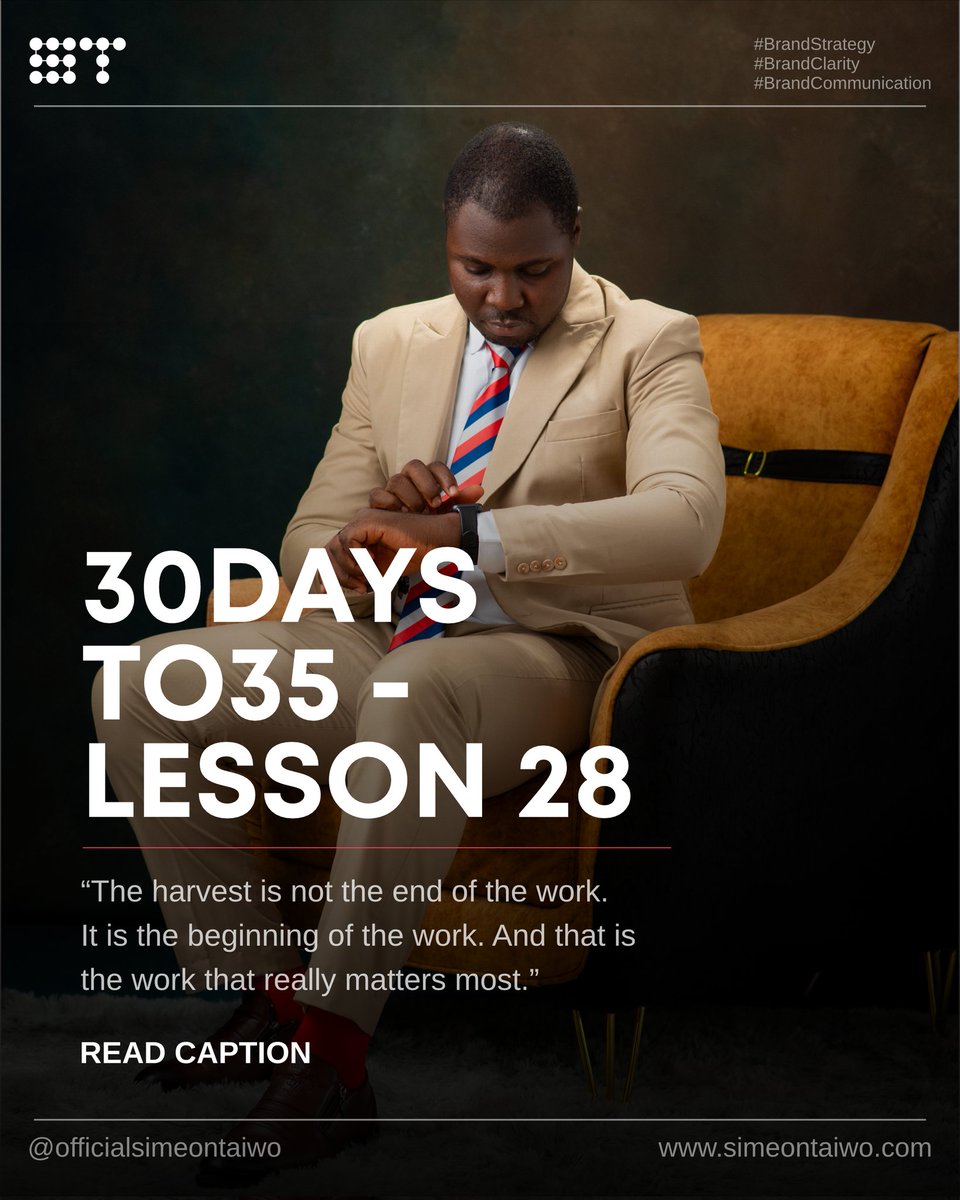
Lesson 28 is this: the harvest is not rest time. The bigger the opportunity, the more the pressure on your character and consistency. Press harder exactly when you feel entitled to ease up.
.
.
Hear me out.
.
.
Jesus did not say the harvest is here, so sit down. He said, "The harvest truly is plenteous, but the labourers are few." Matthew 9:37. Even in the season of abundance, the problem was not the size of the field. It was the shortage of people willing to work it at full capacity. The harvest did not reduce the requirement. It exposed who was actually prepared for it.
.
.
Think about it. David did not face Goliath at the beginning of his journey. He faced him after years of faithful, invisible labour in the field. The valley was not the warm-up. The valley was the harvest. And the harvest arrived at maximum pressure, at maximum public visibility, with maximum consequences for failure. That is what harvest looks like. Not a reward that lets you breathe. A test that demands everything the years of preparation were building toward.
.
.
I have watched this pattern play out in business more times than I can count. A creative finally lands a big client and starts cutting corners because they feel they have arrived. A consultant gets visibility and starts coasting on reputation rather than preparation. An entrepreneur reaches a revenue milestone and relaxes the standards that produced the milestone in the first place.
.
.
And here is the interesting part. The values that brought the harvest are not what you can now relax on. They are what you must double down on, because the harvest has elevated the stakes. Every step forward raises the cost of inconsistency. Every open door raises the consequences of showing up differently behind it than you did in front of it.
.
.
The harvest is not the signal to rest. It is the signal to match the season with the same character that called it in.
.
.
What breakthrough moment have you walked into and felt the pressure increase rather than decrease? What kept you steady?
.
.
"The harvest is not the end of the work. It is the beginning of the work that matters most."
.
.
I remain your BrandCore Strategist.
#30LessonsBy35 #SimeonTaiwo #BrandCore #CoreGist #Faith #PersonalDevelopment #Leadership #Entrepreneurship
2
36
Jun 10
There is a type of professional the internet has produced in abundance. They have reach. They have presence. They have content going out every week. And yet, if you sit across from them and ask them to solve something real, the room empties quickly.
.
.
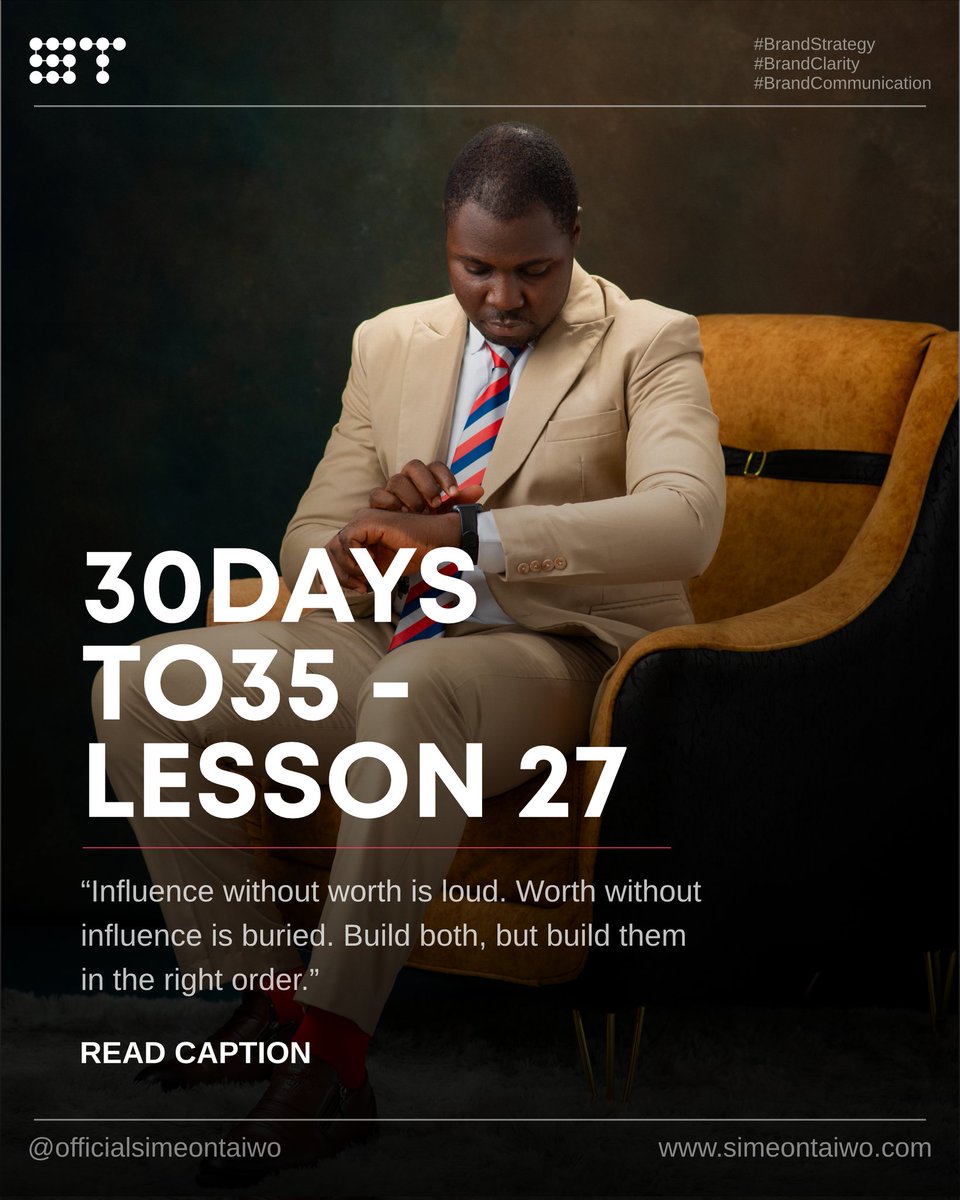
We have confused influence with worth. But they aren't the same. Not even close. And here's the distinction. The quality of people you are useful to is what defines your worth. But the quantity of people you are useful to is what defines your influence. Both matter. But they are not the same currency.
.
.
Worth is measured by the weight of the problems you solve and the difficulty of replacing you. A person who serves a hundred people profoundly carries a different kind of worth than one who reaches a million people superficially. Both have influence. But only one has the worth proportionate to their reach.
.
.
And the expensive error is spending the years designed for building worth on chasing influence. The obsession with scale is producing professionals who are loud and thin simultaneously.
.
.
Loud: visible, present, constantly in the feed.
Thin: no depth behind the volume. No serious problems solved. No body of thinking rigorous enough to survive a serious room.
.
.
The internet rewards the loud. The real marketplace, the one that pays real money and sends real referrals, rewards the deep.
.
.
But the right order is for you to build the depth first. Solve hard problems. Develop a point of view so specific and so earned that nobody else could have arrived at it. Then build influence on top of that foundation. Because when depth comes before reach, your influence carries something. It carries a person behind it, not just a presence.
.
.
Influence without worth is loud emptiness. Worth without influence is buried treasure. Build both. In that order.
.
.
I remain your BrandCore Strategist.
#30LessonsBy35 #SimeonTaiwo #BrandCore #CoreGist #PersonalDevelopment
4
25
Everyone is preparing to defend their job from AI. Nobody is asking whether what they are defending is actually their assignment.
.
.
A job is a description written by someone else's agenda. It was designed before you arrived and will be redesigned after you leave.
.
.
An assignment is a divine entrustment tied to your specific wiring: your history, your instincts, your lived context, the combination of gifts that did not exist before you arrived.
.
.
AI can memorise your job description in four minutes.
It cannot replicate your assignment. Because an assignment is not a description. It is a combination. And that combination belongs to you alone.
.
.
The real crisis AI is surfacing is not a technology crisis. It is an identity crisis. Millions of professionals built their confidence on a role title rather than on irreplaceable contribution. When the title is threatened, everything is threatened — because the title was the foundation.
.
.
The most future-proof professionals I know are not the most certified. They are the ones who have done the deep, uncomfortable work of discovering what they were actually built for. Not what their CV says. What their wiring says.
.
.
If you cannot name the difference between your job and your assignment, you are not building a future. You are renting one from an arrangement someone else can terminate.
.
.
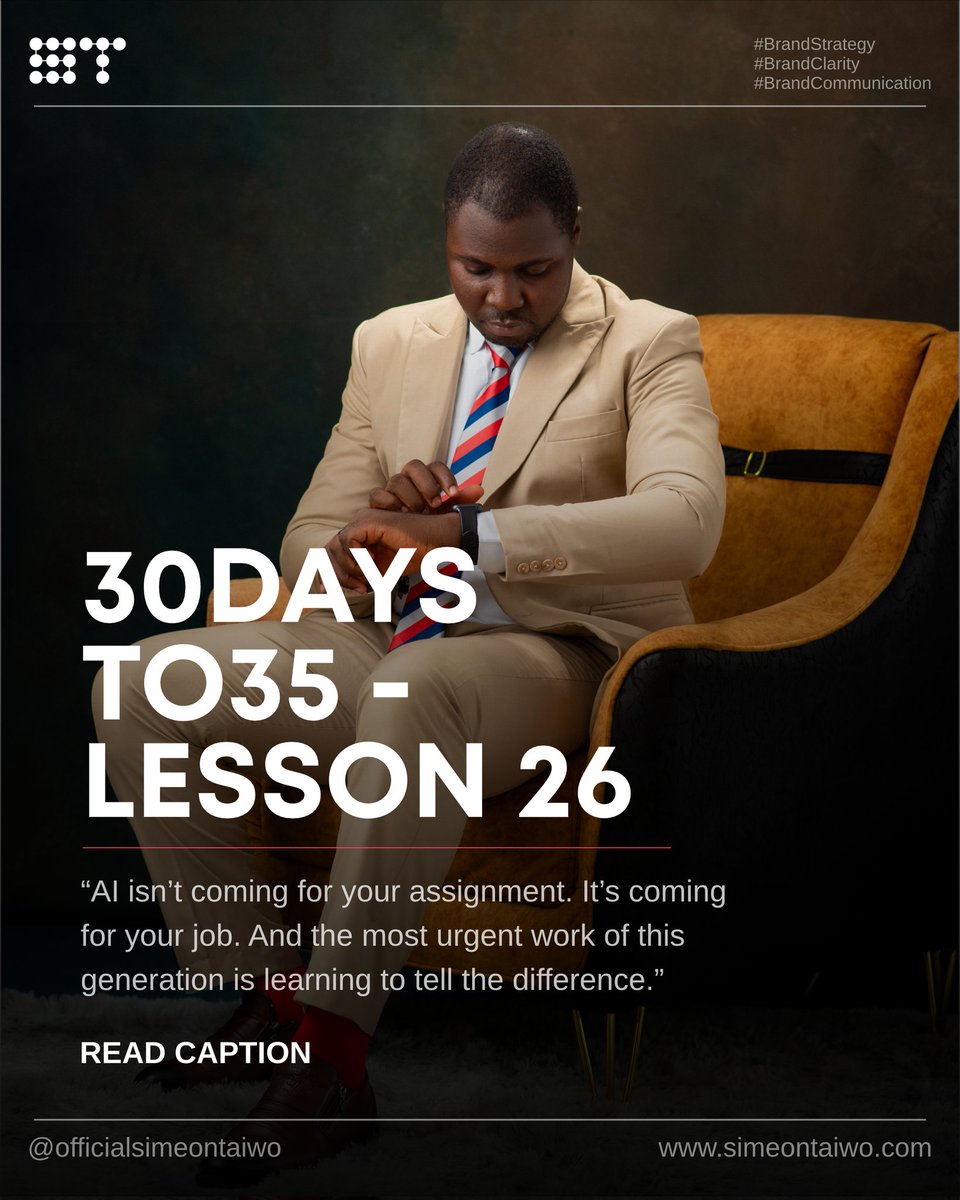
"AI is not coming for your assignment. It is coming for your job. The most urgent work of this generation is learning to tell the difference."
.
.
Are you building around a job description or around an assignment? What would have to change if you took the assignment seriously?
.
.
I remain your BrandCore Strategist.
#30LessonsBy35 #SimeonTaiwo #BrandCore #CoreGist #AIInBusiness
1
22
You found someone who had the results you wanted. You studied what they did. You followed it closely. And somehow, you still could not replicate their results. Hear me out.
.
.
This is not a discipline problem. You have been working. You have been watching. The problem is something more structural. Success leaves footprints. But the size of the foot matters.
.
.
The footprints tell you the direction. They do not tell you everything else. They do not tell you about the cushion that absorbed two failed attempts before the one that worked. They do not tell you about the season the market was in when that positioning finally landed, or the relationship that opened the right room, or the years of inner work that produced the conviction to make the move that looked effortless from the outside. You are reading the visible output. You are not reading the invisible inputs.
.
.
So you copy the blueprint. The same positioning. The same pricing logic. The same offer structure. You follow it faithfully. And you end up somewhere crooked. Not because the blueprint is wrong. But because it was built for a different foot.
.
.
Dangote's path was shaped by a combination of timing, access, and relational capital that is not transferable. Paystack was built for the exact friction in Nigerian digital payments in 2015, at a moment the infrastructure was precisely ready for it. The blueprint is not wrong. It belongs to a different foot.
.
.
Experienced builders do not copy the path. They extract the principle. What problem was being solved that everyone else had accepted as permanent? What did they refuse to do that the rest of the industry kept doing? Those answers transfer. The blueprint does not.
.
.
The principle is the root. The blueprint is the fruit. Study the root.
.
.
Account honestly for the difference between their context and yours. Then build something that actually fits the foot you have.
.
.
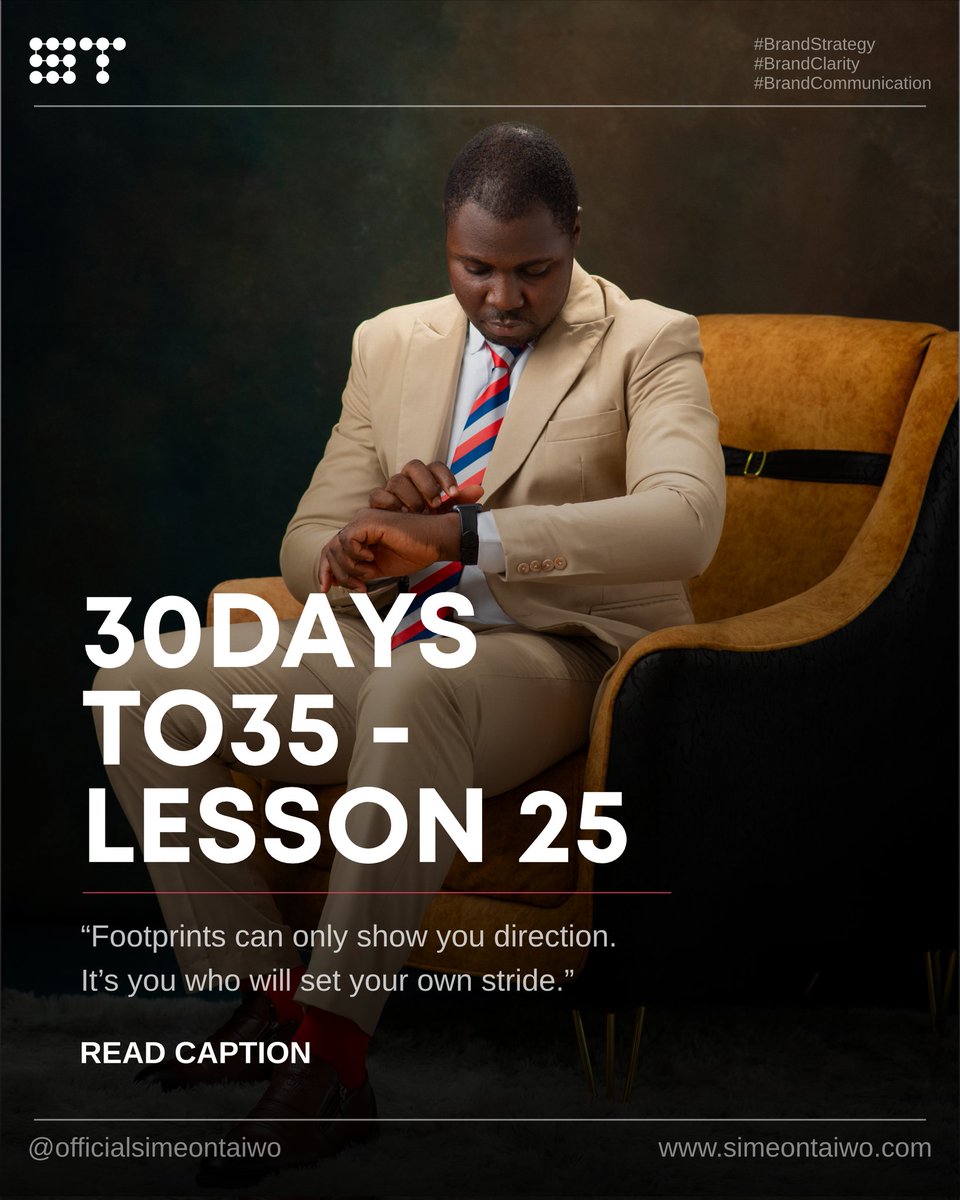
"Footprints show you the direction. Only you can set your own stride."
.
.
I remain your BrandCore Strategist.
#30LessonsBy35 #SimeonTaiwo #BrandCore #PersonalDevelopment #Entrepreneurship
1
21
May 30
Lesson 16 of 30: You have been watching the wrong thing.
.
.
Most entrepreneurs spend their best strategic energy watching competitors. What the other person is building, pricing, launching. And so when they move, they are reacting. One step behind. Every single time.
.
.
Apple did not invent the MP3 player. Paystack did not invent online payments. Flutterwave did not invent money transfers. And yet each of them changed their category permanently.
That is not coincidence. That is what innovation actually is.
.
.
Apple's genius was not a new product category. It was patient observation. Music scattered across folders on a computer. Contact lists buried in keypads. Laptops too heavy for a short flight. They removed those frictions, one product at a time, before their consumers had language for what they were missing.
.
.
Paystack understood something most people were ignoring: how money actually moved in Nigeria. The distrust at checkout. The developer's frustration. They became necessary before the market could ask for them.
.
.
That is innovation. Not a new category. A deeper understanding of an existing one.
.
.
Innovation is not invention. It is the studied understanding of how your audience lives, and becoming increasingly necessary to them before they ask you to.
.
.
The word is studied. Studied the way a doctor studies a patient: deep, sustained, almost obsessive focus on the friction your audience has accepted as normal.
.
.
And here is the interesting part: most of your competitors will never do this. It is slow work. It does not trend. But it is the only work that produces dominance.
.
.
The question is not "What am I building?" It is: "How deeply do I understand the life of the person I am building for?" What friction has your audience started to embrace as normal?
.
.
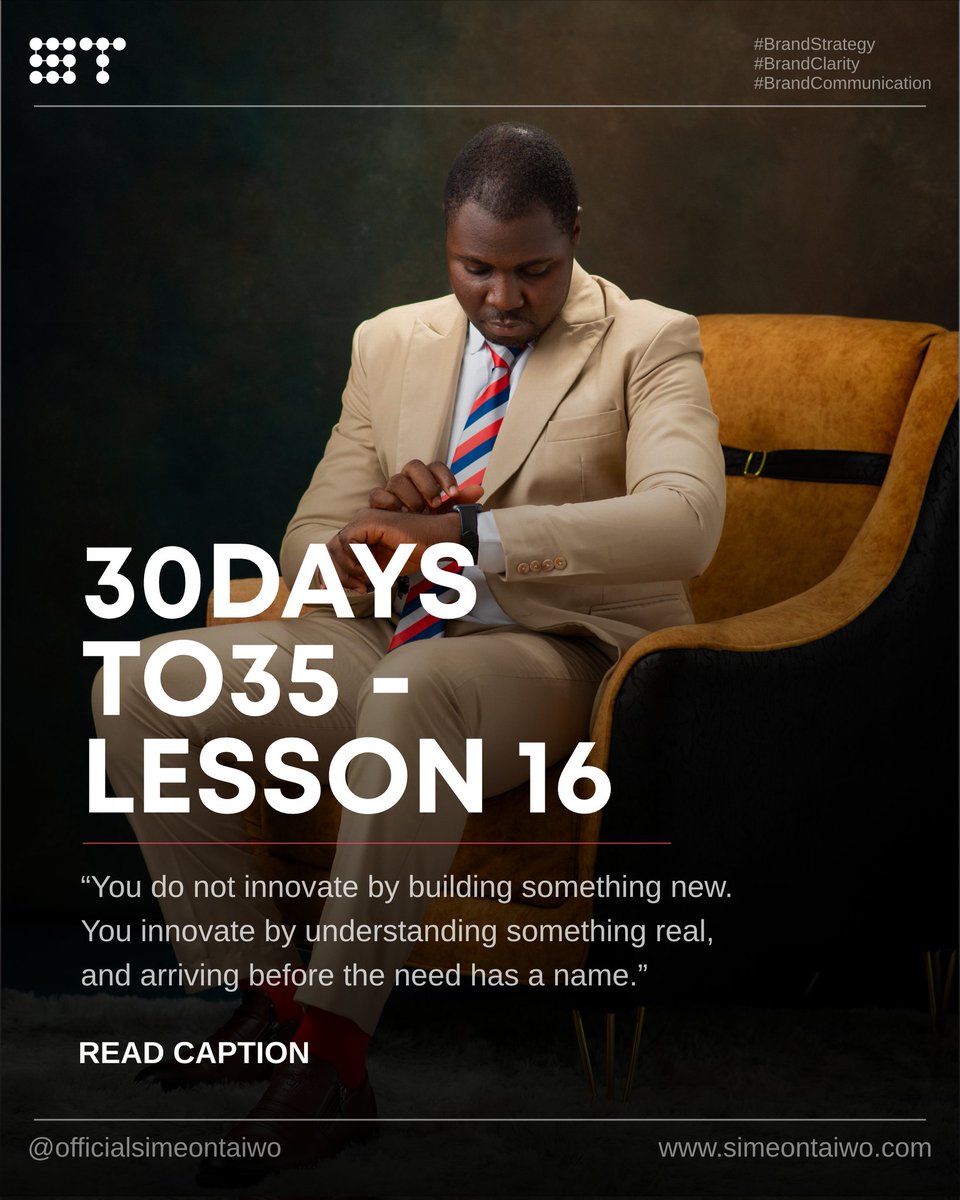
"You do not innovate by building something new. You innovate by understanding something real, and arriving before the need has a name."
.
.
I remain your BrandCore Strategist.
#30LessonsBy35 #SimeonTaiwo #BrandCore #CoreGist #NigerianEntrepreneur
3
21
May 27
Most rebrands fool the public for about six months. The new logo goes up, the website refreshes, the announcement gets traction. Then the real product shows up, and it is the same as it always was.
.
.
In April 2018, @dclmhq Deeper Christian Life Ministry unveiled a new identity. New logo. New headquarters. A new tagline: from "Your spiritual welfare is our concern" to "Achieving heaven's goal."
.
.
Eight years on, that rebrand is still having huge impact in the church's trajectory. Not because of the logo. Because of what changed after it.
.
.
The nature of their programmes shifted. Their willingness to associate with ministers from other denominations opened up. Their investment in youth deepened. Their media and technology strategy transformed. The new tagline was not a marketing decision. It was a declaration. And everything that followed proved it.
.
.
A rebrand is not a visual exercise. It is a behavioural one. The new logo is the last thing that should change, not the first, because it is supposed to reflect a transformation that has already happened on the inside. When the visual changes first and the behaviour stays the same, the new identity sits on top of the old reality like a name badge on an empty room. The real world always surfaces it.
.
.
The question Deeper Life answered correctly: what have we actually become, and does everything we do now prove it? That is the question every rebrand must answer.
.
.
What part of your business or personal brand have you been dressing differently instead of actually changing?
.
.
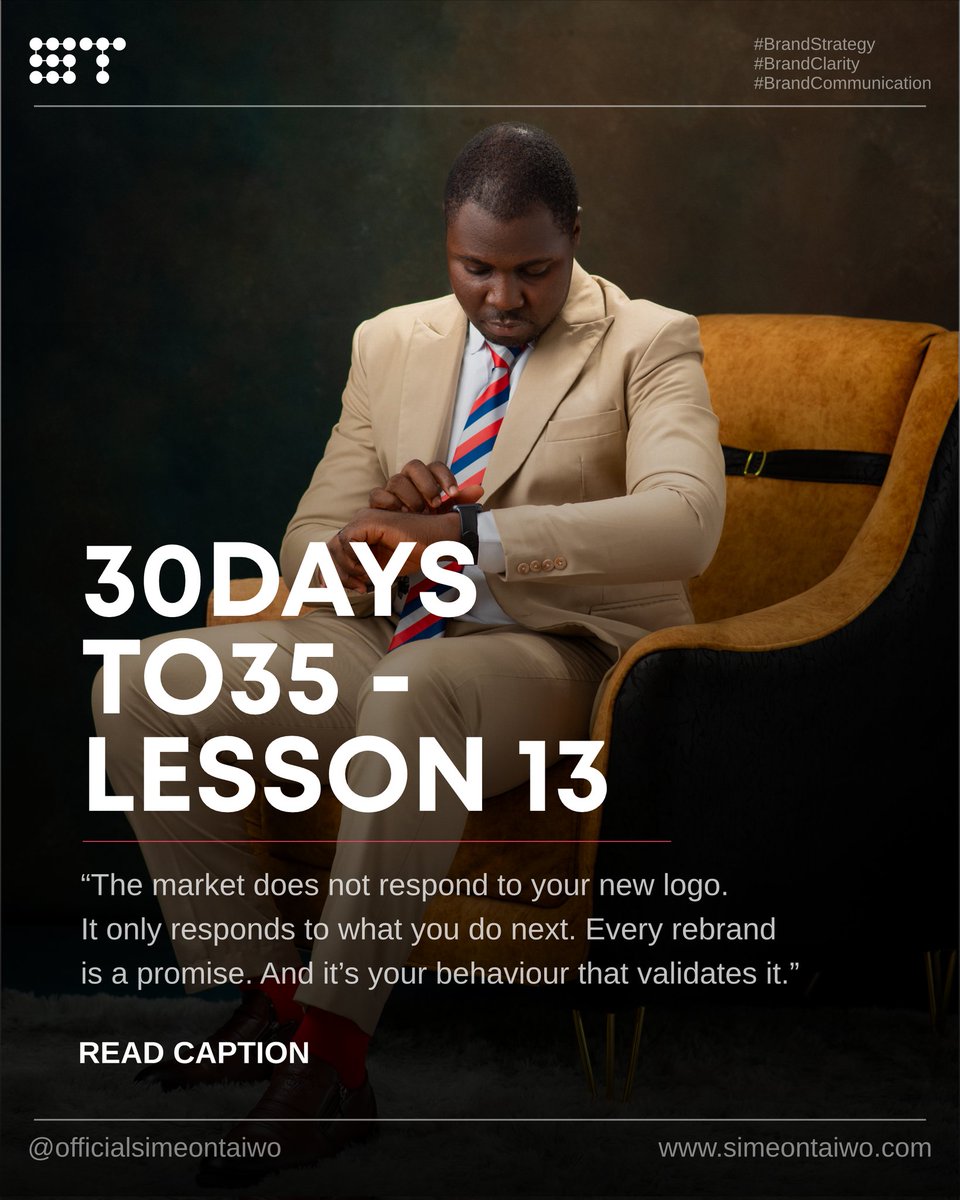
"A rebrand does not begin with a new logo. It begins with a decision that changes what you actually do. The logo is just how you tell the world what you already became."
.
.
I remain your BrandCore Strategist.
#30LessonsBy35 #SimeonTaiwo #BrandCore #BrandingSchool #NigerianEntrepreneur
2
2
24
May 24
Lesson 10 of 30: There is a man in Matthew 13:44 who found treasure hidden in a field. He did not take the treasure and run. He bought the field.
.
.
That has always struck me as one of the most strategic moves in Scripture. He could have grabbed the gem and walked away. But he understood something: the land that produced the treasure was worth more than the treasure itself.
.
.
So he sold everything and bought the field.
.
.
The land, not the gem.
.
.
Most professionals are chasing the gem. The brilliant campaign, the standout project, the breakout moment. And gems matter. But the real wealth is in the land.
.
.
Land generates. Gems get sold. Land keeps producing. Gems get displayed.
.
.
The most strategic thing you can create is infrastructure that keeps opening doors you did not know existed when you started.
.
.
When I built the @clarylifeglobal Brand OS, I was solving one problem: turning weeks of proposal-writing into minutes. We built the system. Proposals that took hours now took under 30 seconds.
.
.
That was the gem.
.
.
But what we had actually built was land. That same infrastructure now powers strategy sessions, client onboarding, team training, and workflows we never imagined.
.
.
@VerseTap is the same. We built it for sermon notes. Close to 700 downloads later, across 35 countries, it is being used for Bible study groups and leadership training. The infrastructure keeps finding new uses.
.
.
That is the land principle. If you build infrastructure instead of just solving the immediate problem, what you have built will keep creating value.
.
.
The man in Matthew 13 understood this. He did not just want the treasure. He wanted the field. Land produces what gems cannot: continual return.
.
.
Gems do not compound. Land does.
.
.
The land, not the gem. The most strategic thing you can build is the thing that keeps generating opportunities you have not yet imagined.
.
.
What is the one thing you have built that keeps creating value without you actively pushing it?
.
.
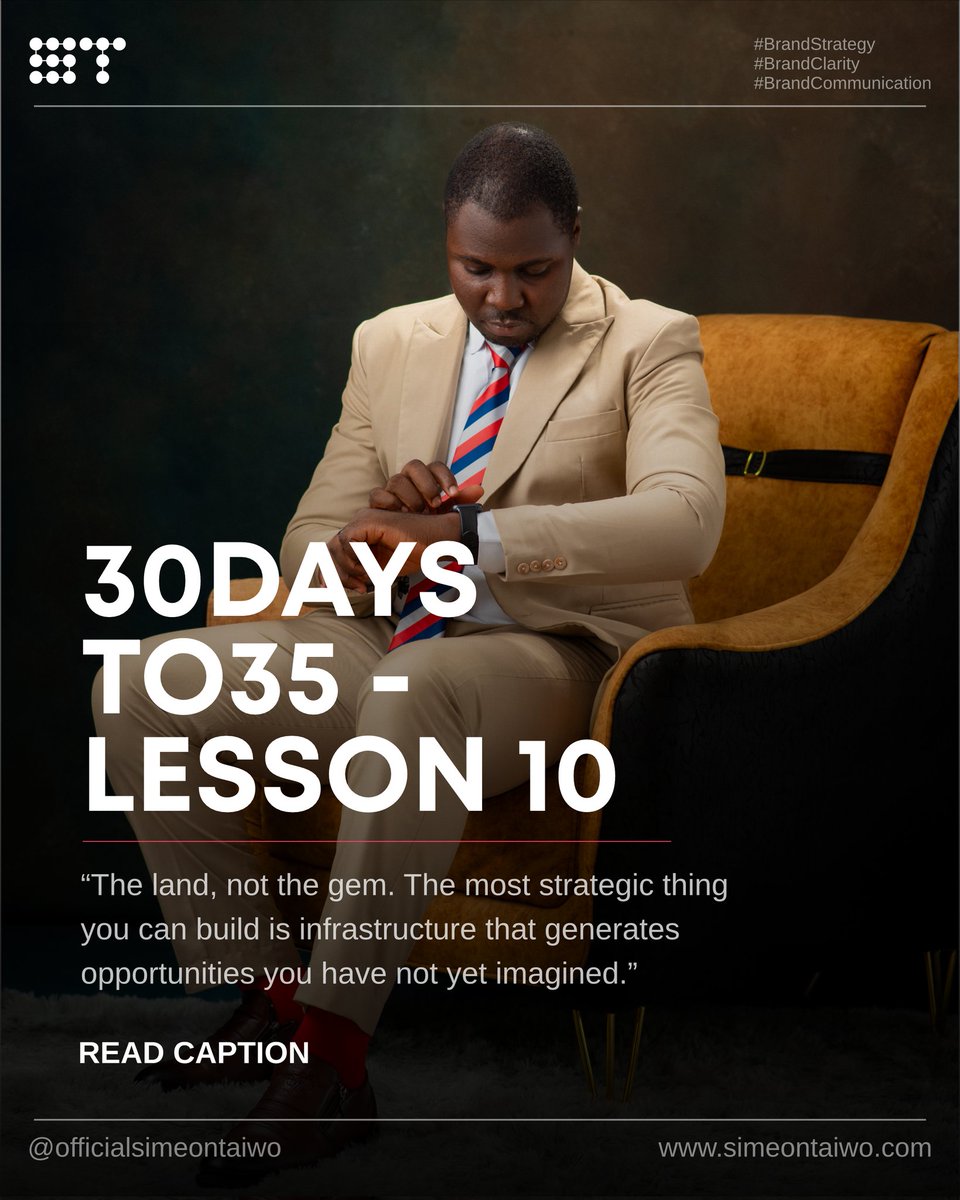
"The land, not the gem. The most strategic thing you can build is infrastructure that generates opportunities you have not yet imagined."
.
.
I remain your BrandCore Strategist.
.
.
#30LessonsBy35 #SimeonTaiwo #BrandCore #SystemsThinking #Clarylife #Faith #Entrepreneurship #NigerianEntrepreneur
1
1
4
53
May 20
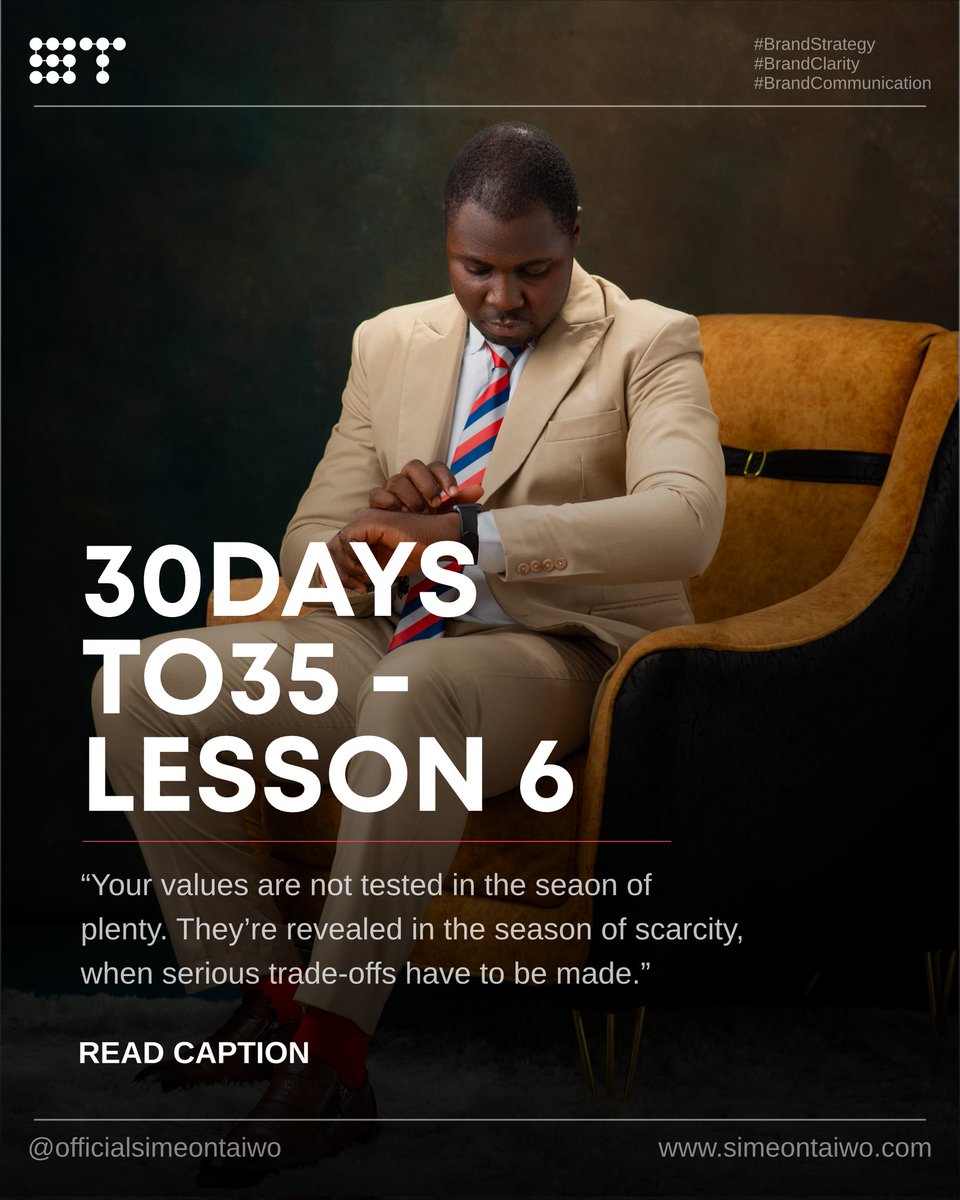
Lesson 6 of 30: Some years ago, there was a month I had exactly enough money to do one of two things. Not both.
.
.
Pay office rent. Or pay my team's salaries.
.
.
That was not a hypothetical leadership exercise. That was a Tuesday morning in my office with a bank balance I had checked three times hoping the number would change. But it didn't change.
.
.
So, I ended up paying the salaries.
.
.
Now, I want you to understand something. That decision was not noble. It was not even strategic in the way people use that word. It was a revelation. I did not sit down and weigh the options calmly. I knew, almost immediately, what I was going to do. And what disturbed me was not the decision itself. It was how quickly I made it. Because speed of decision in a moment like that tells you what has already been settled inside you before the crisis arrived.
.
.
Your values are not what you write on a slide deck for a team meeting. Your values are not the words on your website's "About Us" page. Your values are the thing you reach for when you cannot afford everything and you have to choose. That is where character lives. Not in abundance, where every value can be honoured simultaneously without friction. In scarcity, where honouring one thing means losing another.
.
.
I lost the office space. We worked from alternative arrangements for a period that was longer than I had planned. It was uncomfortable. But the people who had trusted me enough to show up and build with me received what they were owed. And something shifted in how I led after that. Not because I had read a book about servant leadership. But because I had been put in a room with two doors and I knew, with evidence, which one I would walk through.
.
.
And it is not only money that does this. Time does it too. When your calendar cannot hold everything, what survives the cut tells you what you actually value. The leader who says family is everything but has not had an unhurried evening at home in three months has already made a choice. The entrepreneur who says vision drives everything but spends every scarce hour reacting to the loudest fire has already revealed the absence of one. Scarcity of time exposes the strength of your mission the same way scarcity of money exposes the depth of your character.
.
.
Most people discover their values this way. Not through reflection. Through pressure. The pressure does not build the value. It reveals what was already there. Or it reveals what was missing.
.
.
"Your values are not tested in the season of plenty. They're revealed in the season of scarcity, when serious trade-offs have to be made."
.
.
What is one trade-off you have been forced to make, whether with money or with time, that showed you something about yourself you did not fully know before?
.
.
I remain your BrandCore Strategist.
#30LessonsBy35 #SimeonTaiwo #BrandCore #CoreGist #Leadership #Entrepreneurship #PersonalDevelopment
3
32
May 19
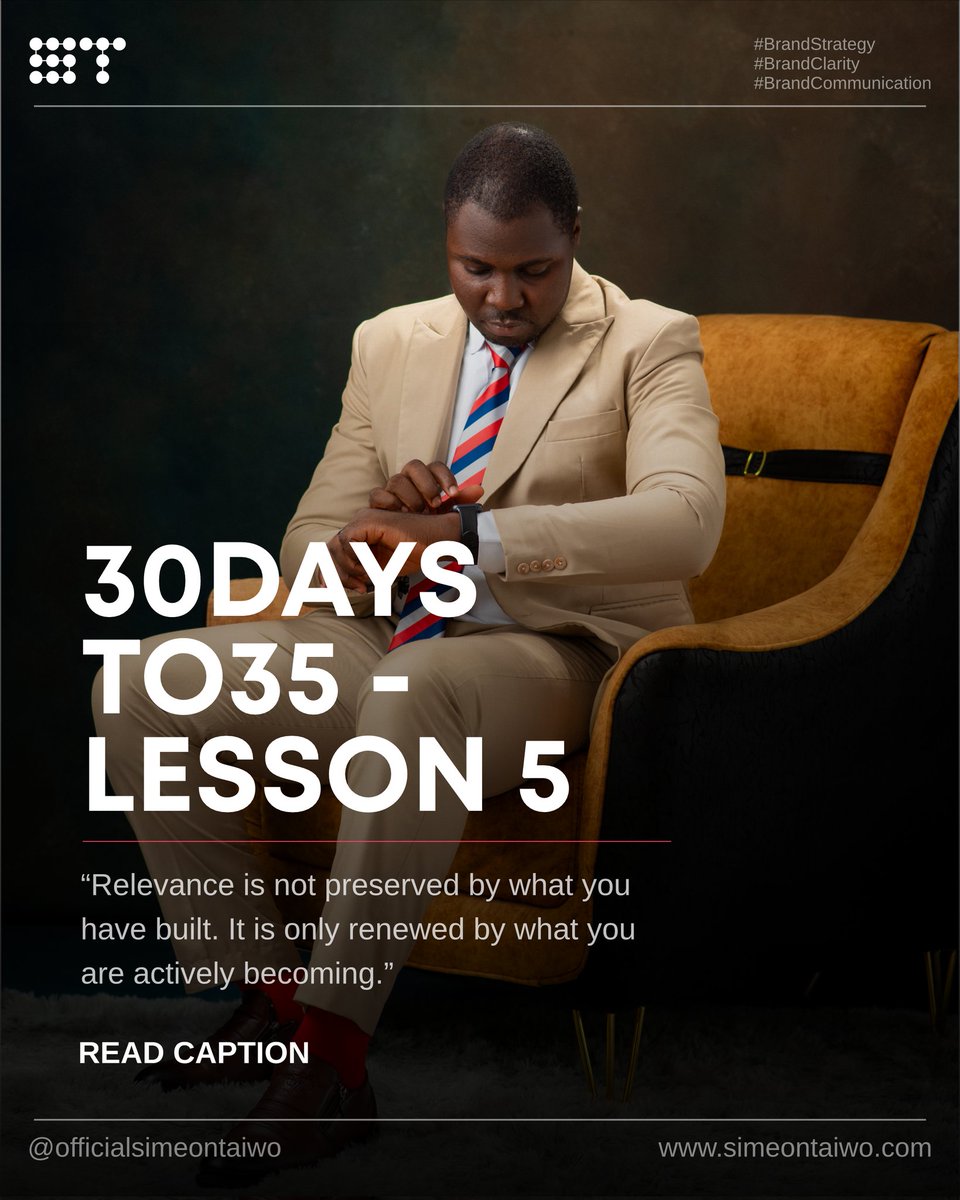
Lesson 5 of 30: Let no one meet you again where they left you before.
.
.
I have said this for years. Most people read it as a call to grow. But it is actually a warning about relevance.
.
.
The most dangerous state you can settle into is being fully figured out. Not because you have done anything wrong. But because when there is nothing left to discover in you, attention moves on, respect becomes ceremonial, and reward quietly dries up. No one applauds twice for the same achievement.
.
.
Think about that. The first time you delivered something remarkable, the room celebrated. If you show up three years later with the exact same thing, with no evolution, no new dimension, nothing that even surprised yourself, the most you will get is polite acknowledgement. Familiarity does not build loyalty. Freshness does.
.
.
Even God, who is the most unchanging being in existence, said this: "Remember not the former things, neither bring to mind the things of old. Behold, I do a new thing." (Isaiah 43:18-19)
.
.
If the Eternal chooses newness as a demonstration of power, what excuse does any builder have for standing still?
.
.
The people who regard you most deeply should never feel they have completely mapped you. Your closest colleagues should look at what you are building now and feel the same pull they felt when they first discovered you. Not because you are performing freshness, but because you are genuinely becoming.
.
.
This is one of the things that has moved me from one level of financial capacity to the next. And it's the naked truth. I built increasing relevance on the wheels of genuine innovation, staying so closely aligned with my vision that I kept birthing new things from it.
.
.
I have always said that I started out by doing flyers, business cards, letterheads, etc. Today, Clarylife Global carries a range of services: systems automation, brand strategy, AI-powered tools, mobile apps, with two subsidiaries already and solid flagship products. The range did not come from restlessness. It came from depth.
.
.
But there is a critical balance here. I followed a principle I hold firmly: build the trunk before growing branches. Stay on one thing long enough to build real reputation around it, then let that reputation carry the weight of new things. Not scattered across ten directions while shallow in all of them. The branches only grow well when the trunk is already strong enough to hold them.
.
.
Freshness without roots is chaos. Roots without freshness is stagnation. You need both, and they are built in that order.
.
.
People only regard and reward you to the degree of freshness they keep seeing from you. Not the freshness of trends. The freshness of genuine becoming: new thinking, new capacity, new things birthed from the same vision that started it all.
.
.
Be so fresh that even those who know you best keep seeing you as a mystery yet to be fully unfolded.
.
.
What is the last thing you produced that genuinely surprised the people who already knew you well?
.
.
"Relevance is not preserved by what you have built. It is renewed by what you keep becoming."
.
.
I remain your BrandCore Strategist.
#30LessonsBy35 #SimeonTaiwo #BrandCore #CoreGist #PersonalDevelopment
1
3
35
May 18
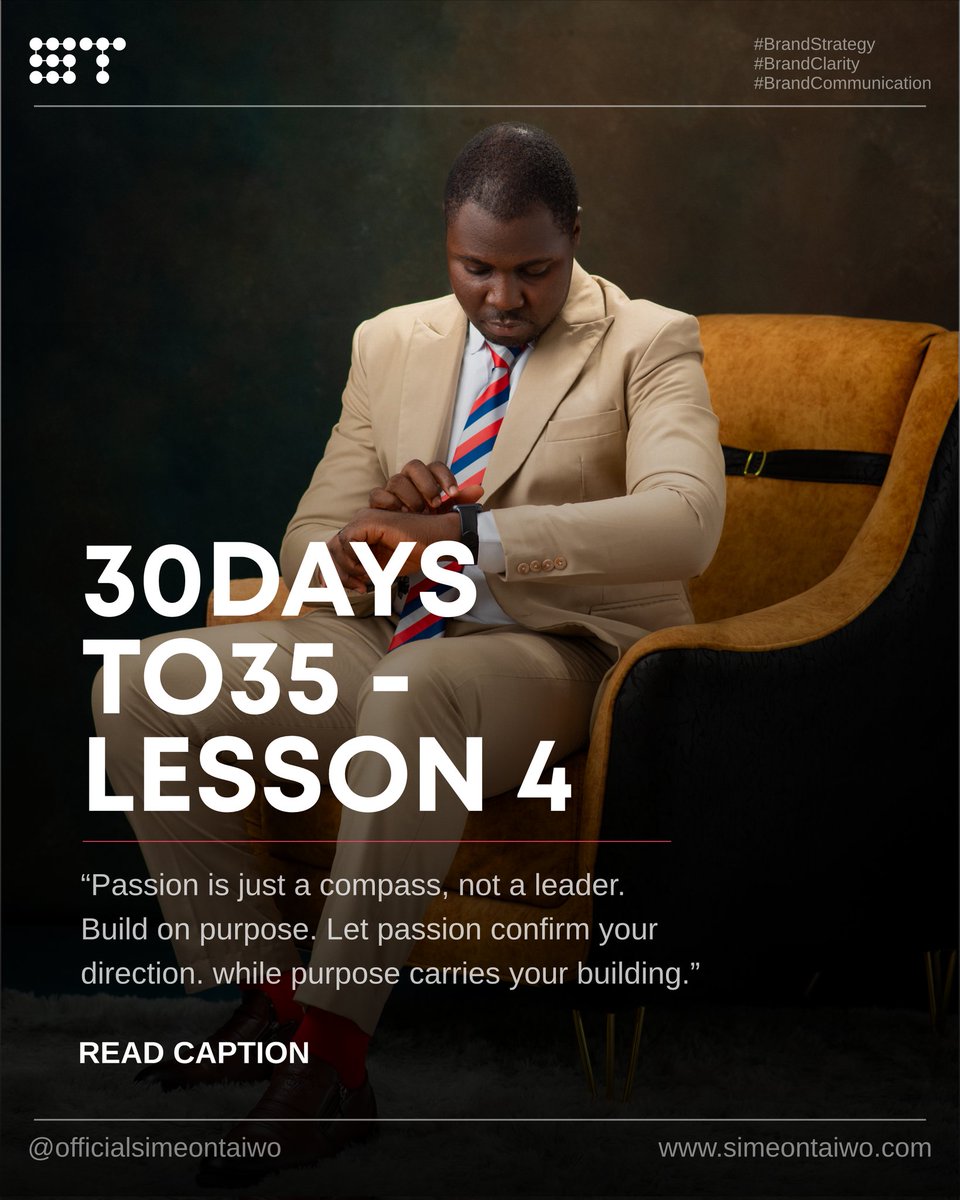
Lesson 4 of 30: The most expensive career advice ever given is three words long: Follow your passion.
.
.
Now, I want to be fair. The advice is not wrong. It is dangerously incomplete.
.
.
Passion is real. It is evidence of something important, a signal from your wiring about where your energy naturally flows. That signal is worth paying attention to. But there is a critical difference between paying attention to a signal and building your life on it.
.
.
Here is the problem with passion as a foundation: passion fluctuates.
.
.
It is high on the exciting days. It drops when the client is difficult, the invoice is unpaid, and the project has been revised seven times. It disappears during seasons of real pressure, fatigue, or disappointment. If your foundation is a feeling, your building shakes every time the feeling changes.
.
.
I have watched talented people abandon careers, businesses, and projects at the exact moment they would have broken through, because the passion was no longer there to confirm they were on the right path. The path was right. The fuel was wrong.
.
.
Passion is a compass. Not a leader.
.
.
And here is where it gets even sharper.
.
.
Passion is what you enjoy doing. Purpose is what you are obligated and committed to do.
.
.
No one pays you to enjoy what you are doing. People pay you to deliver on your obligations and commitments. The market does not audit your enjoyment. It audits your delivery.
.
.
This is why building a career primarily on passion is building on the wrong currency.
.
.
Purpose is the burden that does not leave when the passion goes quiet. It's the problem you cannot stop caring about, the people you are wired to serve. Build on that. Let passion be the signal that confirms your direction. Never let the signal be the structure.
.
.
Ask yourself honestly: if you stripped the passion out of your work today, what would remain? If the answer is nothing, you are operating on feeling. If the answer is a problem I still need to solve and people I still care about, you have found something worth building on.
.
.
Lesson 4 of 30: "Passion confirms your direction. Purpose carries your building."
.
.
What is one thing you have stayed committed to, not because you felt passionate about it, but because the purpose was too important to let go?
.
.
I remain your BrandCore Strategist.
.
.
#30LessonsBy35 #SimeonTaiwo #BrandCore #CoreGist #Clarylife #PersonalDevelopment
1
4
27
May 17
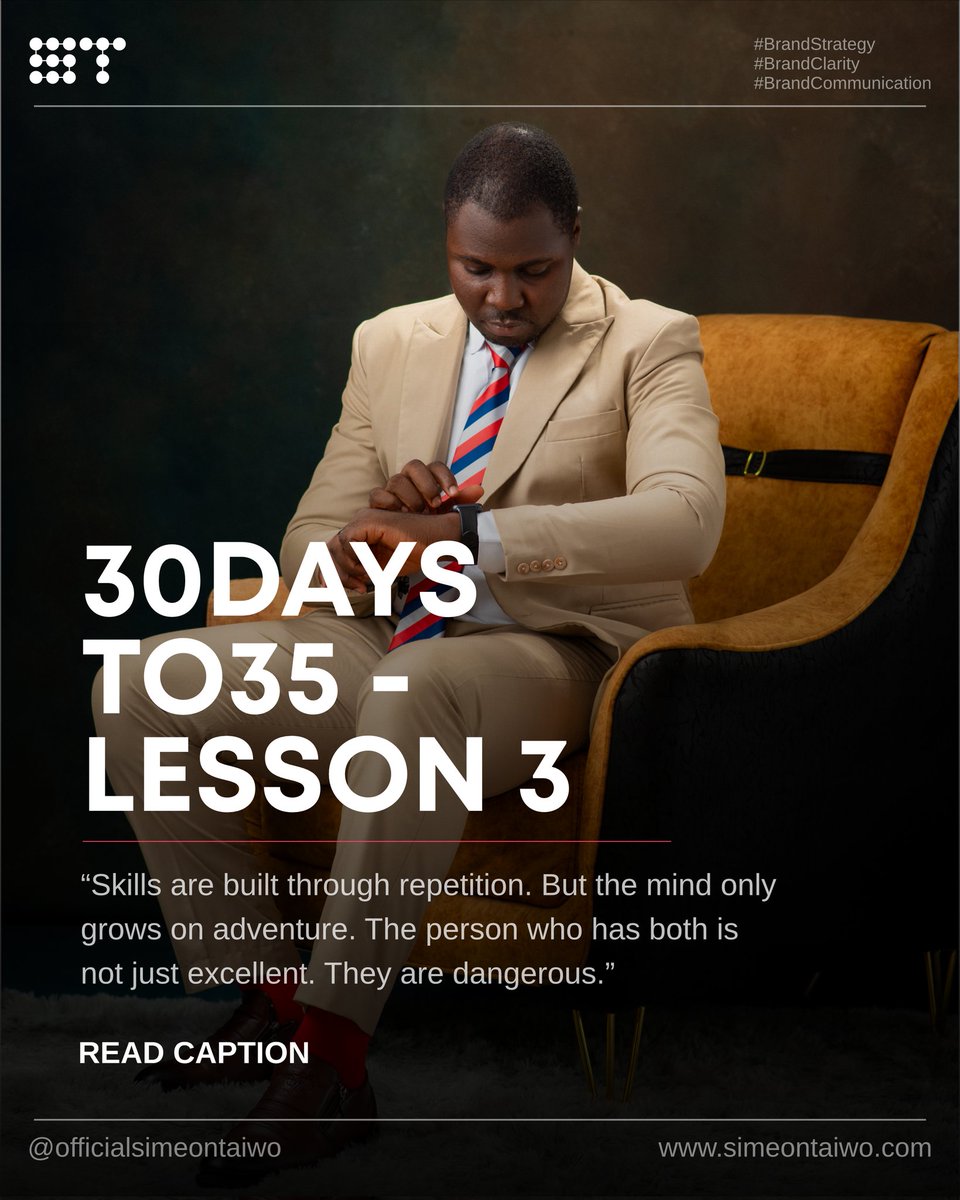
Lesson 3 of 30: You have been doing the same thing for five years. You are better at it than you were when you started. But you are not a different person.
.
.
That is the trap of repetition without adventure.
.
.
Repetition is essential. I will never argue against it. The 10,000-hour principle is real. You become excellent at something by doing it over and over and over again until your hands know the way before your mind gives the instruction.
.
.
But here is what repetition cannot do: it cannot grow your mind. It can only sharpen what your mind already contains. You can repeat your way to mastery of a skill and still be thinking the exact same thoughts you were thinking three years ago.
.
.
Adventure is the other half.
.
.
Not recklessness. Not distraction. Adventure. A new environment you have never navigated. A conversation with someone who thinks nothing like you. A discipline you have no business studying but something in you keeps pulling toward. A room where you are the least experienced person and every assumption you hold is being quietly challenged.
.
.
That is where the mind actually grows. Science calls it neuroplasticity. New experiences form new neural pathways. New pathways expand the range of what you are able to think, perceive, and connect. Without them, you are simply running the same software on faster hardware.
.
.
I learned this the hard way. There was a season where I was deeply committed to improving my craft but rarely exposing myself to anything outside of it. I was getting sharper, but I was not getting wider. The quality of my output improved, but the quality of my thinking stayed the same. The shift only came when I deliberately stepped into spaces and subjects that had nothing to do with my daily work.
.
.
And that is when the dots started connecting in ways repetition alone could never have produced.
.
.
Most professionals I meet are stuck in one mode. The disciplined ones live in repetition. Their skills are sharp but their perspective is narrow. The restless ones live in adventure. Their ideas are many but their execution is thin. Both are half-built.
.
.
You need both. Repetition for your craft. Adventure for your mind. One makes you excellent. The other makes you original. And in this economy, in this season, being excellent at something everyone else can also do is not enough. You need the kind of originality that only comes from a mind that has been stretched beyond its familiar territory.
.
.
At 35, this is one of the lessons I would give my younger self without hesitation: do not confuse getting better at your work with growing as a person. They are not the same journey. And the second one requires you to leave the building sometimes.
.
.
Where are you right now — stuck in repetition, scattered across adventures, or building both deliberately?
.
.
"Skills are built through repetition. But the mind only grows on adventure. The person who has both is not just excellent. They are dangerous."
.
.
I remain your BrandCore Strategist.
#30LessonsBy35 #SimeonTaiwo #BrandCore #PersonalDevelopment #Leadership
2
26
May 15
Thirty days from today, I turn 35.
For the next 30 days, I am sharing one lesson per day from my entrepreneurship journey. Not theories. Not borrowed wisdom. Things I have lived, paid for, and carried long enough to know they are true.
.
.
Day 1.
.
.
In December 2016, I registered @clarylifeglobal. I had just finished university. I was preparing for youth service. And I had a vision: help young people get clarity on who they were, where they were going, and what they were building their lives around.
.
.
I was a clarity coach. That was my positioning.
.
.
But there was one problem.
.
.
I had not yet fully done that work for myself.
.
.
I had the language. I had the passion. I could articulate the concept of clarity with enough conviction to sound like someone who had earned the right to teach it. But underneath the positioning was a young man still wrestling with the very questions he was asking others to answer.
.
.
The initiative stalled. Financial constraints were real. But the more honest truth was this: I needed to build the personal capacity and the visible credibility to stand behind what I was teaching, before I could teach it at the level it deserved.
.
.
So I paused. And I redirected.
.
.
In 2018, Clarylife pivoted to B2B — offering real services to real businesses. The name did not change. Because the mission did not change. The same clarity I had set out to bring to young people was the same clarity I was now bringing into the small businesses I began to work with.
.
.
That pivot was an act of honesty, not retreat.
.
.
Eight years later, Clarylife Global is still standing. And the coaching has returned, not as a young man reaching for a title he had not yet earned, but as someone who has spent years building the proof the teaching required.
.
.
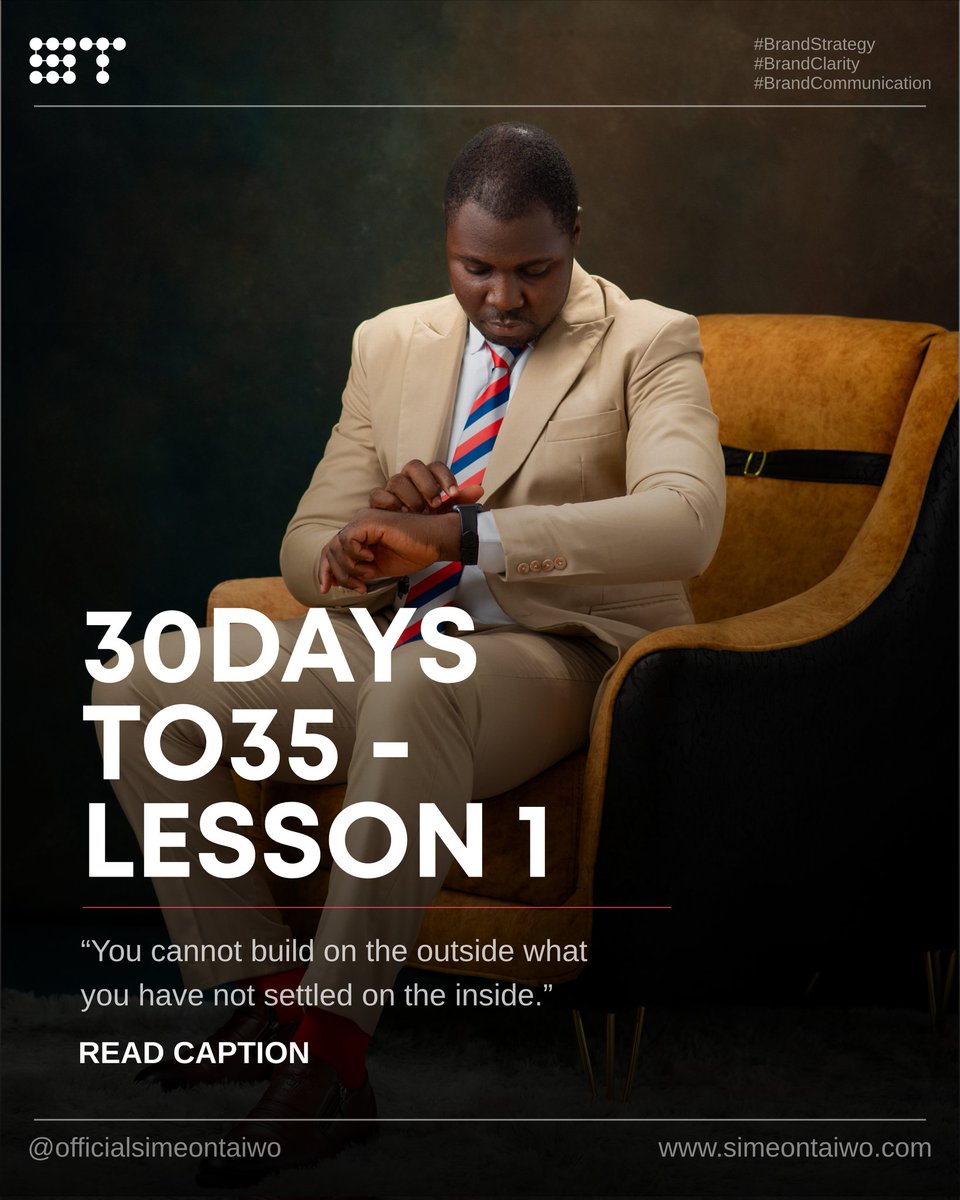
Lesson 1: You cannot build on the outside what you have not settled on the inside.
.
.
The interior work is not soft. It is the hardest, most expensive work you will ever do as an entrepreneur. And it is the only work that guarantees everything else will last.
.
.
What is one area of your life or work where you know the external problem is actually an interior one you have not yet faced? Be a part of my clarity network and let's trash it out. Here's the link to join: simeontaiwo.com/simeons-clar…
.
.
I remain your BrandCore Strategist.
#30LessonsBy35 #SimeonTaiwo #BrandCore #Entrepreneurship #PersonalDevelopment
1
2
17