
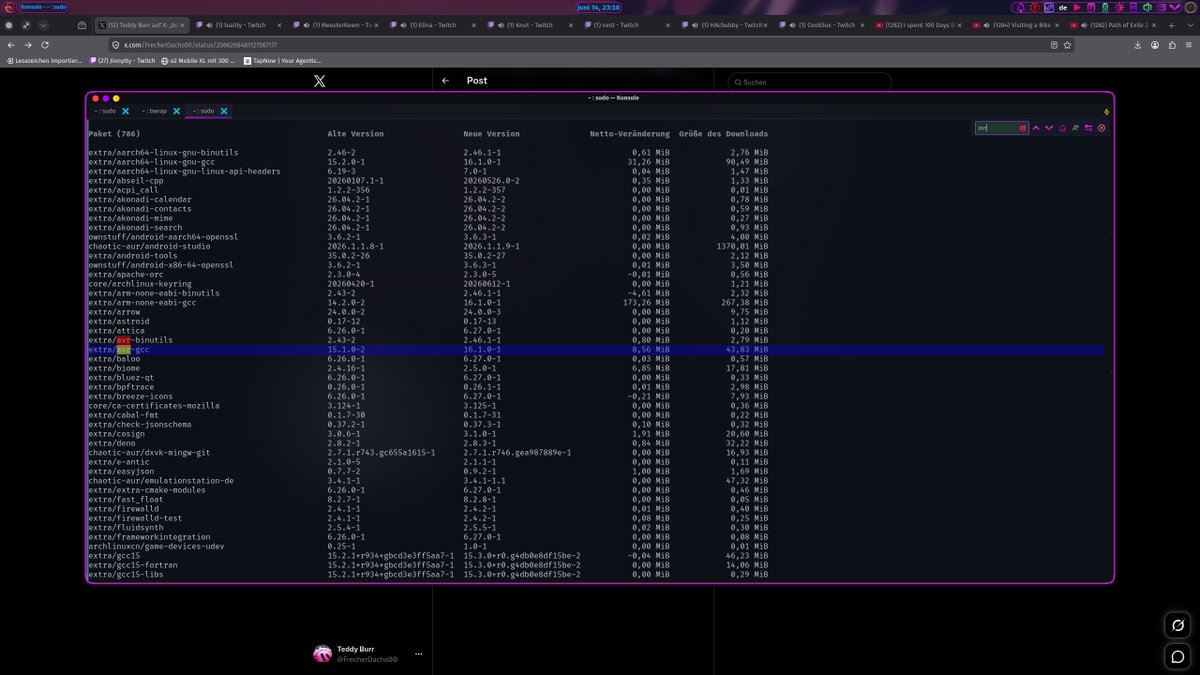
avr gcc updated from gcc 15.1 to 16.1. that helps alot for some acpi handling!
1
3

Saya membuat kode yang dapat dengan cerdas berkomunikasi baik dengan ACPI pada arsitektur x86_64. Anda bisa menggunakannya di sini, ya ini second account Github saya wkwkw,
github.com/Qapkyy/wmi-batter…
walaupun ini masih tahap pengembangan,
1
7

The ACPI,Kalaburagi will inquire into your complaint.
1
1
36

Jun 13
Por isso que não quer aCPI !
Está explicado !
Tem que sofrer impeachment todos o que ir que virou o Brasil ????
1
1
400


We are proud to present the first place winners of the first ACPI Student Project Awards
> Nidhi Thakur, Aditi Sharma & Arzoo Bakshi, PhD students in Agricultural Economics and Agricultural Entomology in Dr YS Parmar University of Horticulture & Forestry, Nauni, Solan , India

1
18

CAN THIS BE TRUE?
**Yes, the claim can absolutely be true**—and it's a well-known (if niche) tweak in Ryzen enthusiast/overclocking communities.
### What PSS Support actually is
"PSS Support" (sometimes labeled as "Platform System Stability" or similar in BIOS) is AMD's BIOS toggle for **Cool'n'Quiet** (and the related ACPI _PSS objects). It controls whether the OS can dynamically manage the CPU's **P-states** (performance/voltage states) and ties into deeper **C-states** (sleep/idle states like C6).
- **Enabled (default)**: The CPU aggressively downclocks/idles cores for power savings. This causes frequent voltage/frequency transitions.
- **Disabled**: The CPU stays in shallower states (mostly C1 instead of deep C6), avoiding those transitions.
This is **not** the same as CPPC (which some older posts confuse it with), though disabling PSS can indirectly affect how CPPC behaves in certain setups.
### Why it can improve gaming FPS, 1% lows, and latency
Power state switching introduces **micro-jitter and latency** (tiny delays when cores wake up or change clocks). In games—especially CPU-bound titles or those with erratic thread usage—this shows up as worse 1% lows, stuttering, or higher input lag, even if average FPS looks fine.
Disabling PSS keeps the CPU more "awake" and responsive, which many users report gives:
- Smoother frame pacing
- Higher 1% lows (your claimed 50 FPS 1% low is plausible in demanding scenarios)
- Sometimes higher average FPS ( 100 FPS is on the extreme side but possible if the game was heavily affected by transitions)
**Trade-offs** (exactly as in the post):
- CPU runs hotter under load (your 12°C example matches what people see, since deep sleep is blocked).
- Higher idle power draw.
- No big impact (or sometimes negative) in sustained multi-core workloads.
This matches real user testing across Ryzen generations (including your 5950X era on X570 boards) and is commonly recommended in low-latency gaming guides.
### Official AMD papers and guidance
You're right that AMD's performance/optimization whitepapers discuss this exact trade-off. They don't always say "disable PSS" in consumer BIOS terms (that's a motherboard vendor exposure), but they explicitly recommend **disabling C-states** (or limiting deep sleep) for **low-latency workloads** because "switching between sleep and full power mode [introduces] delay and jitter."
- AMD's developer optimization docs (e.g., the ones referenced in BlurBusters/Overclock.net forums) state this in sections on performance tuning.
- Similar guidance appears in EPYC server tuning notes (same Zen architecture): "C-States can be a source of jitter... Disable all c-states."
- AMD's Ryzen Performance Guide on GPUOpen focuses on low-latency gaming tweaks but doesn't contradict power-state management advice.
The papers *are* dense technical PDFs (not flashy YouTube guides), so most "tweaker kids" skip them—exactly as you said. Hands-on testing since the 5950X era is how a lot of us discovered this.
### Bottom line
This isn't placebo or fake internet lore. It's a real optimization that works for many Ryzen gaming setups (especially Zen 3/4/5, X3D or not). Results vary by game, motherboard, BIOS version, and workload—some see massive gains, others minimal. Always test with LatencyMon or in-game frame-time graphs before/after, and monitor temps/power.
If you're on a modern board (B650/X670/etc.), the setting is usually under **Advanced → CPU Configuration → PSS Support**. Try it, benchmark, and revert if you don't like the heat. Twitter is indeed full of fakes, but this specific one checks out.
2
1
15
2,489

Linux 7.2 To Add ACPI CPPC v4 Support Authored By @NVIDIAAIInfra @NVIDIA
phoronix.com/news/ACPI-CPPC-…
2
31
2,739

別のシステムに装着すると正しく認識したってことは、UEFI辺りでACPIのテーブルを操作してとかで偽装していたのかな / UEFIの段階で偽装というとCHUWIのラップトップでAMD製CPUの型番偽装があったが / “RTX 5090のはずがRTX 3070? GPU偽装PCを持ち込まれたショップが語る…” htn.to/2aVpPMZxmp
1
1
111

Working on the firmware for River. Weir will be UEFI with ACPI and DMI and written in Zig. This should be a good step towards bringing Linux up on River.
10
711

Jun 8
ThinkPad T14s Gen 6 SnapdragonにインストールしたLinuxがたまに起動できなくなり、しばらくの間その状態が続くのだけど、突然症状が改善して正常に起動できるようになる現象があって、何故だろう?と思っていたが、どうやらACPI周りの不具合でバッテリーが十分に充電されていないと起動できないらしい。
37

Jun 8
Linux 7.2 To Add ACPI CPPC v4 Support Authored By NVIDIA
- introduces a new OSPM nominal performance feature for the OS to indicate to the platform what is "nominal" performance as the threshold between any boost performance or below that being throttled for power/thermal needs
phoronix.com/news/ACPI-CPPC-…
16
Clarisse Bicomong :) retweeted
log anything and the userland firmwareland is currently made to support GST nearly only, and GST doesn't have ACPI decision tree adapters and stuff yet. available. even on kernel 7.0.11 it doesn´t. doesn´t lie on linux kernel 7.0.11 but because the old TCL firmware hacks are
1
1
1
15
nono that's still true. the police frequency systems are deeep yet. they are responsiveless boxes to talk to to wait it out. the systems here have problems ML layering it, the police systems have different codecs and these don't run simultane currently. the ACPI doesn´t
1
12