
30 Apr 2024
Pseudostuttering, or voluntary stuttering, has been used in classrooms to help future SLPs develop skills to use in therapy. This article from #ASHASIG4 discusses recent conversations around pseudostuttering from a neurodiversity standpoint on.asha.org/4dc2J38 @StJohnsU

ALT A multicultural group of abstract individuals drawn without faces look toward the screen with their hands on their chins. A series of multicolored question marks appears in thought bubble atop the group.
1
2
186
2 Apr 2024
The latest from #ASHASIG4 looks at a person-centered treatment program for a young man with acute-onset stuttering after a concussion. Learn about the role telepractice played in his rehabilitation! pubs.asha.org/doi/10.1044/20… @Kintinu_TR #Fluency #SLP2Be

ALT A distressed-looking young man in a white shirt is shown over a blue background. Swirls of stars and bright diamonds are above his head, indicating an injury.
2
2
488
29 Feb 2024
This study from #ASHASIG4 showed that young people with higher positive emotional reactivity were more aware of stuttering, while those with higher negative emotional reactivity were more prejudiced against stuttering on.asha.org/3UTZGWA @UofSouthAlabama #Fluency #SLPeeps
1
101
12 Oct 2023
Check out the October issue of Perspectives, including forums from #ASHASIG4 and #ASHASIG5 on Case Studies in Fluency and An International Perspective on Cleft Care on.asha.org/3PWaoHY
1
2
1,799
9 Oct 2023
This case study from #ASHASIG4 showcases clinical problem-solving in the treatment of a 4 year old girl who stutters. Read more, and get ready for SIG 4's forum on case studies in the October issue of Perspectives! on.asha.org/3toXIBZ #SLPeeps #SLP2B
2
196
21 Sep 2023
In the latest from #ASHASIG4, author Andrew Bowers provides a brief review of insights gained from neuroimaging in stuttering and discusses the future of this technology on.asha.org/3LsbgCU @UArkansas #SLPeeps #SLP2B
2
156
31 Aug 2023
While negative aspects of stuttering have been widely reported in the literature, researchers have also found that people who stutter have reported some positive aspects as well. Learn more from #ASHASIG4 on.asha.org/3EiHRa7 @AIISHMYSORE1 @FIU @StamuraiApp #SLPeeps #SLP2B
4
337

30 Aug 2023
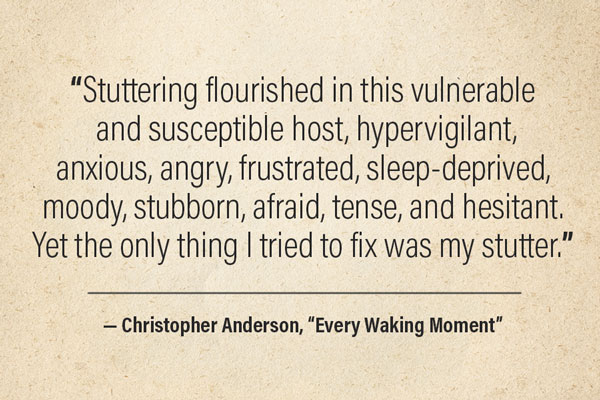
Listen to a discussion w/ author Christopher Anderson on the #ASHAVoices podcast featuring special guest co-host SLP Chaya Goldstein-Schuff of the Sisskin Stuttering Center and the StutterTalk podcast. #ASHASIG4 on.asha.org/3YOXXBP #slpeeps #slp2b @Justconfront
4
750
21 Jul 2023
Hear two guests discuss the lives of people who stutter, including their emotional experiences and the effect culture can play in #stuttering presentation, assessment, and treatment. @NBASLH #slpeeps #slp2b @UTAustin #ASHASIG4 #ASHASIG14 on.asha.org/3Q3ZOAm

3
4
676
13 Jun 2023
Repetitions at the end of words (word-final disfluencies; WFD) have been compared to and contrasted with stuttering-like disfluencies. This article from #ASHASIG4 compared people who exhibit WFD, those who stutter, and people with other disfluencies on.asha.org/3J6F72C
2
3
543
28 Mar 2023
The use of mindfulness-based practices has been seen as a viable complement to traditional stuttering therapy. This study from #ASHASIG4 explores the outcomes of an 8-week remote mindfulness program for adults who stutter on.asha.org/40DNZD8 @FIU #stuttering
1
2
304
27 Mar 2023
A motor-based (rather than language-based) treatment plan to improve speech sound accuracy is appropriate when working with a child who stutters with articulation errors. Learn more from #ASHASIG4 on.asha.org/42JMKE9 @CaraMSinger @GVSchoolofCOM @GVSU
2
273
3 Nov 2022
In this study from #ASHASIG4, authors found that Twitter could be used to enhance negative stereotypes about stuttering. Authors offer an informed direction for future advocacy for people who stutter via Twitter on.asha.org/3sOGH0w @ULLafayette @MidwesternUniv @txstCS
2
3
20 Oct 2022
The issue contains forums from #ASHASIG3 and #ASHASIG4 on pathways to specialization in voice and upper airway disorders and clinical views on cluttering. Read more on the Context blog! on.asha.org/3MPXrO7
1
2
18 Oct 2022
Cluttering in adolescence should be taken seriously. Fast uncontrollable speech can lead to speech distribution followed by strong emotional responses. Speech-language therapists can help. Learn more from #ASHASIG4 on.asha.org/3yMAi9t @Fontys @HagueUniversity
1
2
27 Jul 2022
In this study from #ASHASIG4, researchers found that listeners misunderstood people who clutter, inaccurately identifying the main idea of their message. Listener education can help support people who clutter on.asha.org/3PCzvOB @monmouthu @CCIU_24 @wearetrschools
1
1
20 Jul 2022
What can we learn from talking to three community leaders who clutter? Find out how professionals can help support people with cluttering in the latest from #ASHASIG4! on.asha.org/3IQ8eFW @monmouthu #Fluency #SLPeeps
1
1
7 Jul 2022
How do society’s expectations of people who stutter affect those speakers’ experiences? Listen to #ASHAVoices podcast to find out: on.asha.org/3akGb4D
#ASHASIG4 #slpeeps #slp2be @FSUCCI @FSU_COM
1
3

24 Feb 2022
Interested in practical suggestions for anti-ableist practices in #stuttering therapy and research? Read more here from @Hope_Gerlach_ and #ASHASIG4 on.asha.org/3BImrBr @wmuchhs @FSUCCI #SLPeeps

1
4