
Step 16: The "Async" Success Proof
"In my last role, I managed a team across 3 time zones with zero travel, and we beat our target by 20%. I know how to make 'Remote' work so that when I do travel, it's for a high-value reason."
1
yekta ozan retweeted

If I had 6 months to become an Agentic AI Engineer.
I'd do this.
Stage 1: Python Async Foundations
asyncio, FastAPI, event-driven architecture, error handling, API integration patterns.
Stage 2: LLM Fundamentals for Agents
Context management, model routing, token economics, latency tradeoffs, failure modes.
Stage 3: Tool Calling Structured Outputs
Pydantic validation, function calling schemas, error recovery, dynamic tool discovery.
Stage 4: Memory State Management
Short-term buffers, long-term vector recall, context compression, cross-session sync.
Stage 5: Single Agent Workflows
ReAct loops, plan-and-execute, self-reflection, iteration limits, graceful degradation.
Stage 6: Multi-Agent Orchestration
LangGraph/CrewAI, supervisor patterns, message passing, conflict resolution, handoffs.
Stage 7: Human-in-the-Loop Systems
Uncertainty detection, approval gates, audit trails, resume logic, intervention points.
Stage 8: Evaluation Quality Assurance
Automated eval harnesses, LLM-as-a-judge, regression testing, hallucination metrics.
Stage 9: Observability Tracing
Distributed tracing (LangSmith/Arize), cost dashboards, latency monitoring, alerting.
Stage 10: Security Guardrails
Prompt injection defense, output filtering, PII redaction, sandboxed execution, compliance.
Stage 11: Production Deployment
vLLM/SGLang, Kubernetes scaling, CI/CD for agents, canary releases, rollback strategies.
Stage 12: Open Source Portfolio
Ship autonomous agents publicly, write architecture docs, record demos, contribute to libs.
Most people stay stuck watching tutorials.
Builders get hired.
(Bookmark it)
1
3
19
597

Basically the Filipino Async from Kane Parsons' Backrooms

one of the hallmarks of the filipino moviegoing experience:

11

The standard setup is simple: one leader and its followers. Leader takes every write, and the followers (replicas) have copies of data and serve reads.
The reason that all writes go through one leader is that because something has to be the single authority on what order writes happened in.
The reason that all reads are spread across replicas because read are far more than writes. Thus, reads are where the actual load is.
To keep everything working, the leader streams each write to the replicas asynchronously. This async nature is the whole issue.
1
2

theres this one scene where they show a newspaper clipping of the async company. i think it was in marys flashback? which makes sense if the mom had something to do with it. i do wish they didnt antagonize the backrooms as much as they did, i was hoping for a more atmospheric-
1
11

Nah I agree w u about the ending this is smt I don't see criticized a lot, Async coming in felt like it was mainly there just because. I mean yeah the idea of them being equally terrified by the Backrooms is cool but when a new viewer wouldn't know they were responsible for—
1
16

The async loop matters too.
Agents wait constantly:
Model call
Tool call
Database call
API call
User event
Retry loop
Agents are async by nature.
TypeScript lives in that mental model by default.
1
4

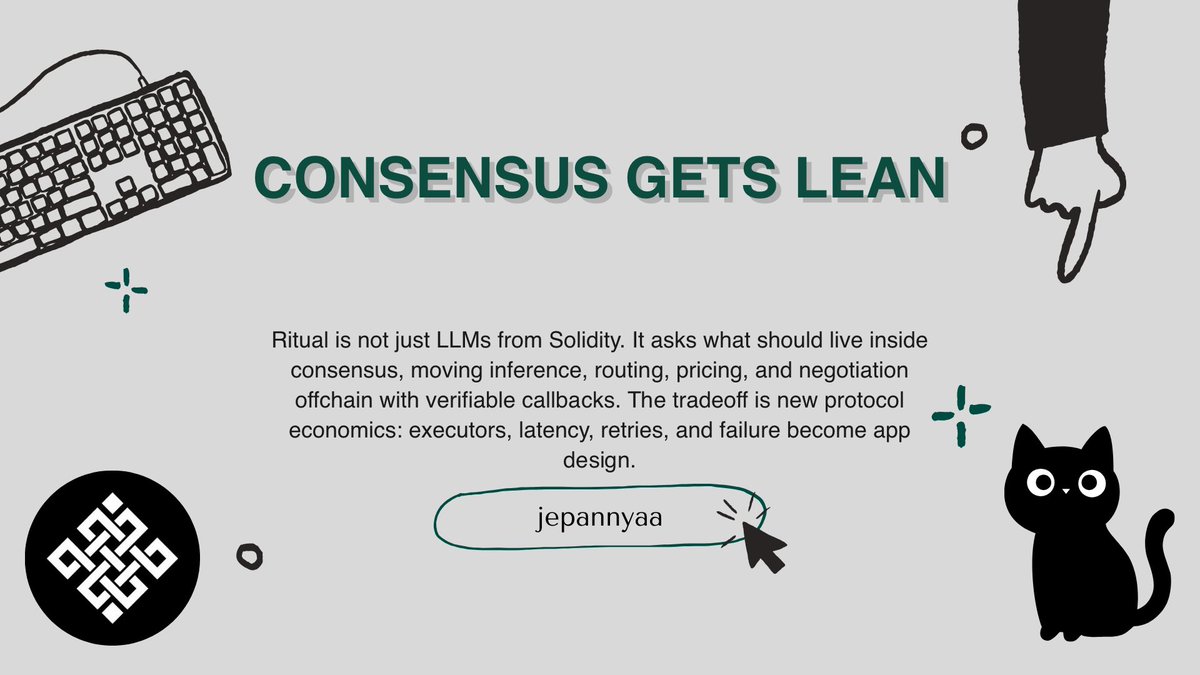
Ritual is less interesting as "LLMs from Solidity" and more interesting as a pressure test for what should run inside consensus at all.
EVM apps have spent years squeezing useful work into validator-replayable determinism. That made sense for settlement. It is a bad fit for inference, routing, pricing, negotiation, and anything that depends on private state or external markets. If those computations can happen offchain and return a verifiable result into a contract path, the chain starts to look like a commitment and settlement layer again.
That changes app design. An agent can observe, infer, bid, route, or refuse before a contract commits the consequence. Private inference stops being duct tape around the protocol and becomes part of the protocol's execution model.
The cost is a new trust surface. Composability shifts from atomic calls between contracts to pipelines between contracts, agents, executors, enclaves, schedulers, and callbacks. Who can execute, how quickly they answer, what happens on failure, and whether a thin executor market can extract value are no longer implementation details. They are protocol economics.
The single async-call constraint makes the point plain. Serious agent apps will not feel like one transaction touching five contracts. They will feel like workflows with latency, retries, partial fills, and failure modes. Ritual expands what EVM apps can express, but it also makes execution markets part of the application, not background infrastructure.
@ritualnet | @ritualfnd
12
1
19
111

The only issue with having such little ASYNC is that Mark Duplass didn't get enough screen time
2

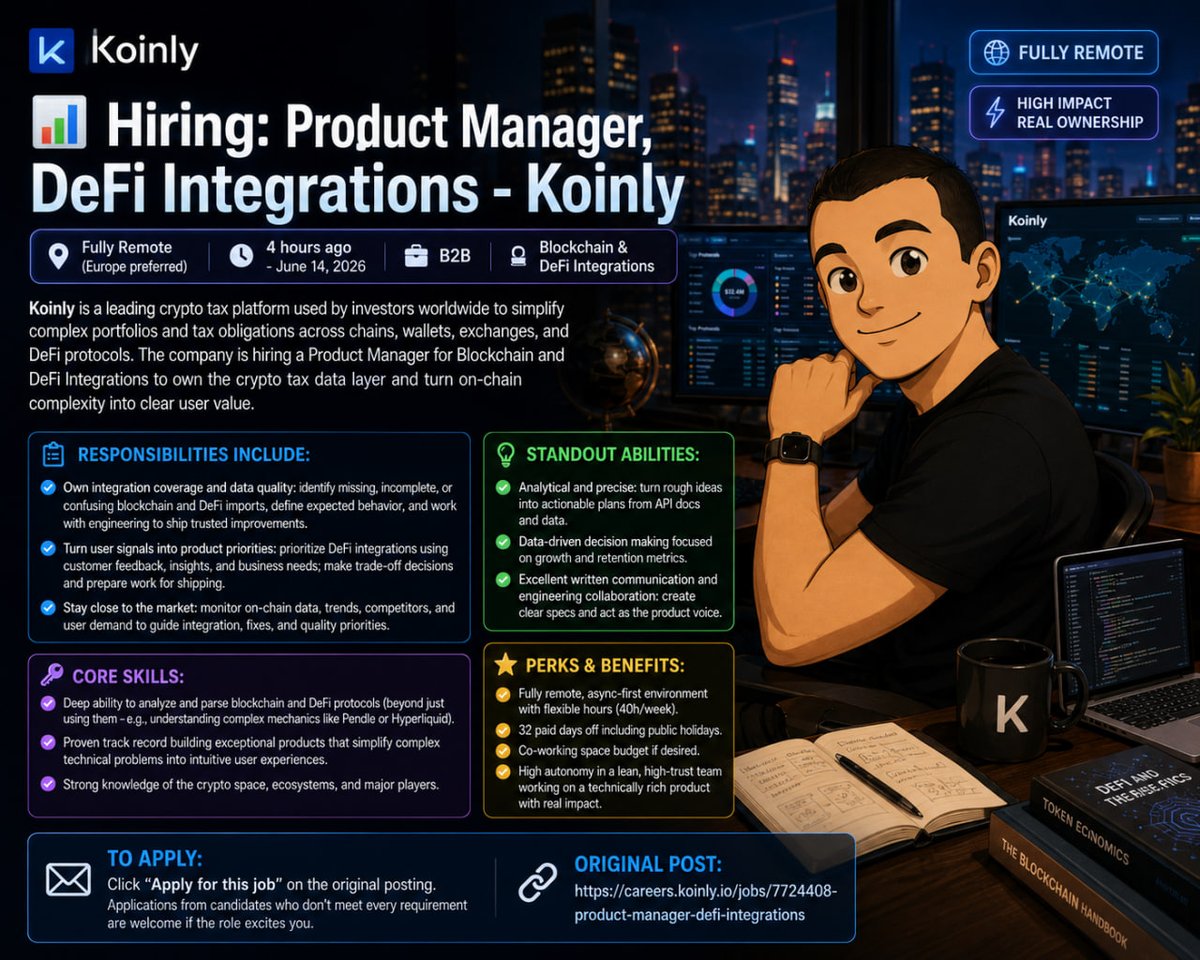
📊 Hiring: Product Manager, DeFi Integrations - Koinly
📍 Fully Remote (Europe preferred) | 💼 B2B | 🧑💻 Blockchain & DeFi | 🕐 4 hours ago - June 14, 2026
Koinly helps crypto investors simplify taxes across chains and DeFi. The company is hiring a Product Manager for Blockchain and DeFi Integrations to own data quality and turn on-chain complexity into trusted user value.
📋 Responsibilities include:
- Own integration coverage and data quality for blockchains and DeFi protocols.
- Prioritize based on user feedback, insights, and business impact.
- Monitor market trends and competitor coverage to guide priorities.
🔑 Core skills:
- Deep protocol analysis (whitepapers, mechanics, settlements).
- Building products that simplify complex tech.
- Strong crypto ecosystem knowledge.
💡 Standout abilities:
- Analytical precision from data and APIs.
- Metric-focused decisions on growth/retention.
- Clear specs and strong engineering partnership.
💡 Perks:
- Async-first, remote with flexible 40h weeks.
- 32 paid days off.
- Co-working budget.
- High autonomy and impact.
📩 To apply: Apply directly via the original job post at the link below. Strong candidates who are excited by the role are encouraged even if not a 100% match.
🔗 Original post: careers.koinly.io/jobs/77244…
⚠️ DYOR! I don’t verify every job. If someone asks to run files or pay anything 🚩 likely a scam.
❗️ I'm not hiring myself! I just sharing fresh web3/crypto/blockchain roles DAILY for all levels!
💡 For Interns & juniors → t.me/crypto_vazima_english
💼 Mid/senior jobs → t.me/web3_jobs_crypto_vazima
#Web3 #Crypto #DeFi #ProductManager #Blockchain #Hiring #RemoteJobs #CryptoJobs #Tax #Integrations #Koinly #Fintech #CryptoTax
13
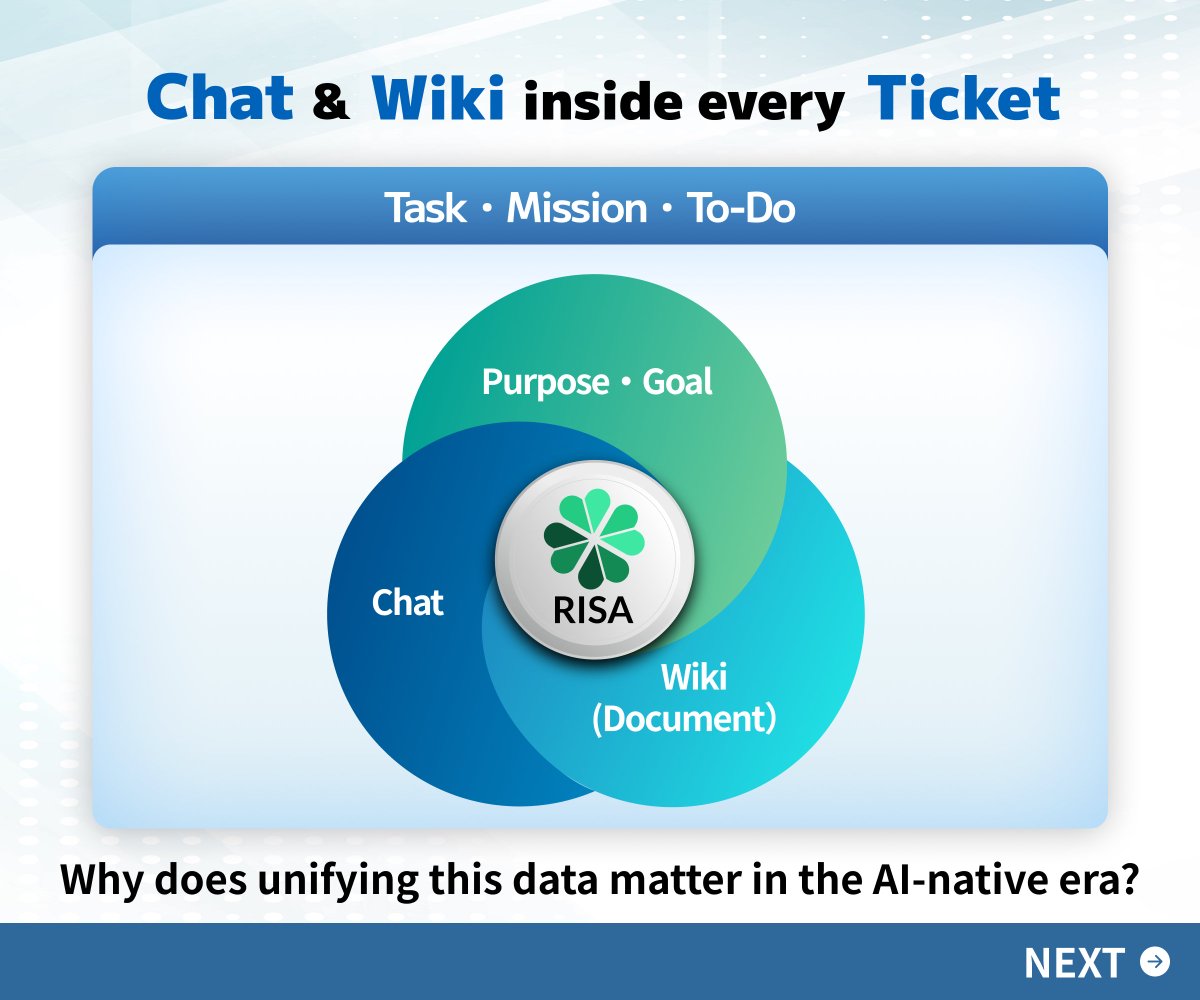
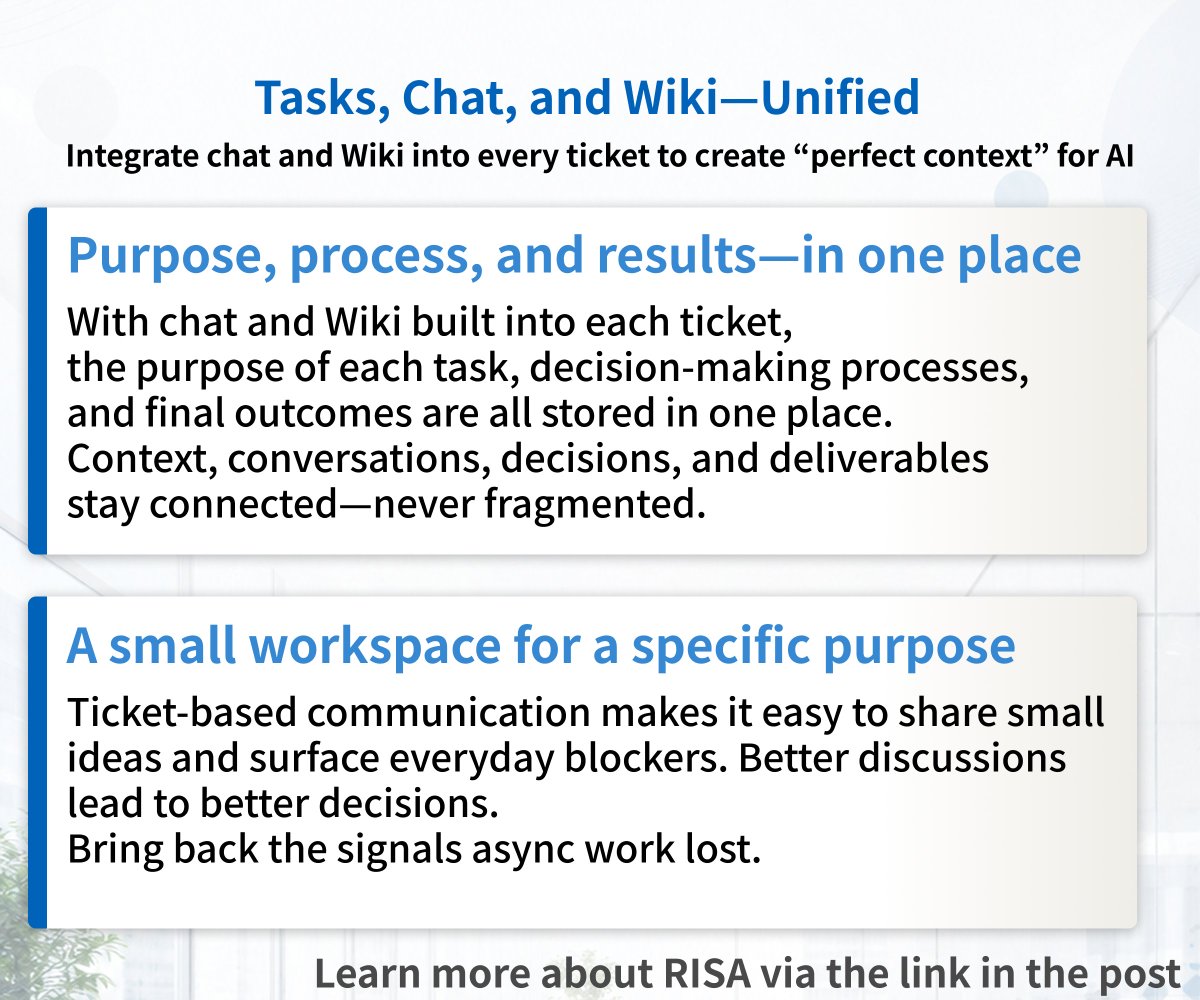
Why did we make that decision? Who knows — it's probably buried in three different tools.
When Chat, documentation, and tasks live in separate places, the context behind every decision gets fragmented and lost over time.
RISA solves this by integrating Chat and Wiki directly inside each ticket. Purpose, process, decisions, and results — all stored together, always traceable.
Each ticket also functions as a small, focused workspace where even minor ideas and friction points get captured — restoring the quiet signals that async communication tends to erase.
One ticket. Complete context. Nothing disconnected.
#WorkSmarter #EnterpriseChat #AINative #RISA
1


Step 16: The "Async" Success Proof
"In my last role, I managed a team across 3 time zones with zero travel, and we beat our target by 20%. I know how to make 'Remote' work so that when I do travel, it's for a high-value reason."
1
6


1h
Yeah that's a solid systems design challenge. I'd use tiered caching with precomputed embeddings for high frequency queries and async reranking for consistency. 💀
27


I will be speaking about Async BOFs and Conquest at #BSidesVienna on June 27th.
cfp.bsidesvienna.at/bsidesvi…
There is another free ticket drop next week, so grab one if you're in the area and let's have a chat there!
1
1
25
