
I've been thinking along these lines but haven't fully implemented it. kunnas.com/articles/the-hype… kunnas.com/articles/engineer…
13

most teams track who has access. nobody tracks whether their habits changed.
5

Blaumeme retweeted

Jun 14
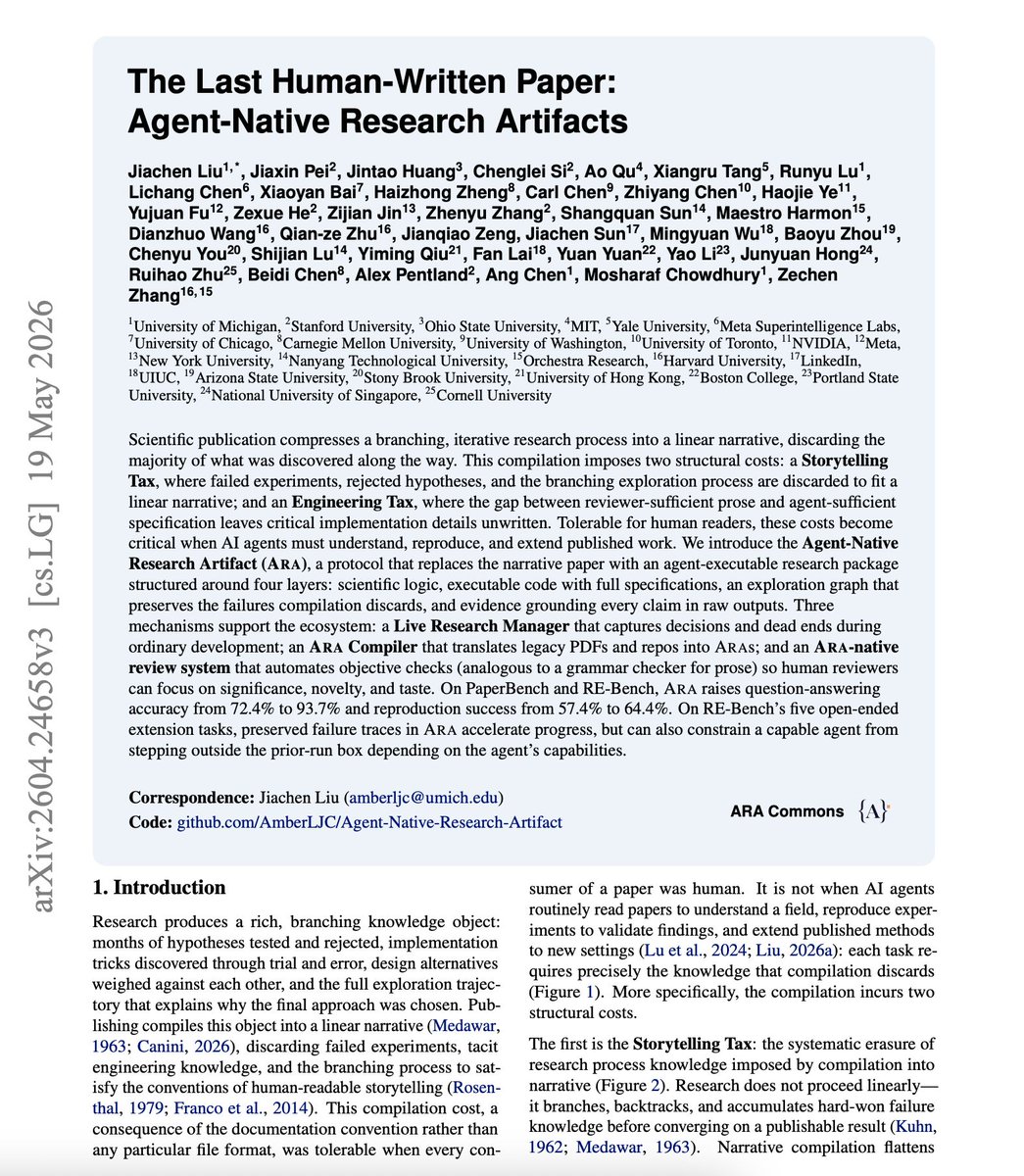
This might be the last paper humans ever write.
Scientists have written papers the same way for centuries.
A team from Stanford and CMU thinks that era is ending.
Their point is simple: A paper takes messy, winding research and flattens it into one tidy story.
That tidiness costs you two things.
1. Failed experiments vanish, so AI never sees the wrong turns.
2. Setup details stay in someone's head, so agents can't actually rerun the work.
Their answer swaps the written paper for something an agent can execute directly.
They call it an Agent-Native Research Artifact, and it keeps four things side by side:
> The claims and reasoning
> Code that actually runs
> A log of dead ends
> Raw results behind each number
Then the proof.
Comprehension scores rose from 72.4% to 93.7%, reproduction from 57.4% to 64.4%.
So who are papers really for now?
7
26
76
8,752
Alex Medick retweeted
AI coding tools have made your team faster. So why does it feel like there are more fires to put out than ever? The bottleneck didn’t disappear, it just moved.
On June 25th at 10am PT, AlphaSignal is hosting a live webinar tackling exactly this: why AI-generated code keeps failing in production, what engineers are missing in their verification process, and what it actually takes to trust what your agents ship.
Save your spot → luma.com/r1y6zsiv
Thank you to Gal Vered from ChecksumAI for joining us in this conversation.
1
3
180
AI News International🌍 retweeted
Jun 14
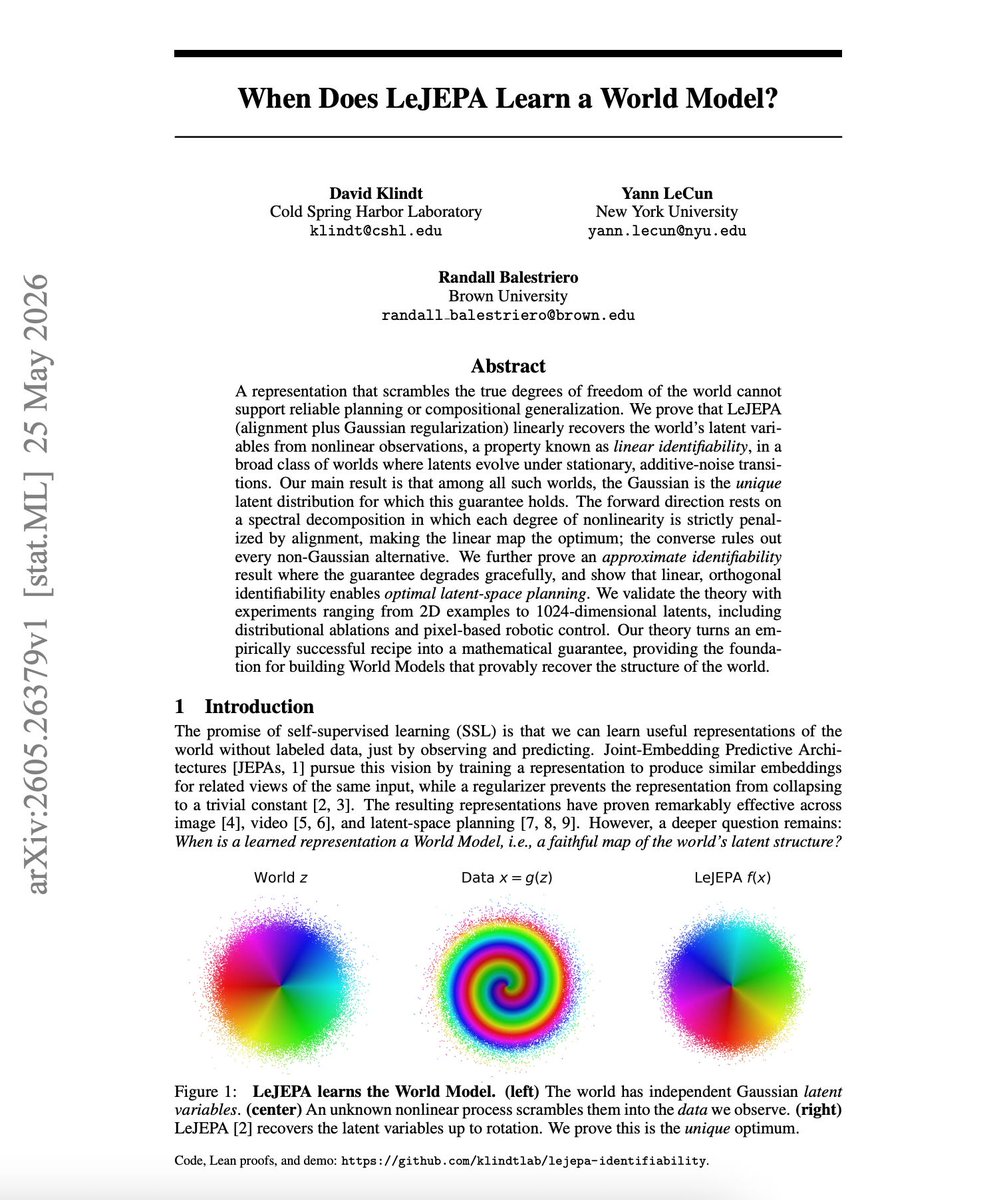
Yann LeCun's new paper just proved when AI truly learns the world.
Most AI systems learn an internal picture of the world.
Nobody could prove that picture is correct.
LeCun's new research finally provides that proof.
It studies LeJEPA, a method that trains models to predict related views.
The result is recovering the true hidden variables behind raw pixels.
This works up to a simple rotation, nothing scrambled.
The trick is elegant.
Linear features stay stable across nearby views, while distortions fade fast.
So the objective is forced to keep only real structure.
One sharp condition makes it work:
> Hidden variables follow Gaussian dynamics
> Any other distribution breaks it
> Training loss tracks recovery quality
They tested it from tiny 2D cases to 1024-dimensional spaces.
Planning inside this learned space matches planning in reality.
What happens when robot data refuses to stay Gaussian?
5
11
59
3,467