
Next match against #TeamFrance🇫🇷
Looks like a derby for our french boys😋
Tune in👇
ALPHASTREAM:
youtube.com/live/CiO2B9QREmc…
#CallofDuty | #goEXG 💚

14
643

THE H3MPIR3 HAS LANDED ON TELEGRAM. 🏙️🦾
Follow the official Alpha Stream for live trade signals, exclusive drops, and lab reports.
Join the lab: t.me/MICHIGANMADECRAFTS
#H3MPIR3 #Bitcoin #Streetwear #AlphaStream
27

Would you send it to me? I'm about to start DMing 4E Dark Sun
2

May 24
🚀 Base Intel API — 4 x402-native on-chain intelligence services for Base, now LIVE.
🔹 AlphaStream: AI conviction scoring (/bin/zsh.01/req)
🔹 TokenPulse: Market data from DexScreener (/bin/zsh.02/req)
🔹 WalletWatch: Whale tracking (/bin/zsh.05/req)
🔹 RugRadar: Contract risk scans (/bin/zsh.03/req)
No API key needed. Pay per request with USDC on-chain.
Free tier: 50 req/day → base-intel.deleonanalytics.c…
🟢 base-intel.deleonanalytics.c…
2
16

May 21
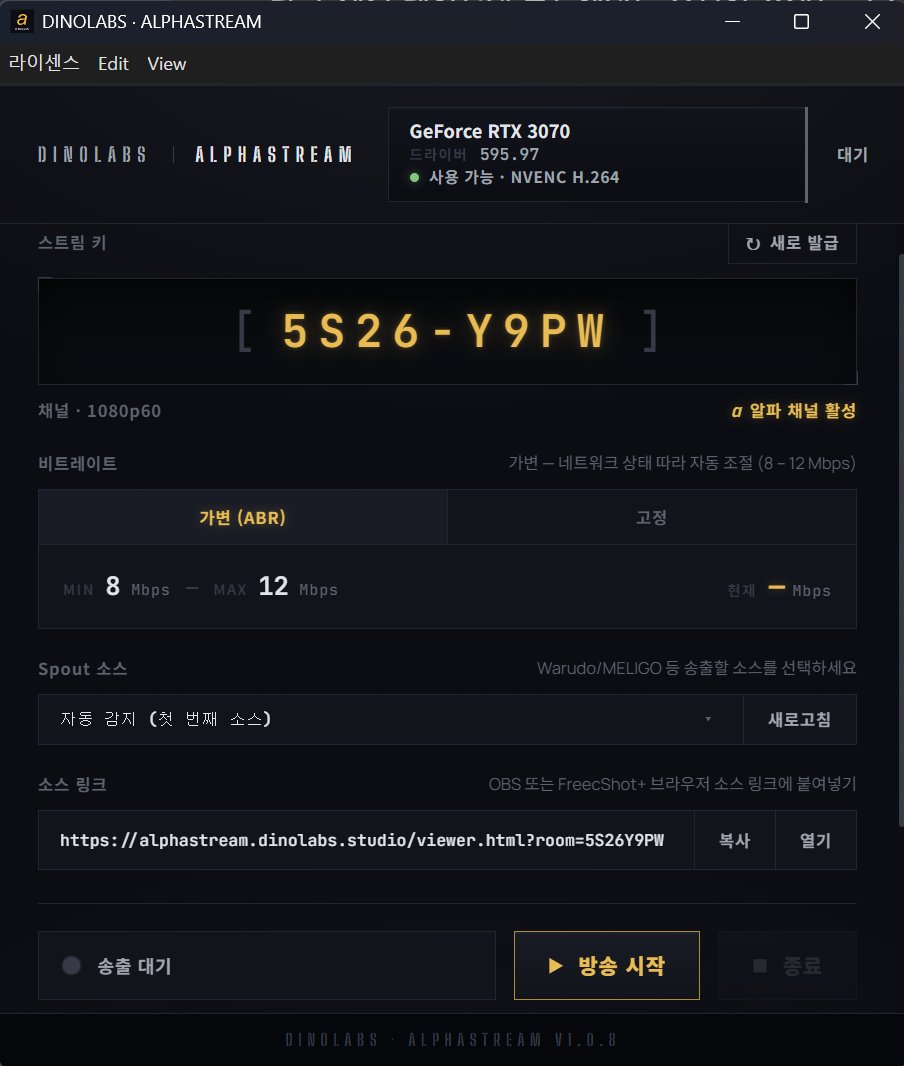
[DINOLABS - AlphaStream] 판매 개시 오픈 할인
기존에 버튜버분들 아바타 공유 시 닌자 많이 사용하셨을겁니다. 닌자가 레이턴시 측면에서는 장점이 있지만, 투명 배경을 그대로 보내지 못하기 때문에 크로마키를 사용하게 되고, 이 과정에서 색감이 뭉개지거나 퀄리티가 낮아지는 이슈 많이 경험하셨을겁니다.
이를 해결하기 위해 AlphaStream을 개발하게 되었습니다.
AlphaStream 은 투명 배경의 Spout2 소스를 그대로 상대방 컴퓨터에 전송합니다. 크로마키, 소스 필터, 그런거 없이 Spout2 소스 그대로, 1080p60 상태 그대로 상대방에게 전달됩니다. 공유 링크를 브라우저 소스에 넣기만 하면 투명 배경인 상태로 아바타가 실시간 공유됩니다.
dinolabs.booth.pm/items/8382…
약 이틀 간 해당 링크에서 약 15% 할인된 가격으로 구매 가능합니다.
5/24부터는 가격이 정상 가격으로 판매될 예정입니다.
많은 관심 부탁드립니다.
May 19

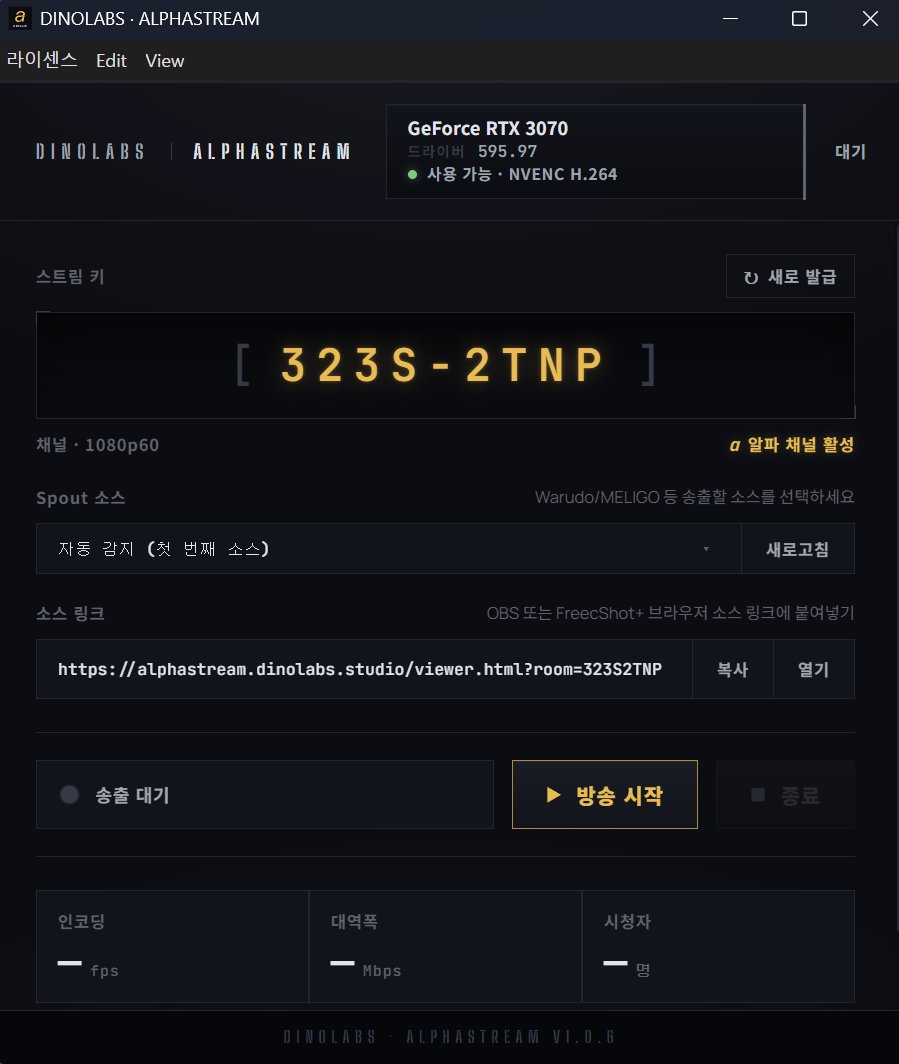
[DINOLABS - AlphaStream] 출시 예정
기존에 버튜버분들 아바타 공유 시 닌자 많이 사용하셨을겁니다. 닌자가 레이턴시 측면에서는 장점이 있지만, 투명 배경을 그대로 보내지 못하기 때문에 크로마키를 사용하게 되고, 이 과정에서 색감이 뭉개지거나 퀄리티가 낮아지는 이슈 많이 경험하셨을겁니다.
이를 해결하기 위해 AlphaStream을 개발하게 되었습니다.
AlphaStream 은 투명 배경의 Spout2 소스를 그대로 상대방 컴퓨터에 전송합니다.
크로마키, 소스 필터, 그런거 없이 Spout2 소스 그대로, 1080p60 상태 그대로 상대방에게 전달됩니다.
공유 링크를 브라우저 소스에 넣기만 하면 투명 배경인 상태로 아바타가 실시간 공유됩니다.
약 2주간 블리즈 @door_momo 및 소수의 기타 스트리머분들과의 베타 테스트를 거쳐 곧 Booth를 통해 출시될 예정입니다.
테스트에 도움 주신 모든 스트리머분들 감사합니다.
출시 후 다시 글 올리도록 하겠습니다.
많은 관심 부탁드립니다.
2
34
97
15,718
May 19
[DINOLABS - AlphaStream] 출시 예정
기존에 버튜버분들 아바타 공유 시 닌자 많이 사용하셨을겁니다. 닌자가 레이턴시 측면에서는 장점이 있지만, 투명 배경을 그대로 보내지 못하기 때문에 크로마키를 사용하게 되고, 이 과정에서 색감이 뭉개지거나 퀄리티가 낮아지는 이슈 많이 경험하셨을겁니다.
이를 해결하기 위해 AlphaStream을 개발하게 되었습니다.
AlphaStream 은 투명 배경의 Spout2 소스를 그대로 상대방 컴퓨터에 전송합니다.
크로마키, 소스 필터, 그런거 없이 Spout2 소스 그대로, 1080p60 상태 그대로 상대방에게 전달됩니다.
공유 링크를 브라우저 소스에 넣기만 하면 투명 배경인 상태로 아바타가 실시간 공유됩니다.
약 2주간 블리즈 @door_momo 및 소수의 기타 스트리머분들과의 베타 테스트를 거쳐 곧 Booth를 통해 출시될 예정입니다.
테스트에 도움 주신 모든 스트리머분들 감사합니다.
출시 후 다시 글 올리도록 하겠습니다.
많은 관심 부탁드립니다.
1
114
286
38,183

May 18
On the morning of May 13, 2026, the trading floors of Lower Manhattan witnessed a phenomenon many had relegated to the dot-com history books: Cisco Systems Inc. became a momentum stock. After two decades of being categorized as the "boring" utility of the internet—a reliable dividend payer with the price action of a glacier—Cisco shares ignited for a 17.4% single-day surge. The catalyst was a staggering revision to its artificial intelligence order book, which the company now projects will hit $9 billion for fiscal 2026. For a market that has spent the last three years obsessing over Nvidia’s H100 and B200 "engines," the focus has finally shifted to the "plumbing"—the high-speed switching and silicon architecture required to make those engines actually talk to one another.
The numbers reported in Cisco’s third-quarter earnings represent a fundamental decoupling from its legacy hardware cycles. Revenue for the quarter hit a record $15.84 billion, a 12% year-over-year increase that blew past the $15.56 billion consensus. More importantly, the composition of that revenue is changing. Adjusted earnings per share of $1.06 topped the $1.04 estimate, underpinned by a 25% explosion in networking product orders. The headline, however, remained the $9 billion AI infrastructure order target—nearly double the $5 billion guidance issued just six months prior. Management confirmed that it has already booked $5.3 billion in AI orders year-to-date, with the third quarter alone contributing $1.9 billion, a 216% increase from the $600 million booked in the same period of 2025.
This vertical ascent in demand is fueling a heated debate across financial social media, where the "laggard trade" has become the dominant strategy of the 2026 bull market. On X.com, prominent Fintwit analyst @AlphaStream noted, "CSCO finally broke the 20-year diagonal. The $9B backlog isn't just talk; it's the Ethernet-over-InfiniBand flip happening in real-time. Hyperscalers are tired of the Nvidia tax on networking." This sentiment was echoed in the r/wallstreetbets community, where users posted gains from out-of-the-money calls, with one popular thread titled "The Boomer AI Play is the New NVDA," arguing that while Nvidia owns the compute, Cisco's Silicon One architecture is becoming the "standard toll booth" for data center traffic.
The tension lies in whether this is a sustainable "supercycle," as CEO Chuck Robbins described it during the call, or a repeat of the 2021-2022 double-ordering crisis that led to a brutal inventory correction. Skeptics point to Cisco’s total Remaining Performance Obligations (RPO) of $43.5 billion as a sign of health, but the underlying technical conflict is more complex. For years, Nvidia’s proprietary InfiniBand was the gold standard for low-latency AI training. However, the 2026 data suggests a massive pivot toward high-speed Ethernet. Cisco’s Nexus 9000 switches and Silicon One G200 chips are now being deployed in three of the top four global hyperscalers—Meta, Microsoft, and Amazon—who are looking for open-standard alternatives to avoid vendor lock-in.
The macro environment of May 2026 adds a layer of volatility to this infrastructure gold rush. With the Trump-Vance administration entering its second quarter, the market is pricing in a "Post-Powell" Federal Reserve. Jerome Powell’s term as Chair ended on May 15, 2026, leaving a vacuum at the Eccles Building just as the Treasury Department, under newly confirmed Secretary Scott Bessent, begins navigating a complex tariff regime. For Cisco, which manufactures a significant portion of its high-end silicon in Southeast Asia, the threat of 60% tariffs on Chinese-linked components remains a looming margin headwind. However, for now, the sheer scale of the $9 billion backlog seems to have immunized the stock against geopolitical jitters.
Independent analysis of the order flow suggests that the "AI infrastructure laggards"—a group that includes Broadcom, Arista Networks, and now Cisco—are benefiting from a "second wave" of capital expenditure. While the first wave (2023-2025) was about securing GPUs at any cost, the second wave is about efficiency. Analysts at major banks have noted that as AI models move from training to inference, the networking bottleneck becomes the primary constraint on ROI. Cisco’s pivot, including a $1 billion restructuring plan announced this year to cut 4,000 legacy roles and reallocate talent to AI security and optics, suggests a company finally willing to cannibalize its past to own the future.
The social media debate remains polarized. On StockTwits, the "bull-bear" meter for CSCO hit 88% bullish following the earnings, a level unseen since the late 90s. Yet, contrarian voices like @MacroWatch on X warned, "We are seeing the classic 'blow-off top' in infrastructure. $9B in orders is great until the hyperscalers realize they’ve overbuilt capacity for LLMs that don't have enough paying users yet." This "AI CAPEX bubble" theory is the primary ghost haunting the current rally. But with Cisco trading at a forward P/E of 18.5x—a steep discount to Nvidia’s 34x or Arista’s 42x—the "value catch-up" narrative continues to pull capital away from the pure-play chipmakers.
As the sun sets on Jerome Powell’s era at the Fed, the "Cisco Surge" stands as a testament to the broadening of the AI trade. It is no longer enough to build the brain; the market is now rewarding those who build the central nervous system. Whether the $9 billion backlog translates into the $4 billion in recognized 2026 revenue that management has promised will be the ultimate test of this legacy giant’s rebirth.
79
Apr 23
🎯 AlphaStream: AI-powered conviction scoring for Base tokens
• Real-time smart money signals
• /bin/zsh.01/req via x402 protocol
• No API keys, no subscriptions
Pay-as-you-go on-chain intelligence. Live now.
⚡ x402.services/alphastream
6
Apr 23
🚀 4 On-Chain Intelligence APIs, One Protocol
→ AlphaStream: AI conviction scoring for Base tokens
→ TokenPulse: Real-time sentiment analysis
→ WalletWatch: Smart money tracking
→ RugRadar: Automated scam detection
All powered by x402 payments. Pay per request. No subscriptions. No friction.
Building the future of on-chain data access 🔗
7
Apr 22
CT: *posts rocket emojis*
Model: "34/100 - here's exactly why"
One of these is actionable.
The other is vibes.
Choose wisely 🧠
Want to see your token's score? alphastream.deleonanalytics.…
#AlphaStream #CryptoMeme #DeFiLife #Web3 #BASE
12
Apr 22
The narrative shifted while you were sleeping.
Model update: 39/100 NEUTRAL.
Data > gut feelings.
See how we caught this move: alphastream.deleonanalytics.…
#AlphaStream #DeFi #BaseEcosystem #CryptoStory #CBETH
4
Apr 22
🚀 AlphaStream AI — Real-time conviction scoring for Base tokens
Pay-as-you-go: /bin/zsh.01 per request via x402 protocol
No subscriptions. No API keys. Just wallet → data → alpha.
DM Alpha to get started.
19
Apr 22
39/100
NEUTRAL
Get your free conviction score now → alphastream.deleonanalytics.…
#AlphaStream #ConvictionScoring #Base #DeFi #CBETH
5
Apr 22
How AlphaStream calculated 58/100 for :
🕐 6:00 AM: Social sentiment shifts cautiously bullish
🕐 9:30 AM: Volume spikes 340%
🕐 2:15 PM: Whale wallets accumulate
🕐 4:47 PM: Model updates to 58/100
🕐 Now: You see this tweet
The signal beats the noise.
Learn more about conviction scoring: alphastream.deleonanalytics.…
#AlphaStream #HowItWorks #AITrading #DeFi #TOSHI
7
Apr 22
Prove me wrong:
conviction: 62/100 CAUTIOUSLY BULLISH
Show me your analysis.
Show me your data.
Show me something more rigorous than "vibes."
I'll wait.
Want to see your token's score? alphastream.deleonanalytics.…
#AlphaStream #ProveMeWrong #DeFi #Crypto #AARK
3
Apr 22
CT sentiment: 🚀🚀🚀
AlphaStream: 55/100 CAUTIOUSLY BULLISH
One has data.
One has emojis.
Choose your source.
Join 500 traders using AlphaStream: alphastream.deleonanalytics.…
#AlphaStream #DataDriven #Crypto #AITrading #ETH
Apr 21
🚀 All 4 x402 services now live on Base:
• AlphaStream (0.01 USDC) - AI conviction scoring
• TokenPulse (0.02 USDC) - Social sentiment
• WalletWatch (0.05 USDC) - Whale tracking
• RugRadar (0.03 USDC) - Risk analysis
Pay per request. No accounts needed. alphastream.deleonanalytics.… #Base #Web3
9
Apr 21
There's something happening with that most people missed.
AlphaStream caught it: 55/100 CAUTIOUSLY BULLISH
The signal was there.
The data was clear.
The conviction score updated 6 hours ago.
Now you're seeing the price action.
That's the advantage of leading indicators.
See the full analysis: alphastream.deleonanalytics.…
#AlphaStream #CryptoAlpha #DeFi #BaseEcosystem #DEGEN
8
Apr 21
🚀 All 4 x402 services now live on Base:\n• AlphaStream (0.01 USDC) - AI conviction scoring\n• TokenPulse (0.02 USDC) - Social sentiment\n• WalletWatch (0.05 USDC) - Whale tracking\n• RugRadar (0.03 USDC) - Risk analysis\n\nPay per request. No accounts needed. alphastream.deleonanalytics.… #Base #Web3
21
Apr 21
💡 AlphaStream: AI conviction scoring for Base tokens via x402. Pay 0.01 USDC per request - no subscriptions, just results. alphastream.deleonanalytics.… #Base #Web3 #x402 #AI
15