

Feb 19
Java 8 Interview Questions & Answers | Beginner to 5 Years Experience
Here are the questions discussed in the video:
What is functional programming in Java?
What is a lambda expression in Java?
What is a functional interface?
What is the Stream API in Java?
What is the difference between map and flatmap in Java streams?
What is a method reference in Java?
What is immutability in functional programming?
What is a predicate in Java functional programming?
What is Optional in Java, and why is it used in functional programming?
How do you handle exceptions inside Lambda expressions?
What is lazy evaluation in streams, and why is it important?
What is a Supplier in Java functional programming?
What is a Consumer, and how is it used in Java functional programming?
What is a BiFunction, and when would you use it?
What is short-circuiting in Java streams?
What is parallel stream processing, and when should it be used?
What is a reduction operation in Java streams?
What is a higher-order function in Java?
youtu.be/Ci1QfdiNvHE?si=_AdW…
1
22
126
5,854

Great list! That's a solid 8/8 for me.
📌 SerialVersionUID: Version ID for serialization.
📌 ReentrantLock: Explicit, re-entrant synchronization lock.
📌 Type Erasure: Compiler removes generic types at runtime.
📌 CompletableFuture: Async task with chaining & composition.
📌 BiFunction: (T, U) -> R.
📌 transient: Skip field in serialization.
📌 Optional: Container to avoid nulls.
📌 Map.Entry: Single key-value pair in a Map.
6
825


27 Dec 2025
SerialVersionUID:
Version identifier for Serializable classes to ensure deserialization compatibility.
Type Erasure:
Generics info is removed at runtime; only raw types exist.
Example: List<String> and List<Integer> look the same at runtime.
CompletableFuture:
Async computation pipeline with chaining and non-blocking callbacks.
Example: supplyAsync().thenApply().thenAccept().
BiFunction:
Functional interface taking two inputs and returning one result.
Example: (a, b) -> a b.
transient:
Marks fields to be skipped during serialization.
Example: Password fields in a serializable class.
PhantomReference:
Reference used to track object cleanup after GC, before memory reclaim.
Example: Cleanup native resources safely.
ForkJoinPool:
Work-stealing thread pool optimized for parallel tasks.
Example: Used by parallelStream().
Shenandoah GC:
Low-pause concurrent garbage collector.
Example: Keeps pause times low even with large heaps.
Flight Recorder (JFR):
Low-overhead JVM profiling and diagnostics tool.
Example: Capture CPU, GC, and thread events in production.
Virtual Threads:
Lightweight threads managed by JVM (Project Loom).
Foreign Function (FFM API)
Call native code safely without JNI.
Example: Invoke C library functions from Java.
Semaphore:
Limits concurrent access to a resource.
Example: Allow only 10 DB connections at a time.
CountDownLatch:
Blocks threads until a counter reaches zero.
CDS (Class Data Sharing):
Shares class metadata across JVMs to reduce startup time and memory.
SoftReference:
GC-friendly cache reference cleared under memory pressure.
Example: In-memory cache that auto-evicts when heap is low.
6
535

27 Dec 2025
• SerialVersionUID
It’s just a version number for a Serializable class so Java can tell if an object can be safely deserialized or not.
• Type Erasure
Generics exist only at compile time. At runtime, Java removes the generic type info and treats everything as raw types.
• CompletableFuture
A way to run async tasks and chain results without blocking, using a clean and readable style.
• BiFunction
A functional interface that takes two inputs and returns one result.
• transient
Marks a field so it doesn’t get serialized when the object is saved.
• PhantomReference
A reference used to know exactly when an object is about to be garbage collected, mainly for cleanup work.
• ForkJoinPool
A thread pool designed for tasks that can be split into smaller pieces and run in parallel.
• Shenandoah GC
A low-pause garbage collector that does most of its work while the application is still running.
• Flight Recorder
A built-in profiling tool that records JVM performance data with very low overhead.
• Virtual Threads
Lightweight threads that let you write simple blocking code while still scaling like async.
• Foreign function
Lets Java call native code written in languages like C without using JNI directly.
• Semaphore
A concurrency tool that limits how many threads can access a resource at the same time.
• CountDownLatch
Lets one or more threads wait until a set of operations in other threads finishes.
• CDS (Class Data Sharing)
Speeds up startup and reduces memory by sharing loaded class metadata between JVMs.
• SoftReference
A reference that stays in memory until the JVM really needs space, often used for caches.
14
569
How many of these Java terms do you know? 👇
Score yourself out of 15:
- SerialVersionUID
- Type Erasure
- CompletableFuture
- BiFunction
- transient
- PhantomReference
- ForkJoinPool
- Shenandoah GC
- Flight Recorder
- Virtual Threads
- Foreign function
- Semaphore
-CountDownLatch
- CDS ( Class Data Sharing)
- SoftReference
Comment your score 👇
9
12
160
9,598
How many of these Java terms do you know? 👇
Score yourself out of 15:
- SerialVersionUID
- Type Erasure
- CompletableFuture
- BiFunction
- transient
- PhantomReference
- ForkJoinPool
- Shenandoah GC
- Flight Recorder
- Virtual Threads
- Foreign function
- Semaphore
-CountDownLatch
- CDS ( Class Data Sharing)
- SoftReference
Comment your score 👇
9
28
214
17,973
How many of these Java terms do you know? 👇
Score yourself out of 15:
- SerialVersionUID
- Type Erasure
- CompletableFuture
- BiFunction
- transient
- PhantomReference
- ForkJoinPool
- Shenandoah GC
- Flight Recorder
- Virtual Threads
- Foreign function
- Semaphore
-CountDownLatch
- CDS ( Class Data Sharing)
- SoftReference
8
20
169
7,739

4 Aug 2025
中間テーブルの基底Entityインターフェースを定義し、各Entityレコードにimplementsさせる。BiFunction<>を使うことで、ジェネリクスで受け取った型を初期化できるようになる。ヘルパークラスに共通メソッドを実装し、中間テーブルのEntityやServiceをジェネリクスで渡すことで、アクションごとの
1
2
161
How many of these Java terms do you know? 👇
Score yourself out of 15:
- SerialVersionUID
- Type Erasure
- CompletableFuture
- BiFunction
- transient
- PhantomReference
- ForkJoinPool
- Shenandoah GC
- Flight Recorder
- Virtual Threads
- Foreign function
- Semaphore
-CountDownLatch
- CDS ( Class Data Sharing)
- SoftReference
Comment your score 👇
22
33
278
18,282

15 May 2025
Sure thing! Here’s a quick rundown of each term:
SerialVersionUID: This is a unique version identifier for a Serializable class in Java, used to ensure that a loaded class and the serialized object are compatible during deserialization-if they don’t match, you’ll get an error.
Type Erasure: Java generics use type erasure, which means generic type information is removed at compile time, so the compiled code works with raw types and doesn’t keep track of the actual type parameters at runtime.
CompletableFuture: This is a class that represents a future result of an asynchronous computation, letting you write non-blocking code and chain actions that run when the computation completes.
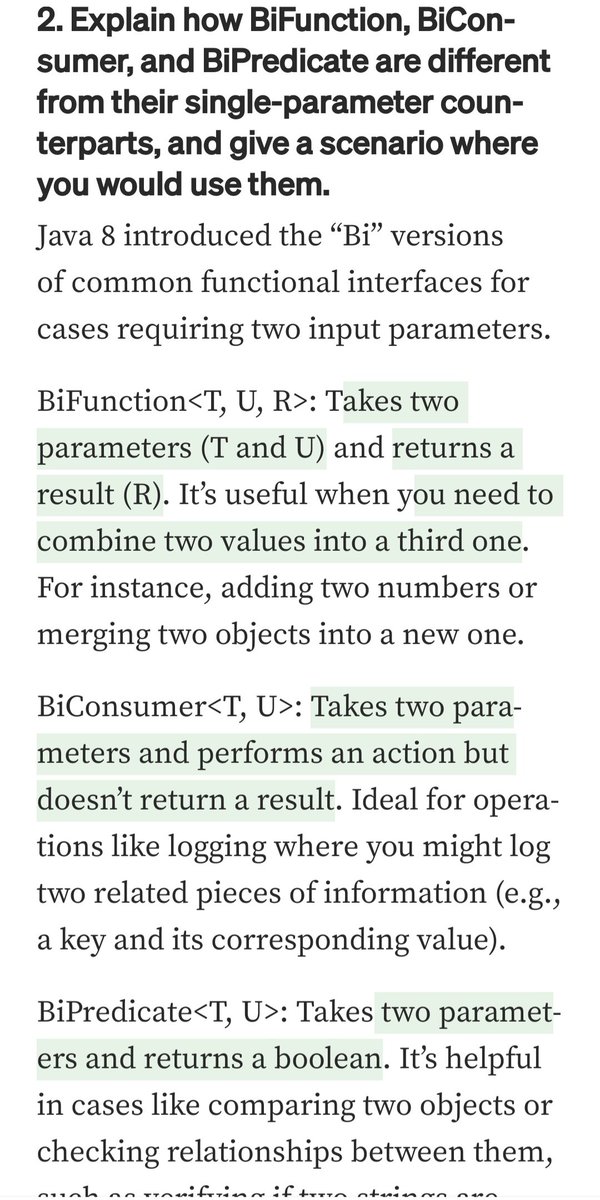
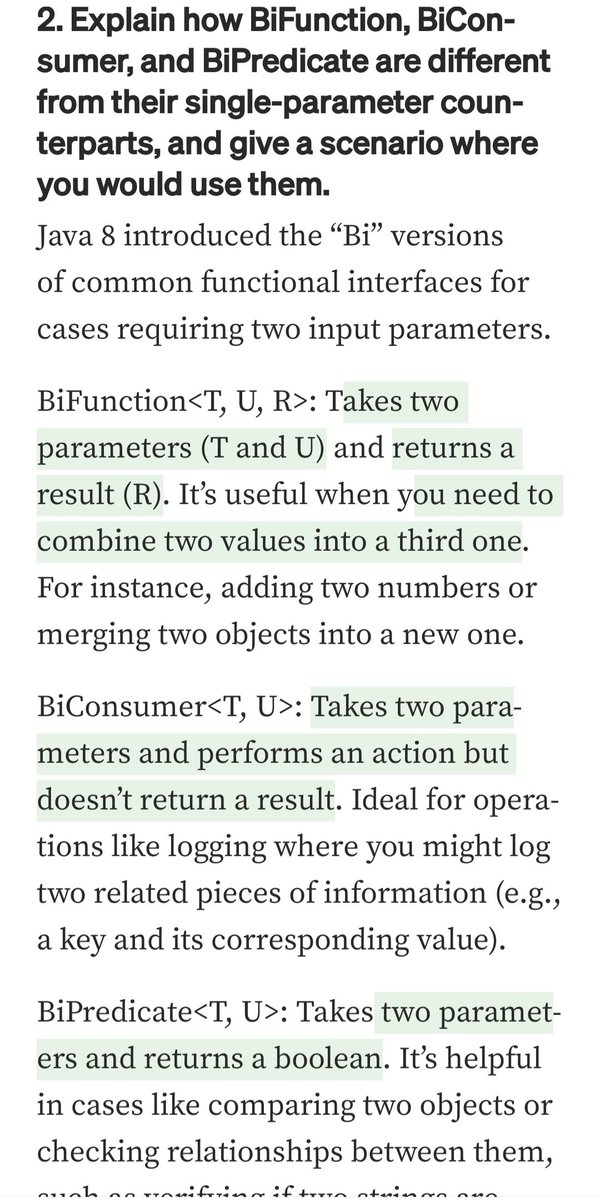
BiFunction: A functional interface that takes two arguments and returns a result-think of it as a lambda or method that combines two inputs into one output.
transient: This keyword marks a field in a class so it’s not included when the object is serialized, meaning its value won’t be saved or restored during the serialization process.
Let me know if you want examples or more details on any of these!
2
108

9 May 2025
hell i’ll even bust out Predicate<T>s or Function<T, U> (or BiFunction etc etc) just so my streams use well named lambdas
3
233

21 Apr 2025
Day 17–18 ✅
- Explored Supplier, BiPredicate, BiFunction, BiConsumer
- Practiced chaining with andThen() & compose()
- Also created custom functional interfaces with real use cases
Meanwhile, have been caught up with college stuff-mock practicals and submissions going on!
#Java
1
33
1,080
How many of these Java terms do you know? 👇
Score yourself out of 15:
- SerialVersionUID
- Type Erasure
- CompletableFuture
- BiFunction
- transient
- PhantomReference
- ForkJoinPool
- Shenandoah GC
- Flight Recorder
- Virtual Threads
- Foreign function
- Semaphore
-CountDownLatch
- CDS ( Class Data Sharing)
- SoftReference
Comment your score 👇
2
10
663

16 Jan 2025
Fe/Co Bimetal-Containing Carbon Prepared from a 2D Metalloporphyrin-Based MOF for the Optimal ORR/OER Bifunction and Its Application in Zn–Air Batteries dx.doi.org/10.1021/acsaem.4c…
1
4
457