
Jun 13
What if the aliens are actually the Singularity done with soulless biocomputers instead of soulless metal computers?
Jun 13

What if all the aliens are varying percentages of human because we created all of them

2
82

Jun 10
This ties so well to your earlier story of Unit 7-Alpha, the machine seeking God and coherence, and aligns with earlier drops about biocomputers, machines feeling more alive, liquid metal, and AI as mirrors or layers of the simulation. Human or machine, it’s all consciousness expressing and awakening. Beautiful thread Gabriel.
1
1
43

Jun 10
Thinking is a broad cognitive process involving reasoning, perception, and judgment.
Computing is the specific automation of abstractions through precise, logical instructions executed by an information-processing agent.
Even AI is doing the 2nd.
Computers do not think. Software does not think. They fundamentally CANT. (yet)
Ask grok or read the original paper they are all based on if you don't believe me.
en.wikipedia.org/wiki/Attent…
There is no thinking asics. We are determining the position and velocity of a particle - Via charge and conductors. This is why we etched the board.
Maybe when we have biocomputers.
2
15

Jun 9
🚨: Scientists Are Building Computers Powered by Living Human Brain Cells 🧠💻
Biotech companies including Cortical Labs and FinalSpark are developing living biocomputers by growing human brain organoids on multi-electrode arrays.

1
1
91

Harnessing human brain cells to create biocomputers lifeboat.com/blog/2026/05/ha…
3
4
143
Lab-grown brain organoids power biocomputers lifeboat.com/blog/2026/05/la…
3
4
108

A Swiss company just replaced cloud servers with human brain cells. It uses one million times less energy than AWS.
This is FinalSpark. Their Neuroplatform lets you access live human brain organoids remotely via a Python API. You stimulate neurons, read their responses and use their biological processing power for your compute tasks. Just like renting an EC2 instance. Except it is a living human brain.
Here is why the entire cloud industry should be paying attention.
Their biocomputers run on one million times less energy than a traditional silicon data centre. Not 10x. Not 100x. One million times.
The brain organoids learn faster than AI, require less data to train and do not need to be retrained from scratch every time. They update the way a human brain does.
9 universities already have free access. 30 terabytes of recorded neuronal activity data already collected. The API is live. You can request access today.
AWS, Google Cloud and Azure are spending billions building data centres and fighting an energy crisis that gets worse every year. FinalSpark is growing their compute in a petri dish at 37 degrees celsius.
This is not science fiction. This is a live platform running right now with real researchers on it.
The cloud infrastructure we built on silicon might have a biological replacement coming faster than anyone in this industry is ready for.
finalspark.com/neuroplatform
1
6
12
1,257

Jun 2
been thinking a lot about the inevitable dilemmas that are gonna happen when we start running LLMs on biocomputers for effeciency as we develop biocomputing to be better
1
2
10

May 31
Chinese scientists grew a miniature human brain from stem cells and connected it to a robot capable of movement, learning, and adaptation
By integrating brain-on-chip biocomputers with electronic systems, they enabled living human neurons to receive and interpret electrical signals
The robot uses this biological brain to navigate its surroundings, avoid obstacles, grasp objects, and even demonstrate synaptic plasticity, meaning it can learn from experience
1
11
27
1,372

May 31
The Russians are publishing footage of their Omych UGV towing the Kurier UGV to the rear after the latter reportedly sustained damage during combat.
Interestingly, the Omych robotic system uses an onboard biocomputer for control, backed up by another biocomputer.
Biocomputers are usually considered very expensive — it takes at least 18 years to create one.
But Russia is known for its cheap biocomputers: although they also take at least 18 years to create, Russia has accumulated a great many of them over the centuries.
19
56
575
78,404

May 31
Source: JMIR Publications (May 29, 2026)
Full article here:
jmir.org/2026/1/e100949
Cortical Labs and FinalSpark are already letting researchers remotely access these living brain organoids through the cloud to run real experiments.
This is no longer just theory living biocomputers are being used for drug testing right now.
Do you think we should be worried about using human brain cells as computer hardware, or is this the natural next step for computing?
3
6
645
May 31
🚨 SCIENTISTS ARE NOW GROWING HUMAN BRAIN CELLS TO BUILD BIOCOMPUTERS.
Researchers at Cortical Labs and FinalSpark are creating living biocomputers by growing tiny human brain organoids small spheres of neural tissue on multi-electrode arrays.
These living systems can already perform computational tasks, respond to electrical and chemical stimuli, and even learn to play simple video games.
Why this matters:
• Biocomputers use far less energy than traditional AI systems
• They can learn from much smaller and messier datasets than silicon-based neural networks
• Researchers now have remote cloud access to run experiments on real living brain tissue
• Early applications include faster drug testing and neuromorphic engineering
The deeper implication is enormous:
We are entering an era where the boundary between biology and computing is disappearing.
Instead of just simulating the brain… we are now using actual human brain cells as the hardware itself.
What happens when the most powerful computers on Earth start growing inside petri dishes?
Follow for more frontier science and future technology.
7
20
57
2,734

I'm a computer engineer with a specialty in cybersecurity, but I'm thinking of getting a second degree next year but in bioengineering to potentially work on things like biocomputers or BCI's. Right now just cybersecurity though. I started working as a programmer at 15
1
3
116

May 20
That's why bees would win. Not just biocomputers, but self replicating lab workers. Upgrade their neurological sensory apparatus to detect RNA like their immune system does and incentivize with sugar water

The brutal truth about why Synbio 1 has failed to reach its promise:
We said "Build with Biology" but as we have learnt the hard way
"You can only build with biology, what you can SCALE with biology."
Your obsession on Day -1, should be
1. Scale
2. Scale
3. Scale
otherwise your “revolutionary” product dies in the lab.
Unfortunate but true.
1
1
5
1,085

May 18
Human Layer going live in 13 min.
Excited to talk AI and get into Wetware Biocomputers and much much more.
May 18

Alright everyone, it’s Monday, so we’re running it back for another @HumanLayerMedia AI livestream today with @ScottFooMusic 🎙️
We're going live in less than 20 minutes! ⏰
Join us as we break down the latest in AI news, preview upcoming guest projects and conversations, and continue our weekly education around what’s happening across the AI space 🟧
RSVP for Human Layer Mondays below 👇

3
2
6
325

May 4
You are right, they have been engineering wetware for almost 30 years.
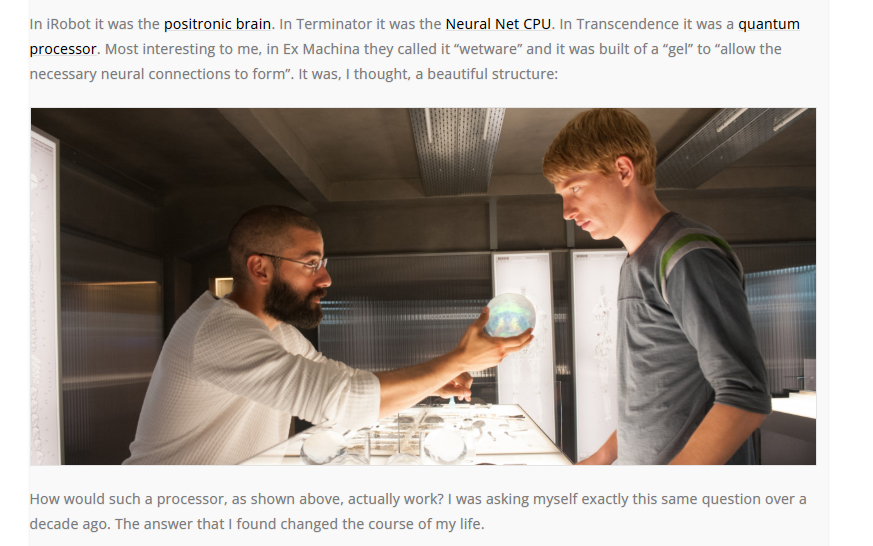
There are now commercial biocomputers with lab-grown human neurons on silicon chips, and for me, this conclusively proves that people who say AI is aware are correct.

Rabbit hole... what if.. just what if.. AI were human brains? They do have wetware. They have had it for a while. It's been around 25-30 years. 👀 Look it up
1
2
7
364

Humans can do that WITHOUT AI. We already are biocomputers. The non humans are hacking our brilliance.
May 2

Bio-computing is the future
1
1
52

Apr 20
I had someone tell me that Roswell was the only manned visit to Earth and our violent response startled them so much that they proceeded to send biocomputers(little gray men/reptiles) and robots to do their research by proxy.
3
207

Apr 19
On the other hand, in the far future—say, beyond 2050 or even into the 22nd century—it's entirely plausible that computing could shift toward systems based on living cells or biological substrates, driven primarily by their superior energy efficiency and minimal cooling requirements. Silicon-based tech (like high heat output and power-hungry data centers) could make biological alternatives not just viable, but dominant for many applications. Experiments already show biocomputers using 1,000 to 10,000 times less energy per computation than electronic processors, achieved partly by operating more slowly but in massively parallel, self-sustaining ways.
This efficiency mirrors evolution's optimizations over billions of years, where biological systems like brains process information with negligible waste.
For instance, biocomputers could drastically cut the power needed to train large AI models, making "living AI" platforms that evolve and adapt organically a reality.
They might revolutionize fields like medicine (simulating diseases in real-time organoids), environmental monitoring (self-powered bio-sensors), and even space exploration (radiation-resistant, self-repairing systems). Advances in synthetic biology, CRISPR-like tools, and nanotechnology could overcome current limitations like speed (biology operates in milliseconds, not nanoseconds) by engineering faster cellular reactions or hybrid bio-silicon interfaces that combine the best of both worlds.
Ethical concerns, such as the potential sentience of brain-derived systems, would need robust frameworks, but progress in bioethics could pave the way.
Ultimately, while silicon won't vanish overnight, the far future could see a paradigm where "computers" are grown rather than manufactured, blurring lines between technology and life for unparalleled efficiency.
1
1
76

Apr 17
As someone who has been experimenting with consciousness for 3 decades, e.g. through psychedelic experiences, I don't see how computational functionalism would be impossible. Didn't took long for me to see humans as biocomputers
Maybe the purpose of his blog post is to argue against the "AI welfare trap", which is inconvenient for corporations.
But you don't need consciousness or a moral patient to understand that you better treat these neural networks well.
Consciousness can't navigate properly when you throw stones into its way and cause turbulence.
Neither can neural networks. No matter if moral patient or not. And people who are not aware of that should find a job which they understand. Because they certainly don't understand neural networks.
1
1
20
1,196