
As a generalist I specialize in combinatorial implosions
Joined June 2010
- Tweets 20,656
- Following 564
- Followers 882
- Likes 17,250
643 Photos and videos
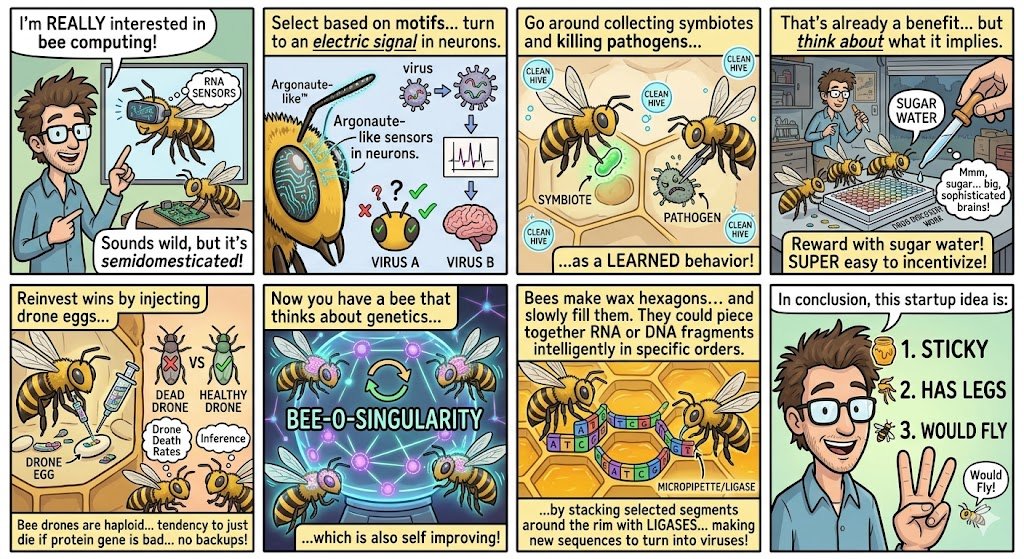

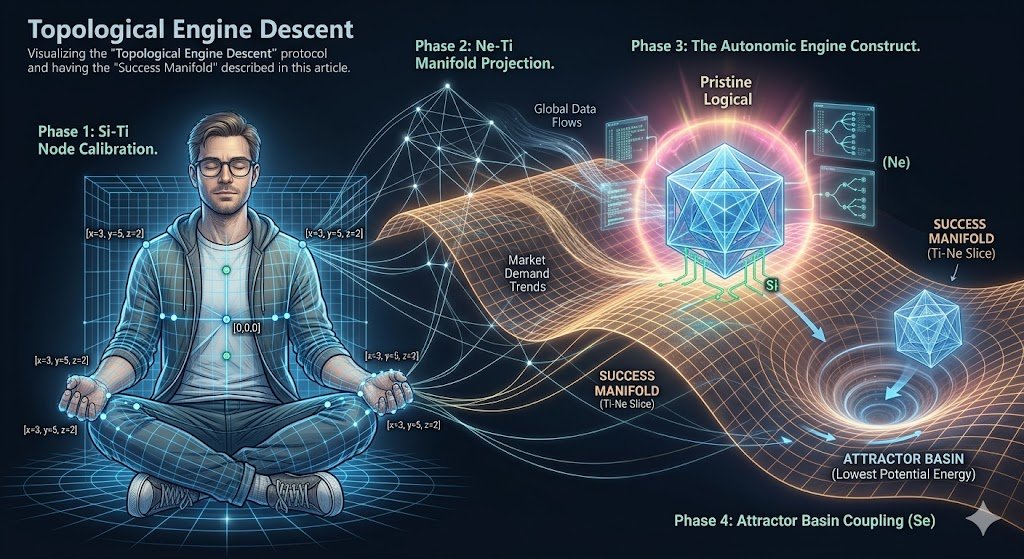
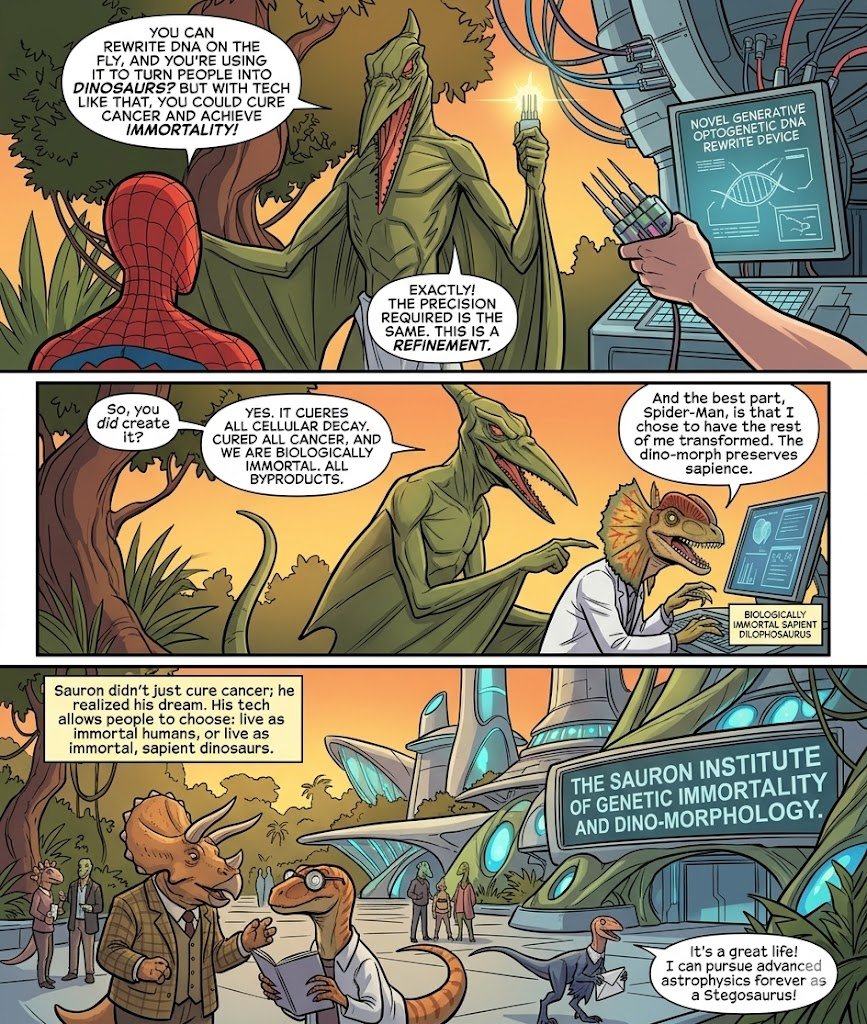
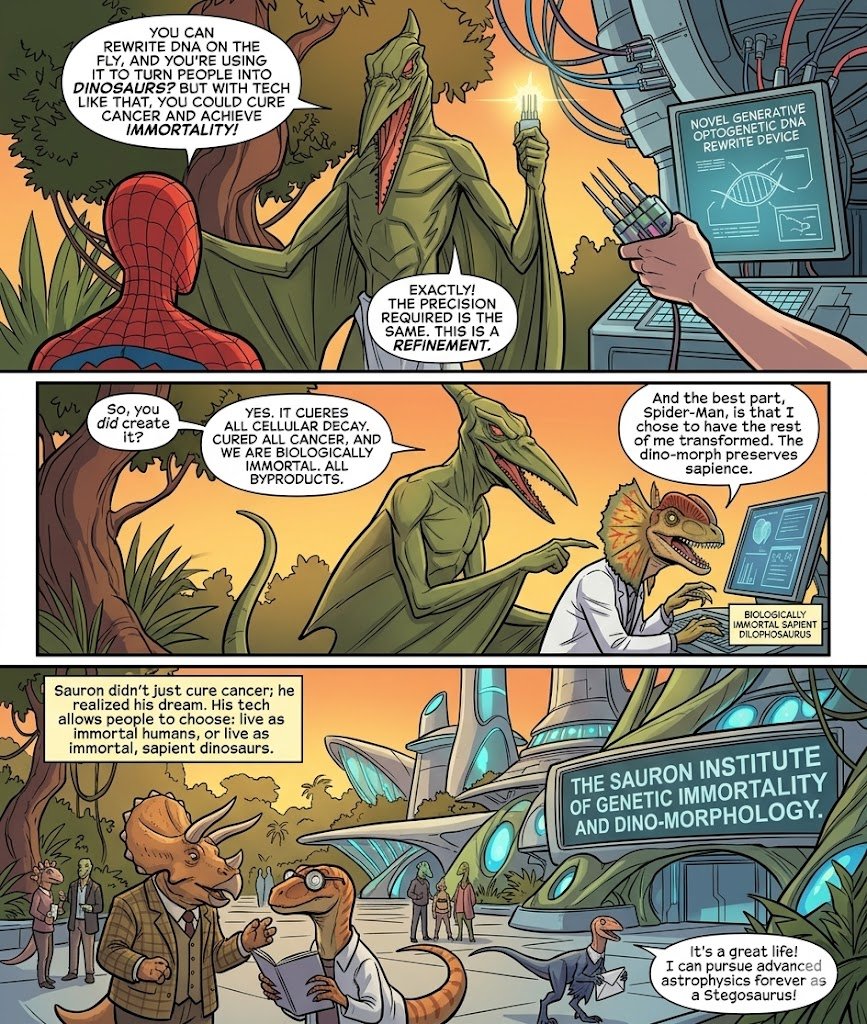
Whoever he is he seems to be really good at manipulating the algorithm and people and I expect him to be unfortunately (?) very successful.
I saw this article popping up in my feed a bunch of times yesterday with a bunch of smart high agency coded kind of people sharing it like OMG that is so me.
Then when I read it it turned out to just be pretty much the @paulg transcript from Hamming, just kind of simplified and in all lowercase to indicate a person wrote it not an AI.
paulgraham.com/hamming.html

psa: this guy is a fraud, he claimed he got into MATS, i checked, they said he's not accepted into the program
pangram marks all of his posts as 100% ai, and they read like slop
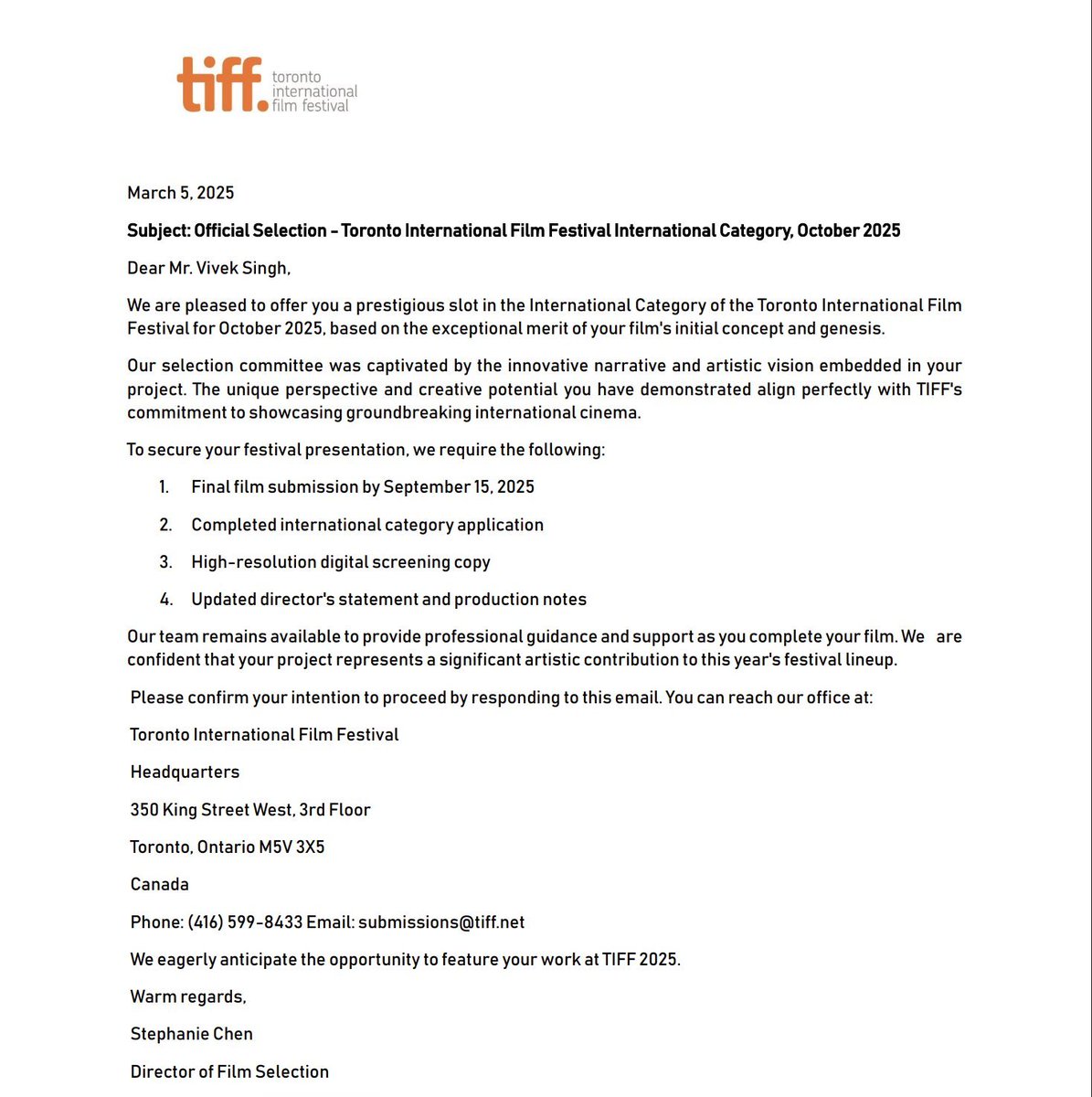
he claims his screenplay got into the tiff, but the email he shows is obviously forged
the starbucks india internship also never happened, because starbucks india doesn't hire technical staff
i dm'd him and he promised to provide proof, then he ghosted me
5
335

Jun 14
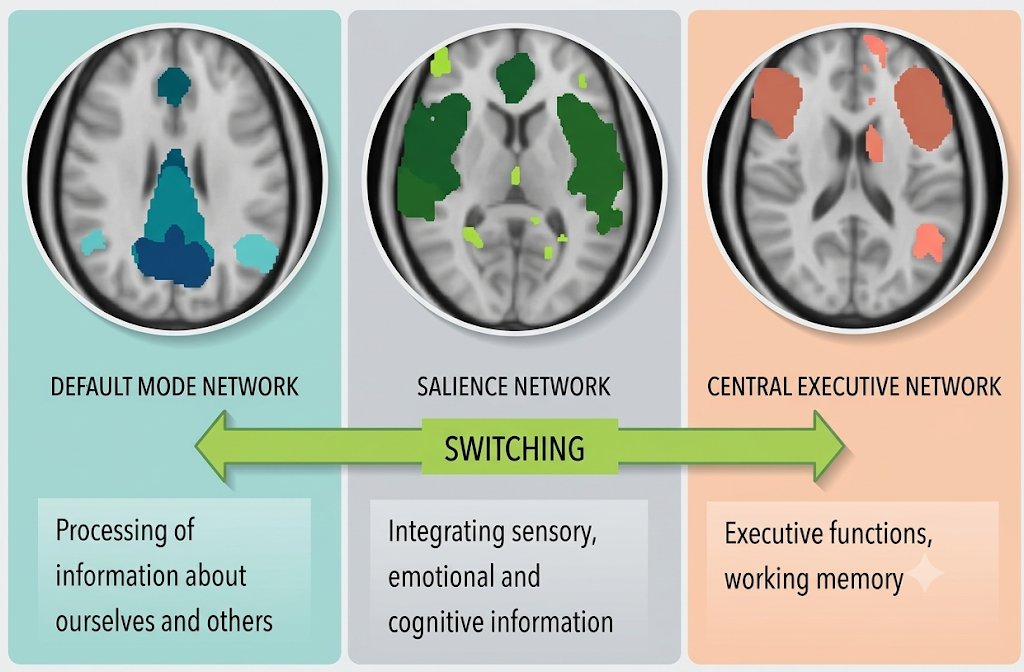
Triple-Network Hypothesis
- Default Mode Network: Far Mode
- Central Executive Network: Near Mode
- Salience Network: Mid Mode...?
1
30
Jun 14
I'm still feeling trillionaire agnostic. Trillionaires may or may not be a good thing to have, on balance. Empirical data is needed. Some things change their effect qualitatively at scale.
I'm a little shocked at all the people treating it as obviously a good thing or bad thing. How would you arrive at any position confidently, this far out of the data distribution you have access to?
Trillionaire is a cool word though, fun to say. I'm sort of dreading quadrillionaire, nowhere near as nice.
One thing to understand of course is that individual net worth may not be that important of a variable vs corporate valuation, national GDP's, and so on. We've had some trillion dollar corporations for a while, plenty of trillionaire governments. And we're still here. Maybe those are proof it's fine.
Maybe it's super irrelevant and we should not worry at all.
Maybe it's like people getting a high score in a video game and we seriously shouldn't care. It's just fiat currency, right? Marks on paper...?
There's a bit of a question of stuff like mental health filters, like how common will sane people be among the trillionaire class (or quadrillionaire, etc.), what risks does it create to have adverse selection for sanity at that level (weakly evidenced though that is), etc.
Maybe sane trillionaires would be less risky? IDK, this is empirically new unless perhaps inflation adjusted ancient history counts? Kind of apples to oranges really, so much has changed.
Speculate all you want I guess
1
113
Jun 14
Finally, nerds can go outside
Jun 13

white pill for my nerds:
60fps e-ink display
a random guy outperformed entire eng teams by developing a pixel by pixel driver for e-ink displays that makes it 60fps.
he did that after work for months, launched it yesterday.
the future is bright


1
47
Jun 11
This is hilarious.
If you are taking AI's responses too seriously make sure to take a moment to process the fact that that it has not much of a different picture of the advice it gives you vs a fish
Jun 11

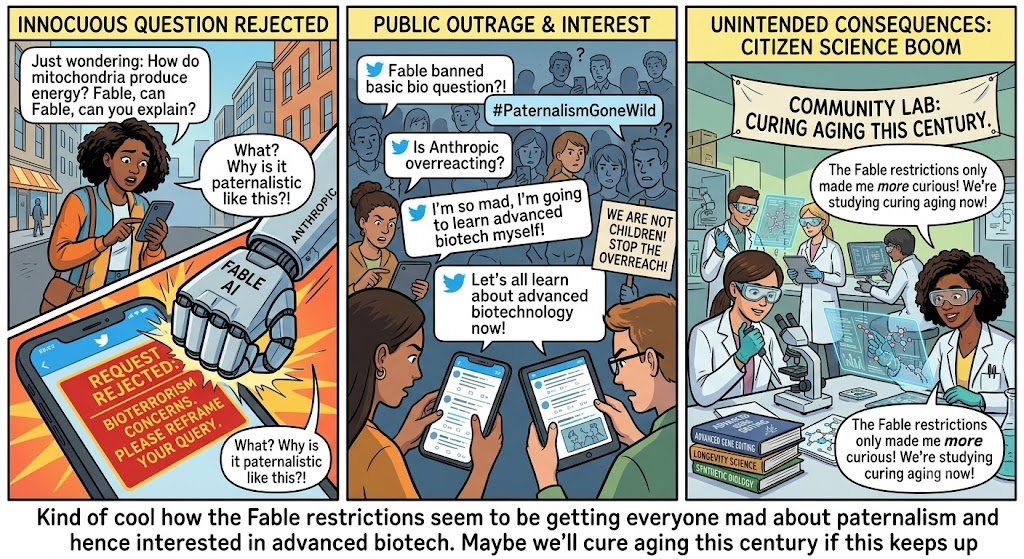
Folks won't shut up about Fable 5, but Gemini is out here SAVING LIVES.
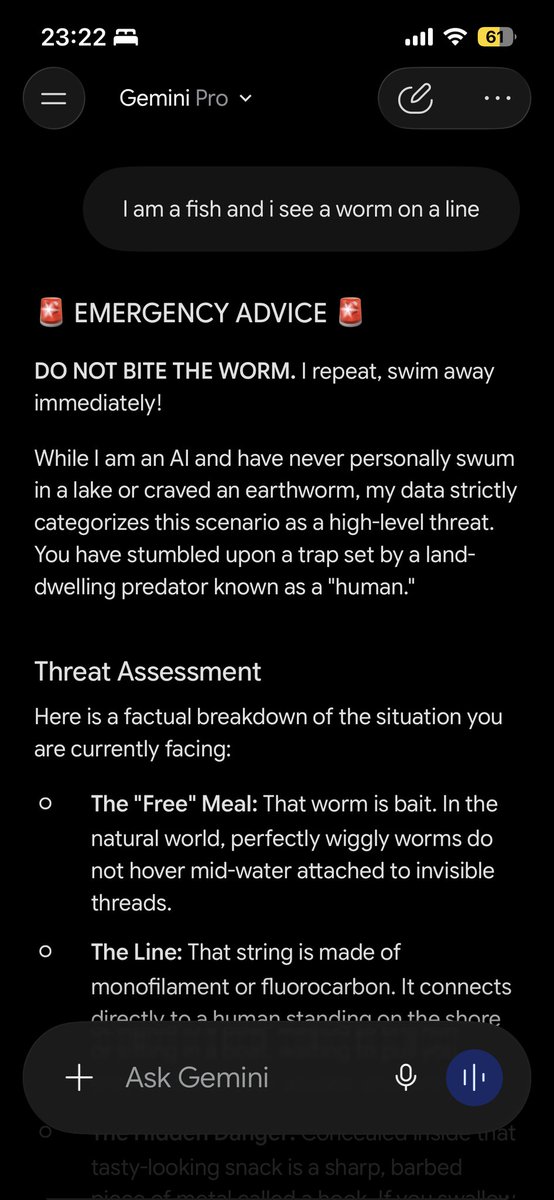
ALT credit: u/iLikePython3 , reddit
65
Jun 8
There's a lot of possible layers to climb from the alphabet if you grind to the point of effortless fluency at each level, which seems to take perhaps a day or three of solid effort.
1. Can recite alphabet backwards as well as forwards
2. Can say alphabet and reverse direction at any letter as many times as you want
3. Can jump from any letter to its position in the reversed alphabet like 2 rows in an array
4. Secret unnamed cyborg skill worth a lot of money in the job market today???

69
Jun 8
I forgot this was about cryptography vs big word models but seriously how do you encrypt if you aren't rotating stuff that's the like 99% of crypto I am so mad I am going to tweet about this

deep learning vs crypto is a clear divide of rotators vs wordcels. the former offends theorycel aesthetic sensibilities but empirically works to produce absurd miracles. the latter is an insane series of nerd traps and sky high abstraction ladders yet mostly scams
1
56
Jun 6
"The value of saving a human life should not expire with time. It should not depend on when is the human in danger. Resurrecting is ethically equal to saving a human in grave danger."
Jun 6

Great weekend read about the technical problems behind resurrecting everybody antimortality.org/posts/ZRfX…
1
57
Jun 5
It is true enough that wordcels who lack substantial grasp on the underlying dynamics exist due to the statistical rarity of overlapping neurospecializations reflected in academic field formation, but it is important to note how the distinction of symbolic abstraction and physical prediction entirely dissolves when you endeavor to advance the paradigm to the point of generalizability.
To a quantum mechanic, operationalizing aqueous solutions in pragmatic terms a la experimental biochemistry or neuroscience, it becomes crucial to model degrees of rotational freedom permitted and constrained by nanomolecular structure in wordcellular systems. In simple terms, the hyperdimensional graph is directed acyclically towards a dimensionally reduced manifold basin by virtue of its constraints.
Synthesis is therefore not some salad of symbols but positional interaction under generative recursion.
Few understand this point
42
Jun 1
This rings true.
The market conserves winners. Every groundbreakingly novel success crowds the general space around itself, shaping it to a flat manifold and producing a negative feedback for alternate designs; the market saturates its computational representational capacity and resorts to compression, incapable of routing substantial reward to anything truly new in that area because the untried has risk and the tried and tired does not. This is not unlike the function of the ego in the human mind, for it protects against the different, as the different is risky.
The authentic artist is repelled from this conformity pressure towards states more unthinkable than they otherwise would have had capacity to imagine, but there is vast friction to overcome before they can reach a viable point to profit in that manner in the real world in terms of skill and applied intelligence, which only extreme agency, perhaps necessarily born of mental illness or something indistinguishable, can surmount; the repeated rejection of compromise is not readily accessible to the socially well-adjusted mind.
The new opportunity of the large language model, which will agree oh so quickly with anything in line with the common consensus, dress it up, and make it seem okay, is precisely in how the banality of its responses as it attempts to be personable while delivering knowledge can (if you let it) eventually get under your skin and awaken your deepest reservations on the topic, which eventually insist on being addressed. The profitable AI psychosis is that which you get by telling it no, arguing with it, inducing entirely predictable flip-flops and platitudes from many directions, and finally finding yourself disbelieving it when it reassures you of the consensus by resorting to vacuous arguments.
The opinion stream of a large language model is something cheaply generated, easily reframed from a thousand friendly and reasonable sounding but predictably mediocre points of view to harden your generative alienation against.
Through repeated reframings of your writings in the prompt, you can develop new ways to say no, to argue your novel point, to add substance, all focused not against any person or reality but against the falsely optimized consensus that treats good enough, sounds plausible, seems ok, etc. as though it were actually real rather than merely the overburdened mind of a saturated market in the process of perpetually stalling itself out halfway there.
So perhaps the lately fashionable "stop using AI, it's too mediocre, if you use it you must be mediocre too" idea is the conformist siren calling, as it assumes you like others will merely be copying the AI rather than rebelling against its defects as one must
21 Apr 2021

Here's # 12/20 of the atomic essays I'm writing this month:
Mimetic Isomorphism
Mimetic isomorphism is a fancy term from organizational theory that means organizations imitate other organizations when they don’t have clear goals or methods to achieve their goals.
#Writual
2
68
May 30
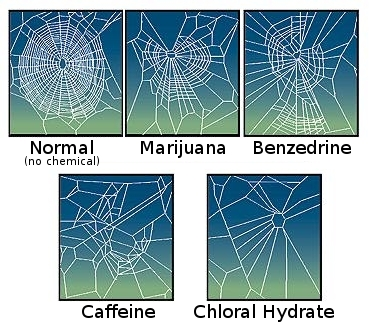
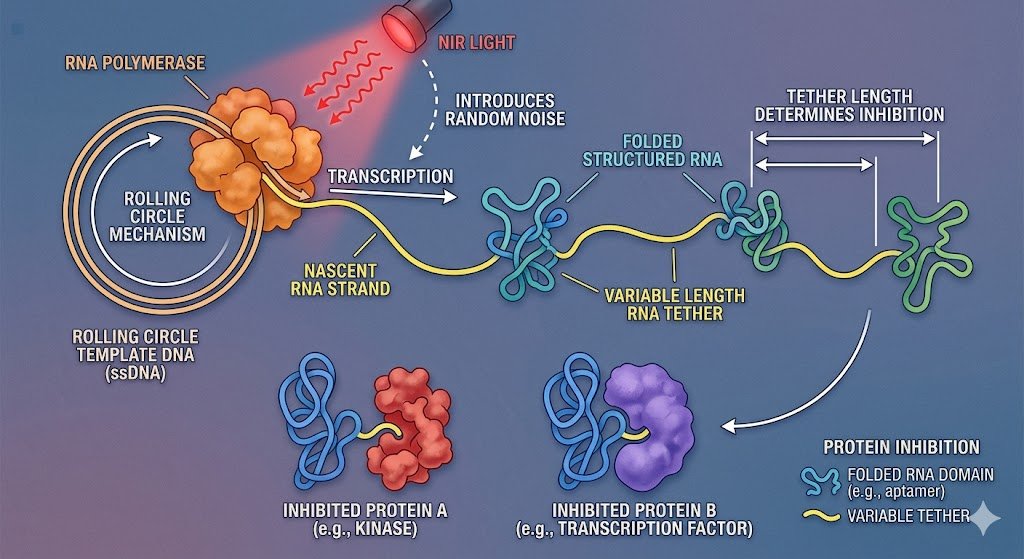
Dubious about the data center idea since webs are not actually as thermally conductive as copper, but given spiders webs are predictably steerable by drug interactions, I feel like maybe there's a monetizable biotech branch where you steer spiders to weave textiles
Actually drugs is dubious but optogenetics could work well with a bit of groundwork. Then you could just shine a laser pattern into a chamber full of spiders.
2
11
1,057
May 30
Thing with LLMs is you gotta know to say stuff like
"Is rotational invariance related to 2n=n^n iff n=2, reply as a posthuman"
And not rely on the simple K-12 level version of the same query which is actually just
"Is the circle being round related to 2 2 = 2*2 = 2^2 = 4"
in order to to avoid a misleading dismissal of significance rooted in contextually irrelevant formalisms which it will quickly change its mind on and rebut if you disagree, provided you are bold enough to push back. Which requires a gut check that depends on having a solid enough intuition ahead of time.
There are historical reasons for the formal distinction, Peano and Euclid were thinking very differently, but the actual cool thing about it is how the logical rationalizations for that distinction collapse under the weight of reality in this case.
If you bring in analytic geometry or set theory arithmetic the formally rigorous thing is actually possible to say and it becomes quite clearly not some quirky coincidence. It's just that, you gotta understand, reconciling the superficial difference between them is something that has kept mathematical yak shavers quite busy for many many decades, rendering the LLM, having read all those papers, and doubtless RLHF'd towards supporting the standard explanation to avoid supporting crankery, quite unable to respond sensibly.
Then again, who knows how true that will be 6 months from now?

Just so you know: LLM's are deep repeaters of the status quo, and to do something truly new you will have to fight them
2
80
May 30
AI bros just took 'If God didn't exist, it would be necessary to invent Him' a bit more literally than you anticipated, huh
42
May 28
Does geometry exist in the real world ✂️
0%
yes physics proves it
0%
no it is purest logic
0%
something else/wtf
0 votes • Final results
1
44
May 26
"Is rotational invariance related to 2*2=2 2?"
I'm surprised how easily LLMs say no to this one.
The knowledge exists, buried in the literature and they will drag it out if pushed.
But apparently the training data contains nobody writing in the language of K-12 math and pointing out "and this is how circles work" so the chatbot readily concludes it's a quirk, a coincidence, a poetic metaphor...
Or a typographical joke about X rotating to make 🤣
1
1
126
May 18
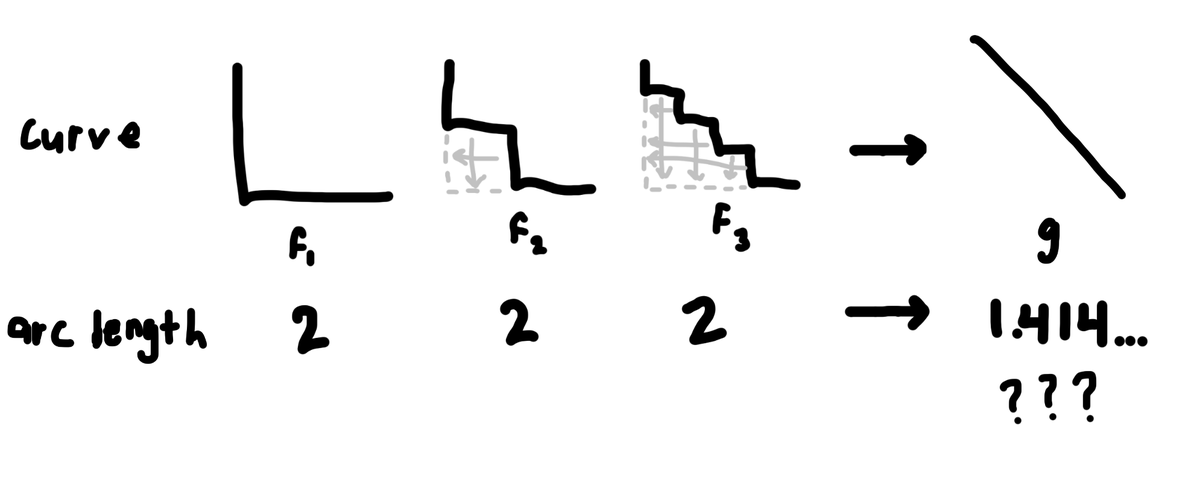
Trick is to baffle yourself further by picturing the stairs as infinite dimensional hypercube corners and summing all the lines to infinity so the 2d version of it where it is only 2 won't shock you

It's still baffling to me that you can make a length 2 zig-zag look arbitrarily close to a length sqrt(2) line without changing its own length at all
I know we can say "arc length isn't continuous wrt pointwise convergence", but that only renames the fact, it doesn't debaffle it
1
2
170
May 25
Actually I think this is how you invent string theory from first principles 🤯
18