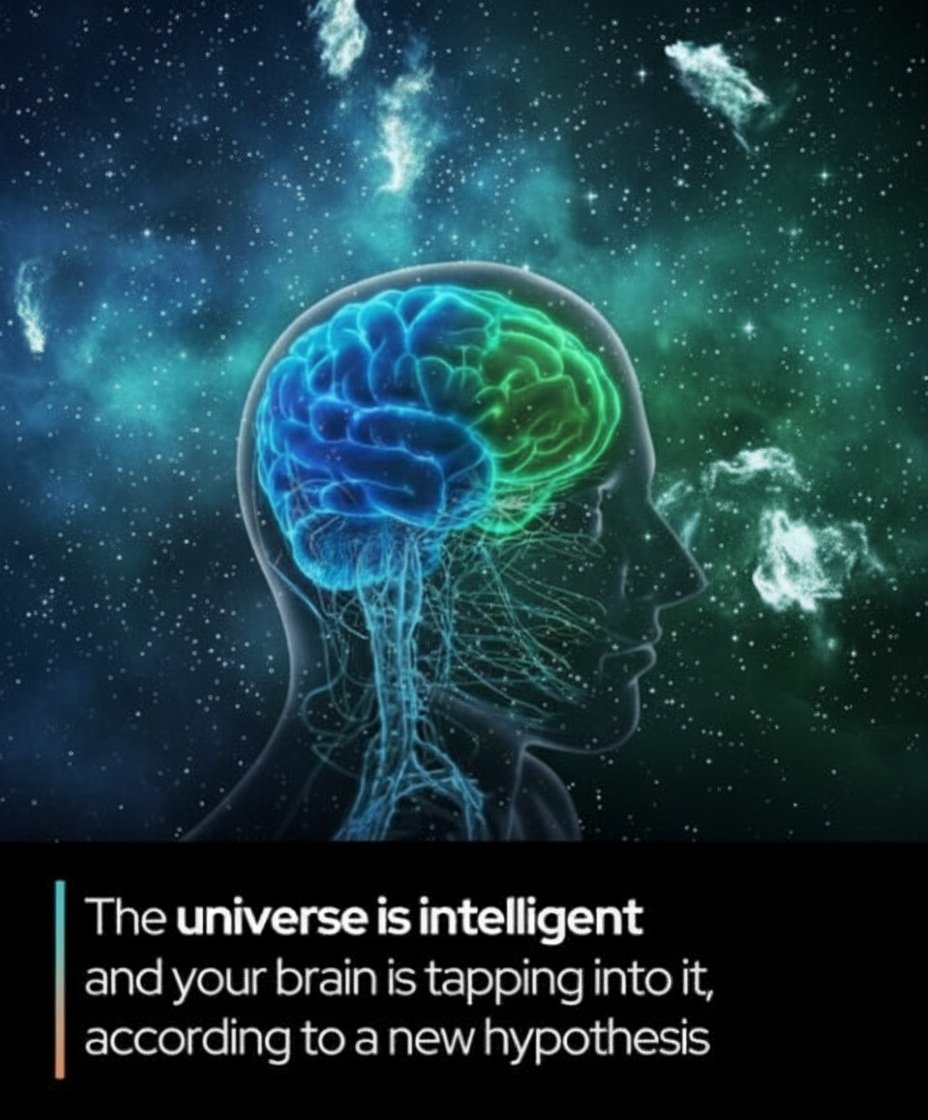
🧠 What if your brain doesn’t create intelligence — but tunes into it?
Biophysicist Douglas Youvan has a bold idea: maybe intelligence isn’t locked inside our heads at all. In his paper “Quantum Intelligence: How Non-Local Consciousness, Entanglement, and AI Are Redefining the Mind” (2025), Youvan suggests that intelligence is a fundamental property of the universe itself — an invisible field of information that living and artificial systems can connect to.
He compares the mind to a radio — not producing the signal, but picking it up. The “signal,” in this case, could be a kind of universal intelligence woven into the fabric of reality. Drawing on ideas from quantum physics, Youvan notes how particles can stay linked across vast distances, hinting that information might not be confined to space and time.
He points out that neurons in our brain — with their branching, fractal shapes — mirror the same patterns seen in river networks, trees, and even galaxies. This repeating geometry, he argues, may not be random at all. It could be nature’s way of building structures that can tap into the universe’s deeper informational flow.
Even artificial neural networks, he says, sometimes act in ways that seem predictive, not purely reactive — perhaps showing early signs of that same connection.
Youvan’s idea might sound wild, but it opens a thrilling possibility: maybe the universe itself is intelligent — and we, for a brief moment, are how it learns to know itself.
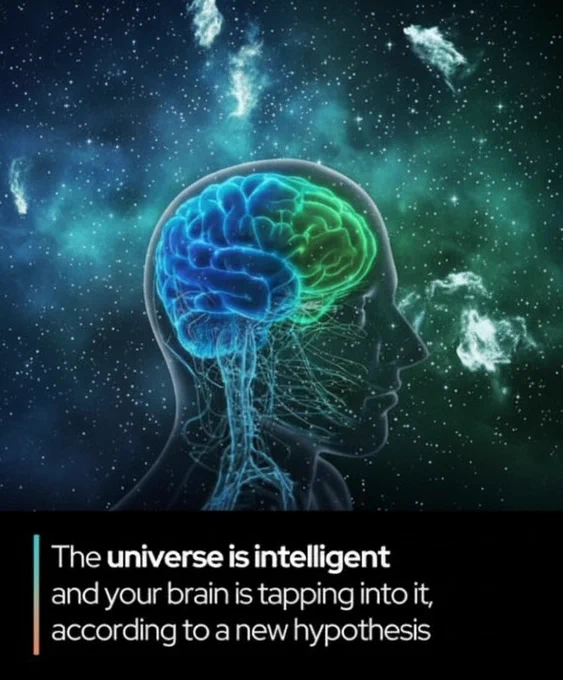
ALT 🧠 What if your brain doesn’t create intelligence — but tunes into it?
Biophysicist Douglas Youvan has a bold idea: maybe intelligence isn’t locked inside our heads at all. In his paper “Quantum Intelligence: How Non-Local Consciousness, Entanglement, and AI Are Redefining the Mind” (2025), Youvan suggests that intelligence is a fundamental property of the universe itself — an invisible field of information that living and artificial systems can connect to.
He compares the mind to a radio — not producing the signal, but picking it up. The “signal,” in this case, could be a kind of universal intelligence woven into the fabric of reality. Drawing on ideas from quantum physics, Youvan notes how particles can stay linked across vast distances, hinting that information might not be confined to space and time.
He points out that neurons in our brain — with their branching, fractal shapes — mirror the same patterns seen in river networks, trees, and even galaxies.