
31 Dec 2025
Más bitdn debería darte vergüenza que como socio en la época de Gonzalez no supiste defender a la U.
1
4
198

6 Oct 2025
eger bu kediyi boydan tam hali ile atmazsan bitdn

5
235

SRC20 tokens, a fungible token standard built on Bitcoin’s blockchain using the STAMPS (Secure Tradeable Art Maintained Securely) protocol, enable the creation of immutable digital assets that are embedded directly into Bitcoin transactions and resistant to pruning. Unlike other Bitcoin-based protocols such as Ordinals or BRC-20, SRC20 emphasizes permanence by storing data in unspent transaction outputs (UTXOs), making them suitable for tokenized assets, DeFi applications, and even art.
Based on recent data up to mid-2025, there is indeed hope for SRC20 tokens, driven by active community engagement, ecosystem growth, and ongoing developments. Here’s a balanced assessment:
Positive Indicators and Momentum
• Market Presence and Listings: SRC20 tokens maintain visibility on major trackers like CoinGecko, with a dedicated category for top coins by market cap. Leading tokens include $STAMP (the flagship SRC20 token with over 4,300 holders), $KEVIN, and $BITDN, showing sustained interest despite market fluctuations. Rumors and community discussions point to potential listings on exchanges like Binance, which could significantly boost liquidity and adoption.
• Community and Ecosystem Activity: The SRC20 space is far from dormant, with robust development and social buzz in 2025. A detailed roadmap extends through 2027, focusing on priorities like resolving delistings (e.g., from KuCoin), building a decentralized exchange (DEX) for better liquidity, expanding partnerships, and growing the community through airdrops, meetups, and social campaigns. Recent X posts highlight ecosystem mapping updates, surging activity surpassing “less secure protocols,” and events like Bitcoin Stamps Asia 2025 in Hong Kong on August 27—aimed at attracting sponsors, artists, and innovators. Artists are actively creating “unprunable works etched forever on Bitcoin,” and shilling is rampant, with sentiments like “Matter of time” and “Only $STAMP can win” reflecting optimism.
• Technological and Use Case Potential: SRC20’s immutability—storing data directly in Bitcoin’s DNA—positions it as a strong contender for real-world applications like security token offerings, fractional ownership, DeFi, and tokenized assets (e.g., real estate or supply chains). Post-Bitcoin halving in 2024, experts anticipated a “meteoric rise” due to reduced Bitcoin supply and growing interest in Bitcoin-based tokens. Development firms continue to offer SRC20 token creation services, indicating commercial viability, and platforms like OpenStamp support minting and trading. Integration with Bitcoin’s Layer 2 solutions could further enhance scalability, drawing parallels to successful tokens like ORDI in the broader Bitcoin ecosystem.
• Broader Market Context: With Bitcoin’s market cap at $4T and fungible tokens on Bitcoin collectively valued around $1.1B, SRC20 represents a high risk/reward opportunity in a niche that’s underrepresented but growing. Community members emphasize its edge over competitors like Runes or BRC-20 due to superior permanence, with calls for major exchanges to recognize “the most immutable and permanent token on earth (after Bitcoin).”
Challenges and Risks
While promising, SRC20 faces hurdles that could temper short-term hope:
• Regulatory Uncertainty: Many jurisdictions lack clear rules for Bitcoin-based tokens, potentially limiting adoption. The SEC’s 2025 guidance classifies tokens as securities if they resemble investment contracts, which could apply to SRC20 if tied to profit promises.
• Competition and Adoption: Bitcoin fungibles remain a small slice of the crypto pie, and SRC20 must compete with more established standards like BRC-20 or Runes. Some critics note early minting was dominated by insiders, raising concerns about fairness and liquidity.
• Market Sentiment: Not all discussions are bullish; some X users question if SRC20 communities are “still alive” amid broader Bitcoin token hype cycles.
2
4
39
1,132

The King of Amapiano, uBab'Motha enters the legendary chat. From back then kuze kube imanje he keeps on dropping hit after hit making sure ukuthi ipiano liyakokota - Kabza De Small is on the Spotlight on BITDN.⬆️📀⏯️
☎️:0861596596
📱:063 839 9959
🌐: Stream online: gagasiworld.co.za
📲: Listen via the Gagasi FM App
#UmsindoTO
#GagasiFM
#TheSoundOfKZN

1
1
8
591

25 Mar 2025
67、Devt&BitDN(2021年&2024年)
这两个放一起说,是特么一个比悲伤更悲伤的故事,因为这2个项目都是同一个朋友推荐我的他自己深度参与的项目。圣斗士不会在同一个地方摔倒两次,我不是圣斗士,所以我摔倒了两次。
我至今仍然记得他在第一个项目害我亏了百万之后,过了2年,跑来给我说的第一句话是,“上个项目害你亏了,我一直不好意思。这次的新项目,我第一时间想到了你,就当还债了。”当时听完还觉得特仗义,眼眶甚至有点小湿润。
这两个项目听过的人可能不多,总结来说,一个是在GameFI热潮快结束的时候,忽悠我肯定上币安,结果做出来游戏一坨屎,被币安果断抛弃。一个是在铭文热潮快结束的时候,忽悠我第一个Lauchpad项目,项目方签好协议要拉盘,肯定上KuCoin,甚至上OKX,随便买。
完事远远不如预期了以后,他的经典言论就是,“没办法,市场变了,项目方也不能白送钱,另外我也亏了很多。”
说实话,我不恨他,我恨自己傻。另外,他还在圈子里混呢,我在想他什么时候来给我推荐第三个项目。
1
5
17,166

9 Feb 2025
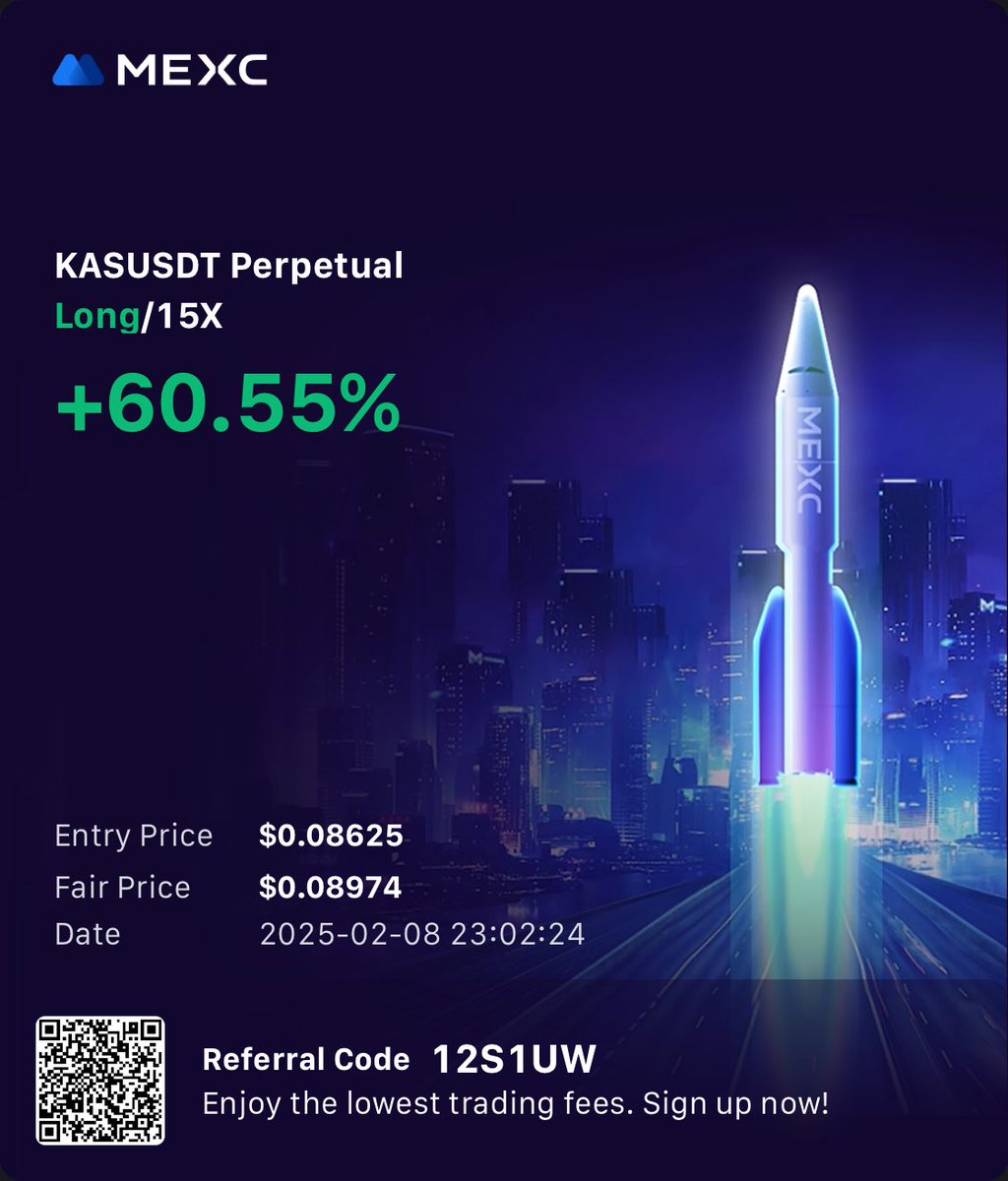
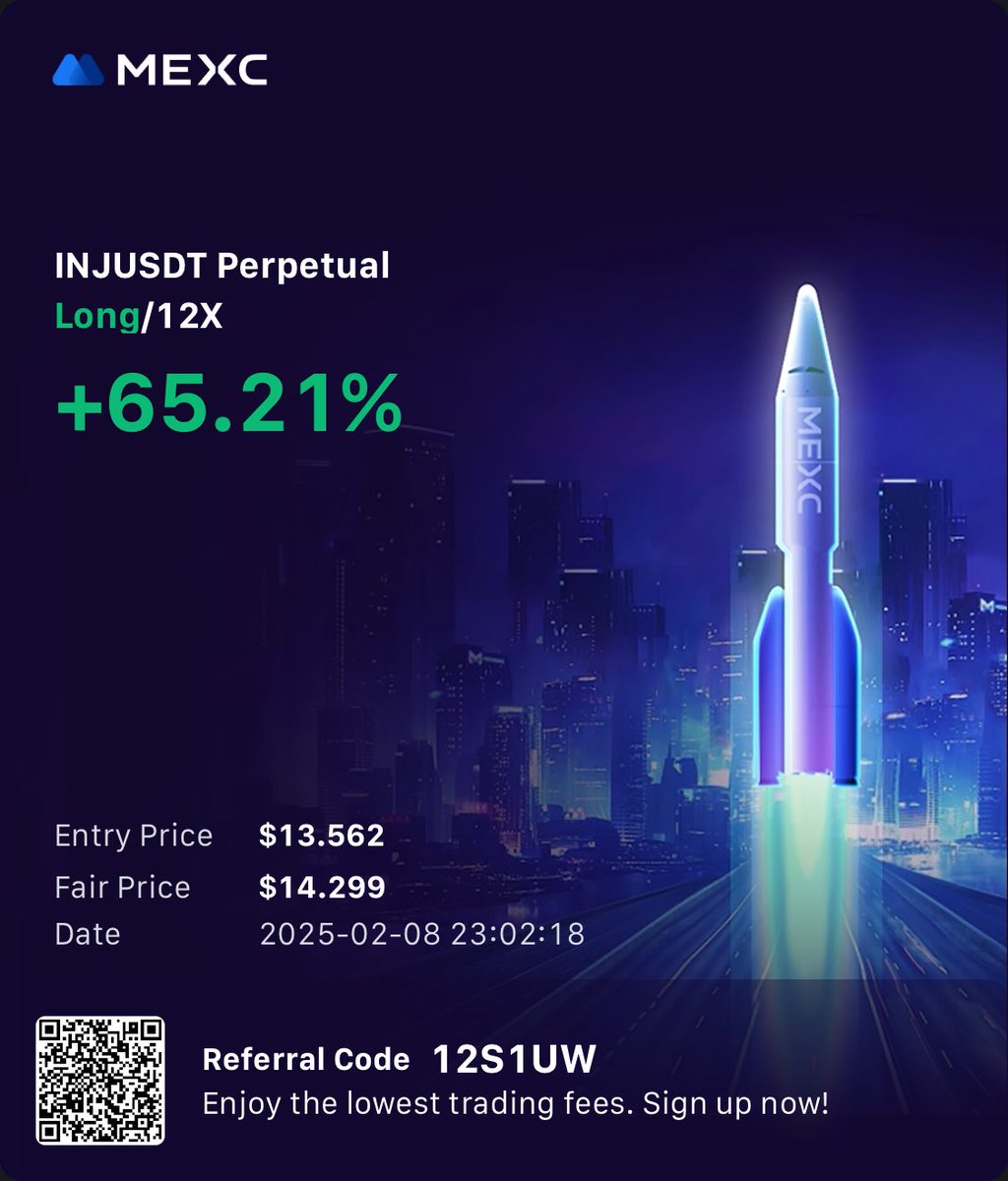
🚨 Market Sentiment vs. Strategy 🚨
While many were screaming for lower prices 📉, the charts were showing potential setups to the upside📊. Instead of following the fear, I focused on what the market was actually doing and it paid off.
I just made over 50% on both trades because I trusted the analysis, not the noise. 📈🔥
🚀 Opportunities are always there you just have to recognize them.
💡 If you want to catch setups like this, Join my #Telegram while it’s still FREE!
#Crypto #Bitcoin #Altcoins #TradingSignals #CryptoSignals #DayTrading #MarketAnalysis #ChartPatterns #Bullish #CryptoCommunity $INJ $KAS #BTC #BITCOIN #SRC20 $STAMP #SRC101 $KEVIN $UTXO $OLGA $SPAD $BITDN $SWP $STMAP $BOBO $VIVA $PXL $PAD $DRGN $PIZZA $KEVIN $DRGN $LUFFY $STUNK $PEPE $BRO $MIKE $QNT @kucoincom @MEXC_Official @coingecko @coinbase @BinanceAcademy @BinanceUS
1
1
7
259
8 Feb 2025
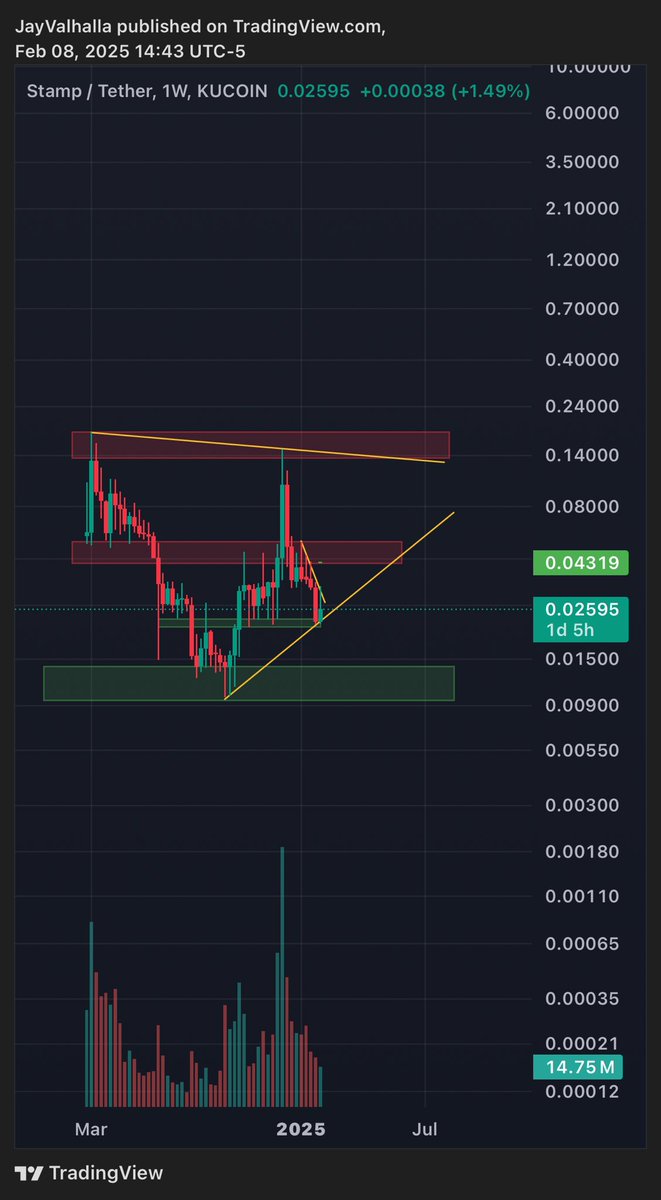
🗣️📊 As long as $STAMP stays inside this ascending triangle and respects the trendline, I remain VERY bullish 🐂 on $STAMP
📈 Price is still at a higher low.
#BTC #BITCOIN #SRC20 $STAMP #SRC101 $KEVIN $UTXO $OLGA $SPAD $BITDN $SWP $STMAP $BOBO $VIVA $PXL $PAD $DRGN $PIZZA $KEVIN $DRGN $LUFFY $STUNK $PEPE $BRO $MIKE $QNT @kucoincom @MEXC_Official @binance @cryptocom @coinbase @okx @gateio_web3 @SuperExet @UpholdInc @BingXOfficial @coingecko @coinbase @cz_binance @BinanceAcademy @BinanceUS @heyibinance @BitnameService
6
8
46
1,787
6 Feb 2025
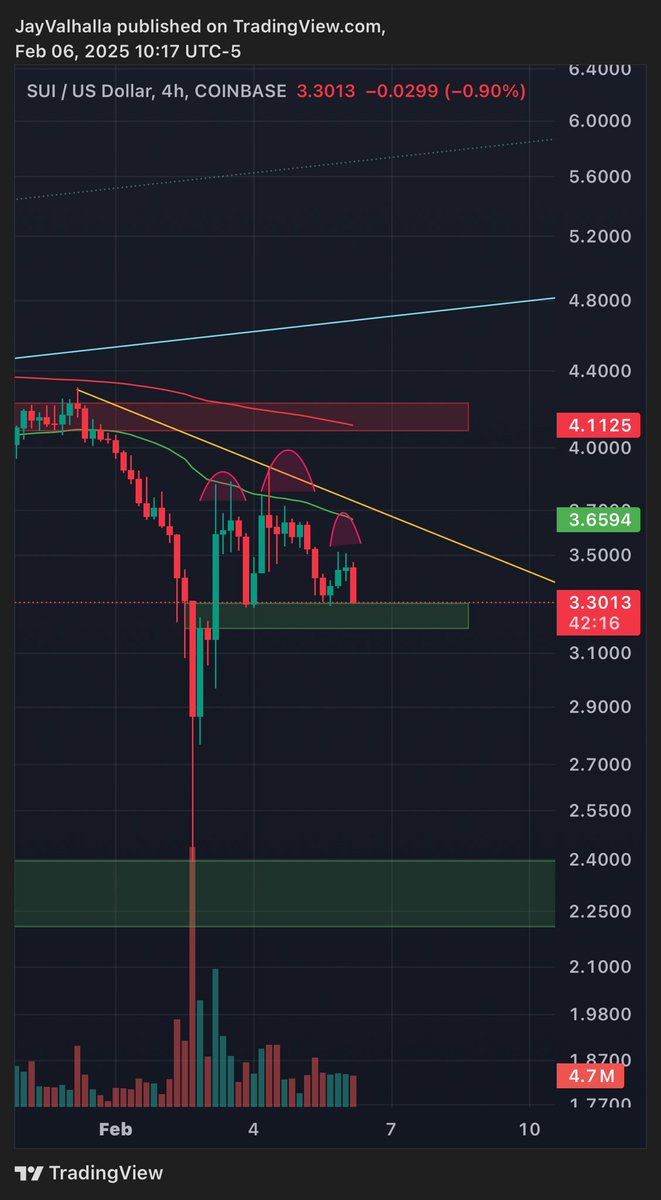
$SUI Trade Idea 🚨
If the 4H candle closes bearish and shows strong momentum, I’ll be looking for a short entry.
🔸 Why?
• Triple top forming
• Head & shoulders pattern
• Potential evening star
📉 Targets:
• First TP: $2.86
• Possible drop to $2.40
⚠️ Invalidation: If the 4H candle wicks up, I won’t enter. Staying patient and watching how this candle closes.
Stay alert! 👀
#TradeIdeas #Crypto #BTC #ETH #SUI #DayTrading #BTC #BITCOIN #SRC20 $STAMP #SRC101 $KEVIN $UTXO $OLGA $SPAD $BITDN $SWP $STMAP $BOBO $VIVA $PXL $PAD $DRGN $PIZZA $KEVIN $DRGN $LUFFY $STUNK $PEPE $BRO $MIKE $QNT @kucoincom @MEXC_Official @binance @cryptocom @coinbase @okx @gateio_web3 @SuperExet @UpholdInc @BingXOfficial @coingecko @coinbase @cz_binance @BinanceAcademy @BinanceUS @heyibinance @BitnameService
4
204
6 Feb 2025
📊 Trading Wisdom 📊
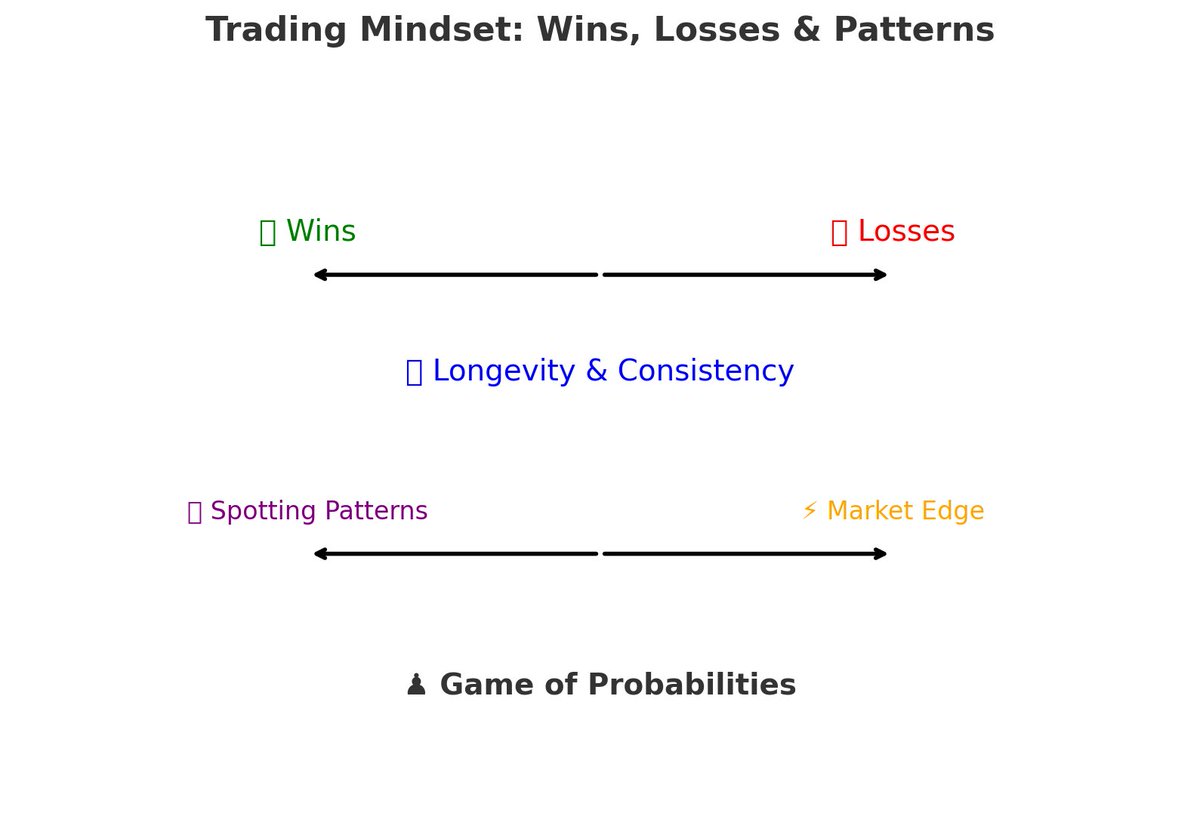
🗣️In trading, you’ll have #wins ✅ and you’ll have #losses ❌, it’s all about how you manage your losses. The #goal isn’t just to win every trade, but to build longevity and maintain consistency over time. 🧠📈
🗣️ Another key point: being able to spot potential patterns 📊 before they fully play out. Recognizing them as they’re forming gives you an edge in the market. ✅
📊 The market isn’t exactly repetitive, but you’ll start noticing familiar scenarios. As you train your eyes 👀, you’ll begin to spot setups early. This doesn’t guarantee you’ll be right every time, but it gives you a higher probability of making solid trades. 🎯
In the end, trading is a career of probabilities, it’s about playing the odds smartly. 📊
#TradingMindset #ConsistencyIsKey #MarketEdge #Probabilities #positivity #growth #Daytrader $sol $bnb $kas $link $ada $xrp $trump $stamp $usdc #eth #btc $doge $shiba $bonk #BTC #BITCOIN #SRC20 $STAMP #SRC101 $KEVIN $UTXO $OLGA $SPAD $BITDN $SWP $STMAP $BOBO $VIVA $PXL $PAD $DRGN $PIZZA $KEVIN $DRGN $LUFFY $STUNK $PEPE $BRO $MIKE $QNT @kucoincom @MEXC_Official @binance @cryptocom @coinbase @okx @gateio_web3 @SuperExet @UpholdInc @BingXOfficial @coingecko @coinbase @cz_binance @BinanceAcademy @BinanceUS @heyibinance @BitnameService
2
2
5
227
5 Feb 2025
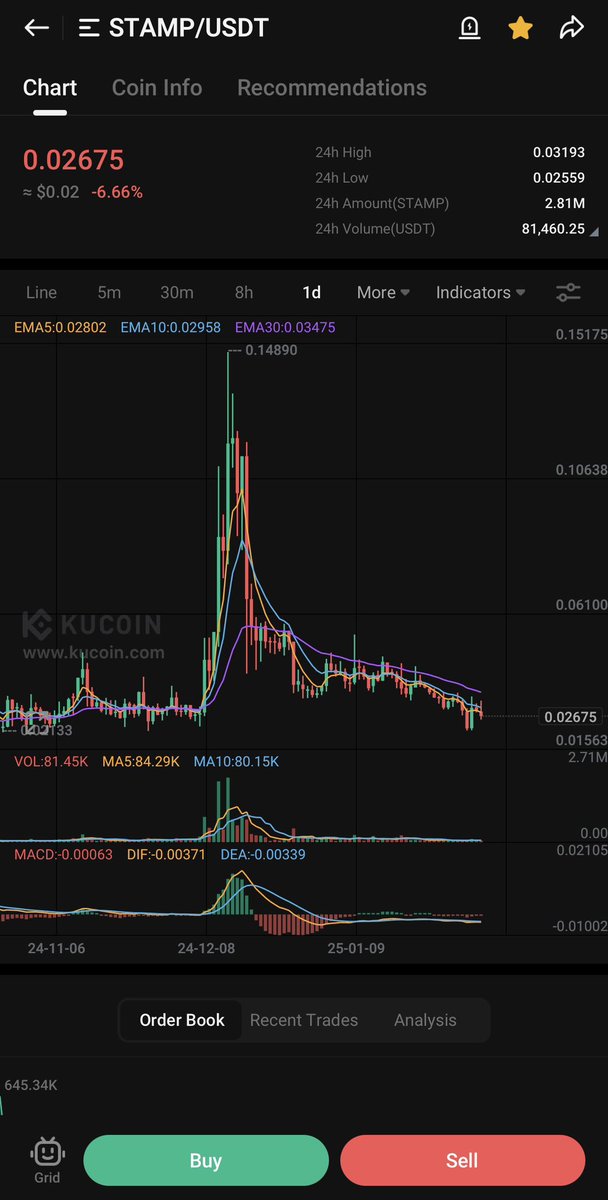
👨🏻💻 $STAMP Update 📊
📈 Overall Trend
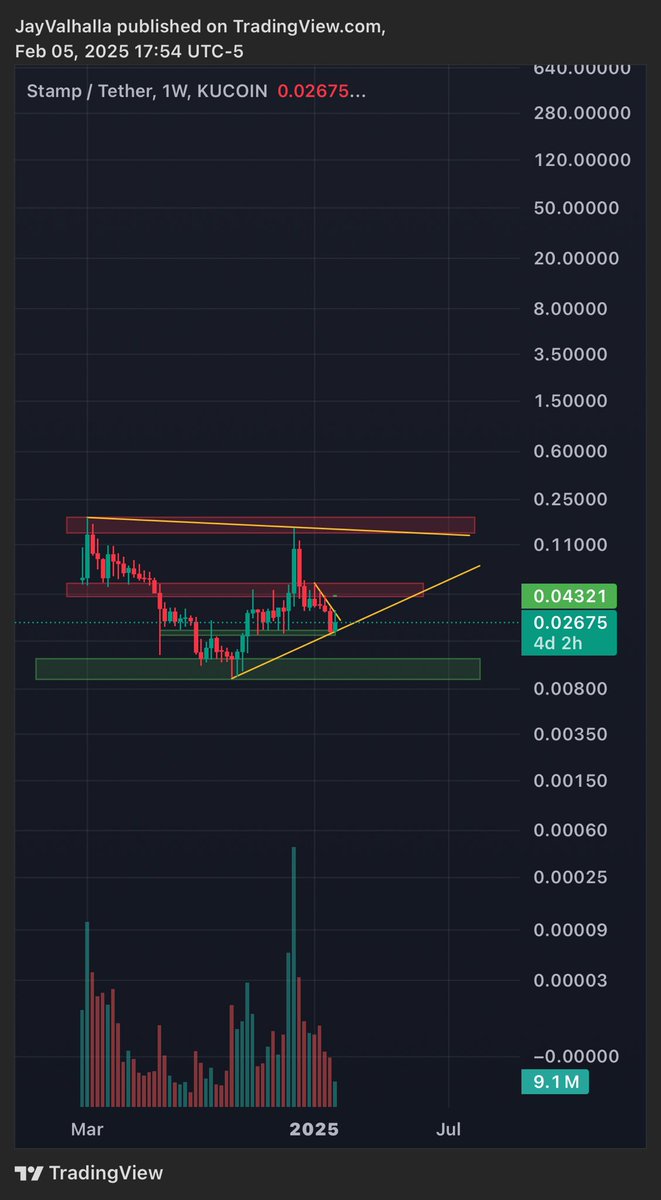
•As mentioned yesterday, $STAMP is currently sitting on an ascending trendline support. 🟡
• Wedge pattern forming looks like we’re due for a breakout. ⏳
📊 Trading Volume:
•Current 24h Volume: 81K
•Slight decline in volume recently, but spikes could be incoming with price action 🔥
💹 MACD
•MACD is showing a bit of bearish momentum atm. 🔻🐻
•But we’re near that point where momentum could shift if buyers step in.
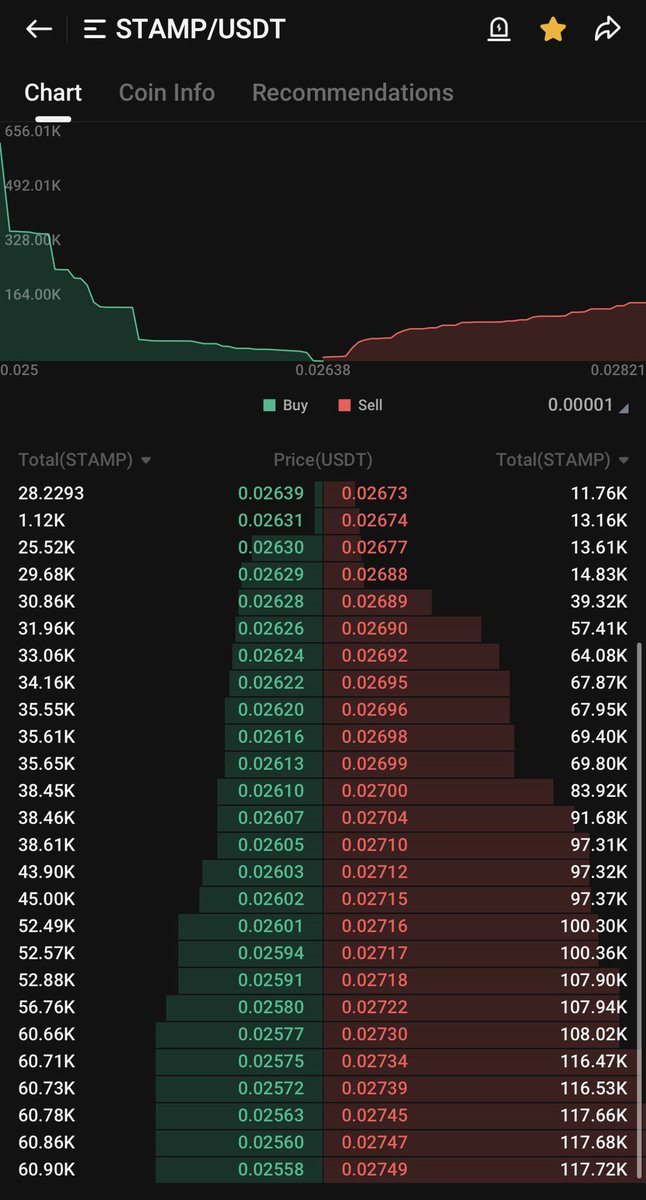
📖 Order Book
•Strong buys around 0.026–0.0265 ✅
•Sell pressure around 0.027–0.028 ❌
#BTC #BITCOIN #SRC20 $STAMP #SRC101 $KEVIN $UTXO $OLGA $SPAD $BITDN $SWP $STMAP $BOBO $VIVA $PXL $PAD $DRGN $PIZZA $KEVIN $DRGN $LUFFY $STUNK $PEPE $BRO $MIKE $QNT @kucoincom @MEXC_Official @binance @cryptocom @coinbase @okx @gateio_web3 @SuperExet @UpholdInc @BingXOfficial @coingecko @coinbase @cz_binance @BinanceAcademy @BinanceUS @heyibinance @BitnameService
4
5
32
599
5 Feb 2025
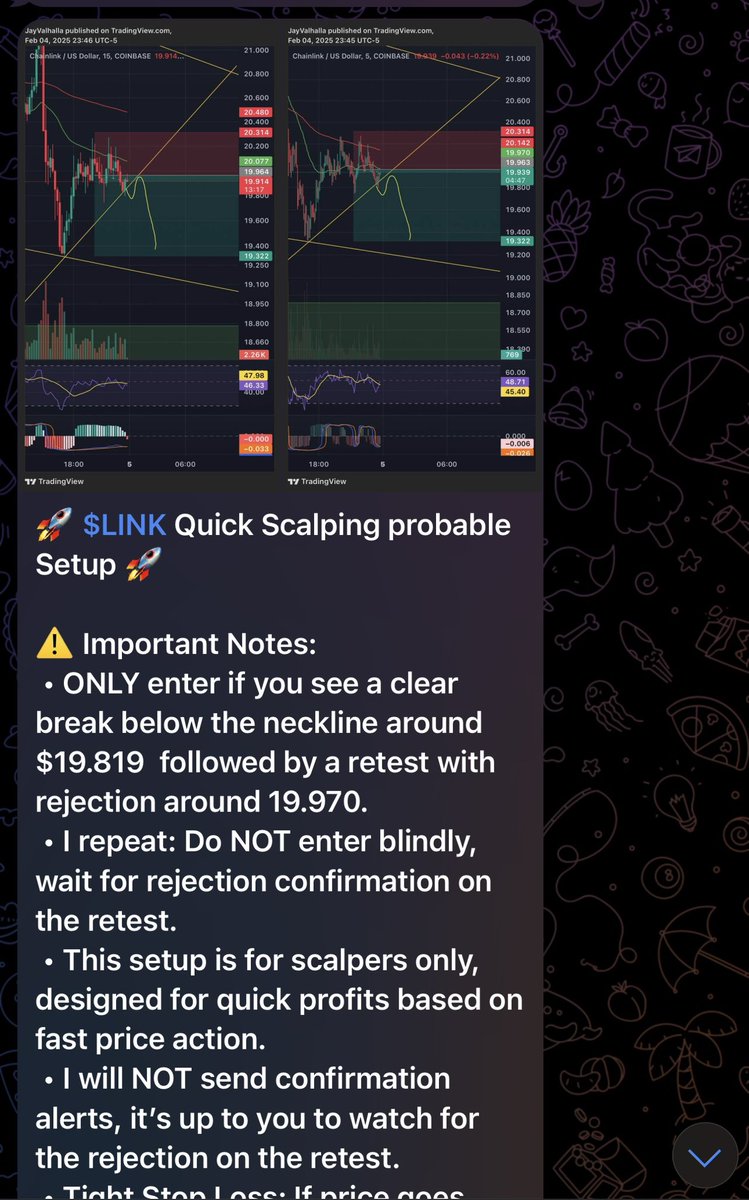
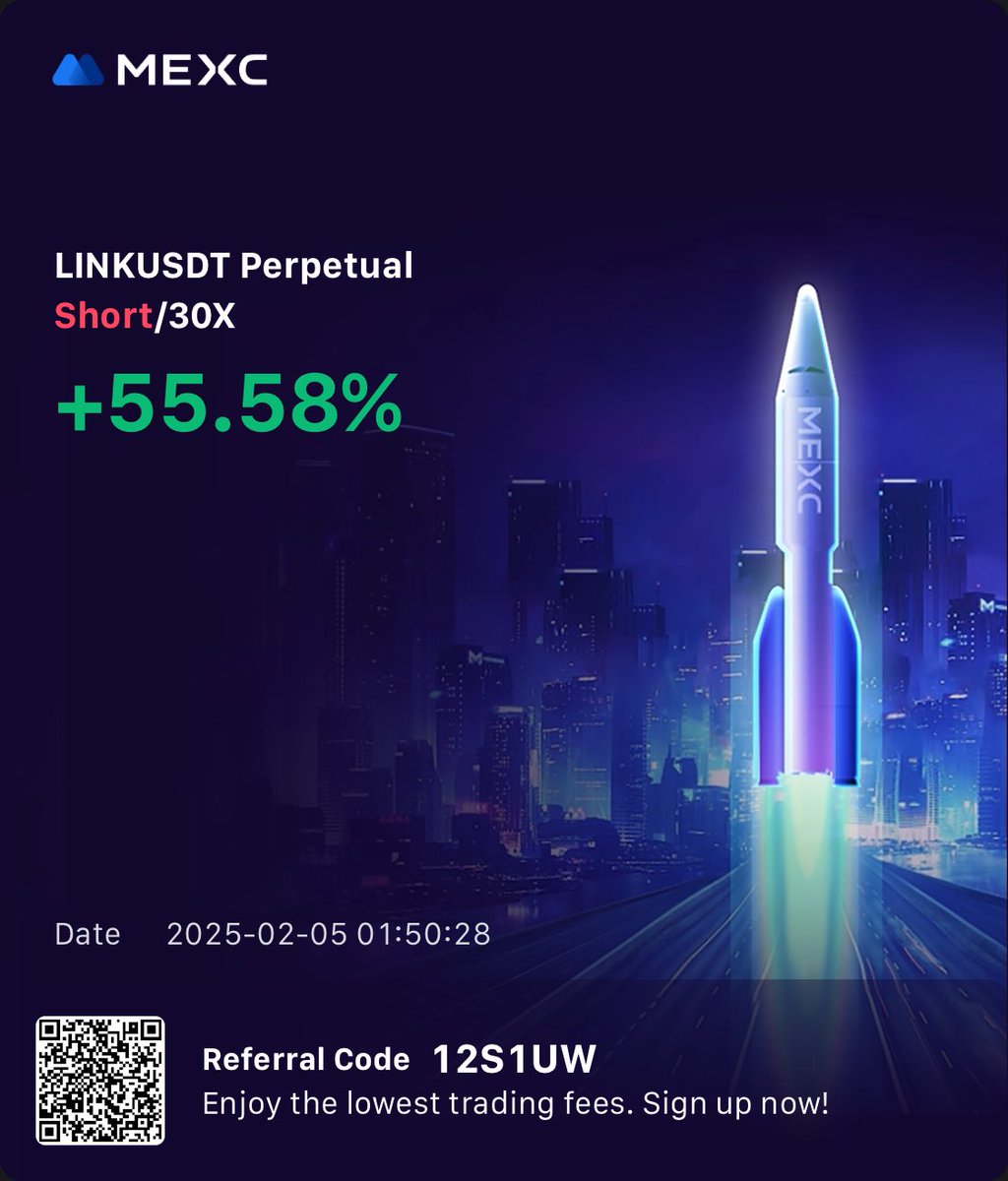
🚨 Just dropped a $LINK scalp call and whoever took it is in profits! ✅📈
But forget that… 👀
👨🏻💻 FOLLOW ME & join my FREE Telegram for more calls! 🚀📲 t.me/ DwcME8vpJLJkZDI5
⚡️ Today’s stats:
✅ 3 calls
💰 2 in profit
⚖️ 1 break even
I don’t guarantee calls every day, but if you wanna learn how to read markets 📊, gain a different perspective 🧠, and keep growing as a trader 💼, join us 🤝🏼
📥 Join now, it’s FREE! Let’s level up together. 🚀🔥
#LINK #SOL #Daytrading #Scalping #Crypto #Signals #TradingTips #Trading #Charts #Levelup #Mindset #XRP #ETH #BTC #SUI #KAS #SRC20 $STAMP #TradingStrategies #BTC #BITCOIN #SRC20 $STAMP #SRC101 $KEVIN $UTXO $OLGA $SPAD $BITDN $SWP $STMAP $BOBO $VIVA $PXL $PAD $DRGN $PIZZA $KEVIN $DRGN $LUFFY $STUNK $PEPE $BRO $MIKE $QNT @MEXC_Official
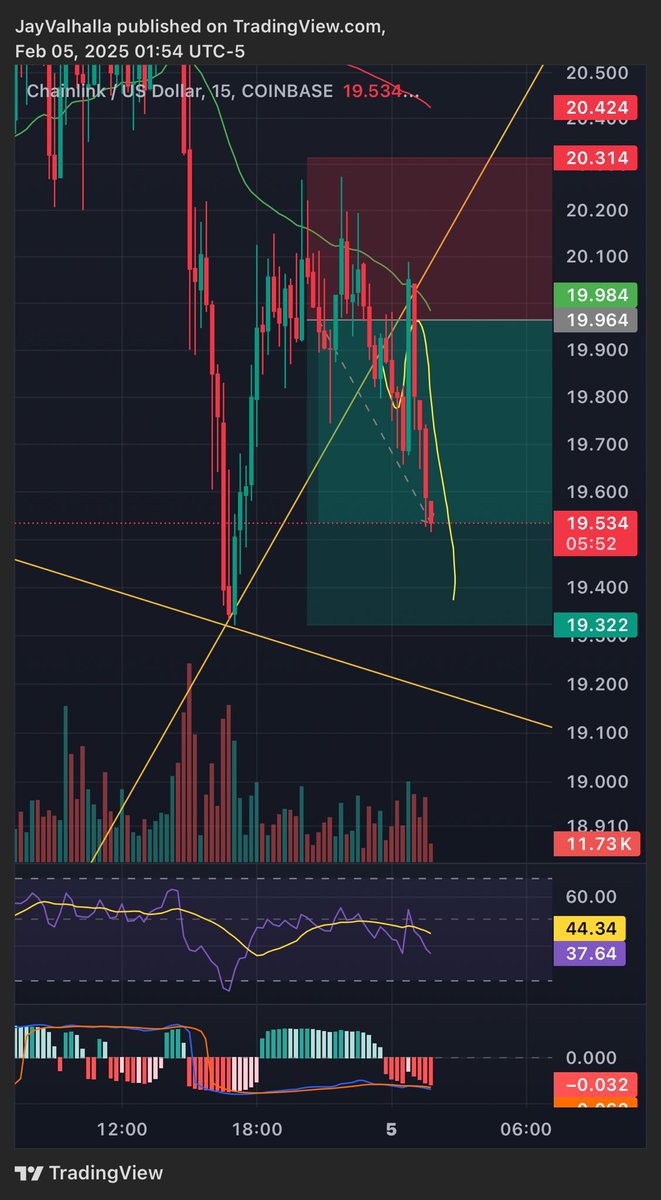
1
1
2
145
4 Feb 2025
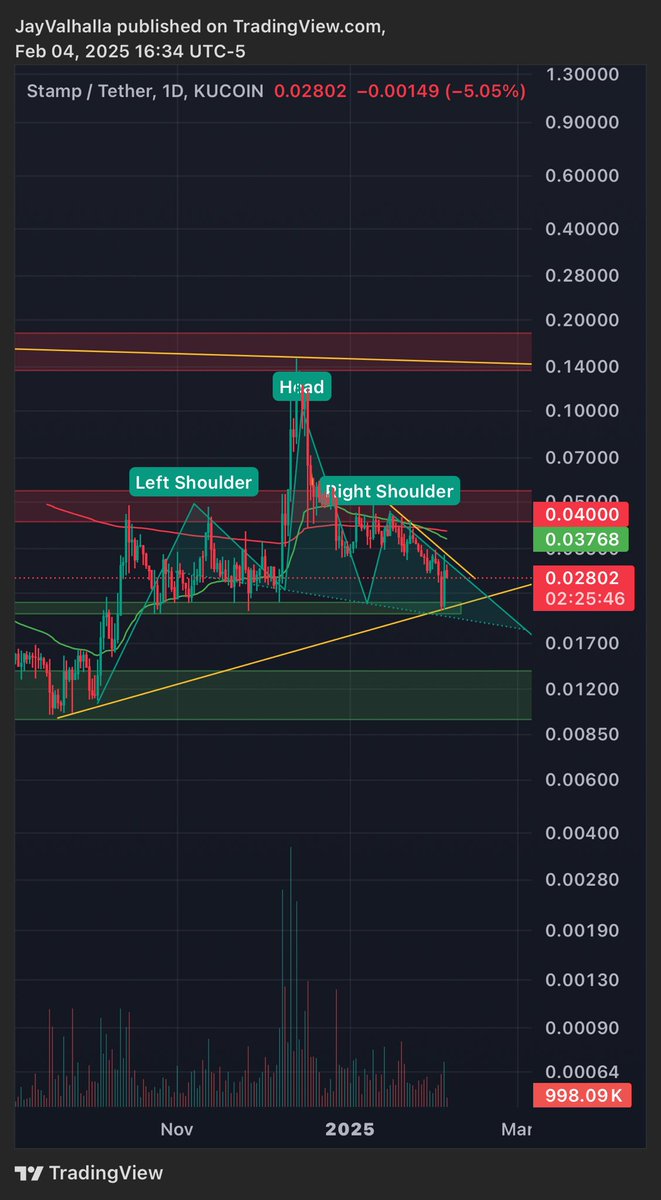
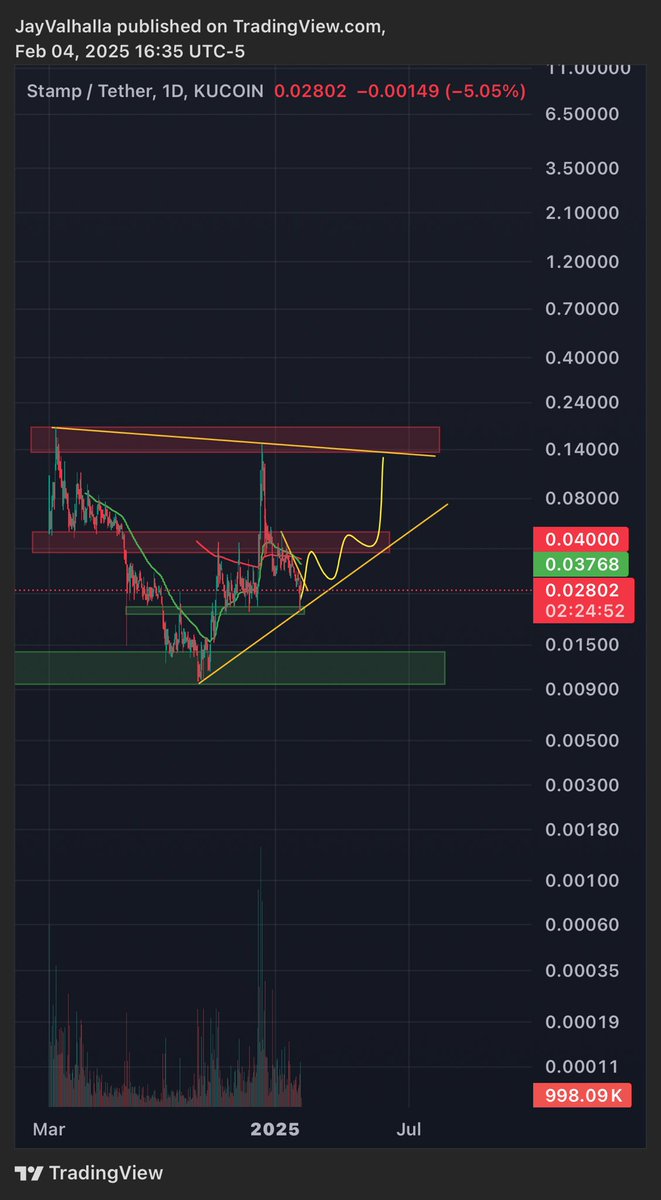
🚨 $STAMP Update 👨🏻💻📊
🗣️Alright my ppl, here’s the situation with $STAMP 👀
It’s either OR, no in between!
1️⃣ We’ve formed a potential Head & Shoulders, which could lead to more downside.
2️⃣ OR we’ll see a breakout and head back up.
That’s it. Either or.
You never really know in #crypto, so stay ALERT. 🔔
These are the two most probable scenarios I see, and yes, it could take time to play out. 50/50 right now.
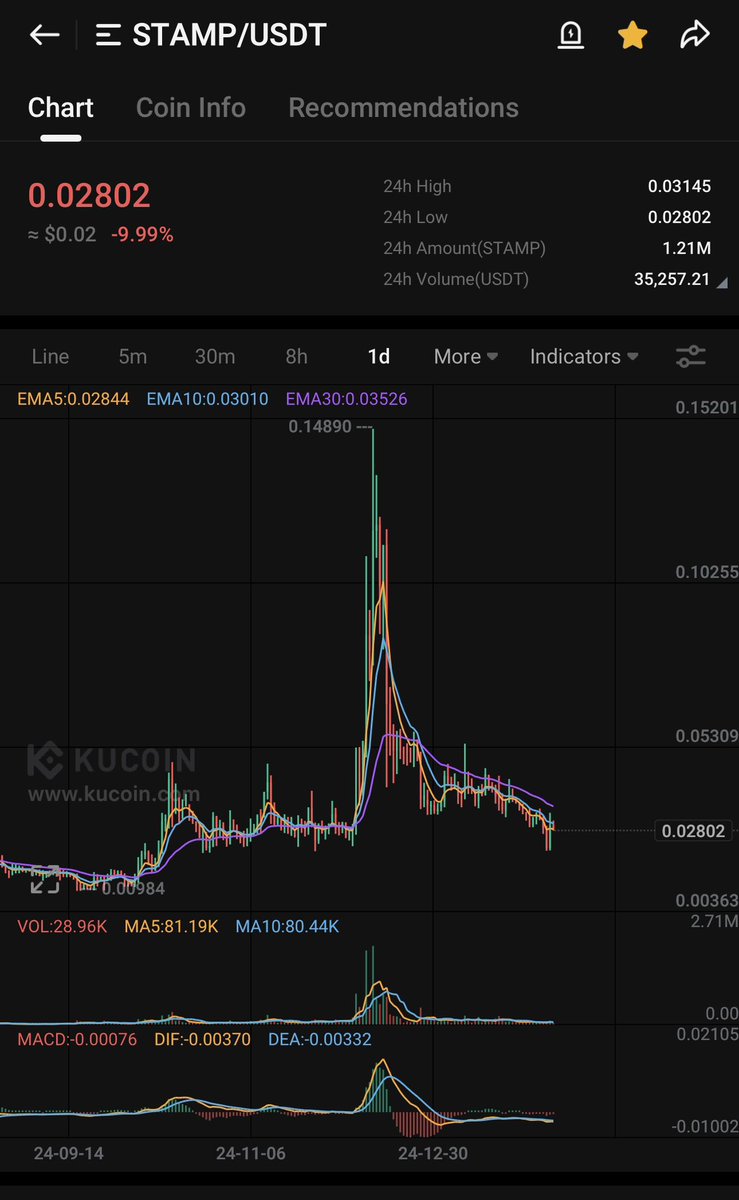
📊 MACD & Volume shows weak momentum, signaling indecision.
📊Trading volume is pretty low, meaning buyers/sellers aren’t fully committed yet.
💬 Join my Telegram (it’s FREE) to catch setups!
I’ve already shared plays for $SUI and $XRP, both currently in profit ✅
Also had an #ETH scalp two days ago, another win! 🚀
📲 t.me/ DwcME8vpJLJkZDI5
I don’t take trades every day. I wait for high probability setups.
More projects coming soon. Join the fam🤝🏼
#BTC #BITCOIN #SRC20 $STAMP #SRC101 $KEVIN $UTXO $OLGA $SPAD $BITDN $SWP $STMAP $BOBO $VIVA $PXL $PAD $DRGN $PIZZA $KEVIN $DRGN $LUFFY $STUNK $PEPE $BRO $MIKE $QNT @kucoincom @MEXC_Official @binance @cryptocom @coinbase @okx @gateio_web3 @SuperExet @UpholdInc @BingXOfficial @coingecko @coinbase @cz_binance @BinanceAcademy @BinanceUS @heyibinance @BitnameService
7
5
38
956
4 Feb 2025
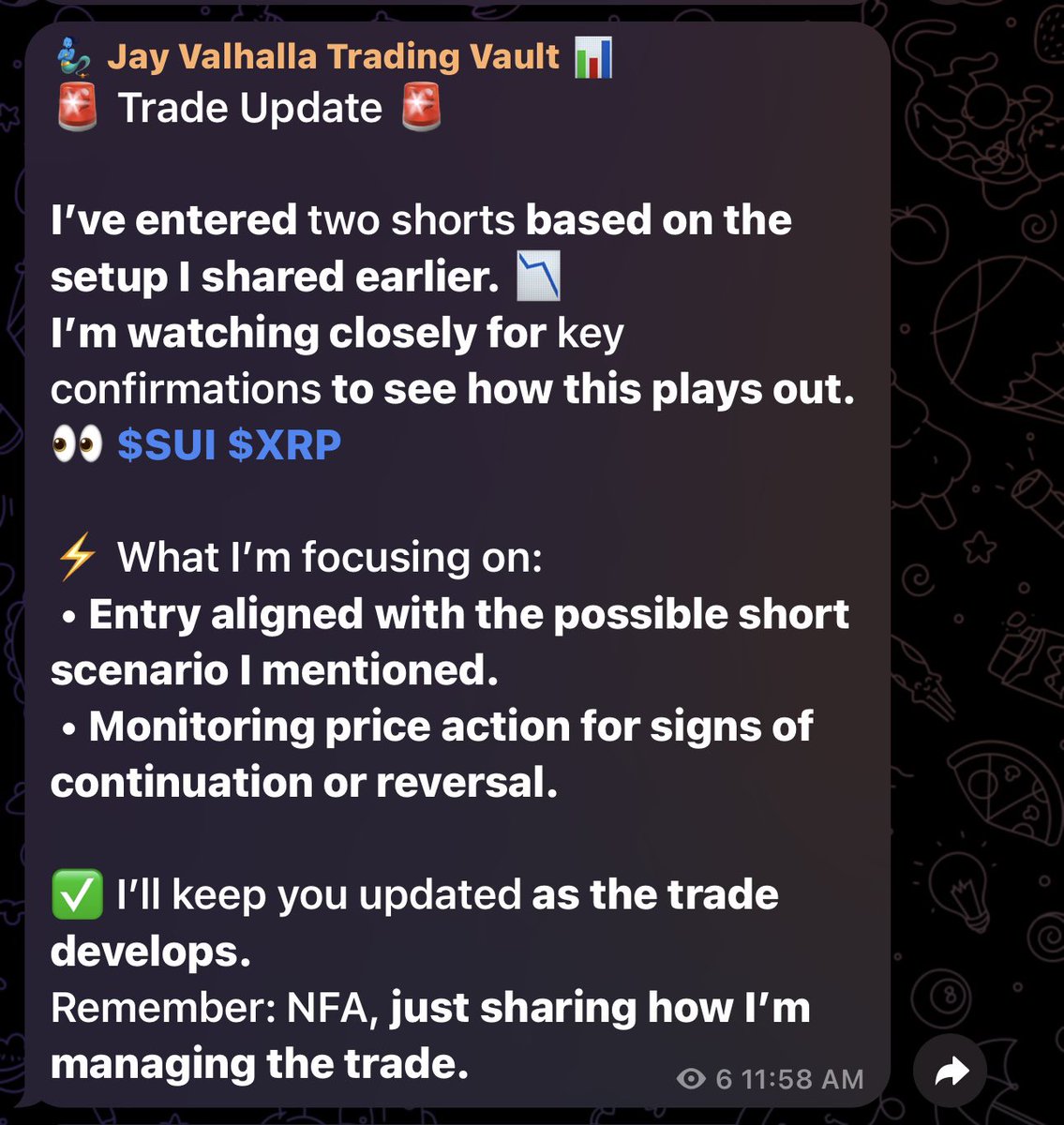
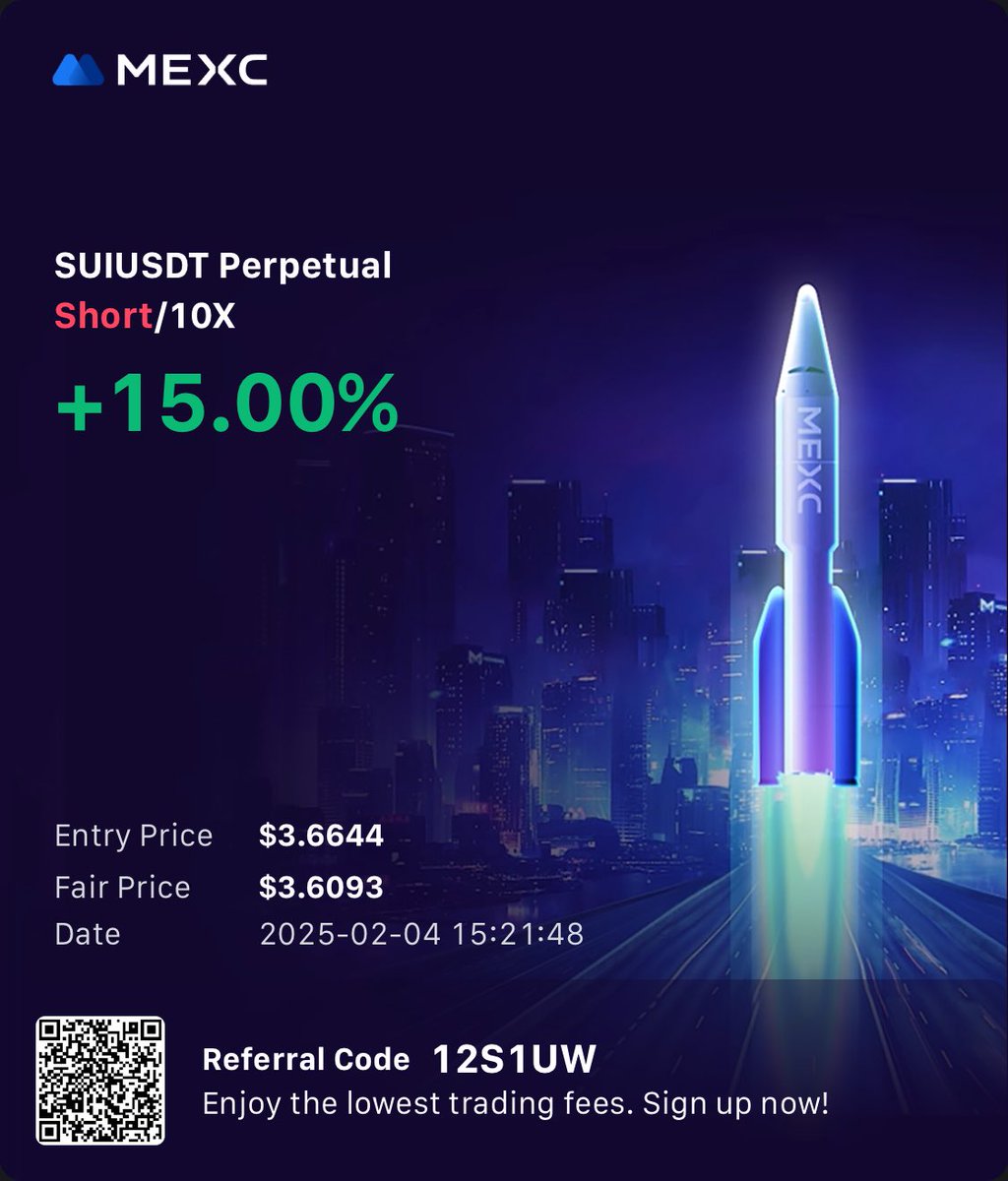
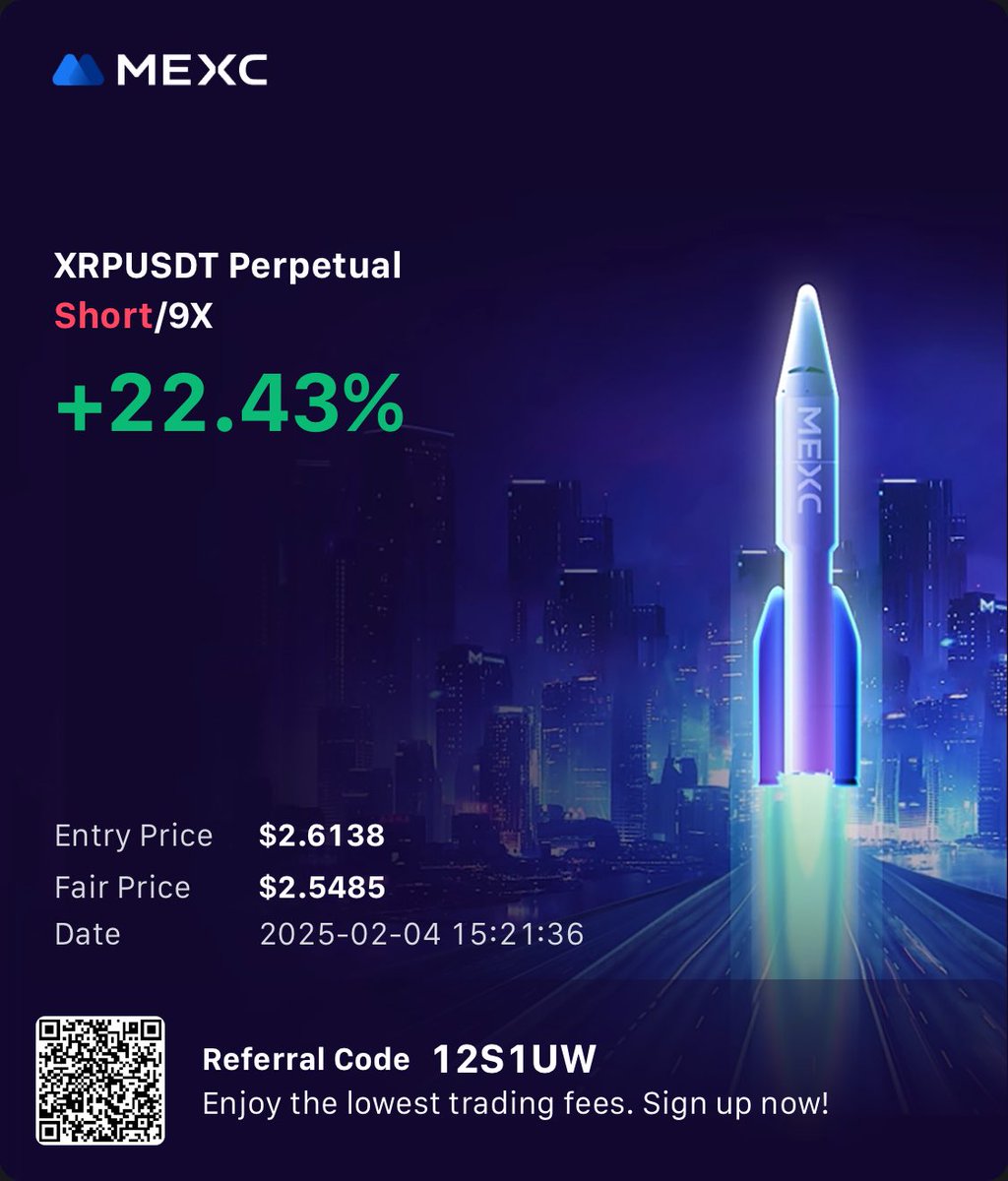
📊 The two trades I shared earlier are playing out so far ✅
If they continue, that’ll be 3 for 3 with recent setups.
t.me/ DwcME8vpJLJkZDI5
These aren’t guaranteed plays, just scenarios I’m taking myself. The market can flip anytime, but I’m being transparent win or lose.
Join my Telegram for more possible setups.
NFA just sharing my analysis. 🚀
#BTC #BITCOIN #SRC20 $STAMP #SRC101 $KEVIN $UTXO $OLGA $SPAD $BITDN $SWP $STMAP $BOBO $VIVA $PXL $PAD $DRGN $PIZZA $KEVIN $DRGN $LUFFY $STUNK $PEPE $BRO $MIKE $QNT @kucoincom @MEXC_Official @binance @cryptocom @coinbase @okx @gateio_web3 @SuperExet @UpholdInc @BingXOfficial @coingecko @coinbase @cz_binance @BinanceAcademy @BinanceUS @heyibinance @BitnameService $XRP $SUI
1
2
5
243
3 Feb 2025
🚀 STAMP Update 🚀
Guys, don’t forget to join my Telegram! 🚀 It’s completely free for more updates on different projects, trade ideas, and possible scenarios for various setups. 📊 link in bio 👇🏼
Tap in and stay updated! 📈
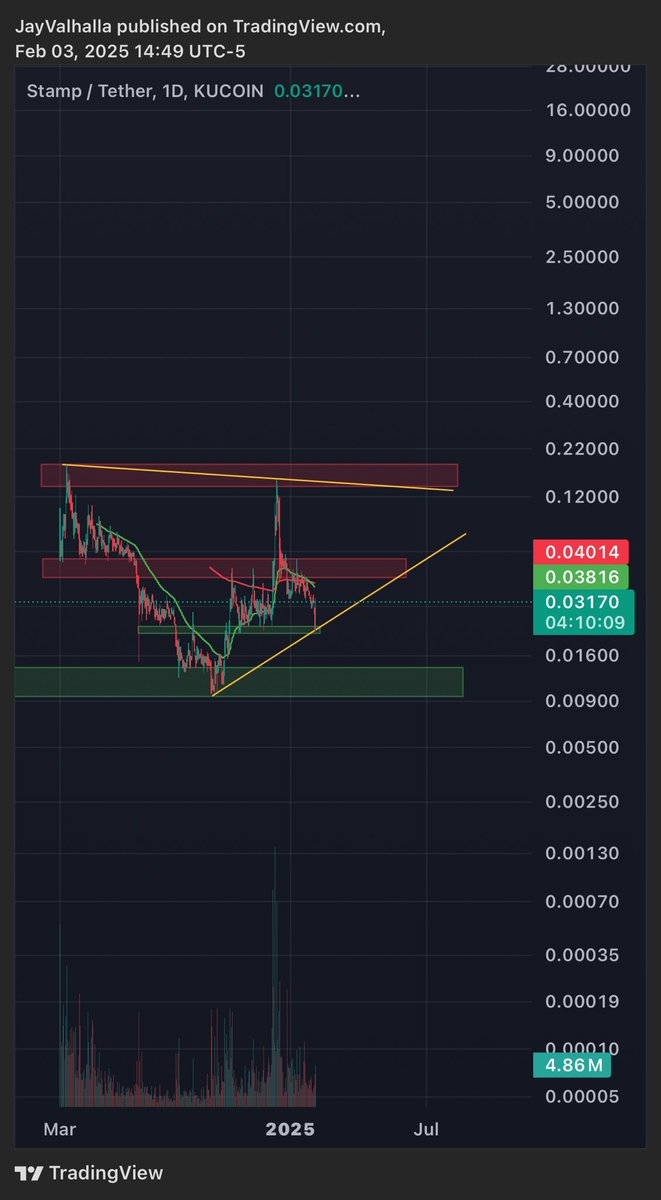
Right now, $STAMP is forming a bullish ascending triangle 🔺we’ve got higher lows consistently showing up on the higher timeframe, which is a good sign. 📈
If $STAMP is can break past the resistance around $0.05850 🚩 with solid momentum, the next key resistance sits around $0.13. That’s where we might see some reactions or pullbacks. ⚡
🗣️ The most important thing right now is to hold this trendline (yellow line). ⚠️ If we break below it, that’s when things could turn bearish, and we might retest the lower support zone again. We don’t want that. 🚫
For now, just keep an eye on how price reacts at this resistance. A clean breakout could lead to some solid moves. 📊
#BTC #BITCOIN #SRC20 $STAMP #SRC101 $KEVIN $UTXO $OLGA $SPAD $BITDN $SWP $STMAP $BOBO $VIVA $PXL $PAD $DRGN $PIZZA $KEVIN $DRGN $LUFFY $STUNK $PEPE $BRO $MIKE $QNT @kucoincom @MEXC_Official @binance @cryptocom @coinbase @okx @gateio_web3 @SuperExet @UpholdInc @BingXOfficial @coingecko @coinbase @cz_binance @BinanceAcademy @BinanceUS @heyibinance @BitnameService
3
10
46
1,203
31 Jan 2025
$STAMP update 👀👨🏻💻
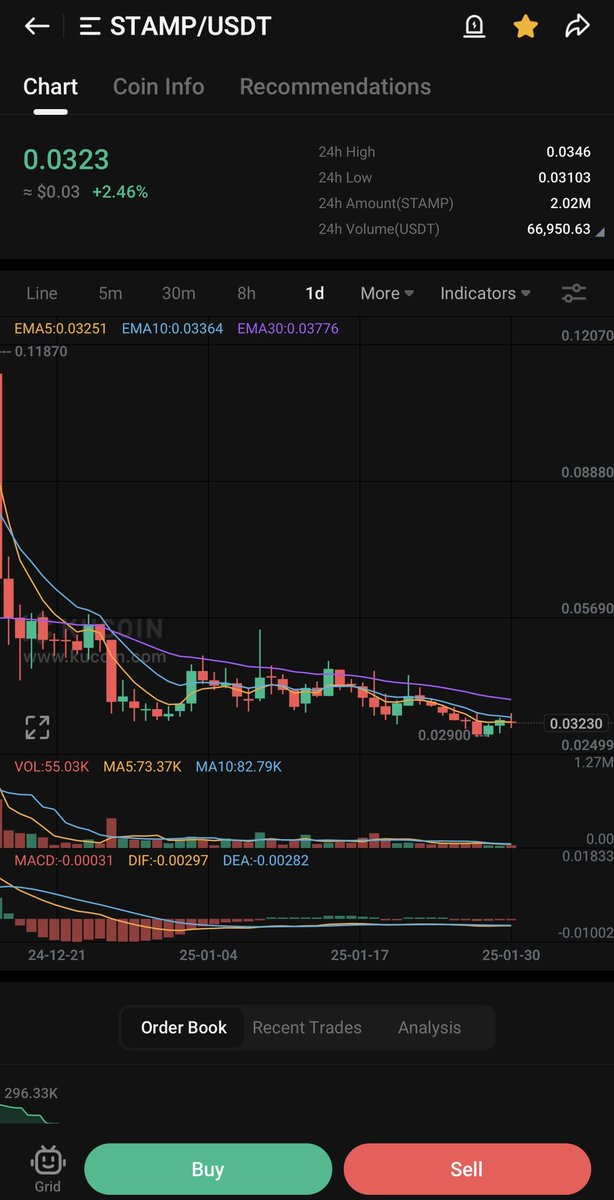
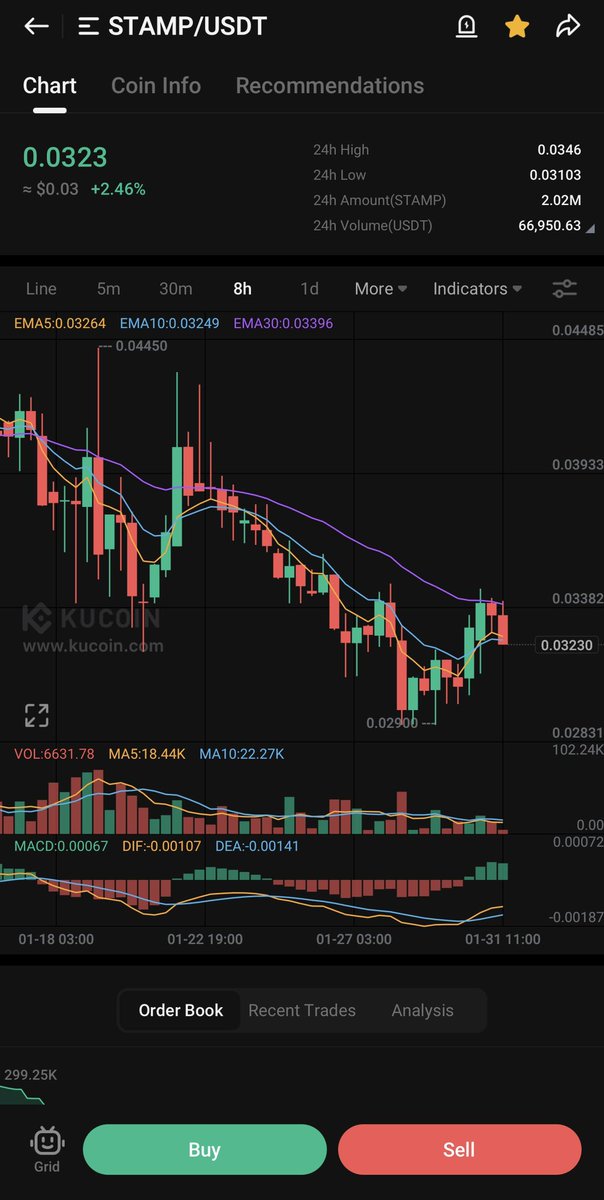
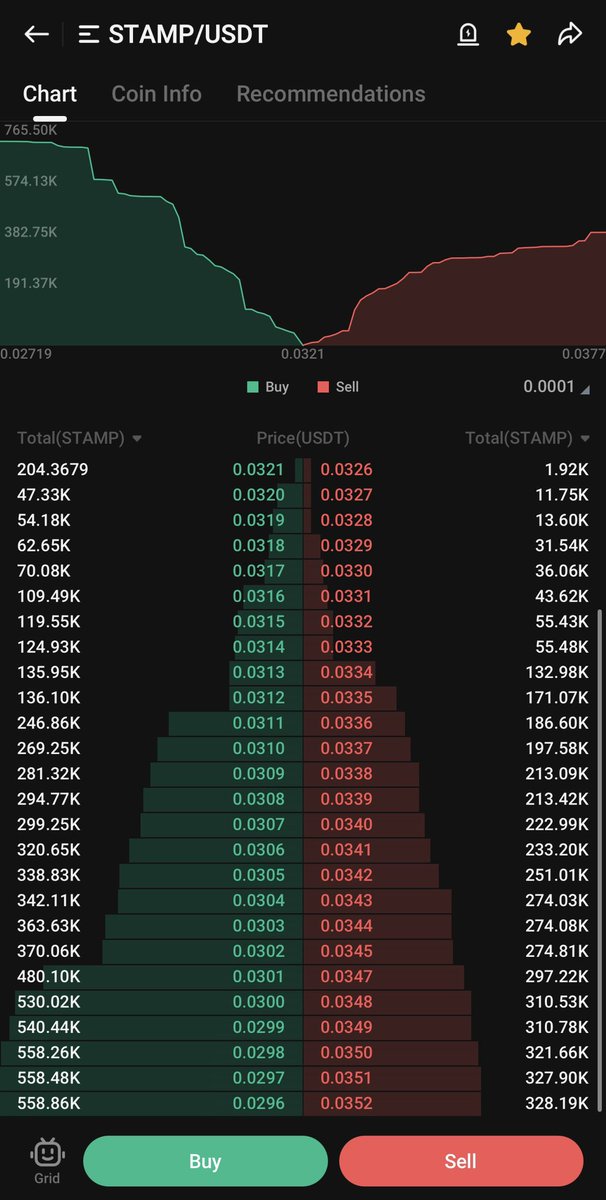
🗣️ I know I haven’t been updating on $STAMP as much lately, and there’s a reason for that 🤔. I’ve noticed that interest has cooled off a bit 😴, and honestly, sometimes I take my time to break things down, but I don’t always see much engagement back, so I figured I’d step back for a little bit. But don’t get me wrong, I’m still bullish on $STAMP 🦾This is a Dust 💨 or Valhalla🧞♂️play for me , and I ain’t changing my conviction 💯
📊 $STAMP trading volume📊 is pretty low 📉, at around 66K in 24H volume. That’s not the greatest, but keep in mind that interest across most #BTC native assets is down rn. Just look at #Runes, #Runestone are sitting at $300, which is crazy low compared to their peak 📉. It’s not just $STAMP, it’s the whole #BTC ecosystems that’s are a down.
📊 Looking at the MACD, it’s still in negative territory, meaning momentum is weak right now 📉. I do see it flattening out, which means the selling pressure is losing steam 👀. If we get a crossover on the MACD in the next few days, we could see a small bounce 📈.
📓 The order book shows 📊 there’s a lot of buy walls building up between 0.029 - 0.031, which tells me people are looking to accumulate at these levels 👀. We’ve got some resistance around 0.033 - 0.035, meaning we’ll need some volume to break through that zone 📊.
$STAMP It’s still a low volume, speculative asset, so it’s really a waiting game ⏳.
🗣️I still believe in $STAMP, and I still think it has potential. I’ll drop updates every now and then, but for now, just know that $STAMP is still in my portfolio, and I’m riding this thing to Valhalla 🧞♂️ or Dust 💨.
#BTC #BITCOIN #SRC20 $STAMP #SRC101 $KEVIN $UTXO $OLGA $SPAD $BITDN $SWP $STMAP $BOBO $VIVA $PXL $PAD $DRGN $PIZZA $KEVIN $DRGN $LUFFY $STUNK $PEPE $BRO $MIKE $QNT @kucoincom @MEXC_Official @binance @cryptocom @coinbase @okx @gateio_web3 @SuperExet @UpholdInc @BingXOfficial @coingecko @coinbase @cz_binance @BinanceAcademy @BinanceUS @heyibinance @BitnameService
9
13
64
1,451
30 Jan 2025
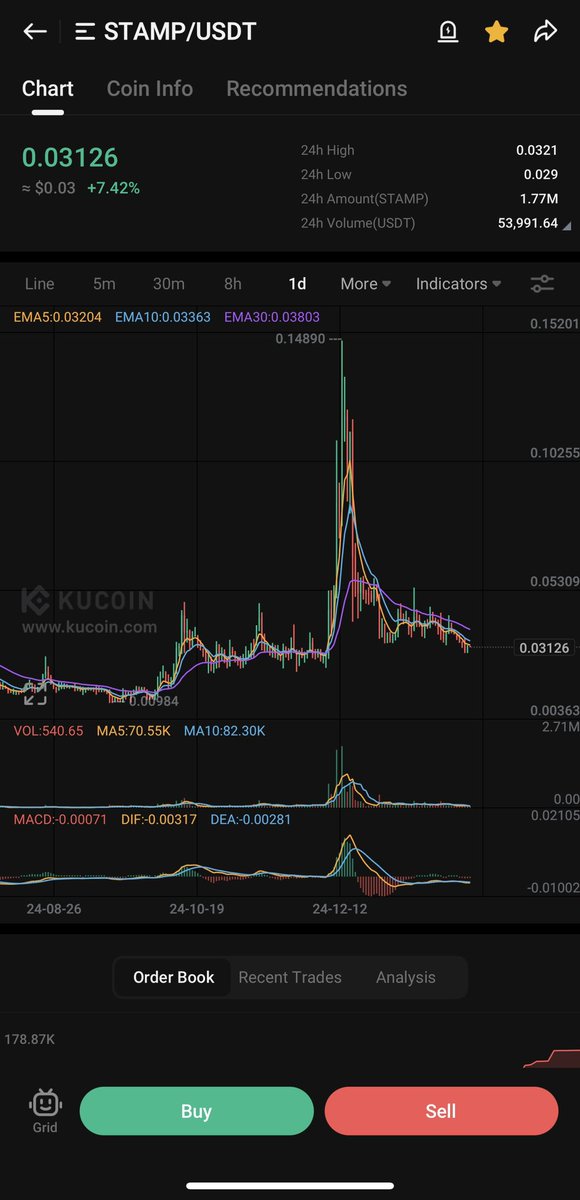
$STAMP UPDATE 👀📈📊
👀 $STAMP just like the entire market, stocks, crypto, everything, has been taking a hit. People hate uncertainty, and even though #jeromepowell wasn’t hawkish today, he leaned more dovish 🕊️. 👀 We’ve got GDP numbers and unemployment claims coming tomorrow, and that’s gonna be CRUCIAL 📊. If the numbers are strong, we might get some relief, maybe even a pump 🚀, but if they’re bad, the market could keep bleeding 🩸. #Crypto follows macro, so everything’s in wait and see for now.
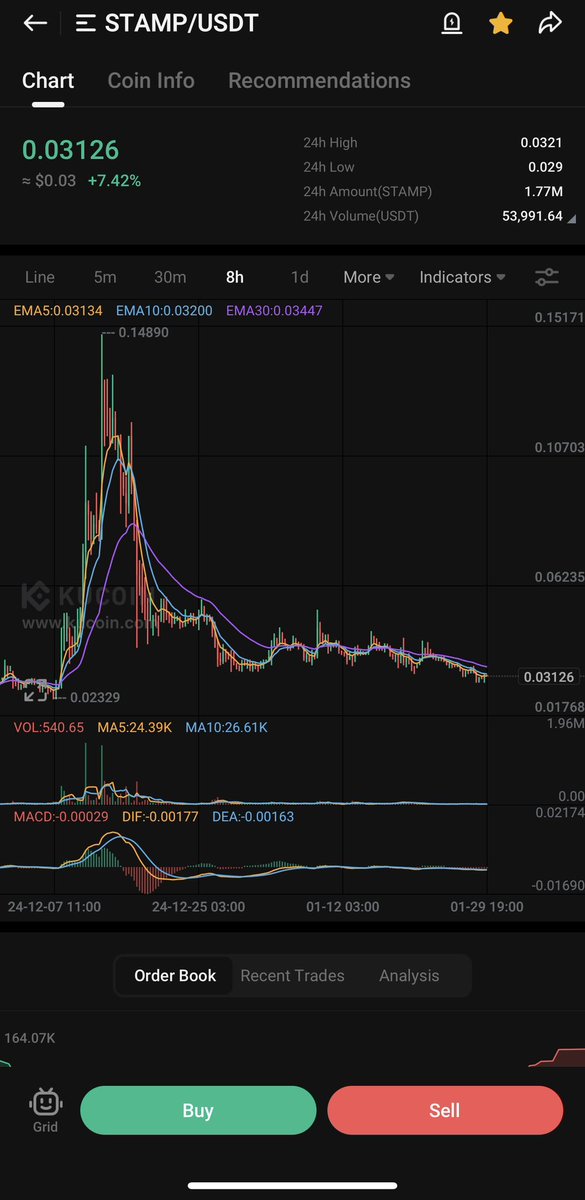
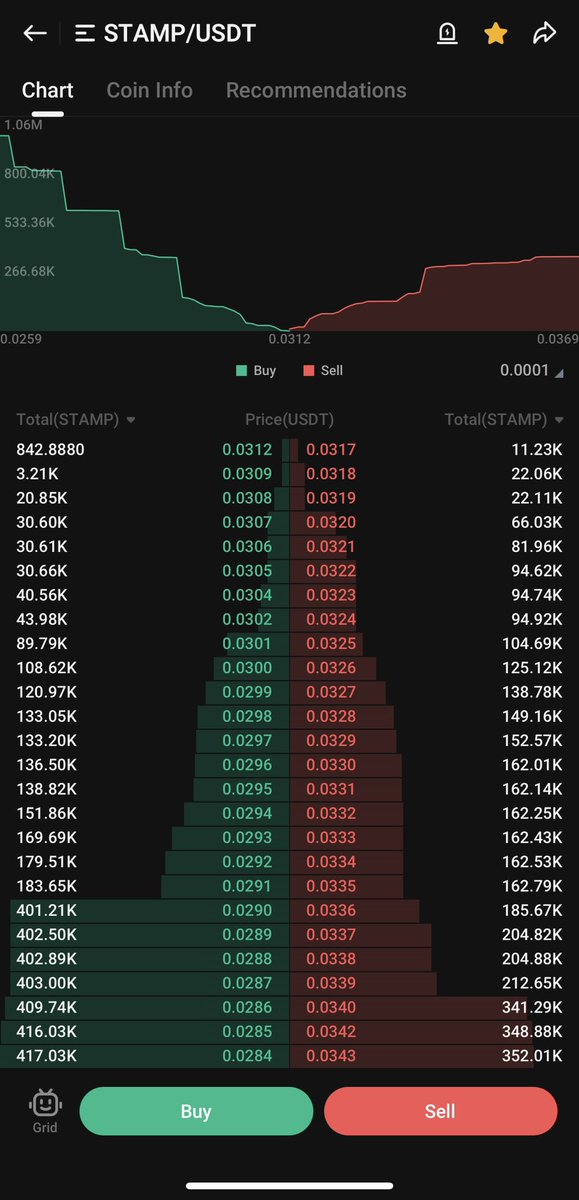
💭 $STAMP has been moving slow 🐌. It’s lagging behind a bit, and we’re not seeing the same enthusiasm that we see in some of the other plays. The trading volume is low AF rn 📉, sitting around 53K in 24H volume, which means there’s just not enough buyers atm 📊. This low volume makes it easy for whales 🐋 to manipulate price action. Still I’m not worried. It’s #Vahalla OR DUST for me🧞♂️💀 . No more accumulating, just holding and watching. 👀
📊 MACD is bearish 🐻rn, and there’s no buying pressure stepping in. The signal line is still below the MACD line, meaning momentum is weak 📉, and we’re still not seeing any confirmation of a reversal 🔄. EMA levels aren’t looking great either. Price is still sitting under the EMA 30, which tells me we’re still in a downtrend📉, without some kind of strong push, we’re not flipping bullish 🐂 anytime soon. If we can break above that level, we might see some momentum, but right now, everything still looks weak.
🤔 $STAMP remains needing a catalyst. Or possibly maybe more adoption. Tomorrow’s #GDP and unemployment numbers will tell us a lot about where things might head next🤷🏻♂️, and if macro gives us some relief, we could see a decent move. 👀
#BTC #BITCOIN #SRC20 $STAMP #SRC101 $KEVIN $UTXO $OLGA $SPAD $BITDN $SWP $STMAP $BOBO $VIVA $PXL $PAD $DRGN $PIZZA $KEVIN $DRGN $LUFFY $STUNK $PEPE $BRO $MIKE $QNT @kucoincom @MEXC_Official @binance @cryptocom @coinbase @okx @gateio_web3 @SuperExet @UpholdInc @BingXOfficial @coingecko @coinbase @cz_binance @BinanceAcademy @BinanceUS @heyibinance @BitnameService
2
3
14
684
28 Jan 2025
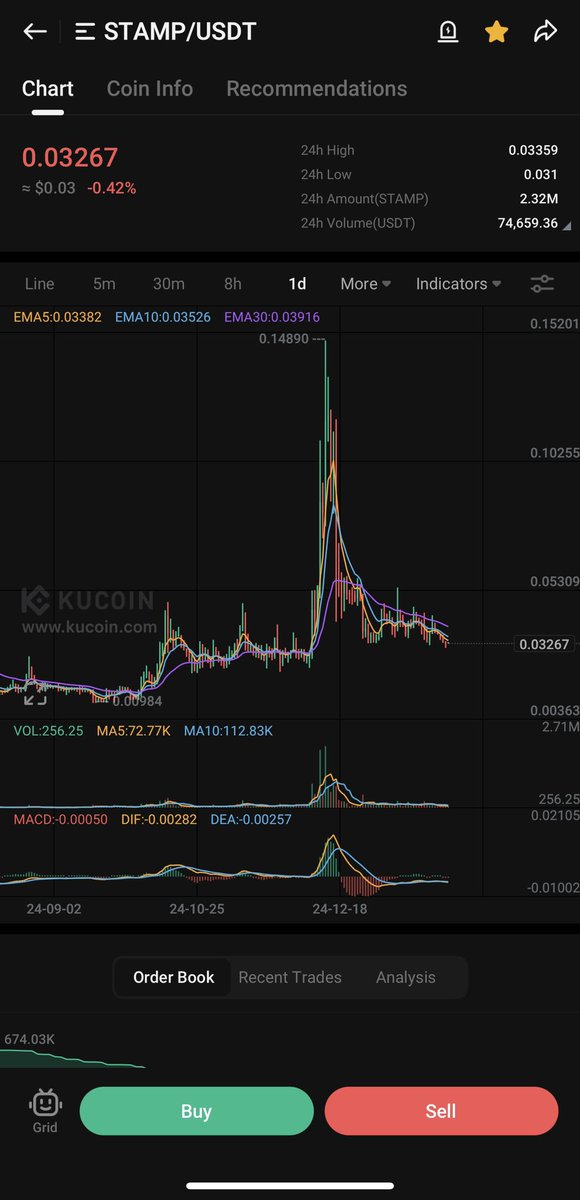
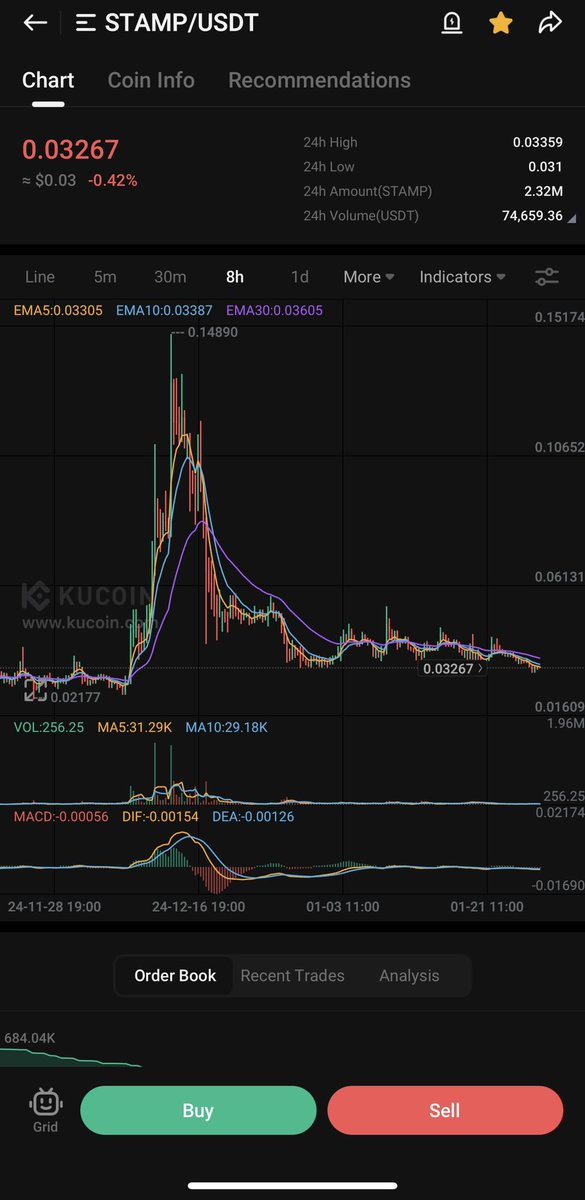
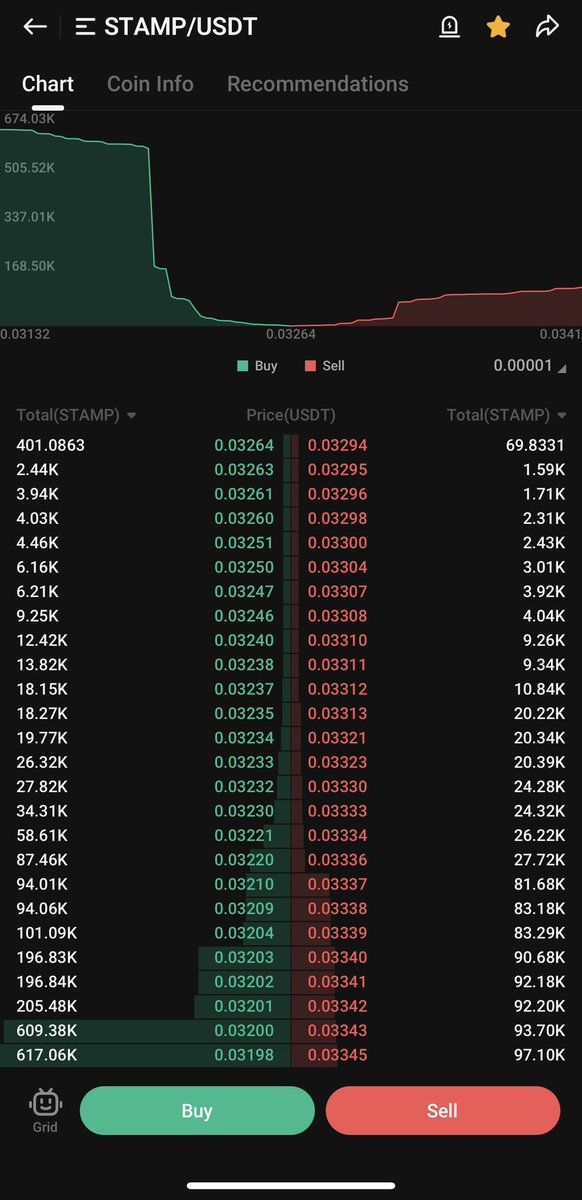
$STAMP Update 👨🏻💻
📊 $STAMP is clearly showing signs of losing interest from buyers, which also aligns with the broader decline in attention toward #BTC based ecosystems. 📉 $STAMP’s price is slowly trending downward, indicating a lack of momentum. It could still be interpreted as consolidation in some ways, the gradual decrease in price shows that sellers are slightly outpacing buyers. 🛑⬇️
📊 The MACD looks pretty weak right now. 📊 The MACD line is sitting below the signal line, and there’s no strong upward crossover in sight. 🚫📈 This tells us there’s indecision and honestly, it feels like theres no momentum. 😬💤 Without some serious movement, the MACD is giving bearish vibes. 🚩😕
The trading is low. 📉 Daily volume is sitting at 74K, which is barely enough to move the price atm. 🪫 This low volume is indicating buyers aren’t paying attention rn. 📉 When the volume dries up like this, it usually means there’s no big buying or selling pressure, leaving the $STAMP in a limbo. 💭 For $STAMP to really make a move, we need volume.
📊 $STAMP is in need of a massive catalyst to move the price. 📈 Without some catalyst news, like a listing, we might see more sideways movement. 🤔💡📉 If something big doesn’t happen soon, it’s likely to stay stuck in this range for a while longer. 🛑⏸️
📜🤔 The MACD is weak, the volume is low. Until a major announcement or some crazy catalyst hits, this remains a waiting game. ⏳🕒
#BTC #BITCOIN #SRC20 $STAMP #SRC101 $KEVIN $UTXO $OLGA $SPAD $BITDN $SWP $STMAP $BOBO $VIVA $PXL $PAD $DRGN $PIZZA $KEVIN $DRGN $LUFFY $STUNK $PEPE $BRO $MIKE $QNT @kucoincom @MEXC_Official @binance @cryptocom @coinbase @okx @gateio_web3 @SuperExet @UpholdInc @BingXOfficial @coingecko @coinbase @cz_binance @BinanceAcademy @BinanceUS @heyibinance @BitnameService
5
6
35
1,065
23 Jan 2025
💭 $STAMP Update 📊👨🏻💻
💡 Macro Bullish News 🐂 Let’s take a second to appreciate the crypto space today 🌎. $TRUMP 🇺🇸 has signed executive orders for crypto 🖊️. That’s HISTORY being made right in front of us! 📜 This is big, crypto is finally being recognized as part of the broader market.
📉 The market dumped earlier to grab liquidity but this is all part of the setup for the next leg up imo📈. Liquidity runs are just market makers shaking off the weak hands before another leg up.
👑 If you’re reading this, you’re already ahead! Whether you’re a blockchain tech 👨🏻💻 or just getting the basics down, you’re here, you’re aware, and you’re part of something massive 🫡 .
🗣️Shoutout to all the crypto heads on CT putting in the work, sharing alpha 🦾🤝🏼. We’re witnessing history, and it’s a blessing to be in this space 🙌🏼.
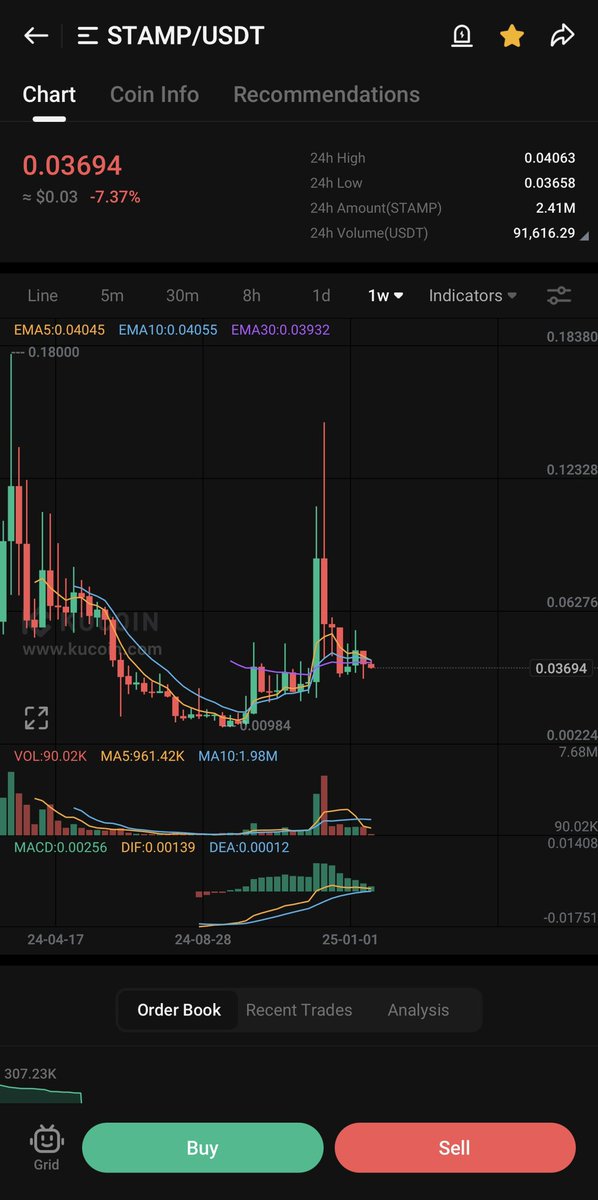
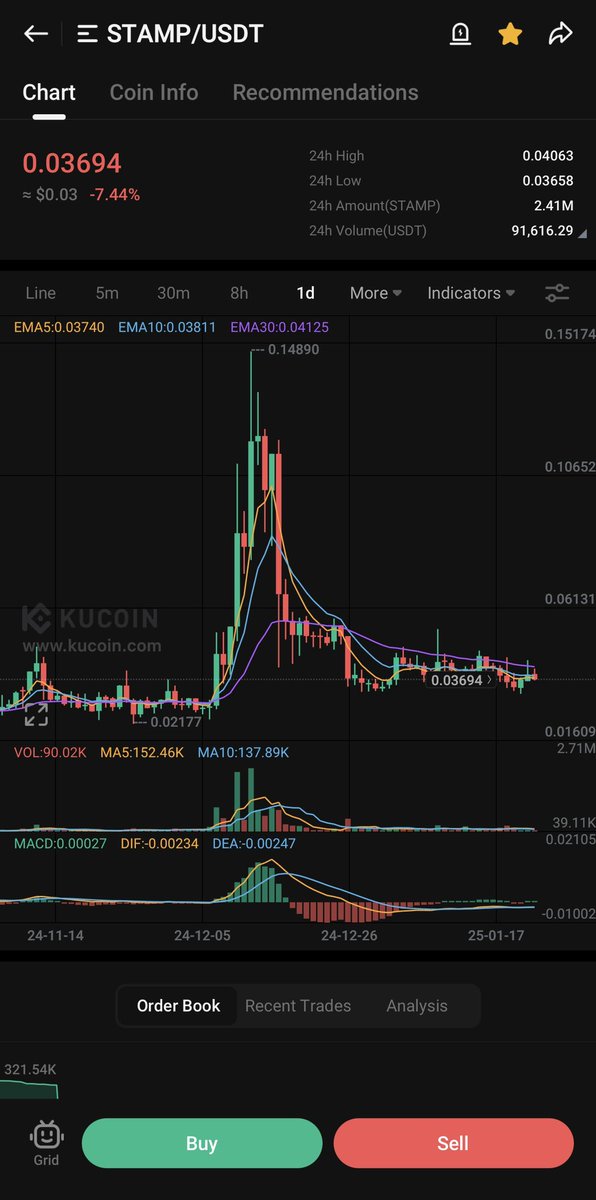
👨🏻💻 Now on to $STAMP.. $STAMP is currently 📈 trading at $0.03694.
🧐 The MACD is still flat. No bullish 🐂 crossover yet, but the bearish 🐻 sentiment has cooled off for $STAMP.
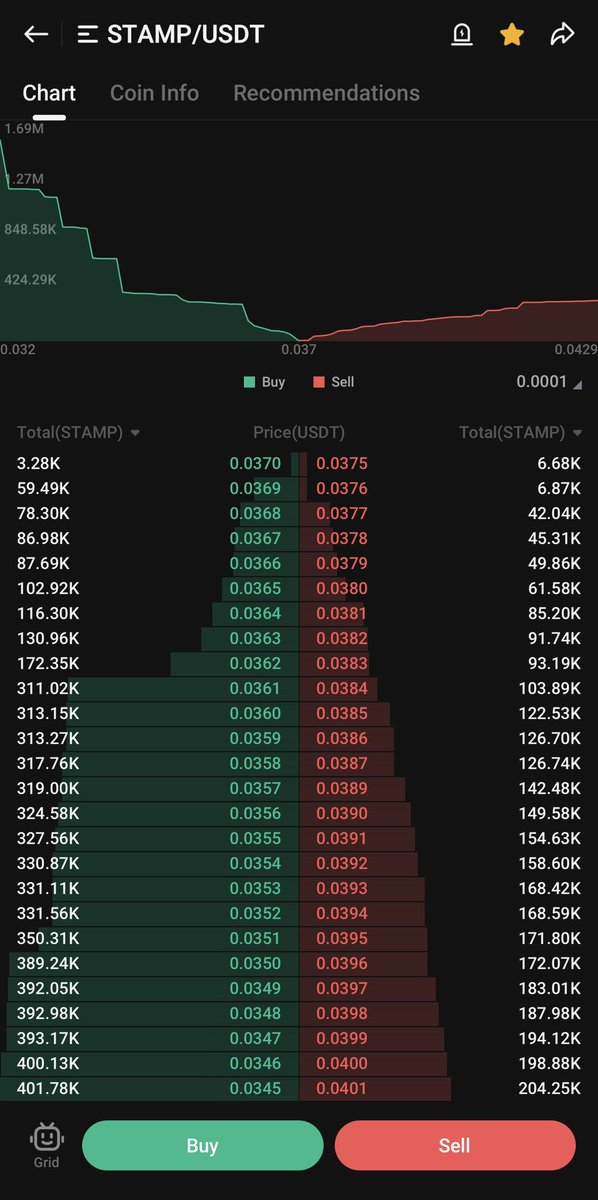
📊 Trading volume is at 91.6k in the last 24H. We still need a real surge in volume to break out of this range 🚀.
📈 The Order Book is showing decent buying 🟢 is trying to show up, holding support in the 0.035-0.037 zone. But there is noticeable sell walls 🧱 around 0.039-0.042 also 💥.
📉 The EMAs 5, 10, and 30 are all converging atm. This confirms $STAMP consolidation. We remain stuck in this range thus far until volume shows up😑. No breakout in sight yet, but the tighter it gets, the bigger the next move will be📈🔥🫶🏼🖼️
#BTC #BITCOIN #SRC20 $STAMP #SRC101 $KEVIN $UTXO $OLGA $SPAD $BITDN $SWP $STMAP $BOBO $VIVA $PXL $PAD $DRGN $PIZZA $KEVIN $DRGN $LUFFY $STUNK $PEPE $BRO $MIKE $QNT @kucoincom @MEXC_Official @binance @cryptocom @coinbase @okx @gateio_web3 @SuperExet @UpholdInc @BingXOfficial @coingecko @coinbase @cz_binance @BinanceAcademy @BinanceUS @heyibinance @BitnameService
1
3
40
991
22 Jan 2025
$STAMP Update 📊👀
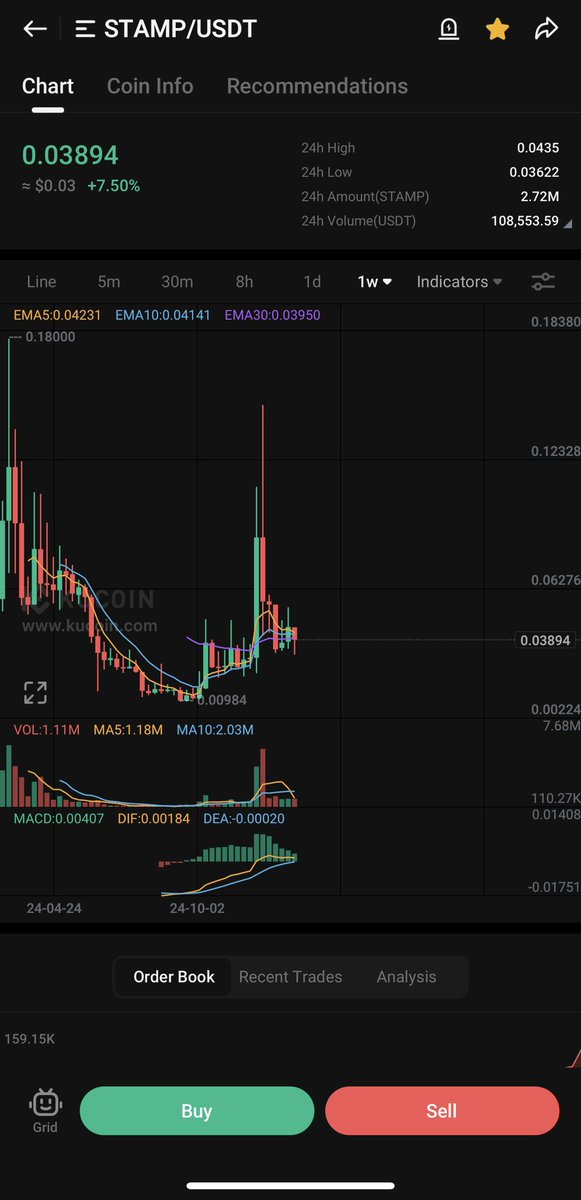
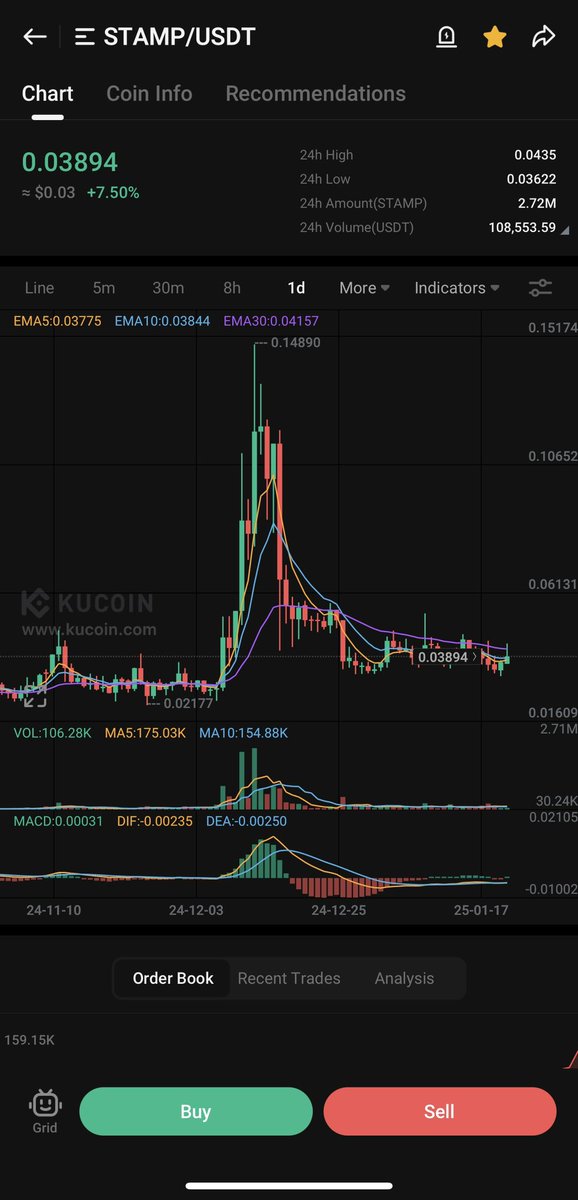
👀 $STAMP is currently trading at $0.03894, showing a 7.50% gain today📈
📈 The MACD is looking neutral rn. The lines are close, with no clear crossover yet 🤔. Momentum isn’t giving us a strong bullish 🐂 or bearish 🐻 signal, which means $STAMP could go either way from here.
📊 The 24H volume is sitting at 108k.
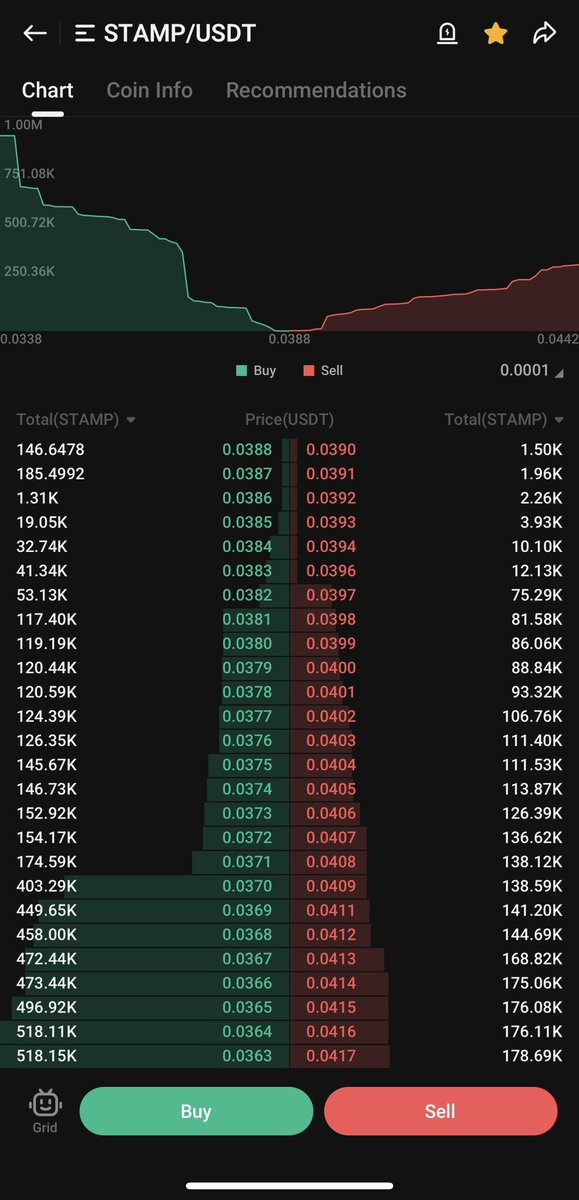
📓 The Order Book buy support is decent around 0.0385-0.0388 🟢, but there are noticeable sell walls 🚧 building up around the 0.039-0.041 levels. 📊 We’ll need more volume to break those sell walls 📊.
🔍 The EMAs 5, 10, and 30 are all flattening out. This shows a lack of momentum 📉. $STAMP is sitting in a tight range, with no decisive movement yet. 🕒.
📊 The chart is still showing consolidation, which is fine for now, but we really need to see buyers step in and push this out of the range 📈.
💭 On the bright side $STAMP and the SRC20 ecosystem are still doing their thing behind the scenes 🔥. 📈 $STAMP still has huge potential, but it needs a catalyst. Whether it’s a new listing 🏦, a major volume spike 💥, or some community driven event, we need something to reignite interest 🔥. This cycle has become highly competitive, and without hype it’s tough to keep up.
#BTC #BITCOIN #SRC20 $STAMP #SRC101 $KEVIN $UTXO $OLGA $SPAD $BITDN $SWP $STMAP $BOBO $VIVA $PXL $PAD $DRGN $PIZZA $KEVIN $DRGN $LUFFY $STUNK $PEPE $BRO $MIKE $QNT @kucoincom @MEXC_Official @binance @cryptocom @coinbase @okx @gateio_web3 @SuperExet @UpholdInc @BingXOfficial @coingecko @coinbase @cz_binance @BinanceAcademy @BinanceUS @heyibinance @BitnameService
4
8
43
916