
July 1, 2026 will separate crypto infrastructure from crypto improvisation.
MiCA does not kill the EU crypto market.
It professionalizes it.
Thousands of VASP registrations are turning into a much smaller CASP-regulated market. The winners will be the teams that can offer clear roles, compliant custody, auditability and institutional workflows.
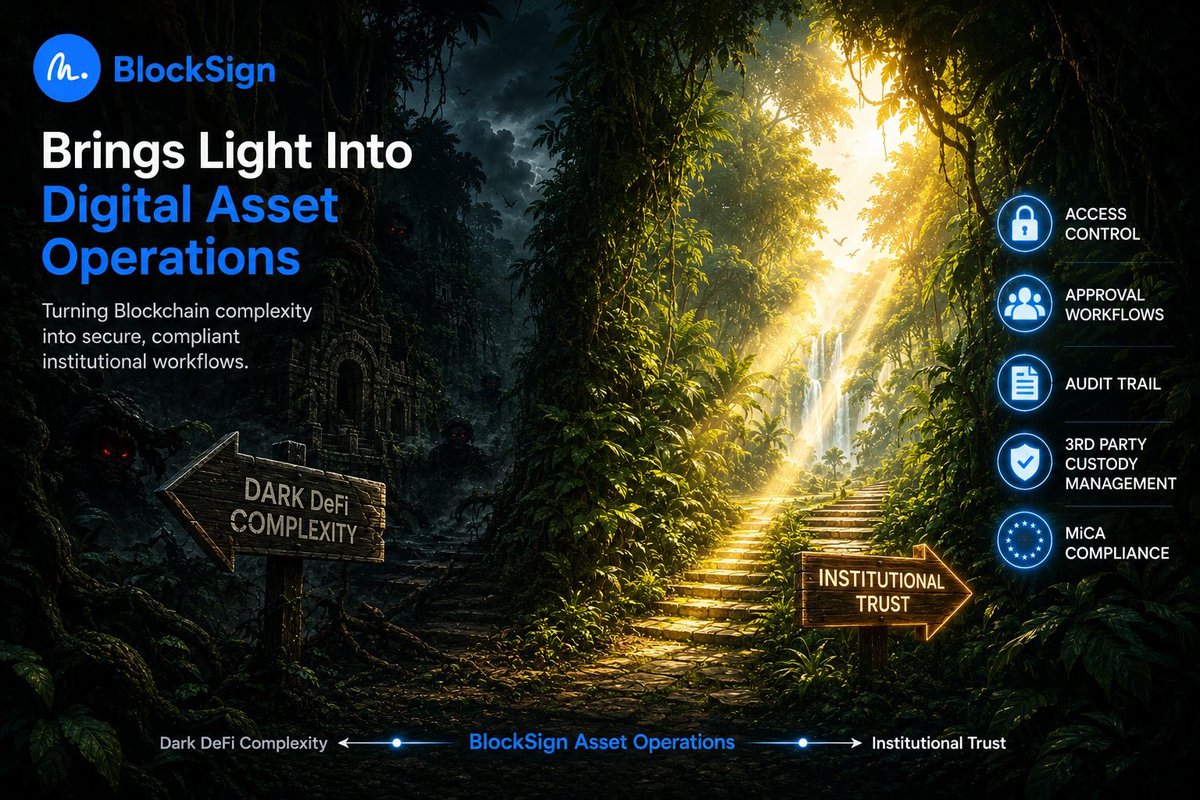
That is exactly why BlockSign prepared early. With BlockSign Asset Operations, institutions can manage digital assets with role-based access, approval policies, transaction controls and evidence-grade audit trails.
And through our partnership with @nbxcom, regulated custody can be separated from the operating platform, giving clients a cleaner structure for MiCA-era digital asset operations.
The future is not “one platform does everything.”
The future is clear separation:
- Operations.
- Custody.
- Compliance.
- Auditability.
BlockSign is ready for MiCA-regulated customers.
2
5
850

Jun 10
Hello James, today, there is, to our knowledge, only one institutional-grade asset operations platform that enables access to Cardano DeFi: BlockSign Asset, built by @BlockSign_io in cooperation with @nbxcom and @Swisscom Trust Services.
I know it is not always fashionable to look at Cardano community-built products first, but we have been building something very special here. Just interview Stig or let us invite you to present the platform.
I‘m supporting $USDM, just sayin‘ 💪
1
7
136
Exactly. A compromised laptop should never be enough to compromise institutional digital asset operations.
Multisig is only one part of the security model. The real question is how the whole operational framework is designed: separation of duties, role-based access, policy-based approvals, transaction limits, audit trails, secure signing architecture, and, where required, independent custody separation.
For institutions, the goal is not only to hold keys securely. The goal is to make every critical action controlled, approved, documented, and independently verifiable.
Side note: In ISO 27001 certified companies, IT security is not an add-on. It is part of the core operating model, from access management and incident response to risk controls, documentation, and continuous improvement (BlockSign GmbH is ISO 27001 certified).
That is the layer BlockSign Asset focuses on: turning digital asset operations from key-based execution into governed, auditable, institutional workflows.
15
Agree, the protocol design is usually not the only problem.
The real risk often sits in the operational layer: who controls the admin keys, how they are stored, who can approve upgrades, and whether the signers are truly independent.
A multisig operated by the same team, on the same devices, with weak processes, can easily become security theatre.
Decentralized governance, timelocks, bug bounties and multisig are all important layers. But for institutional digital asset operations, they need to be combined with enforceable operational controls: role-based access, policy-based approvals, transaction limits, segregation of duties, audit trails, and independent custody or signing separation where required.
That is exactly the layer BlockSign Asset is focused on.
The goal is not to replace multisig or governance. The goal is to make the operational process around critical transactions much harder to compromise, and much easier to audit.
Security is not only about the smart contract. It is about the complete control framework around the people, keys, policies, approvals, and evidence.
1
7
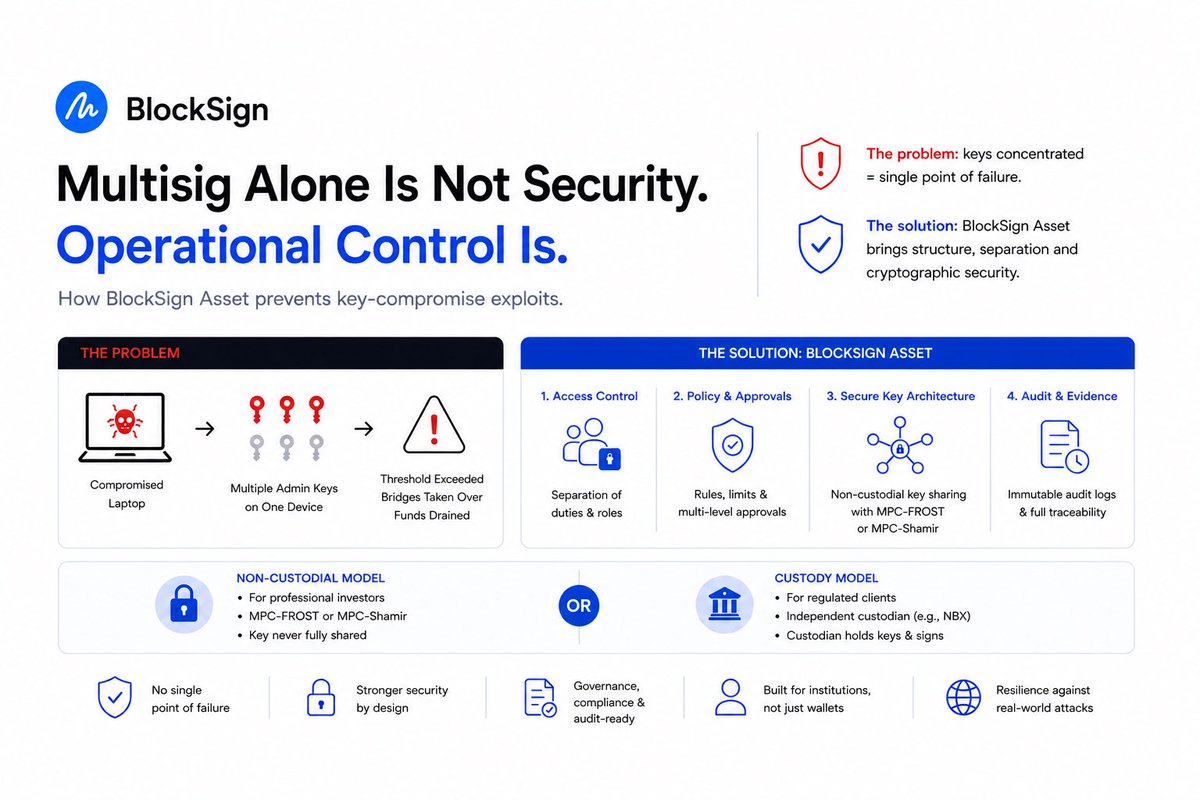
Multisig alone is not security.
The recent Humanity Protocol exploit is a painful reminder that a multisig wallet only works if the keys are truly separated.
If several admin keys are stored, backed up, or generated on the same laptop, the system may look decentralized on paper, but in practice, it becomes a single point of failure.
One compromised device can be enough to take over bridges, upgrade contracts, drain funds, or even mint new tokens.
This is exactly why institutions need more than wallets. They need operational control.
BlockSign Asset Operations is built to reduce this risk through role-based access, policy-based approvals, audit trails, secure key architecture, and clear separation between operations and custody.
For non-custodial professional clients, BlockSign Asset can support advanced key-sharing models such as MPC-FROST and MPC-Shamir, where the full private key is not casually stored or shared on one device.
For regulated clients, custody can be separated through an independent custodian such as @nbxcom, while BlockSign Asset provides the operational layer: approvals, limits, workflows, evidence, and auditability.
The lesson is simple:
Multisig is a tool. Operational governance is the security layer.
Digital asset operations must become institutional, auditable, and resilient before one compromised laptop becomes a multi-million-dollar disaster.
#DigitalAssets #CryptoSecurity
2
9
273
Why the Separation Between Platform and Custody Matters
Binance’s move into stock and ETF trading is an important signal for the future of financial platforms. Even one of the largest and most capitalized crypto exchanges in the world does not execute this model by holding all roles internally. Instead, Binance provides the user-facing platform experience, while regulated brokerage and custody functions are handled by specialized third parties.
This separation is not a weakness. It is a sign of institutional maturity.
Financial markets are moving toward integrated platforms where users can access crypto assets, stablecoins, stocks, ETFs, tokenized assets, and DeFi services from one interface. But the more powerful these platforms become, the more important it is to separate operational access from regulated custody. Institutions do not only need functionality. They need clear responsibility, legal certainty, auditability, and risk separation.
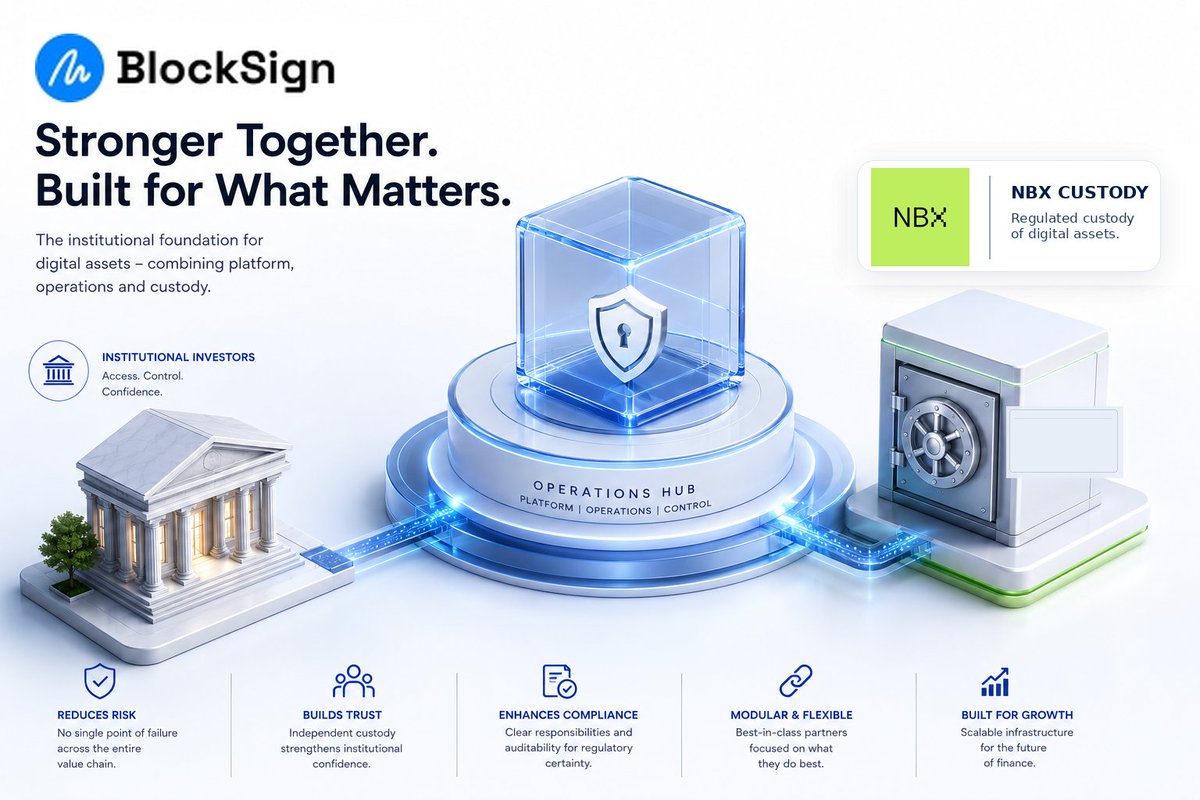
This is exactly the logic behind BlockSign Asset Operations.
BlockSign Asset Operations provides the institutional operating layer: approvals, role-based access, policies, transaction workflows, audit trails, evidence-grade documentation, and blockchain interaction. It allows institutions to work with digital assets and DeFi in a controlled, documented, and compliant way.
Custody, however, can remain with a regulated third-party provider such as Norwegian Block Exchange. This creates a cleaner institutional setup: BlockSign enables secure operations and workflow control, while NBX provides the custody layer where required.
The advantage of this model is clear.
⭐️ First, it reduces concentration risk. One provider does not need to control the entire chain of value: user interface, operational approvals, asset custody, execution, compliance, and reporting. Each party can focus on its strongest regulatory and technical role.
⭐️ Second, it improves institutional trust. Professional investors, funds, corporates, and regulated entities often prefer independent custody because it creates clearer governance and reduces conflicts of interest. The platform that initiates workflows is not necessarily the same party that holds the assets.
⭐️ Third, it supports regulatory clarity. In a MiCA-driven market, the question is no longer only which platform has the best user experience. The question is who is responsible for custody, who controls approvals, who documents decisions, who performs compliance checks, and who can prove the full transaction history.
⭐️ Fourth, it makes blockchain infrastructure more usable for institutions. Institutions want access to stablecoins, tokenized assets, DeFi, and digital securities, but they need this access through controlled operating environments.
The future is not just self-custody or pure exchange custody. The future is modular financial infrastructure.
Binance’s stock trading model shows the direction of travel: large platforms are becoming financial super apps, but even super apps rely on specialized partners for regulated custody and execution.
For BlockSign Asset Operations, this confirms the strategic partnership with @nbxcom as our custody partner.
The winning institutional platforms will not be those that try to do everything alone. They will be those that connect blockchain access, compliance, workflows, documentation, and third-party custody into one trusted operating environment.
That is where the next generation of institutional digital asset infrastructure will be built.
2
6
200
Jun 3
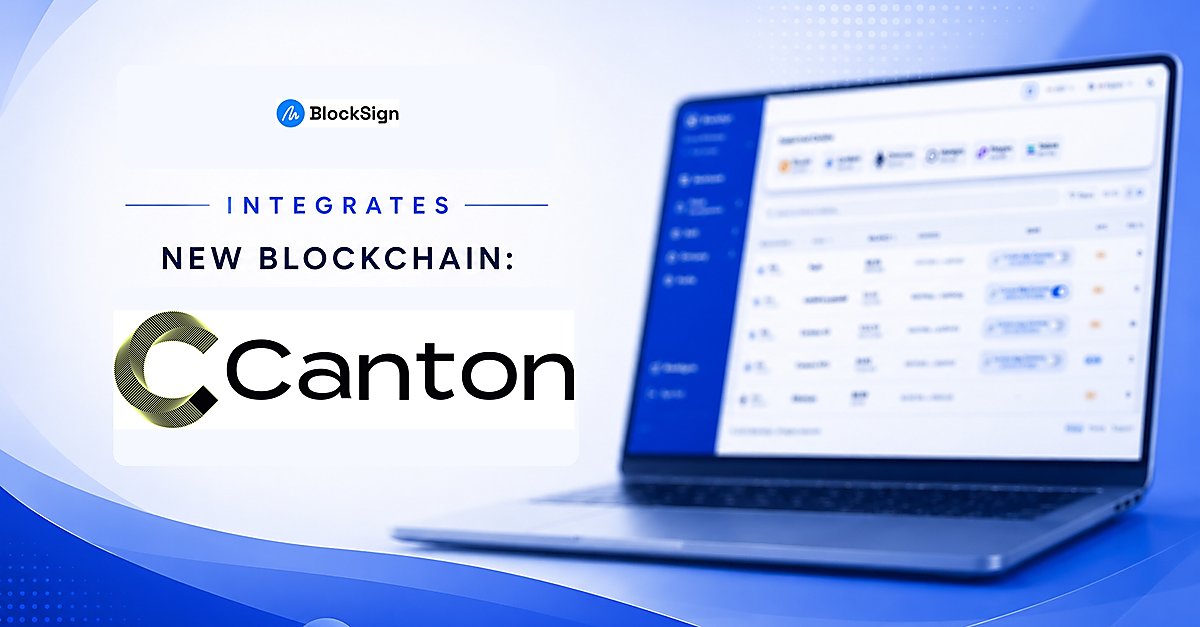
Blockchain integration Number #7 is done:
@CantonNetwork - $CC
A look at what’s coming from BlockSign:
→ Two more chain integrations landing this month
→ Signature module in final development, our hardest USP, built under @Catalyst_onX
→ One new IRL e-signature customer onboarding soon
→ Verify is live, growing, and being shaped by real users
→ lots of new LinkedIn articles are online

We are proud to announce that BlockSign integrates
Canton Network.
Banking is moving on-chain. But institutions don’t just need blockchain rails. They need trust.
BlockSign brings identity, compliance, authorization and legally enforceable validation into institutional blockchain workflows.
The future of finance needs more than infrastructure.
It needs a Trust Layer.
#BlockSign #CantonNetwork #InstitutionalFinance #DigitalAssets #TrustLayer
10
518
We are proud to announce that BlockSign integrates
Canton Network.
Banking is moving on-chain. But institutions don’t just need blockchain rails. They need trust.
BlockSign brings identity, compliance, authorization and legally enforceable validation into institutional blockchain workflows.
The future of finance needs more than infrastructure.
It needs a Trust Layer.
#BlockSign #CantonNetwork #InstitutionalFinance #DigitalAssets #TrustLayer
1
4
672
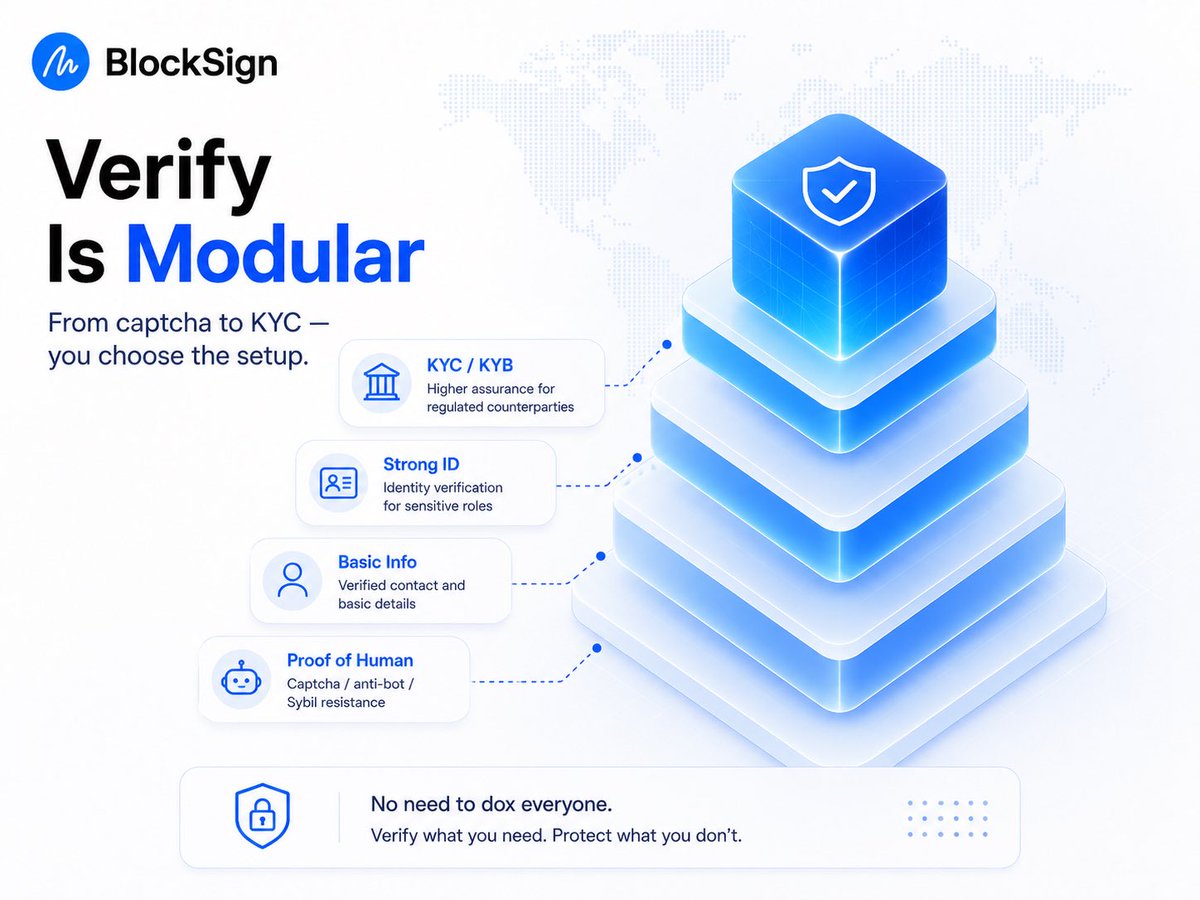
NO UNNECESSARY DOXXING!
BlockSign Verify is modular by design: from captcha-style anti-bot protection and Proof of Human to stronger identity checks, KYC, or KYB where required.
For light verification flows, data can stay within the browser session. For higher-assurance flows, only the required information is processed according to the chosen setup.
Verify what you need.
Protect what you don’t.
That is how digital organizations can build trust without sacrificing privacy.
2
5
354
The BlockSign Trust Tools:
1. BlockSign eSign – blocksign.io: BlockSign eSign provides legally reliable digital signature workflows, from simple electronic signatures up to advanced and qualified signature processes. The goal is to connect legal authorization with verifiable digital evidence and, where useful, blockchain-based proof.
2. BlockSign Asset Operations – asset.blocksign.io: BlockSign Asset Operations is our institutional platform for digital asset and DeFi operations, including role-based approvals, policy controls, audit trails, custody workflows, and Cardano-native smart contract execution. It is designed to make blockchain and DeFi operationally usable for companies, treasuries, custodians, RWAs, and regulated market participants. Custody is fully managed by our regulated custody partner @nbxcom.
3. BlockSign Verify – verify.blocksign.io: BlockSign Verify is our identity and verification layer, ranging from advanced bot protection to Proof of Human / Proof of Personhood concepts and lightweight KYC/KYB flows. We believe this could be highly relevant for your research around Proof of Personhood and identity primitives.
BlockSign Verify article for deep dive:
linkedin.com/posts/blocksign…
1
3
58
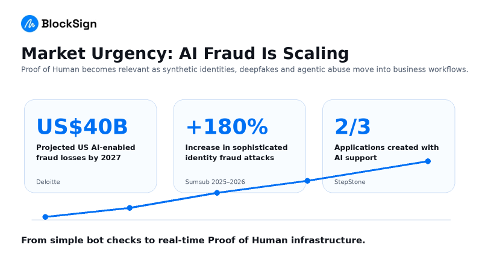
Proof of Human will become the next generation of digital firewall, as AI can now generate applications, identities, voices, videos and documents at scale.
That means digital platforms need a new trust signal:
Proof of Human.
BlockSign Verify helps platforms confirm that a real human is behind sensitive actions from HR applications and onboarding to eSignatures, approvals and financial transactions.
Privacy-first by design:
- No biometric database.
- No raw video storage.
- No unnecessary personal data transfer.
The user’s biometric data stays in the browser. The platform receives only a non-reversible proof of human presence.
More info 👇
1
1
4
85
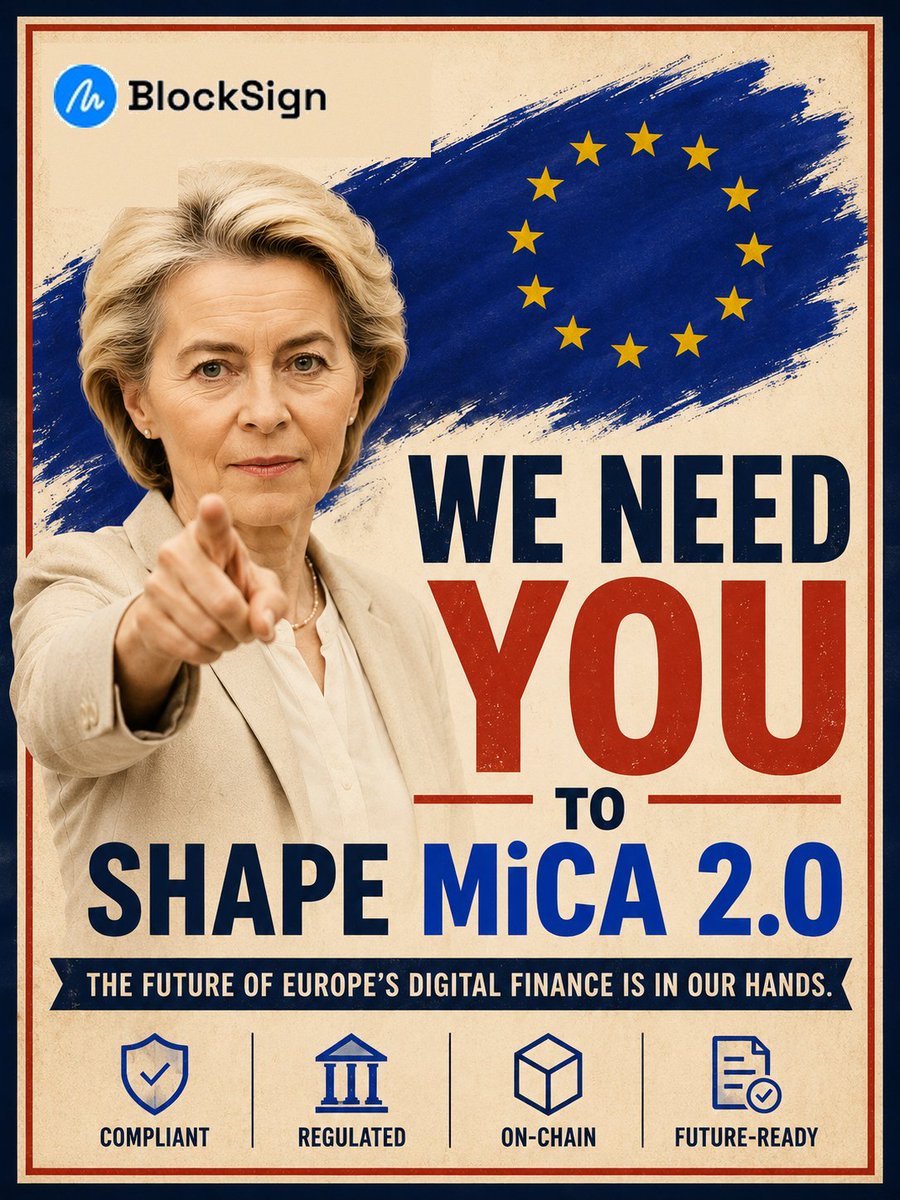
MiCA 2.0 is taking shape.
The European Commission has opened a wide-ranging consultation on whether MiCA is still fit for purpose. This is more than a regulatory review. It is an early signal that Europe is preparing the next chapter of digital asset regulation.
MiCA gave Europe an important head start. It created a harmonized framework for crypto-assets, stablecoins, issuers and crypto-asset service providers across the EU. But the market has moved quickly. Tokenized real-world assets, stablecoins, staking, lending, DeFi, tokenized deposits, smart contract execution and institutional on-chain finance are no longer theoretical concepts. They are becoming part of the real financial infrastructure conversation.
The consultation reflects this shift. It now addresses questions around crypto-asset classification, stablecoin reserves and redemption rights, CASPs and market access, reverse solicitation, non-EU platforms, staking, lending, DeFi access, tokenized deposits, prediction markets, perpetuals, ownership and transfer of tokens, custody, collateral, insolvency and conflicts of law in tokenized markets.
This matters because the next phase of digital assets will not be defined by wallets alone. It will be defined by operational infrastructure. Institutions need to prove who approved a transaction, under which policy, with which authorization, for which business purpose, through which custody setup, against which compliance checks and with which on-chain execution result.
That is why BlockSign Asset focuses on policy-based approvals, custody integration, smart contract control, audit evidence and institutional access to regulated on-chain finance. The key question is no longer whether institutions can hold crypto. The real question is whether institutions can operate digital assets with the same level of governance, control and evidence they apply in traditional finance.
This is where regulated DeFi, tokenized real-world assets and smart contract certification become important. It is also highly relevant for Cardano. Cardano has strong foundations for serious tokenization and institutional DeFi. But technology alone is not enough. The ecosystem also needs regulatory engagement, professional operating models and clear answers to the questions now being asked in Brussels.
A friendly question for the Cardano ecosystem: does a Cardano founding entity have a direct line of communication with the European Commission on this consultation? It could be quite important. The questions being asked now will shape the future of tokenized securities, real-world assets, institutional DeFi, regulated custody, smart contract access, on-chain settlement, tokenized deposits and the legal ownership of digital assets. @planetmaaz @ProofofPierre @Cardano_CF @SandroKnopfelCF @F_Gregaard
Europe had a head start with MiCA. Now it must decide whether it wants to remain only a regulatory benchmark or become a competitive market for institutional digital asset innovation.
The consultation is open until 31 August 2026.
Now is the time to contribute. See link below 👇
#MiCA #Cardano #Tokenization #RWA #DeFi #BlockSign #RegTech #OnChainFinance
Source: European Commission MiCA Review Consultation, 20 May 2026.
3
4
8
994
May 17
Danny, please check the advisors discussion board again.
If you do not also see that, for months now, every possible obstacle, including some that feel deeply unfair, has been used to avoid the payout, then I would be willing to prepare a detailed chronology to discuss this in public. Sadly it will not through good light on Catalyst.
This chronology would include, among other things: the prohibition on changing the project name from Docufi3d to BlockSign; the fact that we had already reached the point where your team rewrote parts of the proposal, while exactly those rewritten points are now no longer being accepted; the discussion around the fact that one of our partners had a change of personnel and that the new contact person now apparently has to be added through a Change Request; and the overall impression that all these obstacles are simply costing us time until your team can eventually say that the deadline has expired and no further payments will be made.
It is also difficult to understand that we cannot switch to a pay-per-use model in order to finally start generating revenue, because your reviewers may still decide that they want to test the live system. From our perspective, the entire process has become extremely frustrating and increasingly hard to take seriously.
The anonymity of the reviewers is a very sensitive issue. Instead of open discussions that help move the matter forward, we are facing clear blockages that cannot be resolved, because one reviewer appears to prevent progress while being shielded by anonymity.
In Germany we have a saying: “The fish rots from the head.”
At the end of the day, this situation may force me to move these projects away from Cardano.
If that happens, then you would also have to acknowledge, at least to yourself, that this process has produced sunk costs and that both human resources and treasury resources have once again been wasted.
I find it very unfortunate that things have reached this point. From our perspective, it increasingly feels as if one reviewer has a deeply personal issue with us, and that this is now harming the project instead of helping the ecosystem.
2
39

May 16
Contributor @ROBINHOOD032786 explores how BlockSign is using Cardano infrastructure to support transparent, tamper-resistant digital verification systems.
Read the full article ↓
explorecardano.com/how-block…
1
6
792
We built a Fireblocks-like asset operations platform with @nbxcom, but with a different angle: Midnight & Cardano support on protocol level!
BlockSign Asset Operations uses institutional compliance rails like Notabene Chainalysis and already integrates DeFi protocol operations.
Key point:
Asset support ≠ protocol participation.
Custody ≠ operations.
An SDK ≠ an operating model.
Institutions need more than wallets:
roles, approvals, policies, evidence, reporting and compliant execution.
Want to operate digital assets like an institution, not just hold them? Let’s talk.
1
43
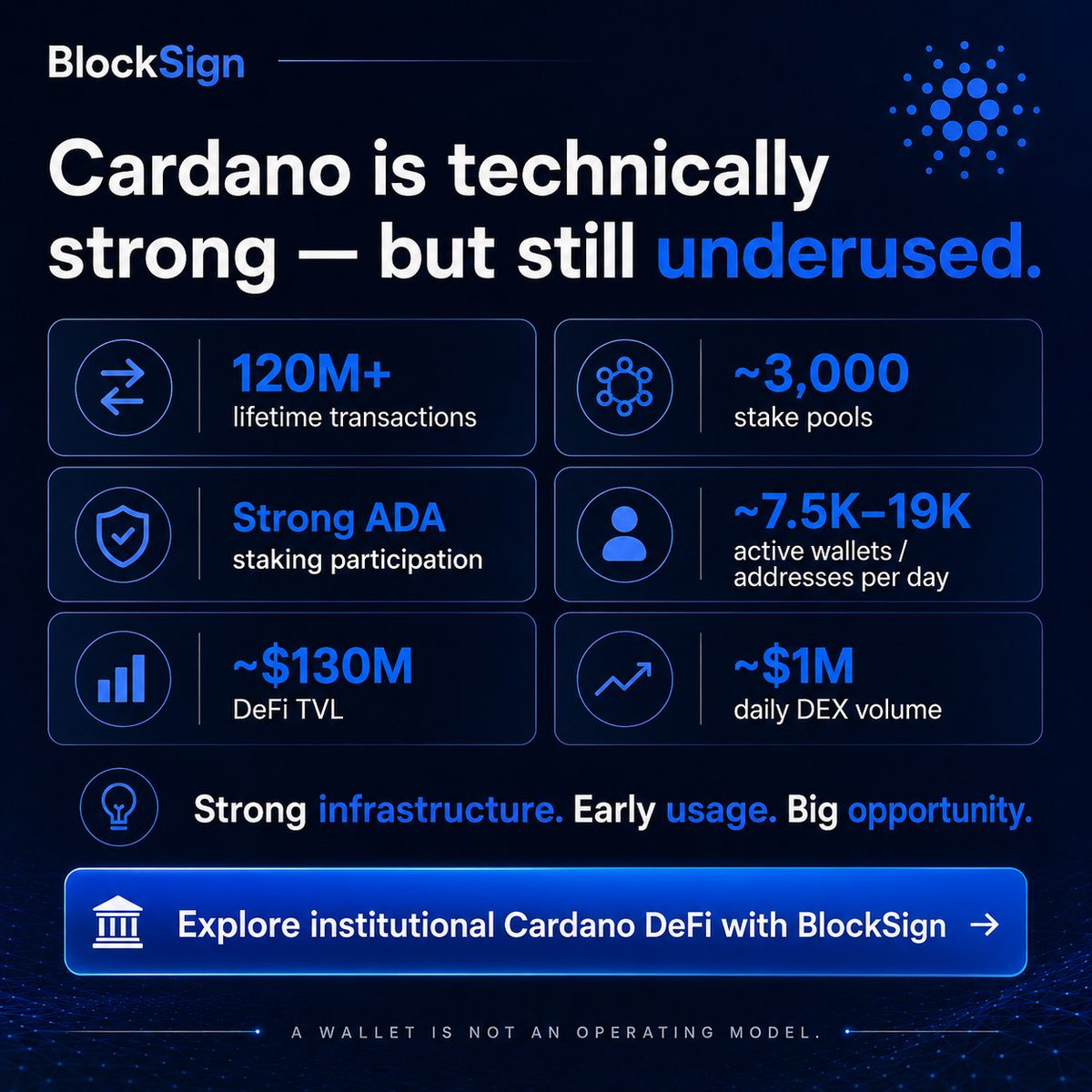
Cardano is technically strong, but still underused by institutions.
Key current signals:
• 120M lifetime transactions
• ~3,000 stake pools
• Strong ADA staking participation
• ~7.5K–19K active wallets/addr. per day
• ~$130M DeFi TVL
• ~$1M daily DEX volume
The gap is clear:
Cardano has serious infrastructure, but application-layer usage is still early.
This is exactly where institutional DeFi, RWAs, stablecoins, compliant smart-contract access and professional asset operations can unlock the next growth cycle.
BlockSign Asset Operations is building for that layer.
3
12
283
May 8
WE ARE FAMILY!
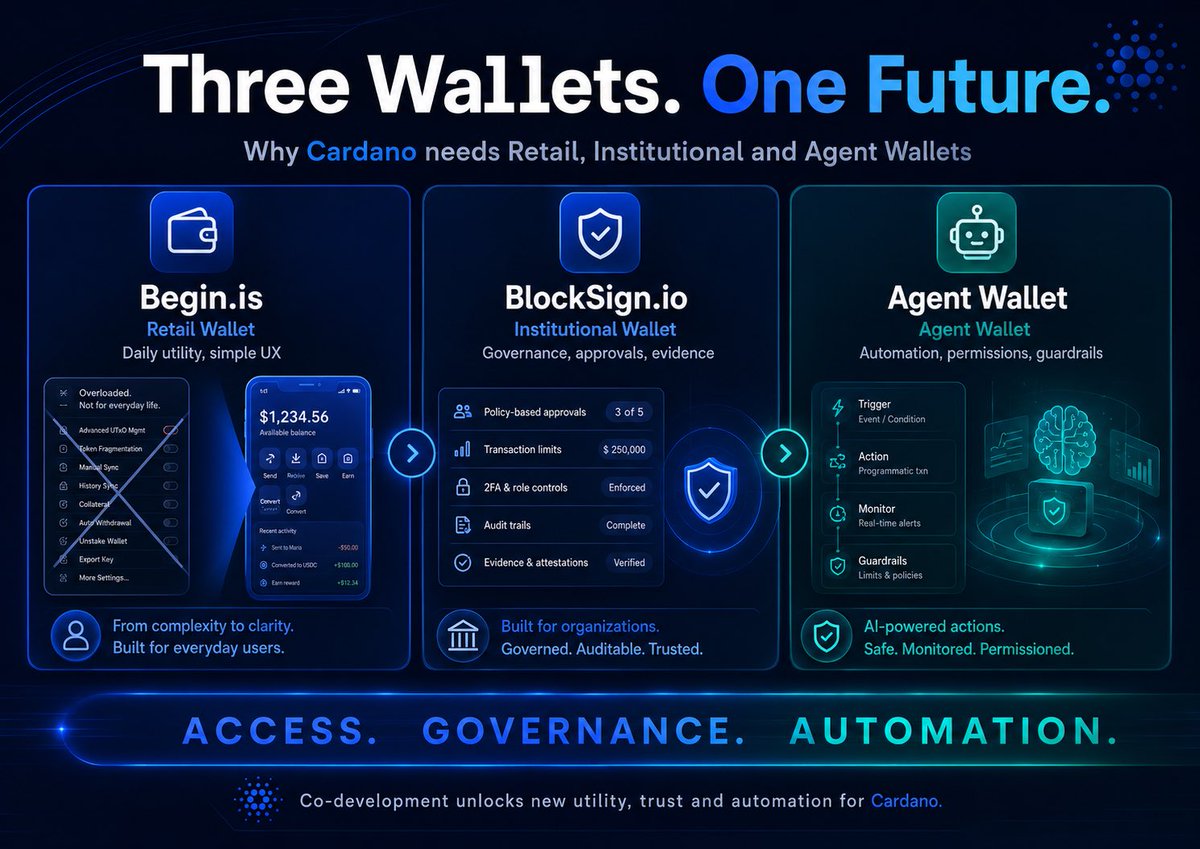
THREE WALLETS. ONE FUTURE.
Begin Wallet 🤝 BlockSign 🤝 Agent Wallet
Crypto wallets are no longer just tools to hold, send and receive assets.
The market is splitting into three very different layers and Cardano needs all of them:
1. Retail Wallets - Access ✅
Begin.is can become the daily-life wallet: simple UX, mobile-first, built for payments, saving, earning, travel, tickets and real-world utility.
The OG crypto wallet must be stripped down for normal users. Most people don’t need UTxO management, collateral settings, seed phrase stress, NFT-first screens or crypto jargon on the home screen.
They need clarity.
“Swap” becomes Convert.
“Staking” becomes Earn.
Token balances become €/$ first.
Long addresses become handles, phone numbers or QR codes.
2. Institutional Wallets - Governance ✅
BlockSign.io serves the professional layer.
Institutions need more than access. They need roles, approvals, policies, limits, evidence, audit trails and legally relevant authorization.
For institutions, a transaction hash is not enough.
3. Agent Wallets - Automation ✅
Agent Wallets are the next category and we have @AgentWalletHQ in the family.
AI agents will pay, book, rebalance, subscribe and execute, but only safely with permissions, limits, monitoring and guardrails.
This is where automation meets control.
The opportunity is not one wallet for everyone. The opportunity is a wallet family:
Begin.is for daily users.
BlockSign.io for institutions.
@AgentWalletHQ for AI-driven execution.
Access. Governance. Automation.
Co-development between these products can unlock new quality, service and utility across different chains and create a stronger adoption path for Cardano.
3
16
581
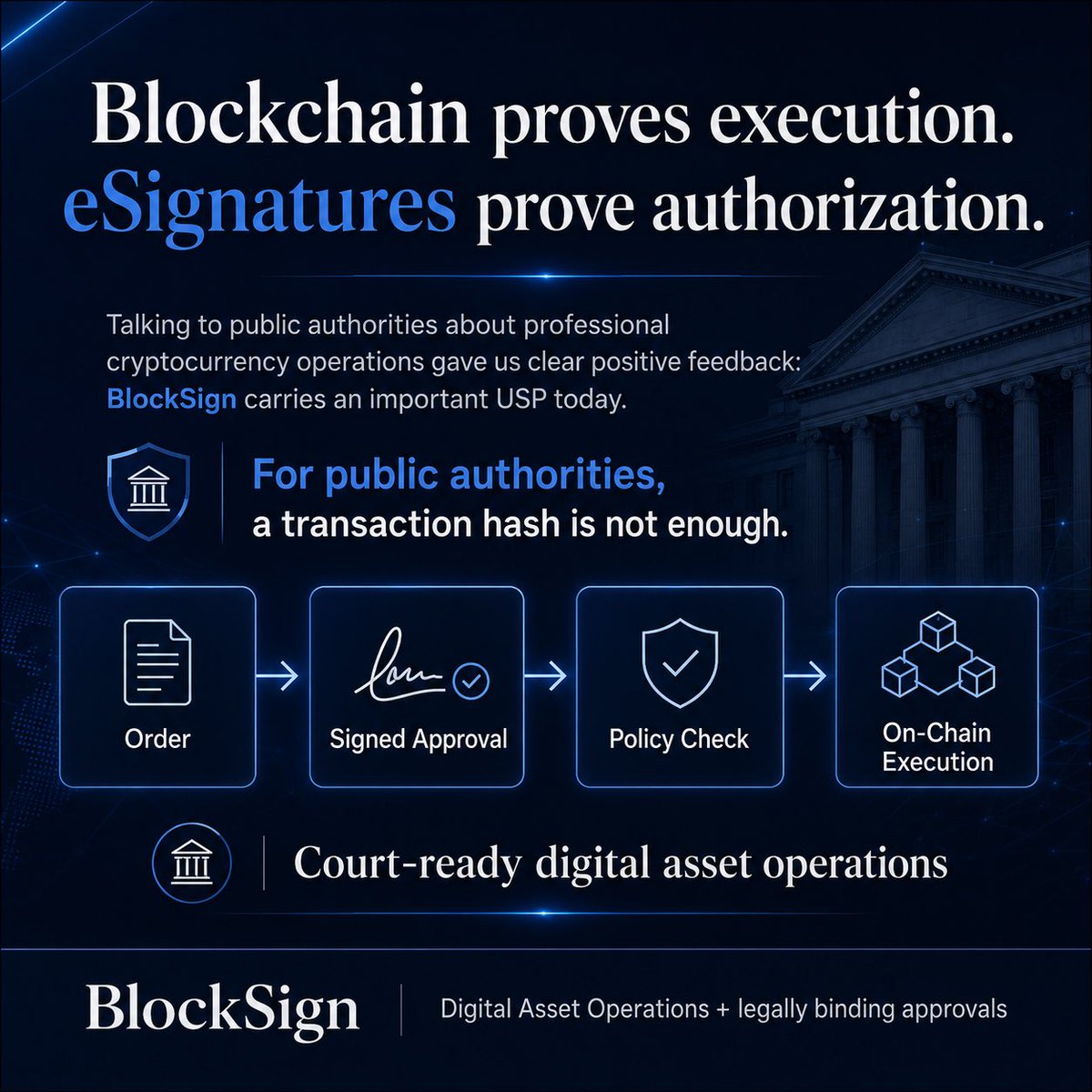
Talking to public authorities about professional cryptocurrency operations gave us clear positive feedback:
BlockSign carries an important USP today.
Most crypto wallets prove only one thing:
👉 A transaction happened.
For authorities, that is not enough. Police, tax agencies, customs and defence organizations must prove:
👉 Who ordered it?
👉 Who approved it?
👉 Which case did it belong to?
👉 Was the legal mandate clear?
👉 Was the four-eyes principle followed?
That is why eSignatures inside a digital asset platform are a game changer. The blockchain proves execution. The signature proves authorization.
Together, they create court-ready digital asset operations.
The combination of institutional custody & governance & legal e-signature in a single product, particularly on Cardano, appears to be genuinely unique. The market has either signing tools or custody platforms, but not both integrated. That’s the moat.
@Swisscom Trust Services 🔏
@nbxcom Custody 🏦
@BlockSign_io Operations 💻
…that’s a very powerful combination!
2
10
229
Huge news from our partner NBX (Norwegian Block Exchange):
@nbxcom has received formal written confirmation from SIX Exchange Regulation AG that it is approved as a new crypto-asset custodian for products listed on SIX Swiss Exchange.
Why does this matter for BlockSign Asset Operations?
Because institutional crypto adoption needs more than wallets. It needs regulated custody, AML/CTF controls, segregation of client assets, audit-ready records, policy-based approvals, role-based access, compliance workflows and controlled execution.
NBX is regulated by the Financial Supervisory Authority of Norway and is listed on Euronext Growth Oslo. With this SIX recognition, NBX strengthens its role as institutional custody infrastructure for exchange-listed crypto products in Europe. 
For BlockSign, this is highly strategic:
NBX provides the regulated custody layer.
BlockSign provides the governance, approval, policy, audit and operating layer.
Together, we move from simply “holding crypto” to operating digital assets professionally.
This is a major step toward institutional access to crypto assets, tokenized products and Cardano DeFi.
Original press release ⬇️
3
14
46
6,027