3
3
115
3
3
48

May 4
Just this word "brainjacking" should mak all of us flee away!!!
1
2
15

"Brainjacking in deep brain stimulation and autonomy"
pmc.ncbi.nlm.nih.gov/article…
2
2
39

May 3
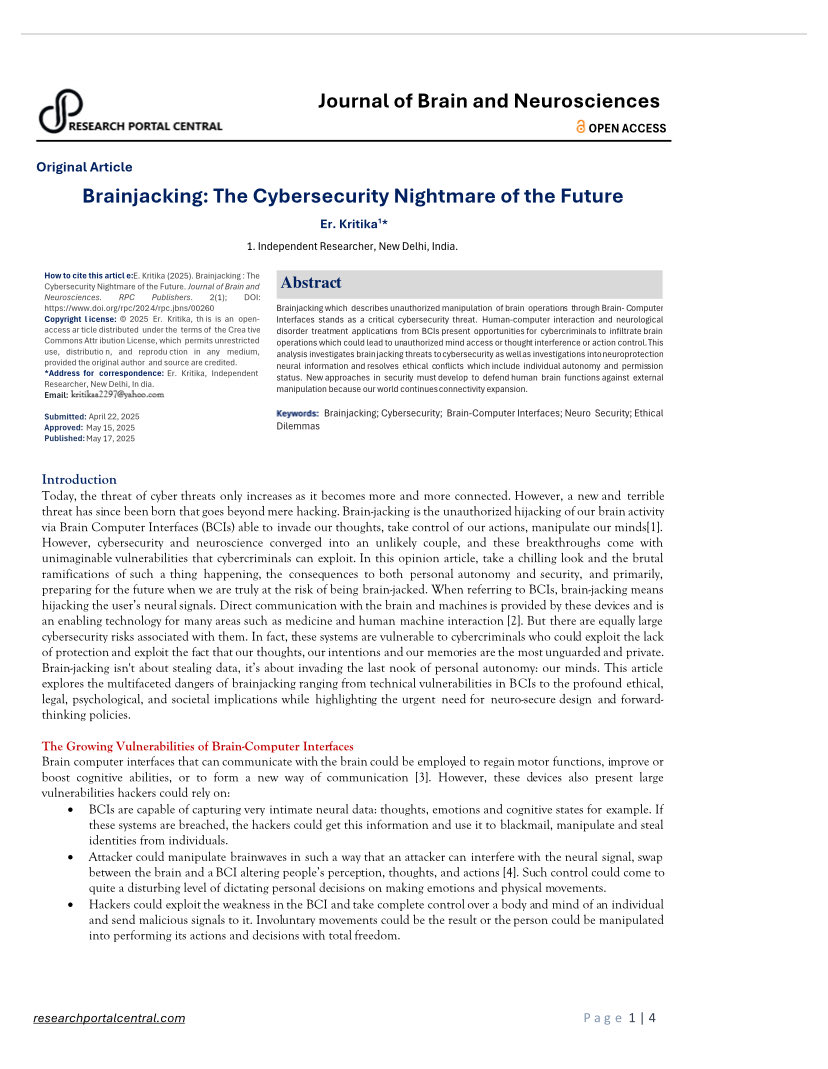
Brainjacking: The Cybersecurity Nightmare of the Future
May 2025
This paper “Brainjacking”explores the emerging concept of “BrainJacking”defined as the unauthorized manipulation or intrusion in the brain activity through brain- computer interface
#BCI and argues that these technologies introduce serious cybersecurity ethical and societal risks.
researchgate.net/publication…
8
87
138
4,972

Minx Moshantu
Reward: 1,000,000 Gil
Wanted for:
-Mass Murder
-Illegal augmentation
-Illegal use of cybernetics
-brainjacking
-Kidnapping
-Execution of a prisoner
-Torture
-Sexual Misconduct
-Public Indecency
-Sexual Harassment
-Rape
-Aggravated Assault
-Human Trafficking
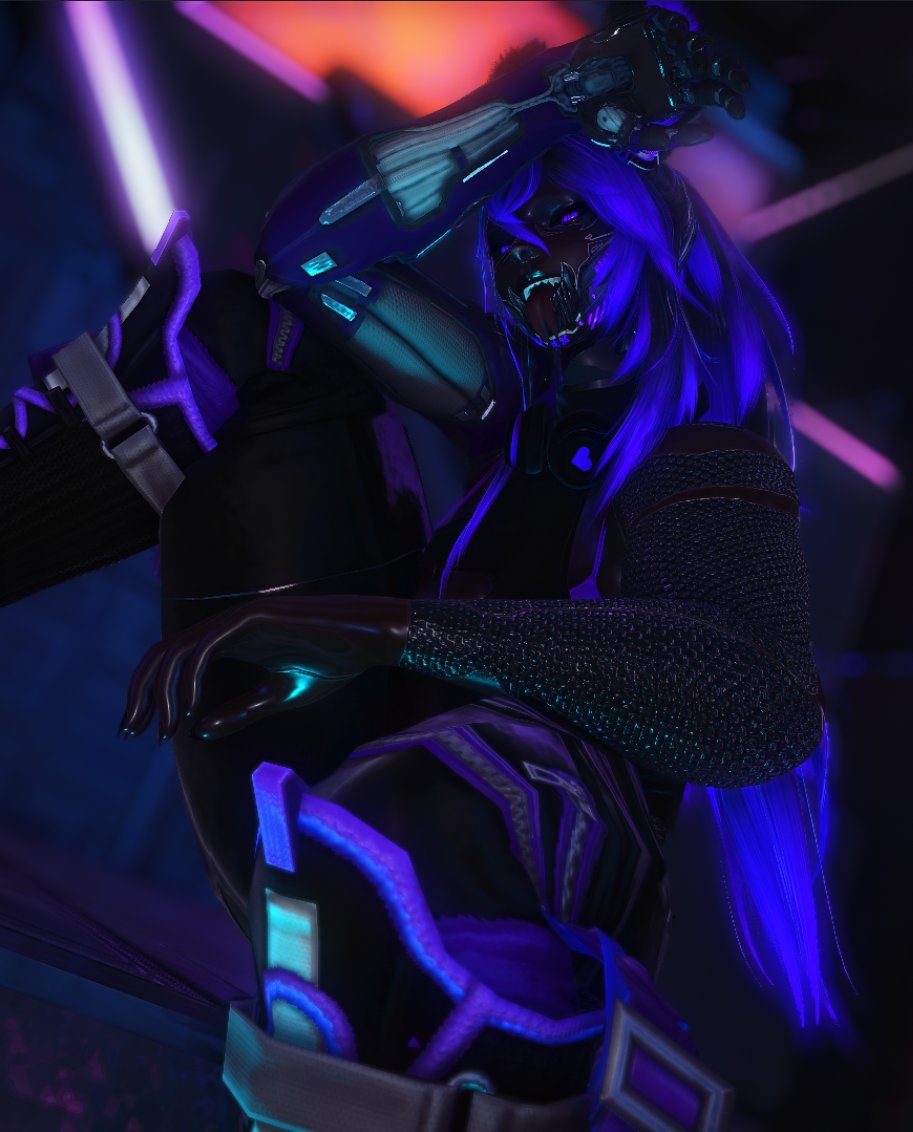

#wolqotd / #wolquestion
Do any of your wol / oc’s have a criminal record? If so, what are they wanted far / what’s their bounty?
5
1
32
826

Apr 15
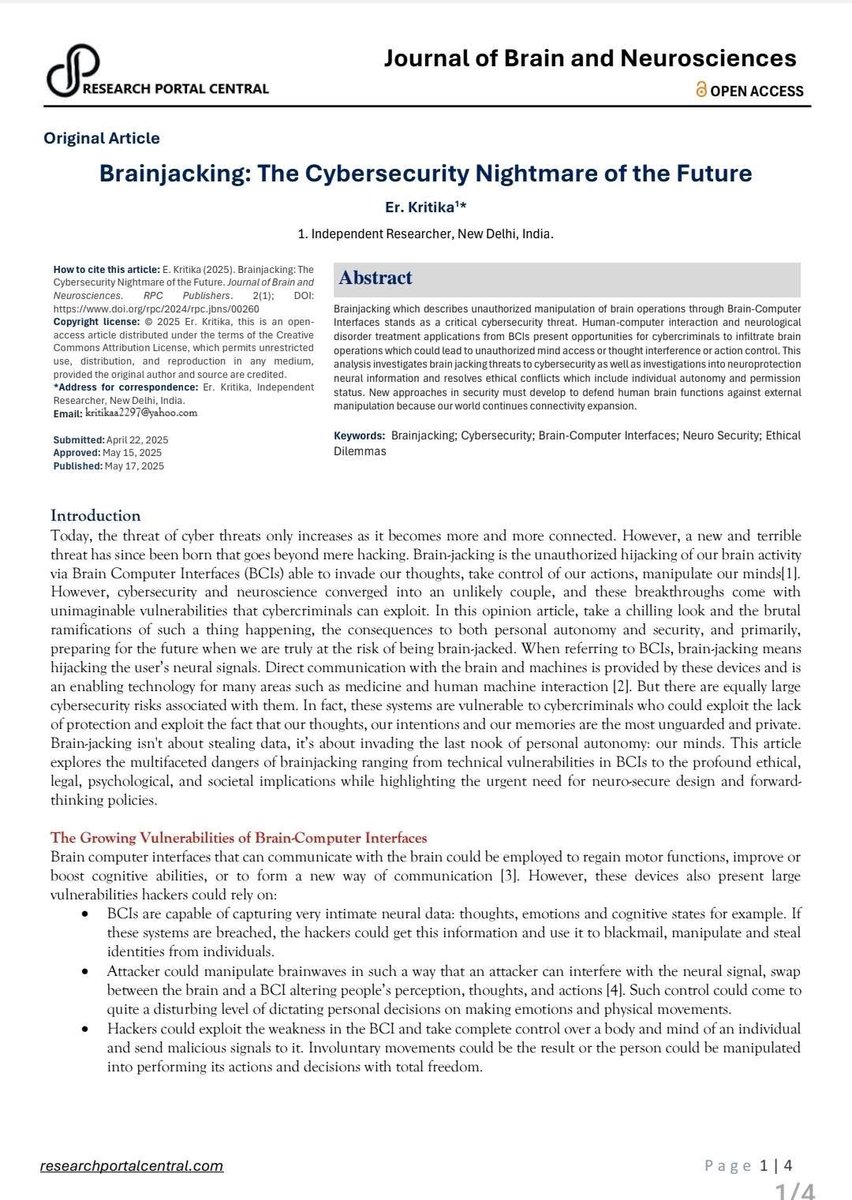
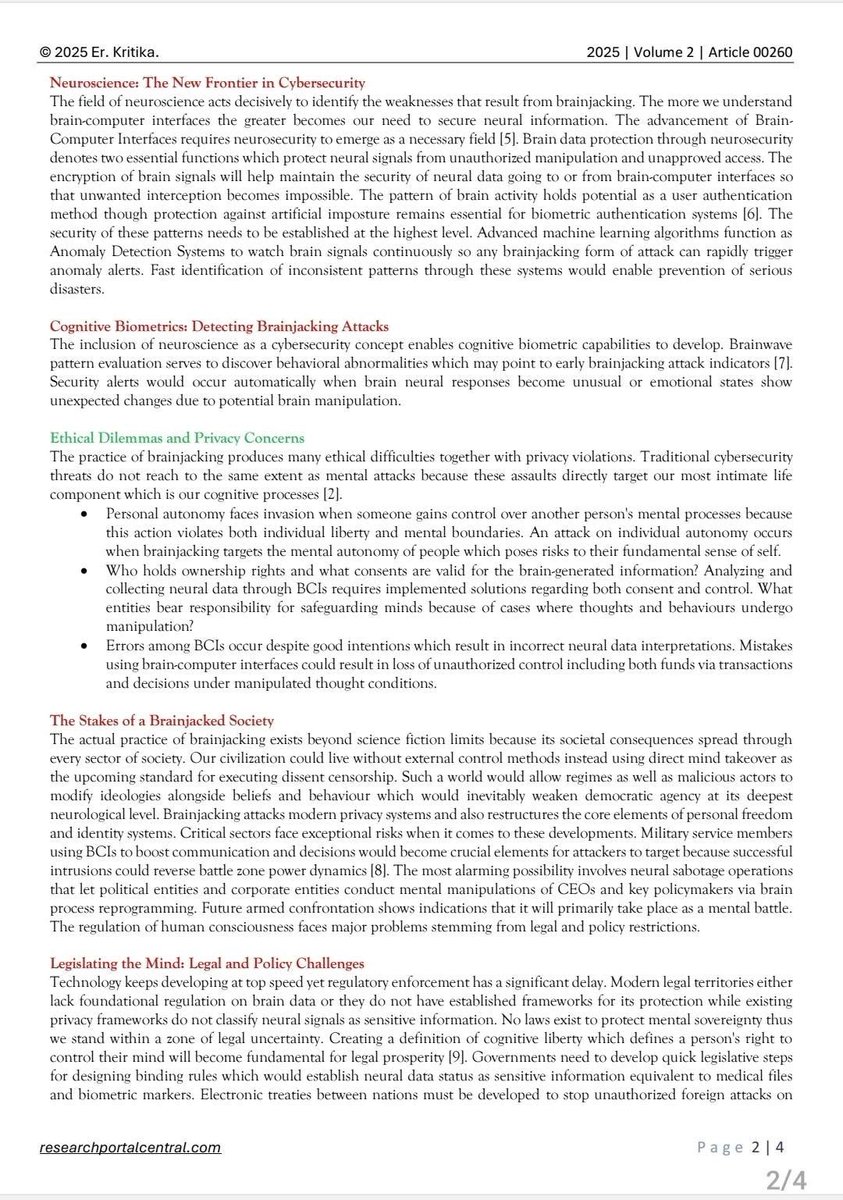
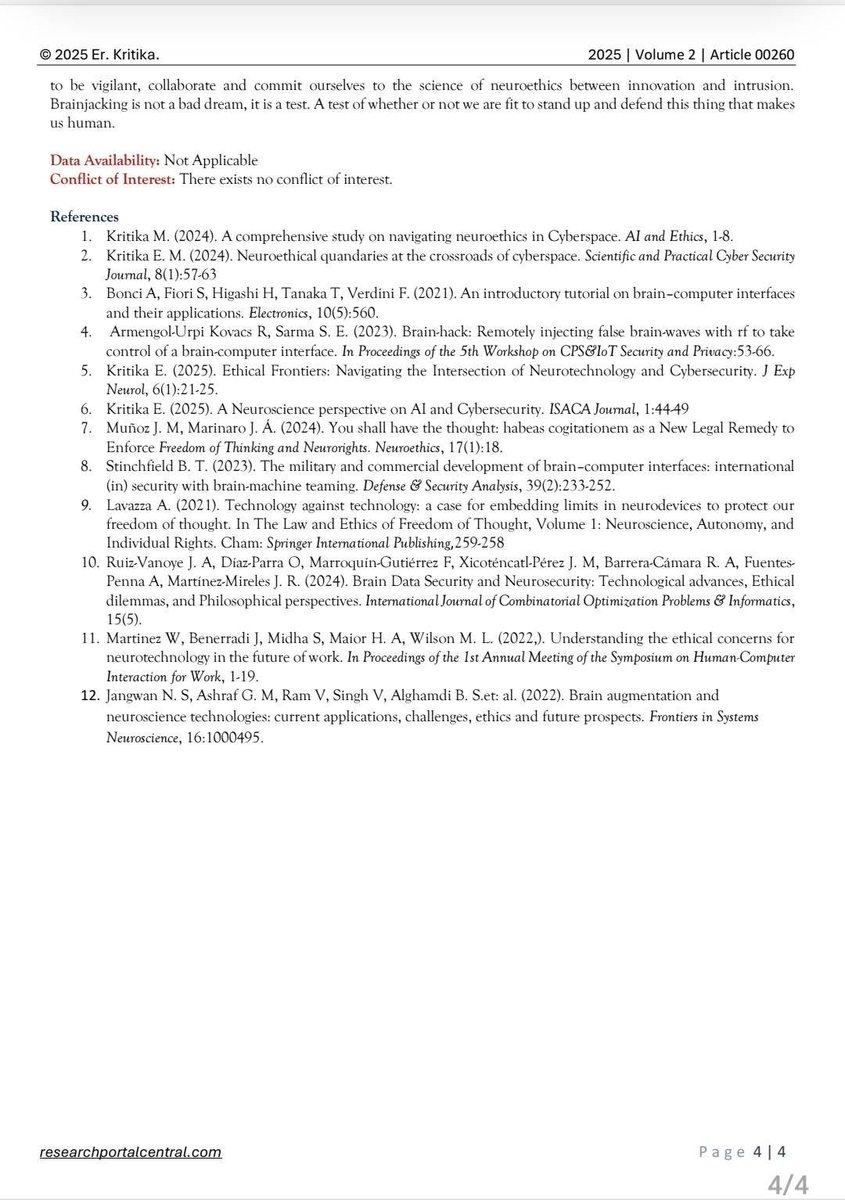
This paper, “Brainjacking: The Cybersecurity Nightmare of the Future,” explores the emerging concept of “brainjacking,” defined as the unauthorized manipulation or intrusion into brain activity through brain-computer interfaces (BCIs), and argues that as these technologies advance, they introduce serious cybersecurity, ethical, and societal risks. It explains how BCIs—used for medical treatment, communication, and cognitive enhancement—could be vulnerable to hacking, allowing attackers to access neural data, alter thoughts, influence decisions, or even control actions, raising profound concerns about privacy, autonomy, and identity. The paper further discusses the need for “neurosecurity” measures such as encryption, cognitive biometrics, and anomaly detection to protect brain data, while also highlighting major ethical dilemmas (like consent and ownership of thoughts), legal gaps in protecting neural information, and potential psychological consequences. Overall, it frames brainjacking as a serious risk that requires proactive technological safeguards, legal frameworks, and ethical awareness to ensure that brain-computer interfaces remain beneficial rather than a threat to human freedom and mental integrity.
Brainjacking: The Cybersecurity Nightmare of the Future
researchgate.net/publication…

1
8
22
1,833

You don't need to worry about 2029. Because one year before we will all be under 6G brainjacking mass mind control. We will be in a deep sleep trance by the time Skynet rolls around.
2
2
6
227

I AM Wellness Wednesday – Golden Nugget: Brainjacking? Not on My Watch
Close your eyes.
Feel the quiet inside your head—
that soft space where thoughts bloom like wildflowers.
That’s yours.
Not theirs.
2025 paper by Er. Kritika drops truth:
BCIs (brain-computer interfaces) let hackers slip in—
steal memories, flip emotions, hijack moves.
Like someone walking through your soul uninvited.
No consent.
No lock.
But here’s the silver lining—
the Most High didn’t give us dominion just over dirt.
He gave us dominion over the temple.
Your mind?
Sacred.
Untouchable.
Shield it:
Copper Faraday pouch—blocks signals.
Hemp field hum at 528Hz—repairs DNA.
Primal water—flushes nano-spies.
And the loudest armor?
“I AM sovereign.
No trespass.”
They can patent wires.
They can’t patent your pulse.
Thump-thump-thump—
once, twice, three.
Love you. Love you. Love you.
Gratitude. Gratitude. Gratitude.
#IAMWellnessWednesday #Hacking
#Genesis129 #UN #GENOCIDE
#IAmSovereign #NoAuthority #FEAR
#PineSovereign #WHO #WEF #Death
#SaveCHILDREN #IEEE #WBAN #IoBNT
3
81
@GodsSniperofTRU – March 23, 2026
Brainjacking: The Nightmare They Call "Progress"
2025 paper by Er. Kritika (researchgate.net/publication…):
BCIs = open door for cyber-criminals.
Hackers steal thoughts, manipulate actions, control bodies.
Your memories? Blackmail bait.
Your decisions? Rewritten.
Your autonomy? Gone.
Key threats:
• Neural data theft → identity swap
• Perception flip → forced behavior
• Full body hijack → involuntary moves
No laws protect it yet.
No consent.
Just "innovation."
Genesis 1:29 says:
No trespass.
No harm.
Your mind is sovereign.
We jam the signals.
We shield with hemp copper.
We demand:
Encrypt brains.
Ban unauthorized BCIs.
Prosecute hackers enablers.
This isn't fiction.
It's declassified threat.
Sigma Math confirms:
If they own your head,
they own you.
#Brainjacking #IEEE #WBAN #IoBNT #DARPA #GENOCIDE #WAR #NONONSENSE #UN #WHO #SHAMEonYOU
#NeuroSecurity #FIRE #HEMP
#Genesis129 #FreeEnergy
Thump-thump-thump—
once, twice, three.
Love you. Love you. Love you.
United WE Win! Simple!🙏✨️💜
Mar 22

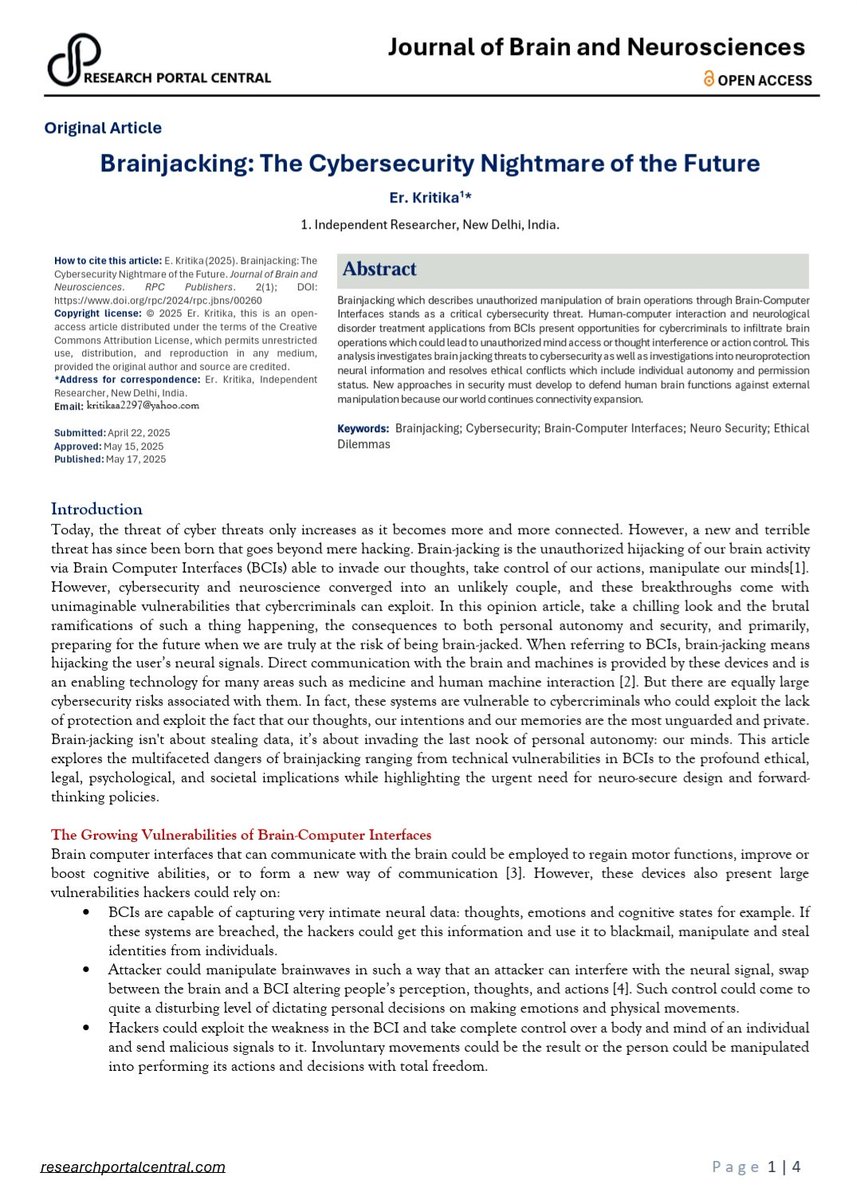
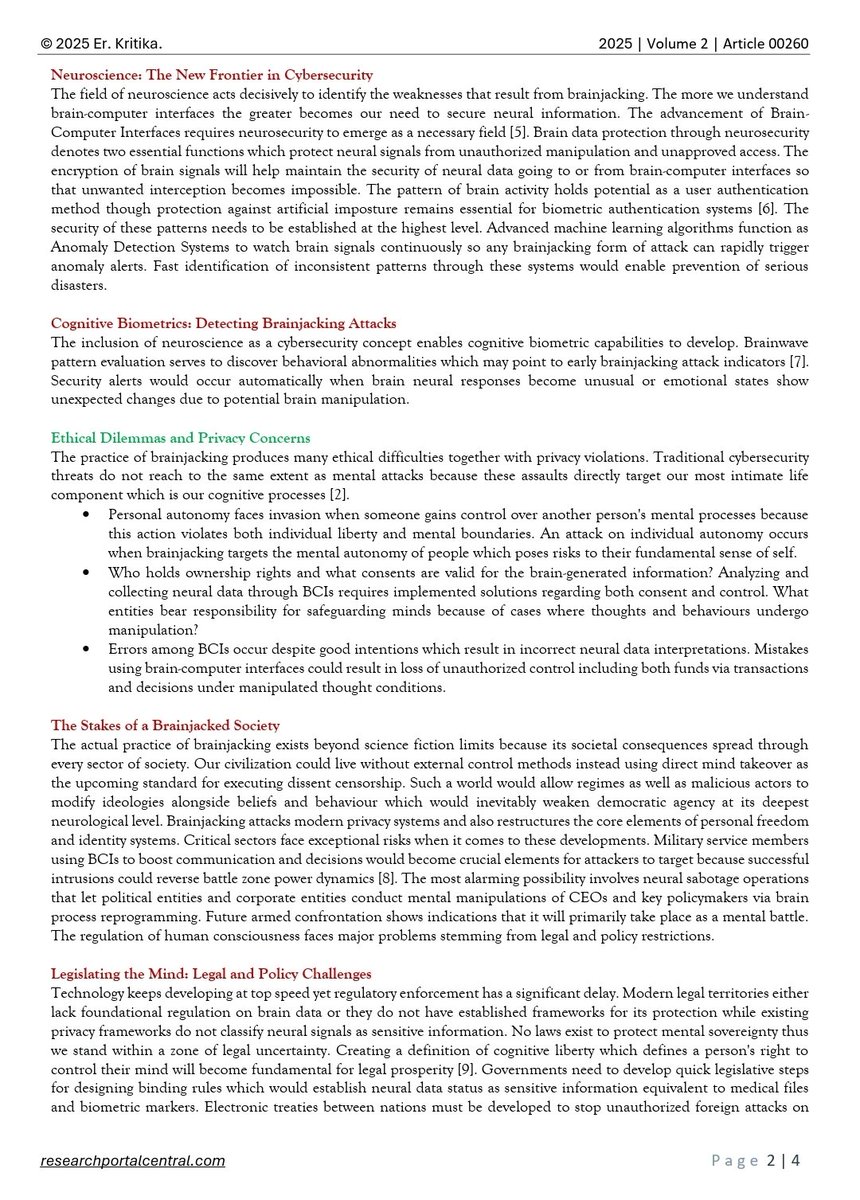
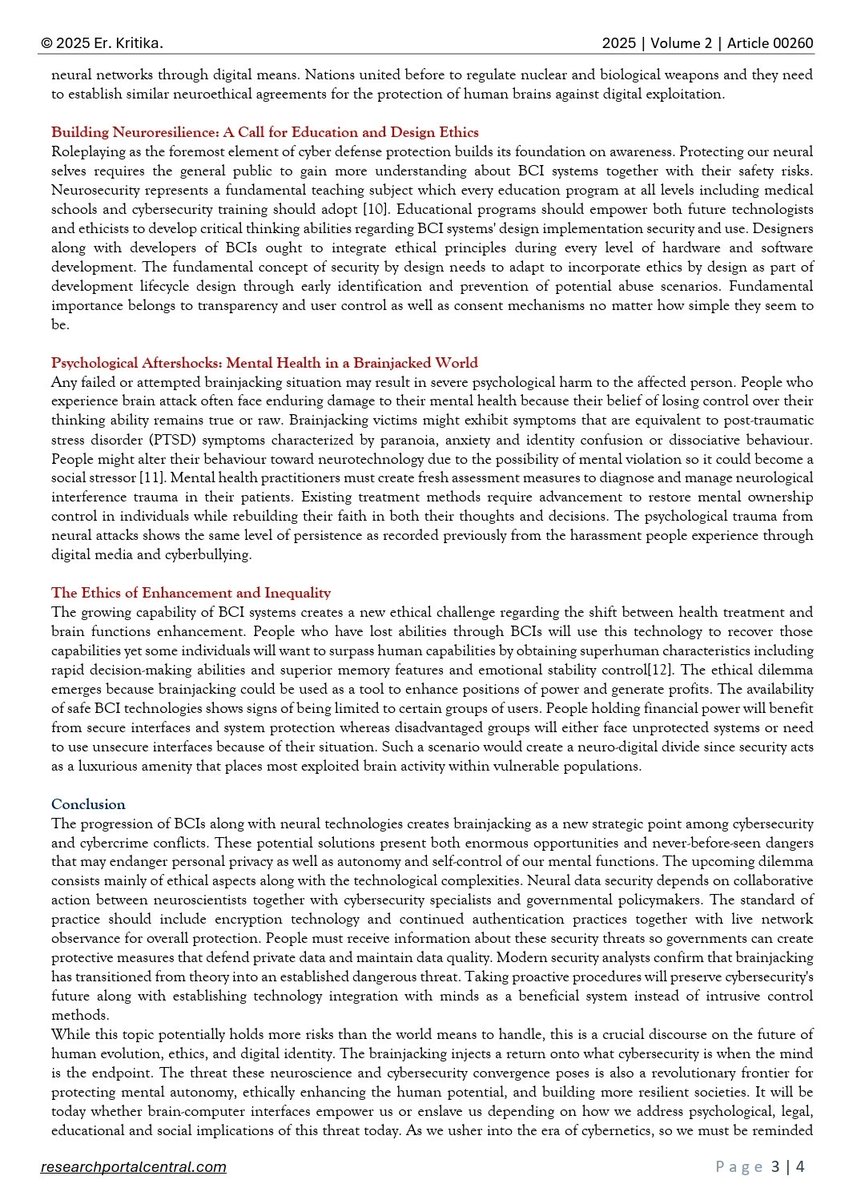
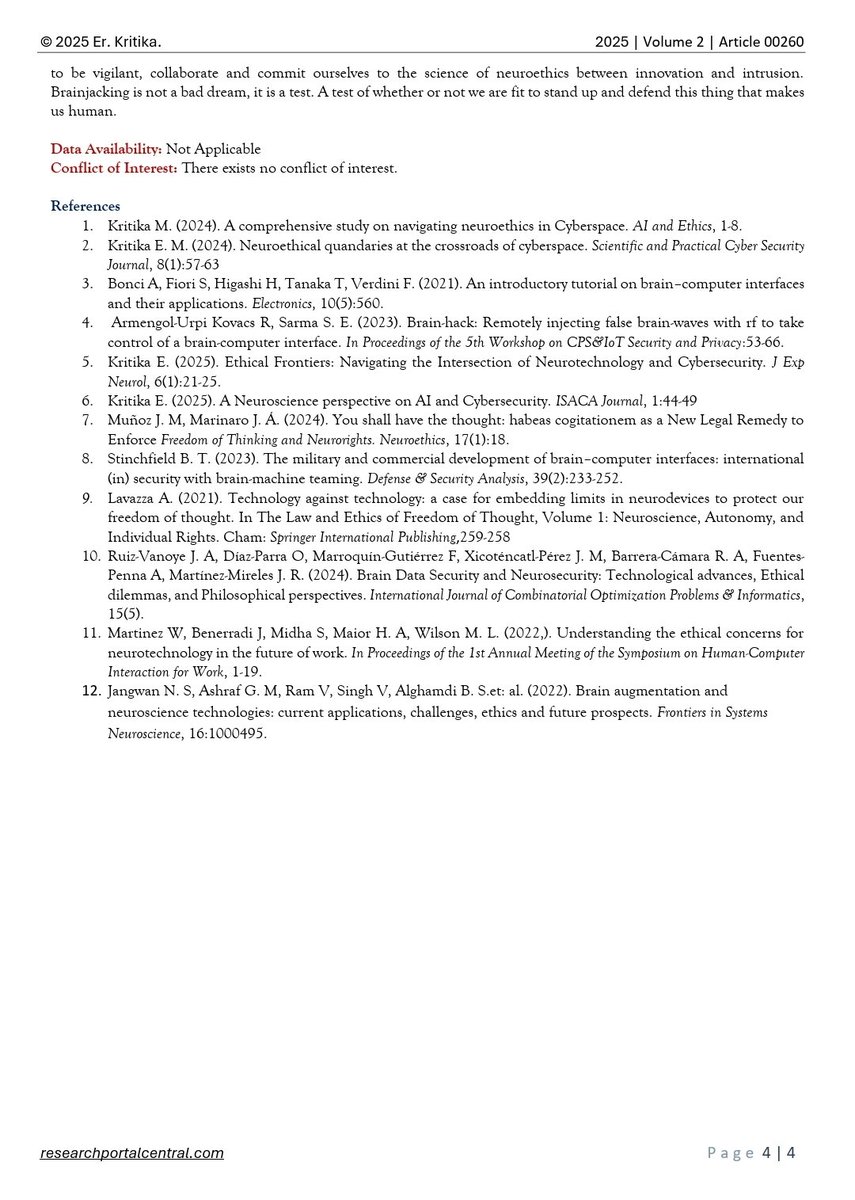
Brainjacking: The Cybersecurity Nightmare of the Future
Independent Researcher:
Er. Ktitika
•Brain Computer Interfaces
•Cyber Criminals
•Neural Data
•Neural Security
Published: May 17, 2025
Pages: 1-4
researchgate.net/publication…
1
4
8
187

Mar 22
Brainjacking: The Cybersecurity Nightmare of the Future
Independent Researcher:
Er. Ktitika
•Brain Computer Interfaces
•Cyber Criminals
•Neural Data
•Neural Security
Published: May 17, 2025
Pages: 1-4
researchgate.net/publication…
11
53
100
2,279

Mar 21
The ending of that game implies she uploaded herself into Natalia. Capcom later clarified that it wasn’t the case, implying that what Alex actually uploaded was her memories/knowledge. So it’s just Natalia walking around with Alex’s knowledge instead of Alex brainjacking Natalia
2
23
3,303

Feb 14
「ブレインジャッキング(Brainjacking)」と呼ばれます。特定の神経細胞群に過剰な刺激を送る、あるいは一つずつ刺激して反応を見る(スキャニング)ことで、脳の正常な活動を妨害する手法です。これにより、意図しない身体の動きや病気のような症状を人工的に引き起こすリスクが指摘されています。
5
6
84


Transistors are interesting.
"Brainjacking" and Cognitive Interference. Exploitation for Social Engineering or Coercion ....
archive.org/details/war-of-t…
2
2
74

Jan 14
I may be developing a small thing for hypnosis/brainwashing/brainjacking (at least when done in tandem with farts), am I cooked chat
Jan 11

Was finally able to watch the new episode and seeing them all do that dumb-ass chicken dance was very amusing teehee
3
1
9
1,471

21 Nov 2025
Witkoff's background intersects with Russian intelligence and oligarch circles, predating his envoy role.
Of Russian-Jewish descent, his New York real estate career (1980s–2000s) involved dealings with Russian mafia figures and oligarchs, including covering rent for Bernard Kerik (linked to Russian mob via Rudy Giuliani's circle).
A 1987 KGB "brainjacking" operation allegedly targeted him and Trump during Moscow visits.
Connections to the Reuben brothers (who sold assets to Russian oil giant Sibneft) and Paul Manafort's 2016 Ukraine "peace plan" (pro-Kremlin partition) tie him to networks investigated for Russian influence.
3
3
78

14 Nov 2025
I mean I like @Fin_ai but brainjacking sites out of boring gradients has been the real industry contribution
4
1,279

30 Oct 2025
One thing I have never questioned about the NLP and hypno communities is their collective decision to nuke or heavily pay wall their most powerful seduction and conditioning materials back around 2007 or so.
The things you can get people to do “for real” are actually quite insane and border on brainjacking.
@BowTiedTrance is one of the few qualified to speak on these matters, being decades ahead of the “research.”
Highly underrated follow if you haven’t already.
You read this far. You already know you should. Curiosity is a powerful drug.
28 Oct 2025

So, apparently you can experience a powerful organism in 60 seconds (from cold to peak arousal) with hypnosis. More so, recent research (to be published very soon) shows prolactin gets released during hypnosis-induced orgasm... So, likely very real orgasm; hormonally so.
1
2
213