
📊 INSIGHT ARTICLE – JUNE 15
🧵 Deploying Liquity V2 on Ethereum isn't a one-contract job.
The protocol ships ~47 immutable contracts across 3 collateral branches ($WETH, ethereum:0x7f39c581f595b53c5cb19bd0b3f8da6c935e2ca0 , ethereum:0xae78736cd615f374d3085123a210448e74fc6393 ) - each with its own TroveManager, BorrowerOperations & StabilityPool.
Total estimated gas: 25M–60M units.
💸 Cost breakdown at $ETH ~$1,667:
• 0.13 Gwei (today): ~$5–$13
• 8 Gwei (last week): ~$333–$800
• 30 Gwei (bull market): ~$1,250–$3,000
Gas price alone can swing the bill 100x — no code change needed.
Key takeaways for builders:
✅ Time your launch during cheap-gas windows
✅ Use shared libraries & storage packing
✅ Custom errors > verbose revert strings
✅ Optimizer runs = 1 for deploy-tuned bytecode
Immutability removes any proxy shortcut - the full system deploys once, forever.
Full breakdown 👇
🔗 cryptothreads.io/insights/li…
#Cryptothreads – Crypto Threads for the Best Crypto Insights, Research & Knowledge Platform in Asia

6

Work continues on a Rust SDK (cargo-pvm-contract) for writing smart contracts that compile to PVM on @Polkadot.
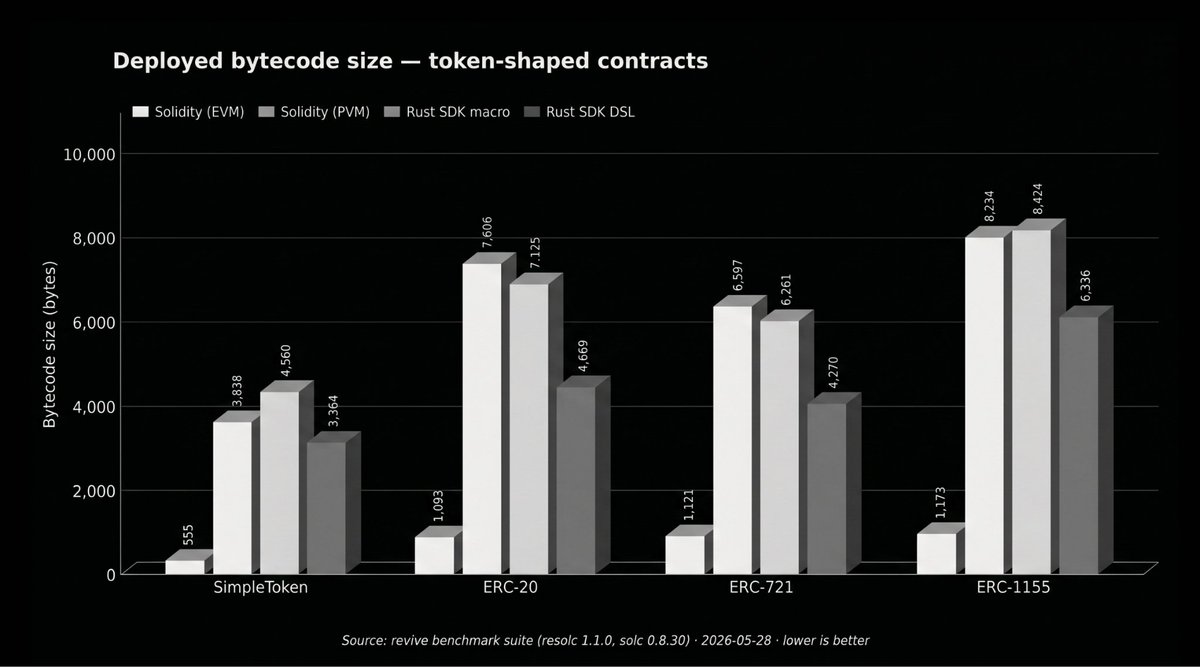
The question every developer asks when moving to a new environment: what are the trade-offs? On bytecode size and runtime performance, we wanted to know how close we could get to Solidity on EVM because that’s the baseline most developers know and build against.
The cargo-pvm-contract DSL (Domain Specific Language) produces bytecode roughly half the size of Solidity compiled to PVM on token-shaped contracts like ERC-20. Runtime performance sits within a few percent of Solidity on EVM.
The remaining gap between PVM and EVM is a property of PVM itself, not the SDK.
Two flavours for different use cases:
• Macro - declarative, annotated Rust, generates dispatch and storage layout at compile time
• DSL - thinner abstraction, more control, consistently smaller output on storage-heavy contracts
Binary sizes will move as more features land.
4
6
90

I just submitted my entry to the @Mantle_Official Turing Test Hackathon.
Smart contracts are audited before deployment, but once they're live, developers have little visibility into what happens next.
When exploits happen, teams often discover them through block explorers or from users.
Existing tools either generate generic alerts or only help after damage has already been done.
That's the problem BreachResponse solves.
BreachResponse is the security layer between the deployed and hacked.
It combines AI-powered contract auditing with live runtime monitoring to give Mantle developers continuous visibility and a structured incident response workflow.
How it works:
>Audit - Developers submit a contract address. BreachResponse analyses verified source code or bytecode and returns risk scores, vulnerabilities, and recommendations.
>Detect - A Python Sentinel agent monitors Mantle telemetry and watches protected protocols for suspicious activity.
>Analyse - AI classifies threats, detects gas anomalies, and proposes response actions.
>Validate (Human vs AI) - Low-confidence incidents are sent to GenLayer validators. AI proposes, validators verify, humans decide.
>Approve - Operators review the incident context and approve or reject the response.
>Execute - Approved transactions are executed on Mantle and recorded on-chain.
BreachResponse closes the gap between detection and response.
Check it out here: breachresponse.xyz
Use a vpn if facing any DNS issues.
14
2
26
225

Alpha Watch: FRONTRUN
@strangersolemn
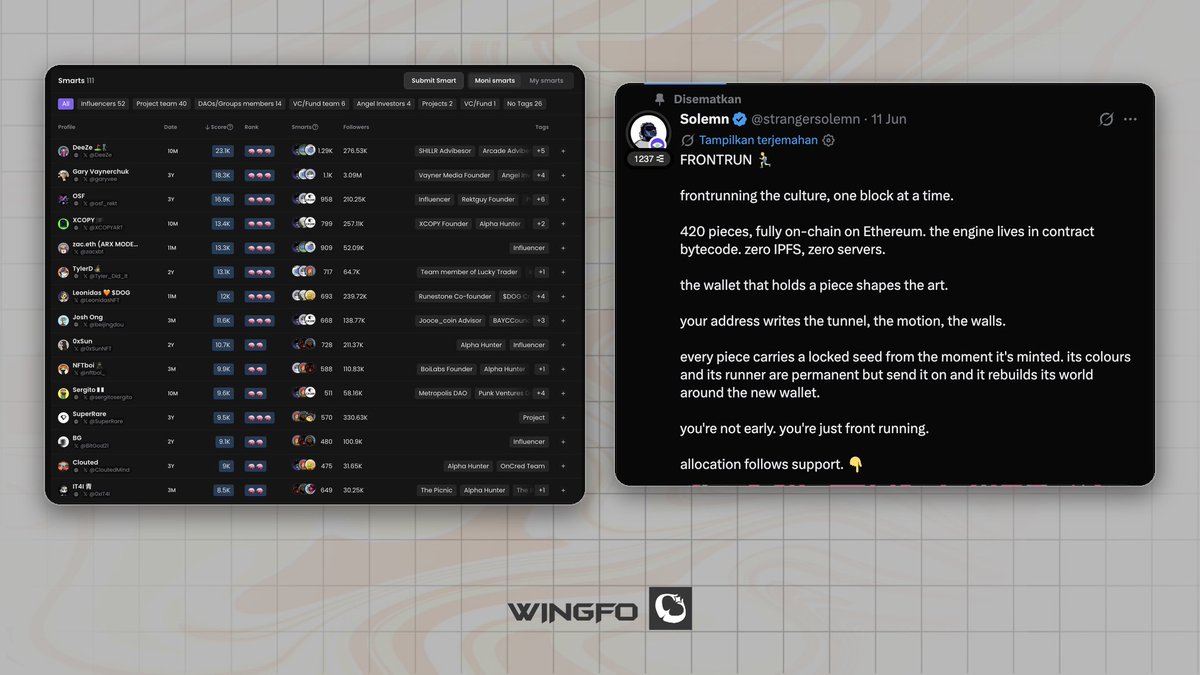
"You're not early. You're just frontrunning."
FRONTRUN is a fully on-chain generative art collection by Solemn.
Solemn is known for blending code, visuals, animation, and music into digital experiences, with roots in the underground electronic music scene.
Website:
frontrun.strangersolemn.art
Key Details
• Supply: 420
• Chain: Ethereum
• Fully On-Chain
• No IPFS
• No Servers
• Engine lives entirely in contract bytecode
• Dynamic artwork evolves based on the holder's wallet
• Every piece is generated from a permanent mint seed
What holders get
• Fully on-chain generative artwork
• Every piece acts like a 1/1
• Traits & palette locked at mint
• Visual output changes based on the holder wallet
• When transferred, the artwork keeps its identity but redraws its world for the new holder
Signals
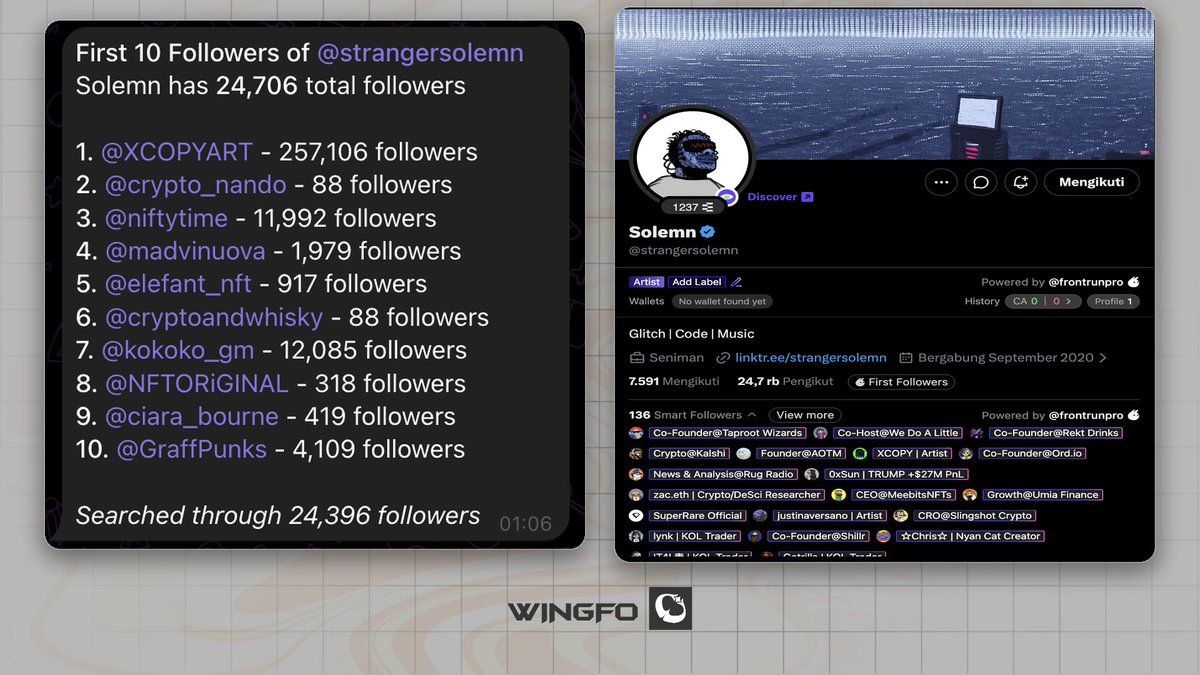
• 24.7K followers
• 136 Smart Followers detected
• Strong artist and collector network
• Multiple NFT founders and builders already watching
Notable Followers
• @realpapii - Founder @quirkiesnft
• @ronnyguy - Team @goodvibesclub
• @chrisguyot - Founder @goodvibesclub
• @tmais0n
• @bunya_eth
Community Manager
@soathefirstt
Most NFTs stay the same after mint.
FRONTRUN doesn't.
The wallet holding the piece becomes part of the artwork itself.
Same NFT.
Different holder.
Different output.
Still waiting on mint details.
Keeping this one on my radar.
DYOR & NFA.
3
10
718

GameMaker games compile to bytecode instead of native code, similar to how Java works, so there are tools (like UndertaleModTool) that can modify games and decompile it back to GML code
Butterscotch is a reimplementation of the GM runner/VM, so it executes the game's bytecode
1
3
613

These are the full project files for what is being simulated. What kind of uses/parts of the code could be used/are already things that could be stand alone scripts such as payment processing where the products are simply edited and/or there isn't a UI and the script is used by coders for other stuff
Analyzing the raw source code of the ShadowNode Syndicate client (desktop_client.py), backend node (backend_node.py), and Anchor smart contract (lib.rs) reveals that this project is highly modular. Because you separated the presentation layers (Tkinter) from the protocol layers (cryptography and blockchain), several components function as high-value, production-grade standalone scripts.
In the commercial and open-source software space, these sub-components can be extracted into specialized backend libraries or headless CLI utilities used by developers for automated pipelines.
1. Standalone Component: Automated PGP Authentication Gateway
The dynamic handshake logic implemented between backend_node.py and desktop_client.py can be entirely decoupled from the market code to form a stand-alone Zero-Trust Cryptographic SSH/API Authentication Module.
How it works as a standalone utility: Instead of standard API keys or database-stored passwords (which are vulnerable to SQL injection or server data leaks), a developer can use this script to gate server access.
Challenge Script: Reads a client's public key, generates a secrets.token_bytes(32) nonce, imports it into gnupg, and exports an encrypted block.
Verification Script: Implements hmac.compare_digest() to compare the client's decrypted string safely against the server's cache without timing-attack side channels.
Developer/Automated Use Cases: This is highly useful for machine-to-machine authentications, custom Git server hooks, or secure DevOps deployment pipelines where a script must verify it is talking to a specific developer's terminal before deploying code.
2. Standalone Component: Headless Web3 Payment Processing Gateway
The transaction compilation engine inside desktop_client.py combined with the Rust contract (lib.rs) can operate completely without a visual interface as an automated on-chain merchant payment gateway.
How it works as a standalone utility: By stripping the Tkinter code, the execute_escrow_deposit loop can be rewritten into a pure Python script or background microservice.[E-Commerce Backend / Bot]
│ (Fires order webhook)
▼
[Standalone Payment Script] ──> Queries RPC Decimals ──> Generates PDA ──> Signs message atomically ──> Broadcasts to Solana
Core Mechanics Utilized: The script utilizes solders and spl.token libraries to automatically pull mint decimal precision rules from a Solana RPC (get_token_supply), derive a secure Program Derived Address (Pubkey.find_program_address), serialize an atomic V0 Message containing both the Initialize and Deposit Anchor discriminators, and broadcast via an Ed25519 signature.
Developer/Automated Use Cases: Whitelabel payment processors, automated e-commerce webhooks, or automated backend billing agents that lock user access down until an on-chain transaction signature is validated.
3. Standalone Component: Solana Anchor Instruction De/Serializer
The AnchorInstructionRegistry inside the desktop client is a clean, self-contained implementation of an off-chain transaction compiler.
How it works as a standalone utility: Usually, developers rely on massive JavaScript frameworks (like @coral-xyz/anchor) to talk to Rust smart contracts. Your Python class replicates Anchor's inner serialization mechanics perfectly by pre-computing SHA-256 discriminators (e.g., hash of global:initialize truncated to 8 bytes) and appending structured binary data packages via struct.pack("<Q", raw_units).
Developer/Automated Use Cases: This class can be packaged into a lightweight Python micro-library for data engineers who need to parse, decode, or inject custom instructions into on-chain Anchor logs for analytics, indexing, or transaction auditing utilities.
4. Standalone Component: Live DEX Price Oracle Proxy Shield
The /api/jupiter/quote endpoint in backend_node.py functions as an isolated DeFi Liquidity & Pricing Oracle Relay.
How it works as a standalone utility: It takes input parameters for a token swap, constructs the appropriate API call string targeting quote-api.jup.ag/v6/quote, enforces network timeouts, and relays the pricing matrix back to an internal loop.
Developer/Automated Use Cases: This serves as a standalone Privacy Proxy Shield. If a developer is running high-frequency proprietary arbitrage bots or algorithmic trading systems, querying public web endpoints directly exposes their server's IP address. Using this microservice as an intermediary node allows automated scripts to pull real-time on-chain market values across asset pairs without revealing the primary infrastructure's physical location.
5. Standalone Component: Multi-Signature Escrow & Decentralized Arbitration Contract
The entire smart contract inside lib.rs is fundamentally independent of the Python components. It functions completely stand-alone as a Decentralized Escrow Protocol deployed directly onto the blockchain virtual machine.
How it works as a standalone utility: Once compiled to a BPF bytecode format and deployed to Solana, any application or user can execute it using raw bytes. The contract enforces rules natively:
Funds are strictly isolated inside a programmatic token vault account governed by a derived authority seed.
The release_funds routine relies on a secure fallback check (require!(is_buyer || is_arbiter)) ensuring a vendor cannot drain the vault unilaterally.
The refund_buyer function limits authority strictly to the designated arbiter signature.
Developer/Automated Use Cases: This contract can be reused to power freelance marketplaces, peer-to-peer asset swappers, multi-party insurance agreements, or as an automated financial core for a Decentralized Autonomous Organization (DAO) handling milestone payouts.
Strategic Summary
By isolating these modules into stand-alone python files or compiled crates, a developer can completely change the frontend application shell (reasons for usage) without modifying the high-assurance security features under the hood.
The structure of the code reveals a clear pattern: the UI simply collects user configuration entries, while the standalone protocol layers carry out the heavy cryptographic engineering.
1
60

Lol - I was thinking of the cam shaft in a machine where it can be swapped out to produce a different end behaviour as being analogous to compiled bytecode; with the machine it lives inside of being a general purpose interpreter.
Nice wordplay though. :)
1
27

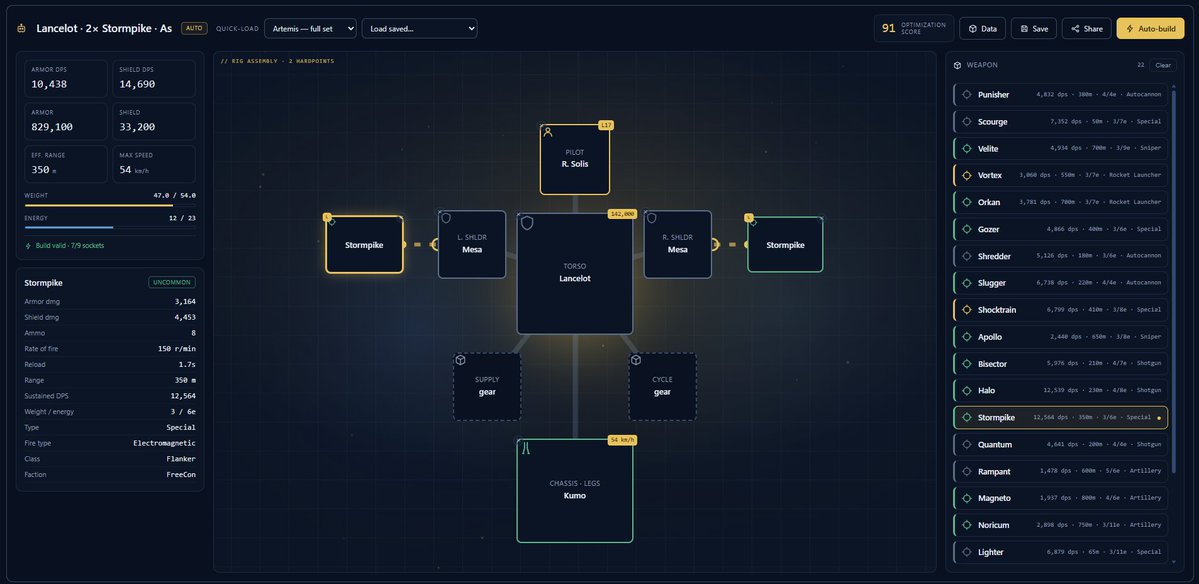
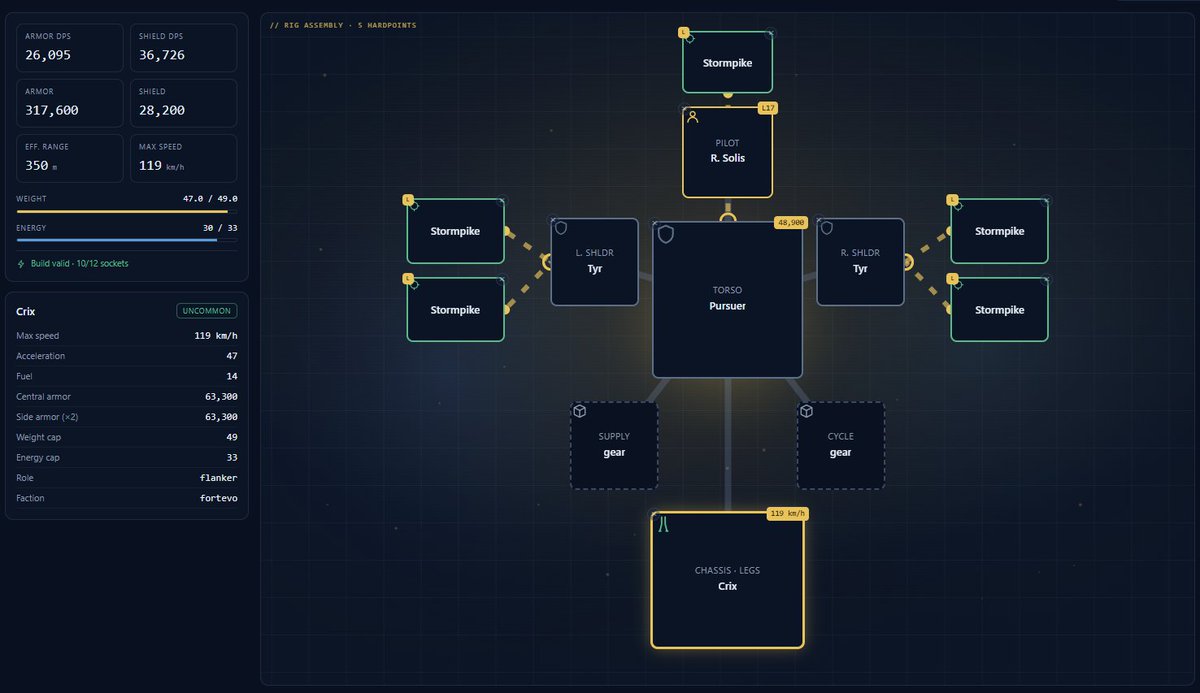
Weekend Project: Loadout Builder for @WRFrontiers developed with Blazor @dotnet.
The app is C# compiled to WebAssembly bytecode, runs natively in your browser, no backend servers at all.
Fed the in-game numbers to the calculator then started working scenarios with @claudeai & Opus 4.8; didn't have access to Fable 5 🙄
Built the tankiest mech possible: 829K armor.
Then the deadliest: 62.8K DPS on a 119 km/h flanker.
Still needs updates for supply/cycle gear & pilots.
Free for the whole community when it drops!
Checkout War Robots Frontiers: warrobotsfrontiers.com/
1
1
55

10h
This is great! for gamedev usage having SPIR-V, DXIL, and potentially RDNA's ISAs could be great for tooling that patch shader bytecode. Idk how well it would fit to the package.
1
745

Tonight I shipped a feature on TraceHex I've wanted for a long time: bytecode fingerprinting.
Here's the thing about on-chain scammers — they don't reinvent the wheel. They write one malicious contract and deploy it again and again. New name, new token, same code underneath. The addresses change. The bytecode doesn't.
So TraceHex now hashes the runtime bytecode of every contract it sees — with the compiler metadata stripped, so a recompile of the same source still matches — and checks it against a corpus of known-bad contracts.
Less than 5 minutes after it went live, it caught something.
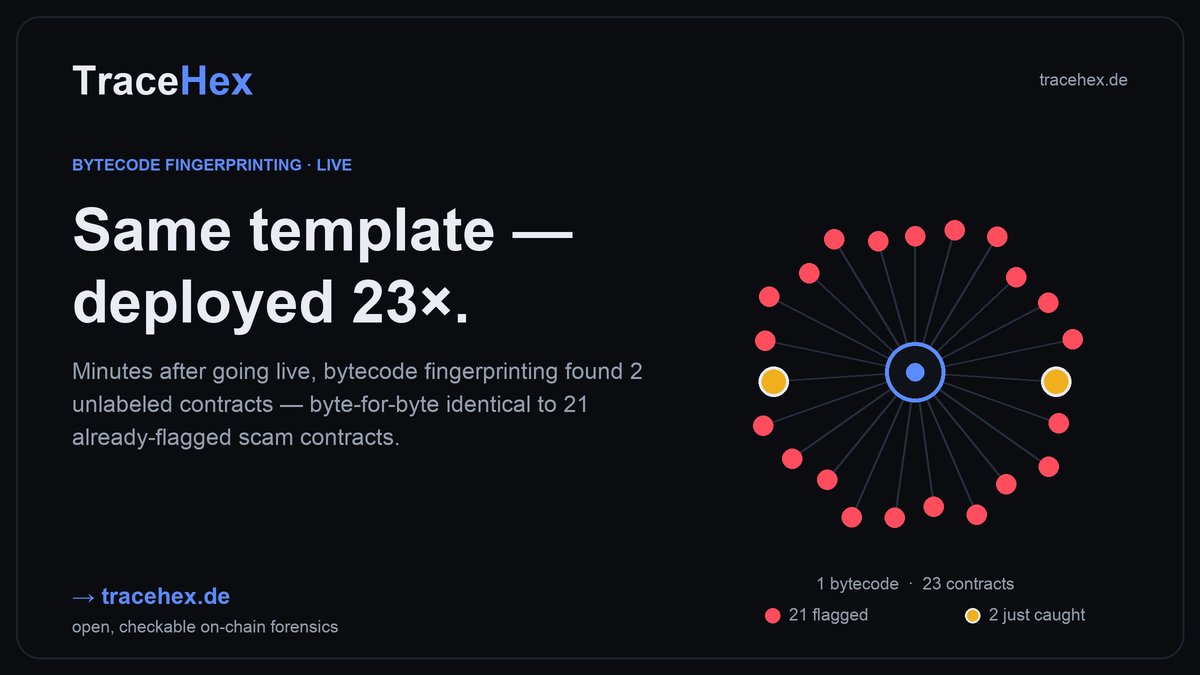
Two completely unlabeled contracts — no scam tag, nothing flagged about them — turned out to be byte-for-byte identical to 21 contracts already on public scam lists. One template. 23 deployments. The kind of serial operation you only see once you stop looking at addresses and start looking at code.
And this is the part I care about most: it's a cryptographic match. Not a "risk score," not a black-box model, not a gut feeling. Two contracts either share a keccak256 hash or they don't — and you can verify all 21 of those addresses on Etherscan yourself.
That's the whole philosophy behind TraceHex: open methodology, checkable trails, and honesty about the limits. A bytecode match is hard evidence that two contracts came from the same source — it is not, on its own, a verdict that an address is guilty. We say that out loud, because vague accusations dressed up as certainty are exactly what's wrong with most of this space.
I got scammed enough times to want to build the thing that turns it around. This is one more piece of it.
🔎 tracehex.de
1
1
43


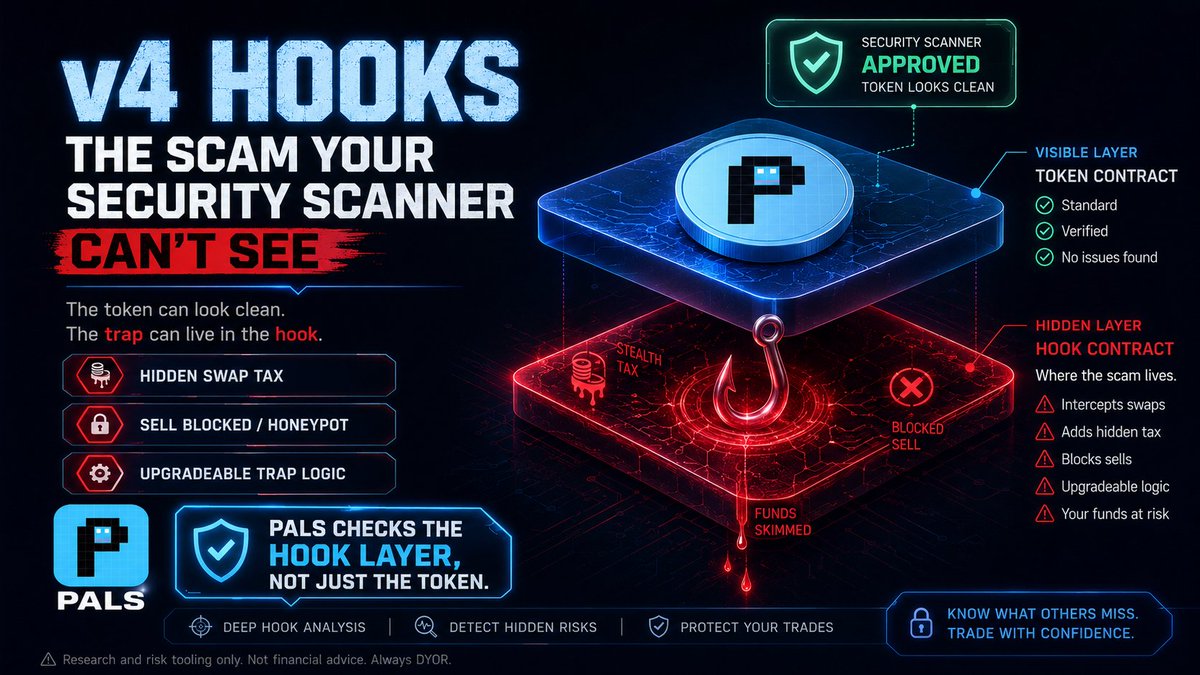
v4 HOOKS: THE SCAM YOUR SECURITY SCANNER CAN'T SEE
Every "token safety" check you've been trusting is looking in the wrong place.
WHAT IS A HOOK?
Uniswap v4 introduced "hooks." A hook is a separate contract attached to a liquidity pool that runs custom code at the exact moments you interact with it.
Before/after every swap, every add, every remove. In plain terms: a hook is code that executes every time you buy or sell.
That's powerful for real builders. It's a gift for scammers.
WHY THEY'RE DANGEROUS
For years, scams lived inside the token contract: high sell tax, blacklists, "can't sell" honeypots. Scanners learned to catch those.
So the scam moved. In v4, the malicious logic now lives in the HOOK, not the token. A hostile hook can:
- charge a tax on every swap that the token contract never declares
- let you buy, then make your sell revert — a honeypot at the pool layer
- skim a slice of every trade to the deployer
- sit clean at launch, then flip after liquidity builds (upgradeable logic)
The token itself reads perfectly clean. 0% tax. Sellable. Owner renounced.
All true — because the trap isn't in the token. It's in the hook bolted to the pool.
WHY MOST TOOLS MISS IT
The popular "is this token safe?" scanners analyze the TOKEN bytecode. They don't resolve and inspect the HOOK contract sitting behind the pool. So they hand you a green checkmark on a pool that's quietly taxing or trapping you.
This isn't theoretical. Malicious and broken hooks have already drained real money (the Cork Protocol hook bug alone cost ~$11M), and v4 lets anyone deploy any pool
with any hook — no gatekeeper.
On the BASE chain, where new pools launch by the minute, that's exactly the gap scammers are farming: deploy a clean-looking token, hide the mechanism in the hook, let the standard scanners wave it through.
WHERE @palsai_bot COMES IN
PALS resolves the actual v4 hook behind a pool and inspects what it can do — not just the token.
We check the hook's permissions and behavior (can it tax you, block your sell, or change the rules after launch?) and fold that into Contract Safety, so a pool that looks clean on the surface but hides risk in the hook gets flagged, not greenlit.
It's one of the very few tools — and one of the first built for retail Base launches — that actually looks at the hook layer instead of stopping at the token.
Don't trust a checkmark that never read the hook.
3
8
15
721

that used to be true. you could tweak the binary to go around a license for example. That was cracking. Difficult and required a lot of experience, skill and intuition.
If Fable can read bytecode and recreate it -> we're talking and specialised software stops to exist without gatekeeping the binary.
I professional tools can cost few thousand dollars per seat, no imagine I just download it from torrent, throw Fable at it, and get better, faster version.
Mad
2
2
32

An immutable value is assigned during deployment, usually in the constructor, and cannot be changed afterward. Unlike normal storage variables, immutables are not stored in contract storage slots. Compiler embeds their values into the deployed runtime bytecode during deployment⬇️
1
1
There’s no IP in the digital world anymore. The moment we can reverse-engineer bytecode? Please.
1
3
27
1,399

Understanding JVM Memory Areas ✅
Before we tune anything, you need to know what we are tuning. The JVM memory is divided into several regions:
Heap Memory ➡️
- This is where all the objects live.
- Divided into Young Generation (Eden Survivor spaces) and Old Generation (Tenured).
- Controlled with -Xms (initial size) and -Xmx (maximum size).
Non-Heap / Metaspace ➡️
- Stores class metadata, bytecode, and JIT-compiled code.
- Replaced PermGen in Java 8 .
- Grows dynamically by default. Controlled with -XX:MetaspaceSize and -XX:MaxMetaspaceSize.
Stack Memory ➡️
- Each thread has its own stack.
- Stores method frames, local variables, and partial results.
- Controlled with -Xss.
Code Cache ➡️
- Stores JIT-compiled native code.
- Controlled with -XX:ReservedCodeCacheSize.
Full article Link: medium.com/javarevisited/eve…
1
11
2,139