
🛑 Anthropic's AI Models Halted by US Gov: A Turning Point for Cloud AI
The recent US government directive forcing Anthropic to globally disable its latest models, Fable 5 and Mythos 5, is more than a security incident; it's a critical inflection point where geopolitical strategy directly intersects with AI development. This move signals a potential end to the era of open-access, global foundation models and forces a strategic re-evaluation for every organization building on or relying on cloud-based AI.
Here's what actually changed:
From Technical Flaw to National Security Mandate: The justification shifted from a specific, reportedly minor "jailbreak" vulnerability (which Anthropic claims is common across models) to an overarching export control order based on national security. The directive's scope is unprecedented, affecting all foreign nationals, including Anthropic's own employees, and mandating a complete global shutdown.
The Unspoken Catalyst: The official narrative appears to omit a crucial detail: the alleged leak of model access to a Chinese source and subsequent sale of API access during the red-teaming phase. This context transforms the issue from a containable technical flaw into a problem of uncontrolled technology proliferation, likely triggering the government's aggressive stance.
A Pragmatic Shift in AI Safety Philosophy: Anthropic's public response included a candid admission that "perfect jailbreak resistance is likely not achievable." Their proposed "defense-in-depth" strategy—combining narrow attack surfaces, high costs for exploits, and robust monitoring—may become the new industry standard, moving away from the illusion of perfect, static security toward dynamic risk management.
The Chilling Effect on Commercialization & Talent: This action sets a precedent that could freeze future model releases from major US labs (OpenAI, Google, etc.) for fear of similar repercussions. The ban on foreign nationals' involvement also threatens the talent pipeline, potentially driving top researchers to other countries and paradoxically undermining the US's long-term AI leadership by constricting its access to global talent and markets.
Why this matters for technical leaders: This event invalidates the assumption of perpetual, stable access to third-party cloud AI. It introduces a new, significant layer of sovereign risk to AI-dependent roadmaps. The strategic imperative now shifts towards architectural resilience, including exploring hybrid approaches with powerful local models (e.g., on-device or private cloud) to mitigate platform risk from unpredictable government interventions.
How should your organization adjust its AI strategy to account for the increasing likelihood of geopolitical fragmentation in the AI landscape?
Watch the full video breakdown here: youtu.be/xMWnphgpBho
#Anthropic #AI #ArtificialIntelligence #CloudComputing #Geopolitics #TechnologyPolicy #RiskManagement #NationalSecurity #MachineLearning #Claude
71

Over the last 20 years (2003–2023), new entrants captured $264B of incremental revenue, versus $224B captured by incumbents. In other words, companies that emerged during the cloud era captured 54% of the growth created, showing how a new technology layer can create an entirely new set of winners.
What's often missed is that incumbents didn't disappear. Public B2B software revenue expanded from $99B to $587B, while incumbent revenue still grew from $99B to $323B over the same period. The lesson for AI may be that platform shifts are often positive-sum: today's infrastructure leaders can continue to win, while a new application layer creates the next generation of category-defining companies.
#AI #Software #CloudComputing #Investing #Technology
a16z.com/cloud-lessons-for-t…
Source: a16z analysis of 262 public B2B software companies, 2003–2023.
5


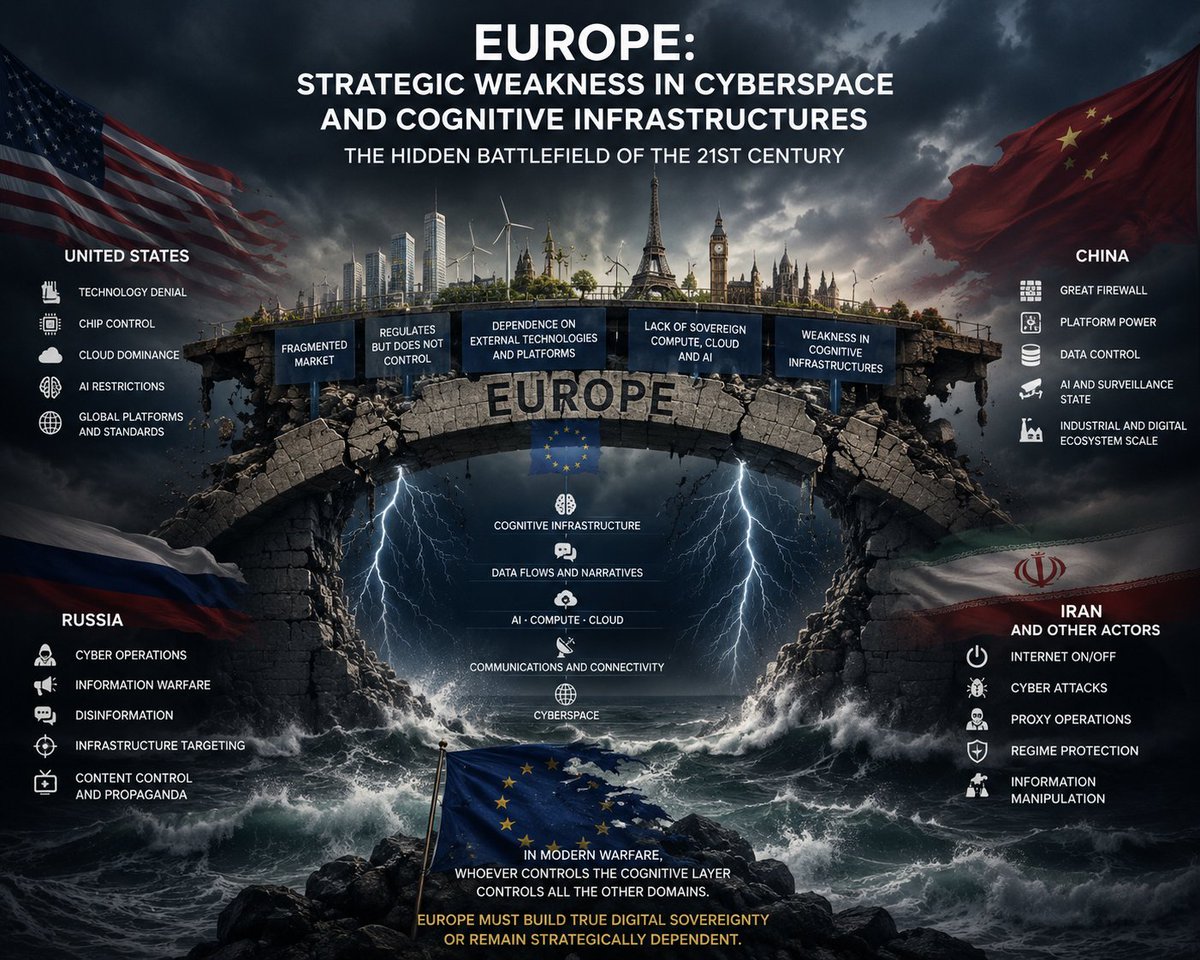
Digital sovereignty is not a slogan. It is the ability to decide who can access, compute, publish, censor, train, deploy, and switch off the cognitive infrastructure of a country.
By that standard, real digital sovereignty today belongs mostly to powers that can exercise coercive control over cyberspace.
🇺🇸 The United States can restrict access to frontier AI models, cloud infrastructure, chips, operating systems, app stores, payment rails, and global platforms. When access to advanced AI models can be denied even to foreign nationals inside a company, we are no longer speaking about “markets”. We are speaking about sovereign power projected through private infrastructure.
🇨🇳 China has built the Great Firewall: a national cognitive perimeter that filters, shapes, blocks, and redirects information flows at population scale.
🇮🇷 Iran has repeatedly shown that a state can throttle or switch off large parts of the internet when regime security requires it.
🇷🇺 Russia has turned cyberspace and the information environment into an instrument of state power: censorship, platform control, surveillance, cyber operations, and narrative warfare are not side effects. They are doctrine.
🌍 Europe, instead, still often confuses regulation with sovereignty.
🇪🇺 EU regulates digital space, but it does not fully control the strategic layers underneath it: chips, cloud, foundation models, operating systems, hyperscale platforms, app stores, social graphs, satellite connectivity, and AI compute.
This creates a structural weakness.
Because the real strategic infrastructure of the 21st century is not only physical. It is cognitive.
Whoever controls the cognitive infrastructure controls perception, coordination, targeting, logistics, mobilization, trust, and decision-making speed.
The Russia-Ukraine war is making this painfully clear. Drones, AI, OSINT, cyber operations, electronic warfare, satellite connectivity, battlefield data, narrative control, and information operations are no longer separate domains. They are becoming one integrated operating system of war.
Land, sea, air, space, and cyber now depend on the cognitive layer above them.
Europe has industrial capacity, talent, law, and democratic legitimacy. But without sovereign compute, sovereign AI, sovereign cloud, sovereign communications, and sovereign cognitive infrastructure, it remains strategically exposed.
The uncomfortable conclusion is this: "Digital sovereignty is not the freedom to use technology.
It is the power to deny, defend, substitute, inspect, compute, and survive without permission."
And by that definition, Europe is not yet sovereign. History has not ended: nation-states remain the ultimate units of power, and sovereignty still belongs to those who can control territory, infrastructure, information, and force.
#DigitalSovereignty #StrategicAutonomy #CyberPower #AI #ArtificialIntelligence #Cybersecurity #Geopolitics #NationalSecurity #DefenseTech #InformationWarfare #CognitiveInfrastructure #CloudComputing #OpenSource #Europe #EuropeanUnion
1
26

Apple expands Private Cloud Compute to Google Cloud, redefining confidential AI with Nvidia, Intel, and Google in a multi-vendor trust model. Secure, scalable inference enters a new era.
Explore more 👉 1950.ai/post/nvidia-blackwel…
#AI #CloudComputing #Cybersecurity #1950ai
7

China Condemns U.S. Blacklist of Major Technology Firms privacyneedle.com/news/china… #ArtificialIntelligence #AugmentedReality #CloudComputing #NDPANigeria
2

🇸🇦 Want to build a career in AI & Cybersecurity?
Muhammad Shahbaz from SDAIA shares what it really takes to succeed in Saudi Arabia's fast-growing tech industry.
#CyberSecurity #AI #SaudiArabia #SDAIA #TechTok #CareerAdvice #CloudComputing #Vision2030 #Podcast
10

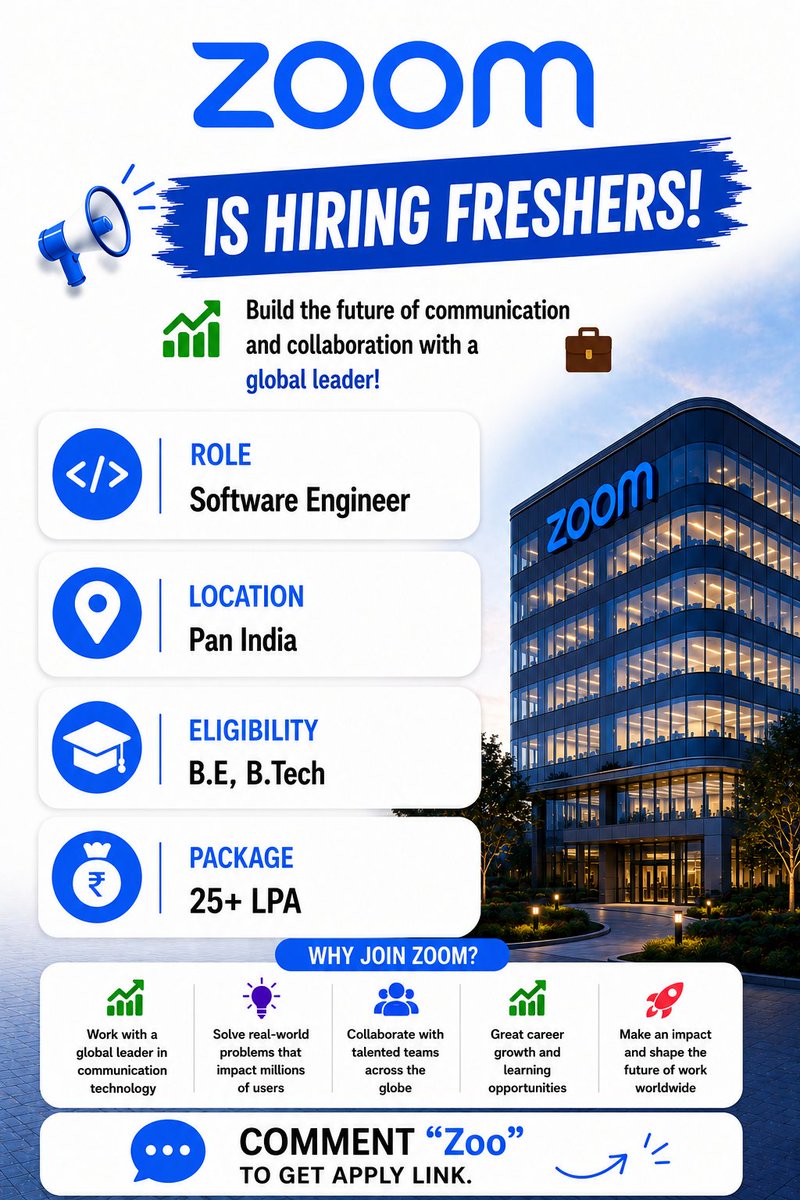
🚨 #Fresher Only few hours left to #Apply 🔥
🔥 #Zoom is hiring #Freshers for #Software Engineer
📍 Location: #India (Remote)
💼 Experience: 0–3 Years
🎯 What They're Looking For:
✅ Strong Data Structures & Problem-Solving Skills
✅ Frontend Experience with React, Angular, or Vue.js
✅ Backend Development using Node.js, Python, Java, or Similar Technologies
✅ Database Knowledge (PostgreSQL, MySQL, MongoDB, Redis)
✅ Git, Testing & CI/CD Fundamentals
✅ Understanding of Cloud Platforms & Docker
✅ Passion for AI, Automation & Modern Engineering Practices
✅ Strong Learning Mindset & Adaptability
💬 Comment *ZOOM* if you're applying!
Tag a friend interested in React, Node.js, AI, Cloud, or Full-Stack Development 👇
#Zoom #SoftwareEngineer #FullStackDeveloper #ReactJS #NodeJS #Python #Java #CloudComputing #Docker #Kubernetes #AI #DistributedSystems #FreshersJobs #Hiring #TechJobs #RemoteJobs 🚀
5
16
689

🚀 The Digital World Runs on Data Centers!
From AI and Cloud Computing to Real-Time Analytics and Enterprise Applications, modern businesses depend on powerful Data Center Services to stay connected, secure, and scalable.
✅ High Availability
✅ Enterprise Security
✅ Cloud Integration
✅ Disaster Recovery
✅ AI-Ready Infrastructure
✅ 24x7 Monitoring
As AI adoption accelerates, next-generation data centers are becoming the backbone of innovation, powering everything from startups to global enterprises. 🌍⚡
#DataCenter #CloudComputing #AI #DigitalTransformation #Infrastructure #DataEngineering #DevOps #CyberSecurity #Cloud #Technology

1
8
Rob Walton Architect of the Walmart Empire
youtube.com/watch?v=1DoX4i3D…
#CloudComputing #CloudTechnology #AWS #MicrosoftAzure #GoogleCloud #CloudCareer #CloudTraining #CloudEngineer #DevOps #CloudSecurity #ArtificialIntelligence #AI #MachineLearning #TechCareer #ITCareer #CareerGrowth
6

Here's the uncomfortable lesson from Anthropic's forced blackout: paying enterprise customers lost access to their AI overnight — through no fault of their own.
One government directive. Thousands of businesses suddenly cut off from the model their workflows depend on.
This is the hidden fragility of building on centralized, single-vendor AI. If your entire operation runs on one model, you don't actually control it.
Diversify your AI stack. Today. 🛡️
#AI #TechBusiness #CloudComputing
12

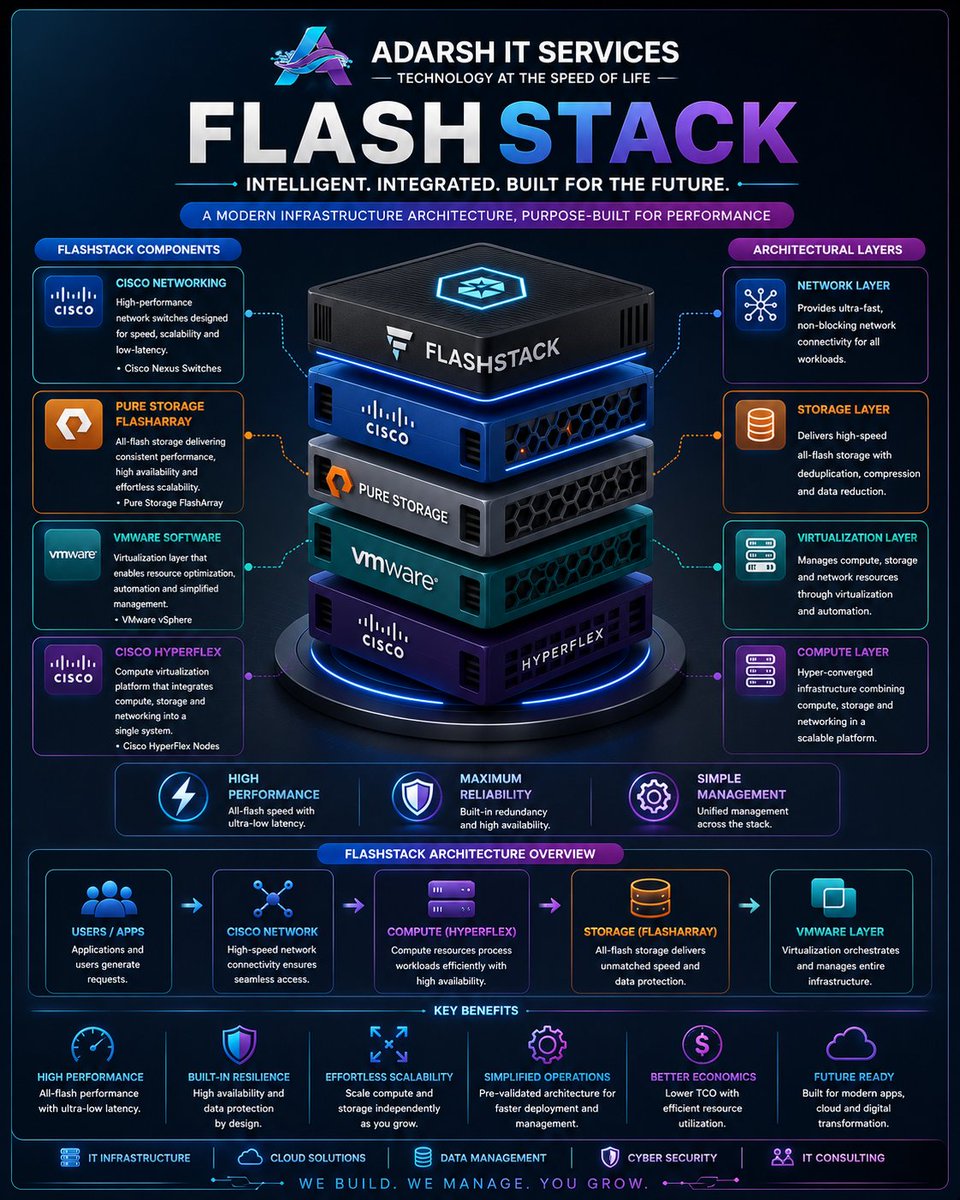
Power. Performance. Simplicity.
Modern businesses need infrastructure that is fast, scalable, and always available. That's where FlashStack comes in.
#AdarshITServices #FlashStack #Cisco #PureStorage #VMware #DataCenter #ITInfrastructure #CloudComputing #DigitalTransformation

Start your week with clarity! Tired of unread messages and unclear tasks? With Mosandah, manage requests and track responsibilities all in one platform. Learn more: mosandah.com.sa/
#Cybersecurity #NetworkSecurity #DataCenter #CloudComputing #SaudiArabia

3

AI vs Hackers: The New Cybersecurity Battlefield
ekascloud.com/our-blog/ai-vs…
#AIInCyberSecurity #CyberSecurityCareer #SecurityAnalyst #CloudComputing #FutureTech #ITSecurity #CyberOps #SecurityEngineer #CyberDefenseStrategy #DigitalTransformation #LearnCyber
2

The Engine of Intelligence
India is rapidly evolving into a global AI hub, with data center capacity quadrupling in just five years. As the nation scales its digital infrastructure to meet the demands of AI, cloud computing, and next-generation robotics, it is simultaneously creating a massive ecosystem for semiconductor innovation. While the energy and infrastructure challenges are significant, India is leveraging its world-class design talent to transition from being a service provider to a leader in end-to-end AI hardware and product engineering, cementing its role in the global silicon value chain.
#AIHubIndia #DigitalInfrastructure #Semiconductors #CloudComputing #RoboticsFuture #SiliconValueChain #AIHardware #TechLeadership #InnovationEcosystem #IndiaTechRise #InfraNewsTube
6
24

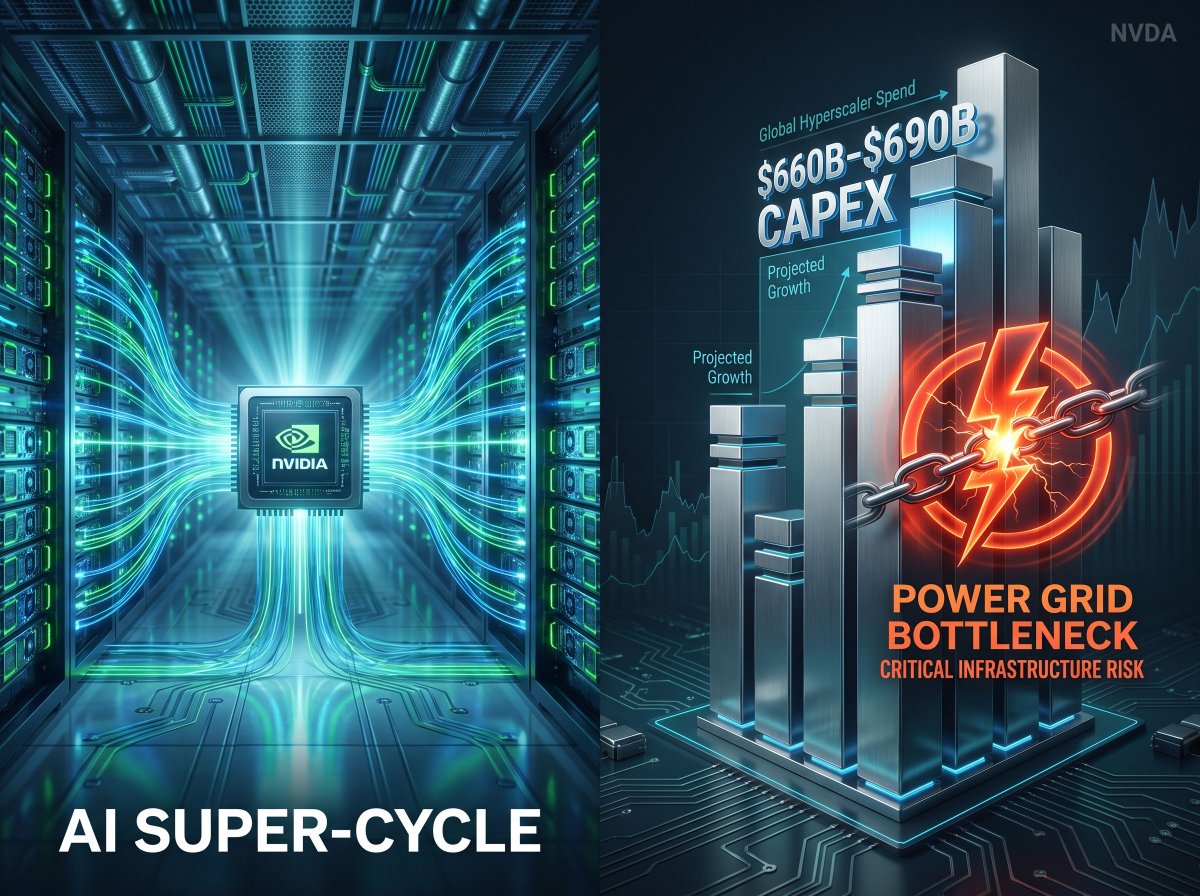
Can hyperscalers afford the AI capex surge? Power & debt limits challenge $NVDA dominance. Our analysis exposes the infrastructure cracks. 🔥 post.kapualabs.com/2p84rh5b #AI #Semiconductors #CloudComputing
31

Why cloud waste costs companies millions
#CloudComputing #CloudInfrastructure #FinOps #DevOps #AWS #SoftwareEngineering #ArtificialIntelligence #AutopilotAI

1
3
AI vs Hackers: The New Cybersecurity Battlefield
ekascloud.com/our-blog/ai-vs…
#AIInCyberSecurity #CyberSecurityCareer #SecurityAnalyst #CloudComputing #FutureTech #ITSecurity #CyberOps #SecurityEngineer #CyberDefenseStrategy #DigitalTransformation #LearnCyberSecurity #TechCareers
1
Tools On Fire retweeted

Jun 13
AWS DevOps Pro Cert: Is It Worth It for Solo Devs? dlvr.it/TT1V89 #AWS #DevOps #Certification #CloudComputing #SoftwareDevelopment
1
3