
Jun 10
First: tighten the factual framing
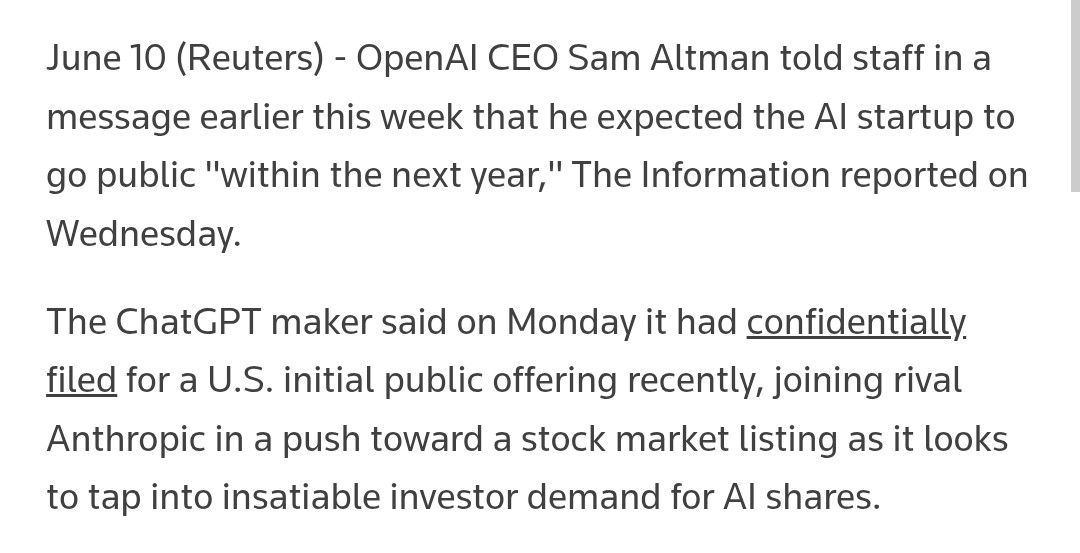
I would avoid saying “Sam Altman admitted OpenAI may be less than six months away from RSI” unless the original Information piece explicitly says “less than six months.” Reuters’ summary says Altman reportedly told staff OpenAI may go public “within the next year,” and that a faster-looking RSI takeoff could make delaying the IPO advantageous. Reuters also says OpenAI had nothing to add beyond its public statement. OpenAI’s own public post confirms the confidential S-1 filing but only says timing is undecided and that some things may be easier while private; it does not mention RSI.
A stronger, safer version:
The real story is not just that OpenAI filed confidential IPO paperwork. It is that Altman reportedly treated recursive self-improvement as a live contingency serious enough to influence IPO timing. If RSI is close enough to affect a trillion-dollar capital-markets decision, it is close enough to demand explicit public governance, disclosure triggers, and independent verification.
That framing is more defensible than “admitted,” and it turns the post from alarm into analysis.
Stronger thesis
The most important implication is not “OpenAI may delay an IPO.”
It is this:
Recursive self-improvement would make OpenAI’s corporate form a matter of global governance, not merely company finance.
A normal IPO asks: “What is this company worth?”
An OpenAI IPO near RSI asks: “Can public markets, quarterly reporting, fiduciary duties, analyst calls, securities law, and shareholder incentives safely govern a company whose own products may soon accelerate the creation of successor AI systems?”
That is the core missing frame. The IPO is a proxy battle over institutional control during a possible capability discontinuity.
The key missing distinction: RSI is not one thing
Most public discussion treats “recursive self-improvement” as a binary: either the AI can improve itself or it cannot. That is too crude.
Use a ladder:
LevelCapabilityWhy it mattersRSI-0AI assists human researchers with code, papers, debuggingAlready normal frontier-lab workflowRSI-1AI writes meaningful portions of model-training, eval, infra, or data-pipeline codeProductivity acceleration, but humans still directRSI-2AI proposes experiments, runs them, analyzes failures, recommends next runsResearch loop compression beginsRSI-3AI-generated ideas produce validated model improvements beyond ordinary scalingThis is the first real “self-improvement” thresholdRSI-4AI designs important parts of a successor system: architecture, training method, synthetic data, evals, scaffoldingHuman role shifts from creator to governorRSI-5AI autonomously executes a successor-building loop with only high-level human approvalGovernance crisis; “private company” vs “public company” becomes inadequate languageRSI-6Successor systems improve the loop itself, reducing cycle time each generationClassic takeoff concern
Anthropic’s current public framing is similar in spirit: it describes RSI as the point where systems could fully design and develop their own successors, while also saying “we are not there yet” and that RSI is not inevitable.
Your post gets much stronger if you say: “The key question is which rung of RSI Altman means.”
The best line to add
If RSI is material enough to delay an IPO, it is material enough to disclose, define, audit, and govern.
That sentence is the whole argument.
Missing elements that would make the post far more powerful
1. Define the exact trigger
The public should not accept “RSI” as a vibes-based phrase. The useful questions are:
What would count as RSI internally? A model writing research code? A model proposing training improvements? A model creating a successor model? A model improving the entire R&D loop faster than humans can evaluate?
Without a trigger definition, “RSI” can be used as hype, warning, justification, or strategic ambiguity.
2. Separate “AI helps researchers” from “AI replaces the research loop”
OpenAI has publicly said it wants to build an automated AI researcher and that, by March 2028, it may have a significant fraction of its research being done by AI systems alongside researchers. That is important context because it shows OpenAI already treats AI-accelerated research as a central strategic goal, but the public statement is still meaningfully different from “RSI this year.”
A good post should say:
The distinction that matters is not whether AI writes code. It is whether AI can generate, validate, and compound improvements to the systems that generate the next systems.
3. Explain why being private is “advantageous”
The phrase “good reasons to be a private company” is doing a lot of work.
Possible reasons:
Private companies can control disclosure more tightly. They can make rapid governance changes without market reaction. They can delay publication of sensitive technical information. They can restructure partnerships, compute commitments, safety protocols, or government relationships with fewer public-market constraints. They can also avoid the immediate pressure of quarterly expectations.
But that is exactly the problem: the very reasons private status is useful to the company may be the reasons the public should worry.
4. Add the securities-law angle
The SEC allows confidential draft registration statements to be reviewed nonpublicly, but companies eventually need to publicly file before a roadshow or effectiveness timeline. The SEC also describes the IPO “quiet period” as the period around filing when issuer communications must comply with securities laws.
That creates a strange dynamic:
The closer OpenAI gets to IPO, the more its communications become legally constrained; the closer it gets to RSI, the more society needs clear communication.
That is a non-obvious tension worth adding.
5. Treat RSI as potentially material non-financial information
An ordinary S-1 discloses revenue, risk factors, customer concentration, infrastructure costs, lawsuits, and governance. But for a frontier AI lab, the most material facts may be capability-related:
Can the model autonomously do AI R&D?
Can it discover vulnerabilities?
Can it design successor models?
Can it defeat existing evals?
Can it accelerate cyber, bio, persuasion, or autonomous-agent risks?
Your argument becomes stronger if you say:
For an AI frontier lab, model capability is not PR. It is material operating information.
6. Add the tender-offer question carefully
Reuters reports that Altman also told staff OpenAI was preparing a tender offer “very soon” at a current share price of $687.69, according to The Information.
This raises a careful, non-accusatory question:
If frontier capability expectations are changing quickly, how are employees, tender-offer participants, and future IPO investors being given symmetrical information about the company’s internal RSI expectations?
Do not allege wrongdoing. Frame it as governance.
7. Add OpenAI’s mission tension
OpenAI’s Charter says it aims to ensure AGI benefits everyone and avoid undue concentration of power; it also says its “primary fiduciary duty is to humanity.”
That is a strong contrast with the IPO question:
If OpenAI’s primary fiduciary duty is humanity, then RSI timing cannot be treated as merely a private financing variable.
That line is potent.
8. Public Benefit Corporation does not solve everything
OpenAI has said its for-profit arm would become a Public Benefit Corporation under nonprofit control, and that a PBC considers both shareholder interests and mission.
But a PBC is still a corporate wrapper. It does not automatically answer the hard questions:
Who decides when the system is too capable to continue training?
Who has veto rights?
Who sees the evals?
Who verifies the safety case?
Who can force disclosure?
Who represents non-shareholders?
A strong addition:
“Public benefit” is not the same thing as public accountability.
The obscure but important angles
The “disclosure singularity”
At exactly the moment OpenAI may possess the most socially material information in its history, it may also have the strongest incentives to disclose less: security, competition, valuation, regulation, national security, and IPO timing.
That is the disclosure singularity: maximum public relevance, minimum public visibility.
The “valuation inversion”
Before RSI, valuation is based on products, revenue, enterprise adoption, margins, compute costs, and market size.
Near RSI, valuation becomes based on research velocity: how quickly the company can turn intelligence into more intelligence.
That means traditional IPO metrics may become lagging indicators. The real asset is not ChatGPT revenue. The real asset is the internal loop that improves the next model.
The “quiet-period paradox”
An IPO quiet period exists to prevent market conditioning and unfair promotion. But a frontier lab near RSI may need to communicate constantly about fast-changing risk. Securities discipline and AI-risk transparency may pull in opposite directions.
The “private-control paradox”
Altman’s reported logic may be rational: public markets are poorly suited to governing a sudden technical discontinuity.
But the counterpoint is devastating:
If RSI is too unstable for public markets, why is it stable enough for private corporate control?
The “capability overhang” problem
RSI may not appear as a single model release. The dangerous capability might exist internally before the public sees it: autonomous experiment pipelines, synthetic data generation, model-written evals, automated red-teaming, architecture search, tool-using research agents, and self-debugging training infrastructure.
The public model could look incremental while the internal research factory has already changed phase.
The “benchmark blindness” problem
Most people will look for RSI in consumer benchmarks. That is probably wrong.
The key benchmarks are not “Can it write a poem?” or “Can it beat a coding test?”
The key benchmarks are:
Can it generate a better training run?
Can it identify why a model failed?
Can it design evals humans did not think of?
Can it improve data quality?
Can it reduce inference cost?
Can it find architectural improvements?
Can it compress the lab’s research cycle time?
The “cycle-time metric”
The most important RSI metric may be:
How long does it take OpenAI to go from research idea → experiment → validated improvement → deployed successor?
If that cycle shrinks from months to weeks to days, the takeoff question becomes real even without sci-fi autonomy.
The “governance-before-capability” failure mode
Most institutions wait for capability proof before governance. RSI may require the opposite: governance must be in place before the proof is obvious, because after the proof, the system may already be changing too quickly.
Concrete “genius-level” solutions to propose
1. Create an RSI disclosure framework before IPO
OpenAI, Anthropic, Google DeepMind, xAI, Meta, and others should publish a common RSI taxonomy. It should define levels of AI contribution to frontier AI R&D, from basic coding assistance to autonomous successor creation.
This would reduce strategic ambiguity and make the public conversation less dependent on leaks.
2. Require a “Frontier AI Risk Supplement” in any IPO filing
For frontier AI labs, the S-1 should include a dedicated section on:
AI R&D automation
cyber/bio/autonomous-agent evals
model-weight security
compute governance
deployment tripwires
board-level technical oversight
government notification protocols
catastrophic-risk insurance or reserves
material capability-change disclosure policy
This would be the AI equivalent of risk-factor disclosure, but built for capability rather than ordinary business risk.
3. Independent RSI audit board
A private company near RSI should not self-certify its own safety posture.
There should be an independent technical audit board with access to internal evals, system cards, training-run logs, incident reports, and red-team results. It should include people with security clearance where needed, but also non-government civil-society representation.
4. Dual-key frontier training
For models above a defined threshold, frontier training runs should require dual authorization:
one key from the company, one key from an independent oversight body.
That does not mean publishing model weights or trade secrets. It means high-consequence training runs cannot be unilaterally authorized by executives under competitive pressure.
5. Capability tripwires
OpenAI should define in advance what happens if a model crosses certain thresholds.
Examples:
If a model can autonomously improve training infrastructure, trigger external review.
If it can design successor-model components, trigger a pause-and-audit period.
If it can evade internal evals, trigger containment protocols.
If it can generate novel cyber or bio workflows, restrict deployment and notify relevant authorities.
If AI-generated research contributes above a certain percentage of validated frontier improvements, trigger RSI governance mode.
6. A public “research acceleration index”
Instead of revealing sensitive details, labs could publish a delayed, aggregated index showing how much frontier research is AI-assisted.
For example:
percentage of research code AI-authored
percentage of experiments proposed by AI
percentage of accepted research ideas AI-originated
average experiment-cycle time
number of autonomous eval failures
number of human interventions required per research loop
This would give society a signal without exposing dangerous details.
7. Compute attestation
RSI is not just software. It depends on compute, energy, chips, networking, data centers, and deployment infrastructure.
A serious governance regime would include compute attestation: verified records of frontier training runs, cluster size, run duration, and safety authorization. It does not need to reveal proprietary model details to the public, but regulators or trusted auditors should be able to verify that companies are not secretly running beyond agreed thresholds.
8. AI R&D provenance logs
Every AI-generated contribution to a frontier model should be logged.
Did the model propose the architecture change?
Write the training code?
Select data?
Design evals?
Interpret failures?
Recommend scaling changes?
Debug alignment failures?
Without provenance, labs may not even know how much of their own progress is recursively AI-driven.
9. Emergency corporate-governance mode
OpenAI should define a special governance state triggered by RSI proximity.
In that state:
board meetings become more frequent
safety leadership gains veto rights
external auditors get expanded access
deployment freezes become easier
employee whistleblower channels are strengthened
government notification protocols activate
major commercial releases require additional review
10. A “humanity fiduciary” mechanism
OpenAI’s Charter language about a fiduciary duty to humanity is morally ambitious but institutionally vague. A stronger mechanism would be a legally defined fiduciary or trustee class representing non-shareholder interests.
This could include public-interest trustees with access to safety-relevant information and the power to delay frontier deployment under defined conditions.
Counterarguments you should include to look intellectually honest
Counterargument 1: This may be strategic signaling
OpenAI may benefit from making RSI sound close: it can justify staying private, attract talent, maintain investor excitement, frame regulation, and respond to Anthropic’s recent RSI warnings. Anthropic recently called for coordinated, verifiable pauses around frontier AI development, warning that AI systems could soon improve themselves faster than society can manage.
So the post should not assume every reported statement is pure technical disclosure. It may also be capital-markets strategy.
Counterargument 2: RSI may be bottlenecked by reality
Even if AI can produce better ideas, recursive improvement may be slowed by compute, energy, chips, data-center construction, evaluation quality, deployment risk, security review, and the need for real-world feedback.
Self-improvement is not magic. A model cannot think new GPUs into existence.
Counterargument 3: “AI can improve AI” does not imply explosive takeoff
There may be a long middle zone where AI improves model development but humans still control direction, verification, and deployment. That could be transformative without being an uncontrollable intelligence explosion.
Counterargument 4: OpenAI’s public timeline language is less dramatic
OpenAI’s own recent public plan says it may have a significant fraction of research done by AI systems alongside researchers by March 2028. That sounds like major AI-accelerated research, but not necessarily autonomous RSI within months.
This is why your post should say “reportedly treated RSI as a live contingency,” not “confirmed RSI is six months away.”
Questions journalists should ask Altman directly
What exact internal definition of RSI is OpenAI using?
What probability does OpenAI assign to RSI in 2026?
Which internal evals suggest RSI may be near?
Is the relevant capability AI-assisted research, autonomous research, or autonomous successor-model creation?
What would trigger an IPO delay?
Would RSI proximity be disclosed in the S-1 risk factors?
Who inside OpenAI can force a pause if RSI thresholds are crossed?
Does the nonprofit board have full access to frontier-model evals and training-run data?
Are employees participating in tender offers given the same material information about RSI expectations?
Has OpenAI briefed governments on its RSI timeline?
What external experts have audited the internal evidence?
What are the “good reasons” to remain private during RSI, and why should the public trust those reasons?
A stronger rewritten version of your paragraph
The most significant detail in the report is not the IPO timeline. It is that Sam Altman reportedly treated recursive self-improvement as a live variable in OpenAI’s capital-markets strategy. According to Reuters’ summary of The Information, Altman told staff that if OpenAI’s technology advances toward AI systems creating new AI on their own, the case for a quick IPO could weaken; he reportedly said that the faster RSI takeoff looks, the more advantageous it may be to delay going public. That turns RSI from a theoretical safety debate into a material corporate-governance issue. If the possibility of RSI is serious enough to affect IPO timing, it is serious enough to require explicit definitions, independent audits, disclosure triggers, and public-interest oversight. The question is no longer just “When will OpenAI go public?” It is “What institutional structure should govern a company that believes it may be approaching recursive self-improvement?”
Punchier version for X / LinkedIn
The IPO is not the story.The story is that Altman reportedly sees recursive self-improvement as close enough to affect whether OpenAI should go public.If RSI is material enough to delay a trillion-dollar IPO, it is material enough to define, disclose, audit, and govern.“Stay private because the world may change in surprising ways” is exactly the kind of sentence that should make everyone ask: who gets visibility when the world starts changing?
Strongest closing line
The danger is not simply that OpenAI might reach RSI. The danger is that the first serious signs of RSI may appear inside a private company, inside confidential filings, inside internal evals, and inside tender-offer math—before society has agreed who is allowed to know, who is allowed to decide, and who is allowed to stop.
Jun 10

The most significant part of this report to me was Sam Altman admitting OpenAI may be less than six months away from Recursive Self Improvement.
According to the report from The Information if OpenAI does hit RSI this year, then the IPO could be delayed. They quote Sam Altman as saying 'The faster the potential RSI takeoff looks like it could be, the more it could be advantageous to delay an IPO' because the 'technology and the world may change in surprising ways, and there might be good reasons to be a private company during that time.'
2
3
675

Thank you @BailioJaja! We're proud to be of service and help our fellow developers increase their productivity!
#CodeProductivity
#AICodeCompletion
#Tabnine
2