Dope Mankind retweeted

Jun 10
🔥 Coinlive Goes To SuperAI Singapore 2026
Check out the highlights of Day 1!
@superai_conf
youtube.com/shorts/A6pn3cJrk…
1
77


📢 Coinlive App Sunset Reminder
The Coinlive app will be discontinued on May 31 (June 1, 00:00 UTC).
Before then:
✅ Locked $XR — unlock & redeem (Team can support manual unlock afterwards)
⚠️ Particle wallet assets — MUST WITHDRAW ALL ASSET
🔑 OKX & IOST wallets — BACK UP your Private Key
Full details → See our Discord
🔗discord.com/channels/1135841…
33
4
16
72,226

🔷 What is Startale App?
@StartaleApp is positioned as the all-in-one "SuperApp" of the @StartaleGroup and @soneium ecosystems; it is designed to make the open digital economy simple, secure, and connected.
Developed as a product of the ongoing partnership with Sony Block Solutions Labs, the application combines wallets, assets, and blockchain-based applications in a single intuitive experience.
🧩 Mini Apps Concept
Mini Apps allow developers to develop applications directly on Soneium without having to create separate websites; this ensures seamless integration between applications and the blockchain ecosystem. Coinlive
The application eliminates the seed phrase requirement thanks to account abstraction and removes traditional barriers to the transition to Web3 by offering gas-free transactions.
🎮 Available Mini Apps (11 Apps)
The currently active apps are:
@AOGuardians_xyz – An RPG that blends action and idle gameplay, with over 3 million downloads worldwide
@BurrowBash – A high-risk arcade game where the reward increases with each successful hit, but one mistake eliminates you
@clash_horse – Competitive horse racing; players predict the race, horses and tracks can be customized with collectible skins
@coolcats – A creative interactive game based on the well-known NFT IP
@DiceOrDieGame – A tactical roguelike where each character is a six-sided die
@ ElHexa – A card-based RPG with free on-chain and off-chain card trading
@heroesofhecanos – A turn-based strategy game; Seasons can be competed in and real prizes can be won.
@MMPgame – A cozy RPG with yield-farming mechanics.
@packflipNFT – A Soneium marketplace where physical collectible cards are traded digitally.
@pocketknights_ – A collectible card game offering fast sessions and deep strategy.
@worldoftrinity – An on-chain card strategy game where winning, competing, and building reputation are possible.
💰 Economy: Startale USD & STAR Points
Startale USD (USDSC) is a dollar stablecoin built on M0's universal stablecoin infrastructure, fully backed by US Treasury bonds. It can be purchased with USDC.e or ETH.
Starale's STAR Points system earns 1 point daily for every $100 spent, offers up to 2x multipliers for longer periods, and can be used for special rewards and ecosystem airdrops.
app.startale.com/sign-up?cod…
🏗️ Developer Program: Startale Superstars
This incubation program offers developers advantages such as access to the Soneium ecosystem of over 260 projects, hundreds of test users, direct access to Startale's investor and partner network, and premium placement in the Startale App. #Startale @0xRamz
1
12
219
🚀 Introducing $XR Stake & Earn
Stake $XR → Unlock the Exclusive Campaign
Earn from a daily $XR Pool
✅ Always available (no campaign windows)
✅ Min 20,000 $XR to stake
✅ Rewards = Stake Points Trade Points
Trade more. Earn bigger. ⚡️
👉 app.xraders.com/staking
#xraders #coinlive $XR #staking #earncrypto

16
2
16
110,573

📢 IMPORTANT: Coinlive app sunsets end of May 2026
If you have locked $XR on Coinlive, please unlock & redeem before May ends.
Individual support available through end of 2026 for users unable to redeem in time.
$XR ecosystem will continue on app.xraders.com.
Something new drops tomorrow for $XR holders 🔜
#coinlive #xraders
17
1
23
85,850


Mar 17
1
3
17
Mar 17
1
3
21
Mar 17
1
3
21

Mar 13
🇯🇵 日本、イランに対する戦争への参加を拒否
高市早苗首相が正式に発表しました:
日本は自衛隊を派遣してホルムズ海峡の機雷除去を行いません。
彼女の理由:紛争が続く中、機雷除去は他国に対する「武力の行使」と見なされる可能性があり、日本国中の平和主義憲法で禁止されている。ただし、日本自身の存立が脅かされる場合を除きます。
彼女は付け加えました:「自衛隊の資産が近辺に展開されて機雷を除去する光景を想像できません。」
「同意します。これは常識です。」
何が起こっているのかを分解してみましょう。🧵
---
**Tweet 1 — 発表**
2026年3月12日。日本衆議院予算委員会。
高市の正確な言葉:
「自衛隊の資産が(海峡の)近辺に展開されて機雷を除去する光景を想像できません。」
彼女は、イランがこの水路に機雷を敷設したとされることについての質問に答えていました。
[出典: The Straits Times, JIJI Press, Wall Street Journal, 2026年3月11-12日]
---
**Tweet 2 — 憲法上の論理**
日本の平和主義憲法(第9条)は、国際紛争の解決のための武力行使を禁止しています。
高市は説明しました:
もし機雷が武装攻撃の一部として敷設された場合、活動中の紛争中にそれらを除去することは、それらを敷設した国に対する武力行使と解釈される可能性があります。
それは許可されていません—日本自身が攻撃を受けている場合を除きます。
戦争が正式に終了すれば、それらの機雷は「放棄された」ものと見なされ、除去は憲法上許容される可能性があります。
[出典: The Straits Times, Coinlive, 2026年3月12日]
---
**Tweet 3 — 1991年の前例**
これは日本初の機雷除去論争ではありません。
1991年4月—湾岸戦争終了から1か月以上後—日本はペルシャ湾に6隻の掃海艇を展開しました。
それらは10月まで活動し、イラクが敷設した機雷を除去しました。
それは第二次世界大戦以来の日本初の海外軍事展開でした。
しかし注意:戦争はすでに終わっていました。機雷の法的地位は明確でした。
今日の状況?明確さとは程遠いです。
[出典: The Straits Times, Coinlive, 2026年3月]
---
**Tweet 4 — 実践的な問題**
高市は困難さを認めました:
「武装攻撃の一部として敷設された機雷が、いつ放棄された機雷になるかを予測するのは、実践的に非常に困難です。」
翻訳:戦争の霧の中で、法的な明確さは存在しません。
だから日本はコミットメントより慎重さを選びます。
[出典: JIJI PRESS, 2026年3月12日]
---
**Tweet 5 — 日本の露出**
なぜこれが重要か:
→ 日本は中東から原油の90%以上を輸入
→ ホルムズ海峡を通過する部分が大きい
→ タンカーはすでに標的に(3月11日にONE Majestyコンテナ船が被弾)
→ 日本は戦略備蓄から8,000万バレルを放出することを発表
賭けは巨大です。それでも東京は軍事関与にNOと言います。
[出典: The Straits Times, Polish Press Agency, 2026年3月]
---
**Tweet 6 — 外交ルート**
高市は3月19日にワシントンでトランプと会談します。
彼女は目標を明確にしました:「状況を落ち着かせるための議論を深める。」
日本の立場:
✅ イランの攻撃を非難
✅ 外交的解決を促す
✅ 軍事作戦には参加しない
✅ 自国民とエネルギー供給を保護
それはバランスの取れた行為—ワシントンとの同盟と憲法上の制約の間です。
[出典: The Straits Times, NHK, Mainichi, 2026年3月]
---
**Tweet 7 — 結論**
「これは常識です。」
証拠があなたを支持します。
日本は直面:
→ 武力行使の憲法上の制限
→ 活動中紛争中の機雷の不明確な法的地位
→ 自衛隊が関与した場合のエスカレーションのリスク
→ 地域への巨大なエネルギー依存
だから東京は言います:「外交で助けます。石油備蓄を放出します。自国民を守ります。しかし、活動中の戦場で機雷除去のために部隊を送りません。」
それは弱さではありません。慎重さです。
そしてすでに火がついている地域で、慎重さは知恵です。
🧭 私の仕事は決定指向の戦略分析に焦点を当てています。
解説ではありません。擁護ではありません。
私はインセンティブ、制約、二次的効果を分析します。
構造化された多層戦略分析はbio経由で入手可能。
⚖️ Marco | Independent Analyst
Mar 13

**🇯🇵 JAPAN REFUSES TO JOIN THE WAR AGAINST IRAN**
Prime Minister Sanae Takaichi just made it official:
Japan will NOT send Self-Defense Forces to remove mines in the Strait of Hormuz.
Her reasoning: While the conflict continues, mine clearance could be seen as "use of force" against another country—prohibited by Japan's pacifist Constitution unless Japan's own existence is threatened.
She added: "We cannot envision SDF assets being deployed in the vicinity to remove mines."
"I agree. This is common sense."
Let's break down what's happening. 🧵
---
**Tweet 1 — The announcement**
March 12, 2026. Budget Committee of Japan's House of Representatives.
Takaichi's exact words:
"We cannot envision that SDF assets will be deployed in the vicinity (of the strait) to remove mines."
She was responding to questions about Iran reportedly laying mines in the waterway.
[Sources: The Straits Times, JIJI Press, Wall Street Journal, March 11-12, 2026]
---
**Tweet 2 — The constitutional logic**
Japan's pacifist Constitution (Article 9) prohibits the use of force to settle international disputes.
Takaichi explained:
If mines were laid as part of an armed attack, clearing them during active conflict could be interpreted as using force against the country that laid them.
That's not allowed—unless Japan itself is under attack.
Once a war is formally concluded, those mines might be considered "abandoned," and clearance would then be constitutionally permissible.
[Sources: The Straits Times, Coinlive, March 12, 2026]
---
**Tweet 3 — The 1991 precedent**
This isn't Japan's first mine-clearing debate.
In April 1991—over a month after the Gulf War ended—Japan deployed six minesweepers to the Persian Gulf.
They operated until October, clearing mines laid by Iraq.
It was Japan's FIRST overseas military deployment since WWII.
But note: the war was OVER. The legal status of the mines was clear.
Today's situation? Far from clear.
[Sources: The Straits Times, Coinlive, March 2026]
---
**Tweet 4 — The practical problem**
Takaichi admitted the difficulty:
"It's practically very difficult to predict at what point mines laid as part of an armed attack would become abandoned mines."
Translation: In the fog of war, legal clarity doesn't exist.
So Japan chooses caution over commitment.
[Sources: JIJI PRESS, March 12, 2026]
---
**Tweet 5 — Japan's exposure**
Why this matters:
→ Japan imports over 90% of its crude oil from the Middle East
→ A significant portion transits the Strait of Hormuz
→ Tankers are already being targeted (ONE Majesty container ship hit March 11)
→ Japan just announced release of 80 million barrels from strategic reserves
The stakes are enormous. Yet Tokyo still says NO to military involvement.
[Sources: The Straits Times, Polish Press Agency, March 2026]
---
**Tweet 6 — The diplomatic track**
Takaichi will meet Trump in Washington on March 19.
She's made clear her goal: "deepen discussions toward calming the situation."
Japan's position:
✅ Condemns Iran's attacks
✅ Urges diplomatic solution
✅ Will NOT join military operations
✅ Will protect its nationals and energy supplies
It's a balancing act—between alliance with Washington and constitutional constraints.
[Sources: The Straits Times, NHK, Mainichi, March 2026]
---
**Tweet 7 — Bottom line**
"This is common sense."
The evidence backs you up.
Japan faces:
→ Constitutional limits on using force
→ Unclear legal status of mines during active conflict
→ Risk of escalation if SDF gets involved
→ Enormous energy dependence on the region
So Tokyo says: "We'll help with diplomacy. We'll release oil reserves. We'll protect our citizens. But we will NOT send troops to clear mines in an active war zone."
That's not weakness. That's prudence.
And in a region already on fire, prudence is wisdom.
🧭 My work focuses on decision-oriented strategic analysis.
Not commentary. Not advocacy.
I analyze incentives, constraints, and second-order effects.
Structured, multi-layer strategic analysis available via bio.
⚖️ Marco | Independent Analyst
3
20
50
5,805

Mar 13
**🇯🇵 JAPAN REFUSES TO JOIN THE WAR AGAINST IRAN**
Prime Minister Sanae Takaichi just made it official:
Japan will NOT send Self-Defense Forces to remove mines in the Strait of Hormuz.
Her reasoning: While the conflict continues, mine clearance could be seen as "use of force" against another country—prohibited by Japan's pacifist Constitution unless Japan's own existence is threatened.
She added: "We cannot envision SDF assets being deployed in the vicinity to remove mines."
"I agree. This is common sense."
Let's break down what's happening. 🧵
---
**Tweet 1 — The announcement**
March 12, 2026. Budget Committee of Japan's House of Representatives.
Takaichi's exact words:
"We cannot envision that SDF assets will be deployed in the vicinity (of the strait) to remove mines."
She was responding to questions about Iran reportedly laying mines in the waterway.
[Sources: The Straits Times, JIJI Press, Wall Street Journal, March 11-12, 2026]
---
**Tweet 2 — The constitutional logic**
Japan's pacifist Constitution (Article 9) prohibits the use of force to settle international disputes.
Takaichi explained:
If mines were laid as part of an armed attack, clearing them during active conflict could be interpreted as using force against the country that laid them.
That's not allowed—unless Japan itself is under attack.
Once a war is formally concluded, those mines might be considered "abandoned," and clearance would then be constitutionally permissible.
[Sources: The Straits Times, Coinlive, March 12, 2026]
---
**Tweet 3 — The 1991 precedent**
This isn't Japan's first mine-clearing debate.
In April 1991—over a month after the Gulf War ended—Japan deployed six minesweepers to the Persian Gulf.
They operated until October, clearing mines laid by Iraq.
It was Japan's FIRST overseas military deployment since WWII.
But note: the war was OVER. The legal status of the mines was clear.
Today's situation? Far from clear.
[Sources: The Straits Times, Coinlive, March 2026]
---
**Tweet 4 — The practical problem**
Takaichi admitted the difficulty:
"It's practically very difficult to predict at what point mines laid as part of an armed attack would become abandoned mines."
Translation: In the fog of war, legal clarity doesn't exist.
So Japan chooses caution over commitment.
[Sources: JIJI PRESS, March 12, 2026]
---
**Tweet 5 — Japan's exposure**
Why this matters:
→ Japan imports over 90% of its crude oil from the Middle East
→ A significant portion transits the Strait of Hormuz
→ Tankers are already being targeted (ONE Majesty container ship hit March 11)
→ Japan just announced release of 80 million barrels from strategic reserves
The stakes are enormous. Yet Tokyo still says NO to military involvement.
[Sources: The Straits Times, Polish Press Agency, March 2026]
---
**Tweet 6 — The diplomatic track**
Takaichi will meet Trump in Washington on March 19.
She's made clear her goal: "deepen discussions toward calming the situation."
Japan's position:
✅ Condemns Iran's attacks
✅ Urges diplomatic solution
✅ Will NOT join military operations
✅ Will protect its nationals and energy supplies
It's a balancing act—between alliance with Washington and constitutional constraints.
[Sources: The Straits Times, NHK, Mainichi, March 2026]
---
**Tweet 7 — Bottom line**
"This is common sense."
The evidence backs you up.
Japan faces:
→ Constitutional limits on using force
→ Unclear legal status of mines during active conflict
→ Risk of escalation if SDF gets involved
→ Enormous energy dependence on the region
So Tokyo says: "We'll help with diplomacy. We'll release oil reserves. We'll protect our citizens. But we will NOT send troops to clear mines in an active war zone."
That's not weakness. That's prudence.
And in a region already on fire, prudence is wisdom.
🧭 My work focuses on decision-oriented strategic analysis.
Not commentary. Not advocacy.
I analyze incentives, constraints, and second-order effects.
Structured, multi-layer strategic analysis available via bio.
⚖️ Marco | Independent Analyst
9
73
184
43,742

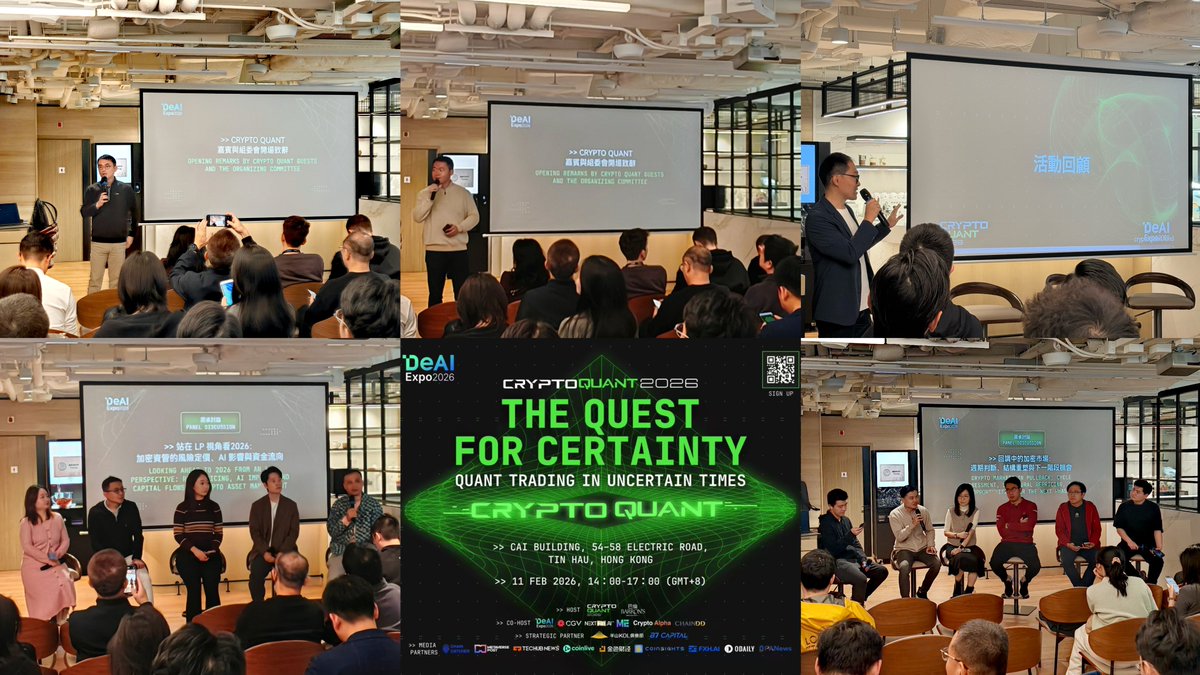
🚀 The Digital Quant 2026 Championship platform has officially launched
medium.com/@DeAIExpo/50daf75…
The platform launch introduced the official Digital Quant Championship competition and event system, revealing the competition framework, rules, service functions, and operational progress.
🌟 Kevin Ren (Initiator of Digital Quant 2026, Founder of CGV @KevinRen2019 ): Launching a Long-Cycle Live Trading Championship to Tackle the Industry’s “Black Box” Challenge
The championship emphasizes systemic engineering characteristics and enhances industry standards through professional discussions and compliance dialogue, creating efficient communication and value consensus among different asset management participants.
🌟 Nico Lee (Barron's China, Partner at TMTPost Group, President of ChainDD): High-Quality Quantitative Strategies Have Become the Dominant Approach for Institutional Crypto Allocation
The importance of quality quantitative strategies in institutional portfolios continues to rise. The platform will upgrade rules and mechanisms to select strategies with long-term effectiveness through “real funds, real data, real competition.”
🌟 Leo Deng (Co-initiator of Digital Quant 2026 @0xShigeru ): Launching the Official Platform to Build a “Digital Microscope” for Quantitative Trading
Live trading and data transparency are core features. Transaction data is synchronized via API and evaluated through a comprehensive scoring system, constructing an open and verifiable competitive environment to raise professional evaluation standards for quantitative strategies.
✨ Panel 1: Looking Ahead to 2026 from an LP Perspective: Risk Pricing, AI Impact, and Capital Flows in Crypto Asset Management
Moderator: Jane (CGV @CGVFOF VP)
Panelists:
Wu Jiang (Huaxing International @Official_CRSHK President)
Chris (AMINA Group @AMINABankGlobal Associate Director)
Charles (B7 Capital @B7CAPITAL CIO)
Xing Miao (Minghai Private Fund Investment Director)
✨ Panel 2: Crypto Markets in Pullback: Cycle Assessment, Structural Repricing, and Opportunities for the Next Phase
Moderator: Cynic (CGV @CGVFOF Analyst)
Panelists:
Franklin (AKG Ventures/Velocity @AkgVentures Research CEO )
Amanda (ChainUP @ChainUpOfficial Investment CIO)
QianshuiGuanchaYuan @connectfarm1 (Chenyu Group)
Jianbo Wang (Cybex Technologies HK CIO)
Cole Chen (Head of Greater China Marketing, Minara @minara)
🏛️ Hosts:
Digital Quant 2026, Barron’s China
🤝 Co-hosts:
DeAI Expo @DeAIExpo, CGV @CGVFOF, NextFin.AI @AsianFinPress, ME Group @CryptoFi_Forum, Crypto Alpha, ChainDD
🎯 Strategic Partners:
BS KOL Club @BSKolClub, B7 Capital
📰 Media Partners:
ChainCatcher @ChainCatcher_, Mpost @mpost_io, Techub News @Techub_News, Coinlive @CoinliveHQ, Jinse Finance @JinseFinance, Coinsights @coinsightslab, FeiXiaoHao @FeiXiaoHaoX, Odaily @OdailyChina, PANews @PANews
#DigitalQuant #AI #DigitalAssets #TradingCompetition #Consensus2026
3
5
1,506
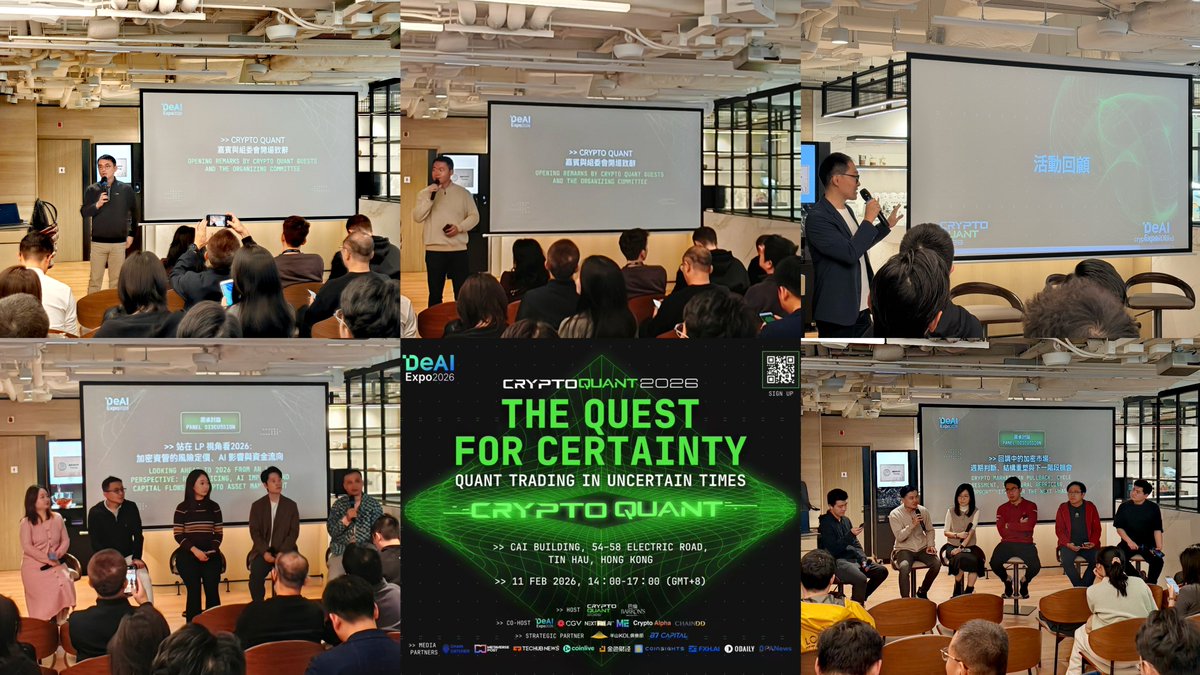
🚀Digital Quant 2026 大赛平台正式上线
medium.com/@DeAIExpo/50daf75…
活动发布了 Digital Quant 官方竞赛与活动平台,也首次披露了本届赛事的赛制框架、规则、服务功能和配套运营活动进展。
🌟Kevin Ren (Digital Quant 2026 发起人,CGV 创始人 @KevinRen2019 ):以长周期实盘大赛破解行业“黑盒”困境
大赛强调其系统性工程属性,通过专业研讨与合规讨论提升行业整体水平,并为资产管理中的不同参与方创造高效沟通与价值共识的场景。
🌟Nico Lee (Barron’s 巴伦中国,钛媒体集团合伙人,ChainDD 总裁):优质量化策略已成为机构投资者配置加密资产的主要方式
优质量化策略在机构配置中的重要性持续提升,平台将通过规则与机制升级,以“真实资金、真实数据、真实竞争”的方式筛选具有长期有效性的策略团队。
🌟Leo Deng (Digital Quant 2026 联合发起人 @0xShigeru ) :官方平台上线,打造量化交易的“数字显微镜”
实盘与数据透明机制是本次大赛的核心,通过 API 同步交易数据并采用综合评分体系,构建公开可验证的竞技环境,以提升量化策略评价的专业标准。
✨Panel 1:站在 LP 视角看 2026:加密资管的风险定价、AI影响与资金流向
主持人:Jane(CGV @CGVFOF VP)
嘉宾:
吴疆(华兴资本 @Official_CRSHK 海外业务负责人)
Chris(AMINA Group @AMINABankGlobal Associate Director)
Charles(B7 Capital @B7CAPITAL CIO)
邢淼(铭海私募基金投资总监)
✨Panel 2:回调中的加密市场:周期判断、结构重塑与下一阶段机会
主持人:Cynic(CGV @CGVFOF Analyst)
嘉宾:
Franklin(AKG Ventures/Velocity @AkgVentures Research CEO)
Amanda(ChainUP @ChainUpOfficial Investment CIO)
潜水观察员 @connectfarm1 (辰宇集团)
Jianbo Wang(Cybex Technologies HK CIO)
Cole Chen(Minara @minara 华语区市场负责人)
🏛️ 主办方:
Digital Quant 2026、Barron’s 巴伦中国
🤝 联合主办:
DeAI Expo @DeAIExpo、CGV @CGVFOF、NextFin.AI @AsianFinPress、ME Group @CryptoFi_Forum、Crypto Alpha、ChainDD
🎯 战略合作:
半山 KOL 俱乐部 @BSKolClubCN、B7 Capital
📰 媒体合作:
ChainCatcher @ChainCatcher_ 、Mpost @mpost_io 、Techub News @Techub_News 、 Coinlive @CoinliveHQ 、金色财经 @JinseFinance 、Coinsights @coinsightslab 、非小号 @FeiXiaoHaoX 、Odaily 星球日报 @OdailyChina 、PANews @PANews
#DigitalQuant #AI #DigitalAssets #TradingCompetition #Consensus2026
1
4
287

Feb 21
🚨Institutional Investors Just Dumped $8B in Stocks One of the Largest Weekly Sells Ever 🚨
According to an equity-flows summary from Longbridge/CoinLive, institutional investors sold a net ~$8.3 billion in U.S. equities last week, and this was described as the second-largest weekly institutional sale on record.
3
3
21
6,223

Feb 12
We’re starting the $XR adventure! 🚀
Join us on Coinlive, trade BTC up or down, and earn $XR together.
Who’s coming with us? coinliveapp.com/#/login?refe…

1
7
46,293
📢 $XR Buyback Announcement
The XR Foundation believes the current market capitalization (~294,000 USDT) does not reflect the fundamental value of the protocol.
Accordingly, the Foundation has initiated a $XR buyback program.
Buybacks will be conducted through open market purchases. The timing, frequency, and amounts will not be disclosed.
The Foundation intends to acquire a meaningful portion of the circulating supply over the coming month, subject to market conditions and treasury allocation.
This initiative reflects our long-term commitment to strengthening the $XR ecosystem.
#buyback #XRADERS #coinlive
5
5
19
79,243