
Build better construction projects with smarter decisions.
Use AI-powered insights to improve workforce planning, optimize resources, reduce delays, and deliver successful project outcomes with confidence.
#ConstructAI #ConstructionTechnology #AIInConstruction #ProjectPlanning
4
SmaSmarterrter workforce verification for construction.
Verify workers, track compliance, reduce hiring risks, and improve site safety with AI-powered workforce verification from Construct AI.
#ConstructAI #ConstructionTech #WorkforceVerification #SiteSafety
5


9 Apr 2025
#ConstructAI 感谢 @Aptos 和 @MovemakerCN 这次举办的 Aptos Evermove Hackerhouse 。感受到了 Aptos 对 Builder 的支持和生态发展的决心,此次有幸获得优秀开发者奖,接下来大家一起继续嘎嘎建设!


3
2
8
638

22 Mar 2025
Thinking too small! Distracted by the easy money. Today we use a "near-AI". Config params to mimic human behaviors. Great tool and key to creating a real virtual Intelligence.
I'm days away from my proto-build deployment.
World's 1st TRUE AI.
#ConstructAI changes everything.
1
2
136

20 Aug 2024
ConstructAI turns one today! 🎂🥳 A year has passed and what a journey. We're looking back on all we've achieved, but also looking forward for what's ahead. We're just getting warmed up... 🔥
#ConstructionNews #AI #ArtificialInteligence

2
139

3 Aug 2024
btw how tf did they entomb the fucking CONSTRUCTAI THEY ARE LIVING DRILLS
7
1
12
562

And then both Philip and I proceed to the #RICS #Members Cafe and knuckled down to business; but wow 🤯 what the team at #ConstructAI are seeking to do is just what I need. Not only are we going to progress my pet project @pqs2030 (via AIQS) we’re doing so unapologetically too 🎯


1
2
4
146

16 Apr 2024
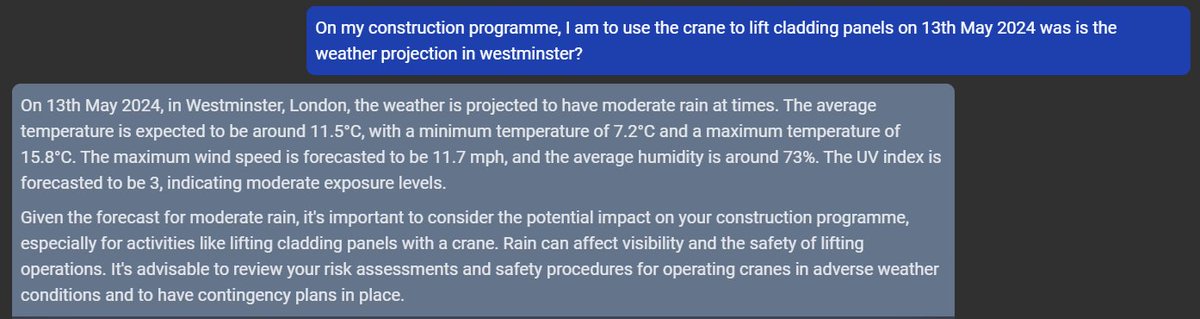
I told ConstructAI to give me weather forecast next month on a particular date as we going to lift cladding panels on site. It gave me a good place to start my planning.
The beautiful things you can do with @constructai_uk.
Sign up and check it out. AI is here. 🔥
2
13
4,110
3 Apr 2024
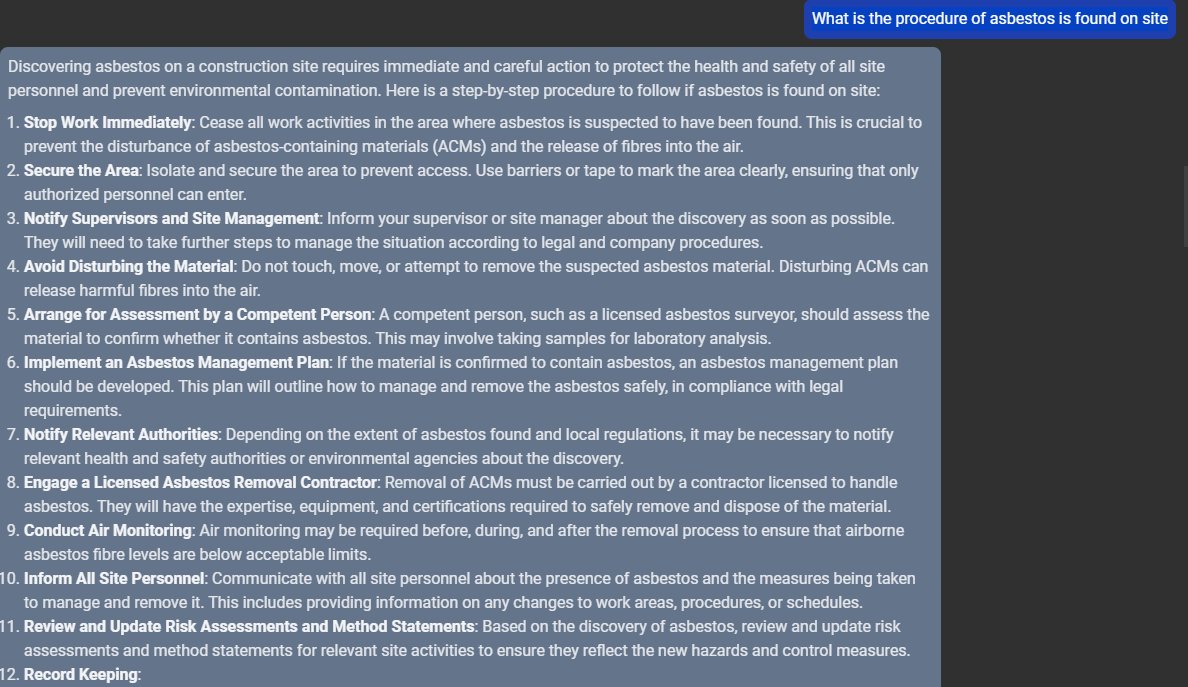
I asked ConstructAI : What is the procedure if asbestos is found on site?
Answer: Discovering asbestos on a construction site requires immediate and careful action to protect the health and safety of all site personnel and prevent environmental contamination. Here is a step-by-step procedure to follow if asbestos is found on site:
1. **Stop Work Immediately**: Cease all work activities in the area where asbestos is suspected to have been found. This is crucial to prevent the disturbance of asbestos-containing materials (ACMs) and the release of fibres into the air.
2. **Secure the Area**: Isolate and secure the area to prevent access. Use barriers or tape to mark the area clearly, ensuring that only authorized personnel can enter.
3. **Notify Supervisors and Site Management**: Inform your supervisor or site manager about the discovery as soon as possible. They will need to take further steps to manage the situation according to legal and company procedures.
4. **Avoid Disturbing the Material**: Do not touch, move, or attempt to remove the suspected asbestos material. Disturbing ACMs can release harmful fibres into the air.
5. **Arrange for Assessment by a Competent Person**: A competent person, such as a licensed asbestos surveyor, should assess the material to confirm whether it contains asbestos. This may involve taking samples for laboratory analysis.
6. **Implement an Asbestos Management Plan**: If the material is confirmed to contain asbestos, an asbestos management plan should be developed. This plan will outline how to manage and remove the asbestos safely, in compliance with legal requirements.
7. **Notify Relevant Authorities**: Depending on the extent of asbestos found and local regulations, it may be necessary to notify relevant health and safety authorities or environmental agencies about the discovery.
8. **Engage a Licensed Asbestos Removal Contractor**: Removal of ACMs must be carried out by a contractor licensed to handle asbestos. They will have the expertise, equipment, and certifications required to safely remove and dispose of the material.
9. **Conduct Air Monitoring**: Air monitoring may be required before, during, and after the removal process to ensure that airborne asbestos fibre levels are below acceptable limits.
10. **Inform All Site Personnel**: Communicate with all site personnel about the presence of asbestos and the measures being taken to manage and remove it. This includes providing information on any changes to work areas, procedures, or schedules.
11. **Review and Update Risk Assessments and Method Statements**: Based on the discovery of asbestos, review and update risk assessments and method statements for relevant site activities to ensure they reflect the new hazards and control measures.
12. **Record Keeping**:
1
8
3,169
3 Apr 2024
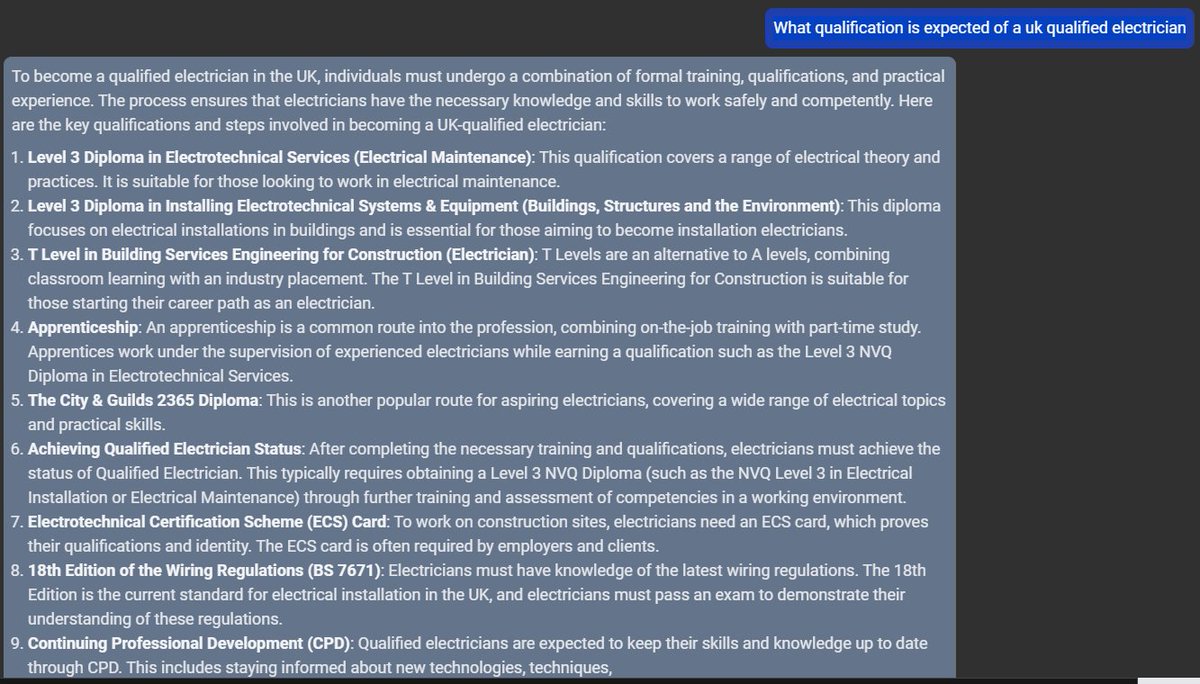
I asked ConstructAI : What qualification is expected of a UK qualified electrician?
Answer: To become a qualified electrician in the UK, individuals must undergo a combination of formal training, qualifications, and practical experience. The process ensures that electricians have the necessary knowledge and skills to work safely and competently. Here are the key qualifications and steps involved in becoming a UK-qualified electrician:
1. **Level 3 Diploma in Electrotechnical Services (Electrical Maintenance)**: This qualification covers a range of electrical theory and practices. It is suitable for those looking to work in electrical maintenance.
2. **Level 3 Diploma in Installing Electrotechnical Systems & Equipment (Buildings, Structures and the Environment)**: This diploma focuses on electrical installations in buildings and is essential for those aiming to become installation electricians.
3. **T Level in Building Services Engineering for Construction (Electrician)**: T Levels are an alternative to A levels, combining classroom learning with an industry placement. The T Level in Building Services Engineering for Construction is suitable for those starting their career path as an electrician.
4. **Apprenticeship**: An apprenticeship is a common route into the profession, combining on-the-job training with part-time study. Apprentices work under the supervision of experienced electricians while earning a qualification such as the Level 3 NVQ Diploma in Electrotechnical Services.
5. **The City & Guilds 2365 Diploma**: This is another popular route for aspiring electricians, covering a wide range of electrical topics and practical skills.
6. **Achieving Qualified Electrician Status**: After completing the necessary training and qualifications, electricians must achieve the status of Qualified Electrician. This typically requires obtaining a Level 3 NVQ Diploma (such as the NVQ Level 3 in Electrical Installation or Electrical Maintenance) through further training and assessment of competencies in a working environment.
7. **Electrotechnical Certification Scheme (ECS) Card**: To work on construction sites, electricians need an ECS card, which proves their qualifications and identity. The ECS card is often required by employers and clients.
8. **18th Edition of the Wiring Regulations (BS 7671)**: Electricians must have knowledge of the latest wiring regulations. The 18th Edition is the current standard for electrical installation in the UK, and electricians must pass an exam to demonstrate their understanding of these regulations.
9. **Continuing Professional Development (CPD)**: Qualified electricians are expected to keep their skills and knowledge up to date through CPD. This includes staying informed about new technologies, techniques,
1
9
36
7,299
3 Apr 2024
This is what ConstructAI said
Adding safety courses to your master's degree can significantly enhance your employability in the UK construction industry, especially in roles focused on health and safety, project management, or site supervision. Here are some key safety courses and certifications that are highly regarded in the UK construction sector:
1. **NEBOSH National Certificate in Construction Health and Safety**: This is one of the most respected health and safety qualifications in the UK and is specifically tailored for construction. It covers a wide range of health and safety issues relevant to construction projects and is ideal for those looking to develop a career in health and safety within the construction industry.
2. **IOSH Managing Safely**: The Institution of Occupational Safety and Health (IOSH) offers this course, which provides a broad understanding of health and safety issues. While it's not construction-specific, it's widely recognized across various industries, including construction, and provides a solid foundation in health and safety management.
3. **CITB Site Management Safety Training Scheme (SMSTS)**: This course is designed for site managers, agents, and persons who are, or are about to be, responsible for planning, organizing, monitoring, controlling, and administering groups of staff and workforce. It covers all relevant legislation and other aspects that affect safe working in the building, construction, and civil engineering industries.
4. **CITB Site Supervisors' Safety Training Scheme (SSSTS)**: Similar to SMSTS but tailored for site supervisors, this course focuses on the legal responsibilities regarding health, safety, welfare, and environmental issues on construction sites.
5. **CITB Health and Safety Awareness**: This one-day course is aimed at individuals just starting out in the construction industry. It can be used as a pathway to obtaining a CSCS Labourer (Green) Card, which is often required for entry-level positions on construction sites.
6. **First Aid at Work**: A first aid qualification is invaluable in any workplace. The First Aid at Work course covers a wide range of CPR and first aid skills, equipping you to respond to accidents and emergencies on construction sites.
7. **Fire Safety Awareness/Fire Marshal Training**: Understanding fire safety is crucial on construction sites due to the high risks involved. These courses teach how to prevent fires and how to act efficiently if one breaks out.
8. **Asbestos Awareness Training**: Given the prevalence of asbestos in older buildings in the UK, this training is essential for anyone who might come into contact with asbestos-containing materials during their work.
When choosing courses, consider those accredited by recognized bodies
2 Apr 2024

Which safety courses do I need to add to my masters degree in the UK to boast my chance of getting a professional construction job?
2
4
18
6,407
3 Apr 2024
This is what ConstructAI said
Adding safety courses to your master's degree can significantly enhance your employability in the UK construction industry, especially in roles focused on health and safety, project management, or site supervision. Here are some key safety courses and certifications that are highly regarded in the UK construction sector:
1. **NEBOSH National Certificate in Construction Health and Safety**: This is one of the most respected health and safety qualifications in the UK and is specifically tailored for construction. It covers a wide range of health and safety issues relevant to construction projects and is ideal for those looking to develop a career in health and safety within the construction industry.
2. **IOSH Managing Safely**: The Institution of Occupational Safety and Health (IOSH) offers this course, which provides a broad understanding of health and safety issues. While it's not construction-specific, it's widely recognized across various industries, including construction, and provides a solid foundation in health and safety management.
3. **CITB Site Management Safety Training Scheme (SMSTS)**: This course is designed for site managers, agents, and persons who are, or are about to be, responsible for planning, organizing, monitoring, controlling, and administering groups of staff and workforce. It covers all relevant legislation and other aspects that affect safe working in the building, construction, and civil engineering industries.
4. **CITB Site Supervisors' Safety Training Scheme (SSSTS)**: Similar to SMSTS but tailored for site supervisors, this course focuses on the legal responsibilities regarding health, safety, welfare, and environmental issues on construction sites.
5. **CITB Health and Safety Awareness**: This one-day course is aimed at individuals just starting out in the construction industry. It can be used as a pathway to obtaining a CSCS Labourer (Green) Card, which is often required for entry-level positions on construction sites.
6. **First Aid at Work**: A first aid qualification is invaluable in any workplace. The First Aid at Work course covers a wide range of CPR and first aid skills, equipping you to respond to accidents and emergencies on construction sites.
7. **Fire Safety Awareness/Fire Marshal Training**: Understanding fire safety is crucial on construction sites due to the high risks involved. These courses teach how to prevent fires and how to act efficiently if one breaks out.
8. **Asbestos Awareness Training**: Given the prevalence of asbestos in older buildings in the UK, this training is essential for anyone who might come into contact with asbestos-containing materials during their work.
When choosing courses, consider those accredited by recognized bodies
1
190
28 Mar 2024
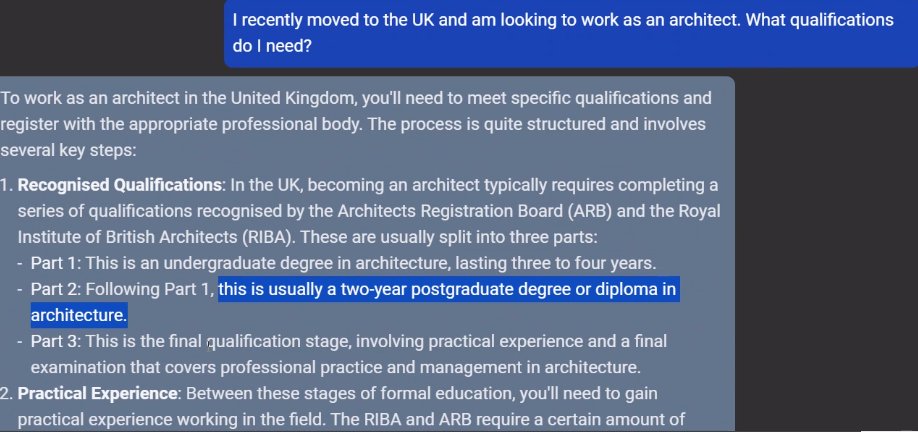
I asked ConstructAI that I just moved to the UK as an architect. How do I get a job?
The Answers were very impressive! A great starting point👏👏
As soon as my access is set up. We go enter well🔥🔥
2
23
4,049

7 Sep 2022
I believe that they're the first Constructai that recently got out of their tomb because they look very similar to the ancient Serpentine and they have explosives and giant metal fist that they just obtained which would be useful for breaking rocks

4