Filter
Exclude
Time range
-
Near
This weekend I wanted to learn Docker. Opened the docs. Got overwhelmed. Closed the docs. So I learned it the only way I know: > Ask dumb questions to gpt >Break stuff >Fix stuff Somehow ended up containerizing resumeX(resumex.rohann.tech).

1
1
10
Replying to @KansaiGaijinEng
For the record. Running the same app stack on native Linux used about 6GB of ram and barely any CPU. Turns out, using windows wsl and russian-doll containerizing everything has a cost. Who knew.
1
1
21
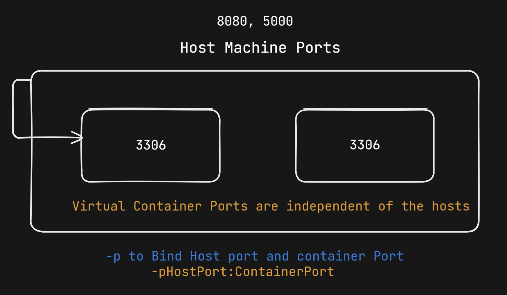
Resumed my Docker learning today 🐳 Learned the basics of Docker commands and how port binding connects containers to the host machine. One step closer to containerizing my projects. 🚀 #Docker #WebDev #BuildInPublic
3
1
39
Replying to @VeriCoin
Good move on containerizing the stack. Makes deployment and updates way cleaner, especially for running nodes across different environments. @VeriCoin follow back appreciated fr
9
Our next #JCON2026 session is live: 'Java Container Mastery: #Optimizing Images Across Build Tools' with @maeddes In today's #cloudnative landscape, containerizing #Java applications has become a standard practice, but the path to optimal … Grab your coffee and hit play: youtu.be/mQ9F-44ETYk
1
62
Kaslin Fields retweeted
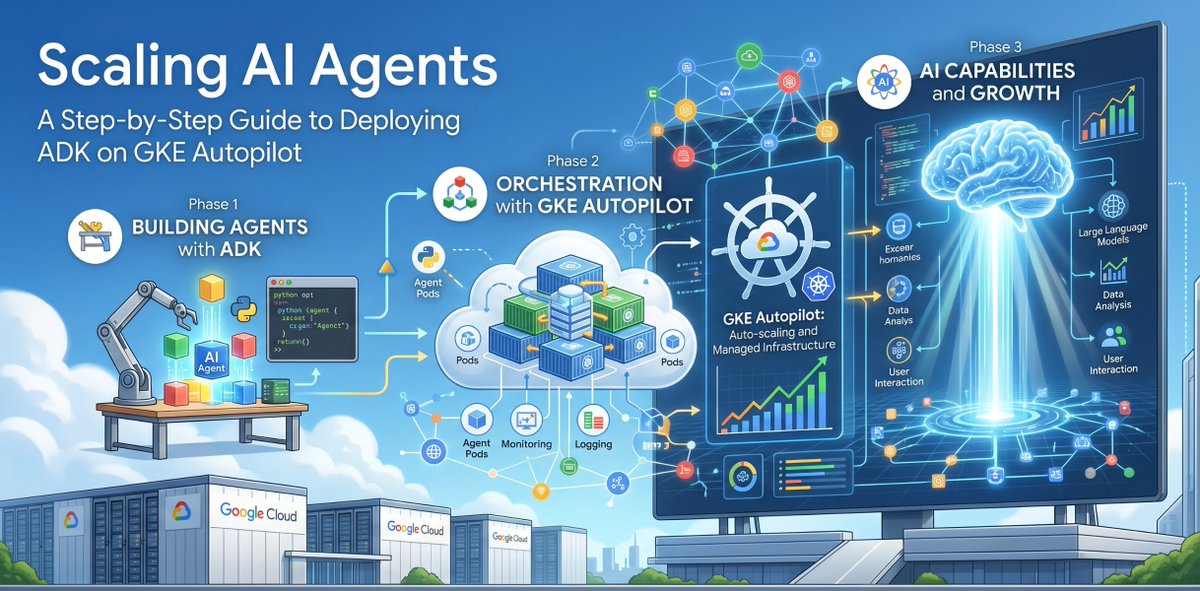
Deploy your AI agent to Kubernetes? Solid choice. I like that @boredabdel does a legit end-to-end example of containerizing, deploying, and configuring an ADK agent on @googlecloud GKE Autopilot. cloud.google.com/blog/topics…
2
7
17
1,372
6 steps to build an AI model, clearly explained: Building an AI model is not one decision but rather a whole pipeline where the algorithm is a single stage, and most of the failures happen in the stages around it. Getting it to production requires 6 steps. Here’s the full breakdown: > Step 1. Setting objectives The work starts before the first line of code, with a clear problem statement and a check on whether ML is even the right tool. That means identifying the use case, running a feasibility study, and defining the KPIs that decide what success looks like. The common failure is optimizing a metric that looks clean offline but has no link to the decision the model actually feeds. A model can win on AUC and still be useless if the threshold it runs at never matches how the output gets used. > Step 2. Data prep This is where most of the time goes, because no algorithm compensates for bad data. The work is collecting the data, cleaning it for missing values, outliers, and inconsistencies, engineering features, then splitting into train, validation, and test sets. One common trap is leakage. If cleaning or feature engineering happens before the split, information from the test set leaks into training, and the offline scores look better than the model really is. Time-ordered data makes it worse, since a random split lets the model look at the future during prediction. > Step 3. Choose the algo Now you pick the approach, like Random Forest, XGBoost, a neural network, etc. The choice depends on problem type, data size, interpretability needs, and latency budget, and the framework follows from that. The usual mistake is reaching for deep learning on tabular data where a gradient-boosted tree usually trains faster and works better. The second is picking a model that hits the metric but cannot be served within the latency the product requires. > Step 4. Train the model The prepared data feeds the model, and it learns, but training is not a single pass but rather a loop of tuning hyperparameters and testing configurations until performance plateaus. One common failure is tuning against the validation set so many times that it stops being a fair check. Every decision made by looking at the validation loss leaks a little signal, and the gap only shows up later on data the model never influenced. I wrote an article on this recently, which explains how to actually use train, validation, and test sets in ML. > Step 5. Evaluate and test Moving on, the held-out test set shows the real performance. You analyze the metrics that matter to the problem, like accuracy, precision, recall, F1, or AUC, and run bias testing across segments. Operational metrics like throughput, latency, etc., are equally important as well. > Step 6. Deploy and monitor The final step is containerizing the model, deploying it to the cloud, and setting up monitoring. Models degrade with time, so monitoring has to catch data drift before users do. One common failure is training-serving skew, where the features computed in production drift from the ones used in training. Without monitoring, nobody notices until the predictions have been wrong for weeks. These 6 steps explain the entire picture. The algorithm tends to get the most attention, but it is one box out of six, and the rest is engineering, infrastructure, and careful thinking. As further reading, I wrote a full article recently that explains how to actually use train, validation, and test sets in ML. Read it below.
10
18
72
7,560
#LSPPDay10 Started exploring Docker today. 🔹 Images vs Containers 🔹 Running apps in containers 🔹 Containerizing applications 🔹 Why Docker is a DevOps essential Learning to build once and run anywhere. 🚀 @lftechnology #60DaysOfLearning2026 #LearningWithLeapfrog
1
29
Replying to @timsneath
I like the idea of containerizing my local AI agents running on Apple Silicon. But I fear Linux muddies the water for hardware/software compat. Can we run the container and it’s Darwin with full app compatibility out of the box?
3
1,963
Containerizing BIDSme: A Reproducible Tool for BIDS Conversion Bradley Spitz, Antoine Jacquemin, Nikita Beliy, Christophe Phillips arxiv.org/abs/2606.09144 [𝚌𝚜.𝙳𝙱]
1
22
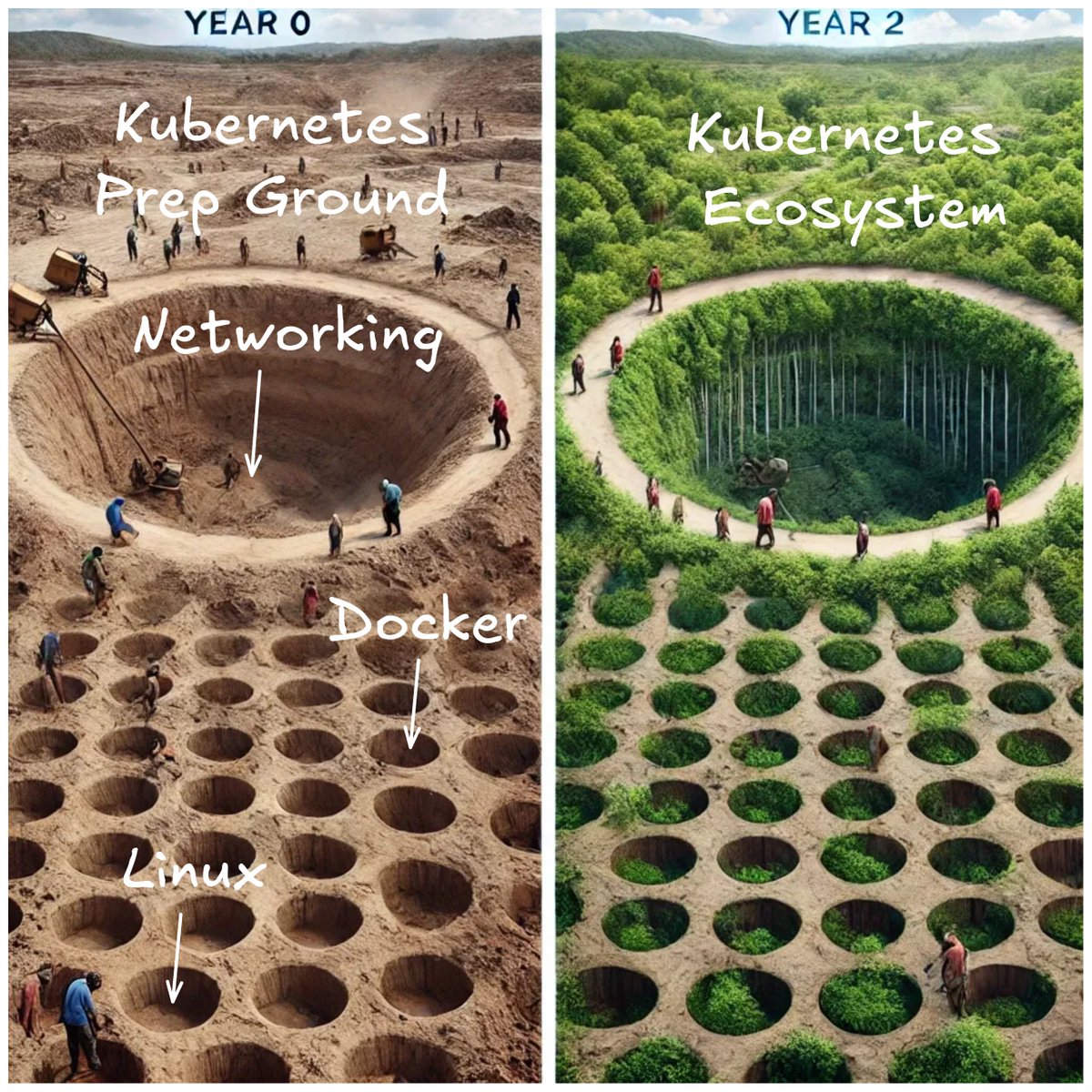
Linux → Networking → Docker → Kubernetes Not the other way around. Linux → For strong fundamentals Networking → For connecting everything Docker → For containerizing applications 48K read my DevOps and Cloud newsletter: techopsexamples.com/subscrib… What do we cover: DevOps, Cloud, Kubernetes, IaC, GitOps, MLOps 🔁 Consider a Repost if this is helpful
7
39
1,004
When recruiters search for candidates, they filter out 90% of applicants because they look like "hobbyists" who only know how to call an OpenAI API. This 7-day sequence completely destroys that perception by demonstrating five core traits of a senior-minded engineer: You can just follow me to build the Mindset that company looks: Recap: Day 1: The Foundation & Credibility 2 years in the ML trenches and the biggest realization? the math is cool but fighting CUDA out-of-memory errors and optimizing pipeline latency is where the real battle is lolgonna start sharing daily raw dev notes here—everything from scaling diffusion models and lora fine-tuning to optimizations that actually save compute costs.day 1/30. if you’re building in the genai space, let’s connect 🚀#mlops #genai #ai #buildinpublic Day 2: The Cost & Efficiency Angle day 2/30everyone loves talking about training models, but nobody talks about the absolute nightmare of scaling inference pipelines in production without burning through cloud budgets.spent a lot of time optimizing heavy genai and image synthesis models. the secret isn't just throwing more expensive gpus at the problem. it’s about aggressive quantization, smart memory management, and containerizing the infra so it scales down when idle.if your production pipeline is eating up all your compute, you’re doing it wrong lol#MLOps #GenAI #BuildInPublic Day 3: The Complex Architecture Hook day 3/30everyone wants to talk about prompt engineering, but if you’re actually building autonomous systems, the real challenge is dealing with agent state management and tool-calling latency.it’s one thing to get an llm to output a clean json payload in a notebook. it’s a completely different beast when you deploy multi-agent loops in production and have to handle race conditions, token limits, and broken api dependencies without the whole system crashing.reliable agents require strict orchestration layers, not just clever system prompts lol#LLMOps #AIAgents #GenAI Day 4: Deep Niche Problem Solving day 4/30if you’re working with diffusion models, you quickly learn that fine-tuning a lora is the easy part. the real nightmare is making sure it doesn't break the base model.you train it to get a perfect style, and suddenly the model forgets how to render basic human hands or backgrounds lolfixing this in production comes down to clean data and strict regularization, not just praying for a good checkpoint.if you’ve dealt with this, how do you handle dataset balancing? let me know 👇#DiffusionModels #GenAI #MLOps Day 5: Real-World Pragmatism day 5/30everyone is trying to build the next big ai app, but nobody wants to talk about how painful it is to maintain clean data pipelines for training.you can have the most advanced model architecture in the world, but if your dataset is filled with duplicate images, bad captions, or low-quality data, your model will output absolute garbage.in production, spending 80% of your time on data cleaning and preprocessing isn't a meme, it is the literal job. building automated filtering scripts saves way more compute than tweaking hyperparameters ever will.what is your biggest bottleneck when preparing data for fine-tuning?#MachineLearning #GenAI #MLOps #BuildInPublic Day 6: The Industry Call-Out (Viral Hook) day 6/30unpopular opinion: the ai/ml space has a major proof-of-concept problem.building a wrapper app or a cool prototype takes a weekend. but taking that prototype and turning it into a real, reliable production system that doesn't break under load is what separates junior devs from actual engineers.if you aren't thinking about model quantization, caching strategies, and strict latency budgets from day one, your app will fall apart the moment it gets real user traffic.stop chasing the hype of new model drops and focus on building robust infrastructure that actually scales.agree or disagree? let’s talk in the comments 👇#MachineLearning #MLOps #GenAI #BuildInPublic Day 7: The Advanced FinOps Mindset day 7/30everyone is rushing to build multi-agent workflows, but the biggest bottleneck nobody is talking about is token cost and latency compounding.when you chain three or four agents together, a single user request turns into ten different internal llm calls. if your agents are passing massive, unoptimized system prompts and entire conversation histories back and forth, you’re just lighting money on fire.building reliable agents isn't about making them "smarter" with longer prompts. it’s about aggressive context pruning, custom semantic caching, and knowing exactly when to hardcode a rule instead of letting the model guess.efficiency is going to separate the viable ai products from the bankrupt ones real soon.how are you guys optimizing token usage in your orchestration layers? 👇#LLMOps #AIAgents #GenAI #BuildInPublic

1
2
2
178
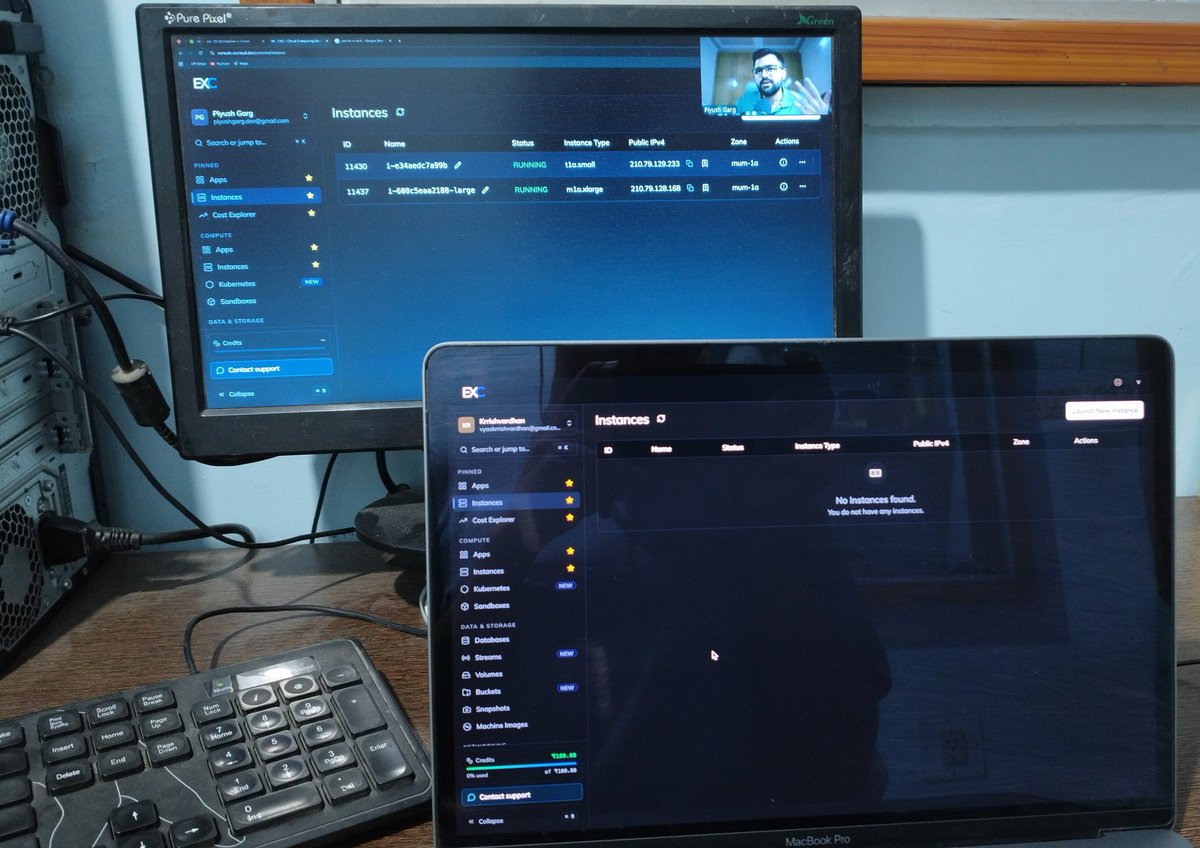
Class on DevOps by @piyushgarg_dev sir ✅ Topics: > CI/CD pipelines > SSH into an ubuntu machine > Containerizing application with docker > SSL certificate creation etc Honestly this class was really fascinating Deployment always scared me 😅 But today a lot of it got cleared
3
38
443
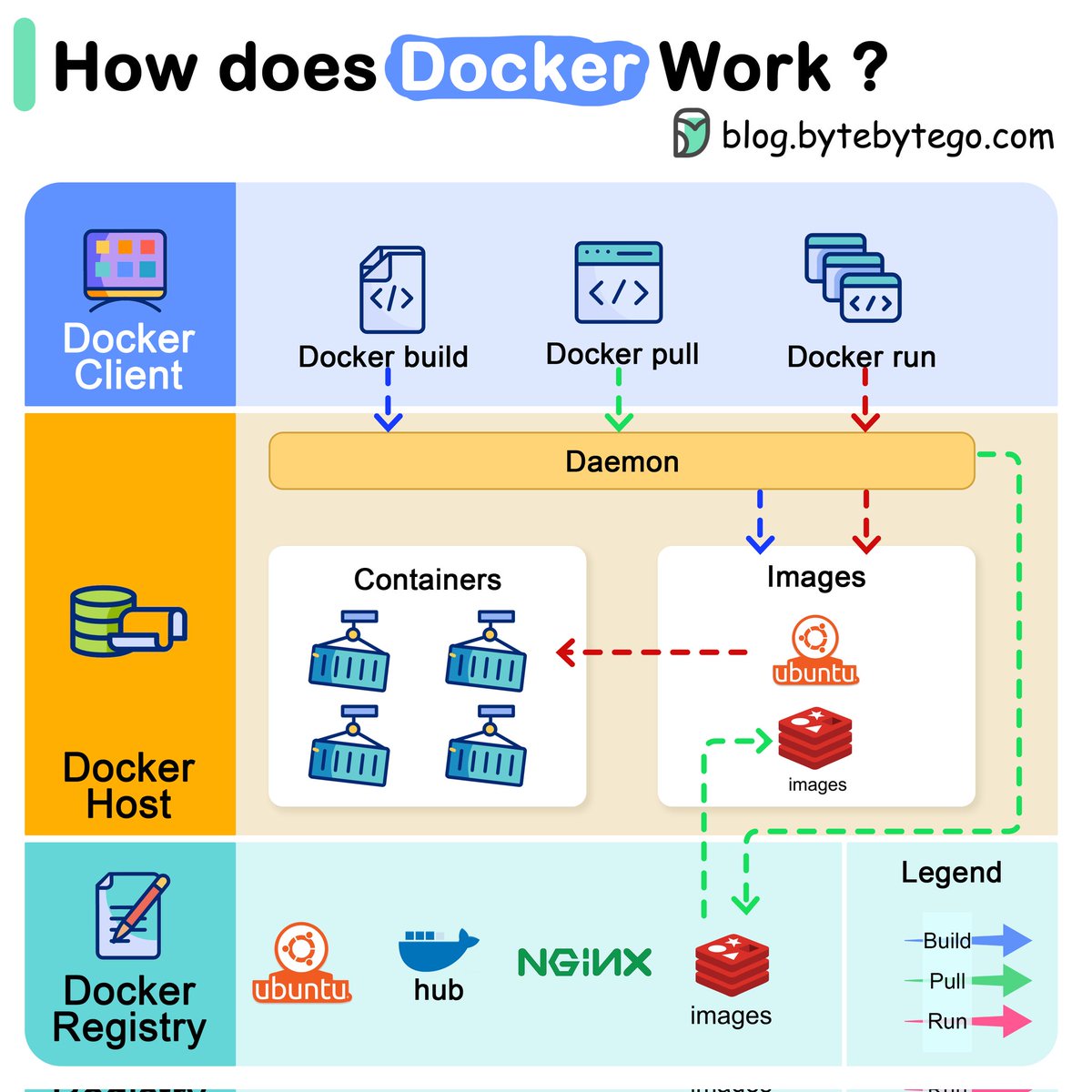
Docker might have the most dramatic origin story in the history of DevOps. It started as an internal project at a tiny company called DotCloud in 2013. The company was struggling. The product was going nowhere. So they open-sourced a side project they had been quietly building internally. That side project was Docker. Before Docker, "it works on my machine" was not a meme. It was a genuine crisis that happened every single deployment. Code ran fine locally, then died on the server because the OS was different, a dependency version was off, or an environment variable was wrong. Docker's answer was one Dockerfile and a few commands. Package the app and everything it needs. Ship the whole thing. Runs identically everywhere. Within two years, Docker had a million downloads. Microsoft partnered with them. Google saw it as the way to bring containers to every developer on earth. Then Kubernetes showed up, and Docker lost the orchestration war. Docker Swarm faded. The company hemorrhaged money. Docker Enterprise was sold off in 2019. The company nearly died. But the tool survived. It always will. Today, Docker is installed on virtually every developer's machine on earth. The Dockerfile became the universal standard for containerizing applications. The company that almost went bankrupt created the foundation that every cloud platform on earth is built on. DotCloud had one last card to play and it changed software forever. That is Docker.
4
4
17
897
day 2/30 everyone loves talking about training models, but nobody talks about the absolute nightmare of scaling inference pipelines in production without burning through cloud budgets. spent a lot of time optimizing heavy genai and image synthesis models. the secret isn't just throwing more expensive gpus at the problem. it’s about aggressive quantization, smart memory management, and containerizing the infra so it scales down when idle. if your production pipeline is eating up all your compute, you’re doing it wrong lol #MLOps #GenAI #MachineLearning #LLMOps #AIAgents #GenAI #BuildInPublic #MLOps #AICommunity
4
2
2
139
fucking containerizing
1
2
3
1,162
day 2 of building & learning in public had my college farewell today 🥂 but the daytime was locked in • JAX: jit, vmap, grad transforms. functional purity XLA compilation is starting to click • AI infra: ML pipeline orchestration, containerizing model workloads
6
100