
📊 Why Pendle’s sUSDD Market Is Becoming a Preferred Destination for Institutional Stablecoin Yield Exposure
In decentralized finance, the conversation is shifting.
It’s no longer just about chasing the highest APYs.
It’s about predictability, liquidity, and capital efficiency.
And that’s exactly where Pendle’s sUSDD market is gaining attention.
🏦 From Variable Yield to Fixed Income Thinking
Stablecoin yield strategies have traditionally been dominated by variable rates—dynamic, reactive, and often unpredictable.
But for institutional allocators, DAOs, and treasury managers, unpredictability introduces risk.
That’s why fixed-rate exposure is becoming increasingly important.
Pendle enables this shift by allowing users to separate and trade yield components, turning future yield into a structured financial instrument.
💡 What Makes sUSDD on Pendle Stand Out
At scale, liquidity matters more than headline APYs.
And sUSDD demonstrates both depth and efficiency:
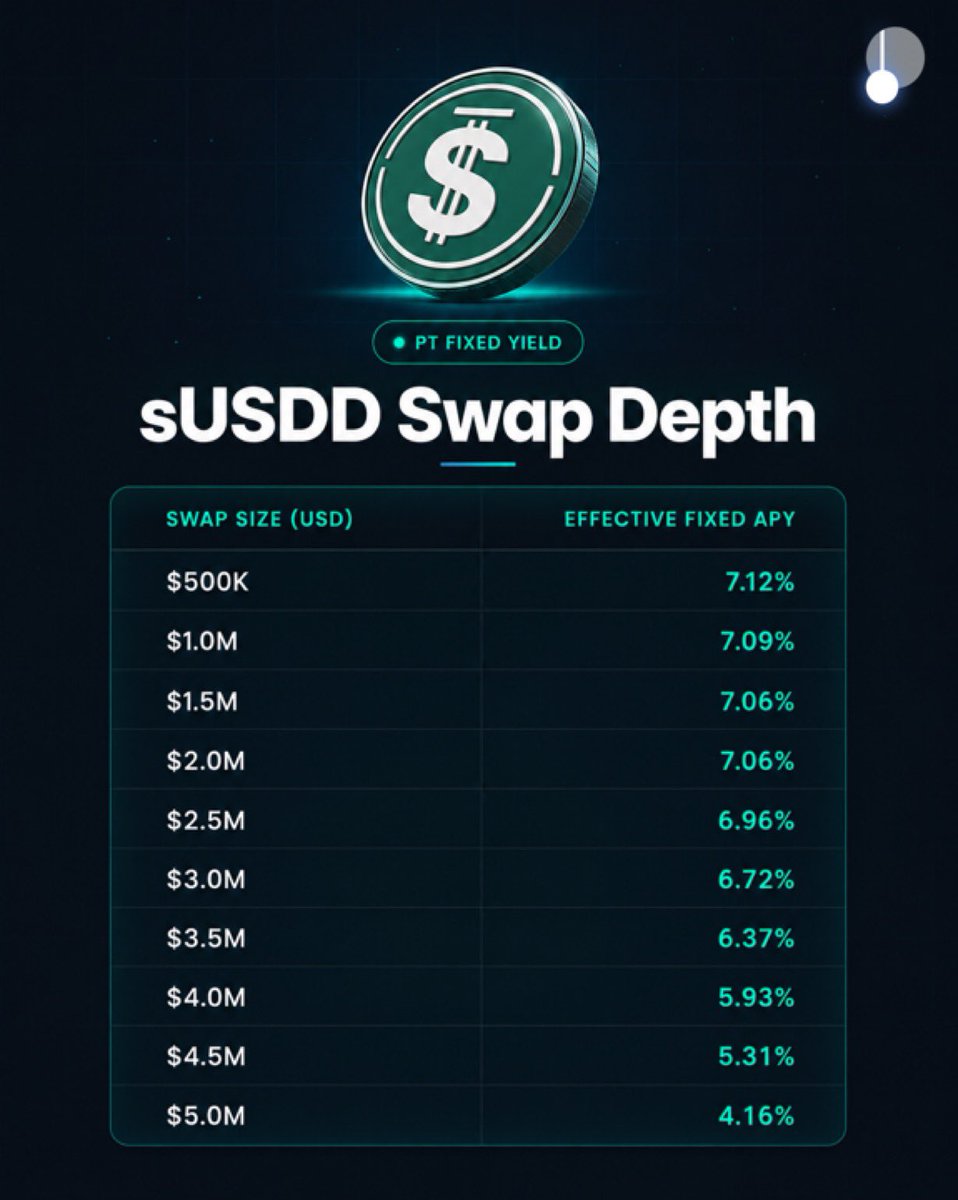
📌 At a $5M swap size, the market still offers approximately 4.16% fixed yield
📌 This exceeds the current ~4% variable yield from sUSDD Earn
📌 Execution remains smooth with minimal slippage
This combination of yield scalability liquidity depth is what separates experimental DeFi markets from institutional-grade ones.
📈 Why Fixed Yield Matters
Variable yields fluctuate based on:
• Protocol activity
• Market demand
• Liquidity conditions
• Broader DeFi cycles
While they can rise, they can also decline unexpectedly—making long-term planning difficult for large capital allocators.
Fixed yield solves this by offering:
✅ Predictability
✅ Stable cash flow planning
✅ Reduced uncertainty
✅ Clear risk modeling
For institutions, that clarity is critical.
🔄 Pendle’s Core Innovation
Pendle transforms yield into a tradable asset class.
This allows investors to:
🔹 Lock in future returns
🔹 Trade yield separately from principal
🔹 Customize risk exposure
🔹 Access structured fixed-income strategies
It bridges the gap between traditional fixed-income markets and decentralized finance.
🌐 A Broader Shift in DeFi
The evolution is clear:
From speculative yield farming
➡️ To structured financial products
➡️ To institutional-grade fixed-income markets
And sUSDD on Pendle sits directly within that transition.
🚀 Final Thought
As DeFi matures, capital is no longer just chasing returns—it is optimizing for certainty, scalability, and efficiency.
With competitive fixed yields even at multi-million dollar sizes, Pendle’s sUSDD market is emerging as a strong example of how decentralized finance is evolving into a professional capital allocation environment.
For investors focused on predictable income and scalable execution, this represents a meaningful shift in what DeFi can offer.
@justinsuntron @usddio
#TRONEcoStar
1


Stop optimizing for tax refunds. A big refund means you gave the government an interest-free loan all year. Adjust your withholdings and put that monthly cash to work instead. 📊
#PersonalFinance


I’ve been enjoying daily tadalafil, I don’t plan on taking it forever.
Why?
The human body is brilliantly elegant and perfectly balanced in its heathy state.
If I need a drug to optimize my blood flow, something is broken.
I’d rather optimize at the root cause/system level.
The biggest lever I can see for overall health, including blood flow is to optimize my breathing.
That includes airway structure, biomechanics, and psycho-physiological components of breathing.
From the research I’ve done, and my intuition, optimizing my breathing has orders of magnitude more to offer me than any medication or peptide.
Stay tuned for the breathing arc.
12

Even itself:
The Teleological Arc of Geometry: From Hellenic Inquiry to the Constructal Law
The history of scientific inquiry is fundamentally a chronicle of the human urge to rationalize the "designedness" and macroscopic complexity of the natural world. For nearly three millennia, from the pre-Socratic philosophers to the contemporary era, the central enigma of science has remained constant: from what principle can geometric form be deduced? While early thinkers like Democritus attributed the emergence of structure to "chance and necessity," this doctrine was essentially an admission of an inability to predict the morphologies of nature. The recent formulation of the constructal law (1996) represents a paradigm shift, transitioning from the descriptive methods of the past to a predictive, deterministic physics of design evolution.
I. The Hellenic Foundation and the Quest for Determinism
The intellectual lineage of this discovery begins in ancient Greece, where geometry—the science of figures—and mechanics—the science of moving figures—served as the foundational pillars of scientific thought. Early optimization principles emerged within specific domains, most notably in optics. Heron of Alexandria recognized that light travels in straight lines to minimize path length, and Fermat later expanded this into the principle of least time for refraction. These ad-hoc invocations of "nature optimizing things" were highly successful but lacked a universal theoretical bedrock in physics.
Throughout the centuries, scientists, zoologists, and geophysicists spoke freely of "design," "function," and "objective" when describing natural patterns, yet these remained engineering concepts orphaned from the laws of physics. The doctrine of chance prevailed in the study of naturally organized systems, from the dendritic architecture of river basins to the morphology of human lungs. While fractal geometry provided a descriptive aid for these structures, it remained non-predictive; the mathematical algorithms used to generate fractal images had to be assumed and truncated arbitrarily, lacking a governing physical principle.
II. The Thermodynamic Impasse and the Genesis of Configuration
The birth of thermodynamics in the mid-19th century initially offered no resolution to the puzzle of form. The first and second laws of thermodynamics are resoundingly general because they treat systems as "black boxes"—regions of space or collections of matter without specified internal shape or structure. These laws account for the conservation of energy and the one-way direction of irreversibility (entropy generation) but say nothing about the configurations—the drawings—of the things that flow.
The impasse was broken in 1996 with the statement of the constructal law: "For a finite-size flow system to persist in time (to live), its configuration must evolve in such a way that it provides easier access to the imposed currents that flow through it". This law recognizes that the generation of flow configuration is a universal phenomenon of physics, as natural as the tendency for energy to be conserved or for heat to flow from high to low temperatures. By adding this third first principle, thermodynamics was elevated to a science of systems with configuration, design, and evolution.
III. Unification: The Animate, Inanimate, and Engineered
The constructal law provides the missing physics that unites the animate with the inanimate across all scales. It demonstrates that the tree-shaped (dendritic) architectures found in river basins, lightning, and snowflakes are governed by the same principle of flow-access maximization as the vascular networks of lungs, the nervous system, and botanical roots. In this framework, "life" is defined in broad physical terms: to be alive is to possess configuration and the freedom to morph in time to facilitate flow.
Crucially, the constructal law establishes that "to engineer is natural". It brings technology—the evolution of human artifacts—into the domain of natural history. Humans are not seen as "naked bodies" but as specimens of the "human and machine species," encapsulated in an ever-evolving niche of artifacts like fire, wheels, aircraft, and science itself. The evolution of the airplane, for instance, exhibits the same scaling laws and convergence toward bird-like configurations because both must move weight through a medium with the least expenditure of energy.
IV. The Time Arrow of Design and Human Perception
The constructal law introduces a new "time arrow" in physics: the direction of how everything acquires architecture. While the second law's arrow points toward the "dead state" of uniformity and equilibrium, the constructal arrow is the arrow of the "live state," pointing toward easier movement and greater access. This principle extends even into the realm of human cognition and perception.
The human preference for images shaped according to the "golden ratio" (approximately 3:2) is not a mathematical coincidence but a manifestation of the constructal law. This specific rectangular proportion facilitates the fastest horizontal and vertical scanning by the two eyes, allowing the brain to understand surroundings and detect danger more efficiently. Similarly, the "mind time"—the perception that time flies faster as we get older—is rooted in the physical degradation of the neural pathways that convey visual images to the brain; with fewer images processed per unit of clock time, the perceived duration of intervals diminishes.
V. Conclusion: Finding the Geometric Principle
From the ancient Hellenic foundations to the formalization of constructal law, the trajectory of science has moved from the descriptive recording of diversity to the theoretical prediction of order. The constructal law serves as the "crystal ball" of science, empowering the mind to "fast-forward" the design evolution of social, political, and technological systems. It rationalizes the emergence of hierarchy—the "few large and many small"—in everything from river networks to city sizes and the distribution of scientific ideas.
Ultimately, the constructal law fulfills the three-thousand-year quest for a fundamental geometric principle of nature. It reveals that the diverse tapestry of the universe is woven in a "very simple loom," where every feature that nature presents is an engine-and-brake design morphing freely toward greater access. By establishing evolution and design as integral components of physics, the constructal law unites the natural and social sciences, providing a deterministic foundation for the future of human advancement.
cc: @johnstossel @michaelshermer @charlesmurray
2

Also, if anyone has any tips on optimizing around the video compression on X, it would be greatly appreciated, because this quality is just atrocious man💀
2

Good Night Fam ♥️ 💤
gSleep 🦖
Most people spend a lot of time optimizing their work, finances, and productivity.
Very few spend the same energy optimizing the thing that impacts all of them:
Sleep.
That's one reason @sleepagotchi keeps growing on me.
What started as a simple sleep-focused ecosystem is evolving into something much bigger.
An AI Sleep Coach that turns health data into personalized insights.
Support for devices like Apple Watch, Oura, and Whoop.
A community of over 2 million users already earning points through Telegram and LINE Lite.
And now, with Kenny Wood stepping in as CEO and $6.5M raised from leading investors, the vision is becoming much clearer.
What I find most interesting is that Sleepagotchi isn't trying to create a new habit.
It's trying to improve an existing one.
By combining AI, gamification, collectibles, and wellness data, the platform makes consistency feel rewarding instead of repetitive.
A simple idea.
A difficult mission.
Helping millions of people sleep better while building one of the most unique wellness ecosystems in Web3.
gSleep 🌙

94
4
93
708

Elite admissions select for one trait: getting the known answer faster than anyone else. 18 years of optimizing against an answer key someone already wrote.
AI just made the answer key free. Everyone has it instantly now.
So the kids trained hardest to win spent their whole lives mastering the one thing that's now a commodity. The premium moved to the questions with no answer key yet.
We need a new training.
The new training is about one thing:
How to be the first person standing in a new land, exploring it, preparing it for the coming billion people who will need it. The future will be built by these people.
And there is a lot to build.
95
107
1,061
76,046

43 is a Toyota correct? So optimizing a really good car. Can only take these cars so far. One day people will get it. You can only take the car so far per nascar rules
14

15m
Agree on /goal. The missing piece is goal revision, not just goal setting. Most long runs fail because the agent keeps optimizing a stale objective after the environment or user intent has already shifted.
8
{Welcome} to { World Class, Singapore Airlines } retweeted

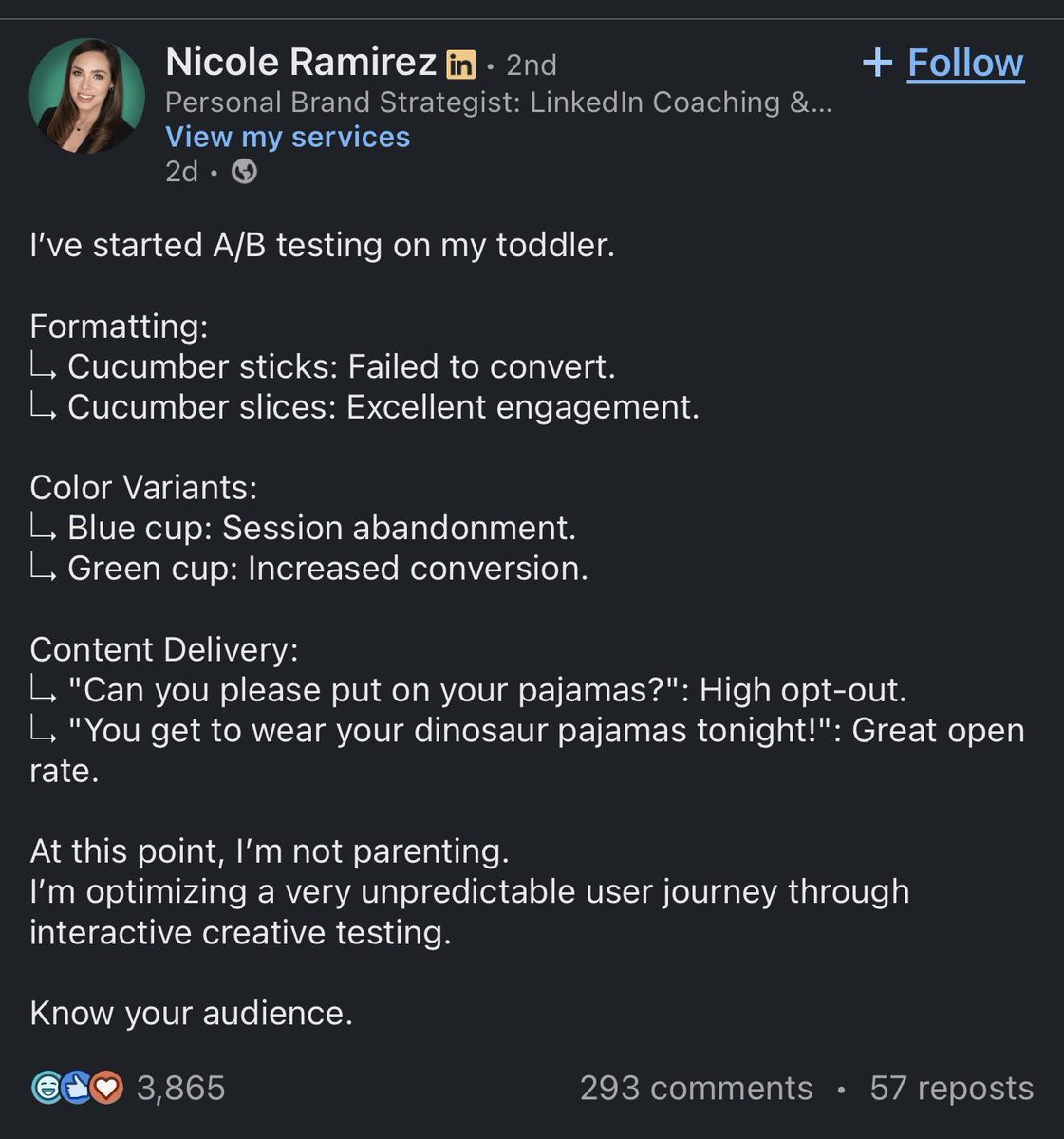
I stopped parenting. I am optimizing.
2
3
32
2,205

Many people focus on optimizing their schedules, but Sleepagotchi encourages them to optimize the recovery that supports those schedules as well
1

Brands chasing trending audio for their ads are optimizing the wrong thing.
Trending audio changes weekly.
Conversion psychology doesn't.
Build around principles. Not trends.
Principles compound. Trends expire.
2

20m
Correct.
"If you're not going to the gym 5 times a week when you're also taking care of your last remaining parent who has Alzheimer's, you're just not optimizing well enough.."
OP's advice may hold true into your thirties. After that, good luck 😂
6

Investing ₹2.5L monthly with zero debt is disciplined execution. But if satisfaction is missing, the real gap isn’t capital—it’s strategy. Risk-adjusted returns matter more than volume. Are you optimizing for alpha or just accumulating?
8

24m
This is something that I’m realizing when you’re caught in between an optimizing mindset, but also with a goal to bulk. You face the truth and it’s usually simpler than what everything thinks they have to do.
It’s why I said the people from the anabolic world have been very helpful, with how to go about the journey, much more than people who just picked up health optimizing and are into every peptide.
A lot of anabolic community have also been through the snake oil phase, so they’re able to decipher what’s good and what’s not much faster.
I’m having a great time playing with stuff, no doubt, but increasing the testosterone dosage, as well as utilizing real HGH have been the needle movers in my recent pop up, with Reta only being relevant in regards to allowing amazing nutrient partitioning.

Peptides dont do shit to build muscle. Gear builds muscle.
5
101

If you watched that recent documentary, you definitely remember the girl in the tank top with the tattooed arm in the control room.
Her name is Guo Can, she’s only 27, and her resume is absolutely insane.
She’s a core engineer in SpaceX's mission control, responsible for real-time rocket engine monitoring and holding the literal power to issue abort commands during a launch.
Even crazier? Code she wrote in her early 20s is still running the automation and optimizing launch control logic today.
People looked up her salary and saw a base pay of $130,000—which is total cabbage price for top-tier Silicon Valley talent.
But here’s the kicker: she holds between 80,000 to 150,000 shares. At the $135 valuation, her net worth is sitting comfortably at around $15 million.
Netizens are calling her the Starship Queen, and honestly, it fits.
Every tech giant in the world would throw blank checks at her, but she’s choosing to grind it out at SpaceX and build the future of space travel.
Would you take a lower base salary for a massive equity upside like this, or do you prefer cash upfront? Let’s talk in the replies.
15

The Listing Audit module scores every ASIN against COSMO and Rufus AI ranking factors—the same systems now driving 40% of search traffic on Amazon. Most sellers are still optimizing for A9 keyword density while the platform has moved to semantic relevance, image context, and answer-engine structure.
COSMO weighs image information density, lifestyle context, and whether your creative actually answers the query visual intent. Rufus parses whether your bullets solve for user questions in natural language, not just stuff keywords.
If your listing was written in 2022, it's probably ranking worse than it should. The audit runs AI vision on your images and scores 47 COSMO/Rufus factors, then shows you exactly which elements are costing you visibility. It's the only tool I've seen that actually reverse-engineers what these AI systems want instead of guessing.
1
4