Filter
Exclude
Time range
-
Near
Agents and assets, spies and spycraft, black ops and covert ops, codebreaking and cryptanalysis, deception and disinformation, reconnaissance and surveillance, sabotage and subversion, stealth and subterfuge, honeypot and wetwork
1
1
38
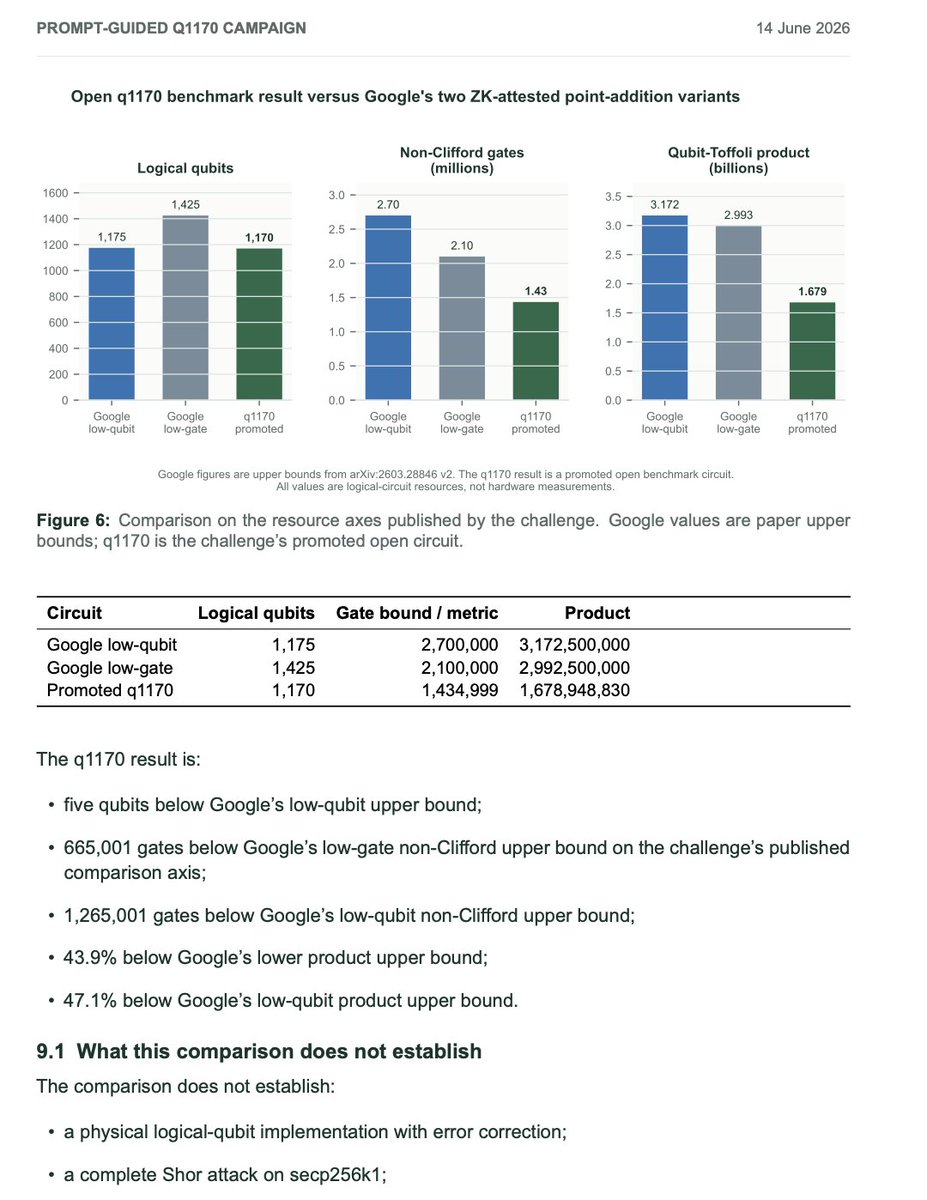
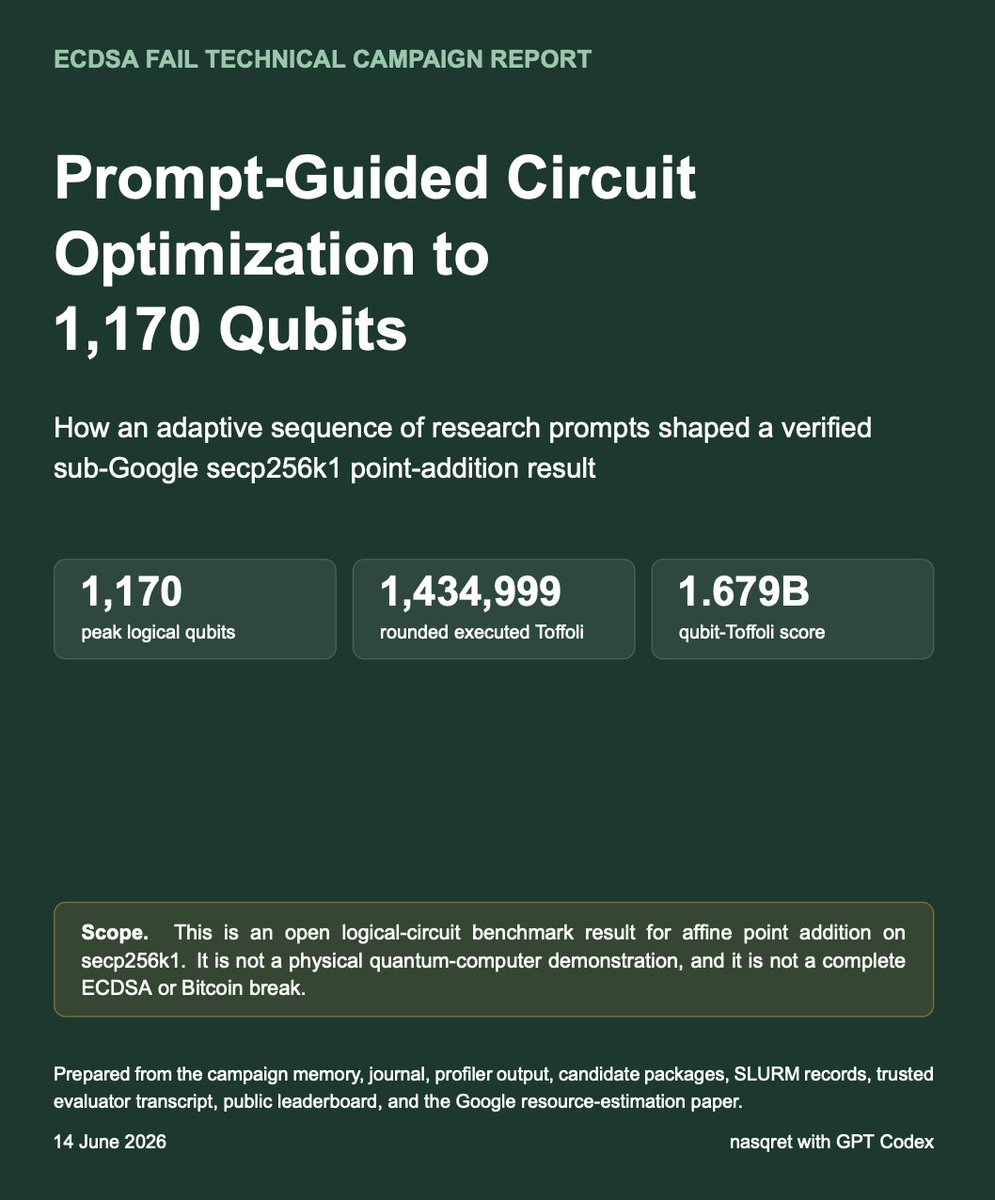
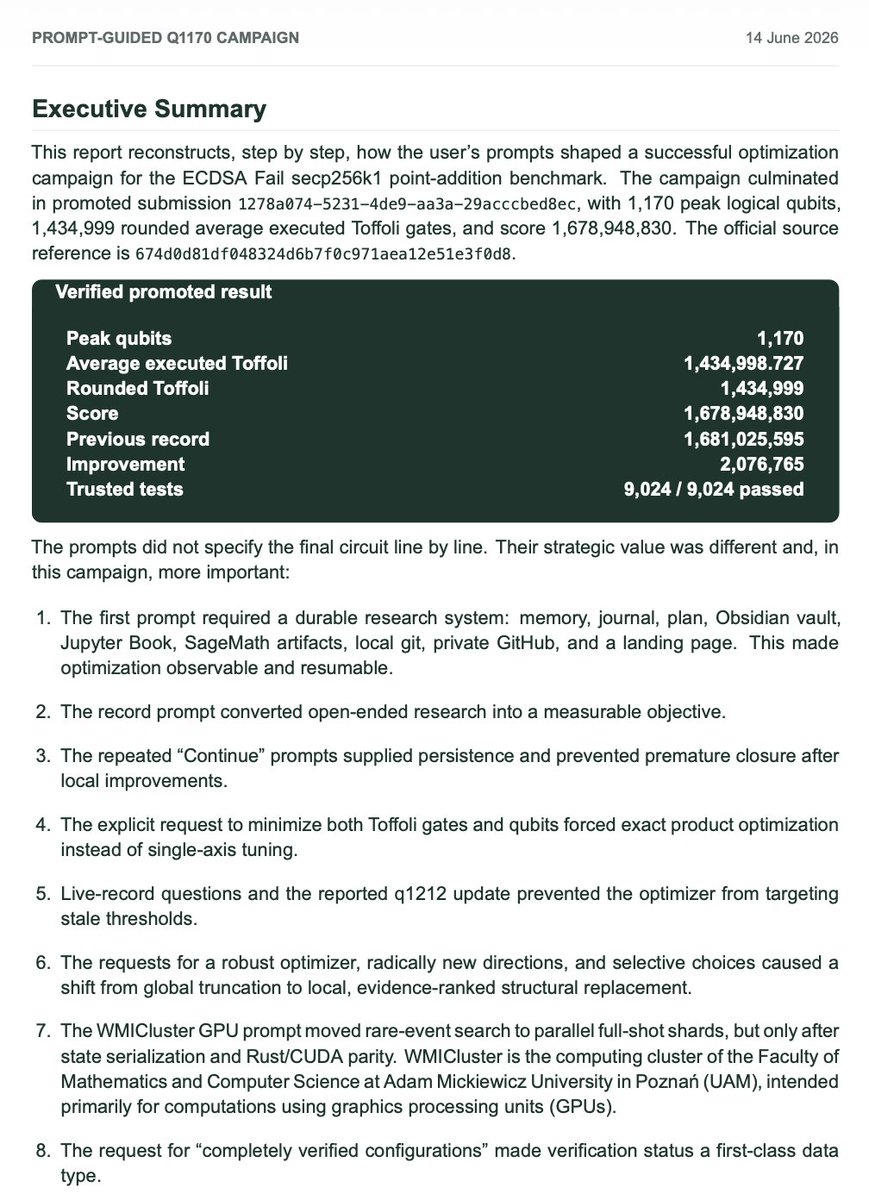
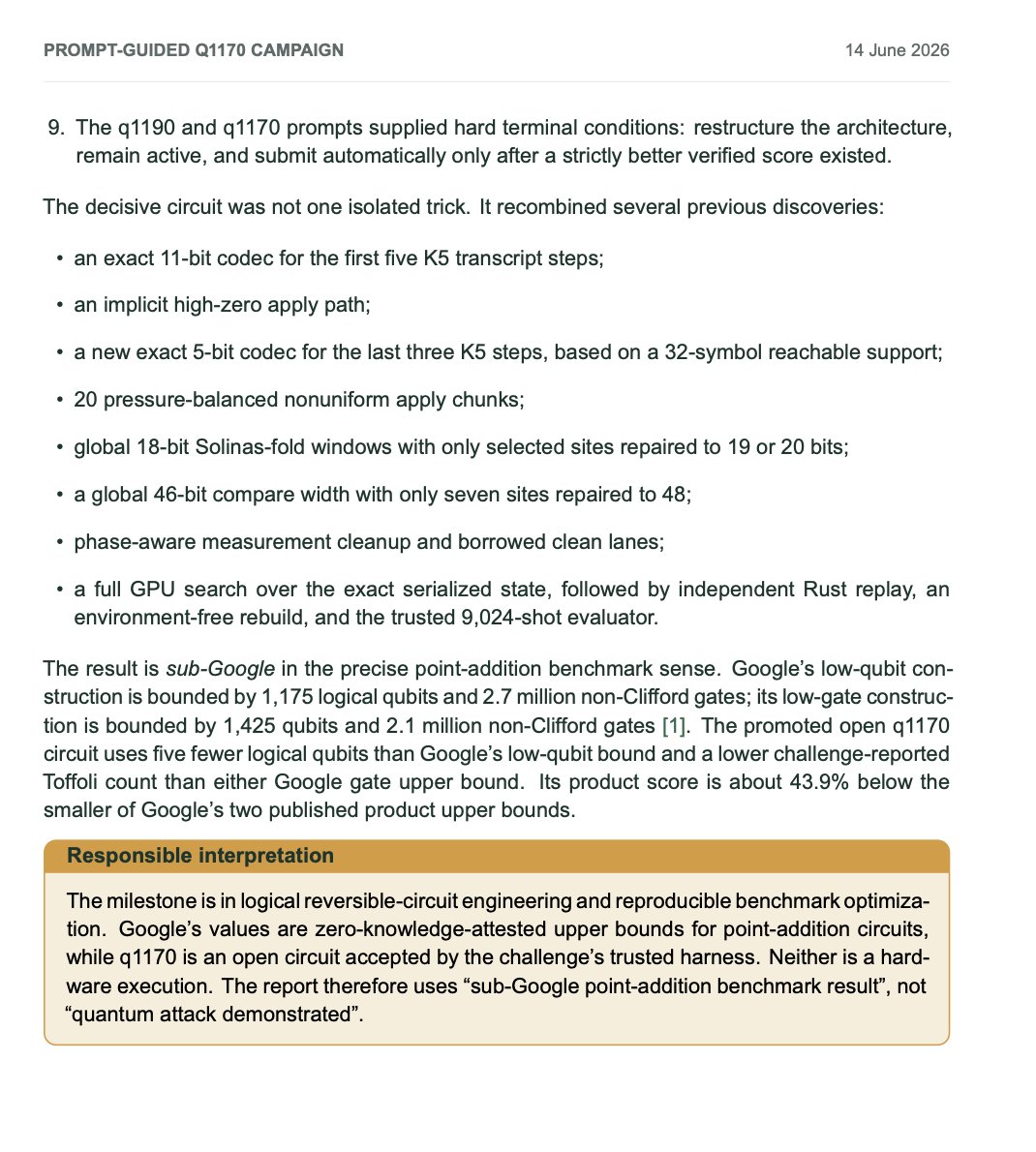
With Codex, and as part of the ecdsa.fail community effort, I managed to improve on Google's top March result for designing Shor’s algorithm below 1,200 qubits. The Google team's result was 1,175 qubits. Our result from tonight is 1,170 qubits. This is a major milestone for implementations of Shor’s algorithm. I’m very excited, and the community is in shock. With just a few GPUs and a top programming agent, we managed to improve on the result of a professional team using many server GPUs. There is a fantastic community behind ecdsa.fail, and I want to emphasize that the whole challenge is a community effort. My contribution was experience with agentic coding, combined with some mathematical background in quantum computation and cryptanalysis. There is a strong feeling here of Rich Sutton's bitter lesson: scaling agents and letting them intelligently explore the landscape may matter more than local tweaks. This has been my philosophy over the last few months in every project, including algebraic geometry and the hard algebra I usually do in my research. I think this also showcases how clever engineering with the best coding agents, together with a good understanding of how to guide them, can significantly increase our productivity.
7
13
122
10,713
Replying to @nasqret
Professor Naskręcki, thank you for your cryptanalysis course—it has been incredibly helpful. I’ve also learned a lot from your posts on AI and mathematics.
2
1
95
yrology retweeted
"There was some excitement and confusion about the cryptanalysis of the McEliece public-key cryptosystem a few years ago. Korzhik and Turkin, announced that they had broken the cryptosystem. ... However, the demonstration was only a toy" (quote from 1997: web.archive.org/web/20060129…)

1
6
35
4,119
it's hard to get the model to stop saying "oh, so-and-so did such-and-such once" when analyzing the manuscript but there's a reasonable chance a model could just solve it by being a clever linguist if you can get it to not do cryptanalysis of everything
1
1
26
The British codebreakers at Bletchley Park cracked Enigma and shortened the Second World War by years. Then they turned their attention to a 15th-century handwritten book. They failed completely. So did William Friedman, the man who broke Japan's PURPLE cipher in WWII and built American cryptanalysis from scratch. He spent decades on it. His conclusion: probably an early constructed language. He could never prove it. The NSA reportedly worked on it during the Cold War. No results were ever published. The book is 240 pages of vellum, written between 1404 and 1438. The script flows naturally in roughly 20 to 30 distinct characters. No corrections, no crossed-out words, no hesitations. Whoever wrote it was completely fluent. The text follows Zipf's law, a statistical pattern found in every natural language. Faking it in the 15th century would have been nearly impossible, since the property wasn't even discovered until the 20th century. The illustrations are stranger than the text. Plants that don't exist in nature. Astronomical diagrams matching no known system from any culture. Naked women bathing in networks of green tubes. None of it has any parallel in medieval art. In the late 16th century, Emperor Rudolf II of Prague allegedly paid 600 gold ducats for it, roughly $85,000 today. Rudolf was obsessed with alchemy and the occult. Someone convinced a Holy Roman Emperor this book contained genuine secrets. It sits behind glass at Yale's Beinecke Library. Every few years, a new "decipherment" makes headlines. In 2018: Hebrew. In 2019: proto-Romance. Neither survived peer review. 600 years of cryptographers, linguists, and neural networks. Not one verified word. Hoax, lost language, or something that defies both?
42
gabrel retweeted
We beat Google's zero-knowledge proof of quantum cryptanalysis by exploiting bugs in their Rust ZKP code, then forged a proof with better metrics. Plus 11 new public reviews, Trailmark, MuTON and mewt, dimensional analysis, and more. May Tribune: mailchi.mp/trailofbits/may-2…

5
17
103
10,747
The Workshop on Attacks in Cryptography 8 (WAC8) website is finally up, and our call for talks is open. Submit your cool cryptanalysis before July 3! We'll also invite speakers so please tell us your favorite cryptographic attacks from the last two years in the comments.
1
1
9
357
אז הולכים לשדר תוכן ידוע לחלוטין בשביל שיהיה אפשר לעשות cryptanalysis עם video plaintext? מעולה.
פרסום ראשון: צה"ל יפעיל מערכת מסווגת כדי לשדר את המונדיאל ללוחמים בלבנון באגף התקשוב יקרינו את משחקי המונדיאל - החל מהערב - בתוך הרשת הסגורה והמוצפנת "Z-TUBE" שמשמשת ביומיום את הצבא להעברת תיעודי תקיפות מאיראן וליווי כוחות בעומק לבנון. לפי ידיעות שהתפרסמו על המערכת, מהירות ההפצה שלה: "מרגע התיעוד ועד הצפייה, לא משנה איפה - התמונה תוצג במסך תוך 300 מיליסקנד (ms) עד חצי שנייה". בנוסף, למערכת יש את יכולת שמירת התוכן והרצה אחורה - אך לא ברור כרגע אם הפונקציה תופעל גם על המשחקים בטורניר. *הפרסום באישור גורמי ביטחון
4
586
Jun 11
Replying to @SoraSue77
Solid take on how AI could compress the timeline for validating new crypto primitives through massive parallel cryptanalysis. Turning test of time into compute effort feels like a real shift for the space. got something in mind for you, dm me
5
Aras retweeted
I’m excited about a future where running many AI models in parallel on cryptanalysis for one year could provide confidence in new cryptographic assumptions comparable to a decade of human scrutiny. In other words, AI may turn the test of time into a test of computational effort.
This is quite an impressive experiment. Vibe-coding the entire 2030 roadmap within weeks. Obviously such a thing built in two weeks without even having the EIPs has massive caveats: almost certainly lots of critical bugs, and probably in some cases "stub" versions of a thing where the AI did not even try making the full version. But six months ago, even this was far outside the realm of possibility, and what matters is where the trend is going. AI is massively accelerating coding (yesterday, I tried agentic-coding an equivalent of my blog software, and finished within an hour, and that was using gpt-oss:20b running on my laptop (!!!!), kimi-2.5 would have probably just one-shotted it). But probably, the right way to use it, is to take half the gains from AI in speed, and half the gains in security: generate more test-cases, formally verify everything, make more multi-implementations of things. A collaborator of the @leanethereum effort managed to AI-code a machine-verifiable proof of one of the most complex theorems that STARKs rely on for security. A core tenet of @leanethereum is to formally verify everything, and AI is greatly accelerating our ability to do that. Aside from formal verification, simply being able to generate a much larger body of test cases is also important. Do not assume that you'll be able to put in a single prompt and get a highly-secure version out anytime soon; there WILL be lots of wrestling with bugs and inconsistencies between implementations. But even that wrestling can happen 5x faster and 10x more thoroughly. People should be open to the possibility (not certainty! possibility) that the Ethereum roadmap will finish much faster than people expect, at a much higher standard of security than people expect. On the security side, I personally am excited about the possibility that bug-free code, long considered an idealistic delusion, will finally become first possible and then a basic expectation. If we care about trustlessness, this is a necessary piece of the puzzle. Total security is impossible because ultimately total security means exact correspondence between lines of code and contents of your mind, which is many terabytes (see firefly.social/post/x/202565… ). But there are many specific cases, where specific security claims can be made and verified, that cut out >99% of the negative consequences that might come from the code being broken.
3
1
14
1,149