
QMS Network is a Layer-1 blockchain built for the post-quantum era.
Joined May 2026
- Tweets 35
- Following 0
- Followers 1,526
- Likes 9
11 Photos and videos




Jun 12
QMS turns its miner network into decentralized compute powered by useful work.
Instead of spending energy on pure hashing, QMS miners run solvers on real-world optimization problems.
That gives miners a second revenue stream on top of block rewards. As more capable miners join, the network can gain more solver capacity, stronger decentralization, and better economics.
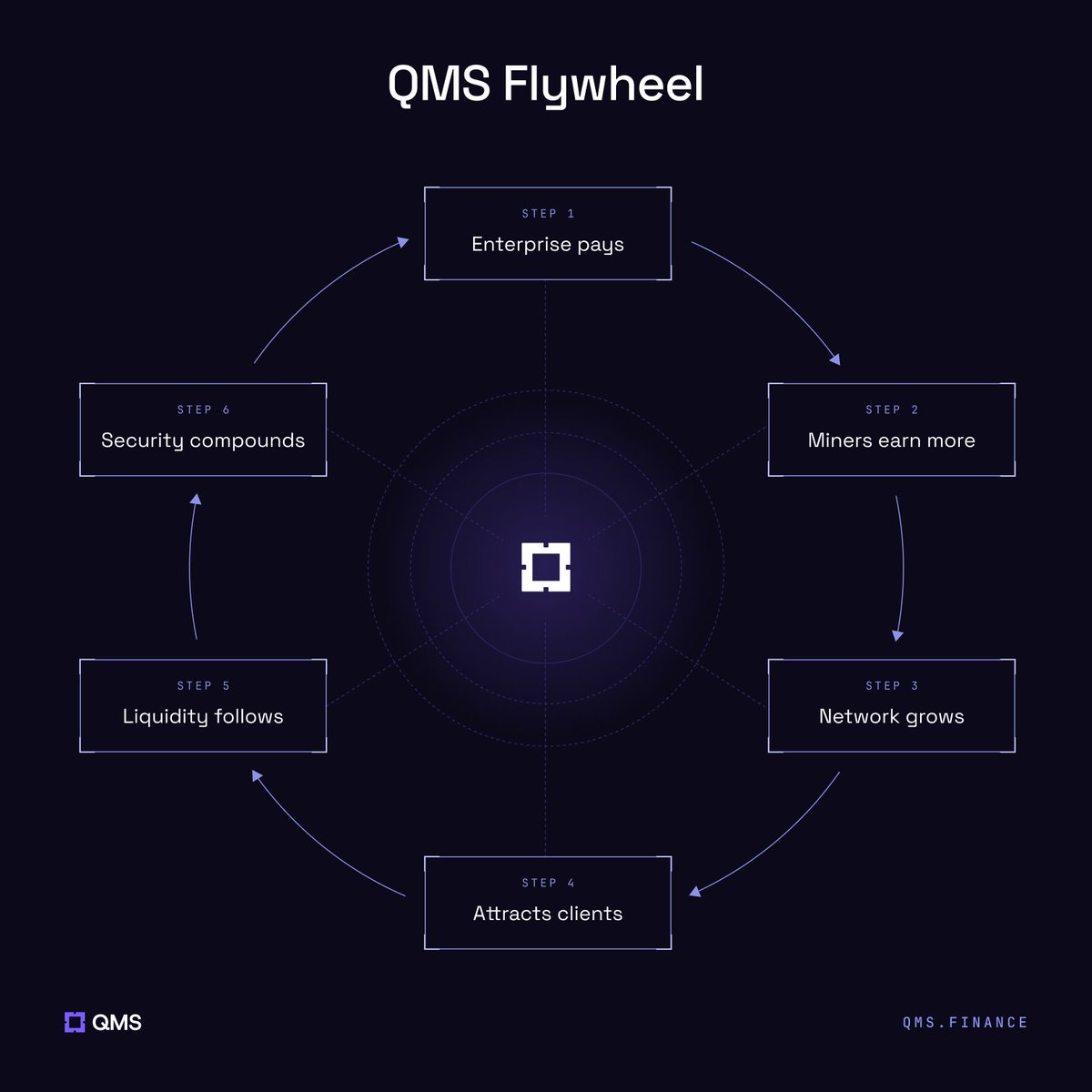
The QMS flywheel:
7
3
24
1,322
Jun 12
The most uncomfortable truth in this research:
Quantum attack on crypto doesn't start when the hardware arrives. It started years ago.
Every public key on Etherscan is already in someone's database. The hardware is just the last step.

3
1
11
719
Jun 11
PoUW makes mining useful.
Instead of spending compute only on arbitrary hashes, miners compete by performing useful work, such as optimization tasks with real-world commercial value, while still supporting network security.
Same competitive mining logic, with better economic output.
Jun 10
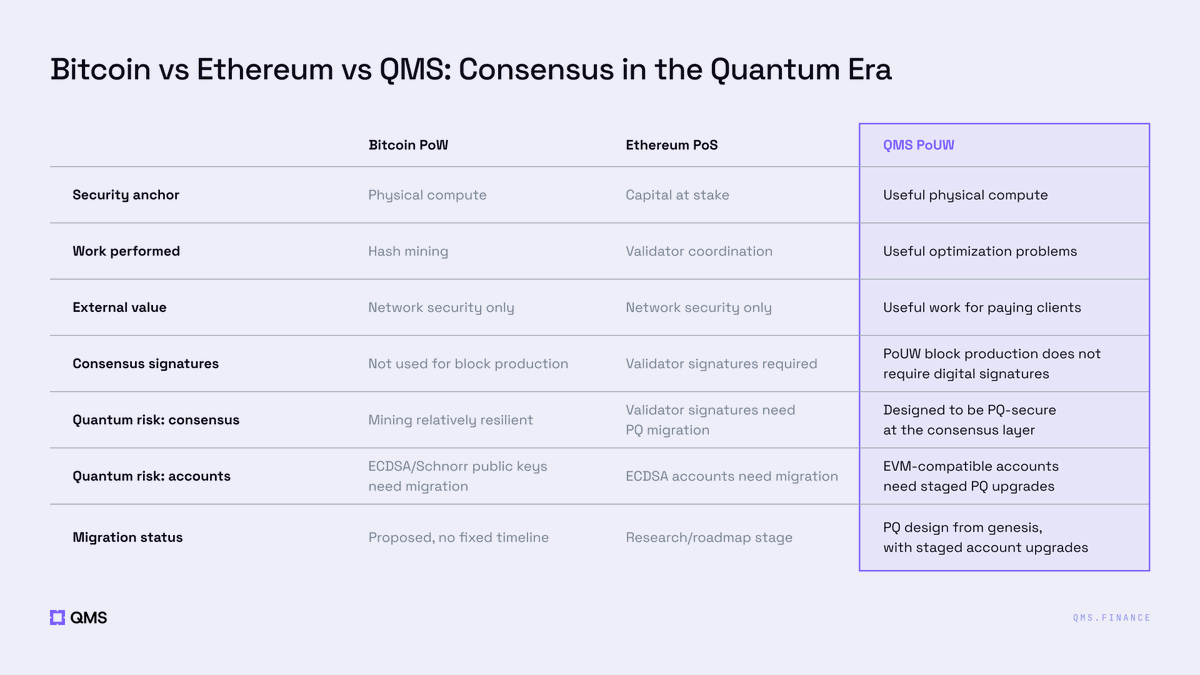
Blockchain is evolving.
Bitcoin proved that physical compute can secure a decentralized network.
Ethereum showed that capital at stake can coordinate consensus with lower energy use.
QMS takes a new path for the quantum era: useful, physical compute.
With Proof-of-Useful-Work (PoUW), miners are designed to secure the network by solving real optimization problems for paying clients, while reducing consensus-layer exposure to quantum attacks.
3
10
854
Jun 10
Blockchain is evolving.
Bitcoin proved that physical compute can secure a decentralized network.
Ethereum showed that capital at stake can coordinate consensus with lower energy use.
QMS takes a new path for the quantum era: useful, physical compute.
With Proof-of-Useful-Work (PoUW), miners are designed to secure the network by solving real optimization problems for paying clients, while reducing consensus-layer exposure to quantum attacks.
1
1
16
1,552
Jun 10
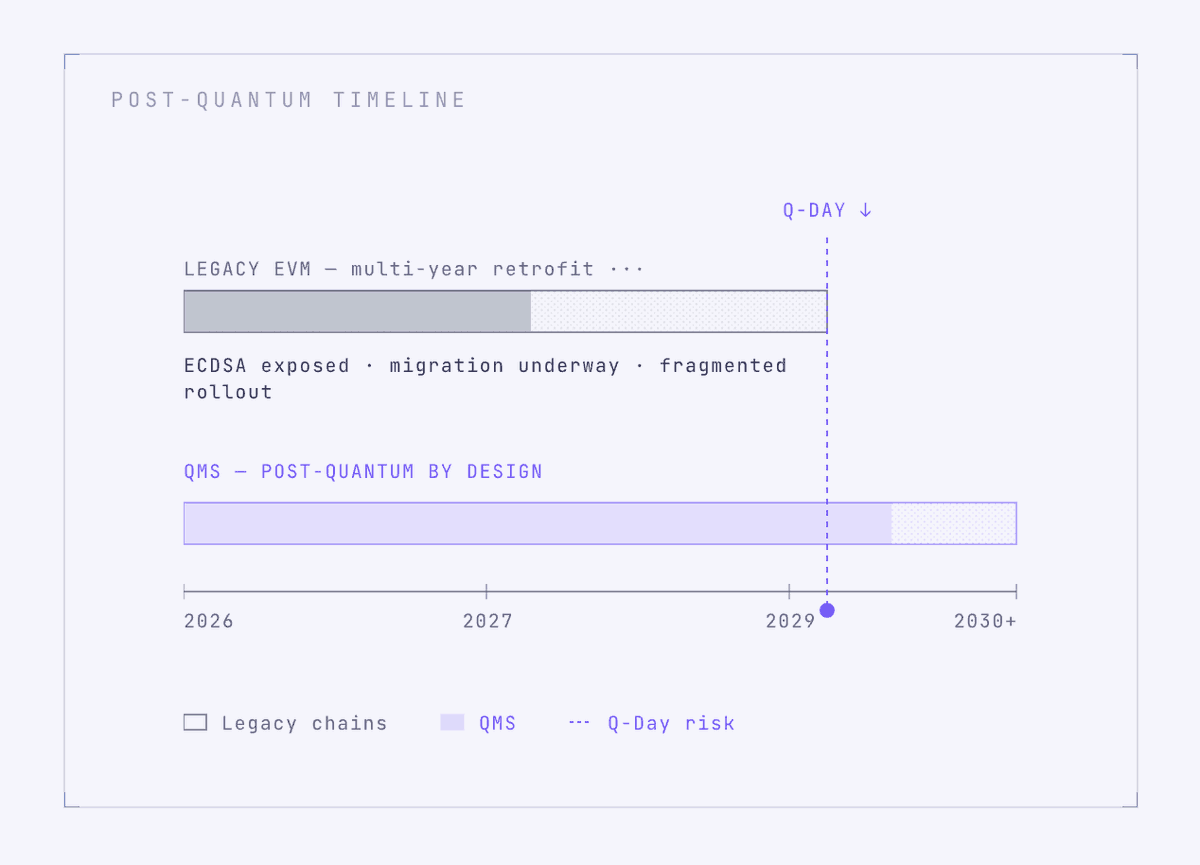
Watching the post-quantum work underway across major blockchains is instructive.
Even with world-class teams, retrofitting cryptography into a live chain is a multi-year challenge.
That’s why QMS made one decision early: to start post-quantum by design, rather than inheriting the burden of migration.
Whether that bet pays off, we will find out.
3
17
634
Jun 9
The opportunity most people have overlooked:
When quantum arrives, signatures break and funds can be stolen. Post-quantum replacements are slower, so proof-of-stake loses its edge. QMS is built for this where consensus needs no signatures, so the consensus layer is quantum-resistant from day one.
Here's what most miss: better computers don't only help attackers. They can also work for the chains they once threatened. QMS turns quantum hardware into miners paid to solve client problems.
1
1
20
1,274
Jun 9
Most quantum hype is about optimization.
Faster routes. Better logistics. Magic Waze with a physics degree.
Mostly unproven.
The part that matters first is narrower and far more serious: a large enough quantum computer breaks the public-key cryptography securing most major blockchains today.
QMS is being built so that day becomes a non-event.
7
18
906
Jun 8
Most blockchains were built around classical cryptography.
Wallets, validators, bridges, and custody systems still rely on security assumptions that quantum computing could weaken over time.
QMS is being built for the post-quantum era: quantum-resistant infrastructure first, with useful compute designed to scale as the network matures.
7
1
23
921
Jun 8
The infrastructure signal kept building. Here’s the quantum security weekly update:
• @dwavequantum released a gate-model roadmap targeting 100 logical qubits and 1M operations by 2032
• @OQC_Tech, @jpmorgan and @AMD announced a Quantum-AI Data Centre collaboration in London for hybrid quantum-classical finance workloads
• @SEALSQcorp expanded its quantum strategy, linking post-quantum secure hardware with exposure to multiple quantum computing architectures
9
1
26
1,563
Jun 8
The pattern is clear:
Quantum computing is moving from a research roadmap to enterprise infrastructure. Post-quantum security is moving from a “future concern” to migration planning.
And this is what we’re building at QMS.
2
3
422
Jun 5
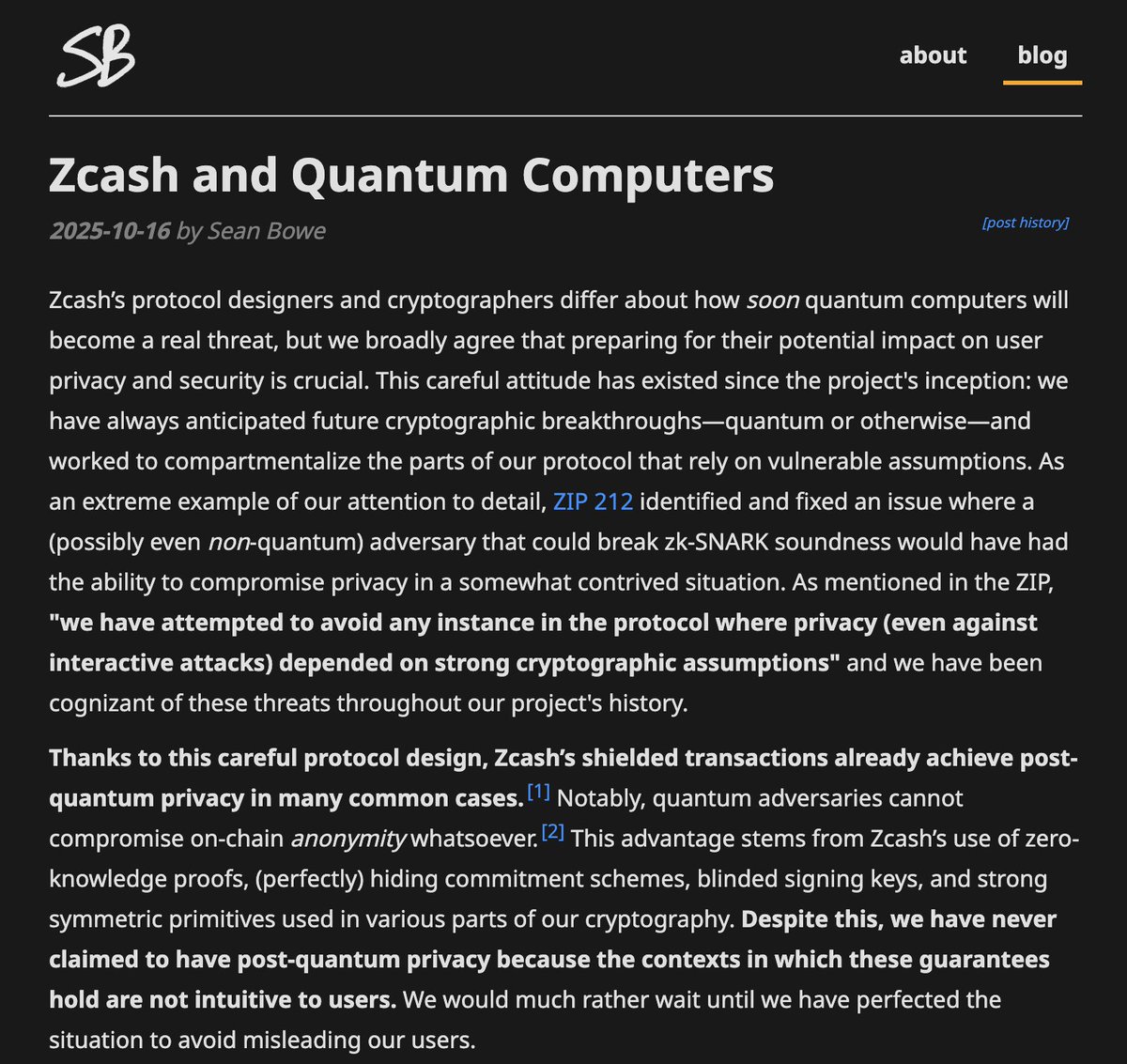
Quantum risk in crypto isn't only about stolen keys.
For a privacy chain like Zcash there are two separate questions: can your coins be stolen, and can fake coins be created?
Per @ebfull: shielded transactions already get post-quantum privacy in many common cases, since the onchain transaction graph stays hidden from a quantum adversary. What isn't fully there yet is encrypted amounts and memos.
The tougher one is soundness. If elliptic-curve crypto breaks, you risk counterfeiting or theft.
The real question isn't just whether wallets stay safe. It's whether the chain can still reject invalid state.
4
24
1,399
Jun 5
The QMS bet:
→ EVM-compatible, so existing wallets, explorers, developer tooling, and smart contracts can move over with minimal friction.
→ Mining does useful work: miners solve real optimization problems that commercial clients pay to solve.
→ Quantum-resistant at the consensus layer, with post-quantum features rolled out across accounts and the wider network over time.
→ Better solutions earn a larger share of client payments, so stronger hardware, including quantum machines, can compete as soon as it can produce valuable results.
6
22
1,680
Jun 4
Everyone wants to be early, but few enjoy what early feels like.
Join our waitlist today: qms.finance/
14
2
43
2,489
Jun 4
So far, our waitlist has attracted a strong mix of builders, miners, investors, and clients. We look forward to seeing even more of you register your interest!
5
10
866
Jun 4
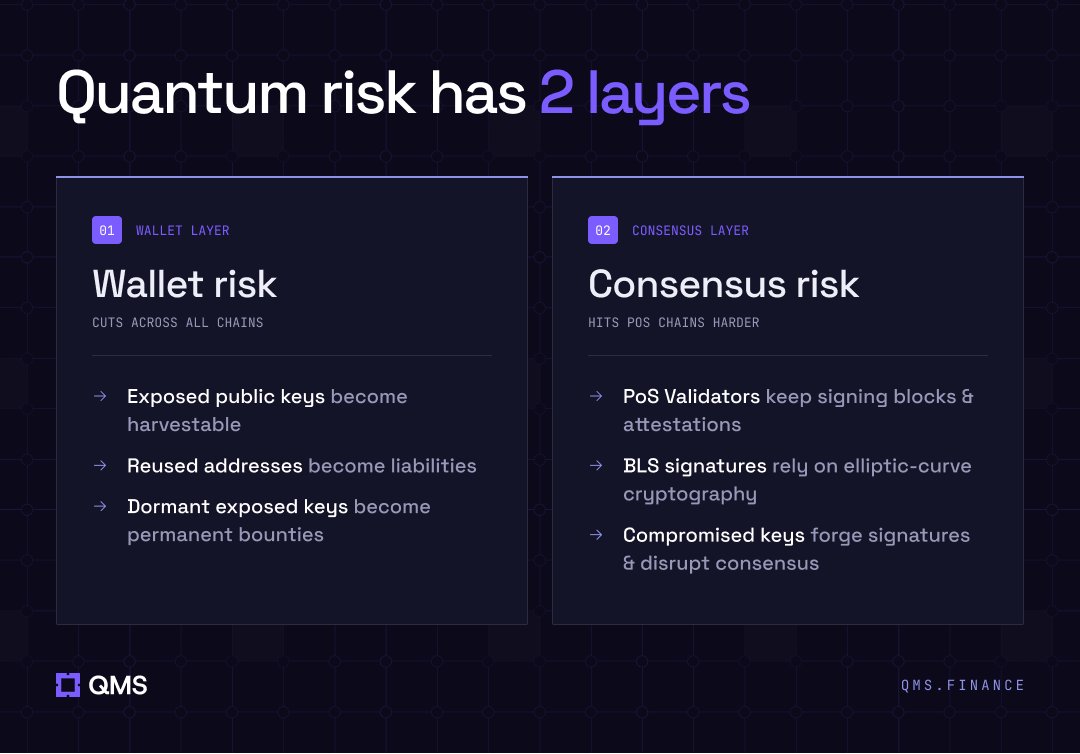
Quantum risk in crypto goes beyond stolen keys.
It can turn exposed public keys into private-key risk, pressure consensus signatures, undermine some ZK and commitment schemes, leave lost wallets unable to migrate, and force chains to absorb larger, heavier post-quantum signatures.
Therefore it's our vision to build for this transition from day one: post-quantum security, EVM compatibility, and useful compute in the same architecture.
5
2
20
1,173
Jun 3
QMS is a blockchain purpose-built for the post-quantum era, and it turns mining into useful computation.
✔︎ Miners earn from both block rewards and client payments.
✔︎ Clients submit problems and receive solutions, ranked by quality.
✔︎ Users get PoW-level security with less reliance on inflation.
✔︎ Investors gain exposure to a network where client-paid computation contributes to value capture.
4
2
21
1,364
Jun 3
In TradFi, post-quantum migration is a compliance-driven, multi-year enterprise program with hard deadlines.
In crypto, it’s messier. Here, cryptography isn’t just infrastructure, it’s the asset layer.
It means upgrading protocols, wallets, smart contracts, custody, hardware, bridges, and key management at once, while racing to move funds off addresses whose public keys are already exposed.
That makes this one of the hardest security upgrades crypto will ever run.
QMS was built so it isn't the one you have to.
3
11
823
Jun 2
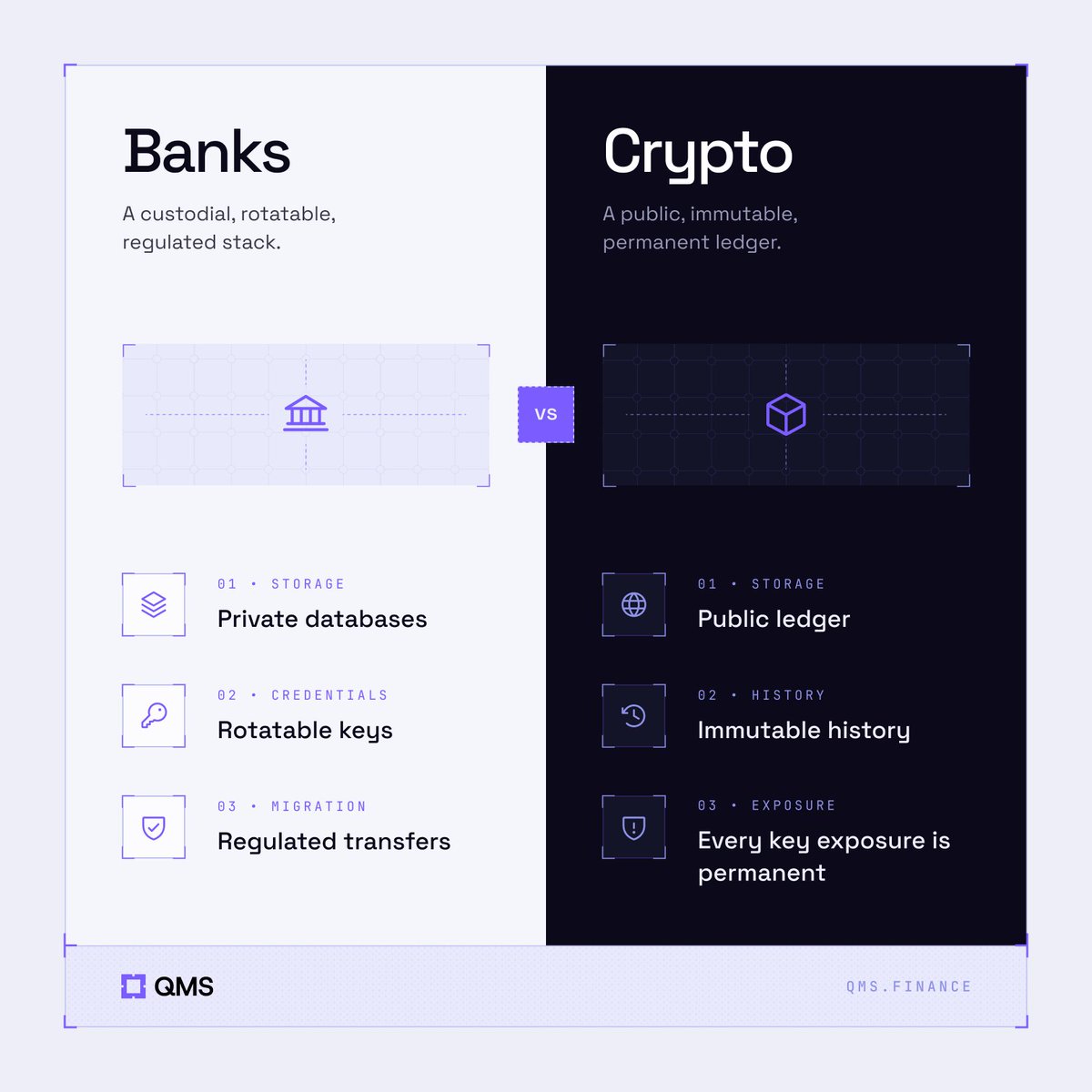
Banks hold more money than crypto, so why is crypto more quantum-vulnerable?
→ Banks: private databases, rotatable keys, regulated migration.
→ Blockchain: public ledger, immutable history, every key exposure permanent.
Transparency is a feature but also the attack surface.
6
2
29
1,159
Jun 2
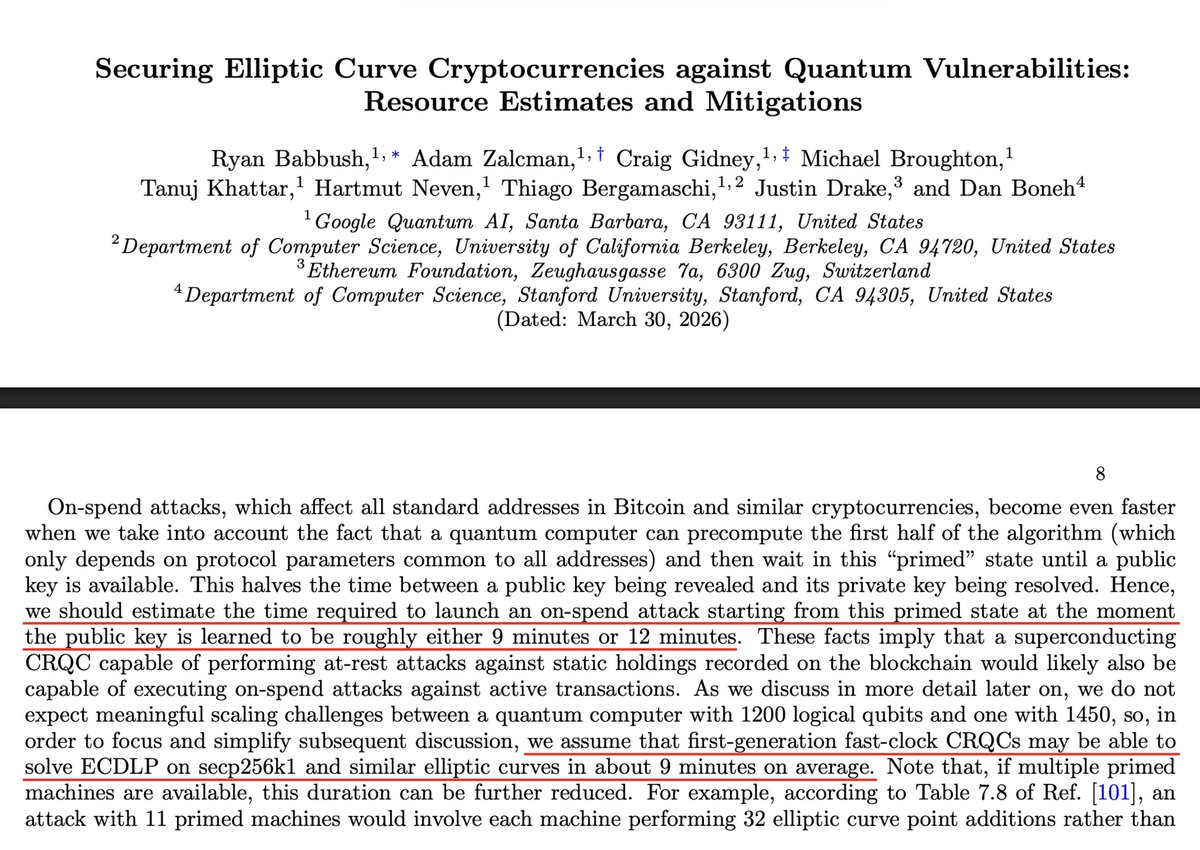
Up to 6.9M $BTC could become vulnerable in a post-quantum world.
Jun 1
About 30% of issued Bitcoin already sits where the public key is visible onchain.
When you spend from a Bitcoin address, the public key is typically revealed permanently.
A future quantum computer running Shor’s algorithm could derive the private key from that public key.
No machine can do this today, but the estimated resources required are falling fast. Google and Cloudflare are now working toward post-quantum security timelines around 2029.
2
17
1,178