
#DRPSOne: Toyota Calamba (DMSA) Digital Ad Q2 2026 10s (Laguna, Version 2) [1:1/ST]
PHCA CID PHCA-2026H1-8561/June 16, 2026
6
#DRPSOne: Toyota Calamba (DMSA) Digital Ad Q2 2026 10s (Laguna, Version 1) [1:1/ST]
PHCA CID PHCA-2026H1-8559/June 16, 2026
8

Kişniş kana karışıp, DMSA benzeri (o nun kadar olmaz tabi) etki gösterir mi?
9

Jun 15
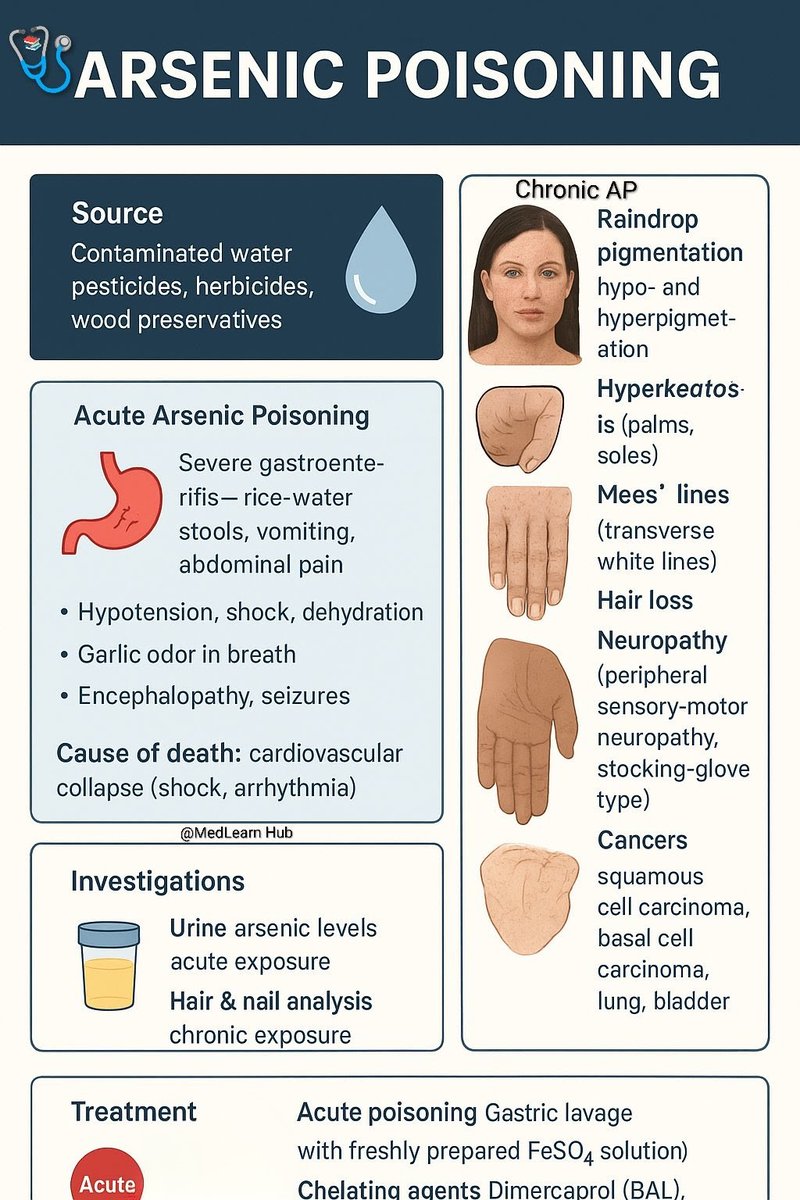
🔶Arsenic poisoning.
∆ Clinical Features-:
• Acute poisoning: rice-water stools & garlic odor.
• Chronic poisoning hallmark: Raindrop pigmentation & hyperkeratosis (palms/soles).
• Nail sign: Mees' lines.
📍Cancer risk: skin (SCC, BCC), lung, bladder.
∆ Cause of death- Circulatory Collapse.
✓ Management- Antidote: Dimercaprol (BAL).
• Acute Poisoning-: Gastric lavage with freshly prepared FeSO₄ solution, Chelating agents- Dimercaprol (BAL), DMSA, DMPS, Supportive- Fluids, electrolytes, treat shock.
• Chronic poisoning- Removal of source (safe water), Keratolytics, chelation therapy.
2
18
1,082

Hocam DMSA yı ( vitamın naturelde satılan) agır metal temizliği için, detoks için yılda bır kere kullanmamızda bır sakınca var mı?
73
杉葉山 Sugihayama retweeted

Jun 13
ステロイドは最善策ではない。
原因は体内に増えた水銀ヒ素鉛だから。
デトックス剤…DMSAにより水銀ヒソ鉛を排出すること。
ただし、治る過程で、水疱が増える
好転反応が辛い時は
正味はい毒湯など漢方でやわらげる。
DMSAは日本で買えなくされた
海外では安いけど、銀座界隈では超高い
1
2
146

Jun 12
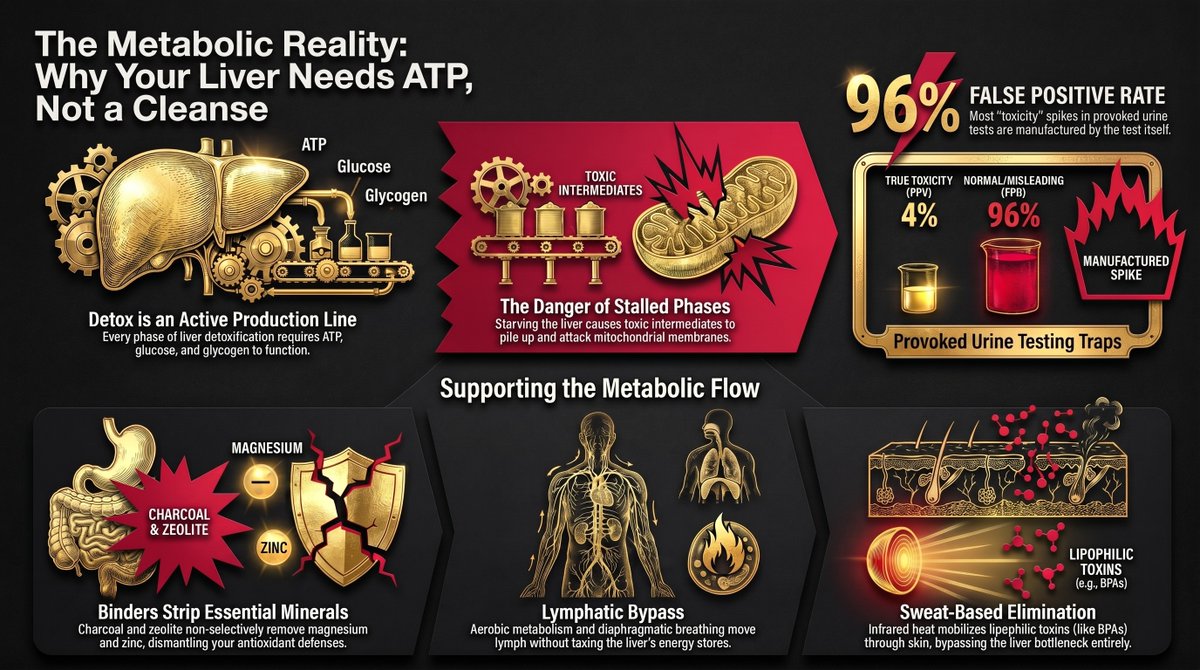
YOUR LIVER DOESN'T NEED A CLEANSE. IT NEEDS ATP.
The wellness industry profits from the idea that your body is dirty and must be scrubbed with juices, herbs, and binders. The underlying biology tells a quieter but far more practical story.
Your liver's detoxification system is not a passive filter that you flush. It is an active, energy-hungry assembly line that depends on ATP and specific raw materials to operate.
Think of the liver's machinery as a three-step production line. Step one (Phase I) uses enzymes to attach a chemical handle to a fat-soluble toxin, making it more water-reactive. You might picture this as tagging a package for export.
Step two (Phase II) clips different water-loving molecules onto that handle so the toxin becomes easy to dissolve and eliminate. Step three (Phase III) actively shoves the finished product into bile or blood for removal.
Every single step costs energy. The liver burns through glucose and ATP to run these reactions.
Glucuronidation, one of the major Phase II pathways, draws directly from glycogen stores. Sulfation consumes two ATP molecules for every sulfate activation. Amino acid conjugation gobbles up mitochondrial ATP and coenzyme A.
When you do a juice cleanse or fast, you drain the glycogen tanks these pathways rely on. Energy production drops. Thyroid hormone conversion, which governs metabolism, slows down.
The assembly line stalls. And a stalled line is worse than a slow one.
Phase I often churns out intermediates that are more chemically aggressive than the original toxin. If Phase II cannot keep pace because the liver is starved, those reactive fragments pile up.
They attack cardiolipin in the mitochondrial membrane, disrupting the cell's power plants and deepening the energy crisis. You haven't cleansed anything. You have jammed the machinery.
The popular binders, activated charcoal, zeolite, chlorella, make this worse in a different way. Wellness culture presents them as magnets that selectively grab toxins from the gut. The physical chemistry is far less discriminating.
These substances adsorb or chelate things based on size, charge, and chemical structure. They snag magnesium, zinc, copper, and selenium right alongside any heavy metals.
Mineral depletion hits antioxidant defenses hard. Copper and zinc are essential for superoxide dismutase, the enzyme that neutralizes superoxide radicals. Selenium is the core of glutathione peroxidase, which quenches hydrogen peroxide and lipid damage.
Magnesium acts as an obligatory cofactor for the enzyme that builds glutathione. Without enough magnesium, glutathione synthesis collapses.
So while someone believes they are pulling toxins out, their own frontline protection against toxin-induced damage gets dismantled. The system left behind is more vulnerable, not less.
The provoked urine testing trap deserves a clear look. An alternative clinic gives you a chelator like DMPS or DMSA, then measures urinary metals. Even very low, harmless levels of lead or mercury stored in tissues get mobilized and create a sharp spike on the test.
The clinic compares that spike to a normal baseline and diagnoses chronic toxicity. The test itself manufactures the abnormal result.
Research has shown a positive predictive value of just over four percent. That means ninety-six out of a hundred people flagged by this test do not have true metal toxicity.
Expert medical bodies have warned against post-chelator challenge testing for years because of these numbers and because the chelators themselves can damage kidneys and deplete electrolytes.
Aggressive chelation poses a redistribution danger. Metal-chelator complexes can fall apart in the bloodstream. Once freed, reactive metals travel.
Mercury hitches a ride on a cysteine molecule that mimics the amino acid methionine. The brain's transport system mistakes this complex for the real thing and carries mercury straight into neural tissue, where it latches onto structural proteins and antioxidant enzymes.
Lead and cadmium, similarly released, head to the kidneys and accumulate in mitochondria. The procedure intended to heal can end up doing the damage.
Your body has other exit routes that bypass the liver's energy bottleneck. The lymphatic system clears macromolecules and debris from the spaces between cells. It has no central pump.
Instead, smooth muscle cells in the vessel walls contract spontaneously to push fluid along. But these contractions are exquisitely sensitive to the local chemical environment.
When cells rely on anaerobic metabolism and produce lactic acid, lymph pumping can fall by seventy to ninety percent. Healthy aerobic metabolism, by contrast, produces carbon dioxide and supports a pH that keeps the lymphatic vessels squeezing.
Simple habits can keep this system moving. Diaphragmatic breathing creates pressure gradients in the chest that pull lymph through the main duct.
Walking engages the calf muscles and the gentle twisting of the spine to compress deeper lymph channels. These activities stimulate clearance without spiking cortisol, which itself can suppress thyroid function and metabolism.
Skin-based elimination through sweating offers another path. Lipophilic chemicals like bisphenol A and phthalates get stuck in fat tissue and resist being urinated out. Infrared heat can penetrate and warm subcutaneous fat, mobilizing those compounds.
Heat also triggers sympathetic nerves to activate sweat glands. Heavy metals and other unwanted substances exit through the sweat, bypassing the liver altogether. This neatly sidesteps the problem of enterohepatic recirculation, where gut bacteria can break the bonds that tag toxins for removal and send them back into the bloodstream.
The real path forward is consistent daily support for the existing detox pathways. That means supplying the right fuel, protecting mineral status, and engaging natural clearance routes without provoking inflammation or depletion.
The detailed practical application of these remedies follows in Part 2, along with a quick-reference bullet cheat sheet in Part 3.
3
11
56
2,525

Jun 12
Metal toxicity is not a joke. It can ruin your life and health, and so can haphazardly redistributing metals without proper preparation or proper chelators. If you have ever gotten amalgams, this is also a huge risk with redistribution to the brain.
There are also all sorts of protocols out there, IV chelation etc. If I can share my two cents...
Imho two of the safer chelators are OSR/NBMI and DMSA. They are dithiol compounds. DMSA is also FDA approved/prescribed. You rarely hear about OSR these days since it is an orphan drug. It used to be available OTC as a dietary supplement, but is back in research now so it's off the market. Nevertheless, I've used it with success. It strongly eliminates the risk of distributing mercury compared to other chelators, as a dithiol compound it fully grabs onto and inactivates mercury. It also is a powerful agent against oxidative stress.
This isn't medical advice but simply a direction to go in research if you're looking for more practical solutions.
2
13
679

Answer: Lead poisoning (plumbism) 🪙⭐
★ Classic triad: abdominal colic, peripheral neuropathy & anemia 🩸
★ Motor neuropathy → wrist drop / foot drop (extensor weakness) ✋
★ Microcytic anemia with basophilic stippling on smear 🔬
★ Inhibits ALA dehydratase & ferrochelatase → ↑ urinary δ-ALA, ↑ zinc protoporphyrin 🧬
★ PBG is NOT raised — that points to acute intermittent porphyria ⚖️
★ Treat with chelation: EDTA, DMSA (succimer), or dimercaprol 💊
#USMLE #Toxicology
📲 More high-yield points: oncourse.onelink.me/xW0t/ins…
1
91

Jun 11
In memoriam Fluffy, before it's too late:
Can I get a veterinary doctor to give a prescription for my dog for DMSA (dimercapto succinic acid) 30 capsules 250 mg/capsule , please. Bau wau
1
34
वेरिंगबाबा_Ahari _वलुआ पाल की आवाज retweeted

May 23
टूटी सड़कें हादसों को न्योता दे रही हैं।
अगर कोई बड़ा हादसा होता है तो जिम्मेदारी कौन लेगा?
@IgpUdaipur
@RajCMO
@DMSalumbar
#ऋषभदेव_सराडा_मागें_सड़क
6
3
21
Advocate Bheem rav Gautam retweeted

आकर गंभीर रूप से क्षतिग्रस्त हो गया है। @112UttarPradesh @bstvlive @ABPNews @Uppolice @CMOfficeUP @sambhalpolice @DmSambhal
1
1
1
82

Jun 10
8/12
Never ignore Nuclear Medicine.
Tc99m MDP
DMSA
MAG3
DTPA
Iodine 131
FDG PET
These appear simple but are repeatedly asked in FMGE.
1
2
162
Pass me over retweeted

Jun 9
📢 DITSONG: MUSEUMS OF SOUTH AFRICA IS HIRING
DITSONG: Museums of South Africa (DMSA) is inviting suitably qualified and dedicated candidates to apply for exciting career opportunities based in Pretoria.
Available Positions:
📚 Publications Editor
🎓Education Officer
🌐 ICT Technician: Network Administrator
🔒 ICT Technician: System Security
📅 Closing Date: 19 June 2026 at 16:00
📥 Apply Here:
ditsong.org.za/en/vacancies/
🔄 Share with educators, ICT professionals, editors, heritage practitioners, and job seekers who may be interested in these opportunities.
👍 Like and follow the page for more daily job updates, internships, learnerships, bursaries, and government vacancies.
7
11
2,092
büşraaa retweeted

May 2
🔴HÜCRE ve DOKULARDAKİ
AĞIR METALLER NASIL TEMİZLENİR....
▶️DMSA (Dimercaptosuccinic asid)
İbrahim...
içimdeki putları devir
elindeki baltayla
kırılan putların yerine
yenilerini koyan kim....
Güneş buzdan evimi yıktı
koca buzlar düştü
putların boyunları kırıldı
İbrahim
güneşi evime sokan kim...
Asma bahçelerinde dolaşan güzelleri
BUHTUNNASIR put yaptı
ben ki zamansız bahçeleri kucakladım
güzeller bende kaldı
İbrahim
gönlümü put sanıp da kıran kim...
➖️Asaf Halet ÇELEBİ'nin muazzam şiiri...
▶️İbrahim şiirinin BUHTUNNASIR'ı...
Asıl adı ile II.Nebukadnezar...
Öküz gibi bağıra bağıra bahçede otlayarak ölen BABİL kralı
➖️MÖ 605–562 yılları arası yaşamış BUHTUNNASIR....Babası ASUR'u yok eden Nabopolassar...
➖️Dunyanin en görkemli ülkesi...İŞTAR kapısı Mavi tuğlalar altın kabartmalar...ASMA BAHÇELERİ...
➖️Ve asma bahçelerinde dolaşan guzelleri put yaoan BUHTUNNASIR'in bir gün eşi kraliçe AMYTİS ölür ve kral çok üzülür...
➖️Sarayı, odaları, bahçe duvarlari....Aklına neresi gelirse eşinin sevdigi renk olan bir değişik sarıya boyar...Fakat tam rengi tutturmak için Antimon ve Kurşun karistirilir (Napoliten sarı)
➖️O zaman bilmeselerde bu aslında zihinsel fonksiyonlari, noronlari, bedensel fonksiyonlari bozan bir zehir..
➖️Kral yavaş yavaş zehirlenir...7 yıl boyunca yavaş yavaş aklını yitirir. Kendini öküz zannetmeye başlar...Bahcelerde otlayarak, öküz gibi bağıra bağıra ölür..
➖️BUHTUNNASIR....
Vaktin ve mülkün sahibine, onun mülkünde her vakit kibirlenen,Beytülmakdis’i yıkan zalim kral.....
➖️Gönlünü put sanıpta kiran kim bilmiyorum ama, BUHTUNNASIR ağır metallerin yükü ile delirdi, güzeller sende kaldı İBRAHİM....
▶️Işte konumuz bu AĞIR METALLER...
💧Ağır metaller MS,PARKİNSON, ALZHEİMER, OTOİMMÜN HASTALİKLAR, Akciğer, kan,pankreas KANSERİ, kemik erimesi gibi bir çok soruna neden olur.
💧Burada iki durum var;
🔸️Bagirsakta bulunan ve henuz iceriye girmeyenler
🔸️Sisteme girip hücre ve dokularda bulunanlar
➖️Bu flood vücudun içinde olanların temizlenmesi ile ilgili olacak...
⏩️Biz bir şekilde gidalardan (örnek ton balığı), çevresel faktörlerden (örneğin egzoz dumanı), mesleki sebeplerle, sigara dumanından,sulardan....Agir metalleri alırız....
💧Gıda, su,vs ile bagirsaklara gidenler, eğer bagirsak enterosit hucreleriniz güçlü, aşırı gecirgen degilse fazla emilmeden atılır. (Bir miktar yinede geçer)
⭐️Ya da SIVI BENTONİT KİL, AKTİF KARBON gibi şelatörler kullanarak iceriye girmeden bunlari bağlayıp dışkı ile atarız...
💧Ama bunlar içeriye girince iş değişiyor...Tabi sigara, egzoz dumanı, mesleki sebeplerle solunanlar zaten akciğerden giriyor
🩸Kurşun, kadmiyum, arsenik, Civa gibi ağır metaller önce stoplazma, sonra hücre içine girip proteinlere tutunur.
🟣ÖRNEK;
🔶️KURŞUN; kalsiyum Ca ² ile yarışarak kemik, mitokondri, nöron sitoplazmasında birikir.
🔶️CIVA; sülfhidril gruplarına bağlanır, özellikle nöron sitoplazması ve böbrek tübül hücrelerinde birikir. (Bu sülfhidril konusu onemli az sonra anlaşılacak)
🔶️ARSENİK : enzimlerin tiyol gruplarını bloke eder, sitoplazmik metabolik yolaklarda toksisite yapar....Enzimler çalışmaz...
🔶️ALÜMİNYUM : Amiloid agresyonu ile Alzheimer gekisimi ve hastaligin artmasinda etkili
🔶️Manganez : Parkinson ve benzeri hareket bozuklukları.
🟥DMSA...
🩸iki sülfhidril (-SH) grubu içerir. Bu gruplar metallere (ör; Kurşun, civa,arsenik,kadmiyum) güçlü sekilde bağlanır.
🩸Ortaya çıkan kompleks suda çözünür hale gelir ve böbrekler üzerinden idrarla atılır.
🩸Ağızdan oral yolla verilebilir; bu sebeple diğer şelatörlerden (örneğin Bi-AL [British anti-Lewisite] veya EDTA) daha kullanışlı ve yan etkisiz yapar.
⭐️DMSA bagirsaklardan emildikten sonra plazmada dolaşır, HUCRENİN İÇERİSİNE GİRMEZ
⭐️Plazmadaki ağır metal temizlendikçe, ağır metal konsantrasyonu düşer (DMSA sayesinde), denge yasası gereği hücre içinden dışarıya doğru metal akışı başlar.
👇DEVAMI ALT TWİTTE 👇

44
83
580
41,821