
Jun 15
Question from experience, if you dont mind me asking (changing some details to ensure deidentification):
How would you communicate this to patients who are successfully delimited to a short-term duration of meds, really want something to help, but arent ready for therapy?
193

Jun 10
Full deidentification via today’s enterprise LLMs is fairly easy. There is no reason to infuse bogus records.
And security by obscurity isn’t particularly effective, either.
1
264

Privacy experts, data scientists, statistical researchers buzzing about the Department of Commerce new restrictions on use of differential privacy.
*Presumably driven by congressional concerns about the perceived impact of DP on redistricting data.
*DP an important tool for deidentification of data used for LLMs, so broader concerns worth discussion.
*But note that some researchers and even civil rights groups were also unhappy with some of the DP driven data. Note solely a partisan issue.
*DP can still be used as a last resort but faces a higher burden...in the end, LLMs are also now powerful deidentification attackers, and DP maybe the only path forward that supports release of census data with major deid risks.
4
2
570

Jun 7
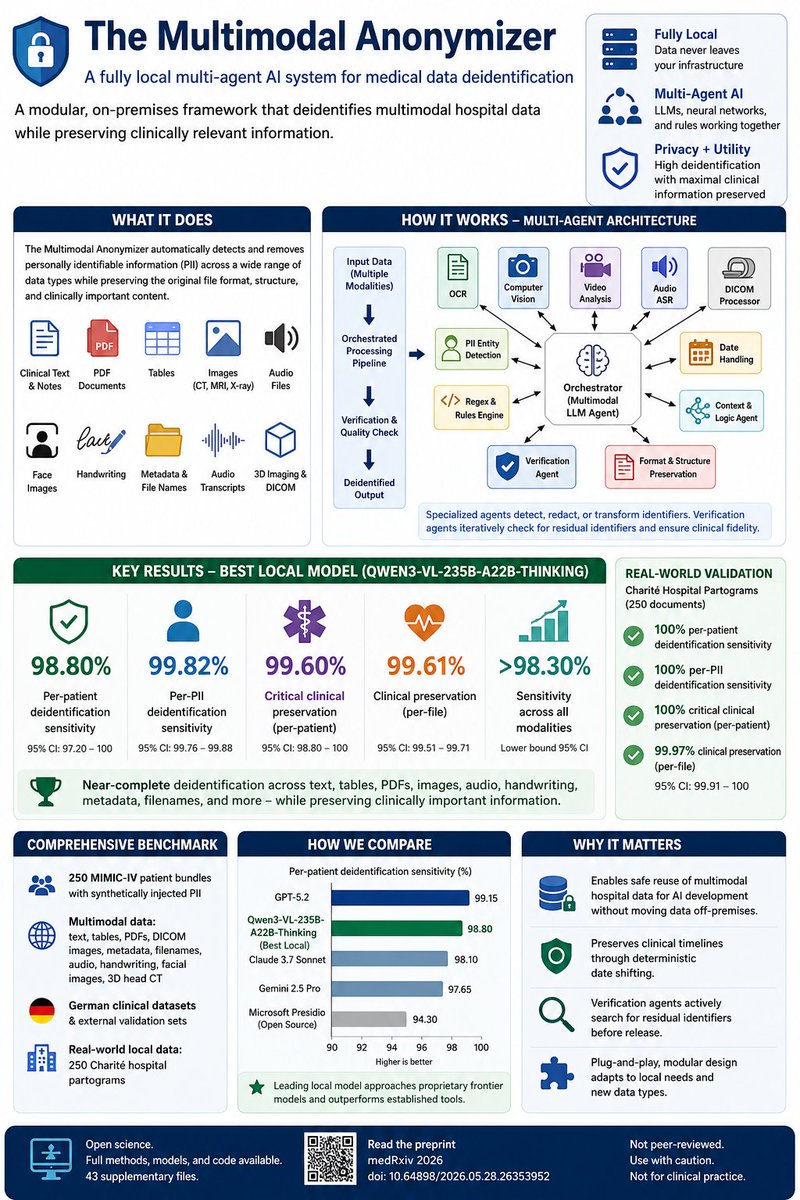
🔒 Multimodal Anonymizer: The Missing Infrastructure for Clinical Foundation Models
Hospitals generate petabytes of multimodal data—clinical notes, PDFs, radiology images, ECGs, echocardiograms, audio recordings, metadata, and even handwritten documents. Yet only a tiny fraction is reusable for AI because patient identifiers remain embedded across modalities.
A new medRxiv preprint introduces the Multimodal Anonymizer, a fully local, multi-agent AI framework designed to deidentify hospital data while preserving clinical utility. Rather than relying on a single LLM, the system combines multimodal reasoning models, OCR, specialized vision networks, rule-based engines, speech recognition, handwriting recognition, and iterative verification agents into a unified workflow.
The benchmark is unusually comprehensive:
• 250 multimodal MIMIC-IV patient bundles
• Text, tables, PDFs, DICOM images, metadata, filenames, audio, handwriting, facial images, and 3D head CT scans
• German clinical documents and external validation datasets
• Real-world validation on 250 Charité hospital partograms
The best local configuration used Qwen3-VL-235B-A22B-Thinking as the orchestrator model.
Key results:
✅ 98.8% patient-level deidentification sensitivity
✅ 99.82% PII-level sensitivity
✅ 99.6% preservation of clinically critical information
✅ ≥98.3% sensitivity across every modality tested
✅ 100% sensitivity and 100% critical clinical preservation on the real-world Charité validation cohort
One of the most interesting findings is that large local open-source models approached proprietary frontier systems. GPT-5.2 achieved marginally higher overall sensitivity, but the leading local Qwen model showed higher specificity and better date-shifting behavior, reducing unnecessary removal of clinically useful information.
The architecture reflects where clinical AI infrastructure is heading:
→ Multimodal reasoning instead of modality-specific pipelines
→ On-premises deployment for data sovereignty
→ Preservation of longitudinal timelines via deterministic date shifting
→ Verification agents that actively search for residual identifiers before release
The broader implication is significant. The bottleneck for healthcare AI is increasingly not model capability but secure access to multimodal clinical data. A robust deidentification layer may become as important as the foundation model itself.
If validated prospectively across institutions, systems like this could become foundational infrastructure for building hospital-scale multimodal foundation models while maintaining privacy compliance.
Reference
Hirsch A, Ten FW, Krüger KS, et al. The Multimodal Anonymizer: a fully local multi-agent AI system for medical data deidentification. medRxiv (2026).
DOI: 10.64898/2026.05.28.26353952
#AI #HealthcareAI #PrivacyPreservingAI #MultimodalAI #LLM #FoundationModels #MedicalAI #DigitalHealth #ClinicalData #OpenSourceAI
1
4
225

Mar 6
The privacy protections look useless in practice:
- Defines deletion of data to include 'deidentification', which does not work.
- Users have no remedy.
- State AG remedy is weak; civil penalty is optional and it's unclear if each user would be a separate violation anyway.
1
82
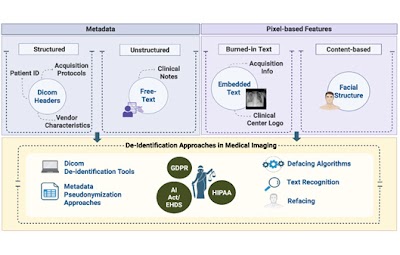
Federated learning, synthetic data generation, de-identification and more! A new review on imaging data preparation for AI doi.org/10.1148/ryai.250273 @Klonmich #FederatedLearning #deID #deidentification
1
2
268

Feb 25
that there is not any entity that is causing it and that there is no entity that is suffering, only then can deidentification take place.
Otherwise all kinds of misunderstandings happen.
Nisargadatta
2
253

The Truth About The “Hard Truth” About Conservatives
In a post titled “Hard truth about conservatives leaving the church, according to social science,” Jasmin Rappleye cites a new BYU study to suggest conservatives are quietly finding a pathway out of The Church of Jesus Christ of Latter-day Saints.
The study does not say that.
Jasmin begins: “A lot of people have assumed that being politically liberal or progressive was the fastest pathway out of the Church, but new data has shown that we’ve been missing a pretty big piece of the puzzle.”
That framing sets an expectation. If liberals were presumed to leave fastest, we are about to see evidence that conservatives are leaving at comparable or alarming rates.
But the BYU paper, Latter-day Saint Religiousness, Well-Being, and Retention in the United States does not identify any specific ideology, liberal or conservative, as the “fastest pathway” out.
It reports that political identification and feeling troubled by the Church’s political stances correlate with higher rates of deidentification.
That is not the same as demonstrating a conservative exodus.
Next, Jasmin states: “One of the top predictors of leaving the Church is if your political identity is more important than your religious one.”
The study does not measure a hierarchy in which political identity “outranks” religious identity.
What it reports is this: among youth who felt “very concerned or troubled” by the Church’s stance on social or political issues, 28% disidentified over a four-year period.
It also reports that not feeling God’s presence daily was a powerful predictor of leaving.
Those are measurable variables. “Political identity being more important than religious identity” is not one of them.
That hierarchy is an interpretive layer added after the fact.
Jasmin continues: “And this is true for both the left and the right… conservatives and Republicans… align more strongly with their political party than with the church.”
Again, the paper does not document a “quiet disaffection” among conservatives.
It finds that political ideology differentiates groups of those who leave. It finds that youth troubled by the Church’s political positions are more likely to deidentify.
It does not present data showing conservatives leaving in significant numbers because they prioritize party over prophet.
There is a difference between feeling tension with institutional stances and loving a political party more than the gospel.
The study measures the first. The video implies the second.
Finally, Jasmin advises: “If you find yourself agreeing more often with what your favorite political pundit or influencer says over what the prophet says, that’s a great reminder to reprioritize our identity.”
This is spiritual counsel, not a finding from the study.
The BYU research is descriptive. It reports correlations in survey data. It does not prescribe moral hierarchies or diagnose members as subordinating religious identity to partisan identity.
When apologists overstate what the data shows, it erodes trust. The paper’s strongest finding is not about conservatives. It is about formation.
Those who reported feeling God’s presence daily were dramatically less likely to leave. Political discomfort was one factor among several.
Reducing that complexity to a headline about conservatives who “prioritize politics” flattens a deeply personal and often painful process into a caricature.
According to the study, retention has fallen from 82% in the 1980s to roughly half today.
That is serious and deserves serious engagement.
But, if we are going to invoke social science inside the household of faith, we should do so carefully, and not try to use it to frame members leaving for reasons the data does not support.
The data says what it says.
We do not strengthen the Church by implying it’s saying something that it doesn’t.
Note: I deleted an earlier version of this post to correct some inaccuracies.

Hard truth about conservatives leaving the church, according to social science.
A lot of people have assumed that being politically liberal or progressive was the fastest pathway out of the church, but new data shows that we’ve been missing a piece to the puzzle.
24
12
92
7,648
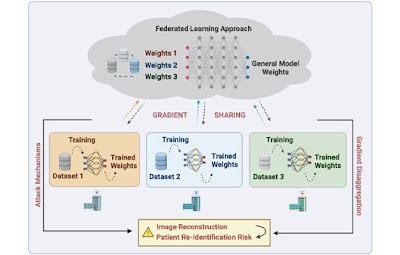
New Special Report! Methods for preparing imaging data for AI while protecting privacy doi.org/10.1148/ryai.250273 @Klonmich #privacy #MachineLearning #deidentification
1
4
256
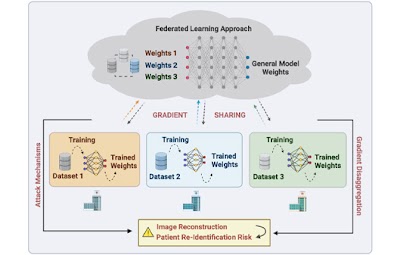
Federated learning, synthetic data generation, de-identification and more! A new review on imaging data preparation for AI doi.org/10.1148/ryai.250273 @Klonmich #FederatedLearning #deID #deidentification
1
4
216

Feb 14
Tell me how, and which privacy act? Also tell me that you don't understand deidentification tools without telling me.
3
64
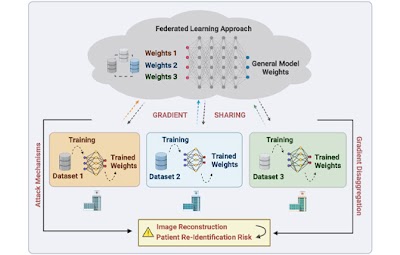
Federated learning, synthetic data generation, de-identification and more! A new review on imaging data preparation for AI doi.org/10.1148/ryai.250273 @Klonmich #privacy #deID #deidentification
1
4
217
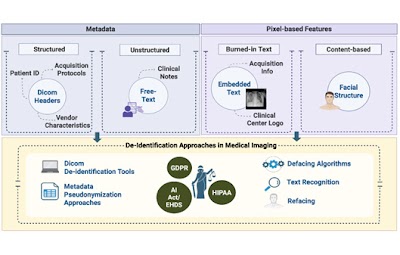
Federated learning, synthetic data generation, de-identification and more! A new review on imaging data preparation for AI doi.org/10.1148/ryai.250273 @Klonmich #privacy #deidentification #ML
3
223

Jan 7
Florida's SB 482 is a massive data-collection/monitoring bill that creates a de facto Digital ID.
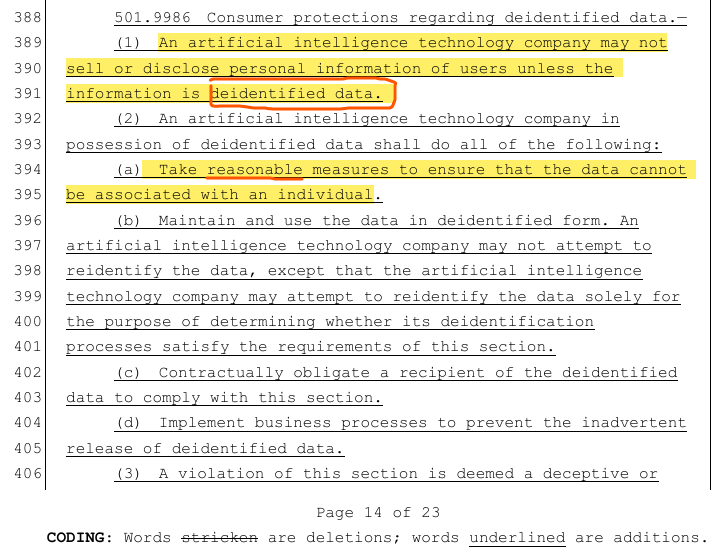
The bill requires AI companies to "deidentify" data. No definition for "deidentification" in the bill.
They are to take "reasonable" measures to ensure the data can't be associated with the individual.
What is reasonable? What's reasonable to me may not be reasonable to you. Who decides? There's no definition, leaving this wide open for interpretation.
WHO writes these policies????
Jan 6

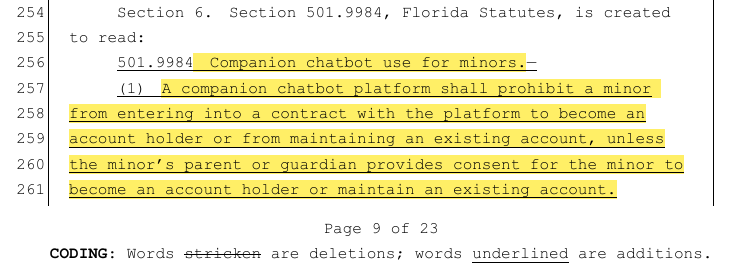
Florida's AI Bill of Rights has a massive red flag. The same red flag all of these "child protection" social media/tech bills have...
How will the platform identify that the user is a minor and therefore in need of parent permission?
And how will the platform connect that the parent/child relationship is legitimate?
By collecting age-verification data from EVERY user of the platform. These bills create a de facto digital ID - something that Governor DeSantis has said he is very much against.
So how do we protect children AND the privacy of users? Parents, y'all need to step up and do your job!!
SB 482 is just another gateway to Digital ID.
6
6
1,005

5 Dec 2025
Apart from that, there is also major privacy concerns. You should looking into standards for medical data deidentification.
1
2
114

28 Nov 2025
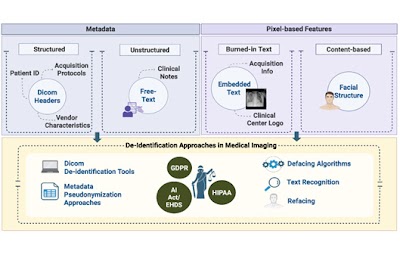
Giouroukou et al. review imaging data preparation for AI use: methods for protecting patient privacy doi.org/10.1148/ryai.250273 @Klonmich #privacy #FederatedLearning #deidentification
3
7
466

6 Nov 2025
Sometimes it isn’t even the volume, but the complexity of prod data that will break things.
It’s great if you’re in an industry that can mirror prod or do reasonable deidentification, but it gets to be a real challenge when you don’t have that luxury like fin or health tech
10
1,723

3 Nov 2025
Before someone asks I’m learning about “deidentification” which is actually incredibly complex and difficult
1
3
546

29 Oct 2025
In June, BYU professors Sam Hardy and Justin Dyer published research regarding religious deidentification and its effects on young people.
Read more at the link in our bio.
#universebyu #byuresearch #religion
2
201

25 Oct 2025
I will not promote anyone from APC in Lagos - it has becoṣe more than apparent to me that the APC in lagos is complicit and part of the greater scheme to dsipalce Yoruba from Lagos and to change the identity of the state.
When TYF wanted to host our June Conference in Lagos State, we wrote to all neccessary offices, not a single respinse from all of you, but quickly you are siding Uzo, and now this Yoruba hater. Your actions and dedications showed that your interest is in the deidentification of Yoruba from Lagos, your Yoruba promotion is only to keep that Yoruba identity vestigial. We see all your moves, you are the most myopic sets of government to ever step foot in Lagos leadership @followlasg @jidesanwoolu @IdrisConnecting
You have zero RESPECT for Yoruba people and you and your generation do not deserve to continue to enjoy the support of the Yoruba people. Many of you will weep at your death bed.


161
177
484
66,129