
Jun 14
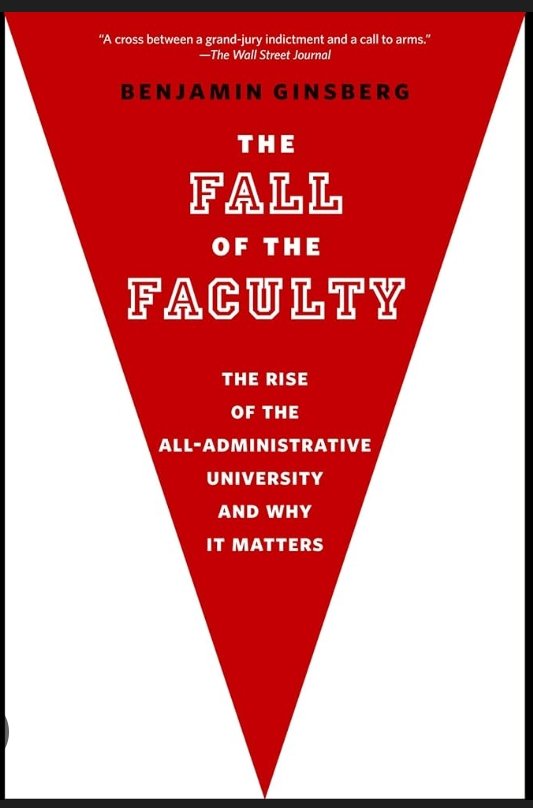
As political scientist Benjamin Ginsberg argues in The Fall of the Faculty: The Rise of the All-Administrative University and Why It Matters, over the last 40 years, the governance roles that faculty members traditionally served at American universities have been absorbed by an ever-expanding assortment of new administrative positions, many of them staffed by persons with few scholarly contributions to speak of —“deanlets” in Ginsberg’s mordant prose.
The Fall of the Faculty a.co/d/06LQsMIV #Amazon
2

"Runtlings" is good. Now universities have those plus "deanlets".
1
363

Apr 14
Ginsberg argues that power in American universities has shifted from the faculty to a growing class of professional administrators—whom he mockingly calls "deanlets"—who often lack serious academic backgrounds
2
1
7
273

Mar 26
we already have too many deanlets who overlap that position
1
207

Jan 16
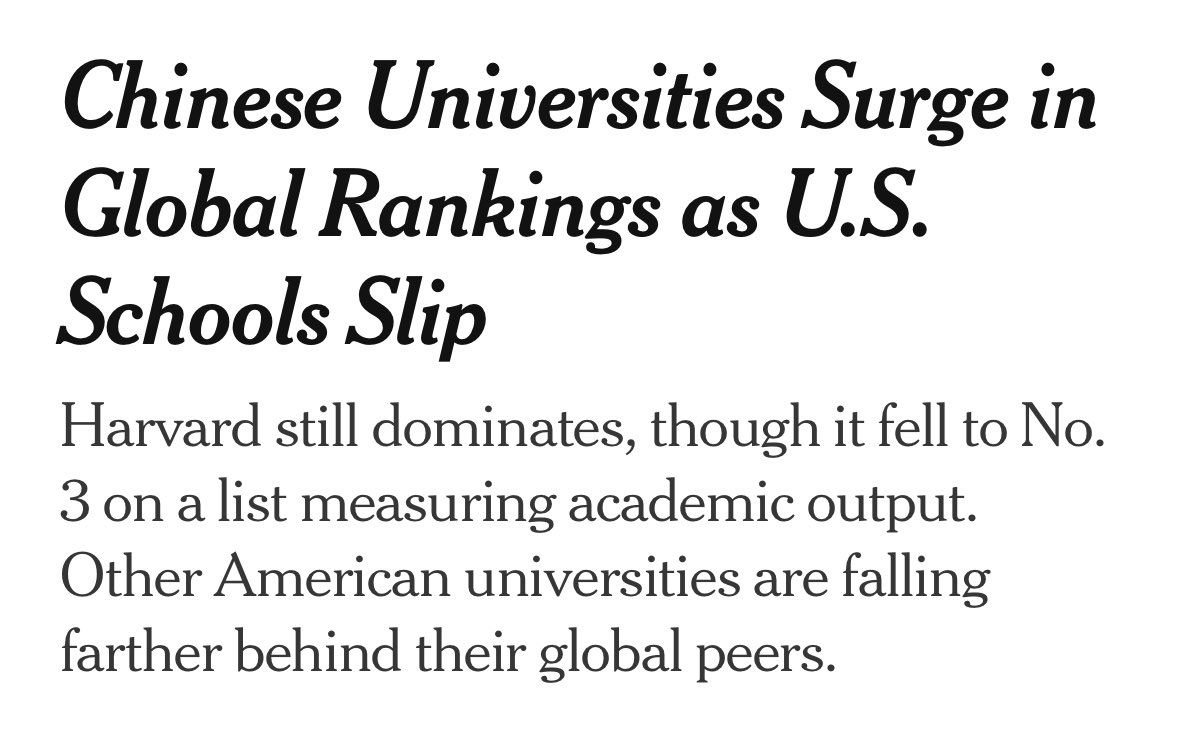
The US Universities are losing because of crappy administrator. The administrative bloat in US schools is unreal. It is worse than a third world bureaucracy. Deans and deanlets are mucking it up.
Jan 15

This should come as absolutely no surprise. The US isn’t losing its edge because our universities got worse. We are losing it because others are investing faster while we cut funding, restrict talent, and politicize science.
These rankings are the first signal of the decline.
1
321

20 Dec 2025
Luckily there’s a whole cadre of deanlets who have been trained in the current environment who will move into more powerful positions and save the day!
20 Dec 2025

The good news is that almost every university is run by people who will tell you they are committed to not destroying higher ed while actively going about destroying higher ed.
1
20
1,137

12 Dec 2025
The corporatization of the university is hollowing the institution out from the inside. Thousands of deanlets are like weeds choking out faculty. This is intellectual blight, and it’s effects will be felt for a generation or more.
12 Dec 2025

Carnegie Mellon’s literature PhD is being liquidated in favor of “computation,” casualized labor, and AI.
That has profound ramifications for, students, faculty, and program alums like myself.
I wrote it about it (w/ Catherine Evans, a current PhD student).
1
3
22
1,166
8 Dec 2025
Running an experimental lab in a US university is like running a start up. In some fields, the chance of funding is in single digits. And the university charges >50% overhead to support "deans" and "deanlets" who basically feel they are doing something without actually contributing anything. So, running a lab in a US university is worse than running a startup ina bureaucratic nightmare of a country.

4
516

5 Nov 2025
“American college students regularly act out little psychodramas of oppression before an appreciative audience of diversity deanlets and associate vice-provosts of inclusion and belonging. Zohran Mamdani, the quintessential product of the academy, is poised to take such performative grievance to one of the biggest stages in the world."
thespectator.com/topic/zohra…
7
9
47
6,741

5 Nov 2025
"American college students regularly act out little psychodramas of oppression before an appreciative audience of diversity deanlets and associate vice-provosts of inclusion and belonging. Zohran Mamdani, the quintessential product of the academy, is poised to take such performative grievance to one of the biggest stages in the world." - @HMDatMI

3
2
10
1,232

3 Aug 2025
The beige, careerist Gen X deanlets (accentuating worst elements of boomers and mils) are sufficiently awful that this drags the Xer avg way down. DeBoer back in 2015 was onto the unholy alliance btwn mil sjws and opportunistic uni admins in 40s-50s
1
9
411
3 Aug 2025
The demise of that “authenticity” attitude has to do with Xer to Millennial turnover…though at same time careerist Gen X deanlets have been the most appalling woke commissars
3
10
632

31 Jul 2025
My friends and I call them the Deanlets and the Administrati. And they all get at least one (if not 3-4) assistants.
1
8
567
22 May 2025
The solution is simple: cut unnecessary administrative position that do the academy no good. Deans and Deanlets draw such high salaries and act as deadweights pulling entire research ecosystem down. Cut the administrative bloat. Drain the swamp!!! Make Academia Great Again!
aps.org/apsnews/2025/04/phys…
3
340

8 May 2025
ChatGPT is not unraveling the entire academic project.
Academic leadership who have never been inside a classroom, a much less given a class, are a much bigger threat.
“Until very recently, American universities were led mainly by their faculties, which viewed intellectual production and pedagogy as the core missions of higher education. Today, as Benjamin Ginsberg warns in this eye-opening, controversial book, “deanlets”–administrators and staffers often without serious academic backgrounds or experience–are setting the educational agenda.”
politicalscience.jhu.edu/fac…
I’m luckily that at least in the institution I work at, everyone is required to teach a class so they don’t lose sight of what we are here for.
7 May 2025

I'm sympathetic to the professors quoted in this, but at a certain point if your students can cheat their way through your class with AI, you probably need to redesign your class. nymag.com/intelligencer/arti…
3
305

20 Apr 2025
The Self sabotage is by the universities themselves the warnings have been known for decades
Benjamin Ginsberg (2011) exposed how “deanlets” turned universities into bureaucratic hedge funds—a reality mirrored in Harvard’s $53 billion endowment and risky private equity bett
Jonathan Haidt documented how “safetyism” bred intellectual fragility, correlating with today’s grade inflation and speech policing
Richard Vedder warned that tax-exempt endowment hoarding would invite public backlash, now materializing in Congressional pressure
All dismissed as reactionary or deplatformed for challenging progressive orthodoxies—laid bare the rot long before Harvard’s bond issues and protests made headlines.
The ruling class is the cause of their own problems & Harvard is now the poster boy of what’s wrong with our elite institutions
4
57

14 Mar 2025
I mean, yes and no. While there are too many PhDs being produced, and WAY too much administrative bloat, the Deanlets and Deans are generally coming from the ranks of the tenured faculty, not from people who can't get academic jobs.
1
10
860

11 Feb 2025
Hey university bureaucrats, the NIH wants more for its money.
Gary Hamel
US universities spend nearly $80 billon per year on research, more than half of which comes from US taxpayers. It’s hardly surprising, then, that a Trumpian rule change by the National Institutes of Health has some university administrators panicking. Henceforth, the percentage of @NIH research grants that can be used to fund university overheads will be capped at 15 percent; 85 percent of funds must be used to cover direct research costs.
Currently, a quarter of NIH grant money is used to pay indirect expenses, but at some universities, the administrative tax is substantially higher. Johns Hopkins University, the largest recipient of federal funds, levies a 63.7 percent overhead charge, while Harvard takes 69 percent and Yale 67.5 percent.
To understand the implications of the rule change, consider that in 2023, Johns Hopkins received $843 million from the NIH. Under the new edict, the universi-ty’s overhead charge would have been $126 million rather than $537 million—hence the protests. Jeffrey Flier, a former Dean Harvard Medical School griped that “no sane government would do this.” Matt Owners, president of the Council on Government Relations, a grouping of academic medical centers and research institutes, warned the shift would “cripple life-saving research and innovation.”
One can debate whether a 15 percent overhead allowance is too miserly (researchers, after all, need facilities in which to do their work); but what can’t be argued is that in recent decades universities have been piling on bureaucratic belly fat like grizzlies bulking up for hibernation.
Johns Hopkins professor Benjamin Ginsberg, author of The Fall of the Faculty, describes the phenomenon well:
“Every year, hosts of administrators and staffers are added to college and university pay-rolls, even as schools claim to be battling budget crises that are forcing them to reduce the size of their full-time faculties. As a result, universities are filled with armies of functionaries—vice presidents, associate vice presidents, assistant vice presidents, provosts, associate provosts, assistant provosts, dean, deanlets, deanlings, each commanding staffers and assistants—who, more and more, direct operations of every school.”
Between 1976 and 2018, the number of full-time administrators employed by US colleges and universities increased by 164 percent. During that time, the number of full-time faculty increased by 92 percent while total student enrollment grew by 78 percent. In consequence, many universities now have more managers and administrators than faculty members. Within the University of California system, there are 8 students for every instructor, and 4 students for every administrator.
Writing more than a century ago, the economist and social critic, Thorstein Veblen, offered a blunt assessment of university administrators:
“They are needless, except to take care of needs and emergencies to which their own presence gratuitously gives rise. In so far as these needs and difficulties that require executive surveillance are not simply and flagrantly factitious …, they are altogether such needs as arise out of an excessive size and a gratuitously complex administrative organization…”
Having known more than a few university administrators, including my late father, I’m inclined to be more charitable, but Veblen was right: administrators produce complexity which can only be managed by (you guessed it!) more administrators.
In an article bemoaning the growth of academic bureaucracy, Bloomberg reporter John Hechinger recounts a conversation with an associate vice provost hired to oversee a cluster of committees working to revise the university’s academic calendar. “[My] job,” said the administrator, “is to make sure these seven or eight committees are aware of what’s going on in the other committees.” Sadly, examples of such administrative excrescence are legion.
As is true with administrative jobs generally, university administrators are seldom accountable for improving outcomes or reducing costs. Mostly, they report to oth-er administrators, and are measured and compensated based on activity, not impact. Says Todd Zywicki, a law professor at George Mason University and the author of The Changing of the Guard: The Political Economy of Administrative Bloat in American Higher Education, “The interesting thing about the administrative bloat in higher education is, literally, nobody knows who these people are or what they’re doing.”
To be fair, bureaucratic bloat isn’t just a problem for universities. Across the US economy, the number of managerial and administrative jobs has increased by 145 percent since 1983, roughly three times the growth rate of all other job categories.
As Michele Zanini and I argue in Humanocracy, the costs of bureausclerosis are becoming untenable—for organizations, economies, and societies. While the NIH’s blunt attack on academic overhead lacks nuance and may disrupt the pro-cess of discovery, one shouldn’t be surprised that President Trump’s efficiency shock troops are intent on shrinking the size of the academic administerium.
2
3
10
1,292