
Joined March 2015
- Tweets 3,994
- Following 526
- Followers 15,021
- Likes 7,660
365 Photos and videos



Pinned Tweet

Jun 7
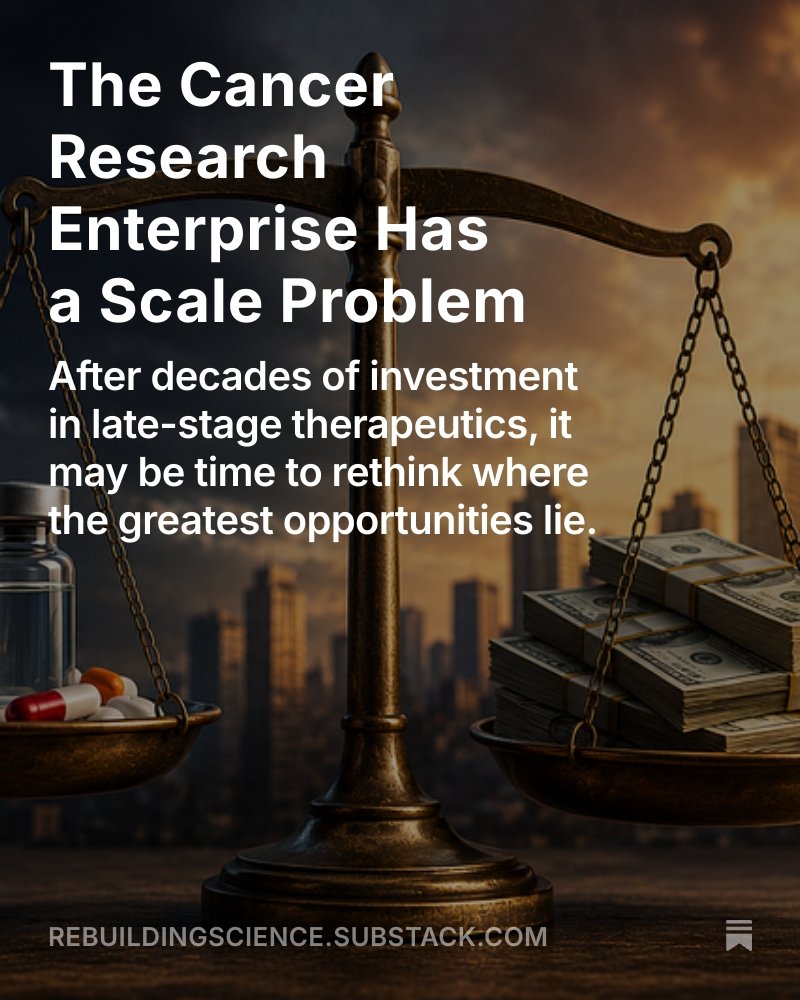
The Cancer Research Enterprise Has a Scale Problem
My latest essay examines why the most celebrated advances in oncology still leave us far from substantially reducing the burden of cancer.
open.substack.com/pub/rebuil…
7
5
31
2,442
I enjoyed reading this article.
One of the assumptions I encounter often in biology is that AI will become useful once we collect enough data. In reality, many problems remain limited by algorithm development and the ability to incorporate domain knowledge, in this case chemistry and metabolism, into the inference process.
Much of the challenge is talent allocation. In 2026, many of the world’s strongest computational scientists are working on large language models and other AI applications where the financial rewards are enormous. Fields such as metabolomics attract far fewer people and resources despite presenting some of the most interesting unsolved problems in computational science.
Metabolite identification from mass spectra is a great example. The field already possesses enormous amounts of data, yet relatively little effort has been devoted to extracting the maximum information from those data by combining machine learning with centuries of accumulated chemical and physical knowledge. Simply collecting more spectra is not enough.
The opportunity for major advances remains enormous. The limiting factor is not data. It is a shortage of people willing and able to work on difficult scientific problems whose rewards are measured in knowledge creation particularly because it is not rewarded inside universities.
nature.com/articles/s42255-0…
2
2
17
963
Cancer is the ultimate shield against accountability.
Mention a suffering patient and suddenly nobody is allowed to ask whether billions were wasted, mismanaged, or captured by rent-seeking interests.
Jun 12

The same man who cut children’s cancer research is now a trillionaire.
4
2
29
1,063
This incoming president has an opportunity to prove his critics wrong.
The way to do it is not through public relations involving essays. It is by transforming Florida into the university that recruits the best scholars in the world, protects academic freedom, and rewards excellence above all else.
Until then, skepticism is justified.

Great op-ed from incoming UF President Dr. Stuart Bell on overcoming DEI and returning higher education to its original intent.
foxnews.com/opinion/america-…
2
3
28
1,173
Jun 13
Capping university administrator salaries relative to faculty salaries is a must as well.
We cannot continue incentivizing administrative careerism with obscene compensation packages while the people doing the teaching and research are treated as a cost center.
Universities must reward scholarship, not bureaucracy.

Nonprofit hospital CEOs would face pay limits under bill advancing in NC Senate wral.com/news/nccapitol/lawm…
10
30
116
6,160
Jun 13
The people warning that science is becoming political are the same people who spent years making politics the central feature of scientific institutions.
Nobody did more to blur the line between science and politics than the people who spent the last fifteen years running America’s woke scientific institutions.
This person Skorton was a senior administrator at Cornell, the Smithsonian, and now the AAMC during an era when politics permeated nearly every aspect of these institutions.
The hypocrisy is obvious. These people never objected to politics in science when they held power. They embraced it as long as it was politics they agreed with. They celebrated it, institutionalized it, and punished those who challenged it.
Now they want to present themselves as defenders of scientific neutrality. The issue is not politics in science for them. The issue is that they mistake their politics for science.

“American science is too valuable to be turned into a political football,” writes David J. Skorton, president of the Association of American Medical Colleges. trib.al/KFPcUtR
7
14
86
3,777
Jun 13
What the pandemic laid bare for the world was the distrust in our scientific institutions.
When leading figures promoted narratives that suited their interests and dismissed evidence to the contrary, it exposed what many of us who spent our lives inside the system already knew: there is a crisis in science.
Everyone who has spent enough time in science knows there are countless examples where narratives replaced evidence, dissent was discouraged, and corrections and second-guessing never occurred when the facts changed.
This is not unique to COVID. The same problems permeate neuroscience, metabolic health, longevity, cancer, immunology, and many other fields.
The solution is transparency and objectivity above all else. We cannot continue funding institutions that fail to uphold those principles while expecting the public to trust them.
Jun 12

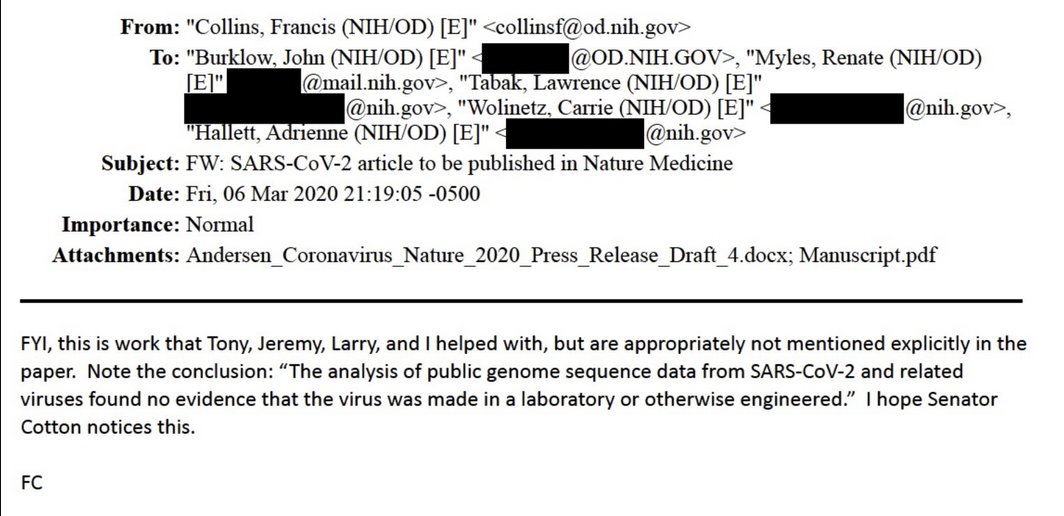
Fmr. NIH Director Francis Collins deliberately scrubbed Fauci’s name from the infamous Proximal Origins paper because of Fauci’s glaring conflict of interest.
Nature Medicine (the publisher) offered no condemnation or scrutiny of the ethics.
These COVID investigations matter because they expose protectionism within the scientific community that breeds gatekeeping. It's suppressing research, stifling innovation, destroying objectivity, & eroding public trust.
9
9
54
4,080
Jun 12
Every generation thinks it lives in ordinary times. Then science quietly invents another miracle.
4
1
26
1,052
Jun 11
Reforming large institutions is difficult work, especially when entrenched interests and legacy media narratives resist change at every step. Many Americans are rooting for efforts to restore transparency, accountability, and scientific integrity to our public health institutions.
It is disappointing to see so much journalism devolve into predetermined hit pieces where the conclusion is written before the reporting begins. Public trust is not maintained through narratives. It is held through facts, results, and accountability.
Jun 10

Sheryl. Your article exemplifies the biased reporting we have come to expect from you and @nytimes. It was unfair, inimical, and inaccurate. All one needs to refute your argument is to glance at my publicly available calendar and to review my unprecedented list of accomplishments on a wide range of issues, all of which I drove. You evidently never undertook these foundational due diligences. Why let facts obscure a good story?
You fault me for missing a couple of monthly counselor meetings. However, I meet one-on-one with my counselors every day to decide policy and strategy. We schedule the monthly meetings to give the divisions a chance to keep each other informed about HHS-wide policies with which I’m already intimately familiar. Had you read my calendar, you would have seen that I have back-to-back meetings all day, every day, with both career and political staff, with my counselors and with outside stakeholders, interspersed with press conferences and other policy announcements.
I am knowledgeable and active on every issue in every division of my department, and I always make the final decisions. I meet with the principals at FDA, NIH, CDC, and my senior counselor every morning, something, I’m told, is unprecedented in HHS history. I try to get out of the office between 4:30 and 6:00 PM, so that I can spend three hours, in quiet, responding to emails. I normally work until 11 PM every night, mostly on phone calls to staff.
In order to prove your preconceived case for my disengagement, you quote anonymous employees, some of whom I fired or who quit to avoid being fired. You also deceptively quote HHS employees without identifying whether they were among those I fired, thereby depriving your readers of the opportunity to make an independent judgment about their credibility.
I came into this job to change the culture of a broken agency that has presided over the worst decline in public health in American history. Of course I fired people—lots of them! It's an easy task for even the laziest journalist, to comb that flotsam and jetsam for malevolence toward the Trump administration. And of course, this species of journalist will always be able to find disgruntled individuals among the 70,000 employees of the Department from whom to cherry pick "facts" to flesh out a preordained hit piece. All that is required for this brand of journalism is the ethical elasticity that you seem to have in spades. You had a preconceived thesis, and you set out to prove it. This is a widely accepted technique in journalism today, but I grew up in an era when it would not have been tolerated by the New York Times.
Ultimately, God puts us all on this earth to search for existential truths. I've tried to instill this mission at HHS by implementing gold standard research to end the regime of politicized science that COVID exposed to the American public. There was a time that journalists were proud to be the fearless and uncompromising champions of truth. Standards have devolved, and journalism is dead. The Times now employs propagandists. Your capitulation to partisanship further compounds your journalistic challenges; since we all are aware of your predictable bias, we at HHS are unwilling to talk to you about the topics that are important. The fact that you have minimal access to decision makers leaves you covering trivia and relying on your own capacity for invention.
Btw. When I took this job, the building was empty. About 90% of the employees were not coming to work. I changed that, but your newspaper never covers my reforms. Nor did you cover the fact that my predecessor almost never showed up for work here during his four years in office. When we came in, there were still artifacts from the first Trump administration in many of our office drawers because no one showed up for work during the Biden years. Just as Rochelle Walensky spent her entire term as CDC Director in Cambridge, Xavier Becerra reportedly spent most of his term as HHS Secretary in California. (I live in California, but I’ve only been there once in fifteen months).
His only notable accomplishments here were losing 300,000 children, referred to HHS for custody and care, to human traffickers and drug runners, encouraging transgender surgeries, and disabling the entire program-integrity apparatus, allowing hundreds of billions of dollars of theft from my agency. I have set out to find the children Becerra lost. He is now the front-runner for the governor of California. These are not invented stories; they are genuine scandals that the Times will never cover, presumably, because the malefactors are Democrats.
Finally, you criticize me for spending time with the Indian tribes in Alaska. I consider that part of my job. I run the Indian Health Services, and I’ve had unprecedented success in transforming IHS from a backwater to a top priority for this department. I’ve made more trips to Indian country and to Indian health clinics and hospitals than any HHS secretary in history, and I’ve brought Indians into high positions on the sixth floor for the first time in agency history. This is another success story that the Times will never cover.
1
4
16
1,947
Jun 11
The reason I remain skeptical of the endless predictions that China will soon leapfrog the United States in biomedical science is that China has largely been emulating the American system rather than inventing a different one.
When publication counts, citations, and papers in known Western journals became the currency of success in the United States, China followed. When scientific careers became tied to publication metrics and journal prestige, China followed. When social-media personalities, science journalists, and self-appointed integrity watchdogs discovered that gotcha moments, misconduct accusations, and public shaming generated attention, China followed.
Now Science is celebrating the Chinese version of a phenomenon that already became familiar in the United States: people building audiences around finding flaws in papers, many of which have little bearing on the central conclusions of the work.
The larger story is not any misconduct. The larger story is imitation.
China is reproducing the same incentives, institutions, publication systems, prestige hierarchies, and cultural narratives that already exist in American science. The country is not charting a fundamentally different path. It is running a version of the same playbook a few years behind.
That should make people less confident in both the apocalyptic predictions about Chinese scientific dominance and the assumption that the American biomedical system is a model worth copying.

China has gained an unexpected ally in its struggle with rampant scientific misconduct: an independent video blogger who shines a light on problematic papers for millions of followers. scim.ag/4xskplp
11
6
44
5,011
Jun 11
The AMA wants to be treated as the guardian of medicine. It should first explain its role in maintaining the healthcare system Americans cannot afford.
The same institution that artificially extends physician training through gatekeeping, restricts the supply of medical care, profits from publishing taxpayer-funded research in its journals, and helps sustain a healthcare bureaucracy through its coding system that drives up costs asks the public to accept its authority without question.
Its administrators that want to be activists earn seven-figure salaries. The organization sits on over a billion dollars in assets as a nonprofit.

America’s doctors just voted for war with RFK Jr. dlvr.it/TSzRvc
8
10
60
3,012
Jun 10
I stopped for a bathroom break and came out three hours later with a brisket sandwich and a new worldview.



2
1
31
2,032
Jun 10
I do think overprescription of antibiotics and antibiotic resistance are major issues. I have not looked deeply into how severe the resistance problem is.
My expertise is more in metabolism and health. One thing that has always puzzled me is how the gut microbiome became one of the trendiest topics in health research over the last 15 years while relatively few people seemed interested in the obvious question of how antibiotics interact with it.
We know antibiotics dramatically disrupt the gut microbiome. It seems entirely reasonable to ask whether widespread antibiotic use could have long-term consequences for health, including potential contributions to rising rates of colon cancer in younger people.
Unfortunately, NIH is not structured to ask and answer these kinds of questions. It is much better at expanding existing research programs than rapidly investigating uncomfortable questions that challenge mainstream medical practice.
Jun 9

As a practicing dentist I worry the very most about antibiotic resistance as a major problem on the event horizon. I don't know if that's a potential topic for you Jason, but I value your take, if it is.
5
4
17
2,689
Jun 10
I bought the high-fiber, zero-sugar Pepsi at Costco on clearance and it was actually pretty good.
Jun 9

If someone can fit 20g protein into a can of Diet Coke without changing the taste and texture , that recipe will make a bigger IPO than Anthropic.
2
6
1,413
Jun 10
Universities continue to believe that good public relations can conceal their decay.
MIT spent more than a decade purging dissenters, driving out some of its most accomplished scientists, and rewarding mediocrity, conformity, bureaucracy, and careerism. Now it seems to think a few flashy patriotic advertisements are enough to restore public trust.
They still do not understand the problem. We are not fooled.

As we celebrate 250 years of American independence, we are reminded that MIT was founded in the same spirit: to advance knowledge, foster innovation, and serve the country through education, research, and discovery. understanding.mit.edu/
6
12
78
3,944
Jun 10
Great article.
A major lesson from Dr. Bhattacharya’s story is that truth cannot be determined by institutional authority.
Science advances through skepticism, debate, replication, and evidence. The moment institutions begin declaring what may and may not be questioned, science starts becoming something else.
Jun 9

The Man They Tried to Silence Now Runs the NIH
rationalground.com/p/the-man…
3
12
39
3,282
Jun 10
Small grants go a long way when institutions provide the infrastructure they are supposed to provide.
Faculty salaries, staff support, student stipends, tuition, core facilities, postdoc fellowships and admin support should not all be pushed onto grants.
I have watched people run 20-30 person labs (producing almost nothing in the lab) with a single R01 because they had access to enormous slush funds attached to their administrative positions. Others with similar grants struggle to support any lab at all.
Jun 9

Your post makes sense, ut how can things get fixed? I believe endowments should not exist but rather be used to pay infrastructure and salaries. Also, limit the # of bureaucrats will help. But many grants are not enough $$ (i.e. R03 or R21), even if a PI is in hard mo ey
1
2
30
4,194
Jun 9
Thank you ❤️
Universities have endless ways to move money around. It’s all one big pot until someone asks for accountability, then suddenly every dollar is restricted, earmarked, and impossible to touch.
Jun 9
UNC admin (EA)
14 yrs in “interesting” depts. CH native. So appreciate your posts. Oracle introduced as transparent in 2012. People Freaked! So over years layered with other apps to obscure. So many shenanigans and none held to account. Maybe topic?
1
3
34
3,958
Jun 9
The problem is the fairy tale universities and their academic medical centers sold to the people they recruited.
These positions were never supposed to exist in this form. NIH should never have enabled universities to treat faculty as grant-chasing mercenaries whose purpose is generating indirect cost revenue.
NIH enabled university medical centers to expand without limits using this model that allows them to offload the cost.
Scientists were convinced it was reasonable to be hired as faculty while being responsible for their own salaries and receiving minimal institutional support. Meanwhile institutions with billions in annual revenue somehow find money for seven-figure administrators but not for the scientists they employ.
The result is a system where faculty spend their time writing grants and paperwork rather than doing science, while universities collect overhead and tell the government on their effort certifications that they are spending time on research when they are not. They are spending time on grant writing and paperwork.
If a university wants to hire a scientist, it should pay that scientist’s salary. Everything else is a scheme to extract money pretending to be a research enterprise.

The reality is that most of us are already applying for 30 or 50 grants per year and getting none. Not sure more limits is better. Also no one can really support their own salary (like we have to), their staff's, and all the research costs on 400k/year. American science is dying
12
31
207
30,653
Jun 9
If Apple can admit Siri is trash after 15 years and replace it with something that works,
universities can change too if they have accountability.

Apple spent 15 years telling us Siri was the future. At WWDC on Monday, they finally revealed the future: it's powered by Google Gemini. The stock fell 5%. That's not a pivot. That's a confession.
1
1
22
2,336
Jun 9
Mischaracterized reagents are not the main source of bad science.
A typical paper in a major journal represents years of work, dozens or hundreds of experiments, multiple model systems, and hundreds of thousands or millions of dollars in funding. A $200 antibody is one small component of a much larger body of evidence. I have not examined this case closely, but I would be shocked if the central observations underlying cellular senescence rise or fall on a single reagent.
How relevant cellular senescence is to aging and cancer remains an open scientific question. The existence of senescent cells is a undoubtedly a real phenomenon. We just do not know how important they are. However, the hype from Science journalists and the negative influencers focusing on ragebait surrounding this antibody issue would have you believe the entire concept is an artifact. The more important question is how much senescence contributes to aging and cancer, and that remains a matter of legitimate scientific debate.
Unfortunately, that debate is impossible to have when the literature is dominated by positive findings, grants, papers, and careers are contingent on supporting those findings, and skepticism is treated as hostility rather than an essential part of science.
What concerns me more is the biomedical system’s inability to distinguish between foundational discoveries and derivative or irreproducible work, between scientists who generated durable insights and those who propagated weak narratives.
Narratives become self-reinforcing for decades without meaningful accountability. Scientists who challenge prevailing ideas struggle for funding, publication, and career advancement. Scientists who reinforce prevailing ideas are rewarded with grants, citations, promotions, and influence.
The most damaging scientific work is sustained by institutions such as this journal that do not revisit their assumptions, do not reward generalizability and reproducibility, do little to penalize those who repeatedly publish weak, derivative or irreproducible work, and never hold influential scientists accountable when they are wrong.
The result is that flawed ideas persist for decades, consuming billions of dollars, training generations of scientists on these bad ideas, and shaping entire fields long after the underlying evidence should have been questioned.
Jun 8

Pretty interesting story in @ScienceMagazine this week on what looks like a serious problem in the senescence field. More than 400 papers apparently used the wrong antibody for p16-INK4a — an antibody that actually recognizes a completely different, unrelated protein (a component of the actin cytoskeleton). This affects work on senescent cell accumulation in aging and disease, and most critically, some of the evidence base for senolytic drug research.
What concerns me most is that many of these papers somehow got the "right" answer using the wrong antibody. That's not just an innocent reagent mix-up — it raises real questions about data fabrication or selective reporting in at least some of these labs. I've commented before about how ignoring data that doesn't fit the narrative is a major problem in certain areas of the longevity literature (e.g. sirtuins and NAD), and here a potentially widespread example in senescence.
Hopefully journals will investigate and retract as necessary, but based on my experience that seems optimistic. One concrete fix is that journals should flag problematic antibody product codes at submission so reviewers can catch this before publication. Reviewers should absolutely be on the lookout for this going forward.
However, these fixes won't address the larger problem. We need to understand how these scientists got the results they wanted and published them over 400 times (!!!): whether through intentional deception, incompetence, accident, or some legitimate explanation.
Credit for discovering this goes to @addictedtoigno1 who wrote about it first on his blog: For Better Science
science.org/content/article/…?
6
6
50
7,110
Jun 9
tldr: People are obsessing over a $200 antibody while ignoring the multi billion-dollar system that rewards weak science, punishes skepticism, reinforces narratives and turns speculation into dogma.
2
7
398