
Apr 1
🚨 Anthropic’s Claude Code Source Leak — What It Actually Exposes
A careless build mistake just laid bare one of the most advanced AI coding tools — and the lessons are huge. Insights from Zhihu contributor deephub 👇
🏢 About Anthropic
Anthropic is a leading AI safety-focused company, widely known for building the Claude model series with a strong emphasis on security and reliability.
📉 The Leak in Short
A 60MB source map file was mistakenly bundled in the npm release, revealing full source code, system prompts, and internal logic — though no model weights were leaked.
🧠 Expert Analysis from deephub:
• The incident stems from a basic build configuration error, likely from manual packaging, with a similar quiet incident in early 2025.
• The leak effectively makes Claude Code 「open-sourced」, exposing agent orchestration, tool execution, and context management strategies.
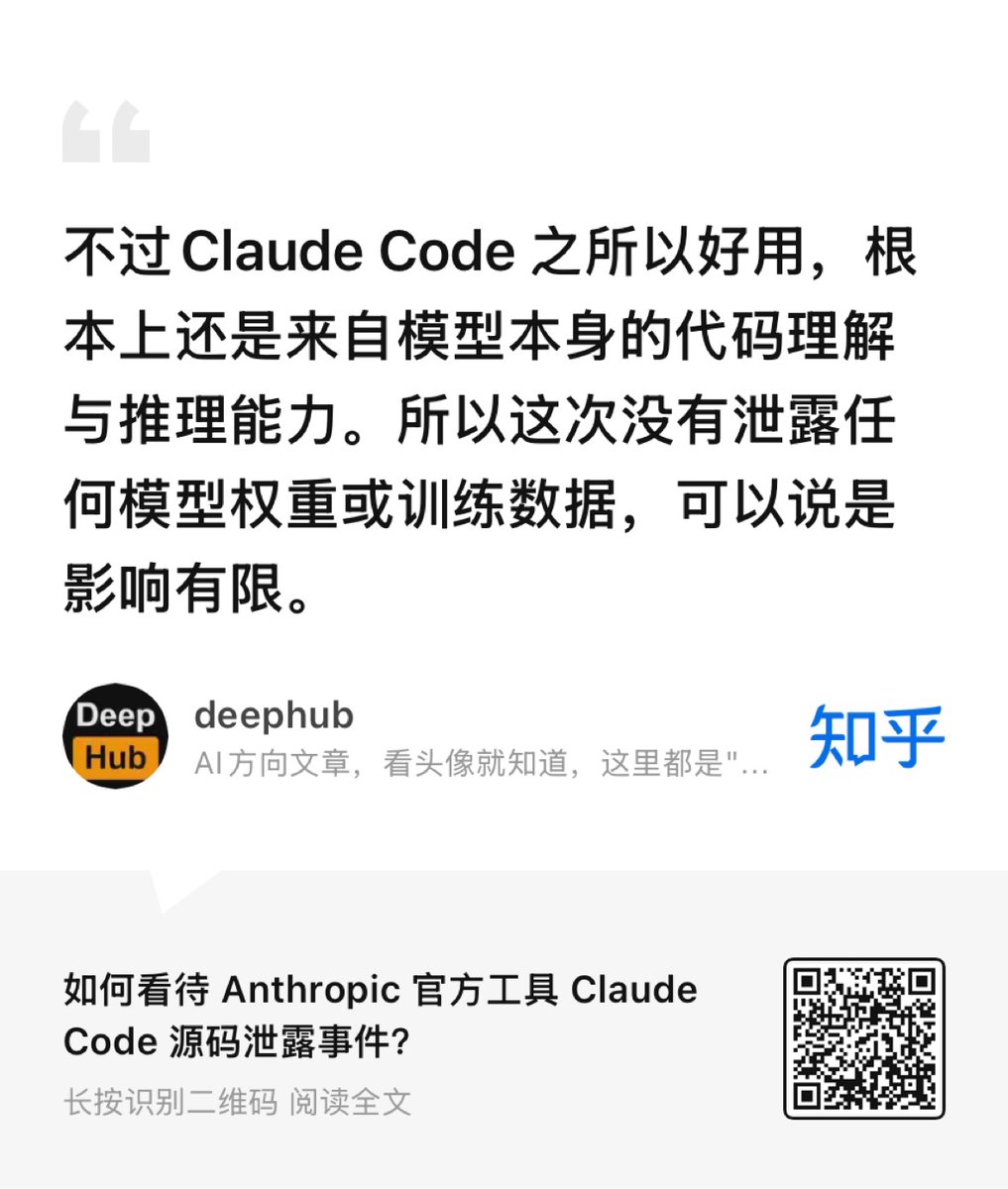
• Yet its real strength lies in the model’s native code reasoning ability, so competitive and technical damage remains limited.
• For a multi-billion-dollar, safety-focused AI company, this low-level engineering mistake is highly embarrassing.
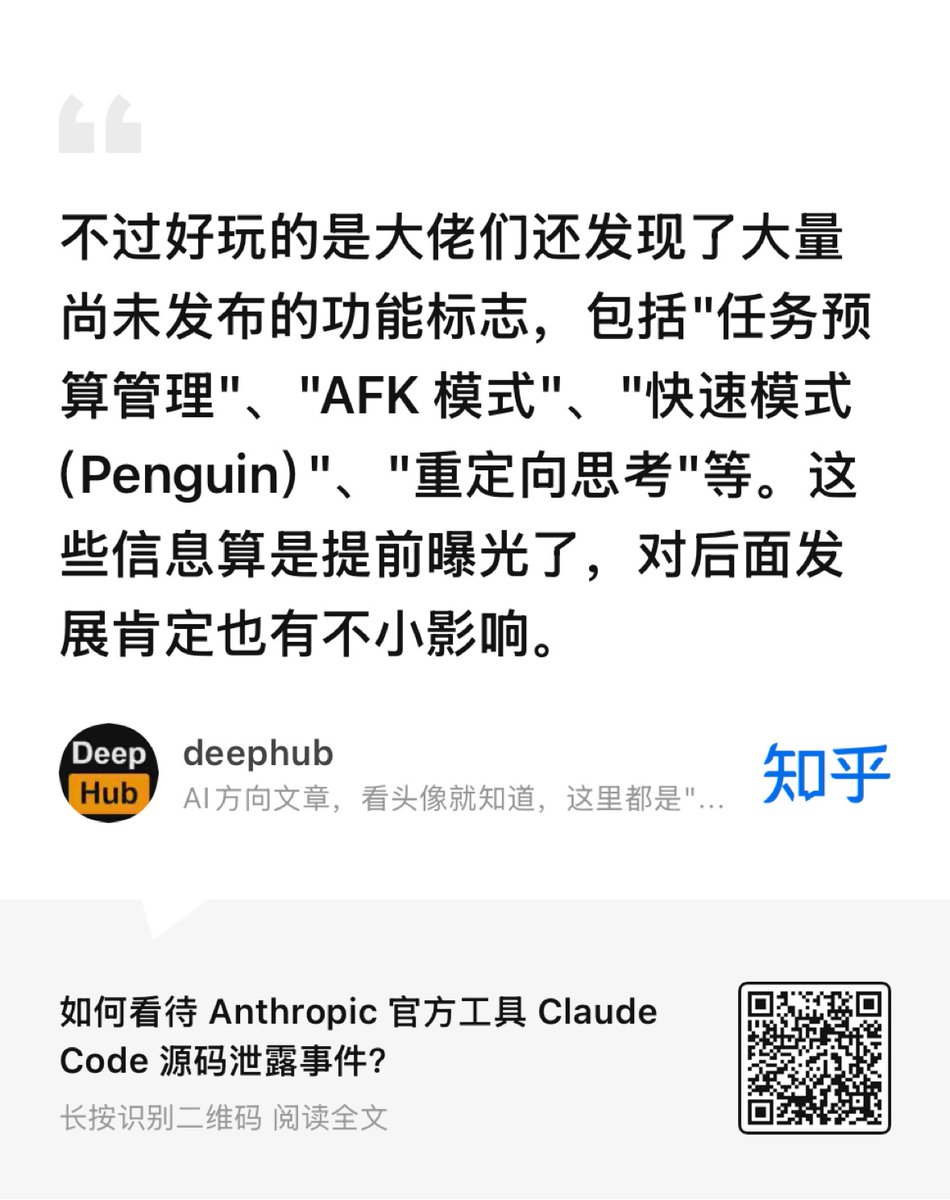
• The leak also uncovered unreleased features: task budget management, AFK mode, Penguin (fast mode), and redirected reasoning.
🎯 Final Takeaway
A costly misstep for Anthropic, but an unprecedented learning opportunity for the entire AI agent community.
🔗 Full article(CN): zhihu.com/question/202239436…
#AI #LLM #Agents #Claude #Engineering #Tech
1
3
690
Mar 25
🚨 Big shift in AI video: Anouncements of OpenAI shutting down Sora are sparking debate—why do flashy AI video products struggle to last?
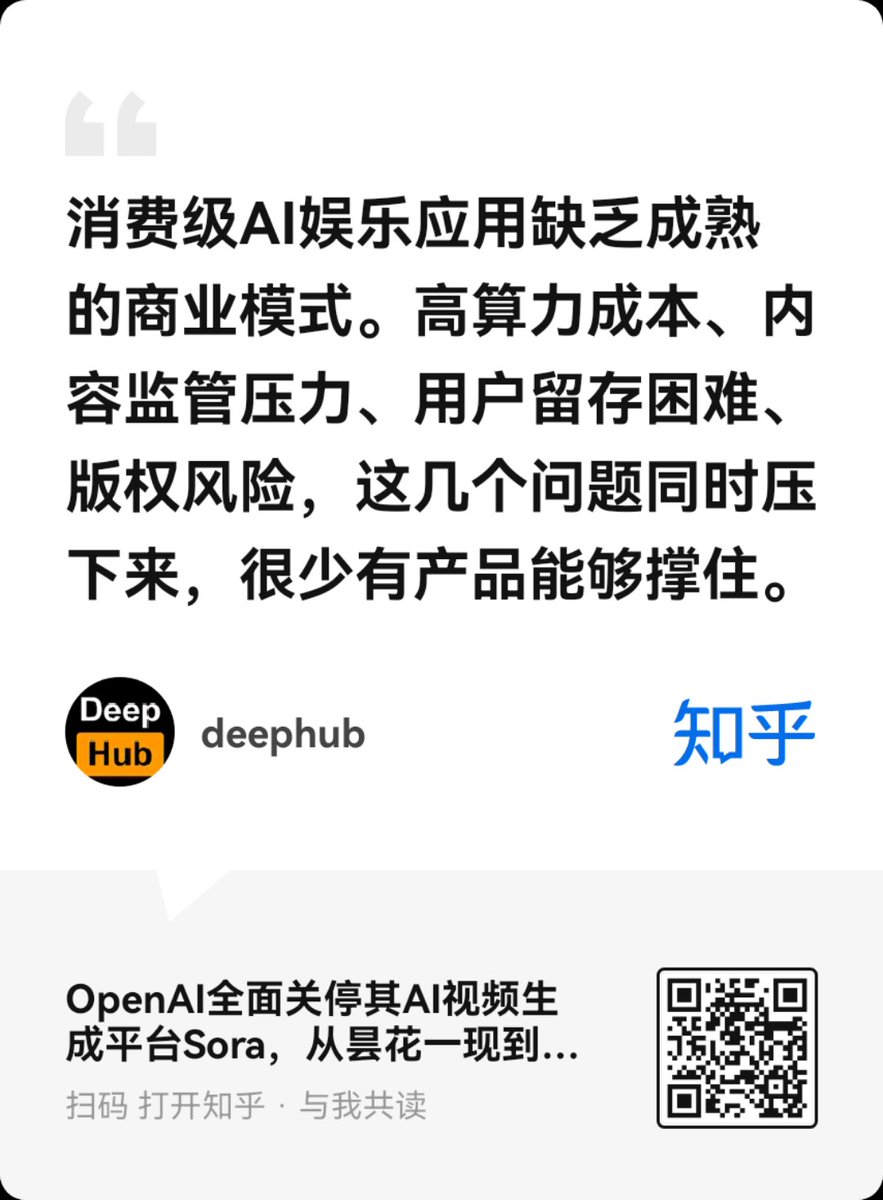
💡 Zhihu contributor deephub: the bottleneck is business, not tech.
• compute is too expensive
• regulation copyright risks
• low retention
👉 Consumer AI video still lacks a sustainable model.
That's why Anthropic sticks to B2B—and OpenAI may follow.
🎰 Zhihu contributor 詹于 compares Sora to Seedance:
AI video is just like a "gacha game" — You generate N outputs, then pick one. What matters is hit rate, not just capability.
Even 1% hit rate = huge usability gain.
• Sora → low accuracy → feels like a toy
• Seedance (ByteDance) → higher consistency, making it from a "toy" → "imperfect but usable tool"
Plus: China has massive "semi-pro" content demand: short videos, livestreams, ads, web novels…
👉 These markets don't need perfection—just better-than-before tools.
That's why products like Seedance can scale quickly.
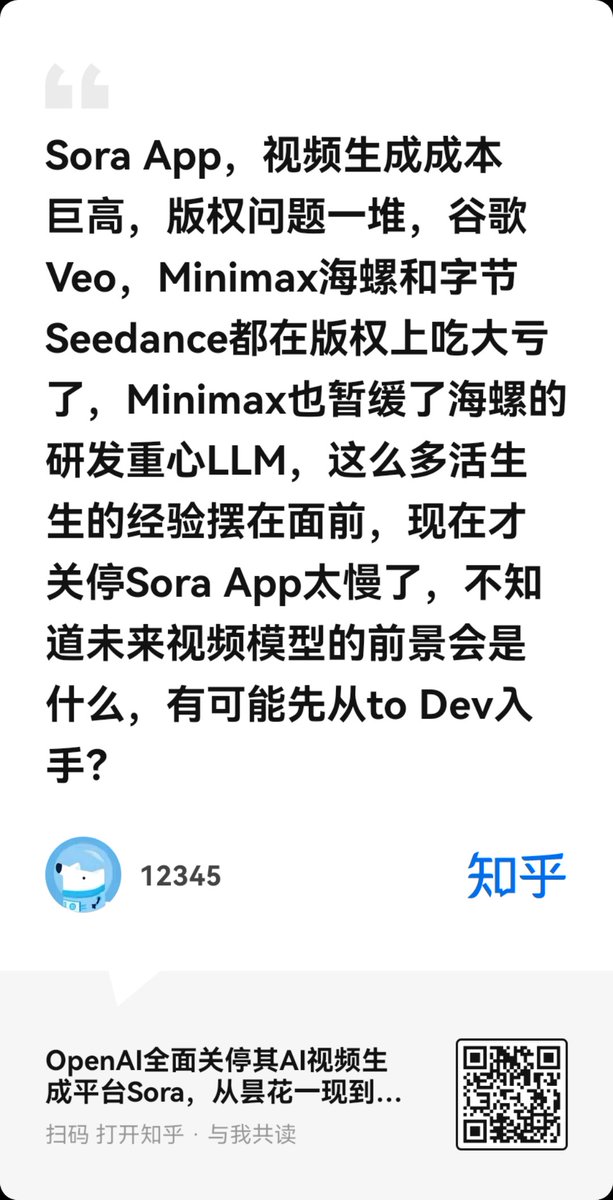
🧠 Zhihu contributor 12345: OpenAI lost focus
Too many fronts (Sora, Atlas, AgentKit, etc.), high cost unclear ROI.
Given extreme video generation costs & ongoing copyright issues (across the industry), shutting Sora might simply be too late—but necessary.
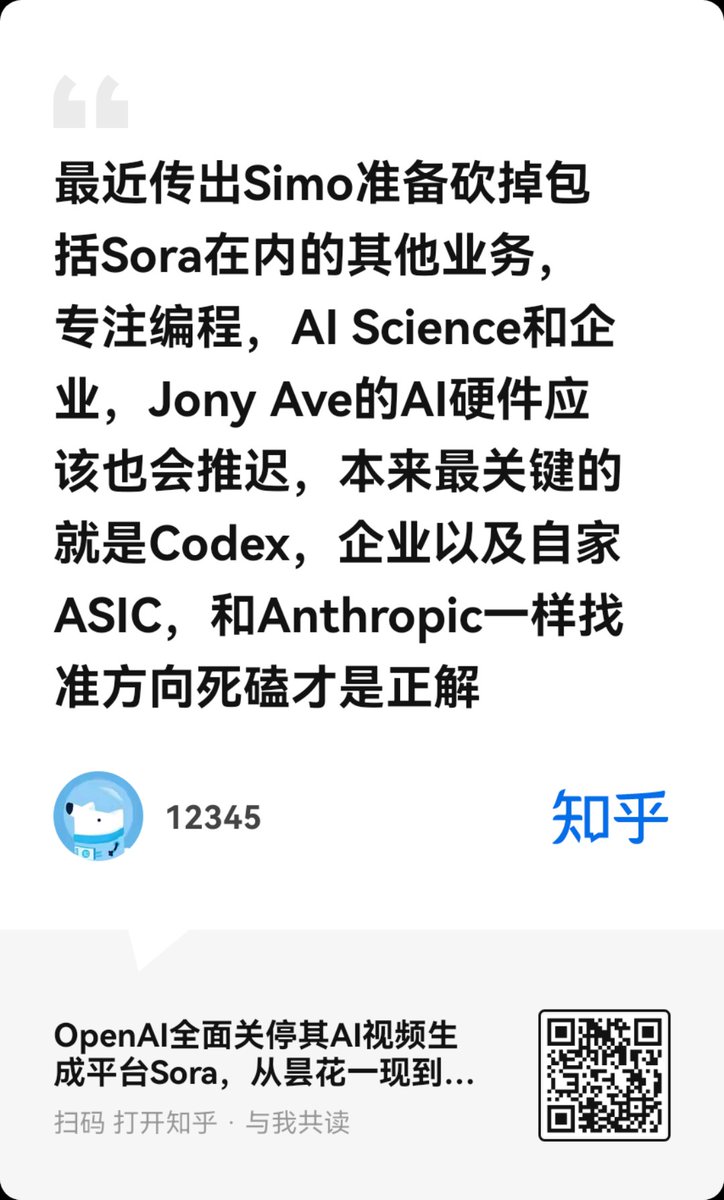
👉 Future direction? Possibly back to devs, coding, enterprise, core infra.
🔗Join the discussion: zhihu.com/question/202006008…
#AI #Sora #OpenAI #Video #GenerativeAI #Tech
4
348
Feb 27
🤔Can agentic LLM inference break free from storage bandwidth limits?
This new paper by DeepSeek together with THU & PKU says yes by rethinking the Prefill / Decode split at the system level, which draws major attention.🚀
What's the real innovation? 👉 Zhihu contributor deephub explains — relentlessly extracting every last bit of GPU bandwidth.
🔍 Core insight: a hidden resource mismatch
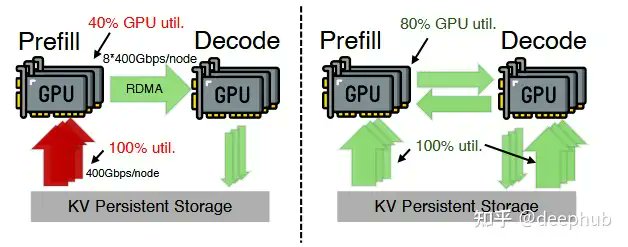
Prefill nodes saturate their storage NIC bandwidth, while decode nodes leave their storage NICs almost completely idle
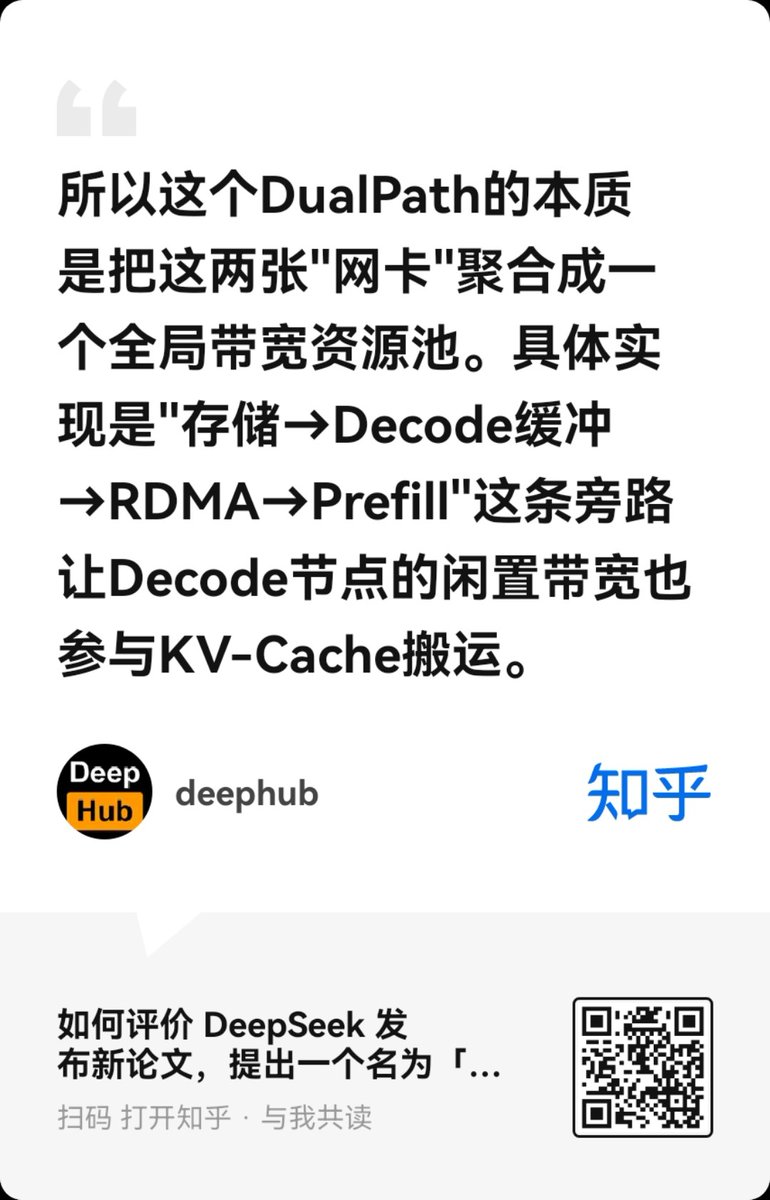
DualPath treats these two NICs as a global bandwidth pool, instead of isolated resources.
So traditional path: Storage → Prefill engine, now for new parallel path: Storage → Decode engine (as a buffer) → RDMA (high-speed compute NIC) → Prefill engine.
💡 In short: idle Decode-side bandwidth now participates in KV-cache movement, not just computation.
⚙️ Why this is hard to build
1️⃣ Dataflow reorganization is extremely complex
• KV-cache may traverse two physical paths
• Must stream layer-by-layer, overlapped with compute
• Requires seamless transitions across storage, DRAM, and HBM
• Any timing mismatch → GPU stalls or buffer overflow
2️⃣ Traffic isolation goes deep into hardware
• Using DSCP marking TC on RoCE for traffic classification is not application-layer work
• Done wrong, KV traffic will starve inference communication and worsen latency
3️⃣ Scheduler design is critical
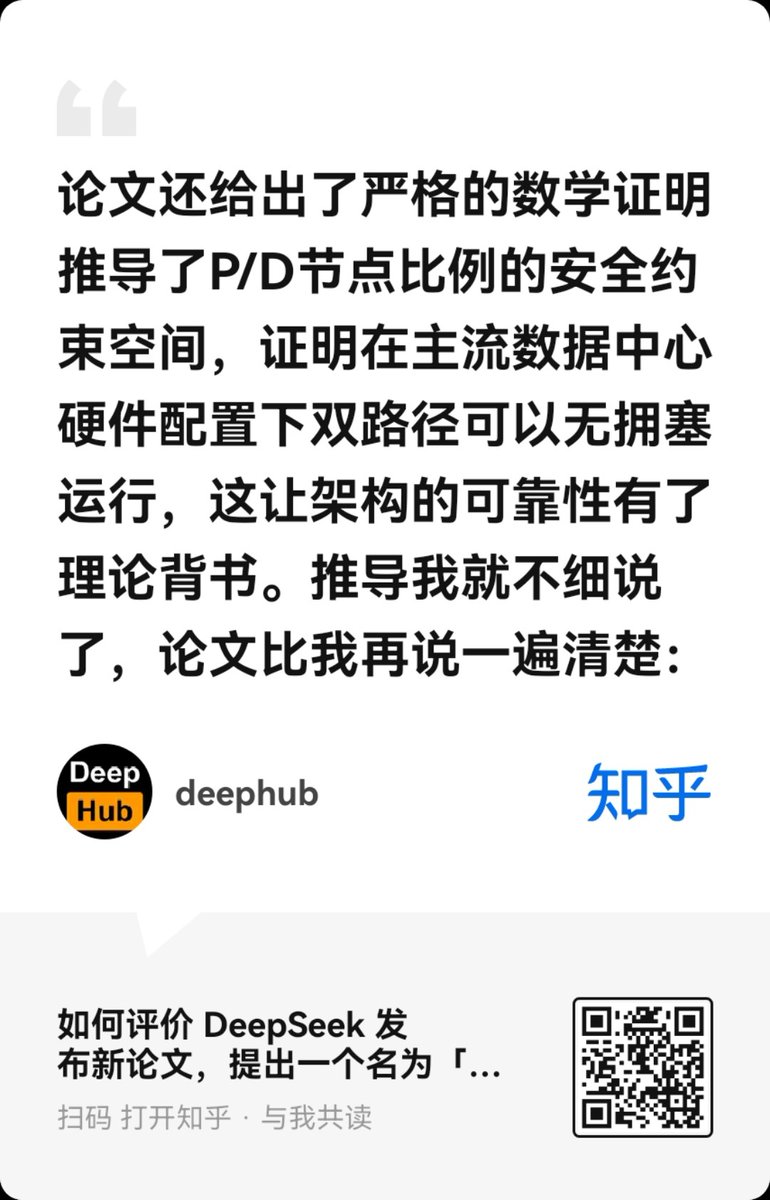
• Must observe disk queues, compute load & both paths in real time, and dynamically allocate bandwidth
• Internally, engines split token blocks via binary search under compute quotas
• Scheduler itself must be fast, or it becomes the bottleneck
📊 Performance results
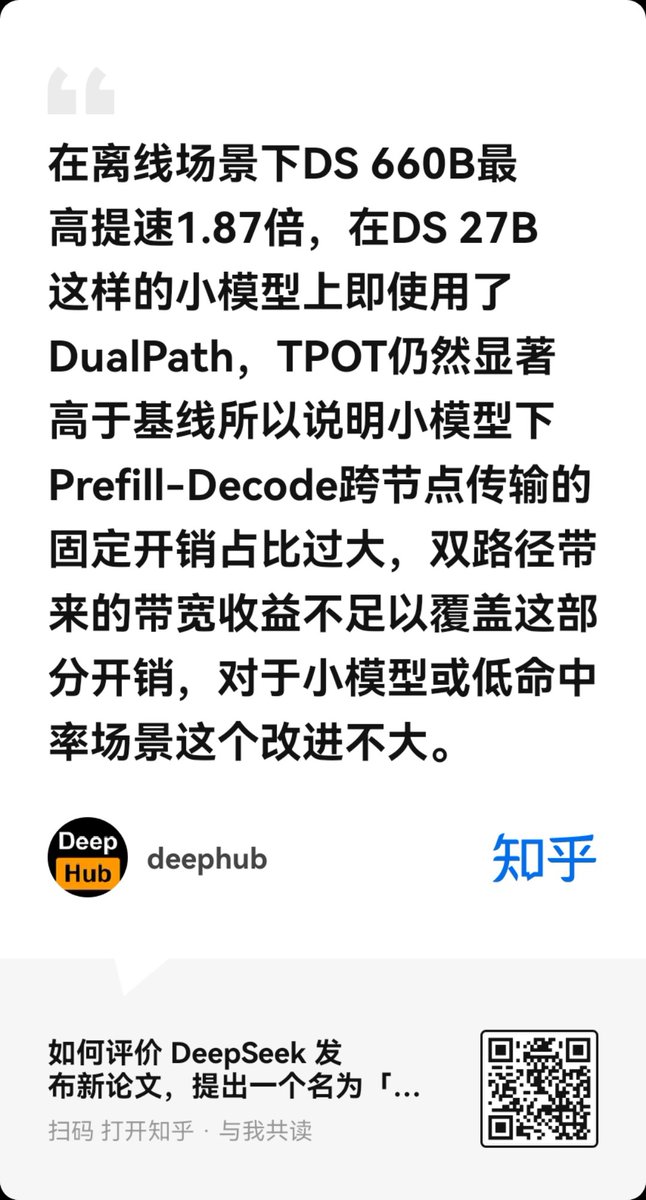
Offline inference: Up to 1.87× speedup on DS-660B
Smaller models (DS-27B): Even with DualPath, TPOT remains higher than baseline → bandwidth gains can't amortize costs
🤖 Why Agentic scenarios matter most
Large agentic models repeatedly access long-context KV caches, where I/O bandwidth becomes the true bottleneck.
DualPath is explicitly designed for this load pattern — enabling higher concurrency, faster responses, and lower inference cost in multi-agent systems.
💬 Join the discussion on Zhihu:
zhihu.com/question/201067068…
#LLM #Agentic #AI #Inference #KVCache #DeepSeek #Infra
1
6
691


Jan 20
Deeptics @Deeptics_ is now live on Sol as DEEPHUB $DHUB,
Robotics 🤖 on-chain ecosystem that unifies robotic simulation.
$7k mc is a gift. Don't miss it
CA: 5mZkHgUtEsFZ4qgdYy3qFMrrx8ndxYAi8zYYg7oFpump
TG: t.me/deeptics
1
1
2
276
Jan 14
@deepseek_ai just dropped a joint paper with Peking University—and it's turning heads. 🧠🔥
Zhihu contributor deephub breaks it down clearly:
📌 The core idea is: Separate "thinking" from "remembering."
DeepSeek is pushing sparsity to the extreme:
• MoE = sparse computation → only a subset of experts activate each step ⚙️
• Engram = sparse storage → only relevant memory fragments are retrieved 📚
Put together, this likely previews what DeepSeek V4 could look like: models with exploding parameter counts, but inference costs that stay surprisingly low.
A future LLM might be: a small, sharp reasoning core with a huge, external, constantly updatable memory system.
❓ What problem are they really solving?
It's about the fact that Transformers have no native memory.
Today's LLMs—even MoE models—use expensive neural computation to simulate memory. They repeatedly rebuild what is basically a lookup table using attention FFN layers, which is inefficient.
👉 DeepSeek's key move: add real memory
They split language tasks into two types:
• Compositional reasoning → needs deep neural computation
• Knowledge retrieval → should be cheap and direct
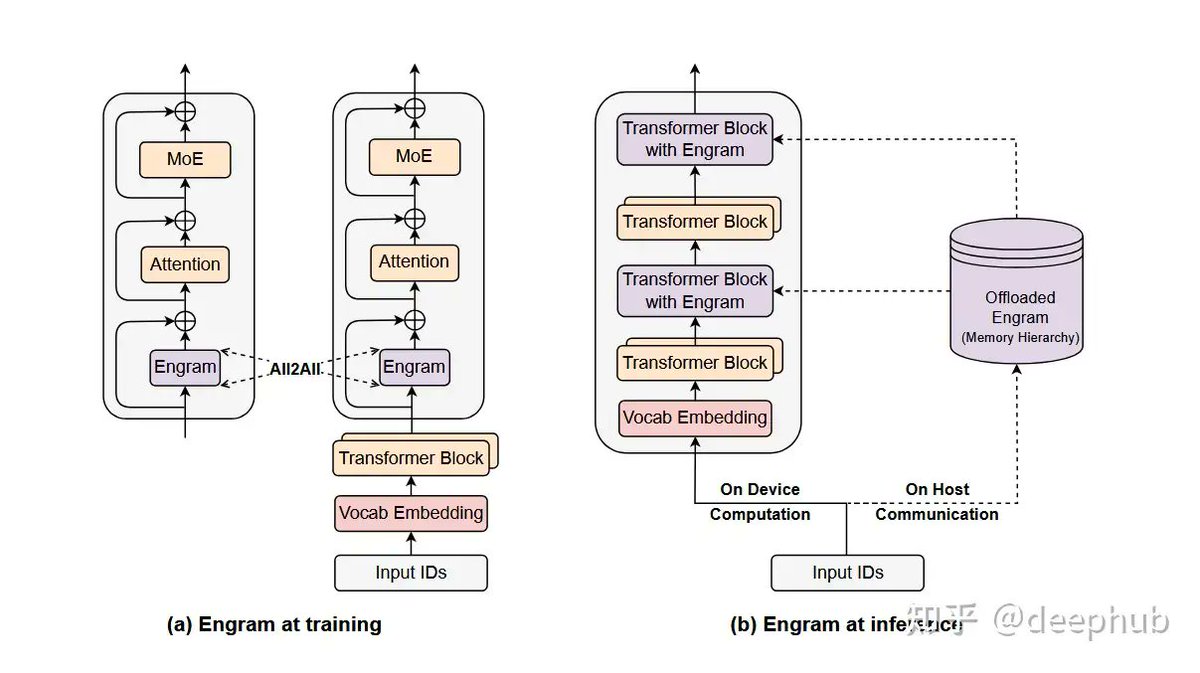
So instead of forcing neural nets to "calculate" static facts, they add a new module: Engram = conditional memory.
How it works:
• Input text is broken into n-grams
• These n-grams are mapped into a huge hash table
• Lookup is O(1) time
• Retrieved vectors are fused with normal Transformer outputs
Names, formulas, fixed phrases, factual patterns: no more wasting layers to reconstruct them.
Cheap memory handles static patterns, expensive compute is saved for real reasoning.
Engram turns the classic process into:
slice → hash → lookup → fuse
constant time, no matter how big the memory gets.
🤔 MoE Engram: how to split capacity?
They study a key tradeoff:
given fixed parameter and compute budgets, how much goes to MoE experts vs Engram memory?
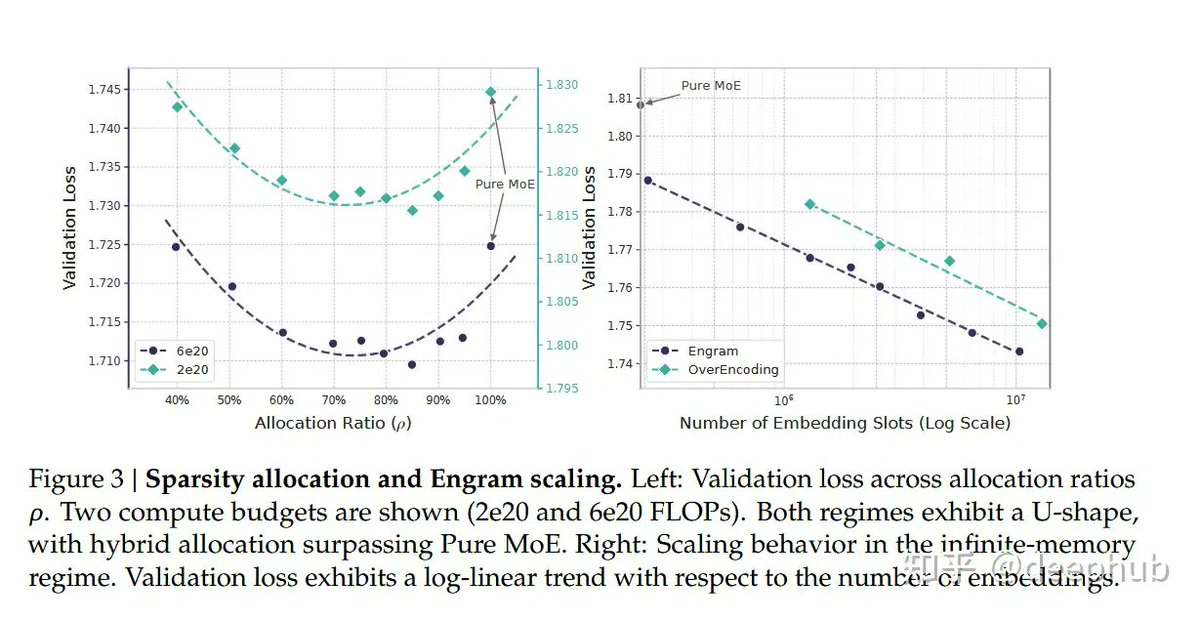
They define an allocation ratio ρ:
• ρ = 100% → pure MoE
• ρ ≈ 40% → already matches pure MoE performance
• Best point: ρ ≈ 75–80% → validation loss drops below pure MoE by ~0.014
This gives a U-shaped curve:
• All MoE → no real memory, wasted compute
• All Engram → weak reasoning
• Balanced → best of both worlds
So MoE and Engram are structurally complementary.
‼️ Infrastructure implications are huge
Engram indices depend only on input tokens, so they're known before the forward pass.
That enables:
• Prefetching memory asynchronously
• Overlapping lookup with early-layer computation
• Hiding communication latency
Even more important: Engram is sparse read-only at inference.
So the memory table doesn't need HBM and can live in normal RAM. You're basically attaching a giant internal knowledge base to the model.
In theory, Engram can be updated directly:
New knowledge → update the table. Faster than LoRA.
Full analysis: zhihu.com/question/199423340…
#DeepSeek #AI #MoE #Engram #LLM #Research
1
8
51
2,525
$DHUB is now listed on @BitgetWallet
We’re excited to share that DEEPHUB ($DHUB) is now available on Bitget, making it easier to track and access $DHUB within the Bitget on-chain ecosystem.
This listing supports broader exposure for DEEPHUB as the execution layer powering DeepticsLabs.
Check it out on Bitget:
bitget.com/ar/on-chain/sol/5…
6
7
13
691
$DHUB Solscan Update
We’ve just updated the $DHUB token profile on Solscan to match our current Deephub ecosystem data. Everything is now aligned and more transparent for holders and new users.
You can check it here:
solscan.io/token/5mZkHgUtEsF…
11
8
19
1,783
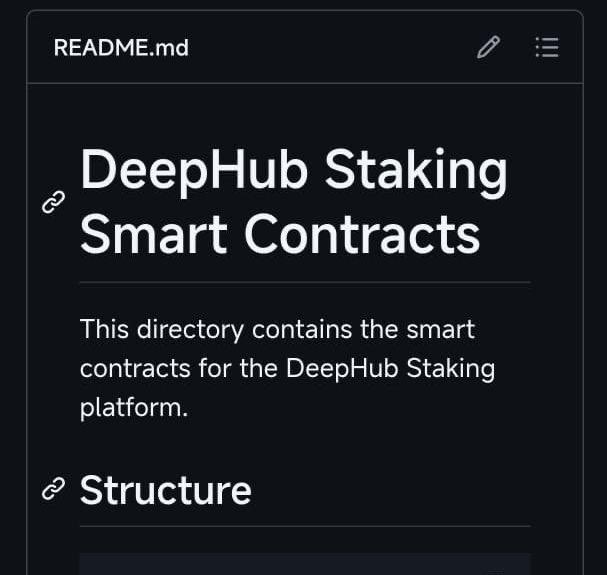
We’re making solid progress on the DeepHub Staking system behind the scenes.
While the repository is still private, we’re actively building and testing:
> the staking backend API (epoch-based rewards, Merkle distribution)
> BSC smart contracts for $DPTX staking and eligibility tracking
> Solana programs for $DHUB reward distribution
> the full flow connecting BSC ↔ Solana without bridging
This work forms the core of Hub Staking, where $DPTX acts as the anchor and $DHUB handles execution and rewards.
We’ll continue sharing development milestones as things move forward.
Appreciate everyone following the build more soon.

DHUB Staking In Progress
We want to share a transparent update with the community.
DHUB staking is currently under active development.
The focus is simple: build it properly, securely, and sustainably.
This is not a rushed feature.
We’re taking the time to ensure the staking logic, reward flow, and contract structure are solid before release.
DHUB staking will be published when it’s ready, not sooner, not later.
More updates will be shared as development progresses.
Thank you for the patience and continued trust.
$DPTX <> $DHUB
3
5
12
4,184
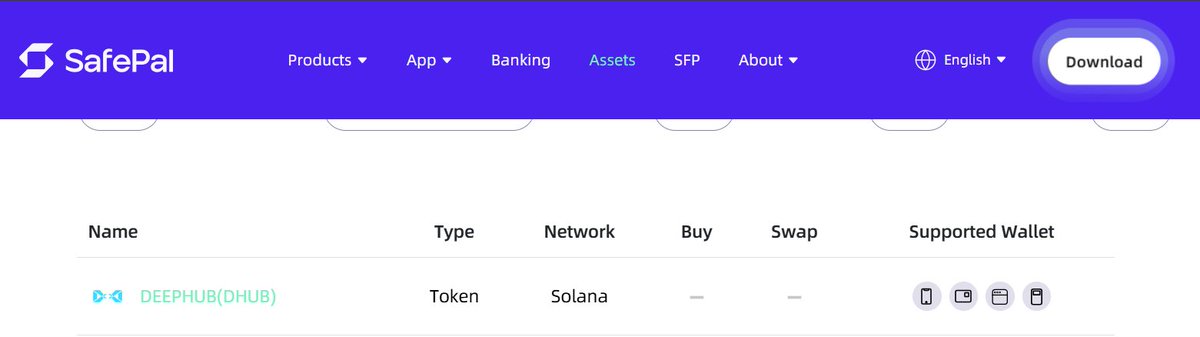
DEEPHUB is now live on SafePal Wallet
You can now check and track $DHUB directly on SafePal Wallet, making it easier to view, manage, and follow DEEPHUB within the SafePal ecosystem.
This listing supports broader visibility for DEEPHUB as the execution layer of DeepticsLabs.
Check it out on SafePal:
explorer.solana.com/address/…
6
6
12
656

31 Dec 2025
✨ Happy New Year Deeptics x Deephub Fams✨
Thank you for being part of our journey. 2025 was about building the foundation 2026 is about scaling, refining, and bringing verifiable robotics simulation closer to real-world impact. Let’s keep building together.
The year ahead is about execution. We are entering this chapter with a clear focus on strengthening our infrastructure, refining our systems, and aligning every layer of the ecosystem to support sustainable growth.
Rather than chasing noise, we remain committed to disciplined development, measurable progress, and shipping what truly matters. Strong foundations take time, and we are building them carefully.
We wish you a year filled with clarity, resilience, and meaningful progress. Thank you for walking this path with us the journey continues.
8
5
15
857
31 Dec 2025
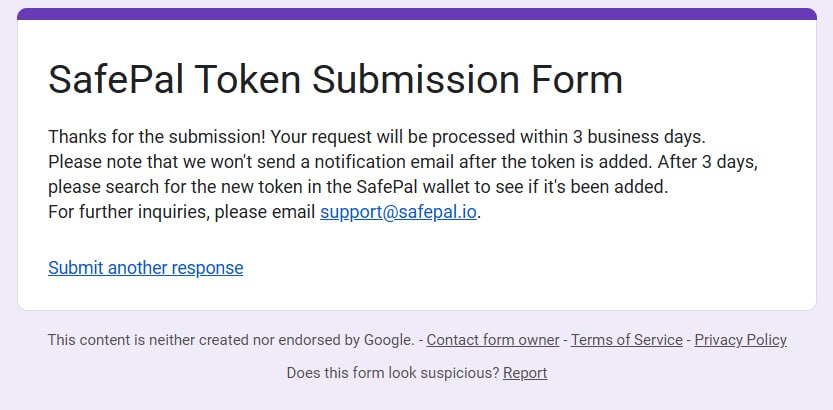
We’ve submitted $DHUB (DEEPHUB) for listing on SafePal.
Now pending review and processing on their side.
1
3
9
909
30 Dec 2025
▶DeepticsLabs
▶January Progress Plan
As we move into the new year, DeepticsLabs is entering a focused execution phase.
January will be dedicated to strengthening the foundation across corporate, infrastructure, and ecosystem layers.
Key progress plans for January:
🤝Deeptics LLC Development
Advancing the operational and structural setup under Deeptics LLC to support long-term product, partnership, and infrastructure growth.
🤝Partnership Alignment
Existing Deeptics partnerships will be aligned and extended to also support DEEPHUB, ensuring continuity across both ecosystems.
⬇️Hub Staking (In Development)
Continued design and implementation of Hub Staking the unified staking framework connecting $DPTX (BSC) and $DHUB (Solana).
> GitHub Repository Expansion
Upgrading and expanding Deeptics repositories:
asset schemas, simulation components, telemetry pipelines, and execution tooling.
> Robotics Development Blueprint
Refining the high-level implementation framework and simulation models that will serve as the groundwork before real-world robotics production begins.
> DEEPHUB Exposure & Listing Progress
Increasing visibility and accessibility of $DHUB as the execution layer of the ecosystem.
$DPTX and $DHUB will each operate with clear roles:
$DPTX (BSC) anchor asset, long-term holding, ecosystem eligibility
$DHUB (Solana) execution, staking rewards, simulation-driven emissions
Together, they support a single ecosystem built under DeepticsLabs.
January sets the tone for a disciplined, infrastructure-first year ahead.
More updates soon as execution continues.
9
5
20
5,301
29 Dec 2025
DEEPHUB $DHUB (Solana Execution Layer)
Staking System (In Progress) > designing and implementing the staking framework that connects BSC holdings $DPTX with Solana-based execution rewards.
Simulation-Driven Emissions> integrating reward logic that is tied directly to verified simulation work, not passive inflation.
Execution & Settlement Logic> preparing the backend for high-frequency reward distribution, telemetry accounting, and future node participation.
12
2
19
1,181
28 Dec 2025
Staking Flow Pseudo-Code (BSC Anchor Solana Execution)
Concept
BSC DPTX = eligibility anchor (stake/hold)
Solana DEEPHUB (DHUB) = execution rewards settlement
APY multiplier if user participates on both chains.
5
1
16
2,156
28 Dec 2025
This buyback is part of our broader effort to:
reinforce ecosystem balance
support liquidity conditions
align incentives as DEEPHUB develops its staking and simulation-driven execution layer
28 Dec 2025
DEEPHUB ($DHUB) Buyback Update
We’ve executed a buyback from the DEEPHUB dev wallet to support the stability and long-term health of the ecosystem.
• Source: Dev wallet
• Network: Solana
• Transaction:
solscan.io/tx/5kCR2btb5sVoXK…
2
1
13
646
28 Dec 2025
DEEPHUB ($DHUB) Buyback Update
We’ve executed a buyback from the DEEPHUB dev wallet to support the stability and long-term health of the ecosystem.
• Source: Dev wallet
• Network: Solana
• Transaction:
solscan.io/tx/5kCR2btb5sVoXK…
8
3
16
1,754
28 Dec 2025
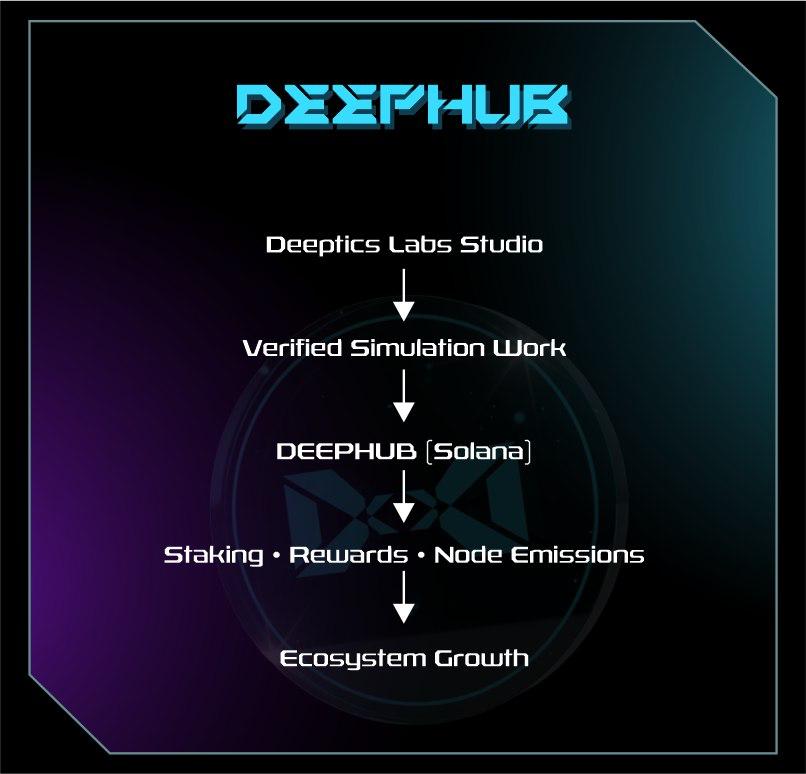
DEEPHUB Execution layer for Deeptics Labs.
Verified simulation work flows from Deeptics Labs Studio into DEEPHUB on Solana, where staking, rewards, and node emissions are coordinated.
Simulation → verification → execution → ecosystem growth.
4
1
12
890
28 Dec 2025
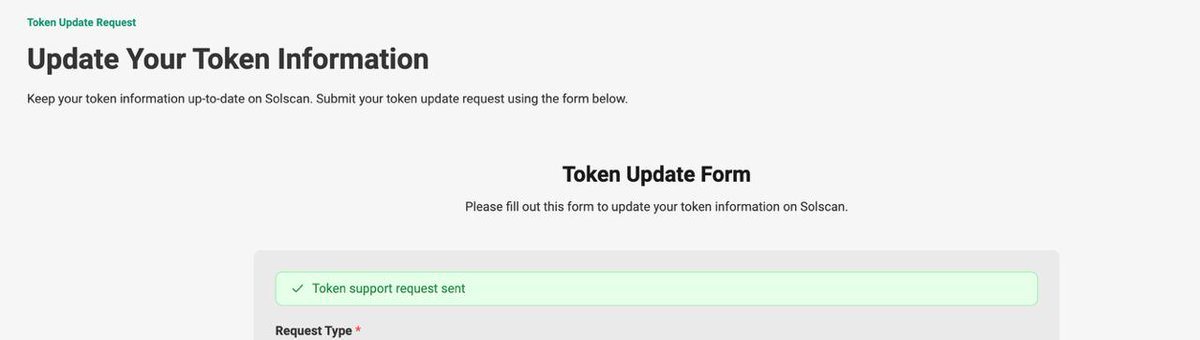
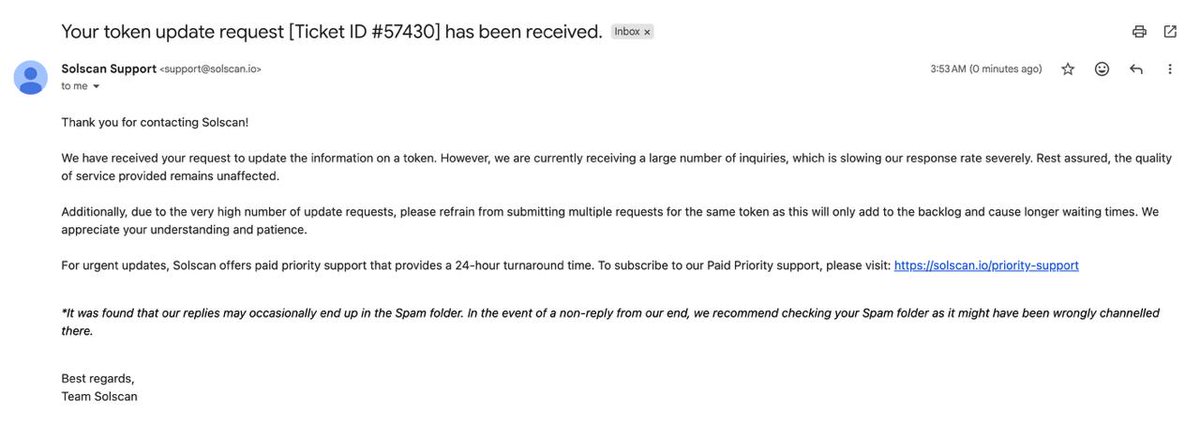
This submission is part of the ongoing infrastructure rollout for DEEPHUB, the execution and reward layer supporting simulation-driven workloads from Deeptics Labs Studio.
While Solscan processes a high volume of requests, our submission has been received and is now in queue.
1
5
464
28 Dec 2025
DEEPHUB ($DHUB) Solscan Submission Update
We’ve officially submitted the token information update for DEEPHUB ($DHUB) to Solscan.
• Token: DEEPHUB (DHUB)
• Network: Solana
• Contract:
5mZkHgUtEsFZ4qgdYy3qFMrrx8ndxYAi8zYYg7oFpump
9
3
11
1,090