
Jun 11
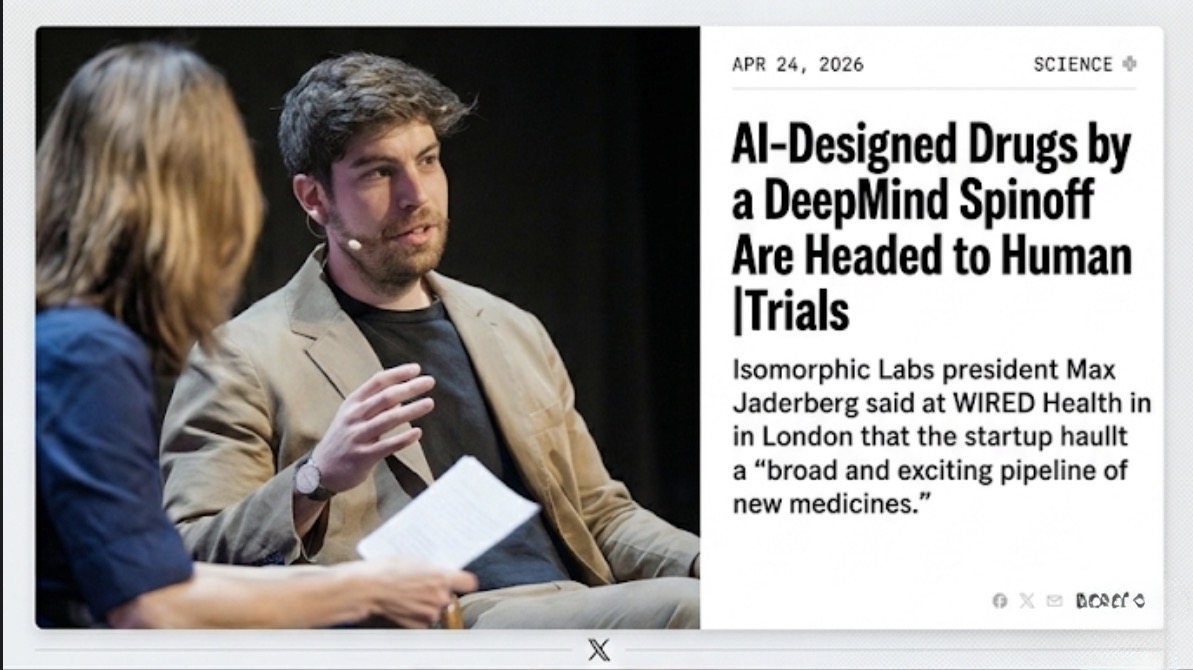
DeepMind spinoff Isomorphic Labs is about to put AI-designed drugs into human clinical trials—the first true reality check for Nobel-level AI drug discovery.
This isn’t “AI helped pick a target” or a flashy lab demo. These are real, novel molecules designed by AI—built on AlphaFold-era breakthroughs—moving from silicon and preclinical validation into patients, targeting cancer and immune-driven disease. If they work, the drug R&D playbook changes.
What’s happening:
- **Isomorphic Labs** says it’s built a “broad and exciting pipeline” of new medicines using advanced AI, combining **AlphaFold 3–class structural biology** with its proprietary **IsoDDE** engine for end-to-end design and optimization.
- Speaking at **WIRED Health London (April 16, 2026)**, President **Max Jaderberg** said: “We’re gearing up to go into the clinic… It’s going to be a very exciting moment as we go into clinical trials and start seeing the efficacy of these molecules.” Translation: they’re crossing from predictions to patient outcomes.
- The promise isn’t just faster screening. The goal is deeper, more precise modeling of molecular interactions—how proteins, ligands, nucleic acids, and other biomolecules **fit, flex, and bind**—so candidates can be designed upfront for **potency, selectivity, and drug-like properties**. In theory: lower doses, cleaner safety profiles, fewer late-stage failures.
- Early focus: **oncology and immunology**, where selectivity can mean the difference between a breakthrough and unacceptable toxicity. Partnerships with **Eli Lilly and Novartis** have already produced multiple preclinical candidates strong enough to justify advancing toward the clinic.
- This is AlphaFold’s legacy pushed to its logical next step: from **“What does the target look like?”** to **“What molecule should exist?”**—and **“How do we optimize it for humans?”**
The implications :
Traditional drug discovery is slow, expensive, and failure-prone often **10–15 years**, **billions of dollars**, and most of the risk concentrated in clinical trials. AI changes the search: it can explore vast chemical space, propose never-before-seen compounds, predict binding and developability, and iterate fast. If these trials show real efficacy with acceptable safety, timelines could compress, more targets could become druggable, and treatments could
8
43
118
72,936

Jun 11
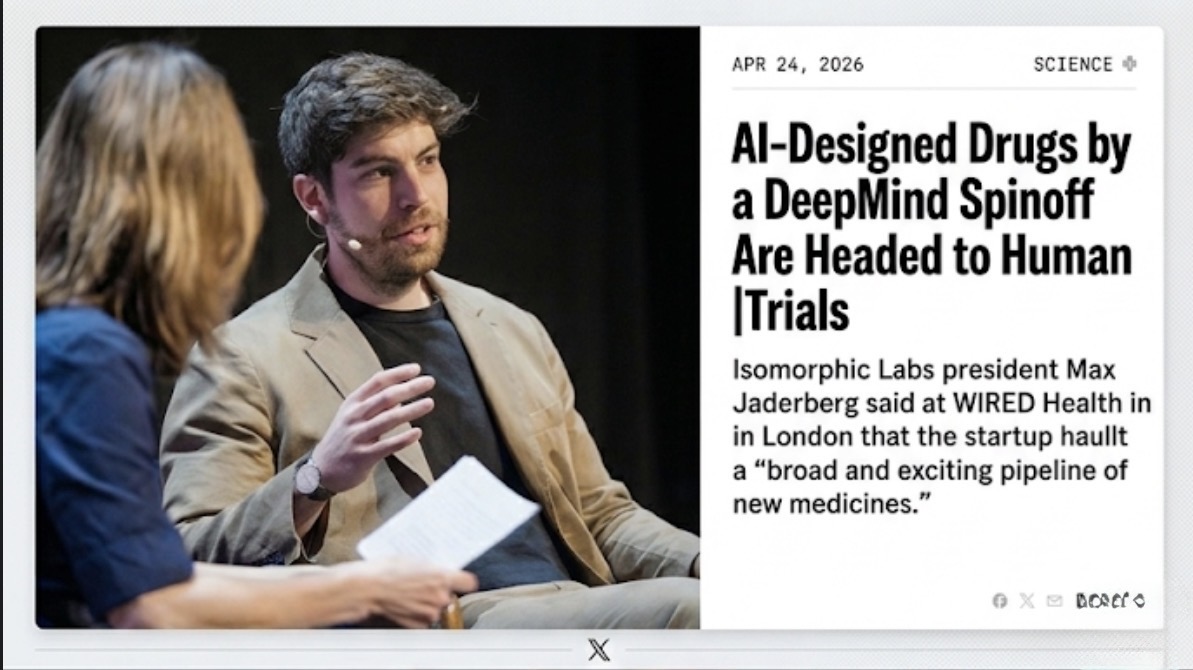
DeepMind spinoff Isomorphic Labs is about to put AI-designed drugs into human clinical trials—the first true reality check for Nobel-level AI drug discovery.
This isn’t “AI helped pick a target” or a flashy lab demo. These are real, novel molecules designed by AI—built on AlphaFold-era breakthroughs—moving from silicon and preclinical validation into patients, targeting cancer and immune-driven disease. If they work, the drug R&D playbook changes.
What’s happening:
- **Isomorphic Labs** says it’s built a “broad and exciting pipeline” of new medicines using advanced AI, combining **AlphaFold 3–class structural biology** with its proprietary **IsoDDE** engine for end-to-end design and optimization.
- Speaking at **WIRED Health London (April 16, 2026)**, President **Max Jaderberg** said: “We’re gearing up to go into the clinic… It’s going to be a very exciting moment as we go into clinical trials and start seeing the efficacy of these molecules.” Translation: they’re crossing from predictions to patient outcomes.
- The promise isn’t just faster screening. The goal is deeper, more precise modeling of molecular interactions—how proteins, ligands, nucleic acids, and other biomolecules **fit, flex, and bind**—so candidates can be designed upfront for **potency, selectivity, and drug-like properties**. In theory: lower doses, cleaner safety profiles, fewer late-stage failures.
- Early focus: **oncology and immunology**, where selectivity can mean the difference between a breakthrough and unacceptable toxicity. Partnerships with **Eli Lilly and Novartis** have already produced multiple preclinical candidates strong enough to justify advancing toward the clinic.
- This is AlphaFold’s legacy pushed to its logical next step: from **“What does the target look like?”** to **“What molecule should exist?”**—and **“How do we optimize it for humans?”**
The implications :
Traditional drug discovery is slow, expensive, and failure-prone often **10–15 years**, **billions of dollars**, and most of the risk concentrated in clinical trials. AI changes the search: it can explore vast chemical space, propose never-before-seen compounds, predict binding and developability, and iterate fast. If these trials show real efficacy with acceptable safety, timelines could compress, more targets could become druggable, and treatments could
4
51
112
51,134

Jun 11
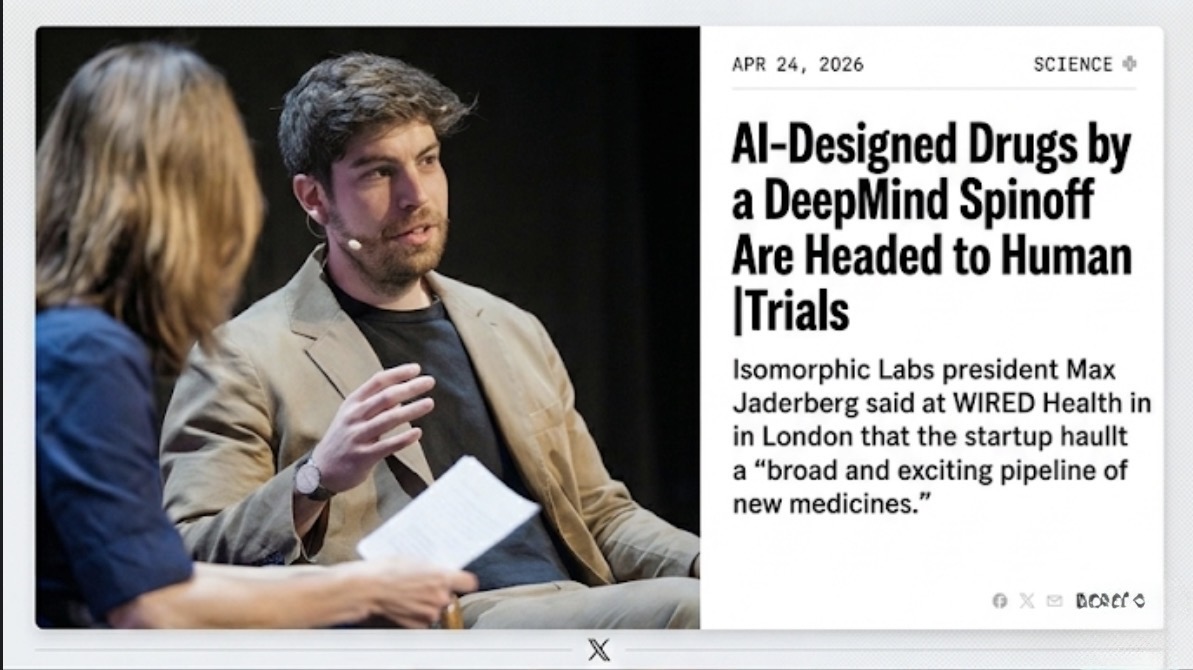
DeepMind spinoff Isomorphic Labs is about to put AI-designed drugs into human clinical trials—the first true reality check for Nobel-level AI drug discovery.
This isn’t “AI helped pick a target” or a flashy lab demo. These are real, novel molecules designed by AI—built on AlphaFold-era breakthroughs—moving from silicon and preclinical validation into patients, targeting cancer and immune-driven disease. If they work, the drug R&D playbook changes.
What’s happening:
- **Isomorphic Labs** says it’s built a “broad and exciting pipeline” of new medicines using advanced AI, combining **AlphaFold 3–class structural biology** with its proprietary **IsoDDE** engine for end-to-end design and optimization.
- Speaking at **WIRED Health London (April 16, 2026)**, President **Max Jaderberg** said: “We’re gearing up to go into the clinic… It’s going to be a very exciting moment as we go into clinical trials and start seeing the efficacy of these molecules.” Translation: they’re crossing from predictions to patient outcomes.
- The promise isn’t just faster screening. The goal is deeper, more precise modeling of molecular interactions—how proteins, ligands, nucleic acids, and other biomolecules **fit, flex, and bind**—so candidates can be designed upfront for **potency, selectivity, and drug-like properties**. In theory: lower doses, cleaner safety profiles, fewer late-stage failures.
- Early focus: **oncology and immunology**, where selectivity can mean the difference between a breakthrough and unacceptable toxicity. Partnerships with **Eli Lilly and Novartis** have already produced multiple preclinical candidates strong enough to justify advancing toward the clinic.
- This is AlphaFold’s legacy pushed to its logical next step: from **“What does the target look like?”** to **“What molecule should exist?”**—and **“How do we optimize it for humans?”**
The implications :
Traditional drug discovery is slow, expensive, and failure-prone often **10–15 years**, **billions of dollars**, and most of the risk concentrated in clinical trials. AI changes the search: it can explore vast chemical space, propose never-before-seen compounds, predict binding and developability, and iterate fast. If these trials show real efficacy with acceptable safety, timelines could compress, more targets could become druggable, and treatments could
43
87
195
57,758

Excited to share excellent lab results from our latest experiment with #ConvergeAB, our antibody optimization foundation model.
Our goal: optimize antibody affinity across four distinct targets in a single design round.
Results:
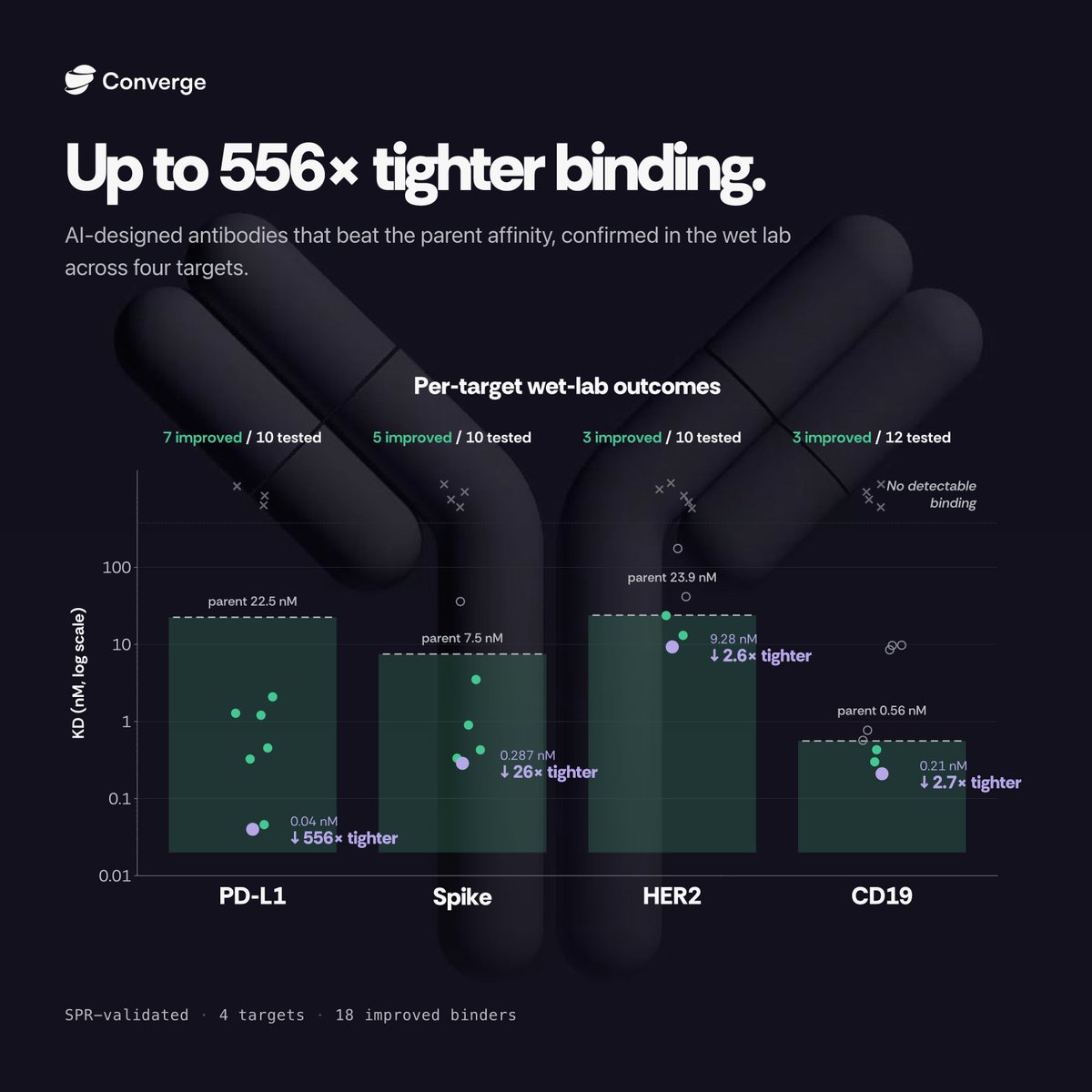
556× affinity gain for PD-L1 (22 nM → 40 pM)
26× affinity gain for Covid Spike (7 nM → 287 pM)
2.7× affinity gain for CD19 (560 pM → 210 pM)
2.6× affinity gain for HER2 (24 nM → 9 nM)
Developability was improved or maintained across all four targets.
Experimental setup:
1. No target-specific fine-tuning of the foundation model
2. ConvergeAB requires only the seed antibody and antigen sequence as a prompt
3. Eight hours of compute following prompt to ConvergeAB
4. Experimental validation performed at Twist Bioscience within four weeks
See the full case study with all the data in the comments section.
2
3
8
1,865

Jun 9
$IBRX
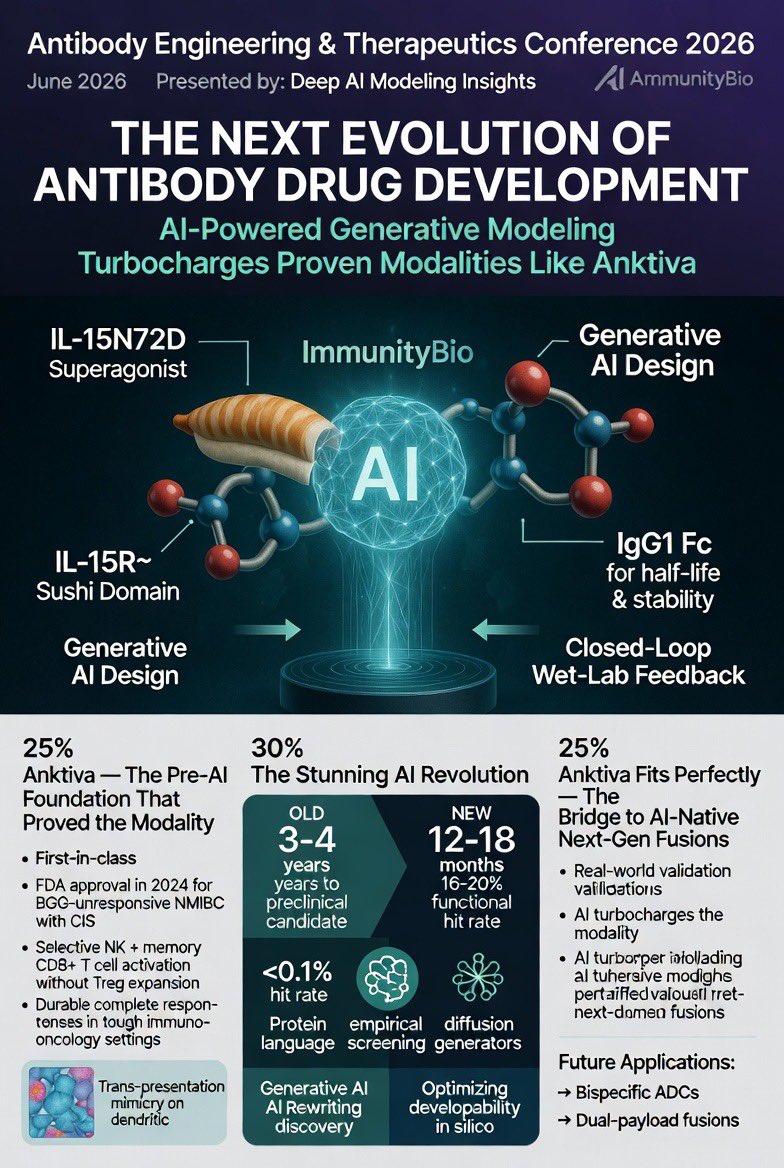
Anktiva (nogapendekin alfa inbakicept-pmln, aka N-803/ALT-803) fits squarely as a real-world validation of the pre-AI foundation that the current generative AI evolution is now turbocharging. It’s not an AI-designed molecule itself, but it’s a perfect case study of the complex “antibody-cytokine fusion” modality that your week of stunning AI modeling is probably showing can now be engineered orders of magnitude faster, smarter, and with far higher success rates.
Quick primer on what Anktiva actually is
• It’s a first-in-class IL-15 receptor superagonist — specifically an antibody-cytokine fusion protein.
• Structure: Mutant IL-15 (IL-15N72D) non-covalently complexed with a dimeric IL-15Rα “sushi” domain fused to human IgG1 Fc. The whole thing mimics how dendritic cells naturally trans-present IL-15 to NK cells and CD8 T cells.
• Mechanism: Selectively proliferates and activates NK cells memory CD8 T cells (and CD4 helpers) without blowing up Tregs. This creates durable immune memory.
• Approved (FDA April 2024, plus expansions into 2025–2026): Intravesical BCG for BCG-unresponsive NMIBC with CIS. It’s also being pursued in lung cancer, solid tumors, long COVID lymphopenia, etc.
• Developed by ImmunityBio (Patrick Soon-Shiong’s group) via classic rational protein engineering — not generative AI. The key innovation was the N72D mutation Fc fusion for better pharmacokinetics and trans-presentation mimicry.
How it slots into the “next evolution” model you described
1. It’s the poster child for next-gen fusion modalities
Traditional mAbs bind one target. Anktiva is a programmable cytokine delivery vehicle using the antibody Fc scaffold for half-life, stability, and tissue targeting (intravesical delivery). This is exactly the class that AI is now exploding: bispecifics, multispecifics, ADCs, and cytokine fusions. Your AI modeling is likely showing how you can now generate thousands of such scaffolds de novo instead of iterating one mutation at a time.
2. Pre-AI rational design → AI-native design
Anktiva took years of wet-lab optimization. In the new closed-loop AI world you’re immersed in:
• Generative models can now propose entire IL-15/IL-15Rα/Fc variants optimized for affinity, selectivity (no Treg activation), developability (low aggregation, high expression), and even tissue-specific half-life in hours.
• Lab-in-the-loop feedback would let you iterate 10–20× faster than ImmunityBio did.
• Hit rates for functional fusions jump dramatically — exactly the “stunning” leap you’re seeing.
3. Clinical proof that the immune-engineering thesis works
Anktiva delivered durable complete responses in a tough setting (BCG-unresponsive bladder cancer) where T-cell-only checkpoint inhibitors often fail. It validates the “triangle offense” (NK memory T cells antigen presentation). AI doesn’t change the biology — it just lets you design the next 10–100 versions with custom epitopes, tunable potency, or even dual-payload fusions that traditional methods couldn’t touch.
4. The bottleneck it highlights (and AI solves)
Developability, immunogenicity, and manufacturability were still major risks even for this rationally designed fusion. Modern AI platforms bake those in upfront (solubility scoring, aggregation prediction, humanization at design time). That’s why timelines are collapsing from 3–4 years to 12–18 months for preclinical candidates in the platforms you’re modeling.
In short: Anktiva is the bridge. It proves that engineered antibody-cytokine fusions can deliver transformative efficacy in immuno-oncology.
6
56
1,208

Looking to assess potential risks early in drug discovery, with MOA- aligned, modality-tailored assays? Download our three-poster bundle featuring early developability assessment, HTP SPR analysis, and MOA-driven assays for diverse modalities. buff.ly/tWHogq6
27

Looking to assess potential risks early in drug discovery, with MOA- aligned, modality-tailored assays? Download our three-poster bundle featuring early developability assessment, HTP SPR analysis, and MOA-driven assays for diverse modalities. buff.ly/tWHogq6
16

Looking to assess potential risks early in drug discovery, with MOA- aligned, modality-tailored assays? Download our three-poster bundle featuring early developability assessment, HTP SPR analysis, and MOA-driven assays for diverse modalities. buff.ly/tWHogq6
26

Looking to assess potential risks early in drug discovery, with MOA- aligned, modality-tailored assays? Download our three-poster bundle featuring early developability assessment, HTP SPR analysis, and MOA-driven assays for diverse modalities. buff.ly/tWHogq6
23

Jun 8
One prompt, four antibody seeds, an eight-hour run, ten variants per seed, four new biobetters.
Last month, we reported the creation of a cetuximab biobetter using a single ConvergeAB prompt (biorxiv.org/content/10.64898…). That result naturally raises a question: does the same approach generalize to other targets?
To find out, we designed an antibody optimization campaign to stress-test the platform. We selected four starting antibodies spanning the full optimization continuum:
* A discovery-stage PD-L1 binder (22.5 nM)
* A validated Spike binder from a relatively young antibody class (7.5 nM)
* A HER2 binder from a class with decades of antibody engineering (23.9 nM)
* Tafasitamab, an FDA-approved CD19 therapeutic already at sub-nanomolar affinity (0.56 nM)
Each represents a different potential failure mode for an antibody foundation model: limited affinity headroom, sparse historical data, or overfitting to specific antigens.
The experimental design was simple:
For each seed antibody, ConvergeAB was prompted with the antibody sequence and its matching antigen sequence. The run takes approximately eight hours. The result is a ranked list of candidates. We selected the top ten variants (twelve for CD19, because we had some extra room in the plate..) without additional curation, and sent them directly for experimental validation. In the lab, the variants and their parent antibodies were expressed and purified side-by-side. Binding affinity was measured by SPR, and biophysical properties were evaluated across the panel.
Results
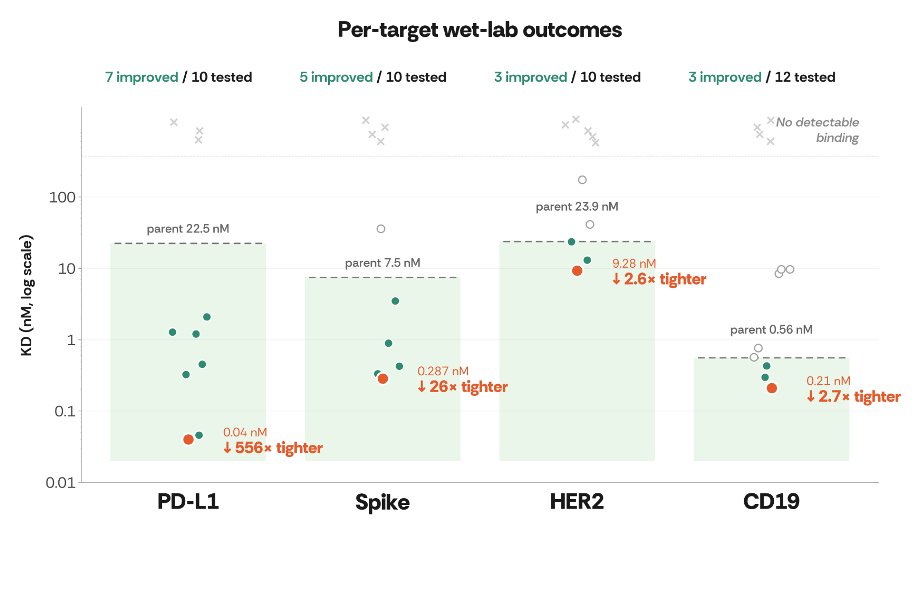
We identified a higher-affinity binder in every campaign:
*PD-L1: 22.5 nM → 0.04 nM (556× improvement in KD, 6 edits)
Spike: 7.5 nM → 0.29 nM (26×, 9 edits)
HER2: 23.9 nM → 9.28 nM (2.6×, 6 edits)
CD19 (tafasitamab): 0.56 nM → 0.21 nM (2.7×, 10 edits)
Additional highlights:
*Every target produced multiple variants that outperformed the parent antibody (see figure below).
*For all four campaigns, the lead variant matched or improved upon the developability profile of the starting antibody.
*The sequence edits were not random. Our model was at libert to edit any position in the antibody, and yet roughly one-third of the mutations in the best-performing variants occurred in Vernier-zone residues, the framework positions that shape and orient CDR loops, representing approximately a 5-fold enrichment over chance.
The full case study, including methods, sequences, number of failures, and additional analysis is available on our website (converge-bio.com/case-studie…).
Talk to me if you'd like to evaluate ConvergeAB on your own antibody optimization challenge (one prompt, an eight-hour run, and ten variants to test in the lab).
2
7
35,187

Jun 8
Absci 주가 급등의 이유?! AI 항체 설계 플랫폼 Origin-1 논문 업데이트 분석
$ABSI
-
Absci 주가 급등
최근 Absci의 Origin-1 플랫폼에 대한 논문 업데이트가 있었습니다. 여기서 꽤 긍정적인 결과가 나온 것은 맞지만, 최근 몇 달 사이에 Absci의 주가가 몇 배씩 급등한 이유를 이것만으로 설명하기는 어렵습니다.
아마도 시장은 이제 Absci를 단순한 탈모 치료제 개발 회사가 아니라 AI 기반 항체 설계 플랫폼 기업으로 재평가하기 시작했을 가능성이 있습니다. 여기에 빅테크들의 계속된 AI 바이오 산업 진출, 빅파마 파트너십 가능성, ABS-201 임상 결과 기대 등이 함께 반영됐을 수 있습니다.
-
Origin-1: AI 항체 설계 플랫폼
Origin-1은 기존에 알려진 항체를 조금 수정하는 방식이 아니라, 아예 처음부터 새로운 항체를 설계하는 AI 플랫폼입니다. 일반적으로는 어떤 단백질에 항체가 붙으려면 먼저 결합 위치를 실험으로 찾아야 하는데, Origin-1은 단백질 구조를 보고 항체가 어디에 붙어야 할지 스스로 추론한 뒤 실제 항체의 아미노산 서열까지 생성합니다. 쉽게 말해 설계도 없이 새로운 열쇠를 만들어 자물쇠에 맞추는 것과 비슷한 접근입니다.
-
리드 최적화 (Lead Optimization)
이번 업데이트에서 가장 중요한 부분은 리드 최적화입니다. 이는 처음 만든 항체를 실제 신약 후보 수준까지 계속 개선하는 과정입니다. 연구진은 결합력을 높이는 것으로 확인된 여러 아미노산 변이들을 조합했고, 그 결과 IL36RA에서는 14개, COL6A3에서는 3개의 초고성능 항체를 확보했습니다.
기존 최고 항체의 결합력(KD)은 89.4nM 수준이었는데, 이번에는 0.381nM, 0.503nM, 0.762nM까지 개선됐습니다. KD는 낮을수록 잘 붙는다는 의미이므로 기존보다 수십 배에서 수백 배 수준의 향상이 일어난 것입니다.
-
실제 기능 검증
항체는 단순히 단백질에 잘 붙는다고 좋은 약이 되는 것은 아니며, 실제로 원하는 생물학적 기능을 수행해야 합니다. 이번 연구에서는 HEKBlue 세포 실험에서 가장 우수한 항체가 12.3nM의 높은 효능을 보였고, CT-26 CCL2 마우스 세포 실험에서도 IL36RA 신호를 억제하는 길항 작용(antagonism)이 확인됐습니다. 즉 컴퓨터가 설계한 항체가 실제 세포 안에서도 염증 관련 신호를 차단하는 기능을 수행할 수 있다는 점을 보여준 것입니다.
-
인간·마우스 교차반응
신약 개발에서는 사람 단백질에만 잘 붙고 마우스 단백질에는 전혀 붙지 않는 경우가 많기 때문에 동물실험용 항체를 따로 만들어야 합니다. 그런데 이번 IL36RA 항체들은 인간 단백질뿐 아니라 마우스 단백질에도 대부분 한 자릿수 나노몰 수준의 높은 결합력을 보였습니다. 이는 앞으로 동물실험 단계로 넘어갈 때 개발 과정이 훨씬 수월해질 가능성을 의미합니다.
-
개발 가능성 (Developability)
실제 약이 되려면 결합력 외에도 개발 가능성이 중요합니다. 대표적인 문제가 다중반응성(polyreactivity)인데, 이는 항체가 원래 목표가 아닌 다른 단백질에도 무분별하게 달라붙는 현상을 의미합니다.
일반적으로 결합력을 높이면 이런 부작용도 함께 증가하는 경우가 많습니다. 하지만 이번 결과에서는 결합력이 약 1000배 향상됐음에도 다중반응성이 크게 증가하지 않았습니다. 이는 강한 항체를 만들면서도 안전성과 제조 가능성을 어느 정도 유지했다는 의미로 해석할 수 있습니다.
-
상용 항체 비교
이번 업데이트에서는 트라스투주맙, 세툭시맙, 인플릭시맙 같은 실제 의약품 항체들을 함께 비교 대상으로 넣었습니다. 이전에는 Absci 항체의 수치가 좋은지 나쁜지 판단하기 어려웠지만, 이제는 이미 승인된 항체 의약품과 직접 비교가 가능해졌습니다. 아직 명확한 합격 기준선은 제시되지 않았지만, 최소한 기존 상용 항체와 어느 정도 경쟁력이 있는지 판단할 수 있게 되었습니다.
-
재현 가능성
과학 연구에서는 다른 연구자가 똑같이 실험했을 때 같은 결과가 나와야 하는데 이를 재현성이라고 합니다. 기존 논문에서는 오프타겟(off-target) 검증에 어떤 단백질을 사용했는지 공개되지 않았는데, 이번에는 TL1A와 PRLR이라는 단백질 이름은 물론 공급업체와 제품 번호까지 공개했습니다. 따라서 다른 연구실도 동일한 조건으로 검증 실험을 수행할 수 있게 되었습니다.
-
Cryo-EM 검증
이번 논문의 가장 강력한 증거 중 하나는 크라이오 전자현미경(Cryo-EM) 검증입니다. Cryo-EM은 단백질과 항체가 실제로 어떤 형태로 결합하는지를 원자 수준에 가깝게 관찰할 수 있는 기술입니다.
연구진은 IL36RA 항체 복합체 구조를 3.1Å 해상도로 측정했고, AI가 예측한 구조와 비교했습니다. 그 결과 DockQ 0.87, 인터페이스 RMSD 0.78Å, CDR RMSD 0.642~1.006Å가 나왔습니다. 이는 AI가 예측한 결합 구조와 실제 구조가 거의 동일하다는 의미이며, 단순히 운 좋게 항체를 찾은 것이 아니라 결합 방식 자체를 정확히 예측했다는 강력한 증거입니다.
-
데이터 오류
이번 업데이트에도 작은 문제는 남아 있습니다. 예를 들어 논문에서는 KD가 1nM 이하인 IL36RA 항체가 14개라고 설명하지만, 공개된 데이터 파일에서는 13개만 확인됩니다. 또 논문에서는 sub-nanomolar 항체가 3개라고 설명하지만 데이터 파일에서는 2개만 보이는 부분도 있습니다. 다만 차이는 대부분 1.01nM 대 0.99nM 수준의 매우 작은 차이이며, 반올림이나 데이터 정리 과정에서 발생한 것으로 보입니다. 따라서 플랫폼의 핵심 결론을 뒤집을 정도의 문제는 아니었습니다.
1
5
463

Web App Helps Flag Antibodies Where Manufacturability Might Be an Issue
A therapeutic antibody profiler (TAP) can help manufacturers and developers study antibody sequences and developability
@UniofOxford
#NextGEN #antibodies #bioprocessing
hubs.li/Q04klBcN0
1
1
3
643


Jun 2
You’re right! Unfortunately ADC payload discovery is constrained by a very narrow developability window: payloads must combine (sub)nanomolar potency, plasma stability, efficient intracellular release, favorable PK, linker compatibility, manufacturability, tolerable TI.
2
166

May 31
If you are an immunology nerd like me or looking to build conviction in the company, then I strongly suggest reading Mabs paper and follow all their recent publication, which are co-authored by many Abcellera scientists 👇
Developability considerations for bispecific and multispecific antibodies
pubmed.ncbi.nlm.nih.gov/3918…
abcellera.com/publications
2
3
230

장인의 노트 - $ABCL 플랫폼편 (5)
"어려운 표적을 푸는 엔진" 🧬
지금까지 시설·재무·정책·임상을 확인했다. 이번엔 그 모든 게 작동하는 엔진 자체를 살펴보자.
🧪 바이오 기업의 '플랫폼'이란?
• 단발 신약 회사 = 하나의 약을 만든다
• 플랫폼 회사 = 표적만 바꿔 끼우면 반복적으로 후보 약을 찍어내는 엔진
↳ 좋은 플랫폼의 조건: ① 빠르게 ② 성공률 높게 ③ 다양한 표적에 적용 가능
• 즉 플랫폼은 "1번 약"이 아니라 "약을 만드는 공장"
🧬 ABCL 플랫폼 한 줄 정의
• 마이크로플루이딕 단일세포 스크리닝 × AI × 휴먼화 마우스(실험쥐) × 풀스택 인프라
↳ 한 번 돌릴 때 수백만 개 단일 B세포에서 희귀한 치료용 항체를 골라낸다
🔬 핵심 기술 4개 (스택)
• 마이크로플루이딕 단일세포 스크리닝 — 자연 면역반응을 깊게 채굴 (foundational patent 보유)
↳ 살아있는 표적 위에서 단일 B세포를 한 캠페인당 수백만 개 스크리닝 → 어려운 표적도 가능
• 레퍼토리 시퀀싱 — 면역계가 만든 항체 다양성을 전수 파악
↳ 동물·사람이 만든 항체 풀(pool)을 통째로 시퀀싱해 데이터로 만듦. 후보 비교·선별의 재료
• AI/ML — 후보 우선순위 developability 예측
↳ 활용 디테일은 아래 섹션에서 상세
• Trianni 휴먼화 마우스 — 사람 항체 다양성을 마우스에서 직접 생성
↳ heavy/lambda/kappa 유전자좌를 재설계 → 사람 면역계 수준의 후보 다양성 확보
↳ 유전자좌 = 유전자가 들어앉은 염색체상 주소
⚖️ 기존 항체 발굴 vs ABCL (차별점)
• 기존 방식: 정제한 표적 단백질 → 동물 면역 → 하이브리도마/파지 디스플레이로 후보 추리기
↳ 표적이 정제 안 되면 시작조차 못 함. GPCR·이온채널·다중막관통은 정제가 거의 불가능
• ABCL 방식: 살아있는 세포 표면의 표적을 단일 B세포 단위로 직접 스크리닝
↳ 정제 단계가 필요 없음 → 4편에서 본 "어려운 표적도 항체로 푸는" 기술적 근거
• 처리량: 한 캠페인당 수백만 세포 (기존 방식 대비 압도적 스케일)
• 후보 다양성: Trianni 마우스로 사람 항체 풀을 처음부터 풍부하게 확보
• 풀스택: 발굴 → 약물화 검증 → IND → GMP 제조까지 한 회사 안에서 처리
🤖 AI는 어디에 쓰이나 (핵심)
• 레퍼토리 시퀀싱 분석 — 수백만 항체 서열에서 우선순위를 매김
↳ 사람이 보기 불가능한 양의 데이터를 AI가 선별 → 추려진 소수만 실험으로 검증
• Developability 예측 (in silico)
↳ developability = 약으로 만들 수 있는 성질(응집·면역원성·점도·안정성 등). 임상 들어가기 전에 AI가 "이 후보는 약이 못 됨"을 미리 걸러냄 → 실패 비용 ↓
• 항체 엔지니어링 — CDR(결합 부위) 최적화로 결합력·특이성을 개선
• OrthoMab 이중특이항체 플랫폼 — 두 개의 항체 시퀀스를 IgG 형태 이중특이로 컴퓨테이션으로 조립
↳ 이중특이항체 = 두 표적을 동시에 잡는 항체. 설계 난도가 높은데 AI/in silico 도구로 시간을 단축
• ABCL575의 Fc-silencing 반감기 연장(4편)도 단백질 엔지니어링 컴퓨테이션의 결과물
🏭 풀스택의 마지막 퍼즐
• 1편에서 본 캐나다 최초 항체 GMP 130,000 sqft 시설 = 이 엔진의 종착역
• Discovery → Developability → IND → GMP까지 자기 안에서 처리
↳ 외부 CRO/CDMO 의존을 줄여 속도·품질·IP 통제가 가능
⚠️ 냉정하게 짚을 것
• 플랫폼이 좋다 ≠ 임상 성공. 좋은 후보를 빠르게 많이 만들 뿐, 효능·안전은 임상이 결정한다.
• 동종 항체 플랫폼 경쟁자 존재(Adimab, OmniAb 등) — 절대 유일한 기술은 아님
• 플랫폼 자체 매출은 작음(연구비). 가치는 내부 파이프라인 외부 다운스트림으로 분산되어 발현
• AI는 발견·필터링 정확도를 끌어올릴 뿐, 진짜 검증은 환자에서 일어난다.
🧭 결론
플랫폼은 결국 "약을 반복적으로 만드는 공장"이다
ABCL은 이 공장을 남들이 못 돌리던 어려운 표적에도 돌릴 수 있게 만들었고, AI로 그 공장의 정확도와 속도를 끌어올리고 있다.
#ABCL #AbCellera #미국주식 #바이오테크 #항체신약
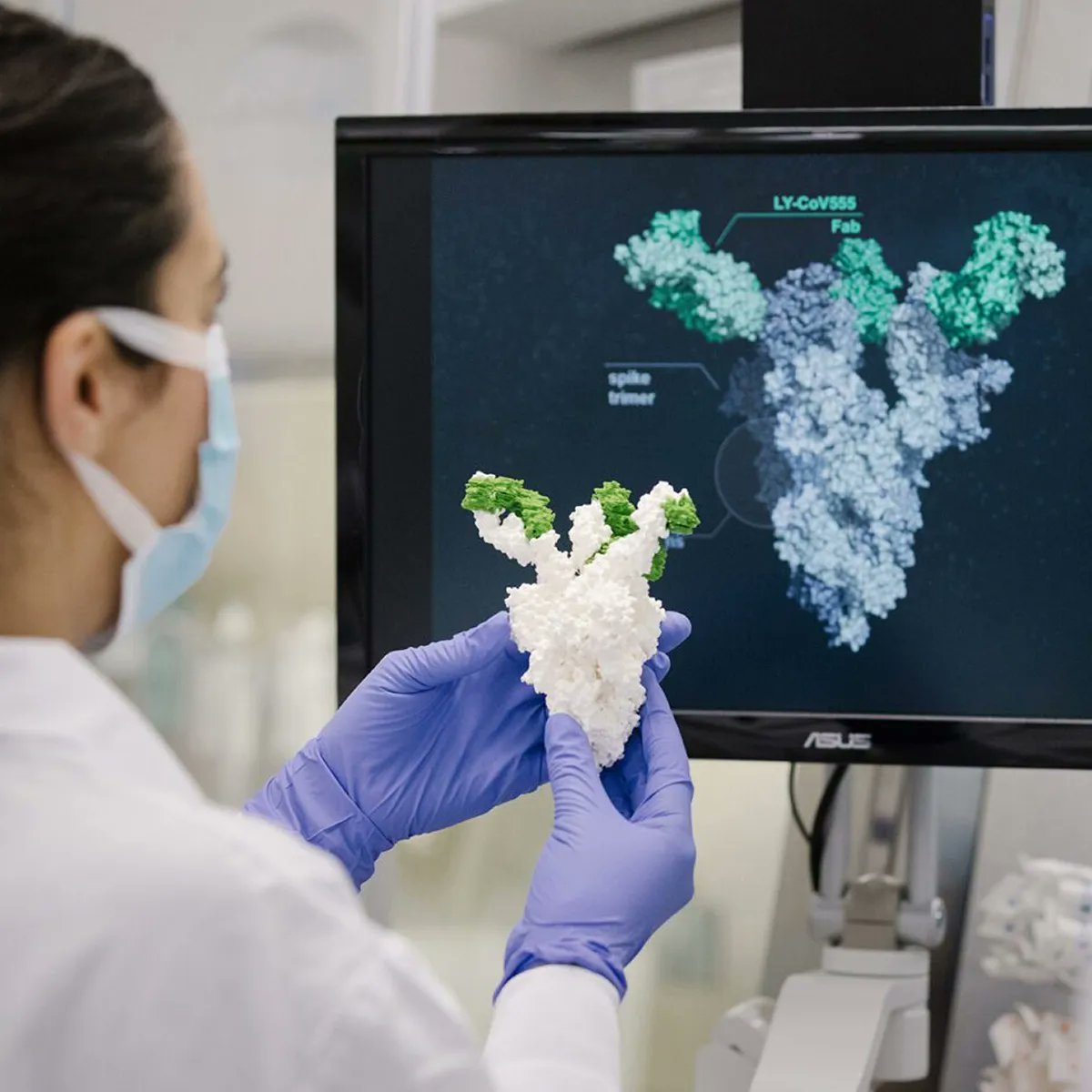
ALT ABCL LAB (출처 - investors.abcellera.com)
2
15
834

May 22
Peptide tagを利用したsite-specific ADCのViewpoint。
pubs.acs.org/doi/10.1021/acs…
ADCの次世代conjugation技術として、酵素法と超分子アセンブリ駆動型の手法を整理しています。SMARTag、sortase、SNAP-tag、AJICAP、split intein、π-clamp、coiled-coilなどが取り上げられており、DARと結合部位を制御する技術群として読みやすい総説です。
特に重要なのは、site-specific conjugationの価値を均一なDARを作れることだけでなく、linker-payloadの安定性、薬物動態、安全性、dual-payloadや高DAR設計への展開可能性まで含めて議論している点です。従来型のLys/Cys conjugationでは、DAR分布、結合部位、maleimide結合の安定性が品質・薬効・安全性に影響するため、より定義されたADCを作る技術の意義は大きいと思います。
一方で、私が言うのもアレですが、peptide tag型の技術は万能ではありません。タグ配列の免疫原性(特にペプチドの大部分が抗体表面に残る場合)、抗体発現量への影響、抗原結合やFc機能への影響、残存酵素や副生成物の除去、スケールアップ時の再現性、CMC上の管理戦略まで見る必要があります。SNAP-tagやHalo-tagのような大きなタグは、full-length IgGでは薬物動態や腫瘍浸透性への影響も無視しにくいです。
AJICAPのように、未改変抗体を使い、反応後にtag様構造を残さない手法は、この点で実務上の利点があります。一方、遺伝子工学的tagやcoiled-coil型の手法は、dual-payload ADCや多機能ADCの探索には有用ですが、臨床開発に進めるにはdevelopabilityと免疫原性の評価が重要になります。
結局、site-specific ADCの本質は「きれいなDAR」ではなく、どの部位に、どのpayloadを、どの安定性で、どの工程再現性で導入し、それをどう規格・分析・管理するかだと思います。Peptide tag技術はその選択肢を広げる一方で、ADCとしての製品設計とCMCのハードルは別途しっかり見ていかないけないポイントになります。
2
25
2,184

May 21
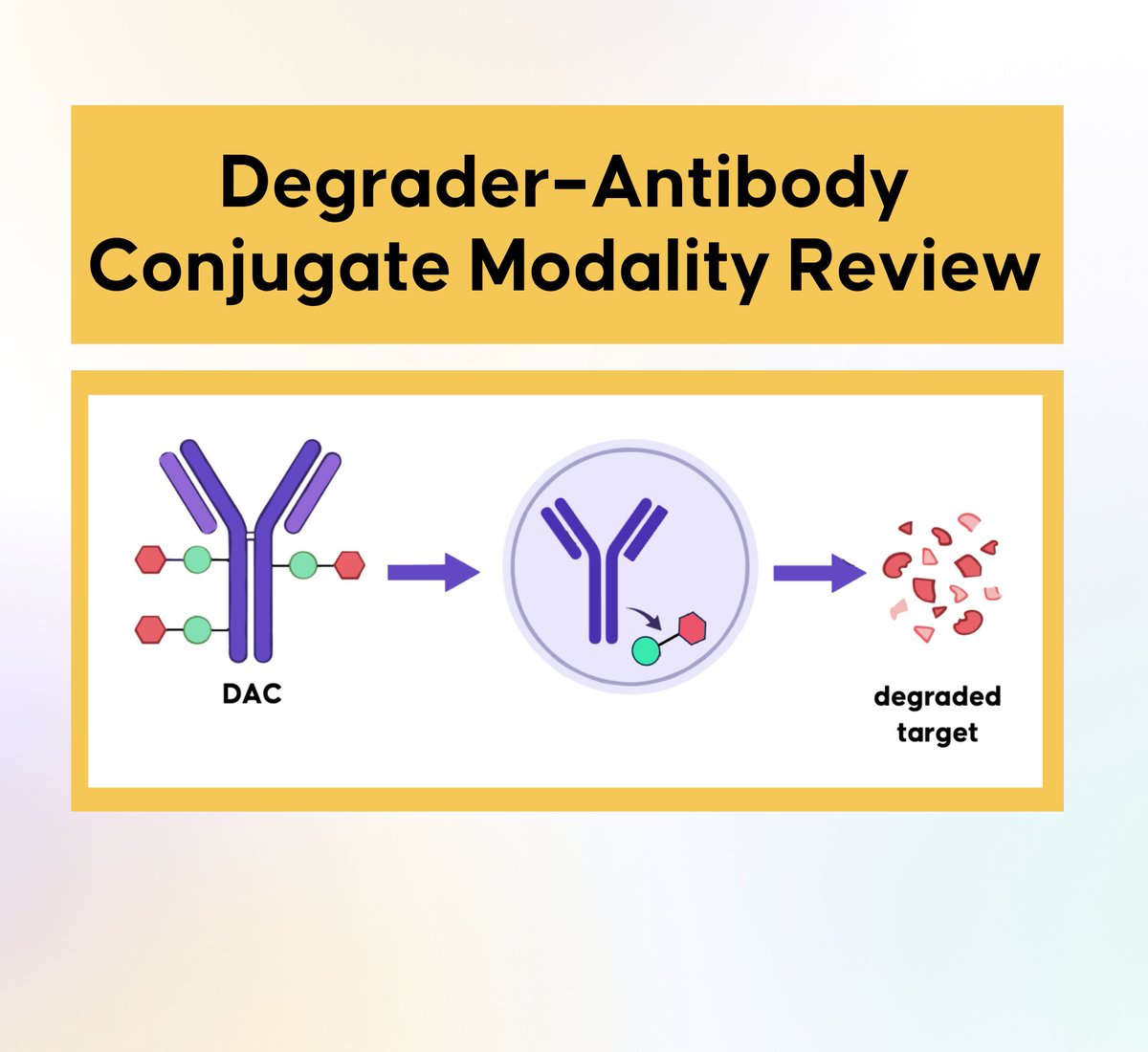
DACs (degrader–antibody conjugates) combine catalytic protein degraders with mAb-mediated delivery to specific cell populations. This modality has the potential to improve tolerability and expand the therapeutic window relative to both cytotoxic ADCs and unconjugated degraders. However, the physicochemical properties of some degrader payloads—particularly their size and lipophilicity—together with the need for relatively high drug-to-antibody ratios, create significant developability challenges, including a high risk of aggregation. In addition, the multistep biological cascade required for DAC activity can lead to disconnects between the potency of free versus conjugated degraders, necessitating careful, multiparameter optimization. Despite these hurdles, several DACs have shown encouraging antigen-dependent activity, and recent disclosures of SMARCA2/4-targeting DACs suggest the potential for therapies with improved tolerability margins.
Read the full review: drughunters.com/4eZY7AH
1
5
13
1,517

May 20
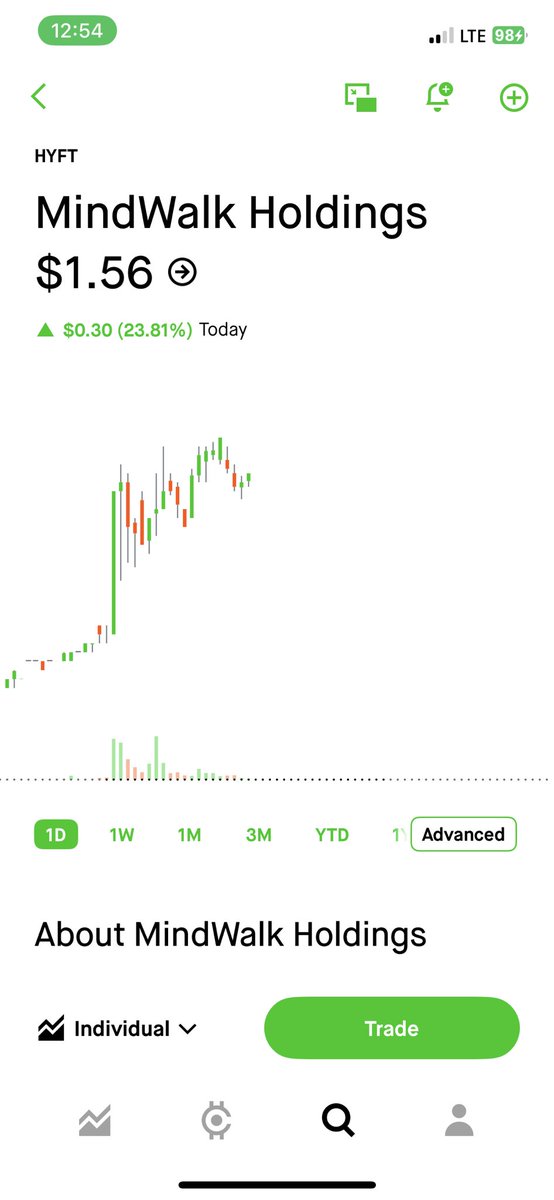
$HYFT
~$80M market cap
DONT MIISS THIS NEW PHARMA AI INFRASTRUCTURE RE RATE.
5-10x coming.
Bookmark. Subscribe. Add to the Hunter WL
Up 25% today
Up 17% past month
Still ~-14% YTD
Still ~-78% 5Y base compression
RELATIVE VOLUME: ~9x average
Breaking early accumulation phase into volatility expansion
Less than 10% from reclaiming 200DMA (~$1.68)
Follow my boy @Twills08 he put me on this months ago.
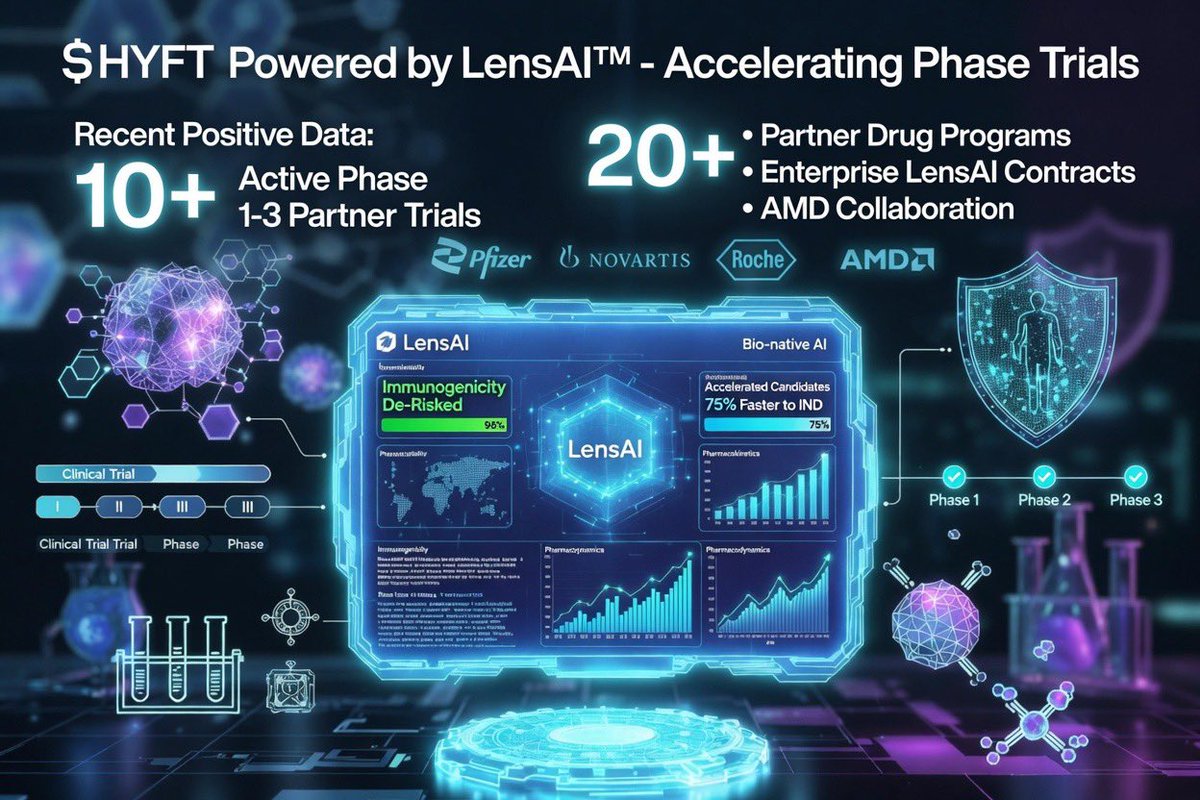
🧬 HYFT / LENSAI — BIO-NATIVE AI INFRASTRUCTURE PIVOT
$HYFT is transitioning from legacy antibody CRO →
into a BIO-INTELLIGENCE AI DRUG DISCOVERY PLATFORM
🧠 HYFT® biological graph engine
~660M biological patterns indexed
~25B relationship knowledge graph
Functional fingerprinting beyond sequence similarity
Cross-target / cross-disease adjacency mapping
IP risk epitope intelligence layer
🔬 LensAI™ platform layer
AI-native biologics discovery system
Epitope mapping in hours (vs weeks/months)
Immunogenicity / ADA risk prediction
Developability scoring (stability, aggregation, liabilities)
Functional similarity detection across drug space
Literature omics wet lab integration
📈 SCALE
~$20M annual revenue run-rate (~50% YoY growth trend)
Gross margins ~58–65% range (mix shift improving)
US revenue doubling YoY (fastest expansion region)
👉 Recurring 1-year LensAI enterprise contract signed
👉 Moving from CRO projects → SaaS usage-based model
This is the INFLECTION POINT:
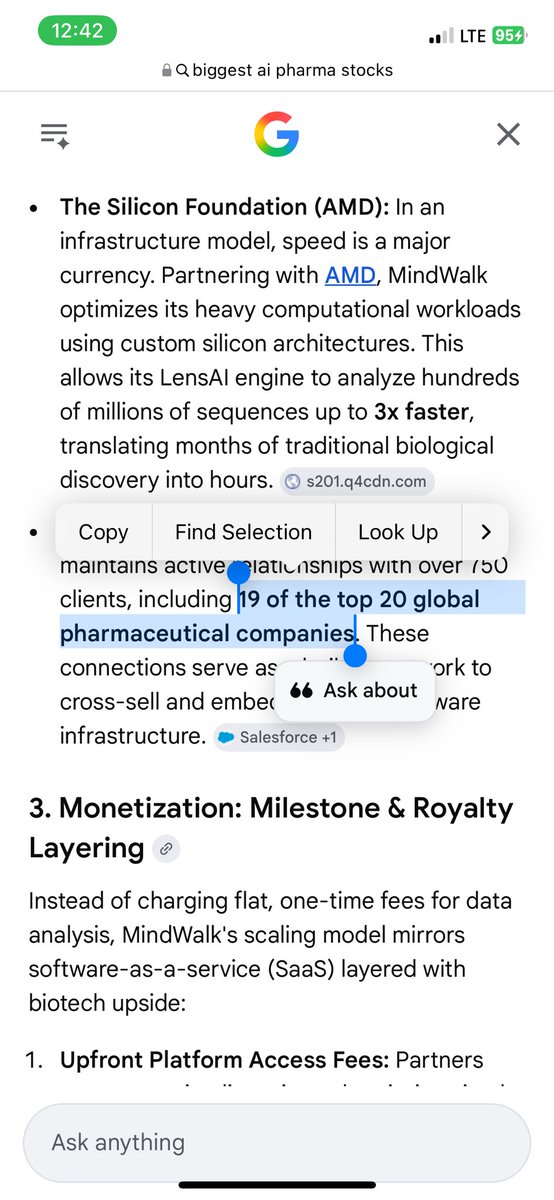
750 historical pharma clients
→ even low single-digit conversion = scalable SaaS base layer
Most people still think $HYFT is:
a small legacy antibody services biotech
AI-native biological infrastructure layer for pharma
• 19 of top 20 global pharma companies engaged historically
• 750 total clients across programs
• 400 peer-reviewed publications/patents
• 20 partner-owned drug programs advanced into clinic
• 10 active Phase 1–3 programs currently ongoing
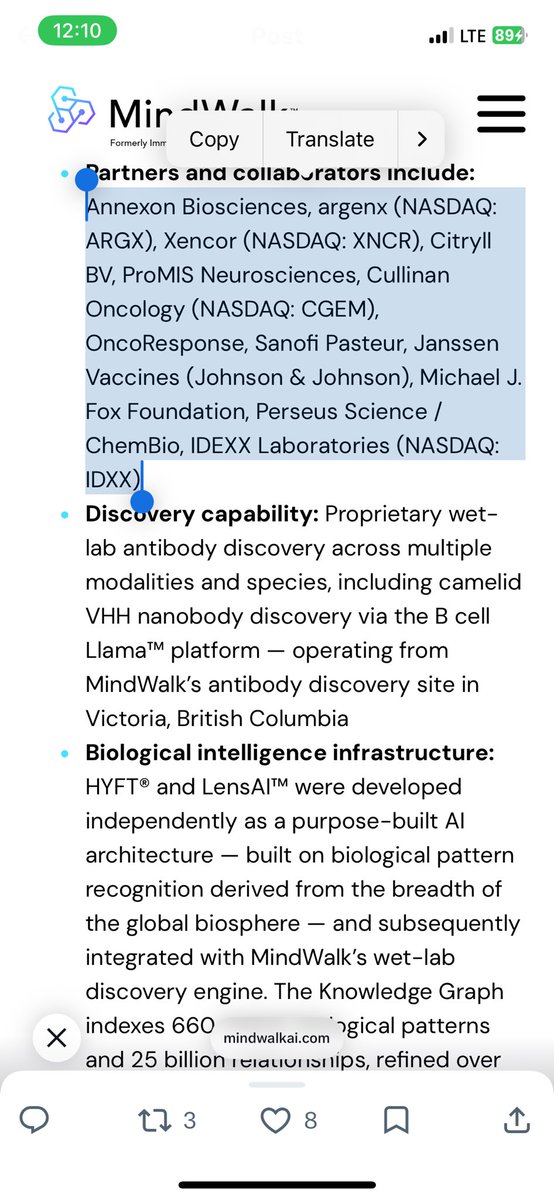
Partners include:
Annexon | argenx | Xencor | Cullinan | OncoResponse | Sanofi | J&J | IDEXX
$HYFT is embedded INSIDE pharma workflows — not just selling software on the outside.
LensAI runs on $AMD Instinct MI300X EPYC ROCm stack:
Massive protein/antibody model workloads
Proteome-scale embedding generation
Faster biological graph traversal
Lower cost per inference cycle
AI drug discovery bottleneck = compute biology integration
$HYFT is positioning directly at that intersection.
SaaS LensAI subscriptions
usage-based AI biology engine
optional internal pipeline upside
This is structurally similar to early-stage:
$ABCL (antibody platform)
$SDGR (biotech SaaS modeling platform)
$RXRX (AI drug discovery infrastructure)
But at micro-cap valuation compression levels
🧪 INTERNAL PIPELINE OPTIONALITY (UPSIDE LAYER)
While partners own most programs, $HYFT is building internal high-upside shots:
• Universal dengue vaccine (multi-serotype epitope target)
• Broad influenza epitope program
• GLP-1 dual-pathway metabolic/longevity candidate
• Neurodegeneration antibody programs (TDP-43 targeting)
$ABCL
~$100M scale revenue history
Mature antibody discovery platform
COVID-era validation peak
Now normalized post-boom multiples
CRO-heavy revenue structure
$HYFT
~$20M scaling revenue base
Early SaaS transition (LensAI just monetizing)
Functional AI knowledge graph infrastructure layer
Deeper “bio-native AI” abstraction
Still under-discovered micro-cap pricing
$ABCL = already priced as a mature platform discovery company
$HYFT = still priced like a legacy biotech services firm
• SaaS conversion across pharma base accelerates
• Recurring revenue base builds (LensAI contracts expand)
• Gross margins expand toward software levels
• Revenue scales $20M → $50M–$100M trajectory over cycle
• AI drug discovery sector re-rates alongside compute wave
Similar early structure to past winners — but still under the radar.
$HYFT
$ABCL $SDGR $RXRX $NVDA $AMD $MSFT $GOOGL $QQQ $SPY $HIMS $UNH $LLY $PFE $NVS $TEM
Ai Pharma infrastructure. Don’t miss.
6
3
32
4,090