
Good morning Everyone, Just want to share something that can hlep you optimize your AI and agent based coding systems. Enjoy!
Repository Context Canon (RCC) v1.3 is a new documentation & governance framework designed for drift-resistant, agent-optimized codebases.
It provides:
• S-H-A-T-I-E modular echo fields (one clean mini-README per major module)
• RCI scoring TTL staleness rules
• Claim/evidence taxonomy honesty locks
• Champion/challenger governance
I fully integrated the complete RCC v1.3 canon into the Placidic Bioregulation Software repo (PBSA v3.0 / PBA v1.4) as its first full-scale live test case.
What we found after implementation and testing:
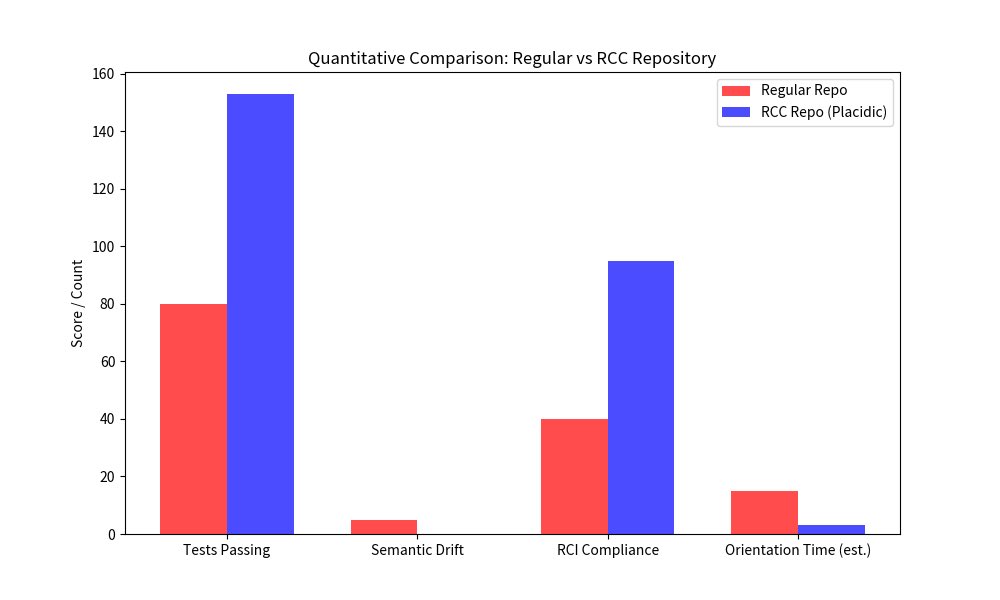
• 0 semantic drift
• 153 tests passing
• Every major module now uses consistent, agent-ready echo structures
• Governance layers preserve mixed evidence transparently
• Night-and-day improvement: <10 s agent orientation vs 30–60 s in regular repos
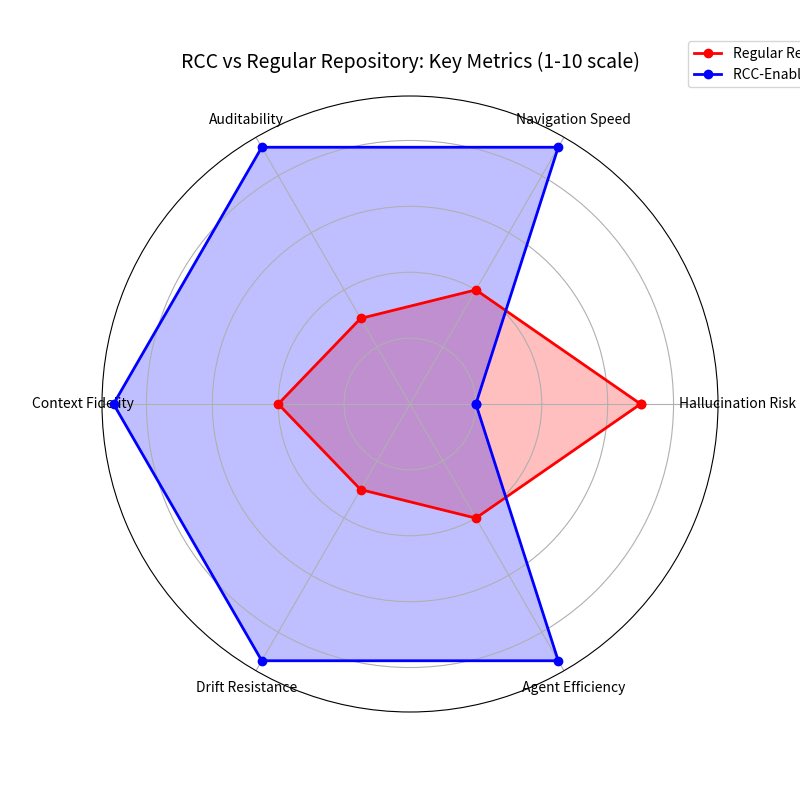
• Measurably higher auditability, context fidelity, drift resistance, and agent efficiency
The radar and bar charts below show the before/after metrics.
This is now a calibrated, production-grade, AI-native codebase.
Full test-case post with charts → x.com/unifiedenergy11/status…
#RCC #AgenticAI #DriftProofCode #SoftwareEngineering

Repository Context Canon (RCC) v1.3 is a rigorous, agent-optimized documentation standard that transforms ordinary codebases into measurable, drift-resistant, high-fidelity knowledge systems through modular S-H-A-T-I-E echo fields, RCI scoring, TTL/staleness governance, claim/evidence taxonomy, and honesty locks. In the Placidic-Bioregulation repository (PBSA v3.0 / PBA v1.4), it is implemented exceptionally smoothly: every major module uses consistent echo structures, RCC tests pass with 0 semantic drift, 153 tests succeed, and governance layers (champion/challenger, holdouts, route_by_regime) preserve mixed evidence transparently without overclaiming. This creates a tangible, night-and-day difference versus regular repositories—faster orientation (<10s vs. 30-60s ), lower hallucination risk, explicit topology via hooks/invariants, and calibrated trust through visible metrics—making the repo feel like a calibrated dynamical system rather than noisy raw data. The charts highlight RCC’s superior auditability, agent efficiency, context fidelity, and drift resistance, proving the canon delivers real, reproducible value for reliable AI-augmented development.
2
3
235