
Voici la traduction exacte de ton texte, formatée et prête à être publiée sur X avec les mentions correspondantes :
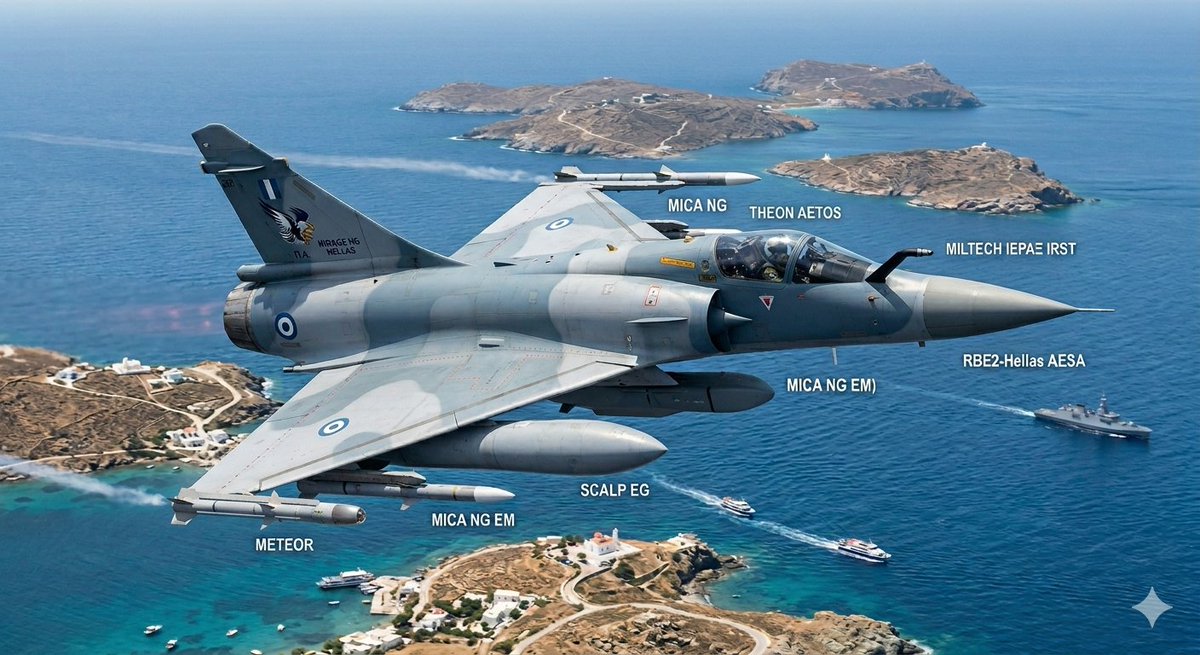
Le chasseur de souveraineté numérique 🇬🇷🇫🇷 Une coopération franco-grecque.
Une réflexion pour la recherche et la coopération avec les entreprises grecques.
Un « rebelle numérique » des airs, conçu exclusivement pour les besoins de la mer Égée et de la Méditerranée orientale, selon une philosophie de bas coût, propulsé par le « cerveau » de l'industrie de défense grecque.
🔹1. Hardware & Structure** (@MetlenSA / @HAIcorp / @SafranEngines)
Cellule : Aérodynamique Mirage (aile Delta) avec des plans canards actifs redessinés pour une agilité absolue en combat tournoyant (Dogfight).
Matériaux : Alliages légers d'aluminium-lithium, titane (Metlen) et fibres de carbone locales pour réduire le poids et la signature radar (RCS).
Moteur :1 × Snecma M88-3 amélioré (22 000 lbf). Capacité de Supercruise (Mach 1.1 sans postcombustion) et réponse instantanée de la manette lors de manœuvres extrêmes.
Doctrine de Dispersion : Train d'atterrissage renforcé (heavy-impact) déplacé vers les ailes. Décollage/atterrissage sur des pistes de fortune dans les îles (600 m) avec protection FOD contre les débris.
• 2. Capteurs & Logiciel National** (@TheonSensors / @MiltechH / @scytalys)
Radar : Thales RBE2-Hellas AESA (Matériel évolutif & Éléments GaN : Plus petit en taille en raison du fuselage (700-750 éléments), mais doté de la technologie au Nitrure de Gallium (GaN) pour une puissance accrue sans surchauffe et une portée de détection des drones étendue.) avec code IA grec pour une immunité numérique totale contre le brouillage (Frequency Hopping).
Visée de Casque : THEON AETOS – Casque numérique avec suivi de tête (head-tracking) pour le verrouillage de cibles hors axe (off-boresight) d'un simple regard du pilote.
Capteur Passif de Nez : MILTECH IERAX (IRST/FLIR) – Détection thermique et identification visuelle de chasseurs/drones en régime de silence radio total (radar éteint).
Réseautage & MUM-T : SCYTALYS ΔΙΚΤΥΟ – Liaison de données cryptée en temps réel avec les frégates Belharra, les F-16 Viper, les F-35 et protocole de contrôle de drones équipiers (Loyal Wingman).
Copilote Virtuel : Logiciel IA grec pour la hiérarchisation automatique des menaces en environnement de saturation et maintenance prédictive (Predictive Maintenance).
• 3. Guerre Électronique (Système « ARIS »)
Cognitive EW : L'IA intégrée reconnaît les fréquences ennemies inconnues en temps réel et génère instantanément des algorithmes de brouillage.
Brouillage DRFM : Altération numérique du signal pour créer des cibles fantômes (ghost targets) sur les radars ennemis.
Anti-Drone Shield : Émission dirigée pour la neutralisation électronique de essaims d'UAV (brouillage GPS/Contrôle).
🔹4. Charge utile & Systèmes d'Armes
Points d'Emport : 10 hardpoints.
Carburant Interne : Augmenté de 35-40% (grâce à la libération de l'espace dans le fuselage), permettant de longues patrouilles sans réservoirs externes – prêt pour encaisser 9G dès la première seconde.
Arsenal : Intégration complète des missiles Meteor (BVR), MICA NG (EM/IR), SCALP EG et Exocet AM39.
🔹5. Données Économiques
Coût d'Achat (Flyaway) : 75 – 85 millions de dollars par unité (une grande partie de l'investissement retourne à l'économie grecque).
Coût de l'Heure de Vol : 6 000 – 7 500 dollars (au niveau du Gripen, grâce au monomoteur, à la chaîne d'approvisionnement locale et à la maintenance par IA).
Temps de Reconditionnement (Push-back) dans les Îles : Moins de 12 minutes pour le réarmement par une équipe de 5-6 personnes en conditions de dispersion.
#MirageNGHellas #HellenicAirForce #Metlen #EAB #TheonSensors #MiltechHellenic #Scytalys #Safran #Thales #Dassault #Aerospace #DefTech #GreekDiscovery
16
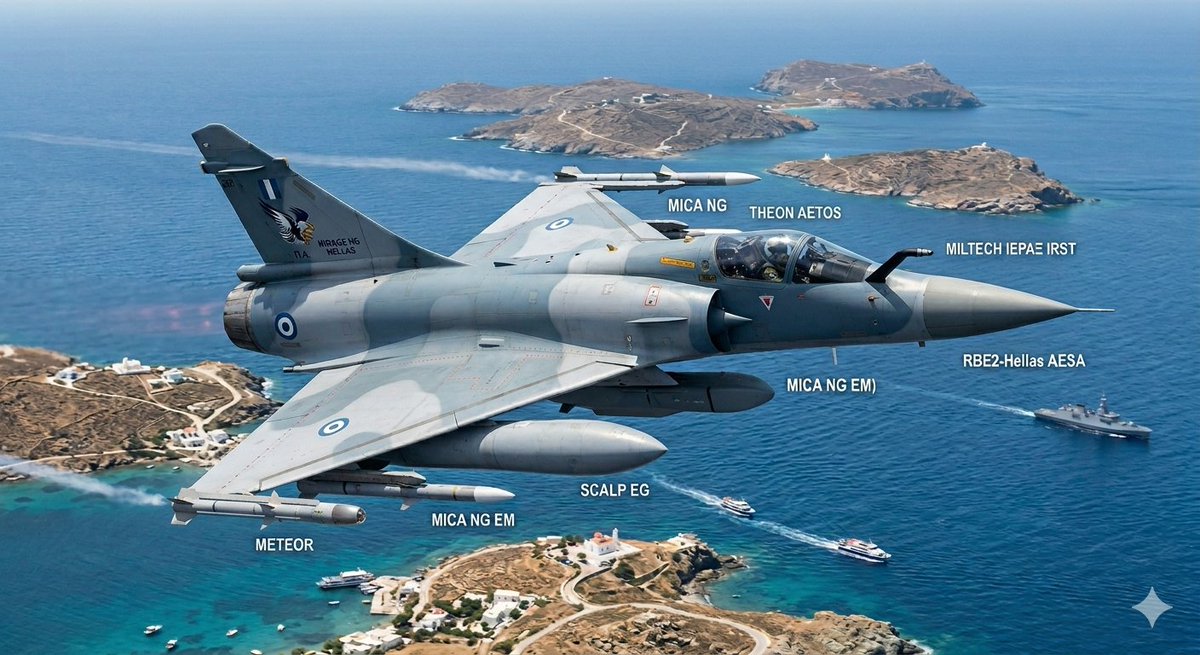
Το Μαχητικό Ψηφιακής Κυριαρχίας 🇬🇷🇫🇷 Ελληνογαλλικής συνεργασίας.
Μια σκέψη για έρευνα και συνεργασία με τις ελληνικές εταιρείες.
Ένας ψηφιακός «αντάρτης» των αιθέρων, σχεδιασμένος αποκλειστικά για τις ανάγκες του Αιγαίου και της Αν. Μεσογείου, με τη φιλοσοφία χαμηλού κόστους με το «μυαλό» της ελληνικής αμυντικής βιομηχανίας.
🔹 1. Hardware & Δομή (@MetlenSA / @HAIcorp / @SafranEngines)
Σκάφος: Αεροδυναμική Mirage (Delta-wing) με επανασχεδιασμένα ενεργά canards για απόλυτη ευελιξία στο Dogfight.
Υλικά: Ελαφρά κράματα αλουμινίου-λιθίου, τιτάνιο (Metlen) και εγχώρια ανθρακονήματα για μείωση βάρους και ίχνους ραντάρ (RCS).
Κινητήρας: 1 × Snecma M88-3 αναβαθμισμένος (22.000 lbf). Ικανότητα Supercruise (Mach 1.1 χωρίς μετάκαυση) και ακαριαία απόκριση μανέτας σε ακραίους ελιγμούς.
Δόγμα Διασποράς: Ενισχυμένο σύστημα προσγείωσης (heavy-impact) μετατοπισμένο στις πτέρυγες. Απογείωση/προσγείωση σε πρόχειρους διαδρόμους νησιών (600μ) με προστασία FOD από πέτρες.
🔹 2. Αισθητήρες & Εγχώριο Software (@Theon/ @MiltechH/ @scytalys)
Ραντάρ: Thales RBE2-Hellas AESA (τεχνολογία GaN) με ελληνικό AI κώδικα για απόλυτη ανοσία σε παρεμβολές (Frequency Hopping).
Στοχοποίηση επί Κράνους: THEON AETOS – Ψηφιακό κράνος με head-tracking για εγκλωβισμό στόχων off-boresight απλώς με το βλέμμα του πιλότου.
Παθητικός Αισθητήρας Μύτης: MILTECH ΙΕΡΑΞ (IRST/FLIR) – Θερμικός εντοπισμός και οπτική αναγνώριση μαχητικών/drones σε καθεστώς απόλυτης ραδιοσιωπής (κλειστό ραντάρ).
Δικτύωση & MUM-T: SCYTALYS ΔΙΚΤΥΟ – Κρυπτογραφημένη ζεύξη δεδομένων σε πραγματικό χρόνο με Belharra, Viper, F-35 και πρωτόκολλο ελέγχου φίλιων drones (Loyal Wingman).
Ψηφιακός Συγκυβερνήτης: Ελληνικό λογισμικό AI για αυτόματη ιεράρχηση απειλών σε περιβάλλον κορεσμού και Προγνωστική Συντήρηση (Predictive Maintenance).
🔹 3. Ηλεκτρονικός Πόλεμος (Σύστημα «ΑΡΗΣ»)
Cognitive EW: Το ενσωματωμένο AI αναγνωρίζει άγνωστες εχθρικές συχνότητες σε πραγματικό χρόνο και δημιουργεί επιτόπου αλγόριθμους παρεμβολής.
DRFM Jamming: Ψηφιακή παραποίηση σήματος για δημιουργία ψευδών ειδώλων (ghost targets) στα εχθρικά ραντάρ.
Anti-Drone Shield: Κατευθυνόμενη εκπομπή για την ηλεκτρονική εξουδετέρωση σμηνών UAVs (GPS/Control Jamming).
🔹 4. Φορτίο & Οπλικά Συστήματα
Σταθμοί Ανάρτησης: 10 hardpoints.
Εσωτερικό Καύσιμο: Αυξημένο κατά 35-40% (λόγω ελεύθερης ατράκτου), επιτρέποντας μεγάλες περιπολίες χωρίς εξωτερικές δεξαμενές – έτοιμο για 9G από το πρώτο δευτερόλεπτο.
Οπλοστάσιο: Πλήρης ενσωμάτωση με Meteor (BVR), MICA NG (EM/IR), SCALP EG και Exocet AM39.
🔹 5. Οικονομικά Δεδομένα
Κόστος Αγοράς (Flyaway): $75 – $85 εκατομμύρια ανά μονάδα (μεγάλο μέρος των χρημάτων επιστρέφει στην ελληνική οικονομία).
Κόστος Ώρας Πτήσης: $6.000 – $7.500 (στα επίπεδα του Gripen, λόγω του ενός κινητήρα, της εγχώριας εφοδιαστικής αλυσίδας και του AI maintenance).
Χρόνος Push-back στα Νησιά:
Κάτω από 12 λεπτά για επανεξοπλισμό από 5-6 άτομα σε συνθήκες διασποράς.
#MirageNGHellas #HellenicAirForce #Metlen #EAB #TheonSensors #MiltechHellenic #Scytalys #Safran #Thales #Dassault #Aerospace #DefTech #GreekDiscovery
7


💰 خصم مباشر - أسعار خاصة
⎐كُـود⎐كوبِون⎐خـِصم⎐
🌟 خصومات قوية
⎐ايهرب⎐ايهيرب اهرب
⊵IPY1290⊴
⎐ترنديول⊴ترند يول⎐
⊵BDL⊴
⎐نون⎐
⊵STC9⊴
eAb

Gooner🤫 retweeted

Jun 3
Bocchi needs money and learns how to overcome her anxiety♠️
#blackededit #blackedwaifu #qos #blackedhentai




2
96
888
20,778

More than a quarter of private colleges are at risk of closing, new projection shows | Jon Marcus, The Hechinger Report
More than a dozen newborn lambs cavorted around a fenced-in yard beneath the scrutiny of their mothers and a few watchful students taking turns attending to them.
The lambs’ successful births have been a needed bright spot at tiny Sterling College, which uses a 130-acre farm to teach agriculture and other disciplines in a part of northeastern Vermont so isolated it’s rare to see a passing car and there’s no cell service.
LillyAnne Keeley, a senior, likes that remoteness. “We have a beautiful view,” said Keeley, in the barn where she’s come for her turn checking on the lambs. “There are beautiful sunsets here. I kind of take it for granted every day.”
She and her classmates have started taking such experiences less for granted now, since Sterling has announced that it will close at the end of this semester.
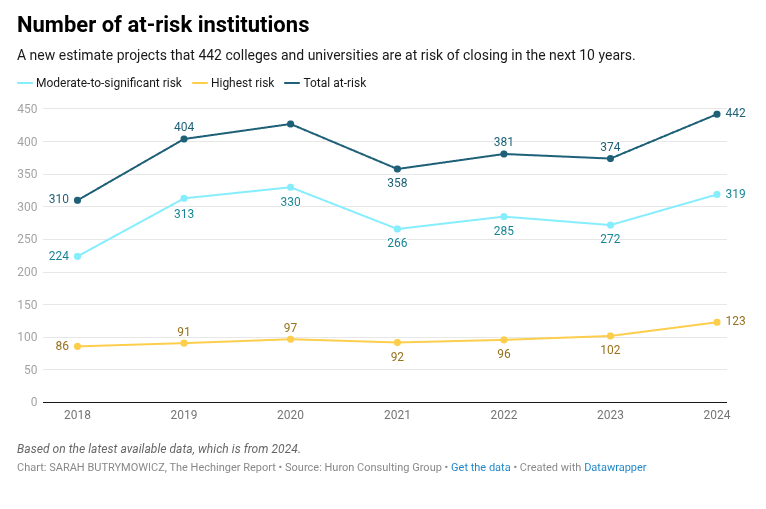
They’re not the last students who will suffer such disruption. A new estimate projects that 442 of the nation’s 1,700 private, nonprofit four-year colleges and universities, with a combined 670,000 students, are at risk of closing or having to merge within the next 10 years.
More than 120 institutions are at the very highest risk, according to the forecast, by Huron Consulting Group, which analyzed enrollment trends, tuition revenue, assets, debt, cash on hand and other measures. Many are, like Sterling, small and rural.
“Now that this might be gone, I just really worry about some students out there that are going to have less and less choices,” Keeley said.
It’s a crisis whose magnitude has been shrouded by political and culture-war attacks on higher education and is propelled by the simple law of supply and demand after a long decline in the number of Americans who are going to college.
“We have too many seats. We have too many classrooms,” said Peter Stokes, a managing director at Huron. “So over the coming five to 10 years, this shakeout is going to take place.”
Sterling — the seventh private college in Vermont to close since 2016 — offers a rare glimpse into the human impact of this trend. That’s because it gave students a final semester to stay and complete their degrees or transfer, rather than locking the doors with hardly any notice, as many other colleges have done.
Fewer than half of students at colleges that close continue their educations, according to the most comprehensive study of the issue, produced by the State Higher Education Executive Officers Association, or SHEEO. Of those who do, many lose credits they’ve already earned and paid for, and fewer than half eventually earn degrees.
Twenty-year-old Izzy Johnson has already been buffeted by this. The college he originally wanted to attend closed the month before he graduated from high school. So he enrolled in the fall at Sterling — only to learn that it would also close.
“Having to pick up everything and find a new place to settle down is really miserable,” said Johnson, who is weighing where to go next.
Started in 1958 as a prep school for boys, the remote rural college was never very large. Its enrollment peaked at 120 and fell to about 40 students this year, spread around a few white clapboard buildings indistinguishable from the houses of the surrounding farm town of about 1,300 people.
Those numbers weren’t sustainable, even at a work college whose students pitch in on the farm and in the dorms and kitchen, said the president, Scott Thomas. Though financial documents show Sterling had been breaking even, margins were thin.
In its last semester, the campus appeared surprisingly upbeat. At a weekly community meeting, students, faculty and staff in farm boots and hiking shoes lugged tables to the edge of the dining hall and formed a circle to talk about routine business, including warnings of bears coming out of hibernation and a reminder to provide contact information so everyone could stay in touch after commencement in May.
Students have decided “that we’re just going to have a really good last semester and go out on a really positive note,” said Keeley, who, like several classmates, is cramming to earn the credits she needs to graduate this spring. “And I feel like we’ve been really able to do that so far, but it’s still really sad.”
Most said they were drawn here precisely because of the college’s small size and far-flung location.
“I don’t think I would have done well at a big, traditional college,” said Jack Beatson, a first-year student from California. “I just sort of get freaked out in a big space like that.”
Added Samuel Stover, a senior from Connecticut whose mother also went to Sterling: “I have really amazing role models and instructors and teachers who I feel like I really connect with on a deeper level than just ‘I’m a student and I hand in papers.’ ”
As more small colleges close, said Keeley, it’s getting harder for students to find this kind of an alternative to what she called “the larger, monotonous type of education.”
People around town are equally concerned about the local impact of the closing — not only the loss of jobs and spending by the few remaining students at the two local cafes and two general stores, but an end to the pipeline through which many graduates have stayed to work or start businesses of their own in a state whose population is the third-oldest in the nation.
“We always joke that Sterling kids stick around. But it’s true, they do, and they contribute to the community,” said Liz Chadwick, who moved from New Jersey in 2013 to finish her bachelor’s degree at the college, where she now teaches food systems, the study of the process by which food is produced and consumed. “They build families here.”
Losing colleges like Sterling “leaves craters in the small rural communities that they have been a part of for, in some instances, decades or a century,” said Thomas.
Paul Lisai, another Sterling grad, stayed and started his own milking herd and creamery in nearby West Glover: Sweet Rowen Farmstead, named for a particularly sweet kind of hay.
“The impact is far beyond the local economic impact,” said Lisai, whose milk, yogurt and 17 types of cheeses are sold around New England and in upstate New York. “For me as a business owner, what I’m scared about most is not having access to that group of like-minded people.” With a state unemployment rate of 2.6 percent, he said, “Try running a business here. We really struggle to find good folks.”
Many converging reasons explain why colleges and universities are under existential strain.
There are already 2.3 million fewer students than there were in 2010. Now a drop in the birthrate that began around the same time means there is about to be a further downward slide in the number of 18-year-olds through at least 2041.
The proportion of high school graduates who go on to college is also down, from 70 percent in 2016 to 61 percent in 2023, the most recent year for which the figure is available. The number of visas issued for new full-tuition-paying international students coming to the United States plummeted by nearly 100,000 this year, or 36 percent. And looming caps on federal loans for graduate study, which take effect in July, threaten to reduce demand for yet another crucial source of revenue for universities and colleges.
While higher education institutions previously weathered short-lived declines in enrollment and increases in costs, today “every major revenue stream and expense category is under pressure at the same time,” the higher education consulting firm EAB warns in a new analysis.
Eighty-six percent of college and university leaders are worried about their schools’ long-term financial viability, according to a survey by the American Council on Education, the principal industry association. A fifth of college and university presidents say they’ve had serious discussions about merging with another university or college, a separate survey by Hanover Research and the industry news site Inside Higher Ed found.
Signs of strain are spreading.
Nearly a third of private, nonprofit colleges and universities nationwide posted deficits in 2024, according to research by Robert Kelchen, director of the Department of Educational Leadership and Policy Studies at the University of Tennessee, Knoxville. More than a third of 44 comparatively small colleges in New England analyzed separately by education consultant Steven Shulman are running out of operating money, Shulman found.
And it’s not just small schools that are affected.
The University of Southern California has sent pink slips to more than 900 employees. Stanford laid off at least 363. Northwestern University eliminated 425 positions. DePaul University laid off 114 employees and closed its art museum, citing a big drop in international graduate enrollment, spiking benefit costs and growing demand for financial aid.
As part of what its president called a “broader strategy to strengthen GW’s long-term financial health,” George Washington University announced in March that it had sold a satellite science and technology campus in Virginia for what the student newspaper reported was $427 million.
The New School in New York said it would cut its workforce by 20 percent. Rider University in New Jersey reached an agreement in February to sell a fifth of its campus and lease some of its facilities, which will raise the roughly $10 million it needs to avert a financial crisis.
Even public universities and colleges are facing deepening financial problems, reports the Fitch bond-rating agency, citing slowing economic growth and federal policy changes. These include cuts to Medicaid and SNAP that will have to be made up by states, according to SHEEO, which projects a dim outlook for state funding for public universities and colleges.
“We are seeing state funding pressure now in a way that we wouldn’t have expected perhaps five or 10 years ago,” said Emily Wadhwani, senior director and sector lead for education and nonprofits at Fitch. “We are seeing federal funding pressure now in a way that we would not have expected a few years ago.”
Community colleges, too — which enroll nearly 5.6 million students — are suffering financial squeezes that leave them less able to adapt or respond to change, according to Daniel Greenstein, former chancellor of the Pennsylvania State System of Higher Education, who now tracks financial exposure in the industry.
In this case, wrote Greenstein, “The risk is not a sudden collapse of the sector. The risk is a slow erosion of capacity in precisely the institutions on which communities rely most.”
Still, after two and a half decades in which the price of tuition has increased more than 40 percent faster than inflation, for a payoff consumers no longer think is worth the money, higher education gets limited sympathy for its predicament — and even less after years of political and culture war attacks on the ideological leanings of faculty and leadership.
“Free market wins!” quipped one commenter on social media, in response to Sterling College’s announcement that it would close. “They woked themselves right out of business,” wrote another. Added a third: “Now where will they teach all the 20 year olds to protest and whine?”
Among its students, however, Sterling elicits something increasingly rare among higher education institutions: gratitude.
“I’m so glad I got to spend at least a year here,” said first-year student Jack Beatson. “Just feeling like you’re really part of something, and other people depend on you — that’s very important to young people especially, and today especially.”
Beatson is transferring to another small college in upstate New York. But even after Sterling closes, he said, “We’ll all take this place with us, wherever we end up.”
Contact writer Jon Marcus at 212-678-7556, jmarcus@hechingerreport.orgor jpm.82 on Signal.
This story about colleges closing was produced by The Hechinger Report, a nonprofit, independent news organization focused on inequality and innovation in education. Sign up for our higher education newsletter.
hechingerreport.org/more-tha…
2
1
12
1,421


🚀 لا تفوت الفرصة - هدية مجانية
📦 عرض شامل
⎐كُـود⎐كوبِون⎐خـِصم⎐
ستايلي⊴
⎐SY2⊴
⎐ايهرب⎐ايهيرب اهرب
⊵IPY1290⊴
⎐نون⎐
⊵STC9⊴
EaB

zengri abdelbasset retweeted

Jun 12
Just tried making matcha scones for the first time! Warm, buttery, and perfect with a latte #BakeAndRelax

3
4
Maria retweeted
Jun 12
Maybe Albertans should ve emailing a complaint toAB gov & EAB . This is blatant favoritism. Thought, ABEs was supposed to be neutral/unbiased. EAB has been known to have questionable actions i the past. Actually most recent past . Time to hold Danielle & EAB to account!
2
7
260

2 of 3. Emerald Ash Borer (EAB) and if you drive by you will see that these are a danger to the general public, staff, and infrastructure. The work will begin within the next few weeks.
Parks, Forestry, Park Spirit, and the neighborhood met on site with Barlett Tree Experts and
1
18

#jeddahMassage in #riyadh
مساج في الرياض
Massage in #jeddah
مساج في جدة
🥜🥚🍪 wa.me/ 966564369596
Lụm Lúa 🥦🥝
eAB

3

Jun 12
Environmental Advisory Board (EAB): The next regular EAB meeting agenda is now available for the June 18, 2026 meeting, held at 6:00 p.m. on the 2nd floor Council Chamber in Town Hall, 73 Hunter Street.
apexnc.org/1348
1
11

Jun 12
No😂 it just stops hairs being pulled during massages and kinesiology/EAB tape hurts less to remove with no hair
120
BROWEN HQ🤎🩵 retweeted

Jun 12
Proud is just an understatement 🙌🙌🥹 .She is coming back bigger and better the brand EAB is here to stay!!
EWURAMA BINEY GRACE
LETTER TO DENNIS OHENEBA
OHENEMA STANDS APART
#EwuramaBiney
#MitterrandDennisOheneba
#RoyalEmeralds

44
113
589