
2/ Some conclusions:
• EOAs generally remain active longer than contracts. ( 55% contracts are accessed in only 1 block).
• The reason why those contracts get accessed in only 1 block is because they are designed to be acted like this (factory, token clones, self-destruct (pre-EIP-6780) patterns)
• Storage usage is extremely concentrated: Around 63% of storage slots have zero span while the top 1000 contracts hold ~half of all slot.
1
18

Fight through chaos. Awaken the power of the soul.
EOAS — Elements of a Soul is coming.
#mmorpg #eoas #gameplaytrailer #elementsofasoul
7


Jun 16
Let’s see what comes up! It’s not going to go be easy!
Set expectations honestly, though: this still is not the distributed per-swap solver/relayer node EOAs. Their own privacy docs describe swaps executing through “neutral broadcaster addresses” that are deliberately not enumerated — that’s the dual-hop privacy design. So what they pointed you to is the deployment manifest (current old contracts two ops wallets), not the broadcaster fleet.
1
1
5
245

Jun 16
Verify section is a good place for users with EOAs to link them with their base account. I have all my transactions on EOA since July 2023 on mainnet f.e. and the only link between baseapp and my EOA is the funding... Which i don't think is enough.
Therefore i've created a soulbound NFT with attest but haven't deployed it yet on the mainnet.
Is it possible to tackle this shortly. Even a simple attestation would actually work. @baseapp @jessepollak
336
Jun 16
No, according to @CrusherHODL’s detailed on-chain analyses, cDAI on PulseChain does not become valuable—it’s essentially a hyperinflated, low/no-value token residue from a yield farm that’s nearly exhausted. @crusherhodl
Key points from his posts (especially the June 13, 2026 deep dive):
• cDAI is the canonical Compound cDAI (inherited at the PulseChain fork, contract 0x5d3a536e4d6dbd6114cc1ead35777bab948e3643), backed by pDAI. @crusherhodl
• Massive inflation: Total supply ~314 trillion cTokens, totalBorrows ~25 trillion pDAI, with an exchange rate ~3.5× mainnet equivalents. Cash in the market is basically 1 wei. These numbers come from runaway interest accrual on a near-100% utilization market, not real DAI inflows. (The borrows alone exceed total pDAI supply by hundreds of times.) @crusherhodl
• It’s a COMP reward farm run by an independent MEV/yield bot (driven by EOA 0xfdbee32b…, using a contract for atomic flash-loan mint/borrow loops). The bot mints/borrows to harvest inherited COMP rewards, dumps them on PulseX for PLS, and repeats—without unwinding positions. This permanently ratchets up supply/borrows. @crusherhodl
• The COMP reward reserve is now essentially drained to dust, so the farm is sputtering out with near-zero harvests. @crusherhodl
• It’s structurally separate from the main PulseChain Compound governance-capture operator/drain (different EOAs, no verified asset flow ties; the bot even self-funded its cETH collateral leg). @crusherhodl
CrusherHODL calls it a “strip-mining” operation on the dead fork’s leftovers. He has also posted lighter content like “cDAI gang is legit” (with memes/videos), but the forensic analysis is the substantive one—showing it’s not a gem with real upside.
Market reality (as of recent data)
cDAI trades at microscopic prices (e.g., fractions of a penny, like ~$0.00000000035–0.00000000036 vs. DAI) on PulseX with tiny liquidity and volume. It’s not pegged or backed meaningfully. geckoterminal.com
Bottom line from his work: Do not treat cDAI as valuable or supply real assets expecting it to moon. It’s farm residue, and the protocol has risks (e.g., pre-staged traps in related markets). PulseChain has plenty of other narratives (HEX, PLSX, INC, etc.), but this isn’t one where cDAI “becomes valuable.” Always DYOR and verify on-chain yourself—CrusherHODL emphasizes “Don’t trust, verify.“
6
1
15
695

Jun 16
What’s interesting is that this shift also creates new opportunities for privacy.
Programmable accounts (smart accounts) make it easier to break linkability compared to traditional EOAs.
17

Ameen retweeted

Jun 16
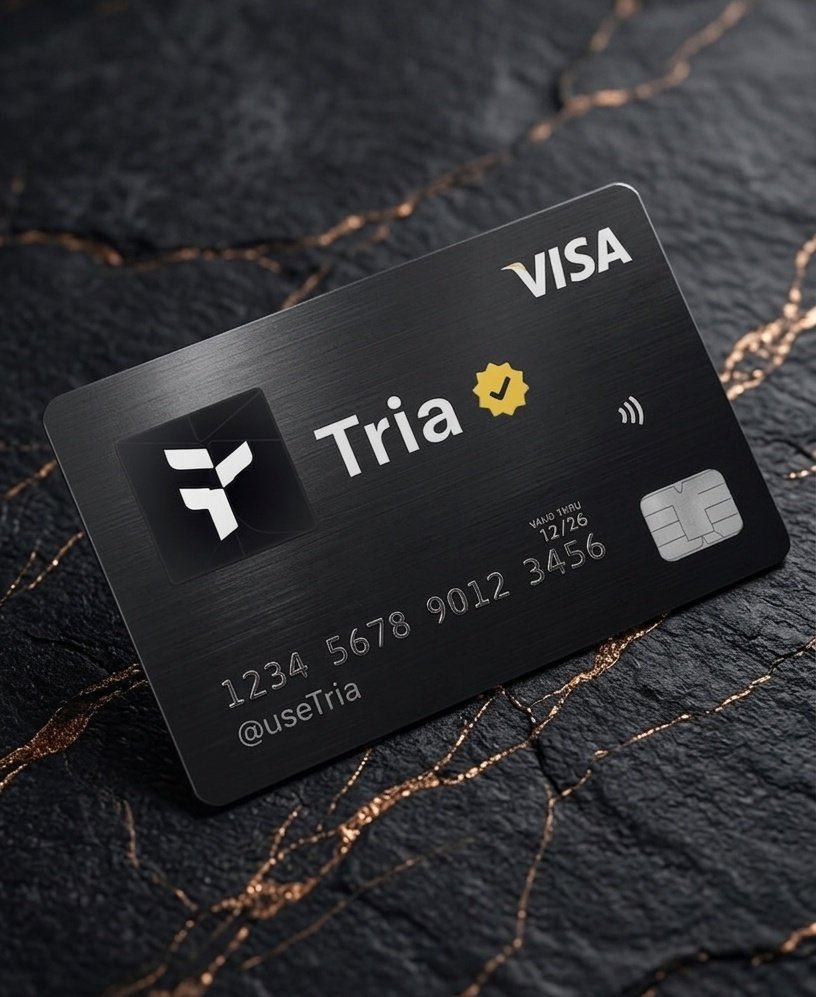
Gm gTria
Universal wallets = multi-chain magic
That's why @useTria supports them alongside EOAs & smart accounts.

75
5
81
466

Jun 16
Good morning.☀️
$Tria just crossed $300M in transaction volume as Season 3 goes live with virtual payment cards now rolling out.
What that actually means:
Universal wallets are designed to work across multiple blockchains and @useTria makes that real, supporting EOAs, smart accounts, and everything in between.
For anyone still learning: this means you can manage assets across Ethereum, Solana, Cosmos, Aptos, and even Bitcoin all from one place.
No switching between wallets and apps. Just one interface for all of it.
That's why the universal wallet model matters.
gMindo.
Morning. Simpler Web3 is here. 🚀

73
6
77
415

Sleep tight fam
gTria
Universal wallets are designed to work across multiple chains and protocols and that's why @useTria supports them alongside EOAs and smart accounts.
Now for those who does not know this it means that users can manage assets from Ethereum, Solana, Cosmos, Aptos, and even Bitcoin in one interface and i believe universal wallets simplify asset management, reducing the need for multiple apps.
gMindo
10
2
15
499
Jun 15
7X)
Proven vs. leading
Proven (direct on-node evidence):
pDAI identity and outstanding supply (44.36B).
The mint mechanism — one fully decoded DaiJoin.exit tx, every selector Keccak-verified.
The Vat is canonical, caged (live=0), with vice = 107.76B (~84% of debt) — uncollateralized issuance, by definition the product of suck.
452,811 sucks ≈ 456,902 mints (the suck→exit loop).
The ward capture: 133 post-fork relys beginning at block 8,928,152, ~500 blocks before the first mint; rely'd wards overlap suck beneficiaries.
The operator EOA and capture spell of the initial takeover tx.
Current ward set: 119 wards, all contracts, zero EOAs; neither operator key authed on any (direct wards() reads); the lone Ownable ward is owned by the Pause Proxy.
Leading / not yet quantified:
Per-ward attribution of the full 107.76B vice (the on-photo suck-recipient totals were not legible enough to assert).
Whether 0xddb10889 (Maker) and 0xd78d8f (Compound) share a funder — untested.
Identity/role of the removed prior ward 0x403689…788e5.
Open items
Funding-source trace on 0xddb10889 and 0x24354d31 to test syndicate overlap with the Compound operation.
Enumerate the full set of 133 rely'd wards and net per-ward suck totals.
Confirm 0x961d2b69 (biggest-suck caller) was a ward at the time (historical wards, requires archive or a rely/deny cross-reference).
Whether the Pause Proxy is itself a direct Vat ward (vs. reaching suck only by routing through a module) — sets the hop-count for any future governance-capture path, and is the one read that fully characterizes the residual risk.
1
4
236
Jun 15
6X)
Current authorization state / residual risk (verified)
Read against current chain state, not history. The capture is historical; this section is whether it is still live.
Current Vat wards: 119 — every one a contract, zero EOAs. Enumerated by calling wards(addr) on the Vat for every address that ever appears in a post-fork rely/deny event, plus the operator EOA and the capture spell.
Neither operator key retains authority. Direct wards() reads return 0 for both 0xddb108893104de4e1c6d0e47c42237db4e617acc and 0x24354d31bc9d90f62fe5f2454709c32049cf866b across all 119 wards (grep 'op1 1' and grep 'op2 1' both empty). The capture spell 0xbaa65281… is no longer a ward (deny'd at block 8,928,244). The loose keys that ran the takeover hold nothing today.
The ward set is governed, not loose. 118 of the 119 are DSS-style module contracts with no owner(); the single Ownable contract, 0x9c257e5aaf73d964aebc2140ca38078988fb0c10, is owned by the Pause Proxy 0xbe8e3e36…. Effectively all 119 sit under the Maker Pause Proxy's authority — the normal inherited MCD topology.
Live-risk read: the mint mechanism is mechanically intact — suck and DaiJoin.exit carry no live gate, so the cage (live=0) does not close the path. But the path is dormant: the only addresses that can trigger it are contracts answering to fork governance. The original operator can no longer mint with the 2023 keys. The inflation is re-armable only by an actor who can capture the governance root (Pause Proxy → DSPause/DSChief → the MKR-equivalent) on this fork. Loose-key exploitability: closed. Governance-capture exploitability: open in principle, untested.
Tools: pdai-curwards.py (ward enumeration), pdai-wardctl2.py (per-ward control triage — owner(), operator-key auth, Pause-Proxy auth).
1
1
6
268

Jun 15
The onchain data says it all.
Celo isn’t a sandbox experiment or a theoretical playground.
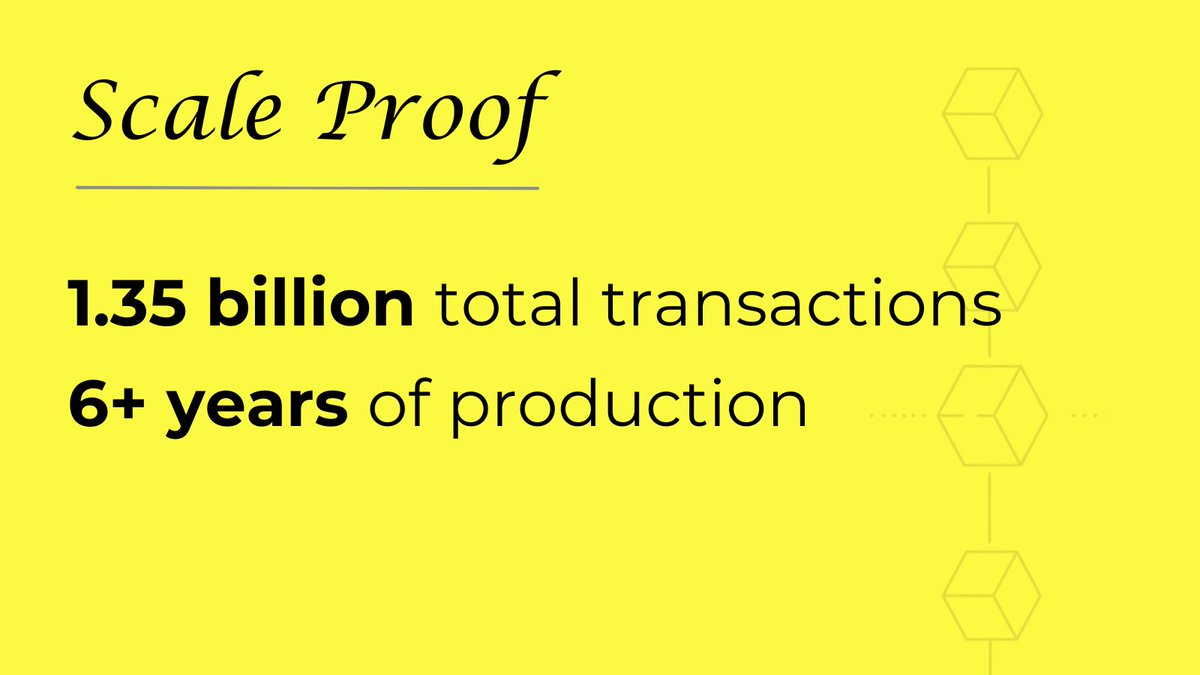
This entire ecosystem is anchored by a battle-tested engine that has been handling massive production volume at scale:
→ 1.35 billion total transactions.
→ 238 million addresses.
→ 18 million active EOAs.
→ Epoch 2228. That's 6 years of production.
For builders, this is what matters. A full ecosystem migration is a major investment of engineering resources and time.
Celo’s solid historical data removes the crippling risk of underlying ledger failure or sudden, breaking architectural changes down the road.
Building on an infrastructure that has safely operated across thousands of Epochs brings absolute predictability back to your business model.
1
3
50


Quantum computers will eventually break the signatures most crypto uses today.
The good news is we have a solid backup plan based on simple hash functions. The bad news is those backup signatures have been too big and too expensive to verify on Ethereum.
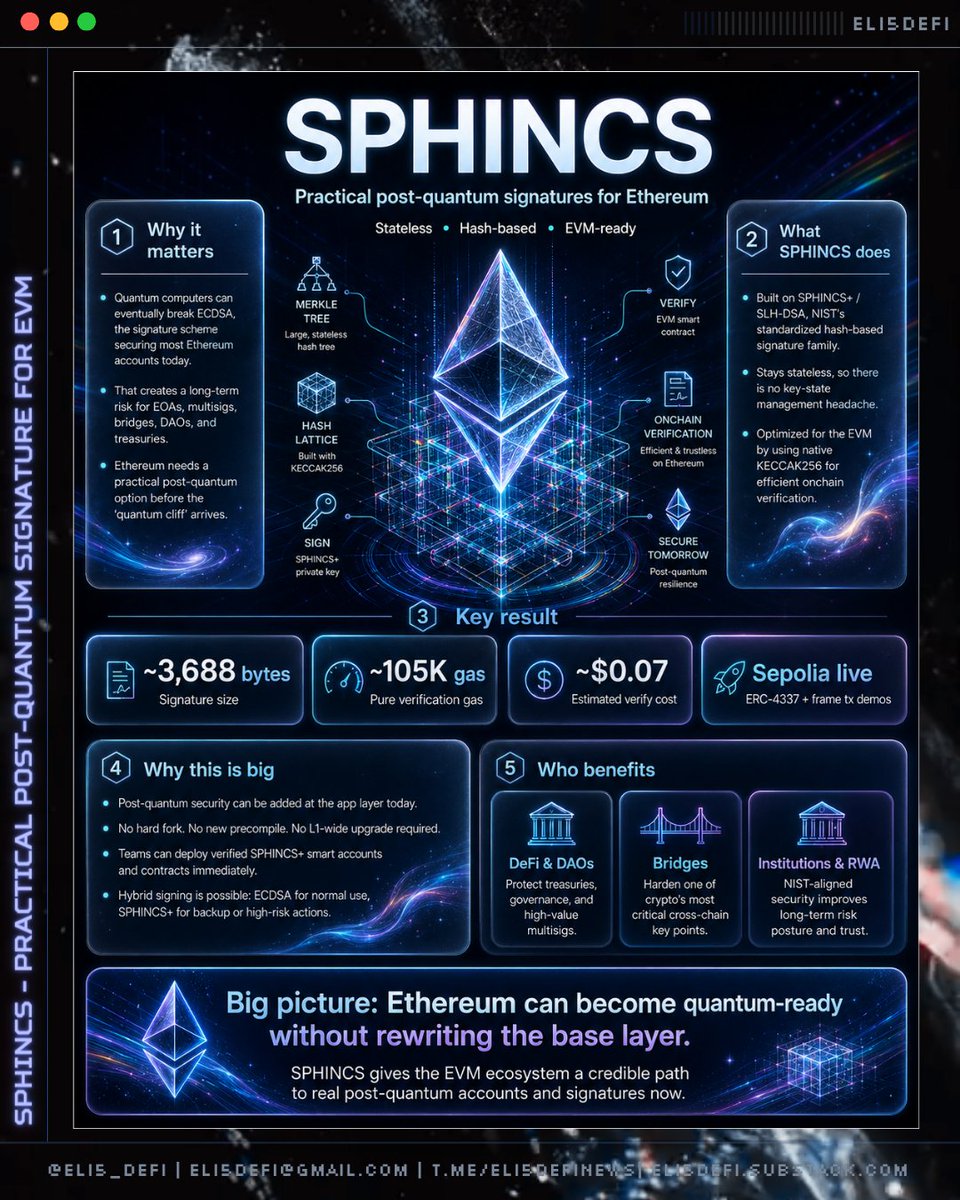
A new optimization called SPHINCS from @ncsgy changes that.
Here's the TL; DR
→ It’s built on SPHINCS / SLH-DSA (NIST’s standardized hash-based scheme), the most conservative post-quantum signature family.
→ It stays stateless, no key state headaches like older hash-based schemes.
→ It’s designed specifically for the EVM, with native KECCAK256
Here's the result:
→ Signature size: ~3,688 bytes
→ Pure verification gas: ~105K gas (assembly-optimized) est. ~$0.07
SPHINCS Already deployed on Sepolia for both ERC-4337 accounts and newer frame transaction patterns.
--
Why This is Good for Ethereum and EVM Ecosystem?
This matters because Ethereum can add post-quantum security at the app layer today, without a hard fork or new precompile.
FYI, Ethereum mostly relies on ECDSA.
If large-scale quantum computers arrive, attackers could forge signatures and drain EOAs, multisigs, bridges, and treasuries. High-value accounts can adopt it now, reducing Ethereum’s “quantum cliff” risk as a store of value and settlement layer.
SPHINCS already has testnet examples, enabling quantum-resistant smart accounts and hybrid signing (ECDSA now, SPHINCS for backup or high-risk actions). This can become a differentiator for wallets serving institutions, DAOs, and large treasuries.
The big win: stronger crypto no longer requires L1-wide consensus. Teams can ship verified SPHINCS contracts and use them immediately.
Impact examples:
- DeFi and DAOs → Protect treasuries, governance, and high-value multisigs can adopt quantum-resistant signing.
- Bridges → Harden key cross-chain attack points. Adding PQ verification here strengthens the whole ecosystem
- Institutions & RWA → NIST-aligned, verifiable security improves long-term risk posture and institutional trust.
Zooming out, crypto agility is turning into a genuine edge. We finally have a practical route to deploy real post‑quantum signatures directly in smart contracts and account abstraction, no need to sit tight for massive network upgrade or hard forks.
That reinforces @Ethereum’s identity as the chain that can evolve fast without perpetually rewriting the base layer. It also gives the ecosystem a believable, concrete quantum‑readiness narrative that Bitcoin and most other networks still don’t have yet.
Jun 12

New post on EthResear.ch!
SPHINCS minus : Efficient Stateless Post-Quantum Signature Verification on the EVM
By:
- nicocsgy
🔗 ethresear.ch/t/25165
Highlights:
- On-chain post-quantum signature verification can already be practical on Ethereum: the author reports Solidity verifiers around ~150K gas for a NIST-style limited-signature SLH-DSA parameter set, and as low as ~127K gas for an aggressively optimized non-standard variant (C13).
- The central optimization is aligning SPHINCS-style hashing with the EVM: swapping standard SPHINCS hash components (e.g., SHAKE256) for keccak256 enables efficient “pure EVM” verification without a precompile or protocol change (but sacrifices strict FIPS 205 compliance).
- Verifier cost is dominated by the number of hash evaluations, not just signature byte size; a calibrated model (ExecGas ≈ 36,118 194 * hash_ops) matched measured traces and showed that modeling real execution changes which parameters are best.
- Key parameter insights for minimizing EVM verification gas include choosing n=16 bytes (128-bit target), minimizing hypertree layers (d=2), and preferring w=8 (more chains but much shorter), plus using WOTS C/FORS C “grinding” knobs (e.g., target digit sum S_wn) to shift work from verifiers to signers without reducing cryptographic security.
- There is an explicit trade-off triangle between on-chain gas, signature size, and signer burden/signature budget: the most gas-efficient variants can require heavy signing work (millions to billions of hash calls) and intentionally reduce per-key signature capacity (e.g., 2^14–2^20) to match realistic wallet usage rather than SPHINCS ’s 2^64 budget.
ELI5:
Today’s Ethereum accounts use a kind of “math lock” (ECDSA) that a future quantum computer could pick. This article explores a new kind of “hash lock” signature (based on SPHINCS /SLH-DSA) that quantum computers shouldn’t break. The trick is making the check (verification) cheap enough to run inside Ethereum smart contracts: the EVM already has a fast built-in hash (keccak256), so the author designs SPHINCS variants that use EVM-native hashing and carefully chosen parameters so verifying a post-quantum signature costs a practical amount of gas—without needing new protocol features or special precompiled contracts.
10
1
22
2,195