

After the phenomenal success of Agbara Nla, Mike Bamiloye said in an interview that he received a clear divine instruction to remake the film in English to reach a wider audience.
At the time, his ministry was in deep financial crisis his family was literally starving yet they chose to obey, trusting God for impact rather than immediate riches. Translating the richly poetic Yoruba script was a huge task.
The original relied heavily on traditional incantations, cultural idioms, and powerful praise poetry, especially in the terrifying speeches of the occult villain Isawuru. These elements had to be carefully adapted into English while preserving their spiritual weight and chilling atmosphere.
The production reunited nearly the entire original cast, including Mike and Gloria Bamiloye and Yemi Adepoju, who delivered their intense, emotional performances entirely in English. Additional actors were brought in to enrich the village scenes in Muwonleru.
The team returned to the exact same rural locations, meticulously recreating sets, costumes, and practical effects. Actors had to replicate every movement, expression, and iconic moment including the famous “Ayamatanga” chants while performing in English.
In post-production, new audio, eerie sound effects, and echoes were recorded and synchronized. Released on VHS in 1994, The Ultimate Power spread rapidly across English-speaking West Africa and beyond.
It successfully achieved its mission, turning “Ayamatanga” into a household symbol of supernatural fear for an entire generation of children who never understood the original Yoruba version.

Agbara Nla, also known as "Ayamatanga" , was a powerful Gospel drama released in 1992 by Mount Zion Films Ministry.
The movie became extremely popular and scared many of us as children. It also brought Mount Zion Films into the limelight.Originally released in Yoruba, its massive success led to a full English version in 1994 titled "The Ultimate Power".
Instead of dubbing or subtitling the original, Evangelist Mike Bamiloye and the team completely reshot the entire film from scratch to reach a wider audience across Nigeria and beyond.
Did this movie scare you as a child too?
2

People when games are playable and have both ludic and narrative elements that connect and are both integral to understanding a game

i do not understand the YOU HAVE TO PHYSICALLY PLAY A GAME TO UNDERSTAND IT THATS THE ONLY WAY discussion. Like dude i think it depends
1
cswㅊㅅ retweeted

Jun 12
Dear SEAblings, today in Jakarta, Indonesia, there will be protests by students and various elements of society against the government. These protests will primarily highlights the government's massive spending programs, widespread corruption, economic depression—
67
38,405
68,826
723,984

Key Psychological Pathologies and Challenges Linked to Goaltending
1. Performance Anxiety and Broader Anxiety Disorders
Pre-competition (or "pre-game") anxiety is frequently cited as one of the biggest threats to goalies. It involves irrational situational anxiety with physical symptoms (e.g., butterflies, clammy hands, racing heart) and cognitive elements like fear of failure, criticism, or negative evaluation. This can lead to dysfunction, negative self-talk, and impaired performance. Goalies often describe the position as the most stressful in professional sports due to singular accountability—one mistake directly results in a goal against, with immediate public and team consequences. Many report lower self-confidence and higher somatic anxiety compared to other positions. Sports psychologists note that goalies must manage constant ebb-and-flow stress that "never disappears."
2. Obsessive-Compulsive Disorder (OCD)
Several high-profile NHL goalies have publicly discussed OCD, often involving intrusive thoughts, excessive checking, contamination fears, or ritualistic behaviors. The position’s demand for precision, control, routines, and hyper-focus may attract or amplify obsessive-compulsive traits, which can become pathological under pressure.
Clint Malarchuk: Long struggled with OCD (exacerbated post-trauma), alongside depression.
Corey Hirsch: OCD, anxiety, depersonalization, and suicidal ideation; hid it during his career.
Connor Ingram: Undiagnosed OCD (contamination obsessions, checking rituals) that affected daily life and performance until addressed.
3. Depression and Mood Disorders
Depression, including major depressive disorder (MDD), is commonly reported, often intertwined with performance slumps, injuries, isolation, or the "roller-coaster" emotional demands of the role. Burnout is also elevated, particularly with a history of concussions (which double or triple risks of depressive symptoms and burnout in elite hockey players).b202af
4. Post-Traumatic Stress Disorder (PTSD) and Trauma-Related Issues
Graphic on-ice injuries (common in hockey) can trigger or worsen PTSD. Malarchuk’s near-fatal throat slash in 1989 led to severe PTSD symptoms, amplified by a later similar incident he witnessed as a coach. Trauma responses can include flashbacks, hypervigilance, and emotional numbing.
5. Bipolar Disorder and Co-Occurring Conditions
Robin Lehner: Openly discussed bipolar I disorder, ADHD, PTSD, and resulting addiction (alcohol and sleeping pills) that began after a concussion. He described being unable to "stand being alone in my brain" and experienced panic attacks misattributed initially to other causes. Self-medication was common before diagnosis and treatment.
6. Substance Use Disorders / Addiction
Frequently secondary to untreated anxiety, depression, bipolar, OCD, or trauma. Players may use alcohol, drugs, or other substances to cope with the mental load or "quiet the mind."
Why Goalies Specifically?
The position combines:
Extreme individual pressure within a team sport (the "loneliest" or most isolating role emotionally).
High-stakes reactivity (tracking fast pucks, split-second decisions) after long periods of relative inactivity.
Singular, visible accountability.
Cultural factors in hockey: Emphasis on "toughness," stigma
冬夜 retweeted

【今日は何の日】
7年前の2019年6月14日は、
『劇場版 うたの☆プリンスさまっ♪ マジLOVEキングダム』の公開日でした!
音楽プロデュースをElements Gardenが担当いたしました!
▽公式サイトはこちら!
kingdom.utapri-movie.com
145
249
10,113

This will never happen. Iran, or unnamed elements within Iran will renege on any deal and continue attacking.
Bomb them. Now. Continue to bomb them until the regime falls.
7
Asim محمد عاصم منیر retweeted

Great News! Dept of State gave a Shut-up Call to Zionists & all those elements who are conspiring to silence voices of dissent on the American soil & threaten First Amendment - core of American psyche!
Dr. Trita Parsi, more than anyone else, has helped American media, think tanks, academia and ordinary people to understand what the Iran War is about! And Dr. Parsi has emerged as the most influential “Voice of Reason” that has single-handedly shaped the narrative! And enriched American discourse! @StateDept
17h

I have fought the neocons and warmongers in Washington for more than 25 years. Throughout, they have tried to silence, discredit, slander, and cancel me. Only recently, however, have they tried to deport me.
At least, that appears to have been the aim of a hit piece in Bari Weiss’s The Free Press, which claimed that Marco Rubio’s State Department was “investigating” me for allegedly seeking to “undermine the U.S.”—presumably because of my opposition to war with Iran.
Yet just hours later, the State Department issued a statement to reporters clarifying that “the State Department has no plans to revoke the green card of Mr. Parsi at this time.” Nor did it provide any confirmation for the central premise of the Free Press story—that an investigation of me existed in the first place.
So here’s what I think happened.
Read the full piece on my Substack: tritaparsi.substack.com/p/so…

14
77
3,359
Frank retweeted

Quintet of the Elements of the USF Birds.
Dedicated to the 1st anniversary of the USF Grouping.
Part One: EARTH.
To mark the anniversary of the USF Grouping (June 11), the media team of the 414th USF Brigade "Magyar’s Birds" prepared a series titled "Quintet of the Elements of the USF Birds":
EARTH – Part 1 ✅
WATER
AIR
FIRE
WORMS
Follow USF results live:
USF Online Dashboard "PIDRAKHUYKA"
sbs-group.army
MAGYAR 🇺🇦
13.06.26
10
85
377
3,966

Challenge: Trump and Sharon - Family Before Country
Dr. Aaron Lerner 14 June 2026
imra.org.il/story.php?id=744…
Ariel Sharon was a sharp military genius whose own experience in the system put him in the unusual position that, despite his rank, he was always open to challenging the defense establishment consensus.
Sharon consistently did what he thought was the right thing to do for the nation.
That was, until he felt compelled to unilaterally withdraw from the Gaza Strip to keep his family out of jail.
Sharon chose family over country.
President Trump may not share Sharon's skill set, but over the past year this mantra has been drilled into him: No enrichment, no missiles, or no deal.
But with the mid-term elections rapidly approaching and the real possibility that a Democrat majority in the House could be the first domino to fall in a process sending him to prison and the loss of the Trump family fortune, President Trump is also pushing hard in a desperate move which puts family over country.
I honestly don't know how we are going to get out of this.
I honestly don't know what combination of technologies and alliances can mee the timeline which takes Iran , after this deal is signed, to posses such a massive number of long range ballistic missiles and launchers that we can no longer defend ourselves.
And to add to the challenge: the Iranians only have the deadline for our destruction slated for 9 September, 2040.
A patient Iran can build up those missiles without launching them for more than another decade if they so choose.
Hezbollah can do the same within the "quiet for quiet" arrangement.
So while Iran will have enough ballistic missiles to effectively destroy our country in a few years, they might opt to wait until our warnings are stripped of any credibility as we are ridiculed for repeatedly "crying wolf".
I listen to some podcasts from what might be considered mainline Democrats as well as elements in the right and when they talk about us it is clear that there is nothing we can do will placate them.
Making a deal with the Palestinians, even dividing Jerusalem and retreating to the "Auschwitz lines" of the pre-1967 borders, won’t do the trick.
I honestly don't know how we are going to get out of this.
But I do know one thing: the less time we spend focused on assigning the blame (with an eye on how that might impact our own Knesset elections) and instead work, united, to meet this existential challenge, the greater our chances of success.
Because success isn't a political goal.
It is an existential need.
1

Countless man-made rocks on Mars:
flickr.com/photos/fossil_lin…
NASA's caption: NASA's Mars Perseverance rover acquired this image using its Right Mastcam-Z camera. Mastcam-Z is a pair of cameras located high on the rover's mast. This image was acquired on June 13, 2026 (Sol 1889) at the local mean solar time of 15:43:34. Image Credit: NASA/JPL-Caltech/ASU
My description: In the subject figure, red arrows point to man-made structures that imitate the shape of vessel elements.
Countless man-made rocks on Mars: flickr.com/photos/fossil_lin…
2

It's not far away to crush the 0.5 front if each one of us collectively exposes such anti-national elements. More strength to you ✊
India First 🇮🇳
@KhargoshJantaP
@ElvishYadav
4

🎧SUNO PROMPTING SYSTEM
My tips on @suno is to use the Lyrics field to describe chronologically all elements of the music using [ and ]
Prompt Style of Music (Tags) :
Lo-fi acoustic guitar, sad cloud trap transitioning to chaotic breakcore, extremely deep raspy male vocal, damaged gritty voice, heavy 808 bass, 200 BPM distorted Amen breaks, glitchcore, cozy melancholic.
Prompt Lyrics (Structure de Production) :
[AUDIO ENGINEER SPEC: Track starts as slow Cloud Trap with a looped lo-fi acoustic guitar. Vocals are an extremely deep, raspy, damaged male voice. Mid-song, the track glitches and drops into ultra-fast, chaotic 200 BPM Breakcore with heavily distorted Amen drum breaks. Ends back in Lo-fi.]
[Intro: The Cozy Room]
[AUDIO ENGINEER SPEC: Short track. Start with a looped lo-fi acoustic guitar and heavy vinyl crackle. Vocals must be an extremely deep, raspy, damaged masculine voice (gritty baritone). Emotional but broken. Heavy Trap 808s and fast hi-hats drop in the middle.]
[Intro: The Cozy Room]
[Lofi acoustic guitar loop playing a sad but warm chord progression]
[Heavy vinyl crackle and room ambiance]
[Very deep, rough male voice clearing his throat, humming low]
(Mmm... yeah... mmm...)
[Chorus: The Broken Lullaby (Acoustic Only)]
[Deep, raspy male voice, sounding tired and damaged]
You don't do much, you just sleep and eat...
Stretching out your little paws, right by my feet...
The world is so loud, but you're fast asleep...
Yeah, you just sleep and eat...
[MASSIVE DROP: XXX Cloud Trap]
[A heavy, distorted 808 sub-bass drops in]
[Fast trap hi-hats and a crisp rimshot]
[The acoustic guitar loop continues underneath]
[Verse: The Purr (Trap Beat)]
[Voice stays extremely deep and gravelly, sliding over the heavy beat]
Wake up for a snack, then you walk away...
Finding the sunbeam where you wanna lay...
My mind is a mess, but you make it okay...
When you purr in my face...
Yeah, you wash it away...
[Chorus: The Broken Lullaby (Full Beat)]
[Heavy 808s bouncing with the sad guitar]
[Voice cracking slightly with emotion]
You don't do much, you just sleep and eat...
Stretching out your little paws, right by my feet...
You're my little peace...
[Outro: Fading Out]
[The trap beat cuts out instantly]
[Just the sad acoustic guitar and the vinyl crackle]
[Soft sound of a cat purring blending with the guitar]
[Deep sigh from the singer]
(Mmm... sleep and eat...)
[Fade to silence]
19
28
279
10,943
the bye guy | mia 🇵🇭 🇵🇸 retweeted

i say this with alllll the love in my heart, but komiket pride has outgrown both ayala malls the 30th and elements at centris. the gays Need a bigger venue. and a venue with better aircon too JDKDKFJDKDJSKS
2
4
34
441

There are definitely some very good psych horror, or at least psych horror that bleeds into the other subgenres.
Fun and cool are the most important elements to me. I realize those words are subjective, and everyone has their own fun and cools. I think my tastes are very simple, tbh. I want to be scared, jump scared, laugh, and get grossed out. Eighties and nineties horror is definitely my thing. Even early 2000’s and a little seventies.
1

Ginevra Jones retweeted

Jun 12
I believe Keir Starmer was coup'd into leadership of Labour, and the British Government, by elements of British intelligence, their peers in the US & Israel, as well as Pierre Omidyar, Carnegie UK and others.
McSweeney is Starmer's handler, and always has been. Democracy died.
Jun 12

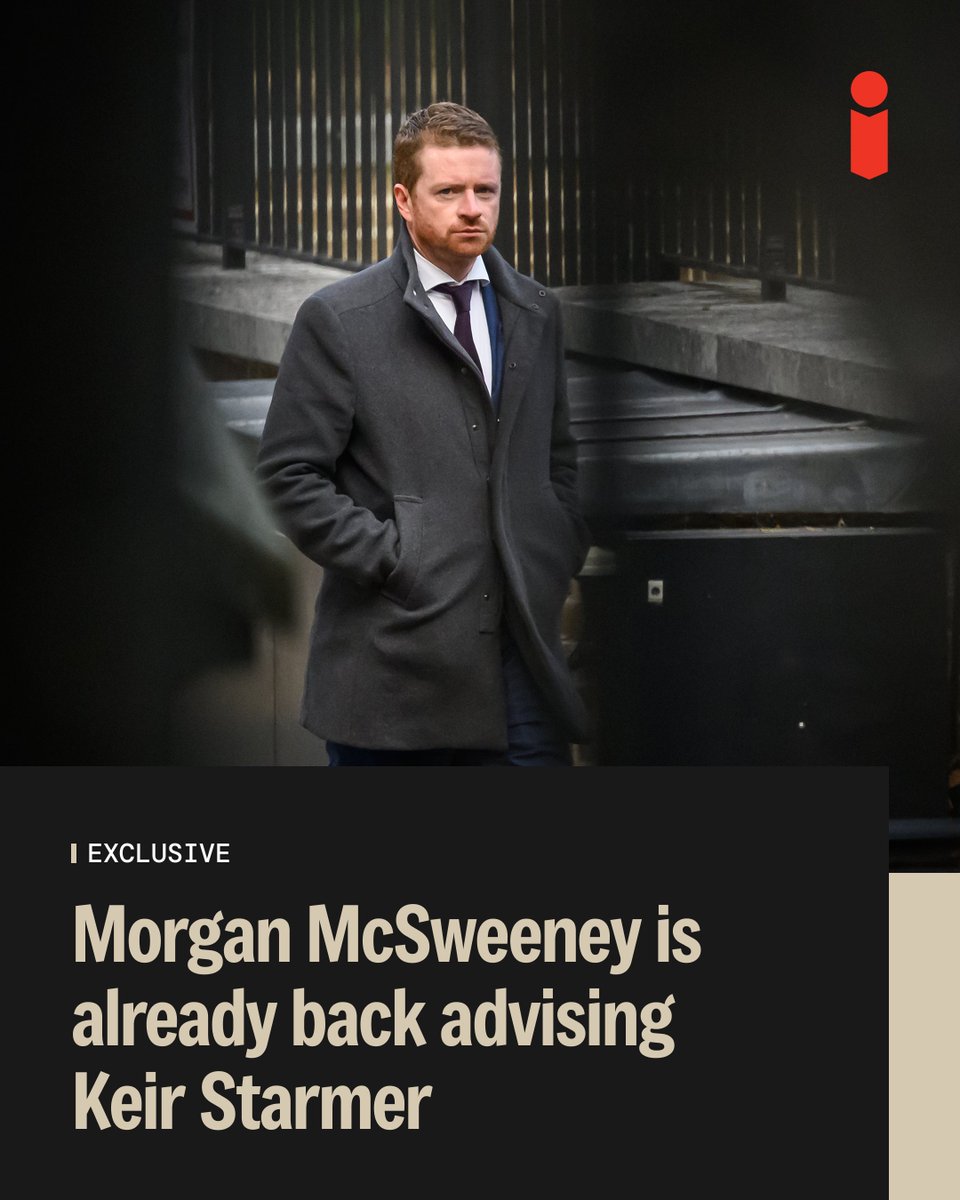
Morgan McSweeney is back advising the Prime Minister – four months after he resigned over his role in the Mandelson scandal
🔴 Exclusive from @cazjwheeler & Richard Vaughan
Read more: inews.co.uk/news/politics/mo…
18
246
693
15,949



4m
Thank you Dori, I really appreciate you saying that because the soft floral elements felt like the perfect way to wish everyone a peaceful evening.
2