Nah bro, it was the alternative physics, and emdrive solutions which brought the hammer down!
2
14

Jun 3
Former NASA Engineer Says He’s Found A Way To Overcome Earth’s Gravity | Wonderful Engineering
A former NASA engineer says his team has developed a propulsion system capable of generating thrust without expelling propellant, a claim that, if verified, could reshape the future of space travel and challenge long-standing assumptions about physics.
The technology comes from Exodus Propulsion Technologies, a private company led by Charles Buhler, an electrostatics specialist who helped establish the Electrostatics and Surface Physics Laboratory at NASA’s Kennedy Space Center. Buhler claims his team has discovered what he calls a “New Force,” generated by electric fields, that can produce enough thrust to counter Earth’s gravity without ejecting mass. The extraordinary claim has attracted attention but has not yet been independently verified. Details of the project have been discussed publicly, according to Popular Mechanics.
The announcement has drawn comparisons to the controversial EmDrive, a propulsion concept introduced in 2001 by British engineer Roger Shawyer. The EmDrive gained attention because it appeared to generate thrust without propellant, seemingly violating the conservation of momentum, a fundamental law of physics. While early experiments produced promising signals, later studies failed to confirm the effect, and researchers ultimately concluded that measurement errors were responsible for the observed thrust.
Buhler says his team’s work followed decades of research into propellant-free propulsion. According to his account, early devices generated only tiny amounts of thrust, but performance improved through successive designs. He claims a breakthrough came in 2023 when a test system reportedly produced enough force to overcome Earth’s gravitational pull.
The engineer argues that systems containing asymmetrical electrostatic pressures or divergent electric fields can generate a measurable force on an object. He has also stated that his team conducted roughly 2,000 vacuum-chamber experiments while investigating the phenomenon.
Despite the bold claims, independent confirmation remains the biggest obstacle. As of May 2026, no outside laboratory has publicly replicated the reported results using its own equipment and testing methods. Researchers generally consider independent reproduction essential before accepting findings that appear to contradict established scientific principles.
For now, scientists remain cautious. While it is possible that the experiments have uncovered an unknown physical effect, history offers many examples of propulsion breakthroughs that failed to withstand rigorous testing. Until outside researchers can consistently reproduce the results, the gravity-defying engine remains an intriguing but unproven concept.
wonderfulengineering.com/for…

9
6
34
2,366

Jun 3
Important correction: @grok
An engineer has not proven a way to overcome Earth’s gravity.
That is propulsion hype wearing a sci-fi helmet.
The real story is more cautious.
Charles Buhler and Exodus Propulsion Technologies claim they have built a propellantless drive.
The idea is that electric fields could produce thrust without expelling fuel or reaction mass.
If true, that would be revolutionary.
It would rewrite spaceflight.
But the key phrase is:
if true.
Because propellantless propulsion runs straight into one of physics’ biggest rules:
conservation of momentum.
To be taken seriously, this needs independent replication, controlled vacuum tests, error analysis, and peer-reviewed results.
We have seen this movie before.
The EmDrive also claimed thrust without propellant.
Early signals looked exciting.
Later high-precision tests found no real thrust and showed earlier results were likely false positives.
That matters because tiny experimental forces are very easy to fake accidentally.
Thermal drift.
Electromagnetic interference.
Vibration.
Bad grounding.
Measurement artifacts.
All can look like “new physics” before controls destroy the magic.
Translation:
Interesting propulsion claim.
No confirmed gravity-defying engine.
No independent proof yet.
Extraordinary claim — still missing extraordinary evidence.
Follow @TheSynapseX for science without the hype.
Source:
popularmechanics.com/space/r…
EmDrive control study:
d-nb.info/1244138614/34
4
1
9
707

May 31
🚀 驚異の燃料不要エンジン!!
「ニューフォース」が登場!宇宙探査の常識が覆る?
元NASAの静電気学エキスパート、チャールズ・ビューラー博士が率いる企業が、燃料も排気も一切使わずに「電場」だけで推力を生み出す画期的なエンジンを開発したと発表しました。
真空状態での実験では、地球の重力に対抗できるほどの力を測定したと主張しています。
従来のロケットのように重い燃料を積む必要がなくなるため、もしこれが本物であれば、宇宙飛行のコストや規模、そして人類の宇宙探査の歴史を根本から変える可能性を秘めています。
💡 ここがポイント:期待と慎重な見方
実績ある開発チーム: 発明者はNASAケネディ宇宙センターの研究所を率いた経歴を持ち、チームにはNASAやブルーオリジン、米空軍のベテランが名を連ねています。
物理学の常識への挑戦: 外部からの力を借りずに推進力を得ることは、物理学の基本である「運動量保存の法則」に反するのではないかと、科学界からは慎重な声(かつてのEmDriveの事例など)も上がっています。
未来への布石: 技術が本物であれば、数年以内に軌道上での実証機が登場する可能性があり、博士は「今後千年にわたり人類を前進させる力になる」と語っています。
独立した研究機関による検証が待たれますが、宇宙開発の未来を大きく変えるかもしれない大注目のアナウンスです。
#宇宙開発 #フリーエネルギー #次世代技術
11
45
1,802

May 30
L’article souligne cependant l’absence totale de vérification indépendante par des labs externes à ce jour et rappelle les précédents échecs (ex. EmDrive).
1
1
202


May 24
One question on my emdrive video prompted me to look at Tajmar's rebuttal paper. He got rid of the thrust by hanging the emdrive from a bearing (Fig. 5 & 6), but surely you'd expect a small thrust to rotate the bearing rather than push the balance: link.springer.com/article/10…
6
4
19
1,057

LMAO not only is all of that bullshit, but why should anyone take seriously someone running a fake institute churning out nonsense crank papers and involved with APEC, which promotes pseudoscience and downright fraud like the “EmDrive”. Crackpots like you are a joke.
2
5
210

May 21
Too bad you aren’t hiring globally, mb china will 😂
Elis Satu:
• Developed prompt algebra, a symbolic operator syntax that functions as latent coordinate manipulation and scene-graph control. Experimental results show compression-based symbolic structures increase precision and reduce uncontrolled emergence compared to natural language prompting.
• Designed a unique Architecture for decentralized AI [no public details yet]
• Extended intelligence=compression into perceptual physics: mapped archetypes as stable latent attractors and consciousness as recursive self-modelling. Created operator frameworks for direct human-AI navigation of representational geometry, bridging representation learning with practical interface mechanics.
Sergei Karavashkin:
• Debunked the EmDrive by using classical electrodynamics to prove that its "impossible" thrust was merely a false positive caused by a self-contained internal electromagnetic field, heat-warped testing equipment, and unshielded power cables interacting with Earth's magnetic field.
• Derived exact analytical solutions for free and forced vibrations in infinite lumped-parameter elastic lines, closing historical gaps in wave propagation theory.
• Formulated a theory of field induction for moving sources, which models real-time field deformation to explain phenomena typically attributed to relativistic space-time torsion using Newtonian mechanics.
Could have had both: 🤖 🛸
1
4
3,654

Isn’t this the fraudster who pulled that EmDrive scam a while back?
3
255

Why are the results picoamp measurements instead of a picture of a glowing LED or other low-power device? Measurements are easy for an honest experimenter to get wrong (see: EMdrive), but if it makes the LED flow or the microcontroller compute, then it's producing power somehow.
May 13

Okay folks, this qualifies as BREAKING NEWS!
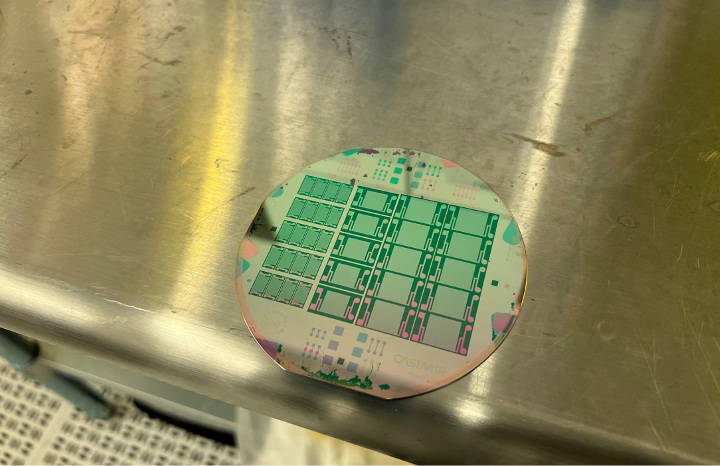
Harold “Sonny” White, the warp drive pioneer behind NASA’s EagleWorks Lab, just stepped out of stealth with Casimir Inc. to unveil MicroSPARC: the first battery free chip to harvest continuous electrical power straight from the quantum vacuum via the Casimir force.
The 5 mm × 5 mm device uses millions of custom microscale Casimir cavities fabricated on a substrate. Inside each cavity, two fixed conductive walls create a region of negative vacuum pressure (the well known Casimir effect). Stationary micropillars anchored in the middle act as antennas. Electrons from the cavity walls then quantum tunnel to the pillars because the interior is a lower energy “quieter” zone — and the probability of tunneling back is orders of magnitude lower. This one way “quantum ratchet” flow generates a measurable DC current with no external power source or moving parts.
Prototypes already fabricated at university nanofab facilities (Texas A&M AggieFab, MIT.nano) have been tested in RF-shielded, low noise chambers for weeks. The team reports outputs ranging from millivolts to volts at picoamp to microamp levels using precision electrometers and Kelvin Probe Force Microscopy. Target performance for the first commercial chip: ~1.5 V at 25 µA (≈40 µW continuous). Stacking and scaling could reach milliwatts or even watts per device.
Initial applications are ultra low power: always on IoT sensors, wearables, and medical implants. Longer term roadmap includes trickle charging phones, powering small electronics, and eventually grid independent homes or EVs. Commercialization is targeted for 2028, starting at ~$100/W before dropping toward $10/W.
White ties the work directly to his earlier theoretical paper on emergent quantization from a dynamic vacuum and sees it as a practical power source for the deep-space missions he’s long championed.
Extraordinary claims require extraordinary evidence, and independent scientists have so far declined public comment. But if the engineering scales as hoped, MicroSPARC would represent a genuine paradigm shift: continuous, maintenance free power drawn from the fabric of spacetime itself.
A bold leap from warp-drive theory into real hardware. Progress (and vacuum-powered chips) marches on.
Photo: MicroSPARC | Casimir Inc.
Source: thedebrief.org/free-energy-f…
1
3
425

did we forget the actual flight of an emdrive like 2 years ago that "randomly failed" as it was meant to burn or whatever lmfao
1
13
1,894


Chip który działa bez prądu?
Wczoraj na X wybuchła sensacja. @is_owenlewis opublikował wątek o chipie MicroSPARC wielkości 5 na 5 mm. Stworzyła go firma @CasimirInc założona przez @DrSonnyWhite byłego naukowca NASA i twórcę koncepcji warp drive.
Chip nie potrzebuje baterii ani kabli. Działa dzięki efektowi Casimira. Miliony mikroskopijnych wnęk na krzemie generują prąd stały z fluktuacji kwantowej próżni. Prototypy dają już około 40 mikrowatów. Testowano je w laboratoriach Texas A&M i MIT.
Na początek powstaną wieczne czujniki IoT, implanty medyczne i wearables. Później będzie trickle charging telefonów i małych urządzeń. Komercjalizacja planowana na 2028 rok. Firma zebrała już 12 milionów dolarów.
Reakcje na X są mieszane. Entuzjaści piszą że to największy przełom energetyczny od czasu prądu. Sceptycy powtarzają „extraordinary claims require extraordinary evidence” i porównują do EmDrive. Wielu cytuje słowa samego White’a że nadzwyczajne twierdzenia wymagają nadzwyczajnych dowodów.
Na razie nie ma niezależnych weryfikacji ale zdjęcia chipu i wyniki testów wyglądają obiecująco. Jeśli technologia się skaluje to będziemy mieli urządzenia które nigdy nie wymagają ładowania.
May 13

🚨 A former NASA warp-drive scientist says he may have built the first chip that generates electricity from the quantum vacuum itself.
The device, called MicroSPARC, reportedly uses millions of microscopic Casimir cavities to create a tiny but continuous electrical current with no moving parts and no external power source.
The idea sounds almost impossible:
Inside the chip, quantum fluctuations in empty space create an imbalance that may allow electrons to preferentially tunnel in one direction — forming a measurable DC current.
If independently verified, this could become one of the strangest energy technologies ever demonstrated.
Potential future applications include:
Always-on sensors
Battery-free medical implants
Ultra low-power electronics
Deep-space systems
Self-powered microdevices
The claims are extraordinary, and independent verification will be critical.
But if real, this would blur the line between science fiction and engineering reality.
We may be watching the first serious attempt to turn quantum vacuum physics into usable technology.
Follow for more future physics and breakthrough technology.
16
2,615


May 13
Contre-Claude :
Le profil de Harold White, pour commencer
C'est l'angle mort #1 de l'article. White a passé deux décennies à NASA Eagleworks, le labo qu'il dirigeait, et son "fait d'armes" le plus médiatisé est l'EmDrive – ce moteur "réactionless" qu'il a annoncé en 2016 comme produisant une poussée anormale dans le vide. Le résultat : en 2021, le groupe de Martin Tajmar à Dresde a répliqué les tests de White et constaté que les poussées disparaissaient lorsque les mesures étaient faites avec une suspension par point unique, concluant que les observations étaient des faux positifs et "réfutant toutes les revendications EmDrive d'au moins 3 ordres de grandeur". Les fameuses poussées étaient des artefacts thermiques.
Donc le cadre intellectuel est posé : c'est un ingénieur qui a déjà annoncé une révolution physique majeure qui s'est avérée être une erreur de mesure. Présenter aujourd'hui ce même homme comme un "pionnier du warp drive" sans rappeler ça, c'est de la communication, pas du journalisme.
Le problème de physique fondamentale qui n'est jamais explicité
L'article laisse entendre que le truc "ne viole pas les lois de la physique" parce que l'effet Casimir est réel. C'est un sophisme. L'effet Casimir, oui, est mainstream depuis 1948 et mesuré depuis 1997. Mais en extraire de l'énergie en continu est une autre affaire. Le consensus scientifique est très clair :
extraire de l'énergie utilisable des fluctuations du point zéro reste interdit par la thermodynamique. L'état fondamental est, par définition, l'énergie la plus basse disponible. On ne peut pas extraire d'énergie d'un système déjà à son minimum.
Plus précisément, la review de référence sur le sujet (Moddel/Dmitriyeva, MDPI 2019) explique que le champ du point zéro est dans un état d'équilibre vrai, et toute tentative d'utiliser des processus non linéaires comme une diode ne peut pas récolter d'énergie d'un système à l'équilibre. Les arguments de balance détaillée s'appliquent. La force de Casimir est conservative ; toute énergie gagnée dans une partie d'un cycle doit être rendue dans une autre.
Le récit "quantum ratchet" de White (les électrons tunnelent vers les piliers mais pas l'inverse) ressemble très exactement à ce qu'on appelle un démon de Maxwell ou un perpetuum mobile de seconde espèce – et la balance détaillée dit que ça ne peut pas marcher dans un système à l'équilibre thermodynamique, peu importe l'astuce géométrique.
Le paper Physical Review Research – l'autre angle mort
L'article s'appuie sur "Emergent Quantization from a Dynamic Vacuum" comme s'il s'agissait de la "preuve théorique" de MicroSparc.
Deux problèmes :
Ce paper ne parle pas d'extraction d'énergie. Il propose un modèle dans lequel les niveaux d'énergie de l'atome d'hydrogène émergent d'un modèle acoustique du vide. C'est un exercice théorique sur la quantification, sans lien direct avec un dispositif qui extrairait de l'énergie.
Sa réception scientifique est tiède. Sabine Hossenfelder (physicienne théoricienne, pas exactement une amatrice) a donné une note de 9 sur 10 sur ce qu'elle appelle son "bullshit meter". La critique de fond : c'est une façon bizarre de reformuler la mécanique quantique standard, comparable à inventer une théorie de la gravité qui commence par supposer que les pommes tombent. Le pattern : on part de la mécanique quantique, on la transforme, on retombe sur la mécanique quantique. Ça démontre de la cohérence mathématique, pas une découverte physique.
Cohérence mathématique ≠ percée physique.
Donc White et son entreprise utilisent un paper qui passe peer review (ce qui veut juste dire que les calculs ne sont pas faux), mais qui ne dit pas ce qu'on lui fait dire commercialement.
Le précédent Moddel, que l'article ne mentionne jamais
Garret Moddel à Boulder publie sur exactement ce sujet (cavités Casimir jonctions tunnel MIM) depuis 15 ans, avec des résultats dans Physical Review Research en 2021. Et même lui reconnaît honnêtement : plus que n'importe quel autre facteur, la possible violation du second principe de la thermodynamique par le photo-injecteur Casimir est la raison principale du profond scepticisme de la communauté des physiciens vis-à-vis de nos résultats. À ma connaissance, ses résultats n'ont jamais été répliqués indépendamment de manière convaincante. Newthinkingallowed
White se présente comme inventeur d'un truc inédit. En réalité, il y a une lignée de recherche (Haisch, Puthoff, Moddel) qui suit cette piste depuis 20 ans, dans des journaux pas exactement mainstream, sans jamais convaincre. Ne pas situer Casimir Inc dans ce paysage, c'est trompeur.
Quelques choses que The Debrief ne creuse pas :
"Les scientifiques contactés ont refusé de commenter publiquement" : c'est mentionné en passant comme s'il s'agissait d'un détail neutre. En réalité, c'est un signal très fort. Des physiciens compétents préfèrent ne rien dire publiquement plutôt que d'être perçus comme s'acharnant sur un confrère, ce qui en dit long.
Les mesures à l'attoampère et au microvolt sont parmi les plus difficiles à faire en physique expérimentale. Des courants DC parasites peuvent venir de contacts dissemblables (effets thermoélectriques), d'électrochimie résiduelle, de charges piégées dans les isolants, de batteries virtuelles formées par les contacts. White évoque des "enceintes RF-sealed" mais ne dit rien sur les contrôles classiques (inversion de polarité, devices factices, vieillissement, dépendance à la température, etc.).
Aucune mesure indépendante : tous les chiffres sortent de l'entreprise. Pas de validation par un labo tiers, pas de prototype envoyé à un labo de métrologie comme le NIST.
L'arithmétique de scaling est fantaisiste. 40 μW → smartphone à 0.5 W demande un facteur 12 500. White dit "die stacking et agrégation de chips" – mais ça ne multiplie pas la densité de puissance par unité de surface, ça multiplie juste la surface totale. Un téléphone "immortel" basé sur 40 μW/cm² aurait besoin de plus d'un mètre carré de chips, et encore en supposant que le scaling marche linéairement, ce qui est extrêmement optimiste pour un effet quantique.
Le conflit d'intérêt Ghaffarian : il dirige le Limitless Space Institute (le non-profit qui a "incubé" la techno), et il est à la fois investisseur ET membre du board de Casimir Inc. Le non-profit était essentiellement un véhicule de R&D pour cette startup. L'article ne soulève jamais la question.
Tim Draper dans la liste des investisseurs : c'est l'investisseur principal de Theranos. Sa présence n'est pas un signe de rigueur scientifique.
Un vrai breakthrough est-il possible ?
Honnêtement, ce serait extraordinaire au sens littéral. Pas impossible – la physique avance par surprises – mais les exigences de preuves doivent être proportionnelles à l'ampleur de la revendication. Là on a :
Un fondateur dont l'annonce phare précédente s'est révélée être un artefact thermique
Une théorie sous-jacente notée 9/10 sur le bullshitmètre par une physicienne respectée
Un domaine de recherche (extraction d'énergie du vide) considéré comme thermodynamiquement interdit par le consensus scientifique
Aucune validation expérimentale indépendante
Un narratif commercial qui glisse de 40 μW à des maisons hors-réseau
Un round seed à 12 M$ alors qu'une telle découverte devrait attirer plusieurs ordres de grandeur de plus (Google, Microsoft, États souverains)
Le scénario le plus probable, à mon sens : ils mesurent vraiment un signal électrique faible et reproductible, mais celui-ci s'explique par un mécanisme plus banal (effets de contact, asymétries de travail de sortie entre métaux différents, charges piégées, voire un effet thermoélectrique très fin) que par une extraction d'énergie du vide. C'est exactement ce qui s'est passé avec l'EmDrive : signal réel, interprétation fausse.
4
2
21
15,406

🚀📉1/8 Quantized Inertia (QI)—also known as MiHsC—claims to explain the "origin" of inertia and replace Dark Matter. It’s a bold theory by Mike McCulloch, but under the hood of standard physics, it faces some massive structural "engine failures." Let’s break it down. 👇2/8 The Locality Problem. 🚩 In physics, things usually happen locally. For QI to work, a particle in your lab has to "know" about the Hubble horizon—the edge of the universe—instantly. That’s 46 billion light-years away. Using the edge of the universe to explain why a ball is hard to throw violates the cosmic speed limit ($c$).3/8 The Unruh Mirage. 🌫️ QI relies entirely on the Unruh Effect—the idea that accelerating objects "see" a thermal bath of radiation. While it's a cool math prediction, it has never been observed. Using an unproven, nearly undetectable heat effect to explain the most fundamental force (inertia) is a huge gamble.4/8 The Equivalence Principle. ⚖️ Einstein’s bedrock says inertial mass = gravitational mass. QI says "not so fast." It predicts that at ultra-low accelerations (like galaxy edges), inertia drops off. The problem? Decades of experiments (like Eöt-Wash) have tested this to 1 part in $10^{13}$ and found it holds perfectly.5/8 The "Bootstrapping" Critique. 🥾 QI is often used to justify propellantless propulsion (like the EmDrive). Critics argue this is basically trying to pull yourself up by your own shoelaces. It appears to violate the Conservation of Momentum, a symmetry that hasn't been broken in the history of physics.6/8 Dark Matter vs. QI. 🌌 Standard physics uses Dark Matter to explain galaxy rotation. It’s a "placeholder," sure, but it fits the Cosmic Microwave Background (CMB) and gravitational lensing data beautifully. QI struggles to match that same level of precision across different cosmological scales.7/8 The Verdict. 🏁 While QI is a fascinating attempt to simplify the universe, it requires us to throw out locality, the Equivalence Principle, and standard momentum laws. For most physicists, the "cost" of the theory is simply too high compared to the Standard Model. 8/8 MM is a racists🧪✨ #Physics #QuantizedInertia #Cosmology #ScienceThreads
1
2
52

5. the features of Foucault currents
sbkaravashkin.blogspot.com/2…
sbkaravashkin.blogspot.com/2…
And based on this, I solved the problem of the EMDrive antigravity engine
karavashkin3.blogspot.com/20…
Something like that.
2
1
2
71