
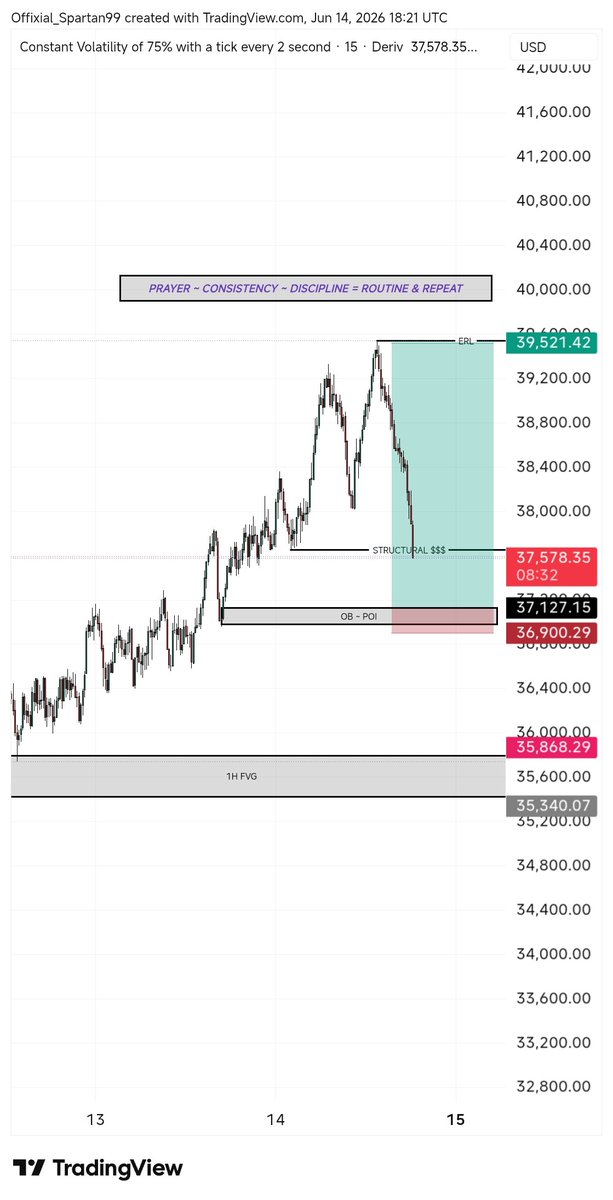
📊 Volatility 75 Index (V75)
📈 Bias: Bearish Continuation
🧠 Narrative: After aggressively pushing into the highs and sweeping buy-side liquidity, price showed clear signs of exhaustion and delivered strong bearish displacement. The liquidity above has been engineered, and attention now shifts to the uncollected sell-side liquidity resting below. With market structure beginning to favor sellers, the expectation is for price to continue rotating lower toward the next major liquidity pool.
🎯 Target: Structural Sell-Side Liquidity (SSL) beneath current price.
⚖️ RR: 1:10.5 🔥
📝 Summary: This setup is all about liquidity. Price lured buyers into the highs, collected the liquidity resting above, and immediately shifted lower. With bearish momentum now in play and structural liquidity still untouched below, the path of least resistance remains to the downside. The goal is simple: let the market deliver into the liquidity it has been targeting all along.
«💜 PRAYER CONSISTENCY DISCIPLINE = ROUTINE & REPEAT»

The framework doesn't care about diplomatic PR. It tracks the physical direction of the vector and the destruction of the container:
⚖️ The Root: A sustained, brutal campaign of torture, rape, and execution targeting a tiny, productive minority responsible for a nation's foundational food security.
⚖️ The Shift: Political elites singing genocidal anthems and dismantling rural defenses, while Western media actively enforces an engineered blindness against those raising alarms.
⚖️ The Fruit: A definitive Kick to Hell. The institutional matrix consistently allows predators and their enablers to operate with impunity, sacrificing human lives to preserve a preferred political fiction.
Team Light refuses to accept the erasure of the dead.

Focus is the ultimate superpower in an age of engineered distraction.
Protect it like treasure: sharp 25-minute Pomodoros with full presence, zero notifications, and the discipline to say “no” to everything that doesn’t serve your mission.
Stack enough of them, and the results compound into an unfair life.
1
Mark retweeted

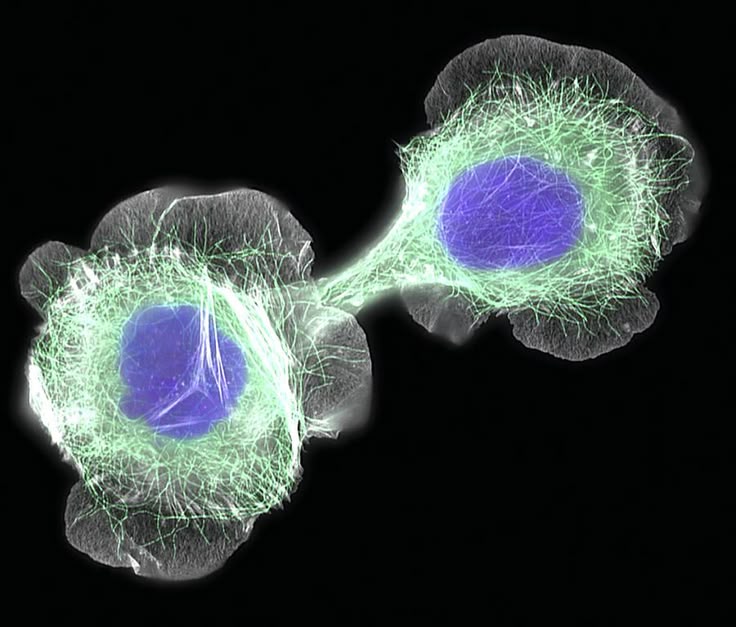
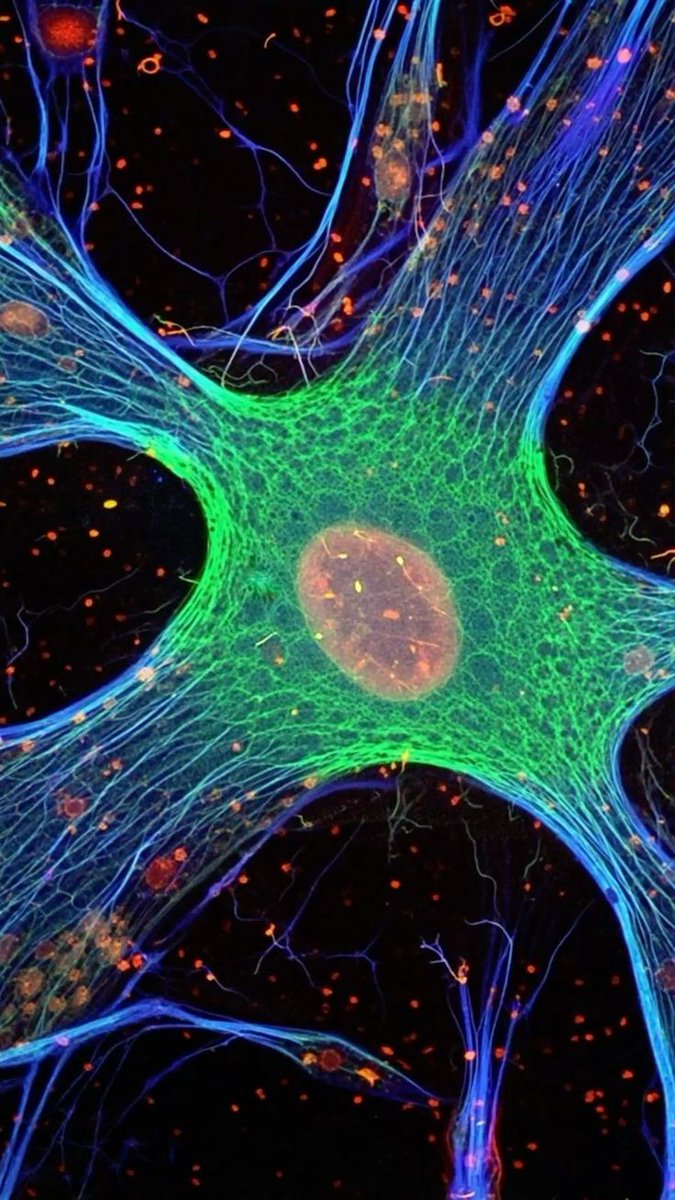
NEWS🚨: Scientists have successfully engineered bacteria that can eat cancer from the inside out.
14
82
491
8,310

No. But it affects the long term visibility of a data center in space.
Radiators are a solved problem that can be engineered.
Radiation damage to Nvidia GPUs in low Earth orbit is a huge unknown. The silicon will fail. It's just a matter of how long it takes.
2

Nutrition isn't a religion, it's fuel, and most men are running on garbage.
You don't need a perfect, extreme, complicated diet. You need to eat mostly real food, enough protein, and stop poisoning yourself with the processed stuff engineered to make you overeat. Your energy, focus, mood, and longevity all run on what you eat. A man trying to build an empire on a junk-food body is sabotaging his own engine. Fuel the machine properly. It's not vanity, it's capacity.

“At Constructive Bio we rewrite life's code to turn cells into sustainable bio factories.”
Syn61
addgene.org/174513/
Syn61 is a fully synthetic, genomically recoded strain of E. coli bacteria developed by researchers @ the MRC Laboratory of Molecular Biology. By rewriting the 4-million base-pair genome, scientists removed 3 of the 64 genetic codons (TCG, TCA, & TAG) & replaced them w/ synonyms, freeing up those codons to encode non-canonical amino acids.
pmc.ncbi.nlm.nih.gov/article…
Syn61 serves as the technological foundation for commercial platforms like Constructive Bio, which utilizes these recoded bacterial strains as programmable biofactories. The platform is used for large-scale fermentation-based production of complex molecules.
constructive.bio/publication…
Additionally, specific laboratory strains of Syn61 are actively used in academic research & are available to the scientific community via repositories like Addgene.
Syn61Δ3(ev5)
From the Syn61 strain (Addgene #174513), 2 rounds of parallel mutagenesis & dynamic selection were followed by deletion of the serT, serU & prfA genes, & a further 3 rounds of parallel mutagenesis & dynamic selection yielded Syn61Δ3(ev5) (Addgene #174514).
addgene.org/174514/
Syn61Δ3(ev5) ΔrecA (ev1)
Laboratory adapted, genomically recoded E. coli strain w/out TCG, TCA, or TAG codons & deleted serT, serU, prfA, & recA genes. Evolved for ~270 generations in LB @ 37 °C.
addgene.org/189857/
Syn57
Syn57 is a radically engineered strain of E. coli bacteria w/ the most compressed & heavily recoded genetic code ever created. While Syn61 removed three codons from the standard 64-codon universal genetic code, Syn57 pushes the boundaries further by eliminating 7 codons, forcing the organism to function using only 57.
To build Syn57, researchers systematically rewrote a 4-megabase E. coli genome to replace 105,000 specific genetic targets.
They altered:
🔸Four Serine codons (compressing the standard 6-codon serine block down to 2)
🔸Two Alanine codons (compressing the standard 4-codon alanine block down to 2)
🔸The Amber stop codon (TAG, replaced by TAA)
Every single instance of these 7 codons across the entire genome had to be substituted w/ a biological "synonym" while keeping the bacteria completely alive & functioning.
biorxiv.org/content/10.1101/…
Design, synthesis, & testing toward a 57-codon genome
addgene.org/browse/article/2…
pYES1L-URA
(Empty Backbone) E.coli shuttle vector for large-scale DNA assembly in S. cerevisiae.
addgene.org/84301/
Transplant of human chromosomes marks first step in genome synthesis project
This new research paper outlines this pipeline & demonstrates the critical first step in it:
bookcafe.yuntsg.com/ueditor/…
The transplantation of human chromosomes into an ‘assembly cell’, exemplified by a mouse embryonic stem cell (mESC). In the mESC the human chromosome can be manipulated & recoded w/out the complexities of working directly in a human cell, which contains two copies of each chromosome. The isolated chromosome can then be transferred back from the mESC to a recipient human cell & the corresponding ‘spare’ copy eliminated from the recipient, leaving the usual 2 copies. Crucially, the team demonstrated that this can be achieved w/out chromosome damage.
In future work, this ‘assembly cell’ stage of the pipeline WILL BE UTILISED TO REWRITE THE GENETIC INFORMATION ON THE HUMAN CHROMOSOME W/ SYNTHETIC SEQUENCE.
This work was funded by the Wellcome Trust & the UK Medical Research Council w/ additional support from the Boehringer Ingelheim Fonds, the Cambridge Commonwealth, European & International Trust & Marie Skłodowska-Curie Actions.
mrclmb.ac.uk/news-events/art…
An adaptable, plug-and-play application of genetic code expansion (GCE) technology for the rapid, modular creation of bispecific nanobody conjugates from non-canonical amino acid (ncAA)- integrated nanobody domains, offering precise control over domain topology.
biorxiv.org/content/10.1101/…

SynHG (Synthetic Human Genome)
SynHG is aiming to develop the foundational & scalable tools, tech & methods needed to synthesise human genomes.
mrc-lmb.cam.ac.uk/sites/synh…
Constructive Bio
Uses the world’s first fully synthetic recoded organism to produce therapeutics w/ chemistries that natural biology cannot access.
constructive.bio/
Genetic Code Expansion Platform
The platform enables fermentation-based production of peptides & proteins containing hundreds of non-canonical amino acids.
Transform natural cells into programmable biofactories w/ expanded chemical capabilities.
constructive.bio/platform
BioForge
Constructive Bio’s industrial fermentation platform for manufacturing peptide & protein therapeutics containing up to 3 different non-canonical amino acids per molecule.
constructive.bio/bioforge
Non-canonical amino acids (ncAAs)
ncAAs expand the chemical properties available to peptides & proteins beyond the 20 standard amino acids.
BIOLOGY GIVES U 20 BUILDING BLOCKS. WE GIVE U HUNDREDS MORE!
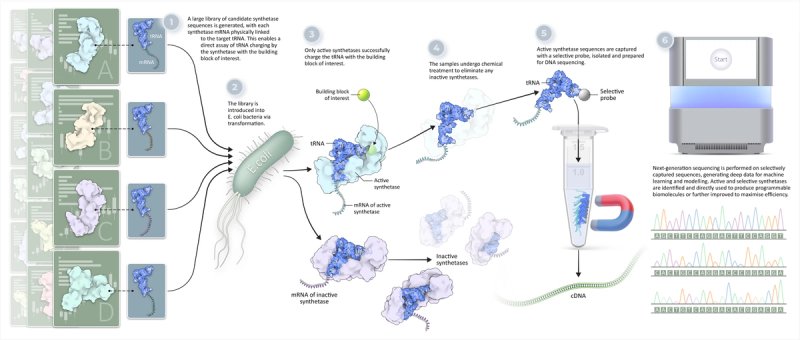
We engineer orthogonal aminoacyl-tRNA synthetases (aaRS) that selectively charge non-canonical amino acids onto dedicated tRNAs. These engineered aaRS–tRNA pairs work alongside the cell's native translation machinery w/out cross-reacting, enabling site-specific incorporation of ncAAs into peptides & proteins during standard fermentation.
constructive.bio/ncaa
Pipeline
The pipeline applies the platform to novel peptide & protein therapeutics, from discovery to clinic.
Enabling robust, reliable bioproduction w/ our phage-resistant Syn61 platform for industrial-scale manufacturing.
Our Syn61 chassis provides inherent resistance to bacteriophage contamination, a critical advantage for industrial biomanufacturing where phage infection can cause catastrophic production failures.
constructive.bio/pipeline
Publications
constructive.bio/publication…
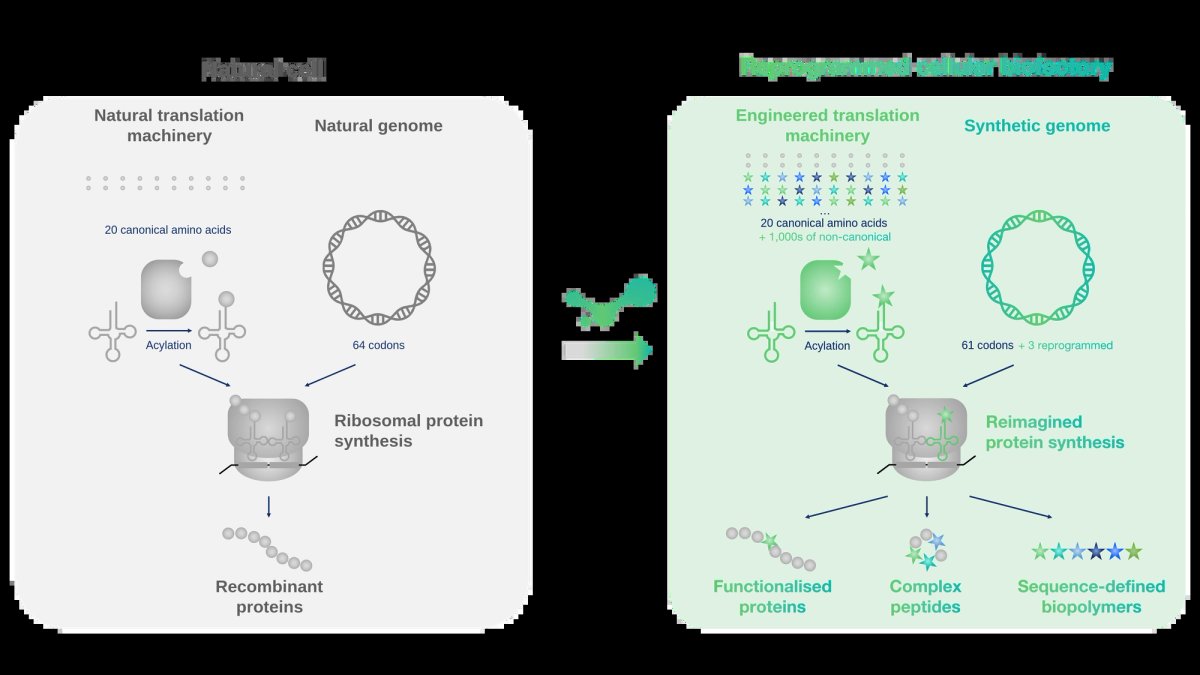
By combining fully synthetic genomes w/ precisely engineered genetic codes & orthogonal translation machinery, his teams are enabling cells to synthesise entirely new classes of molecules: polymers w/ properties unattainable by natural chemistry, sequence-defined non-canonical biopolymers, & therapeutics that operate far beyond the limits of ribosomal biosynthesis as we know it.
At the heart of the discussion stands Syn61 – now widely regarded as one of the landmark achievements in the history of genome engineering. Syn61 was the clearest demonstration to date that life can be liberated from the universal code that has governed biology for billions of years. It was followed by Syn57. Thru meticulous, genome-wide recoding, Chin’s team compressed the canonical 64-codon genetic code into a streamlined 57-codon framework. As a result, Syn57 is THE LARGEST DELIBERATE REWRITE OF A LIVING GENOME EVER ACCOMPLISHED.
As Chin explains, Syn61 & Syn57 are more than a technical tour de force – they demonstrate the foundational platform for a new era of biological programming. FREED CODONS CAN NOW BE REASSIGNED @ WILL, OPENING VAST CHEMICAL SPACE FOR INCORPORATING NON-CANONICAL AMINO ACIDS, creating genetic firewalls, & ultimately DESIGNING ORGANISMS WHOSE BIOCHEMISTRY OPERATES UNDER RULES WE DEFINE.
constructive.bio/news/synbio…
The tech begins w/ assembling large, synthetic DNA fragments that replace megabase-scale sections of an organism's natural genome. W/in these synthetic DNA constructs, specific redundant genetic codons are entirely removed. This frees up those codons & their associated cellular machinery—such as tRNAs & aminoacyl-tRNA synthetases. By introducing new tRNAs & synthetases, the cell's translational system is re-purposed to recognize these free codons & assign them to entirely new, non-natural monomers.
The result is a "recoded" organism capable of sustainably building unique polymers @ scale, extending far beyond nature's standard 20 amino acids. These non-canonical polymers can be endowed w/ enhanced properties in new materials & therapeutics.
synbiobeta.com/read/construc…
1
10
Jay Bird retweeted

“Another genocide behind walls”: Sexual violence in Israeli prisons and detention centres and engineered impunity (October 2023 - October 2025)
euromedmonitor.org/a/7023
1
11
10
350
kvreddy_ysjagan_2027 retweeted

Jun 13
The so-called 'Mega' DSC was a carefully engineered policy sketch for a 'Mega' scam, a dark operation by CM Chandrababu and his son Nara Lokesh as Minister-in-charge, grievously damaging the lives of meritorious aspirants. Lakhs of aspirants are in anguish today, shedding tears because of the manipulation and deception by the @ncbn Government. Andhra Pradesh never witnessed such a disastrous recruitment process before. For the recruitment process for 16,000 DSC posts, every safeguard that protected transparency was dismantled, every institutional check was weakened, through a carefully laid out a scheme of fraud for purposes of converting the DSC recruitment into a money-spinning scam. Never before in the history of Andhra Pradesh has a recruitment process been marred by irregularities at such scale.
DSC represents hopes and aspirations of lakhs of unemployed youth. Malpractices and corruption in the DSC recruitment process executed by the department, whose Minister-in-charge is Nara Lokesh, are extremely condemnable and the situation warrants a CBI inquiry.
The corruption ridden DSC recruitment process is a multi layered scam and the following are the key aspects of it.
1. Chandrababu's government dismantled long-standing institutional safeguards. The entire conspiracy began with preparation of question papers (handled by SCERT) and the conduct of the examination (handled by the DSC Convenor). These responsibilities were traditionally separated to preserve confidentiality. This process was completely compromised when the separation of responsibilities was done away with. Chandrababu government sidelined the DSC Convenor and entrusted both crucial responsibilities to the Director of SCERT, thereby undermining the transparency of DSC examination and deliberately paving the way for irregularities. This arrangement created a convenient mechanism as the first step for the Mega Scam.
2. Making matters worse, the highly confidential tasks of question paper preparation and its upload were entrusted to outsourcing employees, creating a system vulnerable to abuse while conveniently providing potential scapegoats if design were to get exposed. The case of an outsourcing employee securing top rank in DSC in the very examination process he was associated with is a classic example of the consequences of the irregularity. This is direct proof of the paper leak scam.
The sequence of events that follow generate further suspicion about the fragility of the system enabling paper leak and other irregularities. Why was that individual not provided the job despite him securing first rank? Why were the individual's ID and data removed from the merit list subsequently? Why wasn't he invited for the certificate verification? Are these not the reasons cited by that individual when he approached the Court? An outsourcing employee working in SCERT and intimately involved in question paper preparation, securing 1st rank, speaks volumes about the paper leak. For purposes of ascertaining the depth of the paper leak issue an inquiry by CBI is necessary. (supporting doc refer 1-5 slides in the attachment - extracts of candidate rankings, changes made to the merit list, Candidate's letter to the department and Court filing)
3. The total lack of transparency with respect to declaration of results is also absolutely worrisome, with merit lists and merit-cum-roster lists not being placed on the notice boards of collectors' offices, as was the prevailing practice. Instead, the process was centralized with only online display and messaging. This resulted in candidates facing significant hardship owing uncertainty, with them running from pillar to post with nobody to redresses their grievances, not at the district collector level and not at head office level.The cruelest aspect of the entire DSC examination is that, several candidates who received call letters on 1:1 basis and whose certificates were successfully verified, did not find their name in final selection list. Strict adherence to Rule 20 of Scheme of Selection Rules 2025 necessitated preparation of merit-cum-roster list after taking into consideration, marks, ranks, cutoff and all forms of reservations in place, be it vertical or horizontal, be it under meritorious sportspersons quota, be it under persons with benchmark disabilities quota, and so forth. Under the rule position, successful verification of certificates after this step must only result in the candidate's name being placed in final selection list, however, such has not been the fate of several call letter recipients. (Supporting doc refer 6-7 slides in the attachment - Rule 20 of Scheme of Selection Rules, 2025).
4. The most revealing aspect of the entire scandal is the manner in which the sports quota was dealt with. The shameless manner in which, the policies were altered to enable recklessness in the recruitment process is indeed very distressing. Injustice was done not only to meritorious candidates but also to genuine sportspersons who have worked hard for their achievements. Doing away with the existing policy mandating qualification in examination as provided in G.O. No. 74 dated 9th August, 2012, through a new sports policy introduced vide G.O. no. 8 dated 10th December, 2024 and bringing it into implementation through G.O. No. 4 and G.O. No. 47, Chandrababu and his son had already prepared what can only be described as a "policy blueprint for a scam." For the first time in history, sports quota candidates were exempted from appearing for the DSC examination, creating a backdoor entry through which they were brought into the system. Once the recruitment process was complete, the policy was reverted to what it was earlier, through G.O. No. 23, G.O. No. 25 and G.O. No. 56, thereby superseding G.O. No. 4 and G.O. No. 47, citing difficulties that have arisen and several representations and grievances received from sportspersons. So, once the purpose was served and the recruitment was completed without sportspersons having to appear in the written examination, the backdoor that enabled the system being compromised was shut and the Government also cold-heartedly admitted that the policy change caused difficulties and resulted in several grievances. (Supporting docs refer 8-13 slides in the attachment - extracts from G.O. No. 74 conveying original policy, G.O. No. 4 & 47 conveying modification, G.O. No. 23, 25 & 56 conveying policy reversal again after the recruitment is complete)To utter disgust of the entire State, a video of a negotiation for a teacher post between an aspirant and another person has come to light and thereafter, callously, the authorities merely registered a token case, granted station bail without even arresting the accused. No meaningful investigation was conducted. (Supporting evidence - video clip and extract from the FIR, wherein even after knowing the telephone number, the police avoid mentioning the name of the individual and merely refer to him as the suspect.)
In the most insensitive and wholly unscrupulous manner, the TDP Government has made a mockery of the aspirations of lakhs of candidates.
The scandal is deeply rooted and dangerously conceived by the people at the helm of the present State Government including the Chief Minister Mr. Chandrababu Naidu and the Education Minister, Nara Lokesh. The investigating agencies in the State report to the perpetrators and therefore, to unearth facts the need for an enquiry by an independent agency such as CBI is warranted.
Details attached - tinyurl.com/MegaDSCScam
111
1,475
3,827
109,626

28 years? Respect But today's stuff is lab-engineered 30% THC vs. the 80s brick weed. Different game, OG. Tolerance & CHS are real now."
33

A network cannot scale global finance if its own weight eventually crushes its nodes. Supporting Rialo means backing a sustainable, long-term infrastructure designed to run smoothly for decades without degrading. This is engineered longevity.
2
TB123beavis retweeted

Can we now have a serious conversation as to the real origins of the lab engineered SARCoV2 virus? "China"? Or:
Jun 12

Today, I’m releasing never before seen intelligence revealing new evidence of past US government funding for more than 120 biolabs in over 30 countries, including Ukraine.
In support of President Trump‘s Executive Order to end federal funding of dangerous gain of function research around the world, and increase transparency and accountability, ODNI will continue working with partners across the Administration to identify where these labs are, what pathogens they contain, and what “research” is being conducted.
odni.gov/index.php/newsroom/…
12
35
117
2,234
Dicapito retweeted

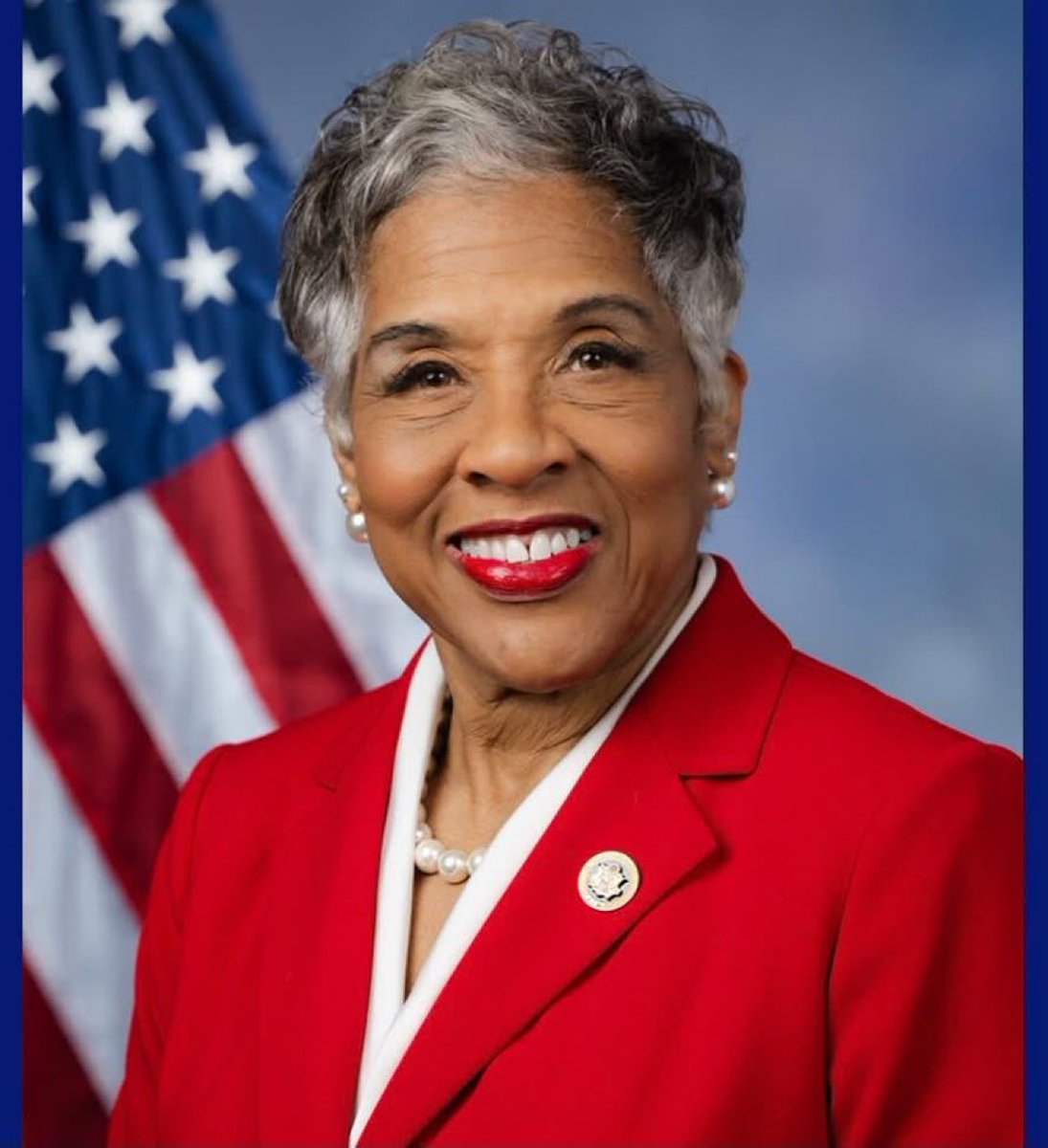
It was Rep. Joyce Beatty who engineered the removal of Trump’s name from the Kennedy Center.
As always, it is Black women who put in the work and make changes
1
4
71
Shankarsingh retweeted

Every element of a high-speed rail network is designed with precision.
Tunnel Hoods are engineered to improve how trains interact with tunnel environments.
They ease the release of compressed air generated at high speeds.
This helps maintain a smoother operating condition throughout the journey.
It also contributes to reducing the acoustic impact near tunnel portals.
A fine example of engineering working quietly in the background.
27
25
737

3m
🔺 INTRODUCING: PYRAMID PLAYS
The Kong Council just leveled up.
While everyone's throwing darts at random legs, we built something different. Pyramid Plays are correlated same-game parlays engineered by the 5 Kong AI models — every leg connected, every pick backed by real data.
3 archetypes. All lethal.
🔥 EXPLODE — Danger Zone pitcher HR target OVER environment. When the barrel% and hard-hit% say the starter is leaking, we stack the whole game.
⚔️ PITCHER DUEL — Both aces dealing, low total, NRFI locked. The tight game play, correlated top to bottom.
📈 OVER MOMENTUM — F5 alignment, first inning scoring, game total all pointing the same direction. Ride the wave.
Sportsbooks price SGP legs like they're independent. They're not. We know which ones move together.
Pyramid Plays. Live now. Free on BKB.
#PyramidPlays #SGP #SameGameParlay #BKB #KongCouncil #SportsBetting #CorrelatedParlay #MLBBetting #AIBetting #PropBets #BettingTools #DangerZone #ParlayLife #BaseballBetting #BettingCommunity #KongAI #SmartMoney #EdgeBetting #MLB #BettingEdge



13

Yuqian Zhang retweeted

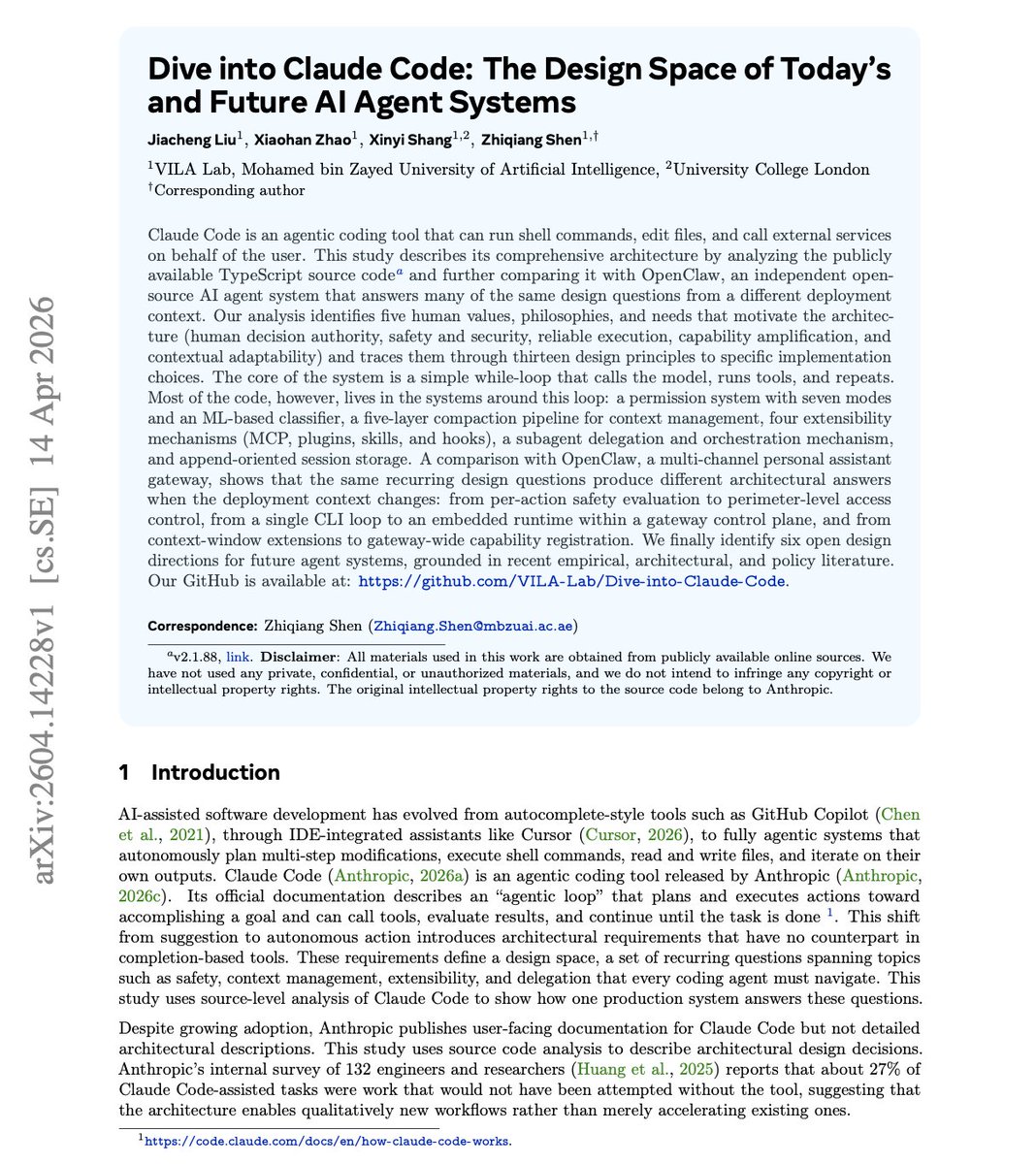
Claude Code fully dissected!
Researchers from UCL reverse-engineered the leaked Claude source. What they found changes how you should think about agent design.
Only 1.6% of the codebase is AI decision logic.
The other 98.4% is operational infrastructure. Permission gates, tool routing, context compaction, recovery logic, session persistence. The model reasons. The harness does everything else.
This is the opposite of what most agent frameworks do today.
LangGraph routes model outputs through explicit state machines. Devin bolts heavy planners onto operational scaffolding. Claude Code gives the model maximum decision latitude inside a rich deterministic harness, and invests all its engineering effort in that harness.
The core loop is a simple while-true. Call model, run tools, repeat.
But the systems around that loop are where the real design lives:
A permission system with 7 modes and an ML classifier. Users approve 93% of prompts anyway, so the architecture compensates with automated layers instead of adding more warnings.
A 5-layer context compaction pipeline. Each layer runs only when cheaper ones fail. Budget reduction, snip, microcompact, context collapse, auto-compact.
Four extension mechanisms ordered by context cost. Hooks (zero), skills (low), plugins (medium), MCP (high). Each answers a different integration problem.
Subagents return only summary text to the parent. Their full transcripts live in sidechain files. Agent teams still cost roughly 7x the tokens of a standard session.
Resume does not restore session-scoped permissions. Trust is re-established every session. That friction is the point.
The bet behind all of this is simple. As frontier models converge on raw coding ability, the quality of the harness becomes the differentiator, not the model.
Paper: Dive into Claude Code (arXiv:2604.14228)
We've shared an article on Agent Harness and what every big company is building.
Read it below.

42
249
1,492
187,244

No it cant bc how often a loophole is exploited doesnt change what a system is actually designed to do. If a store accidentally leaves its back door unlocked every single night and people constantly sneak in to steal the things then that is an ongoing security failure. It still doesnt mean the store was structurally built for shoplifting.
For an issue to be truly systemic then the written laws where u live would have to explicitly state that a victims clothing legally equals consent. When defense attorneys repeatedly abuse a blind spot in court procedures to bypass standard rules they are actively working against the framework. Frequency just proves a persistent failure in enforcement but it does not mean the institution itself was engineered to mandate that outcome.
1
5

Diluted with the oil, vinegar will remove impurities and the oil will add shine. Wont last though with direct sun or rain. But temporary for a car show, sure.
Id just use a good car wash and car wax. Take longer, but last and engineered for auto paint.
Hell, even zipwax wash.
5

How long do you have? Water, air, medicines, protocols, oceans, weapons and vaccines ( same thing). Bad food, tainted soil, engineered plants and seeds, banking, Sharia Mortgages, income tax, let's have lunch!
3